At SEO Circular, we don’t treat every website visit as valuable. A casino needs traffic from adults who live in a licensed market, understand the offer, and can complete registration, verification, and a first deposit. That makes casino marketing far more complex than standard ecommerce marketing — and it is why a generic SEO playbook fails in this vertical.
The strongest plan starts with compliance and measurement, then builds organic visibility through casino SEO and useful content. Referral partners, relevant communities, and direct media placements add trust and reach. Certified paid campaigns then scale the channels that already convert. As a team that handles SEO for restricted and high-risk verticals, we have seen this sequence beat “spray-and-pray” traffic buying every time.
Quick answer: Casinos increase website traffic by combining technical SEO, jurisdiction-specific content, authority links, transparent forum participation, affiliate and player referrals, ads on relevant adult-audience sites, certified PPC, direct media buying, and carefully tested gambling-friendly ad networks.
Running a licensed casino or iGaming brand? Get a free technical SEO audit to see how crawlable and compliant your site is before you spend on traffic.
Key Takeaways
- Compliance and tracking come first — build licensing, responsible-gambling pages, and KYC/FTD analytics before any traffic push.
- Casino SEO is the foundation: crawlable game lobbies, jurisdiction-specific pages, and trust signals on every money page.
- The U.S. commercial gaming market hit $78.72B in 2025 (up 9.2%) — demand is huge, but so are competition and regulation.
- Referrals, forums, and direct media placements add trust; certified PPC and ad networks scale only what already converts.
- Measure to registrations, KYC completion, and first-time deposits (FTDs) — never raw clicks.
The Casino Market Is Large, but Competition Is Intense
The size of the opportunity is not in doubt — the challenge is capturing qualified, licensed-market traffic without breaching platform or regulatory rules.
GGY means gross gambling yield. These figures show demand, not guaranteed results for any single operator.
The Recommended Channel Order
- Fix licensing, responsible-gambling pages, analytics, and conversion tracking.
- Build SEO landing pages and publish helpful content for each approved market.
- Add referrals, forums, digital PR, and direct placements on relevant sites.
- Use PPC, media buying, and ad networks only after compliance approval and small tests.
1. Build the Casino SEO Engine First
Casino SEO creates steady traffic without paying for every click, and it supports branded searches after people see an affiliate review, sponsorship, or ad. The work must match the operator’s licence, products, and target geography.
Map Keywords by Player Intent and Jurisdiction
Create separate keyword groups for game education, real-money play, bonuses, payment methods, withdrawals, mobile play, branded searches, and local casino visits. Add the approved country, state, province, or city wherever the law and licence change by location — but do not create hundreds of thin location pages that all say the same thing. If you need to scale market pages safely, our guide to programmatic SEO for enterprise brands shows how to do it without triggering a thin-content penalty.
- Informational: how blackjack works, slot volatility, RTP explanations, and responsible-bankroll guides.
- Commercial: licensed online casino in [market], live-dealer games, payment-method and withdrawal pages.
- Local: casino near [city], poker tournament, casino hotel, restaurant, show, and event pages.
If you accept crypto deposits, treat crypto-casino terms as their own intent cluster — the audience and compliance rules differ, which is why we run crypto SEO as a distinct discipline.
Make Game Lobbies Crawlable and Fast
Many casino sites load the lobby with JavaScript. Keep important game, provider, and help pages reachable through normal HTML links. Control faceted URLs and duplicate filters with canonicals or noindex rules, and split XML sitemaps by game, content, and market so your team can find indexation problems quickly.
Use a search-friendly rendering approach for public content: a compliant age gate should not make every informational page invisible to search engines. Test key URLs in Search Console, and hold the line on Core Web Vitals — Google recommends LCP below 2.5 seconds, INP below 200 milliseconds, and CLS below 0.1 [3].
Build Trust Into Every Money Page
Show the licence, legal entity, regulator, terms, bonus conditions, payment limits, withdrawal process, KYC steps, customer support, and responsible-gambling tools clearly. Add a named editor or reviewer to legal and game guides, and ask local counsel to check jurisdiction pages. Accurate, current information improves trust and conversion at the same time.
Earn Authority Without Link Spam
Create original data studies, provider announcements, tournament calendars, expert commentary, and local resort guides that publishers can cite. Build relationships with gaming news, payment, tourism, hospitality, and sports sites that match the casino. Never buy ranking links or use private blog networks — mark paid placements with rel="sponsored", because Google treats manipulative link schemes as spam [4].
Physical casino note: optimize the Google Business Profile, map data, hours, parking, hotel, dining, events, accessibility, and local reviews, and link it to the matching casino location page. If you run several properties, our guide to local SEO for multiple locations covers how to structure it.
2. Grow Through Content, Forums, and Referrals
Content marketing should answer a real player question and lead to the next useful page — not repeat the same bonus message across hundreds of URLs.
| Search intent | Casino-specific content | Natural next step |
|---|---|---|
| Learn | Game rules, RTP and volatility guides | Relevant game category |
| Compare | Payments, limits and withdrawal timing | Verified payment page |
| Decide | Bonus terms explained in plain English | Eligible offer page |
| Visit | Events, poker schedules, hotel and dining | Booking or directions |
Refresh high-traffic pages whenever rules, providers, bonuses, payment limits, or laws change.
Use Forums as a Reputation Channel, Not a Link Dump
Monitor Reddit, poker communities, sports forums, and local travel groups for questions your team can answer honestly. Read each community’s rules, disclose the casino connection, and help before linking. Ask moderators before an AMA or promotional post. Never post fake reviews, repeat bonus codes, or manipulate votes — Reddit’s rules require authentic participation and prohibit spam [5].
- Create saved replies for withdrawal, KYC, bonus, and responsible-gambling questions, but personalize every answer.
- Use tagged links only when the community allows them, and measure assisted visits, branded search, and support outcomes.
- Escalate complaints to support. Never argue with a player or request personal account data in public.
Build a Controlled Referral and Affiliate Program
Use CPA, revenue-share, or hybrid deals with approved affiliates. Define allowed markets, traffic sources, brand bidding, claims, bonus wording, age controls, sub-affiliates, and disclosure rules in the contract, and audit placements and creative regularly. In regulated markets, the operator often remains responsible for an affiliate’s marketing [8].
A player refer-a-friend offer can add lower-cost traffic where the licence allows it. Cap rewards, verify both accounts, block duplicate devices and payment methods, and investigate bonus abuse. Never reward referrals from self-excluded or vulnerable customers.
Advertise Directly on Relevant Websites
Buy sponsorships, newsletter placements, native articles, banners, or video on reputable gaming news, poker, sports, resort, travel, and local-event sites with an adult audience. Ask for geography, device mix, viewability, invalid-traffic controls, and past casino results. Use a written insertion order and mark paid links as sponsored.
3. Use PPC, Media Buying, and Ad Networks Carefully
Why Casino PPC Is Tough
PPC can reach high-intent searches quickly, but casino campaigns face strict laws, platform approval, limited countries, age rules, expensive competition, and frequent creative review. Google requires proper certification, approved-country targeting, responsible-gambling information, and no targeting of minors [6]. Meta also requires prior written permission and adult targeting [6]. PPC needs specialist compliance and daily control.
| Channel | Best use | Main control |
|---|---|---|
| Search PPC | High-intent licensed-market queries | Certification, exact GEO and negatives |
| Direct media | Trusted niche publisher audiences | Placement list and audience proof |
| Native/display | Education, brand and retargeting where allowed | Claims, frequency and context |
| Specialist network | Push, pop-under or in-page scale | Source-level fraud and FTD data |
A Safer Search PPC Setup
- Create one campaign per licensed market. Use location presence, not interest alone, and block unsupported regions.
- Separate brand, game, and bonus intent. Add negatives for jobs, hacks, minors, and unsupported products.
- Send ads to a dedicated page with licence details, full terms, and responsible-gambling information. Optimize to verified registrations and FTDs, not clicks.
Media Buying and Gambling-Friendly Ad Networks
Start media buying with one market, one device group, one offer, and three compliant creatives. Compare CPM, CPC, and CPA deals against FTD quality and net gaming revenue.
Networks may offer native, display, video, push, or pop-under traffic, and availability changes by country and licence. Taboola, for example, limits gambling campaigns to approved countries and requires responsible-gaming information, licence details, and risk notices [7]. Specialist networks add reach, but quality varies.
- Confirm publisher sources, GEO and age controls, brand exclusions, source-level reports, postback tracking, and invalid-traffic protection.
- Pause placements that create clicks but no KYC approvals or FTDs. Scale only after NGR and ROAS remain stable.
Non-negotiable: never use cloaking, fake licences, misleading win claims, or approval workarounds. Exclude minors, self-excluded players, and prohibited markets. Great Britain requires socially responsible gambling marketing [8].
4. Measure Traffic That Can Become Revenue
At SEO Circular, we report the full acquisition path. A channel with fewer visits can outperform a large traffic source when more adults complete verification and deposit.
| Metric | Simple formula | What it reveals |
|---|---|---|
| Registration rate | Registrations / visits | Landing-page intent |
| KYC completion | Verified / registrations | Trust and onboarding friction |
| FTD rate | First deposits / verified users | Acquisition quality |
| CPA per FTD | Spend / first deposits | True acquisition cost |
| ROAS | Attributed NGR / ad spend | Paid efficiency |
| LTV:CAC | Player LTV / acquisition cost | Long-term sustainability |
Here is how those metrics chain together in practice. The numbers are illustrative — plug in your own rates — but the structure is exactly how a casino should read acquisition:
| Funnel stage | Rate | Result |
|---|---|---|
| Clicks / visits to the offer page | — | 10,000 |
| Registrations | 4% | 400 |
| KYC-verified | 65% | 260 |
| First-time depositors (FTDs) | 35% | 91 |
At an $8,000 media spend, that is a CPA of roughly $88 per depositing player ($8,000 ÷ 91). If each player is worth about $250 in net gaming revenue over their lifetime, the channel returns about 2.8x ($22,750 NGR against $8,000 spend) — healthy. But watch what a weak landing page does: drop the registration rate from 4% to 2% and you get 45 FTDs instead of 91, the CPA doubles to roughly $176, and the same channel barely breaks even. This is exactly why we optimize to registration and FTD rates, not clicks — a small lift early in the funnel changes the entire economics.
Track channel, campaign, creative, publisher, and source ID, and apply local privacy and consent rules. Before you set budgets, estimate a realistic spend with our SEO cost calculator.
A Practical 90-Day Rollout
- Days 1–30: confirm licences and rules. Audit analytics, KYC/FTD events, indexation, speed, crawl paths, and trust pages. Build the keyword map.
- Days 31–60: publish core game, payment, bonus, legal, and local pages. Start digital PR, an affiliate pilot, forum listening, and direct placements.
- Days 61–90: launch one certified PPC market and one network test. Review FTD, CPA, NGR, and fraud by source. Scale proven placements.
Common Casino Traffic Mistakes
Avoid thin location pages, copied game text, expired offers, hidden terms, forum spam, ranking-link schemes, broad PPC geography, and reports that stop at clicks. Always keep licensed and prohibited markets separate.
Why Work With SEO Circular?
SEO Circular combines SEO, content, digital PR, PPC, CRO, and analytics. We have worked with 500+ clients across 30+ industries, and we focus on qualified traffic and transparent reporting — never instant rankings or revenue guarantees. See the results we have delivered in our case studies.
Want a compliant, qualified-traffic plan for your casino or iGaming brand? Start with a free website audit or talk to our team about a 90-day rollout.
Frequently Asked Questions
What is the fastest way for a casino to increase website traffic?
Certified PPC and direct media placements create visits quickly, while SEO, content, and referrals build the long-term base. The fastest sustainable results come from running both together — paid channels for immediate reach, organic for compounding, lower-cost traffic.
Is casino SEO legal?
Yes, where you hold a valid licence for the market you target. Casino SEO itself is legitimate; the legal risk comes from marketing to prohibited jurisdictions, minors, or self-excluded players. Keep licensed and prohibited markets strictly separate, and show licence and responsible-gambling information on every money page.
Are casino ad networks safe to use?
Not automatically. Verify the licence, inventory, age and GEO controls, fraud detection, tracking, and refund terms before spending. Start small, measure to KYC approvals and first-time deposits rather than clicks, and pause any source that delivers traffic but no verified players.
How long does casino SEO take to show results?
Expect meaningful organic traffic in roughly three to six months for a compliant, well-structured site, longer in highly competitive markets. Technical fixes and trust signals can lift conversion sooner, but authority and rankings compound over time — which is why the channel order in this guide starts with SEO.
Which channels should a new casino prioritize first?
Fix compliance and tracking, then build casino SEO and content. Add referrals, forums, and direct media next, and only layer in PPC, media buying, and ad networks after compliance approval and small, measured tests.
References
- AGA: 2025 Commercial Gaming Revenue — U.S. revenue and growth.
- UKGC: Industry Statistics 2024–25 — GGY and online casino data.
- Google: Core Web Vitals — LCP, INP and CLS.
- Google: Spam Policies — link spam.
- Reddit Rules — authentic participation.
- Google Ads gambling policy; Meta gambling ads — approval, GEO and age controls.
- Taboola gambling policy — country and responsible-gaming rules.
- ASA CAP Code Section 16; UKGC affiliate guidance — social responsibility and third parties.
Compliance note: this marketing guide does not replace legal advice. Gambling laws and platform policies change by market — verify every campaign before launch. Sources accessed August 4, 2026.
To increase conversions from your real estate website, you need a streamlined workflow that combines SEO, PPC, conversion rate optimization (CRO), and email marketing — each working on a different stage of the buyer’s journey.
Every buyer, seller, and investor now relies on Google to find a dependable agent. In fact, the National Association of Realtors found that 100% of recent home buyers used the internet during their home search, and 43% began by looking at properties online (NAR, 2024 Profile of Home Buyers and Sellers). Buyers compare the top results and choose the agent who fits their goals — so the firms that rank at the top capture the majority of inquiries. As real estate SEO experts, SEO Circular understands the complexity of property websites and the conversion-optimized strategy they need. In this blog, we cover the essential factors that will lift the conversion rate of your real estate website.
Not sure why your real estate traffic isn’t converting? Get a free website audit and see exactly where you’re losing leads.
Key Takeaways
- 100% of home buyers use the internet to search, and 43% start online (NAR, 2024) — your website is the first impression.
- Speed is a conversion lever: dropping load time from 3s to 1s can roughly double conversion rate (Portent), and the odds of a bounce rise 32% as load moves from 1s to 3s (Google/SOASTA).
- Trust wins deals: 75% of consumers regularly read online reviews and 50% trust them as much as a personal recommendation (BrightLocal, 2024).
- Speed-to-lead is decisive: contacting a lead within an hour makes you 7x more likely to qualify it than waiting just 60 minutes longer (Harvard Business Review).
- The highest ROI comes from integrating SEO, PPC, and email — not choosing one.
Why Your Conversion Rate Matters More Than Your Traffic
Before chasing more visitors, look at what your current traffic is doing — because doubling your conversion rate is usually faster and cheaper than doubling your traffic. Here is the same real estate website, with monthly visits held completely flat, at a poor conversion rate versus an optimized one:
| Metric | Poor (1%) | Optimized (3%) |
|---|---|---|
| Monthly website visits | 5,000 | 5,000 |
| Leads (visit to inquiry) | 50 | 150 |
| Closed deals (approx. 3% of leads) | 1.5 | 4.5 |
| Monthly revenue (at ~$9,000 avg commission) | $13,500 | $40,500 |
Same traffic, roughly three times the revenue — purely from faster pages, shorter forms, and clearer CTAs. That is why we tell every client to fix conversion before spending more on ads. The elements below are where that lift comes from. (Commission and close-rate figures are illustrative; plug in your own average sale price and lead-to-deal rate to model your own numbers.)
Top Elements That Drive Conversions for Real Estate
The most effective conversion elements on real estate websites are clear CTAs, page speed, mobile experience, and trust signals. Get these right and you rarely need a full website redesign. Effective real estate SEO guides visitors toward action while building trust and removing friction from a high-stakes decision.
Call to Action (CTA)
Your CTA is the single element that turns a browsing visitor into a lead, so its placement and copy do real work. Whether it is “Schedule a Site Visit,” “Request a Callback,” “Download Brochure,” or “Check Price & Availability,” every page should carry a visible, action-oriented CTA.
The form behind that CTA matters just as much. HubSpot’s analysis of tens of thousands of landing pages found that forms with around three fields tend to convert best — every extra field you ask for costs you completions. And because a real estate site is a lead-generation site, load speed compounds this: Google and Deloitte’s “Milliseconds Make Millions” study measured an 8.3% increase in lead-form submissions from just a 0.1-second improvement in mobile load time.
- Place your primary CTA above the fold and repeat it after every property list.
- Keep inquiry forms short — name, phone/email, and intent are usually enough.
- Use one dominant CTA per page; competing buttons split attention and dilute action.
The wording itself moves the needle. Vague, generic button text asks the visitor to do the work; specific, benefit-led text tells them exactly what happens next:
| Weak, generic CTA | Stronger, specific CTA |
|---|---|
| “Contact Us” | “Book a Site Visit This Weekend” |
| “Submit” | “Get My Free Price Estimate” |
| “Learn More” | “See 12 Photos & Floor Plan” |
| “Sign Up” | “Send Me New Listings in [Neighborhood]” |
Page Speed
Imagine your potential lead clicking your link and waiting for the page to load. Every extra second pushes them toward a competitor. The data is unambiguous: Portent’s study of over 100 million page views found that a site loading in 1 second converts roughly twice as high as one loading in 3 seconds, and Google/SOASTA research shows the probability of a bounce jumps 32% as page load time goes from 1 to 3 seconds. To improve your website speed:
- Compress and lazy-load property images
- Reduce unnecessary scripts and third-party tags
- Enable browser caching and a CDN
- Use reliable, appropriately-sized hosting
Mobile Experience
Most buyers search on their phones — NAR’s Real Estate in a Digital Age report found 76% of buyers used a mobile or tablet device in their home search — which makes mobile optimization non-negotiable. A strong mobile experience means responsive layouts, easy navigation, fast pages, and thumb-friendly CTAs and forms. Common mobile issues that quietly kill conversions include:
- Tap targets that are too small or too close together
- Text so small it forces users to zoom
- Forms that are painful to complete on a small screen
Establishing Trust
Buying or selling property is one of the largest financial decisions a person makes, so hesitation is high and proof matters. Client testimonials, Google reviews, local market data, and visible agent credentials all reduce that hesitation. The numbers back it up: BrightLocal’s 2024 Local Consumer Review Survey found that 75% of consumers “always” or “regularly” read online reviews, 50% trust them as much as a personal recommendation, and 88% would use a business that responds to all of its reviews versus just 47% for one that responds to none. The lesson for agents: collect reviews consistently, display them prominently, and reply to every one.
Proven Digital Marketing Strategies to Increase Real Estate Website Conversions
Want to increase conversions on your real estate website? Start with your business goals. If you need long-term, compounding results, SEO is the right engine. For short-term or immediate results, well-targeted paid campaigns win. The choice is rarely either/or — and our real estate SEO consultants can help you map the right mix. Here are the approaches SEO companies use to attract leads and push conversions.
Search Engine Optimization Strategies for a Real Estate Website
If you would rather not depend on paid ads, SEO builds long-term visibility and generates qualified conversions at a lower cost per lead over time. You can optimize for both traditional search engines and AI-powered search experiences.
Conduct Comprehensive Keyword Research
Start by understanding your audience and identifying the high-intent keywords buyers and investors use across their journey. Combine short-tail, long-tail, and location-based terms such as:
- Commercial office space for lease or purchase
- Luxury apartments for sale
- Commercial real estate investment opportunities
- Real estate agents in [target_location]
- Real estate companies in [target_location]
Optimize Individual Property Pages
Ensure every listing page is optimized: titles, meta descriptions, descriptive URLs, structured headings, internal linking, and value-based property descriptions. Avoid duplicate content — write an original description for each listing — and use high-quality images with descriptive alt text to improve accessibility and image-search visibility. If you manage a large catalog, AI can help you scale this; see our guide to generating property listing descriptions with AI.
Build Location-Specific Landing Pages
Buyers search geographically, so create dedicated pages for the cities, neighborhoods, and communities you serve. Include nearby schools, hospitals, transport, lifestyle amenities, and local market trends to make each page genuinely useful. If you operate across several areas, our guide to local SEO for service-area businesses covers how to scale this without creating thin, duplicate pages.
A location page that actually converts follows a predictable anatomy. For a page targeting “Homes for Sale in [Neighborhood],” include:
- A specific H1 naming the neighborhood and intent — “Homes for Sale in [Neighborhood], [City].”
- Live or recent listings for that area, so the page is genuinely useful and not just a wall of text.
- A short local market snapshot — median price, average days on market, and the current price trend.
- A “Life in [Neighborhood]” section — schools, commute times, amenities, and lifestyle notes buyers actually search for.
- An area-specific CTA — “Get new [Neighborhood] listings by email” beats a generic contact form.
- FAQs answering real buyer questions, such as “Is [Neighborhood] a good place to invest?”
The mistake most brokerages make is spinning up dozens of near-identical location pages with only the place name swapped. Google treats that as thin content — each page needs genuinely local information to rank and convert.
Publish High-Quality Educational Content
Content is the backbone of SEO — it builds topical authority and attracts visitors at every stage of the buying journey. Publish home-buying guides, investment tips, market updates, financing explainers, legal documentation walkthroughs, and neighborhood comparisons. This is also what earns citations in AI search results (more on that below).
Optimize for Local SEO
Optimize your Google Business Profile, keep your name, address, and phone (NAP) consistent across directories, actively request reviews, and publish localized content for your service areas. Local intent converts fast: Google found that 76% of people who search for something nearby on their phone visit a related business within a day, and 28% of those searches result in a purchase. For real estate, appearing in the local map pack is often the difference between a call today and a competitor’s call today.
Implement Structured Data
Schema markup helps search engines understand your listings and services, and it can improve visibility and click-through rates. Use structured data for property listings, business information, reviews, breadcrumbs, and articles. One 2026 caveat worth knowing: Google stopped showing FAQ rich results in May 2026, so FAQ schema no longer earns a rich result — focus your effort on listing, review, and organization schema instead.
Earn High-Quality Backlinks
Backlinks remain one of the strongest ranking factors. Build authority with links from reputable real estate publications, local news sites, business directories, industry associations, and trusted blogs. High-quality links raise your domain authority and strengthen credibility in the eyes of search engines.
Optimize for AI Search and Voice Search
Search behavior is shifting fast. Pew Research reports that 34% of US adults have used ChatGPT (58% of those under 30), and Google’s own AI Overviews now appear on roughly 18% of searches. To stay visible, structure content to answer the real questions buyers ask, use conversational language, add clear question-and-answer sections, and build comprehensive resources that satisfy intent. This increases your chances of being cited in AI Overviews and assistants like ChatGPT, Gemini, and Perplexity.
Ready to turn your real estate SEO into booked site visits? Explore our real estate SEO services or book a free strategy call.
Paid Advertising Strategies for Real Estate Websites
Pay-per-click (PPC) advertising charges you only when someone clicks, and it drives targeted traffic fast. But real estate is one of the most wasteful PPC verticals when it’s run like a generic campaign — WordStream’s 2026 benchmarks put the vertical at a 3.70% average conversion rate, a $3.22 average cost per click, and roughly a $102 average cost per lead. The agencies that beat those numbers do a handful of specific things differently.
First, Confirm the Math Actually Works
Most guides skip this, so most agents launch blind. At a $102 cost per lead, if about 3% of your leads become closed deals, you’re spending roughly $3,400 in ad budget per deal ($102 ÷ 3%). Against a $9,000 average commission, that’s about a 2.6x return before overhead — healthy. But drop your lead-to-deal rate to 1% and that same deal now costs $10,200 in ad spend, and the channel is underwater. Run this calculation with your own close rate and commission before you fund a campaign, not after.
Kill Wasted Spend With Negative Keywords
This is where real estate budgets quietly bleed. Without an aggressive negative-keyword list, you pay for clicks from people who will never convert — job seekers, renters when you’re selling, students, and DIY researchers. Add negatives like “jobs,” “salary,” “license,” “for rent” (on sale campaigns), “free,” “how to become,” and “foreclosure” if it’s off-strategy. Mining your search-terms report for new negatives every week is the single highest-ROI habit in real estate PPC, and almost nobody does it consistently.
Match the Ad to the Landing Page, Not the Homepage
If your ad promises “3-Bedroom Homes in [Neighborhood] Under $500k,” it must land on a page about exactly that — not your homepage. That message match is often the difference between a 2% and a 6% landing-page conversion rate. Build one landing page per campaign theme, mirror the ad’s headline at the top, and keep a single CTA and short form above the fold.
Retarget People Who Viewed a Specific Property
Most first-time visitors leave without converting, so retarget them — but do it intelligently. Use dynamic retargeting to show a buyer the exact property (or close matches) they browsed, across the Google Display Network and Meta. Someone who spent three minutes on a listing is your warmest possible audience; a generic “contact us” retargeting ad throws that intent away.
Test Google Local Services Ads for Pay-Per-Lead
Beyond standard search ads, Google’s Local Services Ads sit at the very top of the results with a “Google Screened” badge and charge you per lead instead of per click. For agents, that badge is a trust signal and the pricing model shifts risk in your favor — you pay for a lead, not a click that might bounce. It’s underused in real estate and worth running alongside search campaigns.
Capture Mobile Callers, and Track to ROAS
Most property searches happen on phones, and many buyers would rather call than fill a form — so enable call extensions and call-only campaigns, and count calls as conversions. Then A/B test headlines, creatives, and landing pages continuously, but optimize toward cost per lead and return on ad spend (ROAS), not clicks or CTR. A campaign with a 10% CTR and a $300 cost per lead is worse than one with a 4% CTR and an $80 cost per lead. Measure to booked site visits.
Email Marketing and Lead Nurturing for Real Estate Websites
Most buyers don’t purchase on the first visit — they spend weeks or months researching, comparing prices, and evaluating locations. Email keeps you present through that entire window, and the economics are hard to argue with: Litmus reports an average return of around $36 for every $1 spent on email. In real estate, though, the monthly newsletter barely moves the needle. The emails that actually book site visits are triggered, behavioral, and fast.
Win the First Hour: Speed-to-Lead Automation
The most valuable email you send is the automatic one that fires the instant a lead inquires. Harvard Business Review’s audit of thousands of companies found that firms contacting a lead within an hour were nearly 7 times more likely to qualify it than those that waited just an hour longer, and 60 times more likely than those that waited a full day. In a market where buyers often go with the first agent who responds well, an instant auto-reply — ideally paired with an SMS — isn’t a nicety, it’s the whole game. Automate it so no lead ever waits on your inbox.
The Emails That Actually Convert: Property-Triggered Alerts
In real estate, the highest-converting emails aren’t broadcasts — they’re behavioral triggers tied to live inventory:
- Saved-search alerts: “3 new homes match your search in [Neighborhood],” sent the moment a matching listing goes live.
- Price-drop alerts: “The home you viewed just dropped $15,000” — one of the strongest re-engagement triggers there is.
- Back-on-market alerts: “A property you saved is available again.”
- New-listing-in-area: for buyers who browsed a neighborhood but never inquired.
These beat newsletters because they arrive exactly when the buyer cares, about a property they already signaled interest in.
Segment by Buying Stage, Not Just Property Type
A buyer three months from purchase needs different emails than one ready to tour this weekend. Segment by stage — just-browsing, actively-searching, ready-to-buy — as well as by budget, location, and past behavior. A ready-to-buy contact should get listing alerts and a booking CTA; an early researcher should get market guides and neighborhood comparisons. Blasting both with the same email wastes your best leads and annoys the rest.
Run a Structured 30-Day Nurture Sequence
For a new lead who isn’t ready yet, an automated sequence keeps you top of mind without manual follow-up. Each email does one job and moves the buyer one step closer:
- Day 0 (within the hour): “Here are the details on [Property] you asked about” — instant and personal.
- Day 2: “3 things buyers in [Neighborhood] check before they visit” — helpful, not salesy.
- Day 5: “What $500k actually gets you in [City] right now” — real market context.
- Day 10: A client success story or testimonial that builds trust.
- Day 18: “New listings matching what you were looking at.”
- Day 30: “Still looking? Let’s do a quick 15-minute call” — the soft close.
Don’t Go Silent on Past Clients: The Referral Loop
Real estate runs on referrals, yet most agents disappear the day a deal closes. Keep a light-touch sequence for past clients — an annual home-value update, a “happy home anniversary” note, and the occasional local market snapshot. It costs almost nothing and keeps you the obvious choice when they, or the friends they talk to, buy or sell next.
Why AI Visibility Matters for Real Estate Websites
AI visibility has become essential for any firm that wants conversions, simply because AI usage is climbing and even traditional search now surfaces AI Overviews above the classic results. AI visibility for real estate is the ability of a firm, agent, or listing to appear and be cited by engines like ChatGPT, Gemini, Perplexity, and Google’s AI Overviews. Notably, Pew found that when an AI summary appears, users click a traditional result only 8% of the time versus 15% without one — so being inside that summary increasingly matters more than ranking beneath it. Here is how to optimize for it:
- Publish comprehensive content that explains core topics in depth and builds real topical authority.
- Organize content into clusters around the key subjects and pain points of your buyers.
- Write for conversational queries — the way people actually talk to AI — not just keywords.
- Demonstrate Google’s E-E-A-T signals: experience, expertise, authoritativeness, and trust.
Can You Integrate SEO, PPC, and Email to Improve Conversions?
Yes — combining SEO, PPC, and email marketing is the smartest way to attract and convert real estate leads, because each covers a different stage: PPC captures immediate demand, SEO compounds over time, and email nurtures the long research window in between. The catch is that running all three well is expensive and time-consuming, which is where expert help pays for itself.
Integrating these channels into your real estate website improves conversions through targeted search optimization, interactive property tools, and automated lead capture. Want to see what that looks like for a site like yours?
Get a free website audit, estimate your investment with our SEO cost calculator, or see how we’ve grown other clients.
Frequently Asked Questions About Real Estate Website Conversions
My real estate website gets traffic but no conversions. Can you help me find out why?
Yes. The usual culprits are unclear CTAs, slow page load speeds, and a weak mobile experience — often compounded by a mismatch between your business goals and your marketing strategy. The fastest way to pinpoint the exact issue is a technical audit; get a free AI website audit to see what’s blocking your leads.
What is a good conversion rate for a real estate website?
A solid real estate website conversion rate generally falls between 2% and 4%, with top-performing sites pushing higher. For paid traffic specifically, WordStream’s 2026 benchmark for the real estate vertical is a 3.70% average conversion rate. Rates vary by channel — referral and high-intent PPC traffic typically convert better than cold sources.
What does specialized real estate SEO cost?
Real estate SEO services typically range from $999 to $1,499 per month, though the figure varies by scope, competition, and location. Estimate your own number with our SEO cost calculator.
How does email marketing help convert buyers?
Email nurtures prospects who aren’t ready to buy yet — the majority of them. With personalized recommendations, market updates, educational content, and timely follow-ups, you stay top of mind through a research window that often lasts months, and Litmus data pegs email’s average return at about $36 per $1 spent.
Is local SEO worth it for real estate companies?
Yes. Local SEO puts you in map results and local searches, in front of nearby buyers with high intent — and Google found that 76% of people searching for something nearby visit a related business within a day. If you serve specific areas, it is one of the highest-ROI channels available.
How long until I see results from digital marketing?
It depends on the channel. SEO is a long-term investment that typically takes up to six months to show meaningful results, while PPC drives traffic and leads almost immediately for as long as you fund it. The strongest strategies use PPC for early wins while SEO compounds in the background.
Many businesses come to us when they need to move their existing website to a new domain. The reason varies from business to business. It could be a rebrand, business expansion, a domain upgrade, or simply choosing a name that better represents their company.
While their objective is clear, many don’t realize the impact a domain migration can have on search engine rankings and organic traffic if it isn’t handled correctly.
The good news is that changing your domain doesn’t have to mean losing your SEO. With a well-planned migration strategy, you can help search engines transfer your website’s authority to the new domain while ensuring a seamless experience for your visitors.
Without proper planning, however, a domain migration can lead to broken pages, lost backlinks, crawling and indexing issues, declining organic traffic, and temporary or even permanent drops in search rankings.
This uncertainty often leaves business owners hesitant to make the move.
That’s where we come in.
At SEO Circular, we’ve helped more than 100 businesses worldwide successfully migrate their websites to new domains while preserving their rankings and organic traffic. In this guide, we’ll walk you through the exact step-by-step process we use to move a website to a new domain without losing SEO.
Before you begin the migration, however, there are a few essential preparations you should complete. These steps help minimize risks, prevent common SEO issues, and ensure the transition goes as smoothly as possible.
Planning a Website Domain Migration?
Changing your domain doesn’t have to cost you years of SEO progress. Let our migration specialists handle everything—from SEO audits and URL mapping to redirects and post-launch monitoring—so your rankings and traffic stay protected.
Get a Free Website Migration SEO AuditThings to Do Before Moving to a New Domain
Preparation is one of the most important stages of a successful domain migration. Taking the time to audit your existing website and document its current performance makes it much easier to identify issues and measure the migration success.
Back Up Your Entire Website
Before making any changes, create a complete backup of your website. Make sure your backup includes website files, database, media, theme, template, plugin / extension, configuration files, and more.
Keeping the entire website is like having a lifeboat, as it allows you to restore your website quickly if something goes wrong during the migration.
Perform a Complete SEO Audit or Ask Experts
Understanding your website’s current SEO performance or reach out to us as we do it for free. A detailed website audit service can act as a benchmark for comparison after the migration. Make sure your SEO audit cover these important metrics such as – total indexed pages, organic traffic, ranking keywords, top-performing pages, backlink profile, page speed, crawl errors, and core web vitals. Save this data before the migration so you can identify any unexpected changes afterward.
Record Your Most Valuable Pages
Not every page contributes equally to your website’s performance. So before you start moving to a new domain, create a list of pages that generate the most:
Organic traffic
Leads
Sales
Backlinks
Conversions
These pages should receive extra attention during testing to ensure they function correctly after the migration.
Create a URL Mapping Document
Next, you need to prepare a detailed URL mapping document in which every old url matches the new one. For your convenience, we have shared an example of how to create the document and place old & new URLs. Creating this document before migration reduces redirect errors and prevents missing pages.
| Old URL | New URL |
| olddomain.com/about | newdomain.com/about |
| olddomain.com/services/seo | newdomain.com/services/seo |
| olddomain.com/blog/domain-guide | newdomain.com/blog/domain-guide |
Prepare the New Domain
Before launching, make sure your new domain is fully configured.
Check that:
SSL certificate is installed
HTTPS works correctly
Hosting is stable
Website loads properly
Mobile responsiveness is working
Page speed is acceptable
Launching an incomplete website can create unnecessary SEO problems.
Choose the Right Time for Migration
When it comes to business, the timing is important. And this same logic applies to the website migration as well. Avoid migrating your website during:
Major marketing campaigns
Seasonal sales
Product launches
High-traffic periods
Choose a period when website traffic is relatively stable so any issues can be resolved with minimal business impact if website traffic dropped overnight after migration.
Once you’ve completed these preparation steps, you’ll have everything needed for a smooth and well-organized domain migration. With your website backed up, SEO benchmarks documented, URL mapping ready, and the new domain properly configured, you can move forward with confidence.
Now it’s time to execute the migration carefully, ensuring every step is performed correctly to preserve your rankings, traffic, and overall SEO performance.
Step-by-Step Guide to Move a Website to a New Domain Without Losing SEO
Once you’ve completed the planning phase, it’s time to begin the migration. This stage requires careful execution because even small mistakes can affect your website’s visibility in search results. The following steps will help you migrate your website while preserving as much SEO value as possible.
Step 1: Set Up Your New Domain
Before transferring your website, make sure the new domain is fully configured and ready to go live. Install an SSL certificate, verify that the domain loads securely over HTTPS, and check that your hosting environment is functioning correctly.
If you’re moving to a different hosting provider as part of the migration, test the server configuration beforehand to ensure it can handle your website without performance issues. Slow loading speeds, server downtime, or security warnings can negatively affect both user experience and search engine crawling, impacting future AI search visibility as well.
It’s also worth confirming that the new domain isn’t blocking search engines through a robots.txt file or a noindex tag. These settings are commonly used during website development, but forgetting to remove them before launch can prevent your new website from appearing in search results.
Step 2: Move Your Website Files and Database
With the new domain ready, migrate your website files, database, media assets, and configurations to the new server or hosting environment. The exact process depends on the platform you’re using, but the goal is the same: create an identical version of your existing website on the new domain.
Once the migration is complete, thoroughly test the website before making it publicly accessible. Browse through key pages, submit contact forms, test navigation menus, and verify that images, videos, and downloadable files are loading correctly. This allows you to fix any technical issues before users and search engines start visiting the new domain.
Step 3: Implement 301 Redirects
Redirects are one of the most important components of a successful domain migration and are critical if you later need to recover SEO rankings. A 301 redirect tells search engines that a page has permanently moved to a new location and that the SEO value associated with the old URL should be transferred to the new one.
Ideally, every important page on the old domain should redirect to its exact equivalent on the new domain. Take the help of the old and new URL document you have created before beginging the website migration.
Avoid redirecting every page to the homepage simply because it’s easier to implement. This creates a poor user experience and makes it difficult for search engines to understand where the original content has moved.
After configuring your redirects, manually test a selection of URLs to confirm they lead users to the correct pages without errors.
Step 4: Update Internal Links
Although redirects help users reach the correct pages, your website should not rely on them for internal navigation. Every internal link should point directly to the new domain.
Review your navigation menu, footer links, blog posts, landing pages, and call-to-action buttons to ensure they reference the updated URLs. This improves crawl efficiency and prevents unnecessary redirect hops that can slow down both users and search engines.
If your website contains hundreds of pages, consider using a search-and-replace tool or your CMS’s built-in functionality to update internal links more efficiently.
Step 5: Update Canonical Tags
Canonical tags tell search engines which version of a page should be treated as the primary version. During a domain migration, these tags should be updated to reference the new URLs instead of the old domain.
Leaving canonical tags unchanged sends conflicting signals to search engines. While your redirects indicate that the content has moved, outdated canonical tags may continue pointing to the old domain, making it more difficult for search engines to understand which version should be indexed.
After updating the canonical tags, inspect a few pages to confirm they reference the correct URLs.
Step 6: Generate and Submit a New XML Sitemap
An XML sitemap helps search engines discover and crawl your website more efficiently. After the migration, generate a fresh sitemap containing only the URLs from your new domain.
Before submitting the sitemap, verify that it doesn’t include old URLs, redirecting pages, or broken links. A clean sitemap makes it easier for search engines to identify your new website structure and prioritize indexing as part of a long-term enterprise SEO marketing agency strategy.
Once verified, submit the updated sitemap through Google Search Console and any other webmaster tools you use.
Step 7: Review Your Robots.txt File
The robots.txt file controls which parts of your website search engines can access. During development, many websites temporarily block search engines to prevent unfinished pages from being indexed. Forgetting to remove these restrictions after launch is a surprisingly common mistake.
Review your robots.txt file to ensure important sections of your website are accessible. It should also reference the new XML sitemap to help search engines discover your updated URLs more efficiently.
Step 8: Verify Your New Domain in Google Search Console
Google Search Console plays an important role during a domain migration. Add and verify the new domain as a separate property so you can monitor its performance independently.
Once verified, submit the updated XML sitemap and use the URL Inspection tool to request indexing for important pages. This encourages Google to crawl the new URLs sooner and speeds up the migration process.
If you’re moving the entire website to a new domain, use the Change of Address feature available within Google Search Console. This provides Google with an additional signal that your website has permanently moved.
Step 9: Update Analytics and Tracking Codes
Your analytics platform should continue collecting data without interruption after the migration. Verify that tracking codes are installed correctly on the new domain and that important events, conversions, and goals are functioning as expected.
If you use advertising platforms or marketing tools, update the destination URLs so campaigns continue sending visitors to the correct pages. Overlooking these updates can result in broken ads, inaccurate reporting, and missed conversion opportunities.
It’s also a good idea to annotate the migration date in your analytics platform. This creates a clear reference point when reviewing traffic or ranking changes in the future.
Step 10: Test the Entire Website
Before considering the migration complete, conduct a comprehensive review of your website. Test every major section, including service pages, blog posts, contact forms, login areas, downloadable resources, and checkout processes if applicable.
Pay particular attention to pages that previously generated significant traffic or conversions. These pages are often the most valuable from an SEO perspective, so ensuring they work correctly should be a priority.
Using a website crawler after the migration can also help identify broken links, redirect errors, duplicate content, and missing metadata that may have been introduced during the move.
Step 11: Update External Links and Business Profiles
While 301 redirects pass most of the SEO value from your old URLs to the new ones, it is still beneficial to update important external links whenever possible.
Start by updating links on platforms you control, such as your Google Business Profile, social media accounts, email signatures, newsletters, online directories, and marketing campaigns. These updates ensure visitors reach the correct domain directly instead of passing through a redirect.
If your website has earned backlinks from trusted websites, consider contacting the site owners and requesting that they update their links to your new domain. Although not every website will make the change, updating high-authority backlinks can strengthen your new domain over time.
Remember to update any branded materials that display your website address, including brochures, presentations, business cards, invoices, and downloadable PDFs.
How Long Does It Take to Recover SEO Rankings?
One of the most common concerns after a domain migration is how long it will take for rankings to recover. Unfortunately, there is no universal timeline because every website is different. Factors such as website size, crawl frequency, backlink profile, and migration quality all influence how quickly search engines process the changes.
For smaller websites with only a few hundred pages, search engines may recognize the migration within a few weeks. Larger websites containing thousands of pages often require several months before indexing and rankings fully stabilize, especially for websites implementing programmatic SEO for enterprise brands.
It is important not to panic if rankings fluctuate shortly after launch. Search engines need time to crawl the old URLs, follow redirects, and transfer ranking signals to the new domain. As long as the migration has been implemented correctly and technical issues are resolved promptly, rankings generally recover over time.
Conclusion
Moving a website to a new domain is a complex process, but it doesn’t have to result in lost rankings or declining traffic. With careful planning, accurate redirects, and ongoing monitoring, you can preserve the SEO value your website has built while successfully transitioning to a new online identity.
The most successful domain migrations begin long before the website goes live. Auditing your existing website, mapping URLs, testing every redirect, and monitoring performance after launch all contribute to a smoother transition for both users and search engines.
While some temporary fluctuations are expected, following the best practices outlined in this guide will help minimize disruption and support a faster recovery. Rather than rushing the migration, take the time to complete each step carefully. A well-executed migration not only protects your current rankings but also provides a solid foundation for your website’s future growth.
If you’re planning to migrate your website and want to avoid costly SEO mistakes, the team at SEO Circular is here to help. From pre-migration SEO audits and migration planning to redirect implementation, technical SEO, and post-migration monitoring, we handle every stage of the process to ensure a smooth transition. Whether you’re rebranding, changing domains, or restructuring your website, our experts can make the entire migration process simpler, safer, and more successful. Fill out the form and our subject matter experts will get in touch with you ASAP.
Frequently Asked Questions
Temporary ranking fluctuations are normal because search engines need time to crawl and index your new URLs. If your migration is planned properly, 301 redirects are set up correctly, and all SEO settings are updated, your rankings should recover over time.
It depends on your website’s size and crawl frequency. Smaller websites may be indexed within a few days, while larger ones can take several weeks. Submitting an XML sitemap and requesting indexing through Google Search Console can speed up the process.
Yes. Your old domain must remain active so 301 redirects continue working. If it expires too soon, users may encounter broken links and search engines may lose the connection between your old and new URLs. Keep it for at least 12 months.
A 301 redirect permanently sends users and search engines from an old URL to a new one. It transfers most of the page’s SEO value, including backlinks and ranking signals, while preventing broken links and 404 errors.
It is possible but not recommended. Making multiple major changes at once makes it difficult to identify the cause of SEO issues. Migrate your domain first, then redesign your website later if possible.
Yes. Update internal links to point directly to the new URLs. This improves crawl efficiency, reduces unnecessary redirects, and helps search engines discover your pages faster.
Yes. With proper 301 redirects, backlinks continue passing visitors and most of their SEO value to the new domain. Updating important backlinks is still recommended whenever possible.
You are paying a monthly retainer. You are receiving a report every four weeks, but rankings are flat, traffic is not moving and every call sounds like the same update from last month. If this feels familiar, then you are not alone.
Most businesses never find out their SEO agency stopped doing meaningful work until six months of budget is already gone.
SEO Circular’s Enterprise SEO and AI visibility services are built around full transparency, named accountability and measurable pipeline contribution, so you always know exactly what shipped and what it produced. Get A Free AI SEO Audit and see what your current program is actually delivering.
Key Takeaways
- An active SEO agency produces a verifiable task log every month, not just a performance graph.
- Good reports connect organic activity directly to leads, pipeline and revenue
- Repeated account manager changes and recycled updates are signs of a disengaged agency.
- Asking direct, specific questions about completed work is your fastest way to assess performance.
- Accountability at the enterprise level means named people, transparent workflows and reporting tied to business outcomes.
Is Your SEO Investment Generating Real Business Results?
Traffic charts and ranking reports do not always tell the full story. If you’re unsure whether your agency is driving qualified leads, improving visibility, or contributing to revenue growth, it’s time for a deeper review. SEO Circular provides a comprehensive AI SEO Audit that reveals what’s working, what’s missing, and where your biggest growth opportunities exist.
Book Your Free AI SEO Audit TodayWhat A Working SEO Agency Actually Does Each Month?
A real SEO engagement is not a set and forget program. There should be visible, trackable activity happening every single week.
Think of it this way: if your agency went silent for two weeks and you had no idea, that is a problem. Here is what an active agency delivers monthly
Technical Fixes Are Being Closed, Not Just Flagged
Crawl errors, page speed issues, broken internal links and indexation problems should be going down month over month. If the same issues appear on every report, then no one is fixing them.
Content Is Being Published Against A Real Strategy
New pages should map to your buying funnel not just topics someone thought sounded interesting. Every piece of content should target a specific search intent and link to conversion path.
Backlinks Come With Receipts
A working agency shows you domain names, relevance scores and live URLs. Not a line that says, “link building ongoing.”
Keyword Movement Comes With An Explanation
Which terms moved, by how many positions and why. Not just a green arrow on the dashboard.
Competitor Gaps Are Being Tracked
Your agency should know where competitors are outranking you and have a plan to close that gap.
Explore Educational Content: Website Was Hacked Will My Rankings Ever Recover
Reports That Prove Work Is Happening
A good report does not just show you a graph. It tells you what the agency did, what changed because of it and what is planned next.
Here is what a trustworthy SEO report looks like:
1) A Completed Work Log
Every task that shipped in the reporting period should be listed. Briefs written, pages optimized, links acquired, fixes deployed.
2) Organic Traffic Broken Down by Page
Overall site sessions can be misleading. You want to see which specific page grew and why.
3) Keywords Changes With Context
Which terms moved, by how many positions and what action caused the movement.
4) Leads Or Conversions From Organic
Rankings without revenue contribution are just vanity. Your report should connect SEO activity to actual business outcomes.
5) A clear 30 day plan
Not a vague roadmap. Specific deliverables with names attached.
Here Is What A Bad Report Looks Like
- A PDF with a traffic graph.
- A list of keywords with green arrows.
- A note that says, “we continue to optimize your content.”
That tells you nothing about whether real work is happening.
Was This Information Helpful: Leads Stop After I Redesigned My Website
How to Read an SEO Report Like an Expert?
Most clients receive an SEO report, scroll through it for two minutes, and move on. The problem is not the report itself. It is knowing what to look for inside it. Here is how to read your next report the way an expert would.
Organic traffic needs context, not just direction
A 12% traffic increase sounds good. But if that growth is coming entirely from branded searches, people who already know your name, your agency has not grown your audience at all. Always check whether growth is coming from new non branded keywords.
Rankings should be filtered by buyer intent
200 keywords in the top 10 means nothing if none of them are searched by your actual buyers. Ask for movement specifically on commercial and transactional keywords, the terms people search when they are ready to make a decision.
Backlink reports need three columns, not one
Total link count tells you very little. You need the referring domain, the page it links to, and the relevance of the linking site to your industry. A link from a parked domain is worth nothing.
Impressions without clicks is a warning sign
Growing impressions but flat click through rates means your pages are appearing in results but not compelling anyone to visit. Your agency should already be fixing title tags and meta descriptions.
Conversion data should always be in the report
If there is no mention of leads or form fills tied to organic traffic, you are looking at half a report. Push your agency to include organic conversion data every single cycle.
Your SEO Agency Is Not Working: Signs They Are Doing It Wrong
Some of these signs are obvious. Others are easy to miss until the budget damage is already done.
The Same Update Arrives Two Months In A Row With A Different Date On It
This happens more than most clients realize. If the language in your reports is identical month after month, no one is paying attention to your account.
Your Account Manager Keeps Changing
Every new contact asks you to re-explain your goals. Institutional knowledge disappears with every handoff, and your program resets each time.
No One Has Ever Spoken To Your Sales
An SEO agency that has never asked about your pipeline, your buyers or what a qualified lead looks like to you is not building a strategy. It is building content in a vacuum.
Link Building Reports List Domains You Cannot Verify
If the URLs are dead, irrelevant, or buried on content farms, those links are not helping your rankings and could be actively hurting them.
Content Is Being Published But None Of It Converts
Publishing volume is not the same as publishing strategy. If organic content is driving impressions but zero leads, the targeting is wrong.
Technical Recommendations From Month One Are Still Open
If your agency flagged a site speed issue in the audit and it is still unresolved three months later, ask who is responsible for implementation and why it has not happened.
Get Expert Insights: My Website Traffic Dropped 40% Overnight — What Happened?
How SEO Circular Does It Differently?
Most agencies deliver a deck. SEO Circular plugs into your Jira, shares your Slack an shows up in your weekly standups.
Every enterprise engagement runs on a named pod model. You get a senior strategist, a technical lead and a content lead on every call. Same people, same Slack channel, every Sprint. No junior handoffs. No revolving account managers who need to be briefed on your business every quarter.
Reporting is built around the numbers your CFO actually tracks like qualified pipeline, customer acquisition cost and revenue attribution. Not vanity keyword rankings. Not monthly impressions.
When a core algorithm update drops, the response is already in motion before your next scheduled call. When a competitor publishes a wave of new landing pages, the counter strategy is ready before your Monday standup.
The model is built so you never have to worry whether work is happening because the evidence is always in front of you. If you want to see what that looks like applied to your program, the free AI SEO Services show exactly where your visibility stands and where the gaps are.
Unsure Whether Your SEO Agency Is Delivering?
Many businesses discover performance issues only after months of wasted budget. SEO Circular’s Enterprise SEO specialists provide a detailed AI SEO Audit that reveals completed work, visibility gaps, technical issues, content opportunities, and competitor advantages.
Request Your Free AI SEO Audit Today and uncover what your current SEO program is actually producing.Conclusion
Knowing whether your SEO agency is actually working comes down to one thing which is evidence.
Completed tasks, ranking movement with explanations, content tied to buying intent and backlinks from relevant domains.
If your agency cannot show you all of that on demand, the problem is not SEO itself. It is accountability. The right agency makes the work visible every single week not just on the day the invoice goes out.
Commonly Asked Questions: Enterprise SEO
Most reputable agencies show measurable movement in rankings and crawl health within 60 to 90 days with meaningful traffic and lead impact by month four to six.
At minimum a completed task log, new content published, backlinks acquired with live URLs and a technical fix list showing items closed.
No legitimate agency guarantees specific positions. Anyone who does is either manipulating metrics or misrepresenting how search engines work.
Organic traffic counts all visitors from search. Qualified organic traffic filters for visitors who match your buyer profile and show intent to convert.
Ask both for a sample deliverable. a completed task log from a current client and how they attribute organic work to a pipeline. The answers will tell you everything.
Yes, your search engine rankings can recover after a hack, so you need not worry much. But it can only happen if you act fast and follow the right steps.
A hacked website can lose visibility within days, but businesses that clean properly and rebuild trust signals often return to their pre-hack positions within 2 to 3 months. The longer you wait, the deeper the damage goes.
If your site has been compromised and your traffic has taken a hit, our technical SEO team has helped enterprise brands recover from exactly this kind of damage.
Find Out How Much SEO Damage the Hack Caused
Every hacked website is different. Some lose a few rankings, while others lose thousands of indexed pages, valuable backlinks, and months of SEO progress. The sooner you identify the damage, the faster you can begin recovery. Contact us and get a 30-day SEO recovery snapshot within one business day.
Get Your Free SEO Recovery AssessmentKey Takeaways
- A hacked website damages SEO through spam injection, blacklisting, malicious redirects and lost domain trust, not just security exposure.
- Google detects hacked sites quickly through crawling and issues either algorithmic filtering or manual actions, both of which require formal steps to resolve.
- Most sites that act immediately and clean up completely can recover their rankings within 2 to 3 months.
- A partial cleanup is worse than no cleanup because it gets your reconsideration request denied and leaves the vulnerability open for a second attack.
- Prevention through a web application firewall, regular malware scanning, and weekly GSC monitoring is far cheaper than recovering from an attack.
Valuable for Growing Businesses: My Leads Stop After I Redesigned My Website?
What A Hack Actually Does To Your Search Engine Ranking?
Many website owners think that a hack is just a security issue. But in reality, it is an SEO emergency.
When hackers enter your website then they rarely just steal data. They use your site as a tool. Here is what typically happens to your SEO the moment a hack occurs:
Spam Content Gets Injected
Hackers add hidden pages, foreign language text, or pharmaceutical links to your site. Google crawls notice that. Now the site looks like it is about multiple unrelated topics instead of your actual business. That confuses Google’s understanding of what you do and who you should rank for which causes your rankings to drop.
Your Site Gets Blacklisted
Google’s safe browsing technology flags thousands of hacked sites every day. Once flagged, Chrome shows a red warning screen to anyone who visits your site. Clicks disappear overnight.
Malicious Redirects Go Live
Visitors who land on your pages get silently redirected to gambling or adult websites. Your bounce rate spikes and Google registers this as a terrible user experience.
Your Backlink Profile Gets Poisoned
Hackers sometimes build spammy outbound links from your pages to boost their own sites. Google can penalize you for this even though you did not create those links.
Your Domain Authority Erodes
Every day your site remains compromised, and trust signals weaken. Google has no reason to rank an unsafe website.
Things To Check After Recovering Your Website From A Hack
Once your site is clean and the reconsideration request is submitted, do not assume everything is back to normal. Run through these checks to make sure your recovery is actually working.
- Search your website on Google Search Console to confirm the Security Issues report no longer shows any active flags or warnings against your domain.
- Check the Google Search Console coverage report to see which pages are indexed, which are excluded, and whether any spam pages the hackers created are still appearing.
- Check your email for any pending alerts or notifications from Google that may have arrived during the period your site was compromised and gone unread.
- Check how your site is appearing in search results by searching your brand name and key pages directly on Google to make sure no spam titles, hacked descriptions, or foreign language snippets are still showing in your listings.
How Google Detects And Responds To A Hacked Website?
Google does not wait for you to report a hack. Its crawlers find the problem often before you do.
Here is how the chain of events typically plays out:
Step 1: Googlebot crawls your site and finds spam content, hidden links or malware scripts.
Step 2: Google flags your site under one of two categories. “Hacked with spam” means injected pages exist. “Malware” means your site is actually pushing the harmful code of visitors.
Step 3: A warning appears in Google Search Console under the security Issues report. If you do not have GSC set up then you will likely miss this entirely.
Step 4: Your pages are either deranked or fully removed from search results. Google does not leave harmful pages ranking. If it deems your site dangerous, it pulls the listings.
Step 5: If the issue is severe, Google issues manual action. This is just a human-reviewed penalty, not just an algorithm signal. Manual actions require a formal reconsideration request to be lifted.
The critical takeaway here is that Google acts quickly but it also forgives quickly once you fix the problem the right way.
The Real Timeline For SEO Recovery After A Hack
This is the question every website owner asks first : how long will this take?
The honest answer is that it depends on how long the site was compromised, how severe the damage was and how thoroughly you cleaned it up. Here is a realistic framework :
Weeks 1 to 2:
Site cleaned, malware removed, security gaps closed, GSC reconsideration request submitted.
Weeks 3 to 6:
Google re-crawls the site. If the cleanup was thorough, the Safe Browsing flag clears. Pages begin to return to the index.
Month 2 to 3:
Rankings start stabilizing. Traffic recovers partially. Some pages may need fresh content or new links if hackers stripped authority from them.
Month 4 to 6:
For most sites that act quickly and do a complete cleanup then rankings return to or near their pre-hack levels. Some highly competitive keywords may take longer if competitors gained ground during the downtime.
Sites that delay cleanup, partially fix the issue or miss injected spam pages can take 12 months or more to recover. There are also cases where recovery never fully happens because the domain trust signals were permanently damaged.
See How It Can Help: Website Traffic Dropped 40% Overnight
Step-by-Step Guide On How To Recover Your SEO After A Hack?
Do not skip steps. Every item on this list matters.
1) Take The Site Offline Temporarily If The Hack Is Active
If visitors are currently being redirected or served malware, a brief maintenance page is better than sending thousands of users to a dangerous experience. Google treats a 503-maintenance response as temporary and will not deindex you.
2) Identify Exactly What Was Compromised
Use Google Search Console’s Security Issues report as your starting point. Also run your site through Google’s Safe Browsing Transparency Report and a dedicated malware scanner. You need to know whether the attack was spam injection, malware, redirect hacks or SQL injection before you can fix it.
3) Remove The Malicious Code And Content Completely
This is the step most people rush and get wrong. Every injected page, every hidden link, every malicious script must be identified and deleted. If you are not technical the bring in a developer or a specialist. A partial cleanup will get your reconsideration request rejected.
4) Close The Security Vulnerability That Allowed The Hack
Fixing the visible damage without fixing the entry point means you will be hacked again within weeks. Update your CMS, plugins, and themes. Change all passwords access keys. Enable two-factor authentication. Review your file permissions.
5) Submit A Reconsidered Request To Google
Log into Google search console, go to security issues and request a review. Tell Google exactly what happened, what you found and what you fixed. Vague requests get delayed. Detailed ones get processed faster.
6) Run A Full technical SEO Audit
Once the security issues are resolved, conduct a complete technical audit. Check for crawl errors introduced by the hack, broken internal links, pages that were deindexed and any canonical or redirect changes the hackers made to your URL structure.
7) Rebuild Backlink Trust And Content Authority
If hackers added outbound spammy links from your pages, use Google’s Disavow Tool to distance your site from the domains they linked to. If spam pages were created under your domain and indexed, submit them for removal through the URL Removal Tool before cleaning them up so they leave the index cleanly.
How To Protect Your Website From Future Attacks ?
Once you recover, the goal is to never go through this again. Here are the most important protections to put in place:
- Use a web application firewall to block malicious traffic before it reaches your server.
- Keep your CMS, plugins and themes updated within 48 hours of any security patch release.
- Set up automated malware scanning so you are notified of intrusions within hours, not weeks.
- Use strong, unique passwords and enable two factor authentication for every admin account.
- Regularly back up your full site and database to a secure off-server location.
- Limit admin access to only the people who genuinely need it and audit user roles every quarter.
- Monitor Google Search Console weekly not just when you suspect a problem.
Ready to Recover Your Rankings?
Recovering from a website hack requires more than removing malware. You need to restore Google’s trust, clean up indexing issues, fix technical SEO problems, and monitor recovery progress. Our team helps businesses accelerate recovery and protect their rankings from future attacks. Contact us for a complete website security and SEO recovery assessment.
Book Your Free Strategy Call TodayFeeling Discouraged?
Hacked website is not a death sentence for your SEO. Many big businesses like TELUS faced hacking incidents too. Rankings do recover, traffic does come back and many businesses come out of the process with stronger security and better technical foundations than they had before the attack. But recovery is not automatic. It requires a thorough cleanup, a formal review process with Google and complete technical audit to make sure nothing was missed.
The sites that recover fastest are the ones that treat the hack as an SEO issue from day one not just a security issue. If you are dealing with a compromised site right now or want to make sure your technical SEO foundation is solid before an attack ever happens that is exactly the kind of work SEO Circular handles for enterprise brands every day.
Expert Answers to Popular Questions
Permanent deindexing is rare and typically only happens to sites that repeatedly fail reconsideration reviews or remain compromised for an extended period. Most sites that clean up properly are restored to the index.
Yes, especially user data such as email addresses, passwords or payment information may have been accessed. Many regions have legal requirements around data breach notification.
Yes, Google can suspend ad accounts associated with sites that violate its malware or phishing policies. Your ad campaigns should be paused until the site is fully cleared.
Many hacks are invisible to regular visitors. Run your site through Google’s Safe Browsing Transparency Report and check the Security issues section of Google Search Console. Also search Google for “site:yourdomain.com” and look for unfamiliar pages in the results.
Yes, if your domain or server IP ends up on a spam blacklist because of hacker activity, then your marketing and transactional emails may start landing in spam folders. Check your domain against common email blacklists as part of your recovery process.
If your enterprise has thousands of products, locations, and services, then writing a unique page for each one is not practically possible. That’s where programmatic SEO comes in. Programmatic SEO lets you build one intelligent template that generates thousands of optimized pages automatically targeting each keyword you want to focus on.
In simple terms, just feed data to the template and it will do the work for you by creating pages for every keyword or topic you wanted to focus on.
If done right, then it is one of the most powerful organic growth mediums available to enterprise teams. If done wrong, then it floods the search engines with thin, duplicate content and through that the entire site sections can get penalized.
This guide explains what separates the two outcomes and how enterprise brands are using programmatic SEO to dominate long-term search at scale.
Running an Enterprise Site with Thousands of Pages?
SEO Circular’s technical SEO and enterprise content teams build and govern programmatic systems that drive qualified pipelines, not just traffic.
Get A Free Proposal →Key Takeaways
- Templates plus data equals scale. Build one solid template and let your data do the rest.
- Long tail demand is where enterprise revenue hides. The more specific the search query, the closer the buyer is to a decision.
- Thin content at scale is the fastest path to a Google penalty. More pages mean nothing if each page has nothing worth ranking for.
- Crawl budget is a strategic asset. If Google cannot find your best pages, those pages simply do not exist in search.
- Templates need governance, not just a one-time build. The template left alone will decay. Review it, update it, and treat it as a living asset.
What is Programmatic SEO?
Programmatic SEO is the practice of using structured data and page templates to automatically generate large numbers of search optimized pages. Instead of writing each page manually, you build a system in which there is one template, and that pulls in unique data for each page and publishes them at scale.
Think of it like a mail merge for your website. You have a spreadsheet with hundreds of rows of data. Your template is the letter. Every row produces a unique, published page. The difference is that each page is designed to rank for a specific search query using advanced keyword research strategies that a real buyer is typing into google right now.
Let’s also understand it through a simple example:
A hotel booking platform has 50,000 properties across 200 cities. Rather than writing 50,000 individual pages, they build one template with fields for property name, city, price range, and reviews. Every property gets its own URL and its own page with real, unique content pulled from its database. That is a programmatic SEO at work.
Why Are Enterprise Brands Turning To Programmatic SEO?
Enterprise brands are giving more importance to programmatic SEO because the amount of search demand online is simply too large to handle manually.
Here are some reasons why enterprise brands are turning to programmatic SEO:
1) It Help Brands Scale Beyond Manual Publishing
Large businesses often manage massive amounts of services and data.
For example:
- An E-commerce brand may have 80,000 products.
- A SaaS company may support hundreds of integrations.
- A staffing firm may target thousands of job titles across multiple cities.
Creating dedicated SEO pages manually for all of these would take years.
Programmatic SEO allows brands to create thousands of pages quickly using a scalable system instead of publishing every page individually.
2. It Captures Valuable Long-Tail Searches
Most high-converting searches are very specific.
For example:
- “Accounting software” is broad and highly competitive
- “Cloud accounting software for UK construction firms” is much more targeted
Although highly specific searches may have lower search volume individually, but they usually attract users who are much closer to making a purchase.
Programmatic SEO helps enterprise brands target thousands of these long-tail keyword combinations while improving AI search visibility
3. It Keeps Thousands of Pages Consistent
When hundreds of pages are created manually, maintaining consistency becomes difficult and nearly impossible.
Different writers may:
- Use different tones
- Structure pages differently
- Miss important information
Programmatic SEO solves this by using templates that standardize:
- Page structure
- Formatting
- SEO elements
- Messaging
This ensures a consistent user experience across thousands of pages.
4. It Reduces The Cost Of Content Production
Traditional SEO requires time and resources for:
- Research
- Writing
- Editing
- Formatting
- Publishing
At enterprise scale, this becomes very expensive.
With Programmatic SEO, most of the investment goes into building the system upfront. Once the framework is ready, generating additional pages becomes far more cost-effective. Businesses can even use an SEO Cost Calculator to estimate the long-term cost savings of scaling content production through automation rather than manual publishing.
The more pages a company creates, the more efficient the system becomes.
5. It Speeds Up Expansion Into New Markets
Enterprise brands frequently launch:
- New products
- New services
- New locations
With traditional content workflows, publishing new SEO pages can take weeks or even months.
Programmatic SEO allows businesses to launch large numbers of pages almost instantly using existing templates and data sources.
This helps brands enter new markets faster and capture search traffic before competitors do.
Industries That Benefit Most From Programmatic SEO
Not every business is a good fit for programmatic SEO. The approach works best when a company has large amounts of structured data, multiple products, services, locations, or keyword variations that can be transformed into unique landing pages. Here are some industries where programmatic SEO consistently delivers strong results:
| Industry | Example Programmatic Pages |
|---|---|
| SaaS | Integration pages, feature pages, industry-specific solutions |
| Ecommerce | Product, category, brand, and location pages |
| Travel & Hospitality | Hotels, destinations, attractions, and city guides |
| Real Estate | Property listings, neighborhoods, and city pages |
| Job Boards | Job title + location combinations |
| Marketplaces | Service + city landing pages |
| Financial Services | Loan, insurance, and comparison pages |
| Education | Course, certification, and location pages |
How Can Enterprise Brands Get Started With Programmatic SEO?
Most brands understand the concept of programmatic SEO but very few know how to actually build a strategy that works. Here are some tips enterprise brands can use to scale pages efficiently.
1) Pick A Niche With Long Tail Variations
A good niche for programmatic SEO has hundreds or thousands of specific search variations not just two or three broad terms with most of the volume.
- Choose topics with many keyword variations (hundreds or thousands).
- Each variation should represent a different user intent (location, job, industry, product, etc.)
- Example: “Accounting software for restaurants in Chicago” and “Accounting software for law firms in Austin” are two different buyers with two different pages worth building.
- Validate demand using keyword tools.
- Avoid niches where traffic is limited to only a few broad keywords.
2) Collect Data From Sources Like APIs, Spreadsheets or Public Listings
Your pages are only as good as the data behind them. Weak or inconsistent data produces weak pages at scale.
- Internal data like your own product database, transaction history or customer records is the most valuable because competitors cannot access it.
- External sources like public APIs, government datasets or industry directories work but carry a risk. If competitors use the same source, your pages will look identical to theirs.
- Every field that appears on a page must exist as a clean, consistent column in your data source.
- A field that appears on a page must exist as a clean, consistent column in your data source.
- A field that says “New York” on one row and “NY” on another creates inconsistent pages that signal low quality to search engines.
- Structure and consistency in your data layer is non-negotiable before a single page gets built.
3) Map Out Content Templates With Clear SEO Elements
A template is the blueprint every generated page follows. Getting this right before you build saves you from fixing thousands of pages later.
- The title tag formula must include the primary variable for that page type in a natural position.
- The H1 should match or closely mirror the title tag, not duplicate it word for word.
- Meta descriptions should follow a consistent formula that reads naturally and includes main keyword phrase.
- Internal links must be defined inside the template itself, not added manually after launch.
- Every template should be built around one core question: what is the user searching for when they land on this page? Answer it clearly in the first visible section.
4) Automate content generation with scalable tools
The right tool depends on your team’s technical capability and the scale you are building toward. There is no single right answer but there are clear differences between options.
- Airtable combined with Webflow is the most accessible setup for teams without developer resources. Data lives in Airtable, Webflow generates and publishes pages through it’s CMS, no custom code required.
- Google Sheets combined with a plugin like WordPress works like a charm. All imports work well for moderate scale on WordPress typically up to tens of thousands of pages before performance becomes a concern.
- Custom scripts built by a developer give the most control over page structure, update frequency and crawl management and are the most reliable option at very large scale.
- Whichever tool you use, the connection between your data source and your CMS (content management system) must update automatically when new data is added, manual republishing not required.
- Test the full pipeline on a small batch before committing to a large-scale build.
5) Launch A Few Hundred Pages
Publishing hundreds and thousands of pages on day one is one of the most damaging mistakes in programmatic SEO.
- Launch a controlled first batch of a few hundred pages using your strongest data and clearest search intent.
- Monitor the first four to six weeks for three specific signals
- How many pages are indexed?
- How quickly does Googlebot crawl the sections?
- Whether any early rankings appear or not?
- These signals tell you whether your template quality and data depth are strong enough to scale before you commit to a larger build.
- When you scale, add pages in stages of a few thousand at a time rather than all at once.
- This approach makes it easy to identify problems because the variable that changes between batches is always obvious.
- Never scale a batch that has not yet shown acceptable performance from the previous one.
Also Read: Top Strategies to Improve Brand Visibility in AI Search Engines
6) Prioritize Multilingual Keyword Clusters
For enterprise brands in more than one country or language, localization built into the architecture from the beginning is far less expensive than retrofitting it later. That’s why giving priority to multilingual keyword clusters and localized variations is essential.
- Keyword research for each target language must be done independently, not translated from your primary language.
- Search behavior varies significantly across languages and regions, a strong keyword cluster in English will not map cleanly to its literal translation in German, Japanese or Arabic.
- Each language version needs its own URL, correctly implemented hreflang tags and a data source with localized versions of every field on the page.
- A page that localizes the template language but keeps product names, locations or pricing in English will not perform in that market.
- The data layer must be localized, not just the template wrapper.
- Brands that build multilingual support into the architecture from day one can enter each new market using the same system with a new data source rather than rebuilding from scratch every time.
Turn Structured Data Into Revenue
From SaaS and ecommerce to marketplaces and directories, we build programmatic SEO frameworks designed to generate qualified traffic and measurable business outcomes.
Schedule a Free Strategy CallWrapping UP
Programmatic SEO has become one of the most powerful ways for enterprise brands to scale organic growth. Instead of creating pages manually one at a time, businesses can use structured data, templates and automation to build thousands of search optimized pages far more efficiently.
However, successful programmatic SEO is not about generating pages at scale alone. The brands that see real results focus on building useful, high-quality pages backed by reliable data, strong SEO structure, and clear search intent. They also invest in proper internal linking, crawl management and consistent page quality across the entire system.
When executed correctly, programmatic SEO allows enterprise brands to capture valuable long tail search traffic, expand into new markets faster and create a long-term competitive advantage that is difficult for competitors to replicate.
Programmatic SEO for Enterprises: Expert Answers
Common choices include headless CMS platforms like Contentful or Sanity connected to custom data pipelines, alongside tools like Airtable or BigQuery as the data layer and frameworks like Next.js for templating.
Most enterprise builds begin seeing indexation and early ranking signals within 60 to 90 days, with meaningful traffic growth typically appearing in months four through six as Google establishes trust in the new pages.
Ecommerce, SaaS, travel and hospitality, real estate, job boards, and financial services see the strongest results because they naturally have large structured datasets and high volume long tail search demand.
Yes, the template and data logic can be automated, but quality review of template output, monitoring for data errors, and periodic refreshes based on SERP changes all require human oversight.
The clearest measure is incremental organic leads and revenue attributed to programmatic pages versus the cost to build and maintain the system, tracked against what equivalent paid traffic for those queries would have cost.
Hire us as your Enterprise Programmatic SEO Agency.
The difference between 500 pages and 50,000 pages is not content. It is architecture, crawl management, automation, and governance. We help enterprise brands build systems that continue generating search visibility long after launch.
→ Get a free SEO assessment | Schedule a 15-minute call
Getting more tenders is not just about submitting the right documents. It starts much earlier, when the person looking for a water treatment company types something into Google and your name either shows up or it does not.
Any government body or client will search on Google first to find a contractor. So if your website is invisible then you are missing out on so much.
This is exactly the problem SEO and PPC solve for water treatment companies. SEO builds your long-term visibility, so the right buyers find you organically. PPC puts you in front of them immediately when timing matters. Together they work as a system that keeps your company visible, credible, and findable through the entire buying circle.
SEO Circular helps industrial and B2B companies build search strategies that go beyond traffic and directly impact how many qualified leads and tender inquires land in their pipeline every month.
Struggling to Get More Water Treatment Tenders?
Procurement teams are already searching online for water treatment vendors and industrial contractors. If your company is not appearing in those searches, you are losing valuable tender opportunities. At SEO Circular, we help water treatment companies improve Google visibility and generate more qualified tender inquiries through SEO and PPC strategies.
→ Talk to an Industrial SEO ExpertKey Takeaways
- Procurement teams research vendors online long before a tender is published making early SEO visibility a direct business development advantage.
- Technical SEO, on-page optimization, off-page authority and content strategy must all work together. Investing in only one of them limits results significantly.
- PPC is not a replacement for SEO in the water treatment sector. It is a complement that delivers speed when SEO is still building and fills gaps during time sensitive tender cycles.
- Location specific pages and local SEO are essential since most water treatment tenders are geography bound, and procurement teams search with city or state level intent.
- Success should be measured in qualified inquiries, tender shortlists, and pipeline value, not in keyword rankings or raw traffic numbers alone.
Start With An SEO Audit
Before any keyword strategy, content plan or PPC campaign, the first step is understanding where your website stands right now. An SEO audit tells you exactly what is working, what is broken, and what is stopping your company from showing up when procurement teams search for water treatment vendors online.
For water treatment companies, an audit typically uncovers issues like:
- Service pages that are not ranking because they are targeting the wrong keywords or no keywords at all.
- Location pages that are missing entirely, which means you are invisible in geography specific tender searches.
- Technical problems like slow page speed, crawl errors or duplicate content that are quietly pulling your rankings down.
- Gaps in content where your competitors are answering procurement questions that your website is not addressing at all.
- Weak or zero backlink profile which signals to Google that your company lacks industry authority.
Without an audit, you are essentially guessing. With one, you have a clear picture of exactly where to focus first to start generating more inquiries and tender leads.
SEO Circular offers a free SEO audit for water treatment and industrial companies. A senior strategist reviews your website and sends back a 30 day opportunity snapshot within one business day, showing you exactly what needs to be fixed and where your biggest growth opportunities are.
The Keywords That Actually Bring Tender Leads
Not every keyword brings the same kind of visitor. A water treatment company needs to target the phrases that procurement teams and project heads actually type into Google, not generic industry terms.
The strongest tender-generation keywords usually come from procurement-driven and industry-specific searches.
| Keyword Type | Example Keyword | Search Intent |
|---|---|---|
| Service + Location | Water treatment plant contractor in Dubai | Procurement/vendor search |
| Compliance Keywords | ISO certified wastewater treatment company | Trust & qualification validation |
| Problem-Based Keywords | Industrial wastewater discharge solution | Solution research |
| Tender Keywords | Government water treatment tender contractor | Tender/vendor discovery |
| Comparison Keywords | RO plant vs UF plant | Evaluation stage |
| Industry-Specific Keywords | Water treatment solution for textile industry | Industry-specific procurement |
| Local SEO Keywords | Wastewater treatment company near me | Regional vendor search |
| Commercial Keywords | Hire industrial water treatment contractor | High buying intent |
| Informational Keywords | How does ZLD water treatment work | Awareness & education |
| Brand Authority Keywords | Best water treatment company for municipalities | Vendor shortlist research |
These keyword categories target buyers at different stages of the procurement journey. Some users are researching treatment technologies, while others are actively comparing vendors or preparing tenders. A balanced SEO strategy targets all of these search intents together.
What Your Website Needs Before SEO Or PPC Works?
Before any keyword strategy or ad campaign delivers results, your website needs to be technically sound. A slow, poorly structured or mobile unfriendly website will waste every rupee and every hour you put into SEO and PPC.
Here is what the technical foundation must include:
- Fast loading speed on both desktop and mobile, ideally under 3 seconds
- Clean URL structure that reflects your services and locations clearly
- Proper crawlability so Google can index all your important pages without errors
- Secure HTTPS setup across the entire website
- Schema markup for your services, location and business details so Google understands what you do
- No duplicate content across service pages pr location pages
- XML sitemap submitted to Google Search Console
- Mobile responsiveness since a large share of industrial buyers now search on phone
On-Page SEO
On page SEO is about making sure each page of your website is built to rank a specific keyword and answer a specific question that your buyer is asking.
For water treatment companies, this means:
- Every service should have its own dedicated page, for example a separate page for ETP plants, STP plants, RO systems, ZLD solutions, and so on.
- Each page title should include the service name and location or industry where relevant.
- The first paragraph of every page should clearly state what the service is, who it is for, and what problem it solves.
- Use H2 and H3 headings to break content into sections that match what a procurement officer wants to know, such as technical specifications, compliance certifications, past project scale, and turnaround time.
- Include internal links between related service pages so Google understands how your offerings connect.
- Add client logos, project photos, and compliance certificates directly on service pages since this build immediate trust with procurement visitors.
Off Page SEO And Link Building For Water Treatment Companies
Off-page SEO is about building your company’s credibility and authority in the eyes of Google through mentions, references and links from other trusted websites.
For water treatment companies, this is especially important because Google treats link from industry relevant and high authority sources as a vote of confidence in your expertise.
Here is how off page SEO works for this industry:
- Get listed on government vendor portals, industry directories and procurement platforms since this carry strong authority and direct referral traffic.
- Earn backlinks from engineering publications, environmental compliance blogs and industrial trade websites by contributing useful technical content.
- Get featured in case studies or vendor lists published by project consultants and EPC contractors.
- Build citations by ensuring your company name, address and phone number are consistent across all online directories.
- Partner with associations like CII, FICCI affiliated environmental bodies or water industry groups that maintain online member directories.
Digital PR And Industry Authority
Building Digital PR goes beyond link building. It is about positioning your company as a name that procurement teams already recognize before they even reach your website.
When a facility manager has seen your company quoted in an environmental compliance article, mentioned in a water sector news piece or featured as a case study on an infrastructure portal, they arrive at your website with a level of trust already established.
Here is what a digital PR strategy looks like for water treatment companies:
- Publish original research or data about industrial water consumption, wastewater standards or ZLD adoption rates and pitch it to environmental and industrial media.
- Get your technical directors quoted in articles about new government regulations around water discharge norms.
- Issue press releases when you win a significant project, get a new certification, or expand into a new geography.
- Collaborate with EPC firms and project consultants who mention vendors in their own published content.
The cumulative effect of digital PR is that your company starts showing up not just in Google search but in the broader conversation that procurement teams follow before they even start a vendor search.
Content That Builds Trust
Procurement teams do not buy from companies they do not understand. Content is how you show them before any meeting or presentation that your company knows what it is doing.
The right content strategy for a water treatment company should include:
- Project case studies that show the scale of work you have handled, the compliance outcomes you achieved, and the timeline you delivered within. Procurement teams read these carefully.
- 2) Technical guides that explain how different treatment technologies work, when using ZLD versus conventional treatment or how to meet specific CPCB norms. This positions your team as experts, not just vendors.
- 3) Tender preparation content such as articles about how to evaluate water treatment vendors, what certifications to look for or how to write technical specifications for a treatment plant tender. These attract procurement officers at the exact moment they are preparing to float a tender.
- FAQ pages covering the most common concerns of industrial buyers such as maintenance costs, energy consumption, upgrade compatibility and after-sales support.
Content that answers real procurement questions earn trust faster than any sales pitch.
Local And Regional SEO For Municipal And Industrial Tenders
Most water treatment tenders are geographically specific. A municipal authority in Germany is not going to shortlist a contractor with no regional presence or project history in Europe. The same applies whether you are targeting contracts in the Middle East, Southeast Asia, Africa or North America.
Local and regional SEO ensures your company appears in searches tied to specific countries, cities or industrial zones where you operate or want to operate.
Here is what local and regional SEO looks like in practice for water treatment companies:
- Create dedicated location pages for every country, region or city where you have completed projects or are actively pursuing contracts.
- Optimize your Google Business Profile for every physical office or project location your company operates from.
- Target location plus service keywords such as “water treatment plant contractor in Dubai” or “industrial wastewater solution provider in Germany” or “municipal water treatment company in South Africa.
- Build citations on regional industrial directories, government vendor portals and procurement platforms specific to your target markets.
- Highlight international project experience and any region-specific compliance certifications such as EPA standards in the US, EU water framework directives in Europe or local environmental authority approvals in your target country.
- For companies targeting multiple countries, a hreflang and multilingual SEO strategy ensures your pages rank in the right language for the right geography.
For water treatment companies expanding across borders, a structured global location page strategy can significantly increase visibility in the tender related searches that matter most in each market.
When to Use PPC Alongside SEO for Faster Results?
SEO is a long term investment. It typically takes three to six months before rankings and organic leads start compounding. PPC fills that gap and serves a different but complementary purpose even after SEO is performing well.
Here is when and how PPC works best for water treatment companies:
- Use Google Search Ads to appear immediately for high intent keywords like “ETP plant manufacturer for pharmaceutical industry” while your SEO rankings are still building.
- Run PPC campaigns when a specific tender deadline is approaching, and you need visibility fast in that geography or sector.
- Target competitor brand keywords through PPC so buyers researching other companies also see your name.
- Use remarketing ads to stay visible to procurement officers who visited your website but did not inquire, since industrial buying decisions rarely happen on the first visit.
- Run LinkedIn ads targeting procurement managers, plant heads, and infrastructure consultants at companies in your target industries since many industrial buyers use LinkedIn for vendor research.
- Combine PPC data with SEO strategy by identifying which paid keywords are converting into inquiries and then building organic content around those same terms.
PPC without SEO burns budget. SEO without PPC moves slowly in a competitive tender cycle. Together they cover the full spectrum of where your buyer is and when they are ready to act.
Also Know: How ESG Consulting Firms Can Get Clients Through Google In 2026?
How to Measure Success
Winning more tenders through SEO and PPC is measurable, but only if you track the right numbers. Ranking on page one is not a success. An inquiry from a qualified procurement team is.
Here is what water treatment companies should measure:
- Number of organic leads generated each month from service and location pages
- Which keywords are driving actual form fills and calls, not just traffic
- Cost per lead from PPC campaigns broken down by service type and geography
- Tender inquiry to proposal conversion rate from organic versus paid traffic
- Time on page and scroll depth on case study and service pages since these indicate procurement level engagement
- Growth in branded search volume, meaning more people searching your company name directly, which shows increasing market awareness
- Backlink growth from industry relevant domains over time
- Google Business Profile actions such as calls, direction requests, and website visits from local searches
Review these numbers monthly. Adjust content, keywords, and ad targeting based on what is actually generating inquiries and not just impressions.
Turn Google Searches Into Tender Opportunities
Industrial buyers and procurement teams are already searching for water treatment vendors online. The question is whether they are finding your company or your competitors first. A strategic SEO and PPC approach helps increase visibility, build trust, and generate high-value inquiries consistently.
Get Free Consultation →Conclusion
Water treatment is a high stake, compliance driven industry where trust is built long before a tender is floated. The companies that win more contracts are not always the most technically advanced. They are the ones that show up first, communicate clearly, and look credible online before the first call is even made.
SEO and PPC together give water treatment companies a structured way to build that visibility, earn that trust, and stay in front of the right buyers throughout a long procurement cycle. From technical website foundations to content that speaks the language of procurement teams, every piece of a well-built search strategy compounds into more inquiries, more shortlists, and more contracts won.
Commonly Asked Questions: SEO For Water Treatment Companies
Most companies start seeing meaningful organic traffic improvements between months three and six, with lead volume compounding significantly by month nine to twelve depending on competition and content investment.
Yes. Many government and PSU procurement officers use Google to research vendors before approving a shortlist. Search ads targeting specific service and geography combinations can put your company in front of them at exactly that moment.
Absolutely, A single services page dilutes your ranking potential. Dedicated pages for ETP, STP, RO, ZLD, and other technologies each rank independently and bring in buyers searching for that specific solution.
Links from government portals, environmental compliance publications, engineering trade directories, EPC contractor websites, and industry association pages carry the most weight for this sector.
Yes, Large companies often have weak content strategies and poorly optimized location pages. A focused SEO strategy targeting specific geographies and niche service keywords can help smaller companies outrank larger ones for the searches that matter most.
In 2026, the Environmental, Social, and Governance (ESG) consulting market is projected to grow to $13.56 billion.
This data shows us how important the ESG consulting market is becoming every single day. ESG (Environmental, Social and Governance) framework is a set of standards for how a company operates in regard to the planet and its people.
On the other hand, ESG consulting firms help businesses understand their environmental, social, and governance aspects. But often, ESG consulting firms struggle to get clients due to factors like improper marketing.
To secure clients through Google, ESG firms must focus on high intent, technical and data driven search strategies, EEAT content strategy and alignment with regulations like CSRD and SEC rules etc.
SEO Circular works with B2B consulting firms including ESG consulting firms to build enterprise grade SEO strategies that turn organic search into a predictable client pipeline. If that is what your firm needs then book a strategy call and we will reach out to you.
Want ESG Consultants Rank, Grow & Convert?
We help ESG consulting firms increase visibility, attract high-intent clients, and turn Google search traffic into real business opportunities through enterprise SEO, GEO, and content-driven growth strategies.
Book ESG SEO Strategy Call
Key Takeaways
1) Most ESG consulting websites are not optimized, which makes this an early-mover opportunity for firms that act before their competitors do.
2) Keyword research must reflect how clients describe their problems, not how consultants describe their services.
3) Each core service needs its own dedicated, keyword-focused page rather than being grouped under a single generic services section.
4) Consistent content publishing on regulatory topics and industry-specific challenges is the fastest path to building topical authority in the ESG space.
5) A small number of high-quality backlinks from relevant ESG publications and industry associations will outperform hundreds of generic links in a niche consulting market.
What is ESG?
ESG means Environmental, Social, and Governance. It is a framework used by investors and businesses to acknowledge a company’s sustainability, ethical impact and risk management practices beyond traditional financial metrics. It also helps in evaluating how a company protects the planet, manages relationships, and governs itself. ESG is important because it is a set of standards for how a company operates in regard to the planet and it’s people.
Three Pillars Of ESG
1) Environmental
Focuses on the impact a certain company is doing on the planet. It also includes things like climate change, energy efficiency, carbon emissions and biodiversity.
2) Social
This aspect addresses how a company manages relationships with employees, suppliers, customers and communities covering labor practices, diversity, health safety and human rights.
3) Governance
Governance relates to a company’s leadership, internal audits, shareholder rights, and transparency ensuring accountability and ethical behavior.
These three pillars are essential to modern corporate strategy, helping to mitigate risks like regulatory penalties and reputational damage.
Strategies That Help ESG Consulting Firms To Get Clients Through Google
Let’s dive right into the strategies that can actually help ESG consulting firms in getting clients sooner and expanding their overall business.
Start With An Audit
Begin with SEO audit by analyzing what your ESG business website is lacking at the moment and identify those errors in order to work on them later. Look for errors and fixes in your website’s technical side along with on-page, off -page SEO to identify issues that are currently present.
High Value keywords For ESG Firms to target in 2026
High value keywords For ESG Firms to target in 2026
- “ESG reporting consultant” paired with your city, region and industry focus.
- “CSRD compliance consultant” which is seeing a sharp rise in searches due to new European regulations.
- “Sustainability consulting for (industry type)” such as real estate, logistics or manufacturing.
- “ESG due diligence services” for firms serving private equity or investment clients.
- “Net zero strategy consultant” for firms working on emissions and decarbonization goals.
The principle is simple. Match what your firm actually does to the exact language your clients use when they need it.
| SEO Area | Purpose | Business Impact |
|---|---|---|
| Technical SEO | Improve crawlability and site performance | Better Google rankings |
| Content Marketing | Build topical authority | More inbound leads |
| Local SEO | Rank in city-based searches | Regional client acquisition |
| GEO Optimization | Improve AI visibility | AI-generated mentions |
| Digital PR | Build authority and backlinks | Trust + higher rankings |
| Paid Search | Generate immediate leads | Faster pipeline growth |
On-Page SEO Basics That ESG Firms are getting wrong
On page SEO is about making each page on your site immediately clear to both Google and a first time visitor. For most ESG consulting websites, fixing this alone moves the table before anything else in the room.
Your homepage should answer three questions in the first two paragraphs:
- Who you help?
- What you help them with?
- Where you work?
Most ESG homepages lead with mission statements and values which tells Google very little about what the page is actually for.
Each core service on the website deserves it’s own dedicated page. Do not group ESG strategy, sustainability reporting, carbon reporting, carbon accounting and stakeholder engagement onto one generic services page. Each service page gets it’s own heading structure and it’s own explanation of who the service is for and what it involves.
Key Things To Check On Every Important Page:
- The page title should include the primary keyword near the front, for example “ESG Reporting Consultant For UK Businesses.”
- The meta description should summarize the page clearly and include a natural call to action.
- Headings should use H2 and H3 structure with keywords appearing naturally.
- Every page should link internally to at least one related service or piece of content.
- A clear contact option should appear on every service page, not just the contact page.
Helpful Resources for ESG Firms: Sell Carbon Credits & Make Money
Off Page
Off page SEO is everything that happens outside your own website that signals to Google your firm is credible, relevant and worth ranking. For ESG consulting firms this goes well beyond just getting backlinks.
The most important off-page signals to build in 2026:
Digital PR And Media Mentions
Getting your own firm or your consultants quoted in ESG publications, sustainability trade magazines or mainstream business media sends strong authority signals to Google even when the mention does not include a direct link. Unlinked brand mentions still contribute to how Google perceives your firm’s reputation.
Speaking engagement and event listings
When your firm presents at an ESG conference sustainability summit or industry webinar, event pages almost always link back to your website. These are highly relevant, editorially earned links that carry real weight.
Podcast Appearances
Sustainability and business podcasts regularly feature consulting experts. A guest appearance typically includes a link in the show notes and reaches an audience of exactly the decision makers you want to attract.
Client Reviews On Google Business Profile
Reviews are an off-page trust signal that directly influences local search rankings. Firms with consistent, detailed reviews from real clients rank higher in local ESG-related searches than firms with none.
Association And Directory Listings
Membership pages of ESG bodies, sustainability networks and professional associations pass genuine relevance signals because Google already trusts these domains.
Community Contributions
Thoughtful contributions to ESG forums, LinkedIn groups and sustainability communities build brand citations and drive branded searches over time. When people search your firm’s name directly then Google reads that as a authority signal.
Content Strategy For ESG Firms
Google rewards websites that demonstrate consistent, genuine expertise on a topic over time. But in 2026, it is not about publishing regularly.
Google uses a framework called E-E-A-T which stands for Experiences, Expertise, Authoritativeness and Trustworthiness. For ESG consulting firms, this framework matters more than in most industries because Google treats regulatory and sustainability content with higher scrutiny.
What E-E-A-T Means Practically For Your ESG Firm?
Every piece of content should have a named author with a proper bio that lists their ESG credentials, years of experience and a link to their LinkedIn profile. Generic “admin” authored content signals nothing to Google. Cite real sources. Reference government regulations, official reporting frameworks like TCFD and CSRD and credible third party data. This tells Google that content is based on facts and is grounded not an opinion.
Avoid thin content that gives surface level answers. A 400 words blog on “what is ESG” written without depth will hurt your authority more than help it. Publish original insights where possible. Survey data related to property, client outcomes trends or your firm’s own framework for approaching ESG strategy earns both the trust and backlinks naturally.
The content Types That Work Best For ESG Firms in 2026
Explainers
Regulatory explainers covering frameworks like CSRD, TCFD, and SEC climate disclosure rules. Finance, legal and operations teams across industries are searching for these topics in large numbers. A clear, practical explainer on each one written by a name ESC professional position your firm as the expert they eventually hire.
Guides
Industry specific guides that speak directly to a segment of your ideal client. A piece like “ESG Compliance Checklist For Real Estate Developers” or “How Logistics Companies Can Prepare for Scope 3 Reporting” ranks faster because competition is lower and the reader feels it was written specifically for them.
Discover More Growth Strategies: Carbon Trading Platforms Model & Revenue Streams
Case Based Content Or Case Studies
Case based content written without naming clients where confidentiality is needed. Describe the type of problem, your approach and the outcome. This builds trust with readers and reinforces your E-E-A-T signals with Google at the same time.
One thing most ESG firms miss
Publishing two blogs and waiting does not work. Firms that publish consistently even once or twice a month build a compounding advantage. Every piece you add makes your existing content stronger, and your competitors fall behind.
Paid Search for ESG Consulting Firms
Paid search means running ads on Google so that your firm appears at the top of search results immediately for keywords your ideal clients are already searching for.
For ESG consulting firms it works like this. You bid on high-intent keywords like “ESG strategy consultant” or “CSRD compliance services”, and your ad appears above organic results when someone searches those terms. You pay only when someone clicks.
It is the fastest way to get in front of decision makers while your organic SEO is still getting structured in the background. Instead of waiting six months to rank organically for a competitive keyword, a paid campaign puts you there from day one.
The most effective way ESG firms use paid search is to run targeted campaigns around their highest-value services, test which messaging drives the most enquiries and then use those learnings to strengthen their organic content and service pages at the same time.
Used this way, paid search and SEO work together rather than compete for the same budget.
Estimate the SEO budget required to grow your ESG consulting firm through Google, AI search optimization, and enterprise SEO strategies.
Local SEO
If your firm serves clients in a specific country, region or city, local SEO matters more than most ESG consulting firms realize.
Start with your Google Business Profile. Even if your work primarily remotely or nationally, a complete and accurate profile increases visibility for searches like “ESG consultant in London”, “sustainability consulting firm near me”, or “carbon credit consulting company”. Your profile should clearly list your services, include a keyword-informed description, and have a handful of genuine client reviews.
International SEO For ESG Consulting Firms
If your firm works with clients across multiple countries, then international SEO ensures that Google shows the right version of your website to the right audience in the right location.
For ESG consulting firms, this matters because regulations vary significantly by region. A client in the URL searching “TCFD reporting consultant” and a client needs to understand your firm serves both.
Key Points To Know
- Use hreflang tags to tell Google which pages are meant for which country and language. Without this, Google may show the wrong page to the wrong audience.
- Create region-specific service pages where relevant , for example a dedicated page for ESG consulting in the EU versus the UK versus the US.
- Target region specific regulatory keywords because ESG compliance requirements differ by geography and so do the search terms clients use.
- Build backlinks from publications and associations in each target market, not just your home country.
Technical Fix
You need to have these technical fixes in your website in order to provide better user experience and overall optimization. Consider these important factors while doing technical fix of your website:
- Your website should load in under three seconds on mobile. Google measures this directly and it affects your ranking.
- Every important page should be indexable, meaning Google can find and read it properly.
- Check Google Search Console for any crawl errors or blocked pages.
- Your site should run on HTTPS. Without it, browsers warn visitors and Google treats the site as less trustworthy.
- Your site structure should be clean with each services reachable within two clicks from the homepage.
Building Backlinks Without a Big Budget
Backlinks from other websites pointing to yours remain one of Google’s strongest ranking signals. For ESG consulting firms, this is more achievable than it sounds because the ESG space has a strong ecosystem of publications, associations, and professional networks.
Practical ways ESG firms earn relevant backlinks in 2026:
- Guest articles in ESG-focused publications and sustainability trade magazines. Many actively seek practitioner contributions, and a byline usually includes a link to your website.
- Directory and association listings through ESG industry bodies, sustainability network hubs, and professional association member pages. These are often free, quick to get, and carry genuine relevance.
- Expert source contributions on platforms where journalists look for quotes from subject matter experts. A quote in a relevant article often comes with a backlink and adds credibility beyond SEO value alone.
- One or two linkable assets such as a downloadable ESG framework comparison, a reporting checklist, or a glossary of sustainability acronyms. Reference-style resources attract links passively over time without ongoing effort.
- Partnerships with complementary service providers like law firms, audit companies, or investor relations consultancies. Firms serving similar clients often share audiences and a mutual mention or resource link benefits both sides.
In a niche like ESG consulting, fifteen to twenty highly relevant backlinks can outperform hundreds of generic ones. Quality and relevance matter far more than volume.
GEO for ESG Consulting Firms
GEO stands for Generative Engine Optimization. It is the practice of optimizing your content so that AI-powered tools like ChatGPT, Google AI Overviews, and Perplexity mention and recommend your firm when someone asks them a question related to ESG consulting.
In 2026, a growing number of ESG decision makers are skipping traditional search and asking AI tools directly. Questions like “which ESG consulting firms specialize in CSRD compliance” or “best sustainability consultants for manufacturing companies” are being answered by AI, not just Google. If your firm is not optimized for this, you are invisible to an increasingly large segment of your target audience.
Key points to know:
- Structure your content in a clear question and answer format. AI tools pull answers from content that directly addresses specific questions, so writing in this format increases the chance of being cited.
- Build topical authority across the full ESG subject area. AI engines favor sources that cover a topic comprehensively, not firms with one or two pages on the subject.
- Earn mentions from credible third party sources. AI tools are more likely to recommend firms that are referenced by trusted publications, associations, and industry bodies.
- Keep your firm’s information consistent across all platforms. Your website, LinkedIn, directories, and media mentions should all describe your services in the same clear language so AI tools can confidently surface your firm as a relevant answer.
Build Long-Term Visibility Before Competitors Catch Up
The ESG consulting market is becoming more competitive every year, and firms that invest in SEO, GEO, AI search optimization, and authority building today will dominate search visibility tomorrow. From technical SEO and ESG content strategy to digital PR and enterprise SEO execution, SEO Circular helps consulting firms turn Google into a scalable client acquisition channel.
→ Get Custom ESG SEO RoadmapConclusion
Getting clients through Google in 2026 comes down to showing up clearly and credibly when the right person is searching. Most ESG consulting firms have not done the foundational work, which means there is still a real opportunity for firms that act now.
Fix your service pages, get the keyword targeting right, publish content consistently, resolve any technical issues, and build backlinks from sources your clients already trust. Each of these compounds over time. Firms that start this process today will be the ones competitors are trying to catch up with by 2027.
Top Questions About ESG Lead Generation
Most firms see meaningful ranking movement between three and six months, with results compounding strongly through the twelve-month mark.
Firms with a regional or country-specific client base should prioritize local SEO first, then expand to broader terms as authority builds.
Google treats ESG and sustainability content under its expertise and trustworthiness guidelines, which means demonstrating real credentials and consistent quality matters more than in general industries.
Service pages are important, but blog content helps ESG consulting firms build topical authority and rank for more competitive Google searches. Educational articles also attract decision-makers researching ESG compliance, reporting, and sustainability solutions, helping generate qualified leads organically.
In-house works well once a firm has a clear strategy in place. An experienced agency typically builds the foundation faster and avoids the trial-and-error phase that costs early-stage SEO programs months of progress.
How much do SEO packages cost for a small business? Most small business SEO packages cost between $500 and $2,000 per month. Basic packages typically start around $500–$750/month, standard packages run $750–$1,500/month, and premium packages for competitive markets run $1,500–$3,000+/month. A one-time SEO audit usually costs $300–$1,000. Your exact price depends on competition, location, and how many keywords you target.
This guide breaks down the real cost of SEO packages for small business in plain numbers: what each tier costs, what’s included, what changes the price, and how to budget without overpaying. Estimate your own cost with our SEO cost calculator as you read.
Key Takeaways
- Small business SEO packages typically cost $500–$2,000/month, with most starting near $600/month.
- A basic SEO package includes keyword research, on-page SEO, Google Business Profile optimization, link building, content, and monthly reporting.
- Price is driven by competition, location, number of keywords, and your website’s current condition.
- Avoid $99–$199 “cheap” packages — they rarely include real link building or original content.
- You can start with a basic package and scale up as results and budget grow.
How Much Do SEO Packages Cost for a Small Business?
For a typical local small business in the United States, SEO packages cost $500 to $2,000 per month, and most credible agencies start small business plans at around $600/month. Industry surveys agree on this band: Ahrefs’ study of SEO pricing found monthly retainers most commonly fall in the $500–$1,000 range for small businesses, rising for competitive or specialized markets.
The price you actually pay for SEO packages for small business usually reflects three things: how competitive your keywords are, how many locations or services you need to rank for, and how much technical or content work your site needs before it can rank at all.
| Pricing model | Typical cost | Best for |
|---|---|---|
| Monthly retainer | $500–$2,000/month | Ongoing growth and local ranking |
| One-time SEO audit | $300–$1,000 | Diagnosing problems before committing |
| Project / one-off fix | $500–$3,000 | A specific issue (migration, technical cleanup) |
| Hourly consulting | $75–$150/hour | Advice or one-off strategy sessions |
Small Business SEO Package Pricing: Basic, Standard & Premium
Most agencies structure SEO packages for small business into three tiers. Here is what each pricing tier typically costs and includes:
| Package tier | Typical price | Keywords | What’s included | Best for |
|---|---|---|---|---|
| Basic / Starter | $500–$750/mo | 5–15 local | Google Business Profile setup, on-page fixes, basic content, 2–4 backlinks, monthly report | New or hyper-local small businesses |
| Standard / Growth | $750–$1,500/mo | 15–40 | Everything in Basic + technical SEO, a content plan, more link building, conversion basics | Established SMBs wanting steady growth |
| Premium / Advanced | $1,500–$3,000+/mo | 40+ / competitive | Full technical + content + digital PR + AI-search (LLM) optimization + priority support | Competitive niches or faster growth targets |
A quick rule of thumb: if you serve one city and a handful of services, a Basic or Standard package is usually enough. If you compete nationally or in a crowded niche, you’ll need a Premium package to see movement. Not sure where you fit? Our SEO rate card shows what each level of spend typically buys.
What’s Included in a Small Business SEO Package?
Whatever the price, a legitimate small business SEO package should include these six components. If a quote is missing any of them, ask why.
1. Keyword Research
Finding the specific, buyer-intent phrases your customers actually type — balancing search volume against how realistic it is for you to rank. A Basic package covers 5–15 local keywords; larger packages cover more.
2. On-Page SEO
Optimizing titles, meta descriptions, headings, URLs, internal links, and content so each page clearly targets one topic. This is the highest-ROI work for most small sites.
3. Local SEO & Google Business Profile
For a local business, this is where the leads are. It covers Google Business Profile optimization, consistent name/address/phone (NAP) across directories, local keywords, and review strategy so you appear in the map pack.
4. Link Building
Earning links from relevant, credible sites to build authority. This is the most expensive component to do well, which is why cheap packages usually skip it or use low-quality links that can hurt you.
5. Content Support
Publishing helpful pages and posts that answer real customer questions and give search engines — and AI answer engines — a reason to feature you.
6. Monthly Reporting
A clear monthly report tying activity to outcomes: rankings, traffic, leads, and what’s planned next. Reporting is non-negotiable; without it you can’t tell if the spend is working.
What Affects the Price of an SEO Package?
Two small businesses can be quoted very different prices for good reason. The main cost drivers are:
- Competition: ranking a plumber in a small town is far cheaper than ranking a law firm in a major city.
- Location & scale: one location and a few services costs less than multiple locations or a large service menu.
- Keyword count & intent: more keywords and higher-value commercial terms mean more work.
- Your site’s current state: a slow, poorly built site needs technical work before rankings can improve.
- Link building depth: quality links take real outreach time, and that time is the single biggest line item.
Are Cheap or “Affordable” SEO Packages Worth It?
“Affordable” and “cheap” are not the same thing. An affordable small business SEO package (around $500–$750/month) can be genuinely effective when it focuses on local rankings and on-page work. A cheap $99–$199/month package almost never is — at that price there is no budget for real link building, original content, or a strategist’s time, so you get automated reports and little movement.
A safe rule: an affordable package should still name a real person who owns your account, show you the work each month, and avoid guaranteed #1 rankings (which no honest agency promises). If a price looks too good to be true, it is usually paying for volume, not results.
Why Do Some Industries Pay More Than Small Businesses?
Standard small business pricing assumes a normal local or service business. Regulated, high-competition, or high-value niches cost more because the keywords are pricier, the links are harder to earn, and compliance adds work. Here’s how the ranges compare:
| Business type | Typical monthly cost | Why it costs more |
|---|---|---|
| Small business (local) | $600–$800 | Baseline: local keywords, GBP, light link building |
| Crypto | $1,000–$1,500 | High-traffic keywords, finance links, trust signals |
| Legal / law firm | $1,200–$2,000 | High-value local keywords, authority links, E-E-A-T |
| Finance & lending | $1,000–$1,600 | Product keywords, high-authority links, compliance |
| Casino / iGaming | $1,000–$1,500+ | 30–50 keywords, compliance monitoring, niche links |
| Adult | $1,000–$2,000+ | Expensive niche backlinks, strict compliance |
| Cannabis / CBD | $1,500–$3,000+ | Restricted marketing, compliance content, niche links |
How to Choose the Right SEO Package Without Wasting Budget
The wrong package quietly drains your budget for months before you notice. Use these six checks before you sign:
- Pricing should be transparent. You should know exactly what you get each month for the fee — no vague “SEO services.”
- Industry experience matters. An agency that has ranked businesses like yours will move faster.
- Ask about link building. Confirm links are earned from real, relevant sites — not bought in bulk.
- Monthly reporting is non-negotiable. Insist on a report that ties work to rankings, traffic, and leads.
- Avoid guaranteed rankings. Nobody controls Google’s algorithm; guarantees are a red flag.
- No long lock-in contracts. A confident agency lets its results keep you, not a 12-month contract.
How to Budget for SEO as a Small Business
When you budget for SEO packages for small business, treat the spend as an investment with a payback period, not a monthly cost to minimize. A practical budgeting approach:
- Start with the outcome, not the number. Decide how many leads or calls a month would make SEO worth it, then work backward.
- Budget for 6–12 months. SEO compounds; most small businesses see meaningful movement in three to six months and stronger returns after that.
- Match the tier to the goal. A single-location local business rarely needs a Premium package to start — begin at Basic or Standard and scale.
- Measure cost per lead, not cost per report. A $1,000/month package that produces 10 qualified leads beats a $500 one that produces none.
To model a realistic number for your situation, run it through our SEO cost calculator, or start with a free website audit to see what your site needs first. Agencies and resellers can also review our white-label SEO packages.
Want a package matched to your budget and market? Get a free audit or see how we’ve grown other small businesses.
Frequently Asked Questions
How much does SEO cost for a small business?
Most small businesses pay $500 to $2,000 per month for SEO, with entry-level packages starting around $600/month. The exact cost depends on competition, location, and how many keywords you target. One-time SEO audits typically cost $300–$1,000.
What is included in a basic SEO package?
A basic small business SEO package usually includes keyword research (5–15 local keywords), on-page SEO, Google Business Profile optimization, a few quality backlinks, some content support, and a monthly report. Expect to pay roughly $500–$750/month.
Are cheap SEO packages worth it?
Cheap $99–$199/month packages are rarely worth it — at that price there’s no budget for real link building, original content, or strategist time. An “affordable” $500–$750 package that focuses on local SEO and on-page work is a much better value.
How much should a small business spend on SEO per month?
A common starting point is $600–$1,000/month for a local small business, scaling to $1,500+/month for competitive markets. Budget for at least 6–12 months, since SEO compounds over time.
What is the average price of SEO packages?
Across small businesses, SEO packages average roughly $500–$1,500/month. Basic tiers start near $500–$750, standard tiers run $750–$1,500, and premium tiers for competitive niches run $1,500–$3,000+.
Is a monthly SEO package or a one-time project better?
A monthly package suits ongoing growth and local ranking, because SEO needs continuous content, links, and optimization. A one-time project or audit ($300–$1,000) is best when you only need a specific fix or want to diagnose problems before committing to a retainer.
Conclusion
SEO packages for small businesses aren’t expensive when you match the tier to your goal: $500–$750/month gets a focused local business ranking, $750–$1,500 drives steady growth, and $1,500+ is for competitive markets. What matters is not the lowest price but the cost per lead — and that a real, transparent team owns your results. Start with a package sized to your market, measure what it returns, and scale from there.
You just closed your seed round. The pressure to grow is real. Someone on your team or an agency that slid into your inbox – is telling you that SEO is a long-term play and you need to start now. So, you budget $5,000 maybe $10,000 a month for content, backlinks and technical audits.
It feels responsible. Strategic and even.
But it’s probably a mistake.
Most early-stage AI startups spend heavily on SEO before they have nailed product market fit. Founders pour runway into keywords strategies and content calendars while their core product is still finding its footing. The result is months of spend, a spike in traffic that does not convert and a marketing channel that looks busy but delivers nothing meaningful to growth.
The data supports this. According to FirstPageSage, the average B2B SaaS company takes 9 to 18 months to see meaningful organic ROI from SEO. For an AI startup burning cash in its first 12 to 24 months and that timeline is not a strategy – it is a liability.
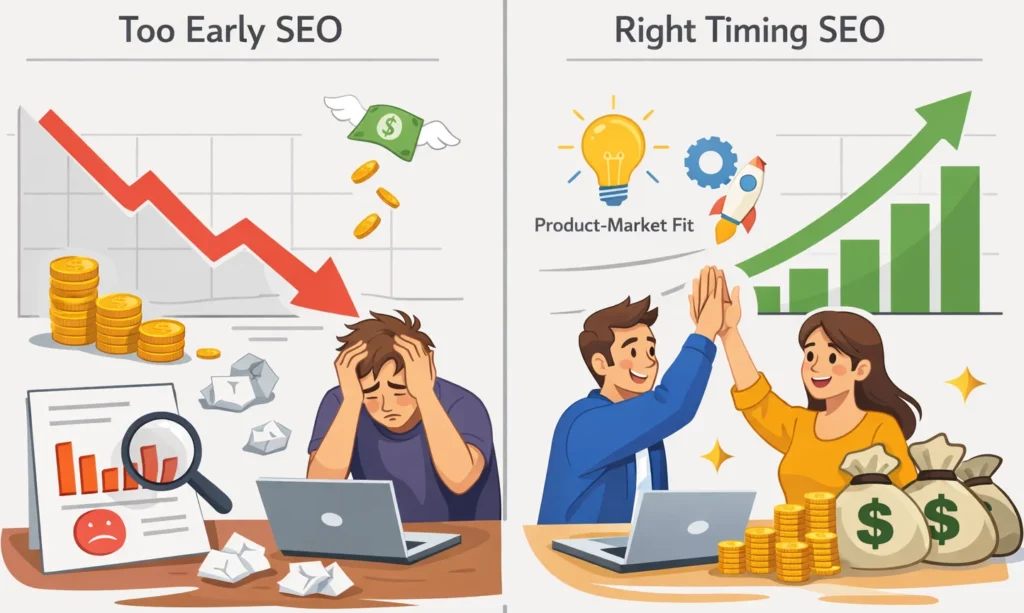
This does not mean SEO is irrelevant for AI startups. It means timing and allocation are everything. This blog breaks down exactly how much you should spend on SEO at the early stage, what you should get for that spend and the signals that tell you when it is time to scale up.
Key Takeaways
- Don’t spend heavily on SEO before product-market fit — it drains runway without delivering meaningful results.
- SEO pricing varies by model — from $50/hour for consulting to $20,000+ per month for enterprise campaigns.
- An in-house local SEO team costs $3,600 to $4,400 per month in salaries alone — add tools and training and the real cost is closer to $5,000 to $6,000 monthly.
- SEO ROI takes at least 6 months to materialize — at 12 months expect 2.6x and at 18 months expect 3.8x on average.
- Timing is everything — SEO is not a question of if, but when. Match your spend to your stage and scale only when your organic channel proves it can convert.
Build SEO That Drives Revenue — Not Just Traffic
Traffic without conversions is just noise. What your startup needs is a structured SEO approach tied to real business outcomes. At SEO Circular, we focus on what matters — growth, conversions, and long-term scalability. Ready to turn SEO into a growth engine?
👉 Get started with a custom SEO roadmap.
How Much Does SEO Costs For AI Startups And Businesses?
The cost of SEO has continuously changed over the years. Various factors affect the overall expense of SEO services regarding specific tasks. If we talk about the SEO pricing in 2025 then it usually comes between $1,000 to $1,500 per month along with some enterprise campaigns exceeding $10,000.
In 2026, the cost for AI startups and businesses should be between $2,000 to $2,500 per month for foundational SEO.
On the other hand, PR and authority building is also one of the crucial step for brand awareness and authority building. Businesses and startups should not ignore this important step. The cost of PR and authority building should be around $5,000 per year. If an AI startup or a business invests around $5,000 based on a year including tasks like PR, media mentions and brand positioning then it can help the business to create a strong credibility and visibility layer. This is really an important step for AI startups because users and investors both look for trust signals before engaging with new platforms.
So, if we explain this in simple terms then the cost for an early-stage startup must look like:
SEO: $2,000 – $2,500 (Monthly)
PR & Authority Building: $5,000 (Yearly)
This blend helps in forming both Higher visibility and authority at the same time.
Also we should keep in mind that this cost is not just a specific set of random numbers. They are actually based on what it will actually take in order to stand out in a kind of market where AI tools are launching every single year.
Many startups at first prefer investing less but they don’t know one major thing is that less investment can often lead to incomplete execution and will unlikely or rarely produce results.
At the same time, spending more without any kind of strategy will not help either. Our main objective is not to spend more but to spend in the right channels with a good strategy and a proper structure.
What affects the cost of SEO?
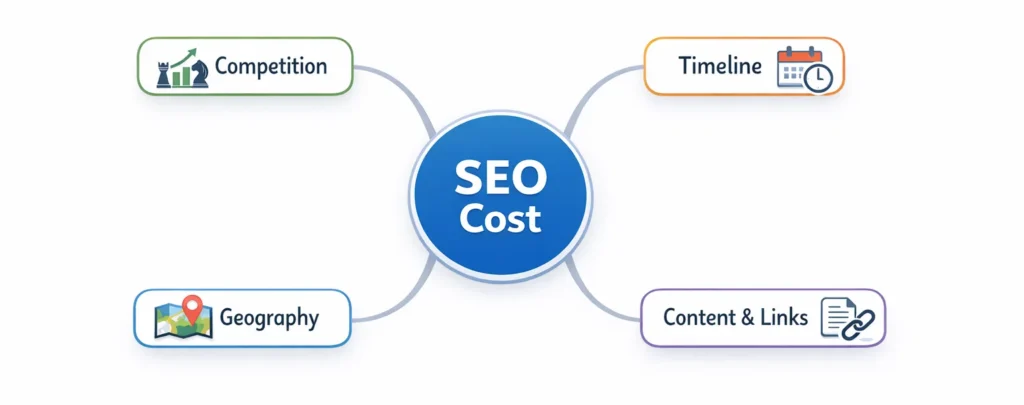
Usually, the cost of SEO ultimately depends on many factors including:
Industry And Keyword Competition
As the competition in any industry is increasing day by day, the need to have more efforts and resources in order to have higher ranking is also getting stronger. The more the competition is, the more you will have to put in the work to stand out in the industry. A space where the competition usually requires a larger scope including more aggressive content creation, extensive link building campaigns and deeper technical analysis. The scope directly affects the hours needed which in turn influences the price.
Time Span And Expertise
SEO strategy and execution take time but the desired speed can shift the overall cost. A more combative timeline demands more resources on time. An SEO team which is experienced with a proven track record in specific areas like advanced AI SEO will demand or need a higher rate than a generalist or a newcomer.
Geographic Targeting
Geo-targeting is essential in SEO because it matches the content of the website with the specific needs and preferences of the target audience. Geographical targeting majorly impacts SEO cost with Localized campaigns usually being cheaper and more efficient than national or international efforts due to lower competition. Cost increase with the number of target locations and the intensity of competition often ranging from $250 to $3,000 along with local services. While broader campaigns require higher more sustained investment.
Content Creation & Link Building:
When it comes to generating high quality content and obtaining high quality backlinks (often $100+per link) majorly raises the overall cost.
SEO Pricing Models For Startups Explained
Learning how SEO is priced is just as knowing how to spend. There is no single, universal pricing structure – agencies, consultants and freelancers use different models depending on the scope of work and your business needs. Here is a breakdown of the four main models and how much each one costs in 2026.
1. Monthly Retainer :
The monthly retainer is by far the most common SEO pricing model. You pay a fixed fee each month for an agreed upon set of services and the work compounds over time. This typically covers on page optimization content creation, link building, technical audits and monthly reporting.
Cost range in 2026
Most businesses in the USA pay between $1,500 and $5,000 per month with the national average for agency retainers sitting around $3,500 to $4,500 per month.
Best for
AI startups that have confirmed product market fit and are ready to invest in long term organic growth.
Watch Out For
Most agencies require a minimum commitment of 6 to 12 months often with 30-to-60-day exit clauses after the initial term. Do not sign a long retainer before your product and messaging are stable.
2. Project based Pricing :
Projects based pricing works best for businesses with well defined goals and a need for specialized, short term SEO services. Common projects include website audits site migrations content strategy build outs and penalty recovery.
Cost Range in 2026 :
Project based SEO typically costs between $5,000 and $30,000 for enterprise specific deliverables.
Best For
Early stage AI startups that need a one time technical audit or an initial SEO foundation before committing to an ongoing spend.
Watch Out For
Project based work delivers a snapshot in time. SEO is not a one-time fix, so use this model to establish a baseline not as a substitute for a long-term strategy.
Hourly Consulting
Hourly SEO services are ideal for businesses needing specific, limited tasks such as audits, consultation or training. This model is commonly used by startups within house marketing teams that need periodic expert guidance rather that full Service management.
Cost Range in 2026
Hourly SEO rates typically fall between $50 and $100 per hour globally with senior consultants in competitive markets charging $100 to $300 per hour.
Best for
Pre-revenue or early-stage AI startups that need strategic direction without committing to a full retainer.
Watch Out For
If a project becomes more complex, it is difficult to predict how many hours will be needed which can add up quickly. Always make sure to set up a cap on hours before engagement begins.
Performance-Based Pricing
Performance based SEO ties payment to measurable results such as keyword rankings, organic traffic growth or leads generated. It sounds attractive on paper but it comes with significant risks.
Cost Range In 2026
Costs vary widely depending on the agreed KPIs and outcomes. Hybrid models with a base retainer and performance bonuses are gaining traction as a more balanced alternative to pure pay for performance arrangements.
Best For
Startups with a stable, converting website that want to align agency incentives with business outcomes.
Watch Out For
Performance based pricing is the least popular model in SEO. Because SEO is a long-term game with considerable nuance, pay for performance is often incompatible with real business goals. Agencies my chase easy low intent keywords just to hit metrics. If an agency promises guaranteed page one rankings with no base fee, treat it is as a red flag.
Quick Comparison Table
| Model | Cost Range (2026) | Best For |
| Monthly Retainer | $1,500 – $5,000/month | Ongoing growth post product-market fit |
| Project-Based | $500 | One-time audits or SEO foundation setup |
| Hourly Consulting | $40 – $90/hour | Early-stage guidance with in-house teams |
| Performance-Based | Varies (hybrid recommended) | Conversion-ready sites with clear KPIs |
Benefits Of Setting Up An In-House SEO team
Sometimes managing SEO tasks altogether at once can become challenging. That’s where we need an experienced In-house SEO team who can help AI startups and businesses scale their SEO journey.
Let’s have a detailed analysis on the advantages of having an In-House SEO team.
Complete Control Over Strategy
An in-house team ensures that every decision aligns with your branding, mission, organizational goals and stakeholder opinions. When your SEO team sits inside your company, there are no approval delays, no miscommunication and no waiting faor your agency’s next scheduled call. You set the priorities and your team executes them directly.
Faster Collaboration Across Teams
Internal teams benefit from proximity. An Internal marketing team can collaborate closely with web development, product sales and leadership without formal handovers. Decisions happen faster, feedback loops are shorter and marketing managers do not need to translates context for external partners. For an AI startup where speed matters, this alone can be a significant competitive advantage.
Deeper Brand And Product Knowledge
Internal teams win on nuance and institutional insight especially for industries with technical or regulated content. AI products are complex. An in-house SEO professional will understand your audience, your use case and your competitive positioning far better than any agency that manages dozens of clients simultaneously.
Long-Term Institutional Knowledge
In-house management allows for complete control over brand voice , SEO strategy and marketing processes. For organizations focused on consistency rather rapid experimentation, this approach reduces reliance on external partners and builds institutional knowledge over time. Every campaign, every test and every insight stays within your organization- compounding in value as your startup scales.
What Does it Actually Cost to have an In-House local SEO Team?
Having an In-house SEO team is a recurring monthly commitment not a one time investment. Once your team is in place, you need a clear image of what it costs to keep them running effectively every single month. Here is a realistic role by role breakdown based on current market data.
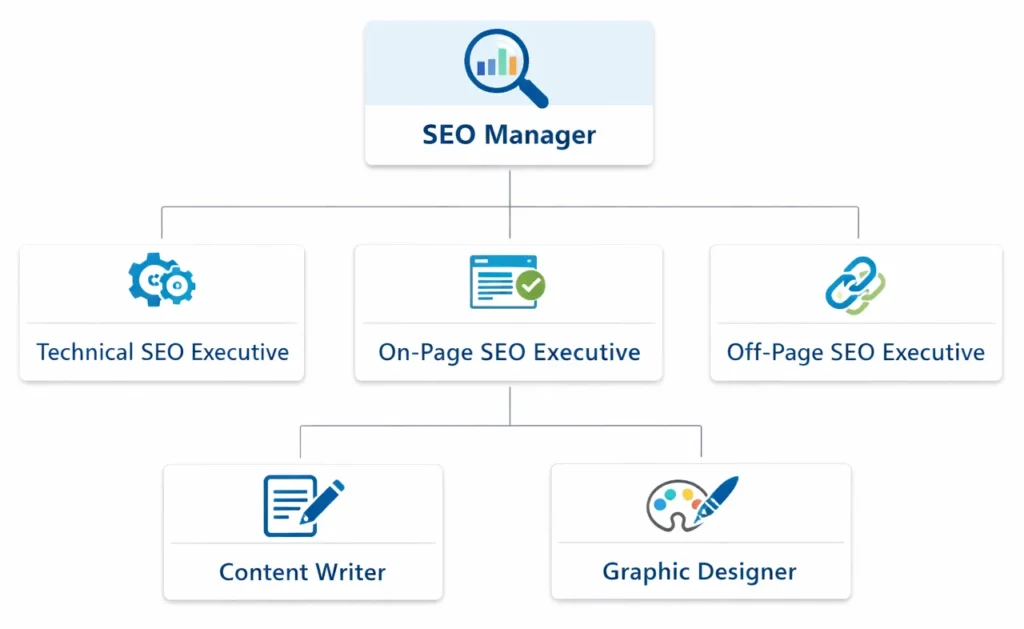
The Core Team Roles & Monthly Costs
1. SEO Manager
The SEO manager leads the entire SEO operation – owning the strategy, managing the team, reporting on performance and aligning SEO efforts with your broader business goals.
Monthly Costs – $1,200
2. SEO Executives
SEO executives are the hands-on operators of your team. Each executive typically owns a specific function including
1) One focused on technical SEO,
2) One on On-page optimization
3) one on off-page and link building
Ensuring all pillars of SEO are covered Simultaneously.
Monthly Cost – $1,200 – $1,800
3. Content Writer
A dedicated content writer produces the local landing page, blog posts and location specific content that drives organic visibility in your target market. Without consistent output, your SEO strategy stalls.
Monthly cost: $600 – $800
4. Graphic Designer
A graphic designer supports the team with blog visuals, infographics and landing page assets. Strong visuals improve user engagement, reduce bounce rates and increase the shareability of your content – all of which indirectly support SEO performance.
Monthly cost – $600
Total Monthly Cost of Maintaining Your In-House SEO Team
| Role | Monthly Cost |
| SEO Manager | $1,200 |
| SEO Executives (×3) | $1,200 – $1,800 |
| Content Writer | $600 – $800 |
| Graphic Designer | $600 |
| Total | $3,600 – $4,400/month |
What this does not include
These figures only cover salaries. Managing an effective in-house SEO team comes with additional monthly expenses that are easy to overlook. They include:
SEO Tools
Platforms like Ahrefs, SEMrush and Screaming Frog are non- negotiable for a functioning SEO team and can add $500 to $1,500 per month
Content tools
Tools like Surfer SEO, Grammarly or Jasper for content optimization carry their own recurring costs
Management Time:
The hours your leadership spends reviewing work, aligning strategy and conducting performance reviews represents a real and ongoing opportunity cost
Hiring & Training Costs
When team members leave or new tools emerge, recruitment and upskilling add expenses that recur unpredictably throught the year
When these additional costs are factored in, maintaining a fully operational in-house local SEO team realistically costs closer to $5,000 to $6,000 per month in total.
How to Measure SEO ROI for Your AI Startup
Without a clear ROI framework, SEO is impossible to justify or to scale. Here is what you actually need to know in order to measure the ROI
The Core Formula
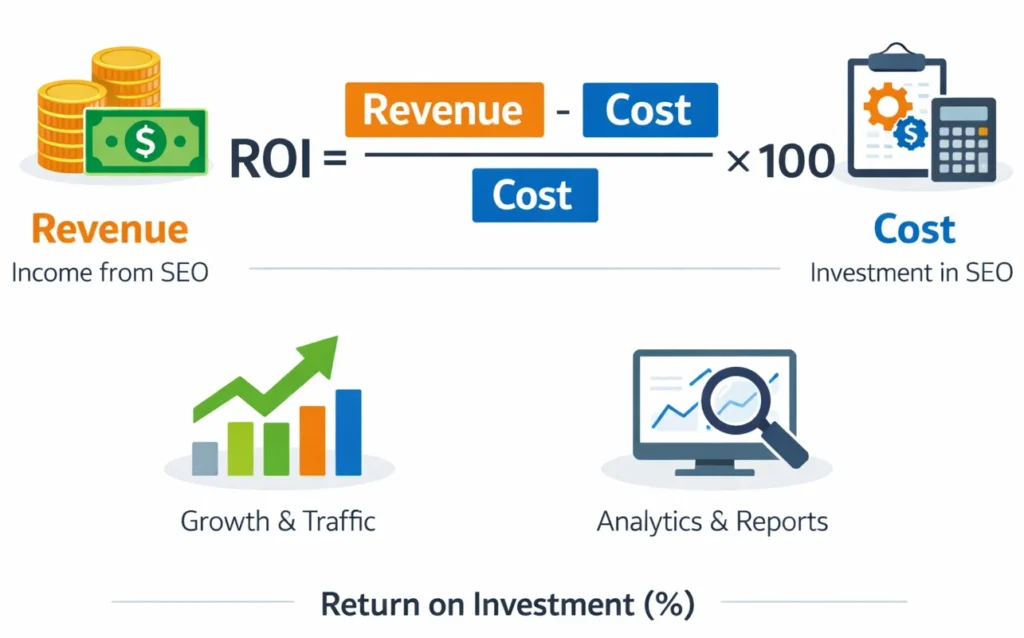
ROI = (Revenue Generated from SEO − Cost of SEO Investment) ÷ Cost of SEO Investment × 100
For example, if your SEO generates $150,000 in revenue against a $50,000 investment, your ROI is 200% — meaning every dollar spent returned $2 in revenue.
What ROI Should You Realistically Expect?
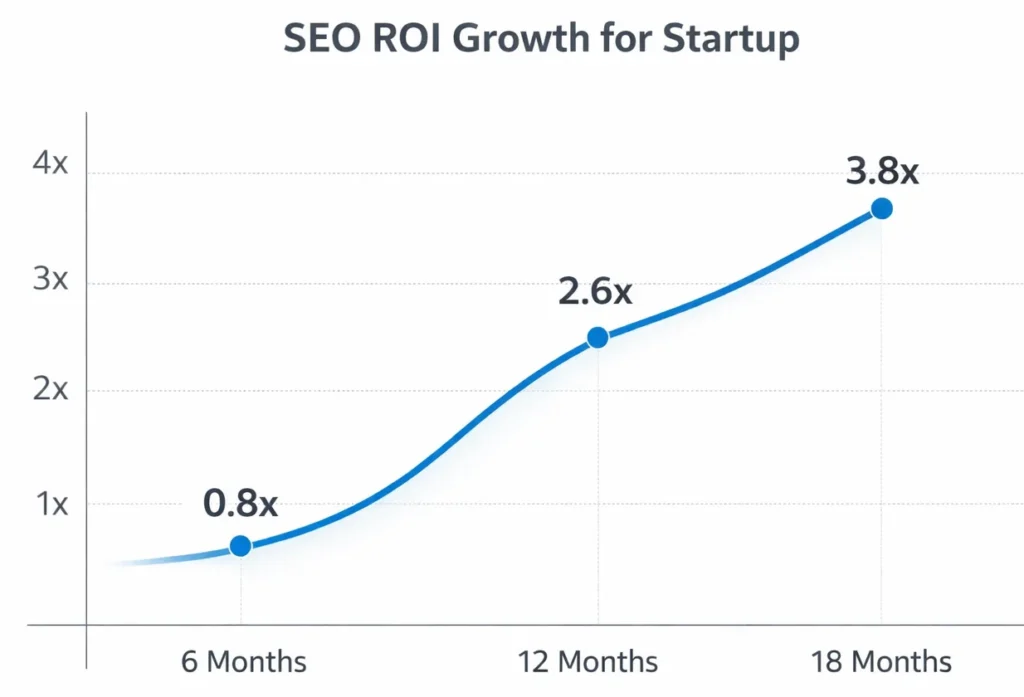
Here is how SEO ROI typically progresses over time:
| Time Period | Average ROI |
| 6 Months | 0.8x |
| 12 Months | 2.6x |
| 18 Months | 3.8x |
Most startups should aim for a 3:1 return or higher. Long-term SEO programs often reach 5:1 or more over time.
The 3 Metrics You Must Track
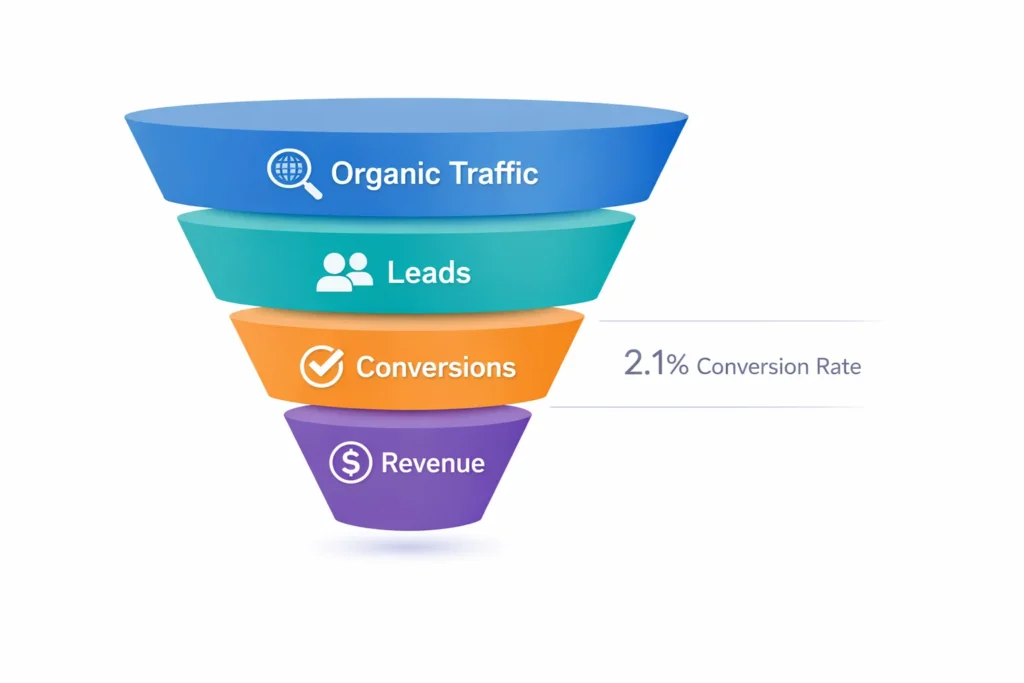
- Organic Revenue — Track organic visitors through to closed revenue in your CRM
- Conversion Rate — The average SEO conversion rate for B2B SaaS companies is 2.1% — use this as your baseline
- Cost Avoidance — Factor in the paid ad spend your organic traffic is replacing
One Important Rule
Never measure SEO return on investment before at least 6 months. Calculating it sooner will produce inaccurate and misleading results. Evaluate SEO year over year, not quarter to quarter.
Conclusion
SEO is not a question of if — it is a question of when and how much. Spending too early drains the runway. Spending too late hands organic growth to your competitors. The right move is timing your investment to match your stage and your overall revenue goals.
For most early-stage AI startups, the smartest first step is partnering with the right SEO agency. You get the strategy, execution and expertise without the overhead.
Ready to grow your organic presence the right way? SEO Circular specializes in helping AI startups build SEO strategies that are lean, focused, and built for results. Get in touch with us today.
Commonly Asked Questions: AI Startup Spend on SEO
Yes — in 2026, GEO is no longer optional. AI Overviews now appear on nearly half of all Google searches, meaning visibility on ChatGPT and Perplexity is just as critical as ranking on Google.
Generic content no longer works. Structure content with clear question-and-answer formatting, concise definitions, and citable statistics, AI models favour factually dense, well-attributed content over broad informational articles.
More than ever. Sites with over 32,000 referring domains are 3.5 times more likely to be cited by ChatGPT, strong backlink profiles now directly impact both Google rankings and AI search visibility.
It adds an overlooked layer of investment. Budget for founder bylines, original research, and verified reviews — a focused 90-day E-E-A-T sprint can close the trust gap against older, more established domains.
Only with a strong editorial layer. Over 82% of content marketers will integrate AI tools by 2026 but an AI-generated content without human oversight risks violating Google’s E-E-A-T principles and triggering ranking penalties.