Why Did My Leads Stop After I Redesigned My Website?
A website redesign should help your business grow, but if SEO is overlooked, it can lead to significant traffic and lead losses. This guide explores the most common reasons rankings drop after a redesign, including missing redirects, deleted landing pages, broken forms, slow page speed, and indexing problems. You'll also learn how to use Google Search Console, Google Analytics, and Bing Webmaster Tools to diagnose issues and implement a recovery strategy that restores organic traffic and conversions.
You spent weeks planning a new website. The design looks clean, the colors are fresh and the layout finally feels professional. You hit publish and waited for the leads to roll in.
Then nothing happened, fewer calls. The phone just stopped ringing.
If this sounds familiar, you are not alone. A website redesign is one of the most common reasons businesses quietly lose their search rankings, their traffic and their leads overnight. The good news is that every single one of these problems has a fix.
Are you worried about how you will get leads after redesigning your website?
SEO Circular’s technical SEO team finds exactly what broke and recovers at this scale. With around 500+ enterprise clients and 500M+ organic visits generated, they have experience regarding such types of issues.
Recover Lost Leads in 30 Days With a Professional SEO Audit
A website redesign should help your business grow, not reduce your leads and revenue. If your traffic has dropped, rankings have disappeared, or enquiries have slowed down since launching your new website, the problem is often technical and fixable. Our SEO specialists identify broken redirects, indexing issues, missing pages, content changes, and conversion roadblocks that may be costing you valuable customers. With experience supporting 500+ businesses across multiple industries, SEO Circular helps brands recover lost visibility, restore rankings, and improve lead generation through proven technical SEO strategies.
👉 Get Your Free Website Redesign SEO Audit & Recovery PlanKey Takeaways
- A website redesign is a high-risk SEO event — URL change, content rewrite, new images, and structural shifts have the potential to cost you rankings and leads.
- Setting up 301 redirects before launch day is the single most important technical step in any redesign project.
- Google Search Console, Google Analytics, and Bing Webmaster Tools together give you a complete picture of where your traffic drop came from and which pages to fix first.
- Not all lead drops are SEO problems — broken forms, missing CTAs, and removed trust signals are conversion issues that a ranking recovery will not fix on their own.
- Running a full SEO audit before a redesign begins is far less expensive and far less stressful than recovering from one that went wrong.
Reason Why Your Leads Vanished After You Redesigned Your Website?
A drop in leads after a website redesign almost always comes from one or more of these problems working together. Here are the ones you need to check first:
1) Broken URLs
Your old pages had rankings built over months or years. If those URLs changed in the redesign and no redirects were set up, every person clicking an old Google result lands on a dead page and leaves immediately.
2) Missing 301 Redirects
A 301 redirect tells Google and visitors that a page has permanently moved to a new address. Without them, all the SEO value built on the old URL is completely lost.
3) Removed Landing Pages
Sometimes key lead generation pages get cut during a redesign because the team did not realize how much traffic they were driving. If the page that ranked for your best keyword no longer exists, then neither does the leads.
4) Lost Or Broken Meta Tags
Title tags and meta descriptions often get wiped or left blank during a CMS migration. These tell Google what each page is about. Without them, rankings might fall.
5) Changed Keyword Content
Copywriters hired for the redesign often rewrite pages with fresh language that unintentionally removes the keywords Google was ranking you for.
6) Slow Page Speed
New design frameworks, video backgrounds, and uncompressed images add weight to pages. A page that loaded in 2 seconds before the redesign may now take 6 seconds which hurts both your rankings and conversions.
7) Broken Contact Forms
A redesign often involves changing plugins or moving to a new form builder. Forms break in the migration and nobody notices because internal testing only checks the front-end design.
8) Removed Trust Signals
Testimonials, review counts certifications and the case study links build trust with visitors. When these get dropped in a redesign, conversion rates fall even if the traffic stays the same.
9) Lost Backlinks
Other website linking to your old URLs now point to dead pages. Those backlinks were part of your domain authority. Losing them weakens your rankings across the whole site.
Also Read: Website Traffic Dropped 40% Overnight
How Does Website Design Affect SEO?
Most business owners think of SEO, White-label seo, and design as two separate things. Design is how your site looks. SEO is how Google finds it. But the truth is that every major design decision you make directly changes how search engines read, crawl and rank your website.
Here is how website design affects SEO in practice:
1) URL structure
When you redesign, old URLs often get replaced with new ones Google had those old URLs indexed. If the new URLs do not match, those rankings are gone.
2) Page Speed
Heavy fonts, large images and new design frameworks can slow your site down significantly. Google uses page speed as a ranking factor, and slow pages lose rankings fast.
3) Content Hierarchy
Your heading structure (H1, H2, H3) tells Google what each page is about. Redesigns often strip or scramble this structure without the designer realizing it.
4) Internal Linking
Navigation menus change when you redesign the website. If pages that used to link to each other no longer do, Google loses the thread connecting your content.
5) Mobile Responsiveness
Google indexes the mobile version of your site first. A redesign that looks great on desktop but behaves poorly on mobile will directly hurt your rankings.
6) Core Web Vitals
Google measures how fair your page loads, how stable the layout is and how quickly it responds to a tap or click. New design code can quietly break all three of these scores.
The key things to understand here is what you redesign in your website, you are not just changing how it looks. You are potentially changing everything Google uses to understand what your site is about and how trustworthy it is.
How to Analyze Traffic Drops After a Website Redesign?
Before you can fix the problem, you need to know exactly where the traffic went and what stopped working. These three tools will give you the full picture.
Google Search Console (GSC)
Google Search Console is the most important tool for diagnosing a post-redesign traffic drop. Here is what to check:
- Go to the coverage report and look for a spike in 404 errors or excluded pages. These are your broken URLs.
- Use the URL inspection tool to check whether your most important pages are indexed and what Google last saw when it crawled them.
- Open the performance report and filter by date to compare your click and impression data from before and after the redesign. A sudden drop in impressions means Google stopped finding your pages. A drop in clicks with stable impressions means your titles or descriptions changed and people stopped clicking.
- Check the sitemap section to confirm your new XML sitemap was submitted. If it was not submitted then Google may still be crawling the old site structure.
Google Analytics
Google Analytics shows you what happened to visitor behavior after the redesign went live.
- Compare your organic traffic sessions from the 30 days after. This gives you the true scale of the drop.
- Check the landing pages report to find which specific pages lost the most traffic. This tells you exactly where to shift your recovery effort.
- Check whether actions like form submission, call clicks or purchases have decreased even if your traffic stayed stable. If they have then the problem is likely with conversions rather than SEO.
- Review bounce rate and engagement rate by page. If visitors are arriving but leaving immediately then your new design may be confusing them or loading too slowly on mobile.
Bing Webmaster Tools
Bing is often ignored but it powers a meaningful portion of search traffic especially from older demographics and Microsoft device users. After a redesign it is worth checking. They are:
- Submit your new sitemap directly in Bing Webmaster tools so that Bing can recrawl your updated structure.
- Check the Crawl information report for 404 errors and redirect chains that Bing is encountering.
- Review the search performance report to see which keywords dropped on Bing after the redesign. If the same keywords dropped on both Google and Bing then the problem is almost certainly on your site rather than an algorithm issue.
Understanding The Difference Between A Small Dip Or A Real Drop in Traffic
Not every traffic change after a redesign is an emergency. Here is how to read what you are seeing.
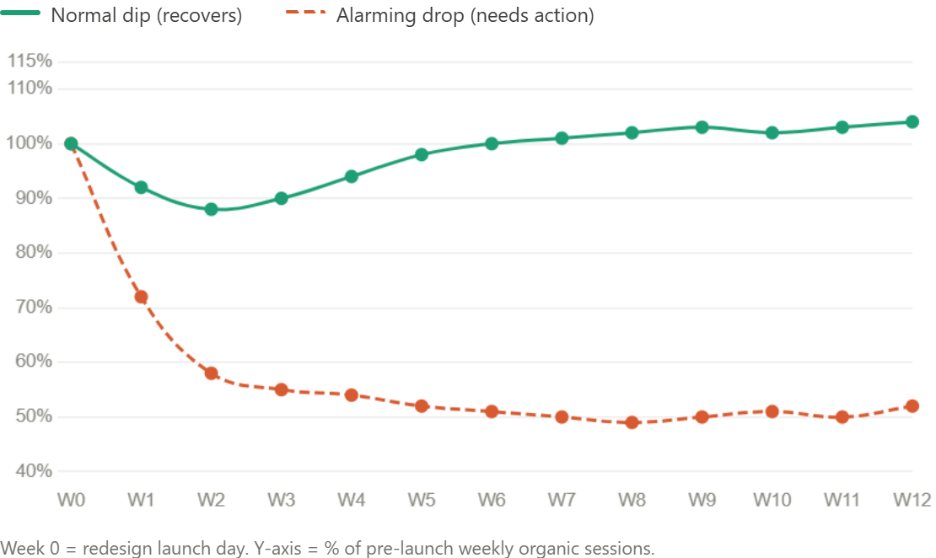
A small drop of 5% to 15% in the first two to three weeks after launch is completely normal. Google needs time to recrawl and re-evaluate your updated pages. This kind of drop usually recovers on it’s own within four to six weeks as long as your redirects are in place and your content is intact.
A sustained drop of 30% or more that continues beyond the first month is a signal that something is structurally broken. This is when you need to act quickly because the longer broken URLs sit without redirects and the longer Google goes without a submitted sitemap then the harder the recovery becomes.
How to redesign a website without losing Leads and Traffic?
The best way to deal with a post redesign traffic is to prevent it from happening in the first place. If you are planning a redesign or helping a client through one then this checklist will save you from months of recovery work.
1) Run A Full SEO Audit
Document every URL that is currently indexed, every page that drives traffic and every keyword you currently rank for. This is your baseline. You cannot protect what you have measured.
2) Preserve Your Existing URL Structure Wherever Possible
The safest redesign keeps URLs exactly the same. If URLs must change then map every single old URL to it’s new destination before launch day.
3) Set Up 301 redirects
Every old URL that is changing needs a redirect in place from the moment the new site goes live. A redirect tells Google that the page moved and transfers it’s ranking value to the new address.
4) Benchmark Your Analytics Before Launch
Screenshot your top 20 landing pages by organic traffic, your total monthly sessions and your key conversions metrics. You need a clean comparison point for the weeks ahead.
5) Submit Your XML sitemap
Do not wait for Google to find it organically. Submit it manually so the recrawl starts as fast as possible.
6) Test The Structure
Keep track of things like every CTA and navigation link before the site goes live after the redesign. Have someone outside the project test every conversion path on both desktop and mobile.
7) Keep Analytics Tool Open For Sometime after the launch
Use Tools Like Google Search Console. Check weekly for spikes in 404 errors, drops in impressions or pages that disappeared from the index. Catching problems in week one is far easier than fixing them in month three.
8) Do Not Rewrite All Your Page Content During The Redesign
If a page currently ranks well, update the design and layout but leave the core content and keyword structure intact. Rewriting ranked content is one of the most common causes of post-redesign ranking drops.
| Traffic Change | What It Usually Means | Action Required |
|---|---|---|
| 0%–15% Drop | Normal Google re-crawling after redesign | Monitor only |
| 15%–30% Drop | Possible indexing or redirect issues | Run SEO audit |
| 30%–50% Drop | Significant technical SEO problems | Immediate investigation |
| 50%+ Drop | Major migration failure or deindexing issue | Emergency recovery plan |
Increase Qualified Leads by Up to 70% With SEO-Driven Optimization
A great-looking website should generate more business, not fewer leads. We help businesses recover lost traffic, improve conversions, and turn redesigned websites into growth engines through proven SEO and conversion optimization strategies.
👉 Request Your Free SEO Recovery ProposalWrapping Up
A website redesign is supposed to grow your business not shrink it. But when it is done without protecting the SEO foundations that were already working, it almost always leads to a traffic drop and a leads downfall that can last months.
The core problem is that most redesign projects focus entirely on how a website looks and almost never on how Google reads it. URLs change without redirects. Content gets rewritten and loses it’s keyword signals. Forms break in migration. Trust signals disappear in the name of clean design. The result is a site that looks modern but performs worse than the one it replaced.
Understanding how website design affects SEO, knowing how to analyze a traffic drop with the right tools and having a clear recovery plan in place puts you back in control. Also if you plan a redesign in the future then running an SEO audit before launch day is the single most important step you can take to protect what you have already built.
Important Questions About Website Redesign SEO
How long does it take to recover SEO rankings after a website redesign?
With redirects in place and a sitemap resubmitted, most sites begin recovering within 6 to 12 weeks, though full recovery can take up to 6 months depending on how many issues were created.
Can a redesign permanently hurt my SEO?
Yes, if broken URLs go unredirected for a long time, Google removes those pages from its index entirely and the backlinks pointing to them lose their value permanently.
Do I need to tell Google when I redesign my website?
Google will eventually discover the changes on its own, but you should always manually submit your updated XML sitemap in Google Search Console to speed up the recrawl process.
What is the safest CMS to use for a redesign if I want to protect my SEO?
The CMS matters less than the process. Any platform can preserve SEO if you maintain URL structures, set up redirects, and carry over all existing meta tags and content correctly.
Will my paid ads traffic also drop after a website redesign?
Paid ad traffic is not directly affected by the redesign, but if landing pages change URL or get removed, your ads will point to broken destinations, which will hurt your ad performance and quality scores.
Ready to rank on Google and AI at the same time?
We help brands win across search and AI answers — technical SEO, content strategy and Generative Engine Optimization in one workflow. Tell us your goals and we’ll show you the plan.