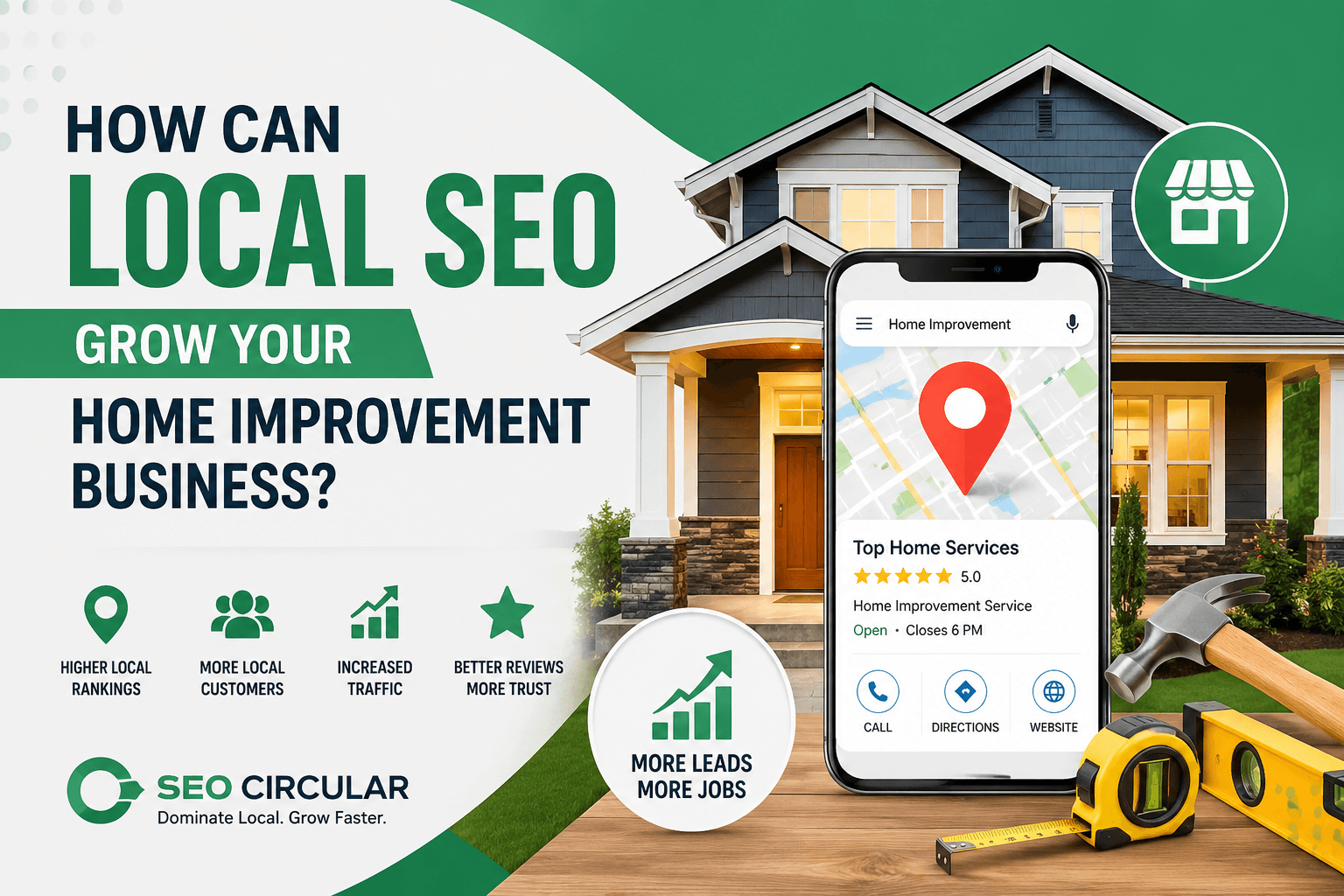
Most home improvement businesses we have worked with have a similar story. They deliver exceptional results, earn glowing reviews, and generate a steady stream of referrals from satisfied clients. Yet despite doing everything right on the job site, they still struggle to scale.
The reason is simple. Homeowners no longer rely solely on word-of-mouth recommendations. They search online.
In today’s digital-first world, a strong online presence isn’t a competitive advantage. It’s a business requirement.
If your home improvement business doesn’t appear when homeowners are searching for the services you offer, you’re invisible during one of the most important stages of the buying process. It doesn’t matter how skilled your team is, how long you’ve been in business, or how many referrals you’ve earned over the years.
That’s the reality of local SEO for home improvement businesses. It presents both a challenge and an opportunity.
By the end of this guide, you’ll understand how local SEO works for home improvement contractors and why a professional website audit service is often the first step toward better rankings. It’s one of the highest-ROI marketing channels for local service businesses, and the exact steps you can take to build a search presence that consistently attracts qualified leads in your target market.
At SEO Circular, we provide home improvement SEO services that help contractors, remodelers, and renovation companies increase their online visibility, attract qualified local leads, and grow their business through organic search. Get your free website audit today and take the first step toward transforming your home improvement business.
Get More Local Leads
Find out why your home improvement business is not ranking locally. Get a free SEO audit from our experts.
Get Free SEO AuditWhat Is Local SEO and Why Is It Different for Home Improvement Businesses?
Search Engine Optimization (SEO) is the practice of improving your business’s visibility in organic (unpaid) search results. Local SEO is the specific application of that discipline to businesses that serve customers in a defined geographic area.
Local SEO matters more for home improvement businesses as;
Nobody in Chicago hires a kitchen remodeler based in Houston. Nobody in Manchester books a bathroom fitter from London. The entire commercial value of your online presence is concentrated in the local geography you actually serve. And that’s why local SEO holds more value for home improvement businesses.
Here’s how local SEO services are different for home improvement businesses;
1. The Map Pack Drives Most Local Clicks
When people search for “contractor near me” or “remodeler in [city],” Google shows the Map Pack before organic results. These top three business listings include ratings, addresses, and call buttons. Ranking here often brings more leads than being first in organic search.
2. Reviews Improve Rankings and Build Trust
Reviews help your business rank higher in local search. Google looks at review count, quality, and freshness when ranking businesses in the Map Pack. Strong reviews also give homeowners confidence to contact your business.
3. Every Service and Location Can Rank
Each service in every city is a separate ranking opportunity. If you offer four services across three cities, you have twelve chances to appear in local search. Creating optimized pages for each service and location helps your visibility grow over time through a scalable programmatic SEO approach.
The Core Elements of Local SEO for Home Improvement Businesses
Local SEO relies on a few essential elements that help your business rank higher in local searches. Optimizing each one improves visibility, builds trust, and attracts more qualified leads from your service area. Here are eleven core elements of local SEO for home improvement businesses;
Google Business Profile: Your Single Most Important Local SEO Asset
For home improvement businesses, your Google Business Profile (GBP) is what powers your Map Pack listings. It is the most important single asset in your local SEO arsenal, and it is free.
Most home improvement businesses either have not claimed their GBP, have claimed it but left it half-finished, or have filled it out once and never touched it again. All three scenarios leave significant visibility on the table.
Apple Business Connect deserves a place in your local SEO strategy too.
While Google dominates local search, thousands of homeowners use Apple Maps every day to find nearby contractors and home improvement services. A complete and up-to-date Apple Business Connect profile helps your business appear in those searches, giving you another way to reach potential customers.
At SEO Circular, we treat both Google Business Profile and Apple Business Connect as essential digital storefronts that keep your business visible wherever homeowners are searching.
Local Keyword Research: Understanding How Your Customers Search
Homeowners do not search the way contractors think they do. They rarely search your business name or your specific trade terminology. Rather, they search the way they talk and often use keywords with geographic specificity.
Understanding these local keyword patterns is the foundation of our entire local SEO strategy for home improvement businesses. Here are the four keyword categories that matter for contractors;
- Service + Location searches are the highest-converting terms like “kitchen remodeler in [city]” or “bathroom renovation contractor [area].” These users are ready to hire and are actively comparing businesses.
- Service + Near Me searches such as “contractor near me” come mostly from mobile users. These depend on your Google Business Profile and local signals, not the exact phrase on your website.
- Problem or project searches like “small kitchen ideas” or “how to add a room” come from homeowners still researching. These are best targeted with helpful blog content.
- Cost and comparison searches such as “kitchen remodel cost in [city]” show strong buying intent. Clear, local pricing guides help turn these searchers into leads.
Our SEO experts analyze all these keyword types and build a focused SEO strategy around them to help home improvement businesses rank where it matters most. By targeting high-intent local searches, we ensure your business shows up throughout the entire customer journey.
Your Website: The Foundation Everything Else Depends On
If your Google Business Profile gets homeowners to your door, then your website is the room they walk into. A slow, hard to navigate, or outdated website fails to convey credibility on a phone screen. And you end up losing leads that your GBP correctly earned.
Website fundamentals for home improvement contractors:
1. Mobile Performance Matters
Most local searches happen on mobile devices and Google uses the mobile version of a site’s content for indexing and ranking. In case the mobile version of your website loads slowly or is not user-friendly, this can impact your overall rankings and conversions.
2. Build Dedicated Service Pages
Create separate pages for each service like kitchen remodeling or bathroom renovation. These pages rank better, target specific keywords, and give homeowners the detailed information they are searching for.
3. Make Contact Details Easy to Find
Make sure your phone number and contact form are visible on every page. At times, most users decide within seconds, so make it simple for them to reach you for any home improvement need.
4. Show Real Project Work
Before-and-after photos build trust and drive inquiries; make sure they are visible on the home page. Label projects with service type and location to strengthen local relevance and credibility. As a diversified portfolio, boost your chances of converting users with different home improvement needs.
Building and Managing Your Online Reviews
Reviews are one of the most powerful yet underused tools in local SEO for home improvement contractors. They directly influence how high you rank in local search and how much trust new homeowners place in your business. Consistently requesting genuine reviews helps build a steady stream of social proof that compounds over time and drives more leads.
Think about it this way. If you had to choose between a contractor with 20 reviews and another with 200 reviews and a 4.9 rating, you would likely go with the one that feels more established and trusted.
That is exactly how your potential customers think too.
So, the sooner you start building reviews, the faster you strengthen your visibility and outperform competitors.
Local Citations and NAP Consistency
A local citation is any online mention of your business name, address, and phone number (collectively called NAP). Google uses local citations as a trust signal. And the more frequently your business information appears across reputable online directories, the more confident Google is that your business is legitimate, established, and accurately located.
For home improvement businesses, the most important citation sources include:
- General business directories: Google Business Profile (your primary citation), Bing Places, Apple Maps, Yelp, Facebook Business, Foursquare, and the Better Business Bureau.
- Home improvement-specific directories: Houzz, Angi (formerly Angie’s List), HomeAdvisor, Checkatrade, Rated People, TrustATrader, Thumbtack, and Bark.
- Local directories: Your local Chamber of Commerce directory, city business listings, regional trade association directories, and local newspaper business listings.
Our SEO team first audits your existing citations before building new ones. We search your business name on Google and check every listing for accuracy. We correct inconsistencies before creating new local citations and NAP profiles.
Invest in Content Marketing: Earning Trust Before the First Phone Call
Most home improvement businesses think about content marketing as blogging for the sake of blogging. That misses the point entirely.
Strategic content marketing for home improvement contractors is about being the most credible, most informative, most helpful source of information for homeowners who are planning the exact type of project you specialise in. This approach becomes even more powerful when combined with AI-driven local marketing tactics.
Homeowners are consuming more video and less written content. For home improvement businesses, video is one of the fastest ways to build trust before the first call. Simple videos explaining basic renovation tips, showing real project work, or walking through what you offer can make your expertise clear in seconds.
Posting this type of content on social media helps you reach local audiences and generate consistent leads. A strong video presence positions your business as helpful, credible, and easy to choose.
Building Local Backlinks
Backlinks from other sites are one of Google’s most important ranking signals. For local SEO, local backlinks carry particular weight because they signal geographic relevance alongside domain authority.
The good news for home improvement contractors is that the backlink opportunities in your local market are often significantly less competitive than in national categories.
You do not need links from major publications. You need links from locally-relevant, geographically-matched sources that confirm your business’s connection to your community and your trade.
Technical SEO: The Foundation That Holds Everything Together
Technical SEO is often the most overlooked part of local search optimization, yet it is what keeps everything else working. For many home improvement businesses, it is also the biggest hidden reason their website does not rank.
If your site has crawl errors, slow load speeds, broken pages, or poor mobile structure, Google cannot properly read or rank your content.
Even well-written service pages and strong content will struggle if the technical foundation is weak. A clean, fast, and properly structured website ensures every SEO effort actually performs as intended. We also offer a free website audit where our SEO experts review key technical issues that may be limiting your visibility. Contact us to get started.
Tracking, Measuring, and Improving Over Time
Local SEO is not a one-time task. It is an ongoing process that improves with consistent attention and steady refinement. Without tracking, even good efforts can become guesswork.
Measuring rankings, website traffic, calls, and lead sources helps you see what is driving results and what is not. With this data, you can make small, focused improvements that compound over time into stronger visibility and better quality leads.
AI Search Is Becoming the New “Word of Mouth”
Homeowners are no longer relying only on Google results to choose a contractor. They are asking AI tools for recommendations the same way they would ask a friend, expecting a short list of trusted options instead of hundreds of links.
In this new environment, AI becomes a digital referral system, making AI search visibility increasingly important for local businesses. AI search systems pull data from multiple sources before suggesting a contractor:
- Your website content and service pages
- Google Business Profile and Apple Business Connect listings
- Customer reviews and ratings across platforms
- Mentions of your business on other websites and directories
- Consistency of your business name, address, and phone number
If this information is incomplete, outdated, or inconsistent, AI systems are less likely to surface your business in recommendations.
How Long Does Local SEO Take to Produce Results?
This is the question every home improvement business asks before investing in local SEO, and it deserves an honest answer.
The truthful answer is: it depends on your starting point, your local competition, and the specific strategies being implemented.
For most home improvement businesses starting from a basic web presence in a mid-size local market, a realistic timeline looks roughly like this:
Month 1–2: Foundation work which includes – GBP optimisation, technical SEO fixes, citation cleanup, and on-page optimisation. You may see small early improvements in your GBP’s local search appearance, but significant ranking changes are unlikely this early.
Month 3–4: Meaningful improvements in Map Pack visibility and local keyword rankings typically begin to appear. Content published in months one and two begins to get indexed and drive initial organic traffic.
Month 5–6: Measurable increases in organic traffic and local search leads. Your GBP review profile has grown (assuming you have been systematically generating reviews), further improving your Map Pack ranking and conversion rate from Map Pack impressions.
Month 6–12: Compounding growth. Content published earlier in the campaign is now ranking for multiple keyword variations and driving consistent traffic. Your domain authority has grown through local link building. Your GBP is a well-established presence in your local Map Pack. New service and location pages are being indexed and beginning to rank.
Beyond month 12: The compounding nature of local SEO becomes its most valuable characteristic. Rankings achieved through genuine quality work are durable. Content assets keep generating traffic without additional investment. Your review profile continues to grow with each completed project. The return on each month of SEO investment improves over time.
In our experience, the home improvement contractors who benefit most from local SEO are the ones who treat it as a long-term investment rather than a quick fix.
Final Thoughts
Local SEO is the most sustainable and highest-ROI marketing channel available to most home improvement businesses. However, it requires patience, consistency, and a realistic understanding of how it works.
It will not produce instant results and is not an alternative to paid advertising in the short term for a business that needs leads immediately. Local SEO will only work if treated as a one-time setup task rather than an ongoing discipline.
What it will do, when approached correctly and sustained consistently, is build a compounding organic presence that generates qualified leads from homeowners in your service area month after month.
The home improvement contractors who will dominate their local markets over the next three to five years are the ones investing in local SEO today. The ones who wait will find themselves competing against well-established local search presences that are increasingly difficult and expensive to displace.
If you run a home improvement business and want to understand where your local search presence currently stands, we at SEO Circular offer a free local SEO audit. We will assess your Google Business Profile, your website’s technical health, your current local keyword rankings, your review profile, and your citation consistency, and give you a clear picture of where the gaps are and how to close them. Reach out to our subject matter experts today!
Frequently Asked Questions
How long does local SEO take to work for a home improvement business?
Most businesses see early improvements within 3 to 6 months. Strong, consistent growth builds over time.
Is a Google Business Profile really that important?
Yes. It is the main factor for appearing in the Map Pack and generating local calls and leads.
How many reviews do I need to rank in the Map Pack?
There is no fixed number. You need better and more recent reviews than your local competitors, along with a strong rating and regular review activity.
Should I build location pages for every area I serve?
Yes. Dedicated location pages help you rank in each service area and capture more local searches.
What is the difference between local SEO and regular SEO?
Local SEO focuses on ranking in specific geographic areas, especially the Map Pack. Regular SEO targets broader, non-location-based search results.
Do I need to hire an agency, or can I do local SEO myself?
Basic SEO can be done in-house, but advanced strategies like technical SEO, content planning, and scaling across locations usually perform better with expert support.