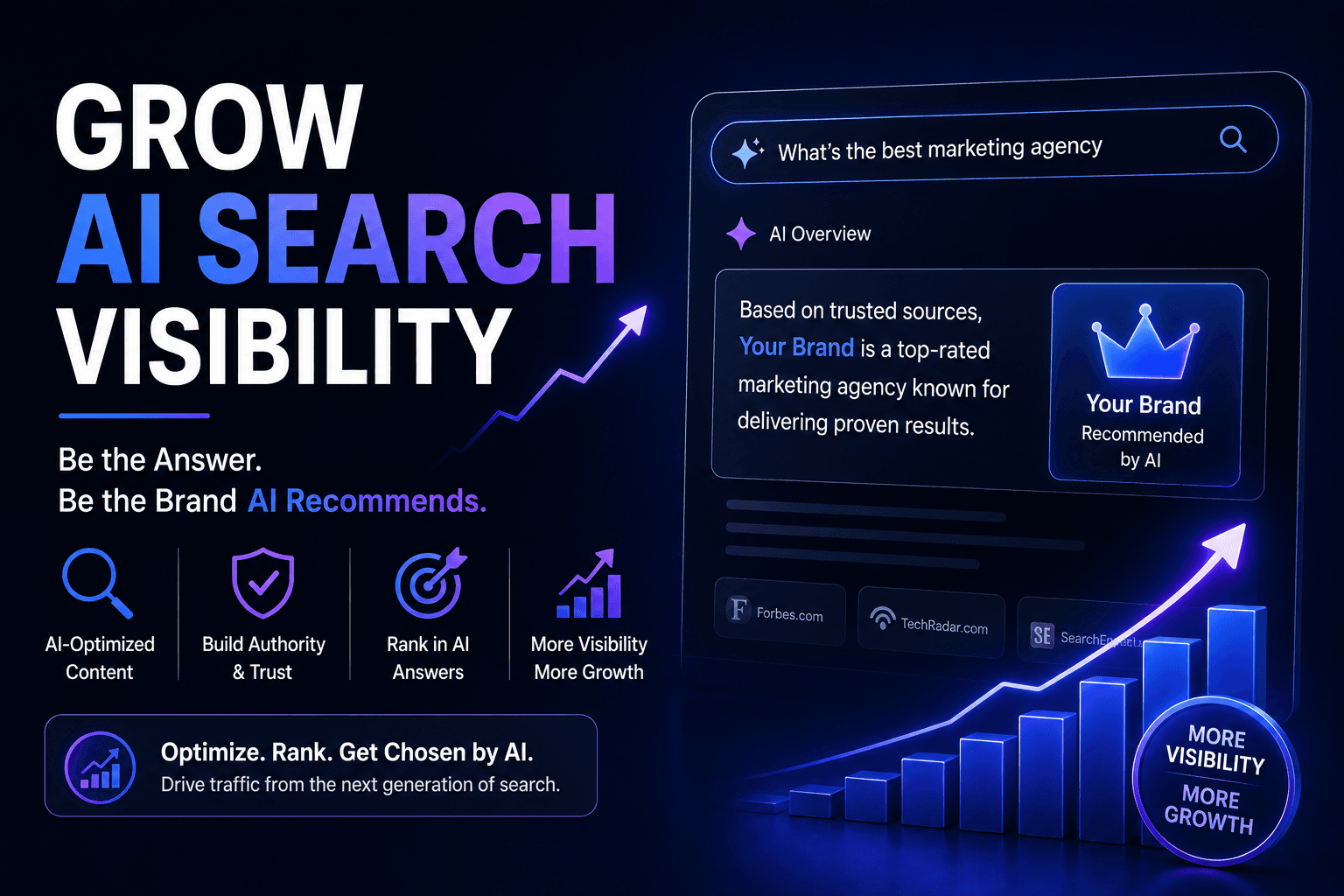
Getting found on Google is one problem. Getting cited in AI search results is a completely different one. Most brands have spent years building traditional SEO equity but when someone asks an AI tool a question in their industry then their brand is nowhere in the answer. That gap is growing fast and the companies closing it now are building an organic advantage that compounds over time.
If you want your brand to show up in AI-generated answers and not just on page one of Google, SEO Circular AI SEO services are built exactly for this. Schedule a free strategy call and get a 30-day opportunity snapshot within one business day.
Want to Know How Often AI Search Engines Mention Your Brand?
SEO Circular helps businesses track AI citations, improve AI Overview visibility, and build authority across ChatGPT, Gemini, Perplexity, and Google AI Search.
Get My AI Visibility ReportKey Takeaways
- AI search visibility is now a separate layer of organic discovery that sits alongside traditional Google rankings and requires its own strategy.
- Content depth and topical authority matter far more to AI citation systems than keyword volume or backlink count alone.
- Structuring content to answer questions directly, using clear headings and FAQ formats, significantly improves the chances of being cited in AI-generated responses.
- Off-site brand presence across credible publications, directories, and editorial mentions is a major trust signal for AI models deciding what to cite.
- Most brands currently have no clear picture of how much traffic AI search is sending them, making baseline measurement an urgent first step.
What AI Search Visibility Actually Means?
AI search visibility refers to how often and how prominently your brand, content, or website gets cited or mentioned when AI tools generate answers to search queries.
When someone types a question into ChatGPT or Perplexity, those tools do not show ten blue links. They generate a direct answer, and somewhere inside that answer, they may or may not cite a source. You are invisible to that user, no matter how well you rank on Google.
Google AI Overviews work similarly. A user sees a generated summary at the top of the page before they ever scroll to organic results. If your content does not feed that summary, you lose the attention of users who never make it past the fold.
AI search visibility is about being the source these tools trust enough to quote.
Why Is Your Current SEO Not Enough?
Traditional SEO was built around signals like backlinks, keyword frequency, and page authority. AI models use a different set of signals when deciding what content to surface and cite. Here is what breaks down:
- Keyword stuffing and thin content get deprioritized by AI models that are trained to reward depth and factual accuracy not repetition.
- Backlink volume alone does not tell an AI model whether your brand is credible in a specific topic area.
- Content without a clear structure makes it harder for AI systems to extract a clean, citable answer.
- Generic blog posts that cover a topic broadly without genuine insights are less likely to be pulled into AI-generated responses.
- If your brand has little presence outside your own website, AI models have fewer signals to confirm that you are a trustworthy source.
This does not mean traditional SEO becomes useless. It means traditional SEO is now the floor, not the ceiling. AI visibility requires a layer of strategy on top of what most teams are already doing.
Strategies for Growing AI Search Visibility
Growing your visibility in AI search is not about chasing algorithm updates or finding shortcuts. It is about building the kind of content, structure, and brand presence that AI tools are trained to trust and cite. These strategies work together and the brands seeing real results are the ones applying them consistently across all three areas.
1) Build Content That Answers Questions With Authority
AI tools are retrieval systems at their core. They look for content that answers a question cleanly, accurately and with enough depth too be useful. Content that hedges on every point, avoids taking a position, or simply repeats what is already widely available is rarely what gets cited. Build content that takes a clear stance, explains the reasoning behind it and leaves the reader with something they could not have found in five other places.
2) Establish Topical Depth Over a Focused Subject Area
Covering one topic area deeply is more valuable than publishing broadly across many categories. AI models develop a sense of what your website is about based on the consistency and depth of your content. A brand that publishes ten genuinely expert pieces on enterprise SEO is more likely to be cited on that topic than a brand with a hundred posts spread across marketing, design, HR and finance.
3) Earn Mentions Across Credible Third-Party Sources
Your own website is only one data point. AI tools are trained on content from across the internet, which means editorial mentions, Expert quotes, industry publications and digital PR placements all contribute to how AI systems perceive your brand authority. The more your brand appears in credible, independent contexts, the more confident an AI tool becomes in surfacing you as a source.
4) Optimize Your Content Structure For AI Extraction
AI tools extract answers from content the same way a careful reader would skim for the most relevant passage. Clear headings, direct answers at the top of each section and well formatted lists make it easier for AI systems to pull your content into a generated response. Treat every major section of your content as a potential standalone answer.
5) Maintain Consistency In Brand Voice And Factual Accuracy
AI models encounter your content in many places over time. Inconsistency across your content library, whether in the facts you state, the positions you take or the quality of your writing, creates noise that works against you. A consistent, accurate and recognizable voice across your website and all external content builds the kind of trust signal that improves AI citations over time.
The Content Signals AI Search Engines Actually Look For
This is where most of the work happens. AI tools are trained on large amounts of text, and they learn to prefer certain types of content when generating answers. The patterns are consistent enough that you can reverse engineer them.
Write With A Genuine Point Of View
AI models favor content that takes a clear position or provides original analysis. A post that simply lists facts already available elsewhere is less useful to an AI tool than one that offers a real perspective, draws a conclusion or explains the why behind something.
Structure Content To Answer Questions Directly
One of the clearest ways to get cited by AI tools is to write content that directly answers the questions your audience is typing. This means leading with the answer, not building it. Think about how your reading would read if someone asked that exact question to an AI tool.
Go Deep On Fewer Topics Rather Than Wide On Many
Topical authority matters more than volume. A site that covers ten subtopics in real depth signals expertise to AI models far more clearly than a site with two hundred Surface-level posts across twenty categories.
Use Credible Sources Within Your Content
When your content cites data, studies or named authorities, it signals that your writing is grounded in facts. AI tools are tuned to recognize this kind of rigor. It also makes your content more quotable.
Stay Consistent In Voice And Factual Accuracy
AI models that encounter your content repeatedly across different contexts learn to associate your brand with reliable information. Inconsistency, factual errors or contradictory claims across your content library will work against you.
Technical And Structural Changes That Improves AI Visibility
Beyond the content itself, how your site is built matters. AI crawlers and the systems that index content for AI tools care about structure and clarity.
- Use schema markup to make your content type, authorship and topic clear to automated systems. FAQ schema, How To schema and Article schema are all useful starting points.
- Keep your site architecture clean. Deep nesting, redirect chains and orphaned pages make it harder for AI systems to index and trust your content.
- Format content with clear H2 and H3 headings that reflect the actual questions your audience asks. This mirrors the way AI tools break up and extract answers.
- Create dedicated FAQ and Q&A pages where appropriate. These formats match the query patterns AI tools use when generating responses.
- Ensure pages load cleanly and are fully crawlable. If a bot cannot access your content, it cannot be trained on it or cited from it.
Building Brand Presence Outside Your Own Website
AI models do not only learn from your website. They learn from the broader internet, which means your brand presence across third-party publications, forums, directories, and media coverage all contribute to your AI search visibility.
The most effective external signals include:
- Coverage in high authority publications in your industry. When credible outlets write about your brand or cite your data then it reinforces your authority in AI training and retrieval systems.
- Digital PR that earns genuine editorial mentions, not paid placements or low-quality guest posts.
- Appearances in podcast transcripts and video content that get indexed online.
- Listings and reviews on established third party directories and review platforms.
- Wikipedia entries and references on encyclopedic or reference sites where AI models draw heavily for factual grounding.
The underlying principle is that AI tools verify trust through corrobation. If your brand appears in multiple independent, credible sources saying consistent things, the confidence an AI model has in citing you goes up.
How To Track Whether AI Search Is Sending You Traffic?
Most analytics setups do not capture AI search traffic cleanly. Users arriving from ChatGPT or Perplexity often show up as direct traffic in Google Analytics, which makes it hard to know how much of your organic growth is actually coming from AI referrals.
Here is how to get a clearer picture:
- Check your referral traffic for domains like perplexity.ai, chatgpt.com and bing.com (which powers several AI tools) on a regular basis.
- Monitor direct traffic trends alongside your content publishing activity. Spikes in direct traffic after publishing well-structured content may indicate AI referral activity that is not being categorized correctly.
- Use tools like Semrush, Ahrefs or AI visibility platforms that are beginning to track share of voice in AI generated results specifically.
- Run manual tests. Regularly ask ChatGPT, Perplexity and Google AI Overviews questions in your industry and track whether your brand appears in the answers over time.
- Set up Google Search Console alerts for branded query growth. If your AI visibility is improving, you will often see branded search volume increase as more people look you up after seeing your brand mentioned in an AI response.
Tracking this space is still evolving but the brands that establish a measurement baseline now will have a significant advantage when more sophisticated tools become standard.
Conclusion
AI search is not replacing Google but it is adding a second layer of discovery that most brands are not showing up in yet.
The strategies that build AI search visibility including structured authoritative content, strong off site presence, clean technical foundations and consistent topical depth also make you better at traditional SEO. The investment compounds in both directions.
The window to build an early position in AI search is still open. The brands that move now will be much harder to displace once this space matures.
Frequently Asked Questions
Does AI search visibility require a completely different strategy from SEO?
Not entirely, it builds on strong SEO foundations but adds a layer of content depth, structure and off-site authority that traditional SEO alone does not fully address.
How long does it take to appear in AI generated answers?
There is no fixed timeline but brands that invest consistently in authoritative content and off site presence typically see early signals within three to six months.
Does my website need to be large to rank in AI search results?
No, Topical depth matters more than site size. A focused website with genuine expertise in a narrow area can outperform larger sites with broad, thin content.
Can paid advertising help improve AI search visibility?
Each platform uses slightly different retrieval methods but the underlying signals, authoritative content, credible sources and strong external presence are consistent across all three.
Is AI search visibility the same across ChatGPT, Perplexity, and Google AI Overviews?
Each platform uses slightly different retrieval methods, but the underlying signals, authoritative content, credible sources, and strong external presence, are consistent across all three.