Best SEO Strategies for Healthcare Providers in 2026
The best SEO strategies for healthcare providers in 2026: medically reviewed content, E-E-A-T and YMYL signals, local SEO, HIPAA-compliant tracking, and fast, accessible medical websites.
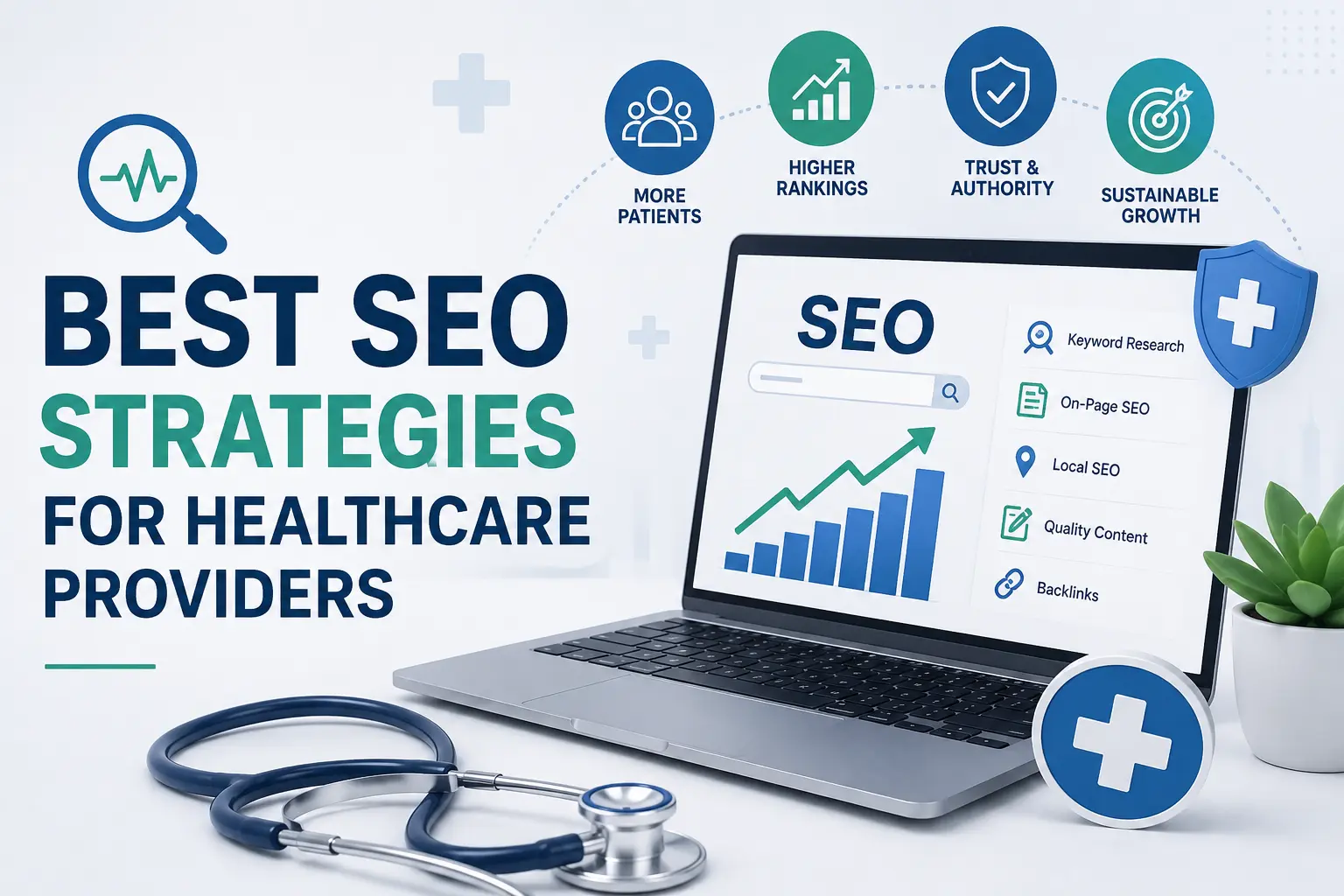
The best SEO strategies for healthcare providers in 2026 combine patient-focused, medically reviewed content, strong E-E-A-T and YMYL signals, local SEO for your practice, HIPAA-compliant forms and tracking, and fast, accessible websites. Together, these help clinics, hospitals, and specialists rank for high-intent patient searches and build the trust that turns visitors into booked appointments.
Patients no longer rely only on referrals from friends or family. They research providers in depth online — and increasingly ask AI tools which clinics or specialists to trust. Google has long said roughly 1 in 20 searches are health-related, and Pew Research found in 2026 that 22% of U.S. adults now get health information from AI chatbots. If your practice isn’t visible where patients search, a competitor is. As a healthcare SEO agency, we build medical SEO strategies tailored to each provider’s specialty, compliance needs, and local market.
Want to know where your medical website stands today? Get a free technical SEO audit before you invest in content or ads.
Key Takeaways
- Healthcare is YMYL content — Google holds it to the highest quality bar, so E-E-A-T and medical accuracy are non-negotiable.
- Add author bylines and “medically reviewed by” credentials to every clinical page; it’s the single biggest healthcare E-E-A-T signal.
- Local SEO (Google Business Profile, reviews, location pages) drives most patient bookings.
- HIPAA compliance extends to your website: secure forms, no PHI in analytics or tracking pixels, and compliant review handling.
- Structure content by the patient journey — symptom, condition, treatment, cost, and booking intent each need their own pages.
Build Your Healthcare SEO Around Patient Search Intent
The biggest shift in SEO is targeting intent, not just keywords. Patients search differently depending on where they are in their care journey, and each stage needs its own content and page type:
- Informational: “what causes chronic headaches,” “early symptoms of diabetes,” “how long does a root canal take,” “is knee replacement surgery painful.”
- Navigational: “children’s hospital near me,” “best dermatologist in Dallas,” “cardiology clinic nearby.”
- Transactional: “book dentist appointment,” “schedule MRI scan,” “knee replacement surgery cost,” “does [clinic] accept [insurance].”
Two intent types most healthcare sites neglect are cost and insurance queries (“[procedure] cost,” “accepts Medicaid/Aetna”) and telehealth queries (“online doctor consultation,” “virtual urgent care”) — both are high-intent and low-competition for most practices. Map your content to every stage, from a patient’s first symptom question to the moment they’re ready to book.
Create Medically Accurate, Patient-First Content
Search engines evaluate clinical content on quality and accuracy, not word count. Patients want plain-language answers, not jargon or sales copy. Every condition or treatment page should answer the questions a real patient asks:
- What is the condition, and what causes it?
- What are the symptoms, and how is it diagnosed?
- What treatment options exist, and what happens during recovery?
- When should someone see a doctor?
What separates a medical page from a generic blog is authorship and sourcing. Every clinical page should carry a named author with credentials (for example, “Written by Dr. Jane Smith, DDS”), a “medically reviewed by” line where appropriate, a review date, and citations to authoritative sources such as peer-reviewed journals, medical associations, or government health resources (.gov). This is exactly what Google’s quality raters look for on YMYL pages, and it’s the fastest way to earn trust from both patients and AI answer engines. A consistent stream of this content also increases visibility in AI Overviews through AI SEO services.
Strengthen Local SEO for Your Practice
For clinics and hospitals, local SEO is where the appointments are. Patients book with providers near them, and 71% use online reviews as the first step to finding a new doctor (Software Advice, 2020). Here’s how to win local visibility.
Optimize Your Google Business Profile
Keep your profile accurate and complete: practice name, phone, website, hours, services, high-quality photos of the facility and providers, and a direct appointment link. Add every service line and specialty, and post updates for new providers or offerings.
Encourage (Compliant) Patient Reviews
Reviews are the first thing patients see, and they influence both trust and rankings. Ask satisfied patients for feedback after successful appointments — but never disclose protected health information (PHI) in your responses, even to confirm someone was a patient. Reply with general, HIPAA-safe language and take specifics offline.
Create Dedicated Location Pages
If you run multiple clinics, build a unique page per location with localized content, on-site provider profiles, an embedded map, contact details, accepted insurance, and services offered there. Large medical groups can scale this with local SEO for multiple locations and programmatic SEO — without creating thin, duplicate pages.
Keep NAP Consistent
Your name, address, and phone number must match across your site, Google Business Profile, health directories (Healthgrades, Zocdoc, Vitals), and insurance provider listings. Inconsistent data weakens local rankings and confuses patients.
Build Topic Clusters Around Your Medical Specialties
Publishing scattered, unrelated posts signals nothing. Organizing content into interconnected topic clusters signals genuine clinical authority. For a cardiology practice, a cluster might look like this:
- Pillar page: A Complete Guide to Heart Health
- Supporting articles: causes of high blood pressure, understanding cholesterol, heart-attack warning signs, a healthy-heart diet, cardiac rehabilitation, stress and cardiovascular health, exercise for heart-disease prevention
Link every supporting article back to the pillar and to related resources. This internal-linking structure helps Google — and AI engines — understand the depth of your expertise in a specialty, which is exactly what E-E-A-T rewards in medicine.
Optimize for AI-Powered and LLM Search
Traditional results are now supplemented with AI summaries and conversational answers, and patients increasingly trust them for early research. To get your clinical content cited by AI engines like Google’s AI Overviews, ChatGPT, and Perplexity:
- Lead each section with a concise, direct answer to the patient’s question.
- Publish comprehensive pages covering symptoms, causes, diagnosis, treatment, recovery, prevention, and FAQs.
- Cite named medical sources and show author credentials — AI systems favor trustworthy, attributable health content.
- Use clear heading structure so machines can extract and quote your answers.
For the exact structure that earns citations, see our guide on how to structure content for LLM citation and our LLM SEO services.
Technical SEO and Core Web Vitals for Medical Websites
Patients often search in urgent or anxious moments, frequently on a phone — a slow site loses them to a competitor before your booking form even loads. Technical performance matters more in healthcare than most verticals, and medical sites carry specific challenges: heavy facility and provider imagery, appointment-scheduling widgets, and third-party portal embeds that slow pages down.
- Meet Core Web Vitals: aim for LCP under 2.5s, INP under 200ms, and CLS under 0.1 — especially on symptom pages and booking flows.
- Compress medical imagery (facility photos, provider headshots, procedure diagrams) and lazy-load below-the-fold images.
- Mobile-first: most health searches happen on smartphones, so appointment forms and click-to-call must be effortless on small screens.
- Stable layouts: prevent shifting buttons and forms so anxious patients don’t mis-tap a booking.
Run regular technical SEO audits to catch broken links, crawl errors, slow pages, and missing metadata before they cost you patients.
Accessibility Is a Healthcare Requirement, Not a Nice-to-Have
Many patients are elderly or have disabilities, and healthcare sites in the U.S. face ADA and Section 508 expectations. Accessible design also improves SEO. Include readable font sizes, strong color contrast, descriptive alt text for medical images, keyboard-friendly navigation, and screen-reader compatibility.
HIPAA-Compliant SEO: The Step Generic Guides Miss
This is where healthcare SEO diverges sharply from every other industry. Standard marketing tactics can create genuine compliance risk when patient data is involved:
- Secure every form. Appointment and contact forms collect PHI, so they must use HTTPS end-to-end and store data in HIPAA-compliant systems — not a generic form plugin that emails submissions in plain text.
- Watch your analytics and tracking pixels. U.S. regulators (HHS Office for Civil Rights) have warned that tracking technologies like the Meta Pixel and standard Google Analytics on patient-facing pages can expose PHI and breach HIPAA. Use a signed Business Associate Agreement (BAA) and configure tracking so it never captures health details, appointment types, or condition-specific URLs.
- Handle reviews and testimonials carefully. Never confirm someone is a patient or reference their condition publicly without explicit written consent.
Getting this right protects your patients and your practice — and it’s exactly the kind of specialized work a general SEO agency overlooks.
Use Healthcare Schema Markup
Schema markup is structured code that helps search engines and AI systems understand your content and can improve visibility across Google and AI-powered search. Healthcare organizations should use medical schema to describe physicians, services, locations, reviews, and articles. Implement:
- MedicalOrganization and Physician schema (unique to healthcare)
- LocalBusiness schema for each location
- FAQ, Review, Breadcrumb, and Article schema
Medical schema types like Physician and MedicalOrganization let you specify credentials, specialties, and accepted insurance — details that reinforce E-E-A-T and help you surface for specific patient queries.
Earn Authoritative Medical Backlinks
Backlinks remain a powerful ranking signal, and in healthcare the source matters as much as the count. A link from a hospital network or medical journal carries far more weight than a generic directory. Focus on earning links from:
- Medical associations and professional bodies
- Universities and academic medical centers
- Reputable healthcare publications
- Government health resources (.gov)
- Local organizations and community health partnerships
Never buy links or use private blog networks — on a YMYL site, low-quality links are a liability, not a shortcut.
Google’s Quality Standards for Healthcare: YMYL and E-E-A-T
Healthcare websites operate under Google’s strictest standards because medical content can affect a person’s health, safety, and finances. Two frameworks decide whether your pages deserve to rank.
YMYL (Your Money or Your Life)
Pages about diseases, treatments, medications, surgeries, mental health, and nutrition are classified as YMYL, so Google applies stricter quality checks. Every clinical page should be medically accurate and evidence-based, easy for patients to understand, transparent about its sources, written or reviewed by qualified professionals, and updated to current clinical guidelines.
E-E-A-T (Experience, Expertise, Authoritativeness, Trustworthiness)
E-E-A-T is how Google’s quality systems judge credibility — and it maps directly to how you present your providers:
- Experience: years in practice, patients treated, real treatment outcomes.
- Expertise: qualifications, board certifications, specialties, and the procedures you perform.
- Authoritativeness: your reputation in the field — published content, citations, and mentions from trusted medical outlets.
- Trustworthiness: HTTPS, transparent contact and credential information, honest testimonials, and clear medical-review bylines.
Why SEO Matters for Doctors and Healthcare Providers
For most businesses, SEO is a marketing channel. For a medical practice, it’s how you build patient trust and clinical authority before the first appointment. When a patient searches “best knee replacement surgeon near me,” the providers at the top capture the calls — the rest are effectively invisible. Strong healthcare SEO helps you:
- Increase qualified organic traffic and appointment requests
- Improve visibility for high-intent and local searches
- Strengthen online reputation and patient confidence
- Reduce dependence on paid advertising and improve marketing ROI
Wondering what it costs to get there? See our breakdown of healthcare SEO costs for clinics and startups.
Healthcare SEO Mistakes to Avoid
- Publishing clinical content without credentials. Medical pages with no named author, reviewer, or sources fail YMYL scrutiny. Add bylines and citations to every condition and treatment page.
- Leaking PHI in tracking or reviews. Standard analytics pixels on patient pages, or a review reply that confirms a diagnosis, can breach HIPAA. Configure compliant tracking and train staff on review responses.
- Thin, duplicated symptom or location pages. Cloning a template across conditions or cities confuses search engines and dilutes authority. Make each page genuinely specific.
- Outdated medical information. Old statistics or superseded treatment guidance erodes trust and rankings. Schedule regular clinical reviews and show the update date.
- Weak or missing CTAs. Every page should make booking, calling, or reaching your clinic obvious.
- Ignoring technical SEO. Broken links, slow pages, and crawl errors quietly cost appointments.
Healthcare SEO Checklist for 2026
Website & technical: secure HTTPS, fast-loading pages, mobile-friendly design, clean architecture, XML sitemap, correct robots.txt, optimized images, monitored Core Web Vitals.
Content & E-E-A-T: original, medically reviewed content; named author and reviewer credentials; medical citations; clear H1–H3 structure; relevant internal links; comprehensive service and condition pages; patient FAQs.
Trust & compliance: detailed physician profiles, professional certifications displayed, HIPAA-compliant forms and analytics, patient-privacy information, secure appointment booking, transparent contact and About pages.
Local SEO: optimized Google Business Profile, consistent NAP, a dedicated page per location, accurate hours, accepted insurance, positive patient reviews, and local citations across trusted health directories.
Performance tracking: monitor organic traffic, keyword rankings, appointment requests, and local visibility, and schedule content updates.
Frequently Asked Questions About Healthcare SEO
Is SEO for healthcare difficult to execute?
It’s not difficult so much as complex, because medical sites are YMYL and directly affect patient wellbeing. The added layers — medical accuracy, E-E-A-T bylines, and HIPAA compliance — are what make specialized healthcare SEO different from generic SEO.
What are the most important ranking factors for healthcare websites?
E-E-A-T signals (author and reviewer credentials), local SEO, mobile usability and site speed, medically accurate content, authoritative backlinks, and genuine patient reviews.
Do I need to worry about HIPAA in my SEO?
Yes. Any page that collects patient data or any tracking that captures health details can create HIPAA exposure. Use secure, compliant forms, a signed BAA for analytics, and PHI-safe review handling.
How does SEO help telehealth and virtual care?
Patients search for “online doctor,” “virtual urgent care,” and condition-specific telehealth. Dedicated, well-optimized telehealth pages capture this high-intent, fast-growing demand that many practices ignore.
How often should a healthcare website publish content?
Consistently, in focused chunks rather than occasional bulk drops. Regular, medically reviewed updates signal an active, authoritative site — and keep clinical information current.
Is local SEO necessary for hospitals and clinics?
Yes. Most patients search within a specific area, so local SEO drives visibility for queries like “family doctor near me” or “orthopedic clinic in [city]” — where the majority of bookings originate.
Conclusion
Healthcare SEO in 2026 is about trust as much as traffic. Providers that publish medically accurate, credentialed content, win local visibility, respect HIPAA, and deliver a fast, accessible experience will earn both Google’s rankings and patients’ confidence. Start with the fundamentals, prove your expertise on every page, and build from there.
Need a compliant, healthcare-specific SEO strategy? Talk to our medical SEO team, or see how we’ve grown other healthcare practices.
Ready to rank on Google and AI at the same time?
We help brands win across search and AI answers — technical SEO, content strategy and Generative Engine Optimization in one workflow. Tell us your goals and we’ll show you the plan.