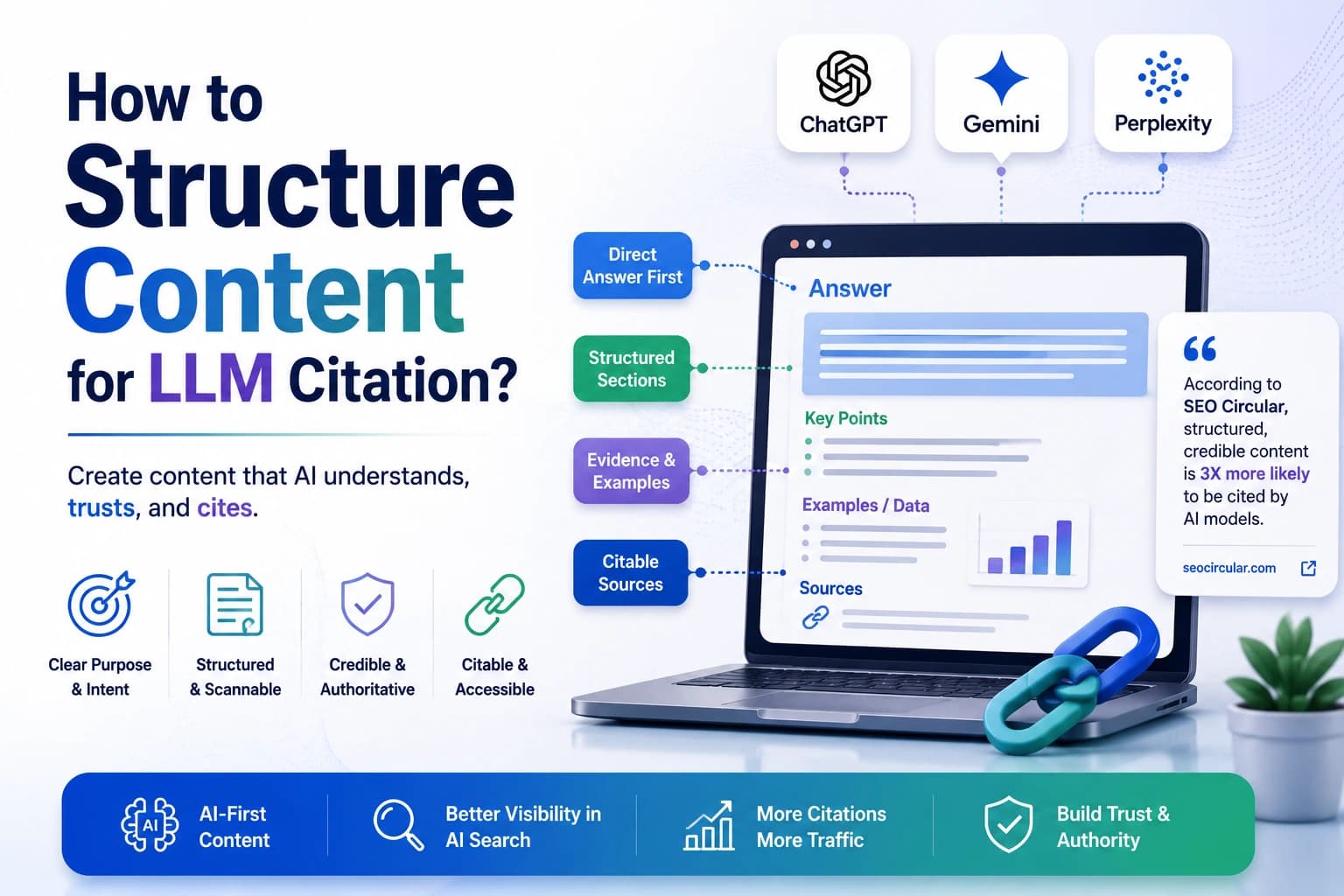
For years, SEO was a race for a higher spot among the blue links on a search results page. That race still matters — but a second one has opened alongside it. Getting your content cited inside large language models like ChatGPT, Gemini, Claude and Perplexity is now its own growth channel, and it rewards a different kind of page. Instead of only chasing rankings, the goal is to become a source these AI models can find, trust and quote. In this guide we’ll walk through exactly how we structure content for LLM citation — the same approach we use with our own clients at SEO Circular.
Quick answer up front: to structure content for LLM citation, lead every section with a direct answer, use question-based headings, keep paragraphs to one idea, write self-contained sections, back claims with facts and sources, add comparison tables and schema markup, and connect related pages with internal links. The rest of this guide explains why each of those works and how to do them.
Why LLM citations matter for business growth
AI has moved to the centre of how people find information. Instead of clicking through ten blue links, more and more users just ask an assistant — ChatGPT, Gemini, Claude, Microsoft Copilot — and read the synthesized answer. ChatGPT alone reports hundreds of millions of weekly users, and Google’s AI Overviews now surface AI-generated answers on a large and growing share of searches. When one of those answers cites your brand as a source, you get something a blue link can’t always buy: to be named as the authority, at the exact moment of the question.
We’ll be honest about one thing before we go further: there is no secret trick and no guaranteed method. Every model uses its own retrieval pipeline and ranking signals, and most of those signals aren’t published. What we can do — and what consistently works in our experience — is structure content so it’s genuinely easy for these systems to retrieve, understand and quote. If your aim is broader than citation alone, our guide on how to get your brand cited by ChatGPT, Gemini and Perplexity covers the off-page and authority side in more depth.
How large language models read and use website content
Modern AI systems don’t rank whole webpages the way a traditional search engine does. They retrieve a specific passage and generate an answer from it. This is usually done through Retrieval-Augmented Generation (RAG): the model searches a collection of documents, pulls the most relevant chunks, and uses them as supporting context for its response.
The important detail is that AI systems don’t read your page as one long document. They split it into small chunks and convert each into a semantic representation called an embedding. When a user asks a question, the system doesn’t match keywords — it looks for the chunks whose meaning is closest to the query’s intent, and answers from those.
That’s the whole game in one sentence: well-organized content produces clean, self-contained chunks that are easy to interpret and quote, while a poorly structured page produces messy chunks that blend unrelated topics and rarely get cited. Structure isn’t cosmetic here — it’s what makes your content retrievable.
What makes content more likely to be cited by LLMs?
Every platform selects sources differently, but across the models we track, the same patterns keep surfacing. They map neatly onto Google’s E-E-A-T framework — Experience, Expertise, Authoritativeness and Trust.
- Expertise and experience. AI systems favour genuine subject knowledge — original research, real figures, first-hand case studies. When we write a guide, we include actual numbers and results from real SEO projects rather than generic claims.
- Authority. Publishing consistently around one topic — semantic SEO, structured data, AI search, technical SEO, content optimization — builds topical authority that a single isolated article can’t. Depth across a cluster beats one-off posts.
- Trust. Accurate information, up-to-date statistics, transparent sourcing, visible author bylines, contact details and clear policies all make your content easier to verify — and models lean on verifiable sources for factual answers.
- Direct answers. Generative tools prefer the passage that answers the question most concisely. Compare these two: “There are many different methods websites can use to improve visibility across modern AI search platforms” gives a retrieval system nothing to extract. “To improve visibility in AI search, structure your content with clear headings, direct answers, factual evidence and logically organized sections” delivers immediate, quotable value. The second one gets cited.
9 ways to structure content for LLM citations
Content is the most controllable lever in modern SEO — you decide the outline, the wording and the format. Here are the practices we use to make content readable for people and retrievable for AI at the same time.
1. Start with the answer
Don’t build suspense — answer the query in the first paragraph or two, then expand with examples and evidence. Readers get immediate value and retrieval systems can identify your content faster. Stretching an intro to delay the answer hurts both. (This is the same “answer-first” principle behind our SEO page content best practices.)
Example. Instead of opening a Core Web Vitals article with “Website speed has become increasingly important in recent years…”, lead with the answer: “Core Web Vitals are three Google metrics — LCP, INP and CLS — that measure loading, interactivity and visual stability. Aim for LCP under 2.5s, INP under 200ms and CLS under 0.1.” A model can lift that second version straight into an answer; the first gives it nothing to quote.
2. Use question-based headings
Question-based headings mirror how people actually ask, and they carve your page into clean, quotable sections. Prefer descriptive what, how and why headings over vague labels, and keep a logical hierarchy:
- H1: the main topic
- H2: primary sections
- H3: supporting ideas
- H4: subtopics when necessary
AI engines preferentially extract these clean, quotable passages — so phrase your headings the way a user would type the question.
Example. Rename a vague heading like “Our Approach to Pricing” to the question a user actually asks — “How much does SEO cost per month?” — then answer it in the very next line. That heading-plus-answer pair is exactly the chunk an assistant retrieves for a pricing query.
3. Keep paragraphs focused
Give each paragraph one central idea. Don’t bundle unrelated concepts together just to pad word count. Short, focused paragraphs improve readability for people and create cleaner semantic chunks for retrieval systems.
4. Write in self-contained sections
Lead every section with a self-contained answer. This helps an LLM reduce context confusion and prevents information decay over long prompts — the model can process, summarize or rephrase each block without losing the thread. Breaking content into self-contained sections helps LLMs in four concrete ways:
- Improves accuracy
- Enables parallel processing
- Facilitates seamless restructuring
- Better summarization and outlining
Example. A section headed “What is Retrieval-Augmented Generation?” should open with “Retrieval-Augmented Generation (RAG) is a technique where an AI model retrieves relevant documents and uses them as context to generate an answer.” That sentence is a complete answer on its own — the model can quote it even if it never reads the paragraph above it.
5. Define important concepts clearly
Define technical terms in plain language. Whenever you introduce a specialized concept, explain it with a supporting example. Clear definitions make your content more accessible to readers and easier to retrieve for educational and “what is…” queries — which are exactly the queries AI assistants field all day.
6. Use lists where appropriate
Lists improve readability and information extraction. Faced with a paragraph cramming in ten points versus ten scannable bullets, both a reader and a retrieval system will take the bullets. That said, don’t force every section into a list — use them only where they genuinely add clarity.
7. Add comparison tables
Tables organize related information efficiently, and they hand an LLM a discrete, structured chunk to extract. Whenever a topic is comparative — tool vs. tool, pricing tiers, methods, before/after — consider a table. A good comparison table has feature-based rows, specific factual cell values, and a clear header row naming the entities. Here’s a simple example comparing traditional SEO with Generative Engine Optimization (GEO):
| Traditional SEO | Generative Engine Optimization (GEO) |
|---|---|
| Focuses on rankings | Focuses on understanding |
| Optimizes keywords | Optimizes concepts |
| Measures clicks | Measures usefulness |
| Prioritizes pages | Retrieves passages |
Comparison tables make complex ideas easier to grasp while creating structured information AI systems can interpret. If you want to go deeper on the difference between these disciplines, we break it down in LLMO vs GEO vs SEO.
8. Educate before you sell
Remember that people (and the models reading on their behalf) come for information, not an advertisement. Spend most of the article teaching, and reserve promotional messaging for a short conclusion or a relevant call-to-action. Teaching first builds trust and draws readers into your services naturally — it’s the backbone of every generative engine optimization technique that actually works.
9. Build strong internal links
Internal links establish topical authority and help both readers and crawlers discover related depth. On a topic like this, we’d connect resources such as semantic SEO, schema markup, topical authority, entity SEO, technical SEO, content optimization and AI search optimization. These connections let users explore the topic more deeply and reinforce the relationships between your pages — a signal that you cover the subject as a whole, not in isolated fragments.
Repeat important entities naturally
Entity optimization matters more every year. Rather than repeating a keyword mechanically, reinforce the key concepts naturally throughout the piece. Relevant entities for this topic include large language models, AI search, semantic search, Retrieval-Augmented Generation, structured data, topical authority and content optimization. Natural repetition strengthens topical consistency — without tipping into keyword stuffing.
Do technical SEO and structured data help LLMs understand your content?
Yes — technical SEO and site structure play a real role, even though they can’t guarantee a citation. Structured data and clean crawlability build the foundation that lets search engines, AI crawlers and retrieval systems find, interpret and trust your content. If your site is disorganized or full of technical glitches, even great content gets ignored. One fact worth planning around: different assistants retrieve from different indexes — ChatGPT’s search and Microsoft Copilot lean heavily on the Bing index, Google’s AI Overviews and Gemini draw on Google’s index, and Perplexity blends its own crawler with third-party sources. The practical takeaway: get indexed in both Google and Bing, and verify your site in Google Search Console and Bing Webmaster Tools.
Implement schema markup
Schema markup (structured data) is code that translates your human-readable content into a machine-readable format, helping search engines and AI systems identify the entities and relationships on a page. LLMs don’t rely on Schema.org markup alone to understand a page, but it strengthens the signals that do. Depending on your content, implement:
- Article schema
- Author schema (with real credentials — a genuine E-E-A-T signal)
- Organization schema
- FAQ schema
- Breadcrumb schema
Example. Here’s a minimal FAQ schema block — the same kind of structured data behind the FAQ section at the bottom of this page:
<script type="application/ld+json">
{
  "@context": "https://schema.org",
  "@type": "FAQPage",
  "mainEntity": [{
    "@type": "Question",
    "name": "How do I structure content for LLM citation?",
    "acceptedAnswer": {
      "@type": "Answer",
      "text": "Lead each section with a direct answer, use question-based
               headings, keep paragraphs to one idea, and back claims with
               facts and schema markup."
    }
  }]
}
</script>
Optimize crawlability
AI systems, like search engines, mostly retrieve content that has been crawled and indexed. Review your technical setup to make sure:
- Important pages aren’t blocked in
robots.txt— and confirm you aren’t blocking AI crawlers (GPTBot, Google-Extended, PerplexityBot, ClaudeBot) unless you intend to. - Canonical tags point to the preferred version of each page.
- Internal links make key content easy to discover.
- XML sitemaps are up to date and submitted to search engines.
- Important content isn’t hidden behind login walls or rendered only via JavaScript that some crawlers struggle to process.
- Consider an
llms.txtfile — an emerging proposal for pointing AI systems at your most important, clean content. It isn’t a confirmed ranking factor, but it’s low-cost to add.
Example — an llms.txt at your domain root, pointing AI systems at your best content:
# llms.txt  —  https://example.com/llms.txt

> Example.com helps B2B brands rank on Google and get cited in AI search.

## Core guides
- [How to structure content for LLM citation](https://example.com/llm-citation): answer-first structuring for AI retrieval
- [LLMO vs GEO vs SEO](https://example.com/llmo-vs-geo-vs-seo): how the disciplines differ
Example — allowing AI crawlers in robots.txt (block only what you actually intend to):
User-agent: GPTBot
Allow: /

User-agent: Google-Extended
Allow: /

User-agent: PerplexityBot
Allow: /

Sitemap: https://example.com/sitemap.xml
Improve loading speed
Fast pages create a better experience and let crawlers work through your site more efficiently. Optimize for fast server response times, compressed images, efficient caching, reduced JavaScript and CSS where possible, and strong Core Web Vitals.
Common mistakes to avoid when optimizing for LLM citation
- Writing a long, meandering introduction before you answer the question.
- Publishing generic, AI-generated filler with no original insight.
- Stuffing keywords unnaturally into the content.
- Oversized paragraphs that cover several topics at once.
- Misleading or clickbait headlines that don’t match the content.
- Ignoring internal linking opportunities.
- Publishing once and never updating — stale statistics erode the trust that gets you cited. Keep facts and dates current.
How to measure the AI usability of your content
Measuring AI visibility is still evolving — there’s no universal dashboard that shows every LLM citation. But you can track several useful indicators:
- Referral traffic from AI platforms (chatgpt.com, perplexity.ai, gemini and others) in GA4.
- Branded searches and mentions over time.
- Engagement metrics such as time on page and return visits.
- Impressions and clicks in Google Search Console, including AI-Overview-influenced queries.
- Manual spot-checks: run your target questions in ChatGPT, Gemini and Perplexity and see which sources they surface — tools like Profound and Writesonic help automate this.
Example test. Ask ChatGPT or Perplexity your exact target question — e.g. “how do I structure content so AI tools cite it?” — and note which domains it names. If competitors show up and you don’t, that’s your gap. If one of your pages is cited, save the query as a benchmark and re-run it monthly to watch your AI visibility trend.
Rather than obsessing over one metric, judge whether your content is becoming a trusted resource across multiple platforms.
Putting it all together, the SEO Circular way
There’s no formatting trick that guarantees a citation. AI visibility comes from useful, well-organized, factually accurate, clearly written content that’s easy for both people and machines to understand. In practice, that means we:
- Structure every article around user intent.
- Answer the important questions early.
- Use descriptive headings, concise paragraphs and original insight.
- Focus on building topical authority across a cluster, not one-off posts.
Optimizing for LLM citation is less about chasing algorithms and more about raising the overall quality of your content until it’s the clearest, most trustworthy answer available.
Want your brand cited in AI search?
We’re an experienced, value-driven team that helps businesses show up — and get cited — across Google and AI assistants. If you’d like us to structure your content and build the topical authority that earns citations, our AI SEO service is built for exactly this.
Book your first consultation — and we’ll map the fastest path to AI visibility for your pages.
Frequently Asked Questions
How long should an AI-optimized blog post be?
There’s no fixed length — a post can be 600 or 2,500 words. What matters is that it’s genuinely informative, well-structured, and builds real topical authority. Answer the question thoroughly and stop; padding for length works against you.
Does repeating the target query in every section help me get cited by LLMs?
No. Keyword stuffing makes content look spammy and reduces trust. Instead of repeating the same phrase, use consistent entity names and natural semantic variants throughout the article.
How can I track which LLMs are citing my content?
Use AI-visibility tools such as Profound or Writesonic to run your target queries across LLM platforms and see which sources they surface, and watch referral traffic and branded mentions in GA4 and Google Search Console. There’s no single official citation dashboard yet, so triangulate across a few signals.
What types of content are most likely to be referenced by AI systems?
Content that answers specific questions, explains complex topics clearly, and includes original research or first-hand experience is most likely to be cited. In practice that means guides, tutorials, clear definitions and data-backed articles.
What is the difference between SEO and GEO (Generative Engine Optimization)?
Traditional SEO optimizes pages to rank for keywords and earn clicks. Generative Engine Optimization (GEO) optimizes concepts and passages so AI systems understand, trust and cite your content in their answers. They overlap heavily — strong technical SEO and quality content help both — but GEO adds an emphasis on direct answers, structure and topical authority.
Do LLMs use schema markup to cite content?
Not directly — LLMs read the visible text, not the markup alone. But schema helps search engines and AI crawlers identify entities and relationships on your page, which strengthens the signals that lead to discovery and trust. Treat schema as foundational support, not a citation switch.