Content Marketing vs. Inbound Marketing: Which Drives More Revenue?
Hybrid content marketing is the megaphone; an inbound marketing agency is the net. See which drives more revenue in 2026 - with a worked B2B example, real data, and a 90-day plan.
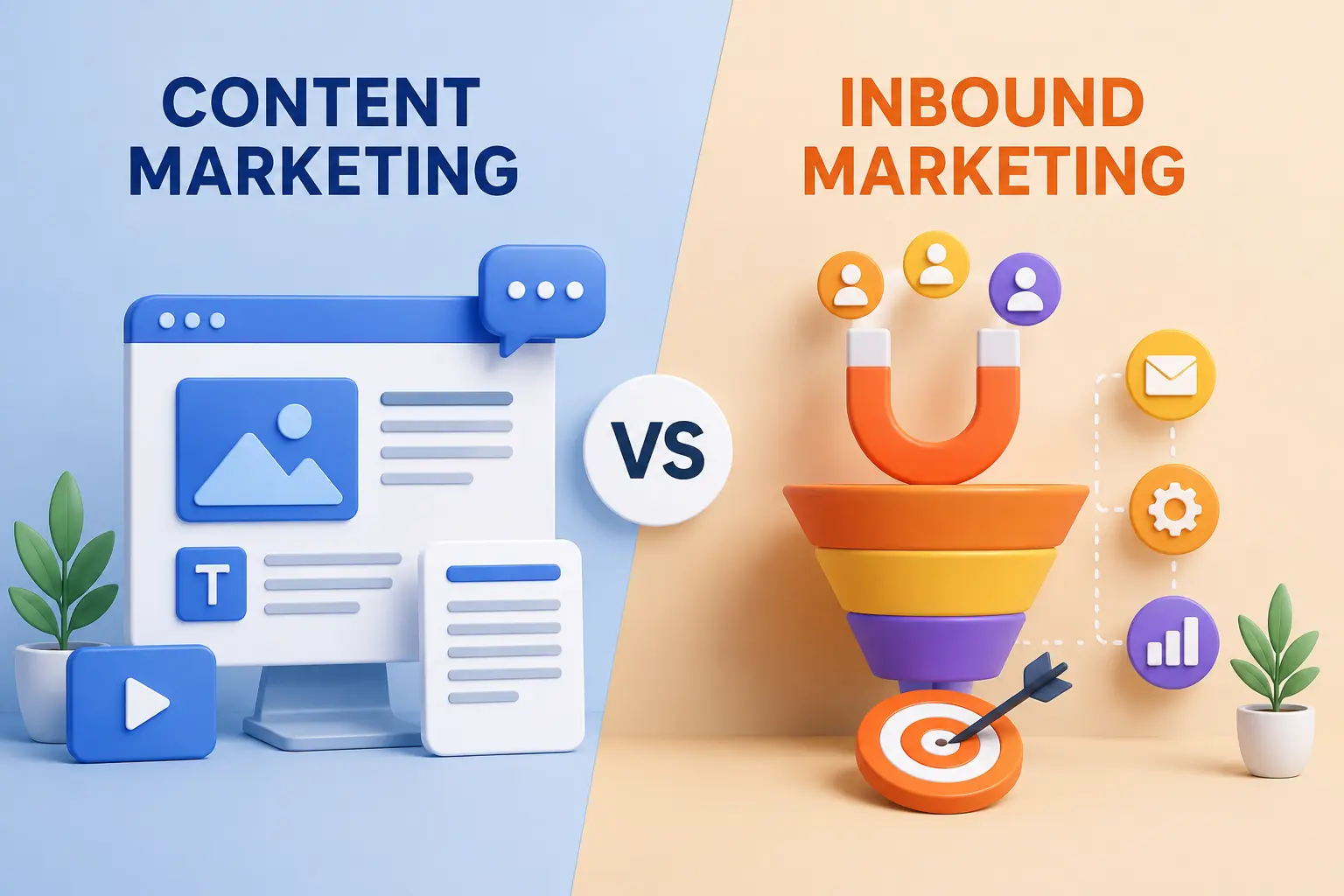
Direct answer: Content marketing and inbound marketing overlap, but they are not the same. Modern content marketing — often run as a hybrid model that blends owned, earned, and paid distribution — is built for faster reach across organic, paid, and earned channels. An inbound marketing agency is built for a structured system of attraction, lead nurturing, automation, and retention. For most competitive B2B brands, the strongest answer combines both.
Here is the easiest way to picture the difference: hybrid content marketing is the megaphone, and an inbound marketing agency is the net. The megaphone creates attention across search, social, PR, and paid media. The net catches that attention and turns it into named leads, nurtured relationships, and customers. Use only the megaphone and you get reach that never converts. Use only the net and you catch demand that already exists — but you never grow the pond.
Not sure which model fixes your growth bottleneck? Get a free audit and we’ll show you whether the gap is reach, conversion, or both.
Key Takeaways
- Content powers both models — the real difference is distribution, funnel ownership, and speed.
- Hybrid creates demand (megaphone); inbound captures and nurtures it (net). Most competitive B2B brands need both.
- B2B buyers spend just 17% of the buying journey with suppliers and 27% researching independently online (Gartner) — your content sells whether or not you’re in the room.
- Choose hybrid for low-awareness or new categories; choose inbound when search demand exists but visitors don’t convert.
- Measure to qualified pipeline and assisted revenue, not article counts or last-click.
Content Marketing vs. Inbound Marketing: The Simple Answer
Many businesses compare these terms as if they describe two completely separate services. They do not. Content powers both approaches — the real difference lies in distribution, funnel ownership, and speed. A hybrid model actively combines content with SEO, AI-search visibility, paid amplification, digital PR, social distribution, and conversion work. Inbound marketing builds a connected system that attracts prospects, captures leads, nurtures them, and supports customers after the sale.
What Is Hybrid Content Marketing?
Hybrid content marketing is a blended growth model that uses owned content, earned exposure, and paid distribution together. The term has no single industry definition, so we use it here to mean a coordinated content system that creates demand and captures existing demand at the same time.
- Owned engine: service pages, topic clusters, case studies, research, videos, and email assets.
- Earned authority: digital PR, backlinks, expert contributions, reviews, and credible brand mentions.
- Paid acceleration: sponsored distribution, retargeting, search ads, and content syndication where the economics work.
What Does an Inbound Marketing Agency Do?
An inbound marketing agency aligns content, channels, CRM data, and automation with the buyer journey. HubSpot describes the modern inbound system as attract, engage, and delight. In practice, an agency uses SEO, helpful content, landing pages, forms, lead scoring, email workflows, sales alignment, and customer advocacy to create a repeatable growth loop. If your core need is turning traffic into pipeline, that is essentially a lead-generation problem.
| Decision factor | Hybrid content marketing | Inbound marketing agency |
|---|---|---|
| Main goal | Build reach, authority, and demand across channels | Attract, convert, nurture, and retain leads |
| Distribution | Owned + earned + paid | Mainly owned and organic; paid can support |
| Speed | Earlier visibility through amplification | Compounds as SEO and automation mature |
| Core system | Editorial + SEO + PR + media + CRO | Content + CRM + automation + lifecycle |
| Best fit | Competitive or low-awareness markets | Long journeys with known search demand |
A Real-World Example: How Both Models Work Together
Theory is easy, so let’s make it concrete. Meet “Northwind,” a hypothetical but realistic B2B company selling workflow software in a new category buyers don’t yet search for by name. Search volume looks tiny, so pure inbound would starve. Here is how the megaphone and the net combine over one 90-day cycle. (Figures are illustrative — plug in your own.)
| Stage | Who leads | What happens | Result |
|---|---|---|---|
| Awareness | Hybrid (megaphone) | Publishes an original “State of [category]” study; earns 12 digital-PR pickups and a podcast slot; boosts the best insight with $3,000 of LinkedIn ads | ~40,000 qualified impressions, ~6,000 visits search alone could never produce |
| Consideration | Inbound (net) | Visitors hit a topic cluster, a comparison page, and a gated benchmark guide; lead scoring + a 5-email nurture keeps them warm | 4% convert to known leads → ~240 leads |
| Decision | Inbound (net) | Nurtured leads are routed to sales with their full topic history | 15% book a demo (~36); sales closes ~20% → ~7 new customers |
| Advocacy | Hybrid (megaphone) | 2 happy customers become case studies, feeding PR and social proof | Fuels the next awareness cycle at lower cost |
The punchline: neither model alone produces those seven customers. The megaphone created demand that did not exist in search; the net converted it. Kill the megaphone and Northwind waits years for search volume to appear. Kill the net and 6,000 visits leave without a trace. This is also why measuring channels in isolation misleads — the win belongs to the system, not a single last click.
Seven Important Differences Between the Two Models
1. Demand Creation vs. Demand Capture
Inbound works best when buyers already search for a problem or solution. Hybrid content also creates demand through thought leadership, partnerships, paid social, and digital PR before SEO captures the later searches. This matters more than most teams realize: Gartner found that B2B buyers spend only 17% of the entire buying journey meeting with potential suppliers, and about 27% researching independently online. Your content is doing the selling whether or not you are in the room.
2. Organic Patience vs. Controlled Distribution
Inbound often waits for rankings, subscribers, and referrals to compound. Hybrid keeps those assets but buys or earns distribution for priority content, reducing dependence on one algorithm. Only content tied to a clear audience and offer should receive amplification.
3. Content Production vs. Content Orchestration
A strong hybrid agency turns one expert idea into a search page, executive post, video, email, sales asset, and PR pitch. A strong inbound agency connects those assets to landing pages, CRM stages, nurture sequences, and customer follow-up.
4. Funnel Ownership
Inbound agencies usually own calls to action, forms, lead scoring, automation, and sales handoffs. Hybrid agencies usually own audience, authority, and distribution. Ask who owns the gap between a page view and a qualified opportunity — that gap is where most budgets leak.
5. SEO and Visibility in AI Answers
Both models need technical SEO, crawlable pages, clear entities, original expertise, and trustworthy sources. This is now urgent: Google’s AI Overviews appear on roughly 18% of searches, and Pew Research found users click a traditional result just 8% of the time when an AI summary is shown, versus 15% without one. Being cited inside the answer increasingly matters more than ranking beneath it — which is why we treat LLM and AI-search visibility as core work, not an afterthought. Google still recommends unique, people-first content, not mass-produced AI text.
6. Measurement
Inbound reporting follows visitor-to-lead, lead-to-opportunity, and lifecycle metrics. Hybrid adds share of search, qualified reach, earned mentions, and blended acquisition cost. The measurement gap is real: CMI’s 2026 B2B research found that 40% of B2B marketers struggle to create content that prompts action, while 33% struggle to measure effectiveness. For a structured approach, see our guide to SEO ROI measurement methods.
7. Technology Dependence
Inbound depends more heavily on CRM and automation; hybrid uses a broader SEO, PR, social, ad, and analytics stack. HubSpot’s 2026 State of Marketing data shows 92% of marketers use automation for data analysis and reporting, and 40% say customer journeys are mostly or fully automated. Tools still cannot repair weak positioning.
Which Agency Should Your Business Choose?
There is no universal winner. The right choice depends on demand, sales cycle, resources, and the cost of waiting. In our experience, businesses go wrong when they buy deliverables instead of fixing the main growth bottleneck.
Choose a Hybrid Content Marketing Agency When…
- Your category is new, crowded, or hard to explain, so search demand alone cannot support growth.
- You need one content idea to work across search, LinkedIn, email, PR, video, and paid media.
- You want faster market feedback without abandoning long-term organic assets.
- You need brand authority and third-party mentions as well as leads.
Choose an Inbound Marketing Agency When…
- Your buyers actively research the problem and compare solutions online.
- You have a long sales cycle and need capture, scoring, nurturing, and sales alignment.
- Your website already receives traffic, but visitors don’t convert or progress through the funnel. (If your leads dropped after a redesign, our guide on why leads stop after a website redesign covers the usual causes.)
- You have clean CRM data and the team capacity to follow up on marketing-qualified leads.
| Your situation | Better starting model | Reason |
|---|---|---|
| Low brand awareness | Hybrid | Paid and earned distribution can create reach |
| Strong search demand, weak conversion | Inbound | Fix capture, nurture, and lifecycle gaps |
| New product or category | Hybrid | Create demand before search volume exists |
| Complex B2B buying committee | Integrated | Educate widely, then nurture by role and stage |
| Limited budget, patient timeline | Inbound-first | Build owned assets and automate carefully |
| Aggressive growth target | Integrated | Combine organic compounding with controlled reach |
Our recommendation: for most B2B and service businesses, build an inbound foundation, then amplify the best content through PR, social, partnerships, retargeting, and selective paid media.
How the Two Models Work Together Across the Buyer Journey
The best comparison is not only about channels — it is about what the buyer needs at each stage. When both systems share one strategy, content can move a buyer from the first question to a confident purchase without an aggressive sales process.
Awareness: Create Demand Before the Buyer Searches
At this stage, many buyers don’t know the correct name for their problem, so search volume understates the real opportunity. Hybrid publishes expert opinions, original research, short videos, podcast contributions, social posts, and digital PR that introduce the issue, with selective paid promotion placing the strongest idea in front of a defined audience. Inbound then supports discovery through educational pages, topic clusters, and newsletter subscriptions. The goal is recognition and trust, not an immediate demo.
Consideration: Answer Questions and Prove Expertise
Prospects now compare approaches, suppliers, risks, costs, and effort. Build comparison pages, use-case guides, industry pages, case studies, checklists, webinars, and expert-led articles — each answering one real sales question and linking to the logical next step. Hybrid distributes these through search, email, social, partners, and retargeting; inbound connects them to landing pages, forms, lead scoring, and nurture paths.
Decision: Convert Trust Into Qualified Pipeline
Broad thought leadership is not enough here. Buyers need proof the offer fits their company: detailed service pages, pricing guidance where possible, implementation plans, security or compliance information, ROI examples, and customer evidence. Use one focused call to action — book a consultation, request an audit, or discuss a specific use case — and route the enquiry to the correct sales owner with the contact’s full topic history.
Retention and Advocacy: Let Customer Success Feed Acquisition
Inbound doesn’t stop when a contract is signed. Onboarding content, product education, and support resources improve adoption; hybrid distribution turns successful outcomes into case studies, review campaigns, and expert commentary. This creates a loop: customer results produce stronger content, stronger content earns trust, and that trust attracts better-fit prospects. Always get permission and remove confidential details before publishing a customer story.
A 90-Day Hybrid Inbound Content Plan
A practical plan connects strategy, production, distribution, and revenue — and avoids random publishing.
Days 1–30: Build the Evidence and Measurement Base
- Define ideal customers, buying triggers, objections, keywords, and topic gaps.
- Audit technical SEO, analytics, CRM stages, conversions, and content quality.
- Interview internal experts to capture original experience and proof.
- Select one outcome, such as qualified demo requests or sales opportunities.
Days 31–60: Publish a Connected Content System
- Create a pillar page and supporting pages for major buyer questions.
- Add comparisons, case studies, expert bylines, sources, and clear next actions.
- Repurpose pillars into videos, executive posts, emails, and sales assets.
- Launch landing pages and nurture workflows based on real intent.
Days 61–90: Distribute, Learn, and Scale
- Pitch original insights to relevant publications and partners.
- Amplify and retarget content that already shows engagement.
- Review queries, AI referrals, conversions, lead quality, and sales feedback.
- Refresh weak pages, strengthen winners, and stop formats that don’t influence revenue.
How to Write for Google and LLM Visibility
Make expert information easy for people and machines to understand, verify, and cite:
- Answer the main question directly near the top, then explain the limits and trade-offs.
- Use clear headings, consistent entity names, short definitions, and descriptive internal links.
- Add first-hand experience, original data, named experts, dates, and primary sources.
- Keep pages crawlable, fast, mobile-friendly, and logically linked.
Don’t chase unsupported hacks — Google says no special AI schema or llms.txt file is required for its generative search features. For the practical structure that earns citations, see our guide on how to structure content for LLM citation. And the strategic case for content is only getting stronger: HubSpot names website/blog/SEO as marketers’ top ROI channel, while CMI reports that 61% of B2B marketers saw their content results improve — 74% of them crediting a refined strategy over new tools.
Budget, Team Structure, and Agency Workflow
A good strategy can still fail when responsibilities are unclear. Before appointing either type of agency, decide what it will own, what your internal team must provide, and how quickly approvals will happen. A slow review process weakens both inbound services and hybrid distribution.
How to Allocate the Budget
Don’t divide the budget equally across every channel — start with the main constraint. If the website has strong traffic but weak conversion, invest first in landing pages, analytics, CRM connections, nurture, and conversion rate optimization. If the offer converts but the market rarely discovers it, invest more in SEO, expert content, digital PR, partnerships, and targeted distribution. Reserve a capped testing budget for new formats, and review spend against qualified opportunities and revenue influence — not impressions or article count. To sanity-check a realistic budget, try our SEO cost calculator.
Define Agency and Client Ownership
The agency should normally own research, the editorial roadmap, keyword and competitor analysis, briefs, production management, optimization, distribution, and reporting. The client provides product truth, customer access, subject-matter experts, commercial priorities, brand approval, and sales feedback. Sales must explain which leads become real opportunities and why others fail — without that feedback, an agency optimizes for easy form fills instead of profitable customers. Name one decision-maker on each side so approvals don’t become a committee exercise.
Use a Practical Monthly Rhythm
At the start of each month, review search demand, pipeline gaps, and customer questions, then approve a small group of connected assets. Each week, check publishing, distribution, and early engagement. At month-end, compare qualified traffic, lead quality, sales progress, and content-assisted revenue. Improve promising assets and stop work that doesn’t move the business.
Common Mistakes That Reduce Results
- Publishing without a distribution plan. Give every priority asset a checklist covering internal links, email, social, sales enablement, relevant communities, partner outreach, and selective promotion. Distribution should match the audience — never become spam.
- Automating a weak message. Workflows can send content at the right time, but they can’t make a vague offer persuasive. Clarify the problem, evidence, differentiation, and next action first, then automate.
- Measuring channels in isolation. A buyer may discover you through an executive post, return through search, read a case study, and convert through email. Last-click credits only the final visit. Use campaign tags, CRM source history, and assisted conversions instead.
- Using generic AI content at scale. AI can organize research and draft, but it can’t replace expert judgment, original examples, or factual review. Add named expertise, real process detail, current evidence, and a clear point of view to every important page.
How to Measure the Right Agency
Ask the agency to connect activity to outcomes. Hybrid should prove that distribution increases qualified demand; inbound should prove the funnel converts and nurtures it. Use one dashboard for SEO, content, email, and paid media.
| Stage | Core metrics | Business question |
|---|---|---|
| Visibility | Qualified impressions, rankings, citations, share of search | Are the right buyers discovering us? |
| Engagement | Engaged sessions, saves, replies, return visits | Does the content earn attention and trust? |
| Conversion | CTA rate, qualified leads, demo or enquiry rate | Does interest become identifiable demand? |
| Pipeline | MQL-to-SQL rate, opportunities, assisted revenue | Does marketing help sales create revenue? |
| Efficiency | Blended CAC, cost per opportunity, content reuse | Are results becoming more efficient? |
Why Businesses Choose SEO Circular
SEO Circular works as a growth partner, not a content factory. Our experience spans 500+ clients, 50+ specialists, and 30+ industries, and we combine SEO, content, digital PR, PPC, analytics, CRO, email, and automation into one measurable plan. See the results in our case studies.
Want one roadmap that covers rankings, authority, qualified leads, and revenue? Start with a free website audit or talk to our team.
Frequently Asked Questions
Is content marketing the same as inbound marketing?
No. Content is the material you create and distribute. Inbound also uses SEO, conversion, CRM, automation, sales alignment, and customer experience to turn that content into a repeatable growth system.
Is hybrid content marketing better than inbound marketing?
It’s better for active distribution and demand creation; inbound is better for capture, nurturing, and retention. Many businesses need both — hybrid to create attention, inbound to convert it.
How long does it take to see results?
Distribution can create signals within weeks. SEO, authority, and lifecycle results usually build over months. Competition, domain strength, offer quality, and follow-up all change the timeline.
Can one agency provide both services?
Yes. Ask for one strategy, one measurement framework, clear channel owners, and proof that content moves from discovery to pipeline — not just a monthly article count.
Which model should a business with traffic but no leads choose?
Inbound-first. If people already arrive but don’t convert, the bottleneck is capture and nurture — landing pages, forms, lead scoring, and workflows — not more reach. Fix the net before buying a bigger megaphone.
References
- Content Marketing Institute — B2B Content and Marketing Trends: Insights for 2026.
- HubSpot — What Is Inbound Marketing?
- HubSpot — State of Marketing 2026 (statistics, trends & data).
- Gartner — The B2B Buying Journey.
- Pew Research Center — Google users are less likely to click when an AI summary appears (July 2025).
- Google Search Central — Optimizing for Generative AI Features; Creating Helpful, People-First Content.
Final verdict: solve today’s biggest bottleneck first. For durable growth, combine inbound conversion and lifecycle systems with hybrid content distribution — one roadmap built around rankings, authority, qualified leads, and revenue.
Ready to rank on Google and AI at the same time?
We help brands win across search and AI answers — technical SEO, content strategy and Generative Engine Optimization in one workflow. Tell us your goals and we’ll show you the plan.