Search is no longer just blue links on a results page. ChatGPT answers questions. Perplexity summarizes topics. Google surfaces AI Overviews before a single organic result loads. In this environment, knowing where your brand appears and where it hasn’t become one of the most important signals your SEO team can track is essential.
An AI search monitoring platform gives you visibility. It watches how AI-powered search tools reference your content, track shifts in search intent and surfaces the content gaps your competitors are quietly filling. The result is an SEO strategy that reacts faster and compounds harder over time.
If you want your brand to show up every time a buyer asks an AI tool a question in your niche, SEO Circular’s SEO service is built for exactly that. We help enterprise brands rank across classic SERPs and get cited by ChatGPT, Perplexity and Google AI, all under one strategy.
Want to know whether ChatGPT, Perplexity, and Google AI Overviews are citing your brand?
SEO Circular provides AI SEO audits, AI visibility tracking, and enterprise SEO strategies that help brands earn citations across modern AI search platforms.
Get Free AI Visibility AuditKey Takeaways
- AI search monitoring platforms track how your content is cited across ChatGPT, Perplexity, Google AI Overviews and other AI-powered search surfaces, giving you visibility that traditional rank tracking cannot provide.
- The biggest SEO blind spot today is not your keyword rankings but whether AI tools are answering buyer questions using your content or a competitor’s.
- Content Gaps identified through AI monitoring can be acted on weeks earlier than those found through traditional keyword volume trends.
- Connecting AI citation data to pipeline metrics is the clearest way to demonstrate the business value of SEO to CFOs and senior leadership.
- Turning monitoring insights into action requires a clear sprint trigger system, not just a dashboard. The teams that win are the ones that move on signals quickly.
What Is An AI Search Monitoring Platform?
An AI search monitoring platform is a tool that tracks how your brand, your content and your competitors appear inside AI generated responses across search engines and large language model tools. Think of it as a listening layer sitting on top of traditional rank tracking.
Where a standard rank tracker tells your position on SERP of Google, an AI search monitoring platform tells you whether ChatGPT mentions your brand when someone asks a relevant question, whether Google’s AI Overview pulls from your content, and whether Perplexity cites a competitor instead of you.
This kind of monitoring turns invisible data into a strategy. Without it, you are optimizing a version of search that represents a shrinking share of how buyers find information.
Why Traditional SEO Monitoring Falls Short Today?
For years, tracking keyword rankings and organic traffic was enough. But the way people search has changed significantly. A growing share of search queries now returns AI-generated answers that do not require the user to click through to any website at all.
Traditional monitoring tools were not built for this. They do not track:
- Whether your content is mentioned inside AI-generated answers.
- How AI tools interpret your brand’s authority compared to competitors.
- Which questions in your niche are being answered entirely by AI, removing organic click opportunities.
This creates a blind spot. You can rank number one for a keyword and still lose the buyer to a competitor whose content was cited in the AI answer above your result. AI search monitoring closes that gap.
Key Ways An AI Search Monitoring Platform Improves SEO Strategy
Here are some of the important ways through which an AI search monitoring platform improves SEO strategy:
Tracks How AI Tools Like ChatGPT And Perplexity Cite Your Brand
One of the most direct benefits of AI search monitoring is knowing when and how your brand appears in AI-generated responses. If a prospect asks ChatGPT to recommend the best enterprise SEO agency, your monitoring platform tells you whether your brand is named, what context it surrounds, and how often it surfaces across different types of queries.
This data shapes your content strategy in a concrete way. When you know which topics generate citations and which do not, you can:
- Invest more deeply into the content formats that AI tools pull from most frequently.
- Identify the specific claims and data points that earn citations.
- Spot the competitor content being cited so you can produce a stronger, more authoritative version.
Surfaces Content Gaps Before Your Competitors Fill Them
AI search monitoring platforms do not just track what exists. They also reveal what is missing. They also reveal what is missing. When an AI tool generates an answer in your niche using third-party sources because no strong first-party content exists, that is a gap your platform will flag.
Finding these gaps early is a significant competitive advantage. Most brands only discover a content gap after a competitor has already claimed the topic. AI monitoring surfaces the opportunity before the race starts.
Monitors Search Intent Shifts Real Time
Search intent is not static. What users mean when they type a query changes as industries evolve, new products launch, and public conversation shifts. Traditional tools track the slowly through keyword volume changes. AI monitoring platforms detect it much faster because they watch how AI-generated answers evolve in real time.
When an AI tool starts answering a query differently, that is an early signal that intent has shifted. Your SEO team can act on that signal weeks before it shows up in traditional keyword data.
Connects Keyword Performance To Actual Pipeline
The most persistent gap in SEO reporting is the one between rankings and revenue. AI search monitoring platforms help bridge that gap by showing you which queries and citations are driving research-stage buyer behavior, not just clicks.
When you can trace a buyer’s first AI assisted search query to a later branded search and then to a form fill, your SEO strategy stops being a cost center and starts being a pipeline driver. This is the kind of attribution that CFOs and CMOs need to justify and scale SEO investment.
What To Look For In An AI Monitoring Platform?
Not every tool in this category offers the same depth. When evaluating an AI search monitoring platform for enterprise use, look for these capabilities:
1) Coverage Across AI Tools
The platform should monitor Google AI Overviews. ChatGPT, Perplexity, Bing Copilot and any emerging AI search surfaces relevant to your audience.
2) Competitor Citation Tracking
You need to see who else is being cites not just whether you are.
3) Intent And Topic Alerts
Real time notifications when intent around a tracked query shift.
4) Integration With Your Existing Stack
Data should feed into whatever reporting or analytics systems your team already uses.
5) History Comparison
Seeing how AI citation patterns change over time is as important as knowing today’s snapshot.
How Do AI Search Monitoring Platforms Track ChatGPT Citations?
AI search monitoring platforms continuously test thousands of prompts related to your industry and analyze how ChatGPT and other AI SEO tools respond. They identify whether your brand, website, products, or content are mentioned in AI-generated answers and compare your visibility against competitors.
| Tracking Area | What the Platform Monitors |
|---|---|
| Brand Mentions | Whether ChatGPT references your brand in responses |
| Content Citations | Which pages or articles are used as sources |
| Competitor Visibility | Brands appearing instead of yours |
| Topic Coverage | Queries where your content is cited |
| Citation Trends | Changes in visibility over time |
| Sentiment & Context | How your brand is described in AI answers |
Can AI Search Monitoring Improve AI Overview Visibility?
Yes. While monitoring tools do not directly influence rankings, they provide valuable insights that help improve your visibility in Google AI Overviews and other AI-powered search experiences.
| Insight Provided | SEO Action |
|---|---|
| Missing Topic Coverage | Create content around unanswered questions |
| Competitor Citations | Build more authoritative content assets |
| Query Intent Shifts | Update pages to match evolving search behavior |
| Citation Opportunities | Add expert insights, statistics, and original research |
| Content Performance Trends | Prioritize pages with the highest AI visibility potential |
| Structured Answer Formats | Improve content formatting for AI consumption |
How To Turn Monitoring Data Into SEO Action?
Collecting monitoring data without acting on it is a common trap. Here is how high performing SEO teams convert platform insights into measurable strategy improvements:
1) Rebuild Thing Pages That Are Losing AI Citations To Competitors
If a rival is being cites instead of you, the monitoring data tells you exactly which page to improve and which claims to substantiate with original data.
2) Create Content Specifically Designed For AI Answer Formats
Long form pages are not always what AI tools cite. Concise, well structured answers to specific questions often perform better. Use your monitoring data to identify which format works for your niche.
3) Set Up Topic Cluster Sprints Triggered By Intent Shifts
When your platform detects a shift in how an AI tool is answering a category of queries, that is a sprint trigger not a quarterly review item.
4) Share Citation Data In Executive Reporting
Showing leadership how often the brand is cited in AI answers alongside traditional ranking data builds the case for sustained SEO investment more effectively then traffic numbers alone.
Conclusion
AI search monitoring is not a replacement for traditional SEO. It is a layer on top of it that keeps your strategy aligned with how search actually works today. Brands that know where they appear in AI-generated answers, where they do not and what it would take to change that have structural advantage over brands still optimizing only for the blue links.
If your enterprise brand needs both the monitoring and the strategy to act on it, SEO Circular works with you across both layers. We help 500+ enterprise clients stay visible across classic search and AI powered discovery, tied to real pipeline outcomes. Reach out for a free AI SEO visibility snapshot and see exactly where your brand stands.
Stay Visible in AI Search
Every day, potential customers ask ChatGPT, Perplexity, and Google AI Overviews for recommendations. If your brand is not being cited, your competitors are gaining that visibility. SEO Circular helps businesses track AI search presence, uncover missed opportunities, and improve AI-driven discoverability.
Request a Free AI SEO Visibility Audit and see how your brand performs across modern AI search platforms.FAQs
1) Does AI search monitoring replace traditional keyword rank tracking?
No, it works alongside it. Rank tracking covers classic SERPs while AI monitoring covers how your content surfaces in AI generated answers.
2) How often do AI search monitoring platforms refresh their data?
Most enterprise grade platforms update daily, with some offering near real-time alerts for significant changes.
3) Can small businesses benefit from AI search monitoring or is it only for enterprises?
Any brand that relies on organic search can benefit, though the ROI is highest for businesses with larger content libraries and competitive niches.
4) Does being cited by AI tools directly improve your google rankings?
Not directly, but the same content quality signals that earn AI citations tend to correlate with stronger E-E-A-T signals that support organic rankings.
5) How is AI search monitoring different from brand mention monitoring?
Brand mention monitoring tracks where your name appears on the web. AI search monitoring specifically tracks where your name appears on the web. AI search monitoring specifically tracks how AI-powered search tools answer queries relevant to your business and whether your content is the source.
Around 77% Of patients search online before booking a doctor, making Google Ads one of the fastest ways for medical practices to reach high-intent patients.
Every day, thousands of patients open Google and type things like “orthopedic surgeon near me” or “best dermatologist for acne”. They are not browsing. They are ready to book. The question is whether they find your clinic or your competitor’s.
Most medical practices rely on word of mouth or a basic website and hope that is enough. In 2026, it is not. Patients research online before they call, compare clinics before they choose, and trust search results. If your practice is not visible on Google, then you will lose leads, clients both in paid ads and in organic search results.
A Google Ads for doctors SEO outline comes with the combination of SEO and paid ads including many strategies like smart location targeting, keyword research optimization for local queries and much more.
If you want a team that understands exactly how to grow a medical practice through search, then SEO Circular’s SEO for healthcare and clinics program is built for this. From patient-intent keyword strategy to technical SEO for clinic websites, the team stays until the end. Schedule a free strategy call to see what can work for you.
Need More Patient Appointments From Google?
Most clinics lose potential patients because they are not visible when people search online. Our healthcare SEO and Google Ads specialists help medical practices attract qualified patients, increase bookings, and improve local search visibility.
Book a Free Healthcare Marketing Strategy CallKey Takeaways
- Trust signals in both ad copy and on-page content are the single biggest factor in whether a patient books or bounces.
- Location targeting in Google Ads and local SEO are not optional, they connect the right patient to your specific clinic.
- Keyword research serves both channels: patient search language drives ad bids and SEO content strategy at the same time.
- Mobile usability, tap to call and tap to book directly determine whether a visit becomes an appointment.
- Technical SEO fixes improve both organic rankings and google Ads Quality Score simultaneously, making it one of the most cost-effective investments a clinic can make.
Build Trust With Your Clients
Before anything else, building trust through reviews and showing your work is really important. Your website should be optimized in a way in which you are showing your team and also adding reviews properly. Many patients while searching online will look for reviews and also seeing your expertise will create trust within them.
Set Smart location Targeting
Unlike an e-commerce store that can sell to anyone in the world, a medical practice serves patients within a specific geographic radius. A patient in one city will almost never travel two hours to see a general practitioner. This makes location targeting one of the most important settings in your entire Google Ads account.
In Google Ads, you have three main location targeting options for medical practices. Radius targeting lets you draw a circle around your clinic and only show ads to people within that distance. This works well for single location practices in cities where patients travel predictably. City or Zip code targeting is better for multi-location practices or those serving defined suburban areas. For specialists who draw patients from a wider region such as fertility clinic or a cancer treatment center, broader city or regional targeting makes more sense.
One the SEO side, location targeting means something different. It means optimizing your Google Business Profile completely, keeping your name, address and phone number consistent across every directory listings, earning local citations from health directories like Healthgrades and Zocodoc and creating location-specific pages on your website if you have multiple clinic branches.
3 location targeting mistakes that drain healthcare ad budgets
- Targeting too wide a radius and playing for clicks from patients who will never travel to your clinic.
- Forgetting to exclude nearby cities or suburbs where you have no physical presence.
- Running the same ads in multiple locations without adjusting a copy to reflect each location’s name or neighborhood.
Optimize For Local Healthcare Search Queries
There is a consistent gap between how doctors describe their services and how patients search for them. A cardiologist may offer “interventional cardiology”. A patient types “heart doctor near me”. A physiotherapy clinic lists “post-surgical rehabilitation”. A patient searches “physio after knee surgery”.
If your keywords and content only reflect clinical vocabulary, then you will stay invisible to patients who are ready to cook. For Google Ads, close this gap by using location specific keywords, location extensions, call extensions, and reviewing your search term report weekly. For SEO Longevity Clinics, or use natural patient language on services pages, add “near me” and location modified variations and implement local schema markup.
5 local query types of every medical practice should be targeting:
- Proximity queries: “dentist near me”, “General practitioner open near me”.
- Condition queries: doctor for back pain (city)”, “allergist for kids (city)”.
- Availability Queries: “same day doctor appointment (city)”, “walk-in clinic open Sunday”.
- Comparison queries: “best orthopedic surgeon in (city)” ,”top rated pediatrician (city)”.
- Insurance queries: “cardiologist accepting (insurance name)”, “private GP (city)”.
Keyword Research For Doctors: Finding What Your Patients Are Searching
Keyword research is the foundation of both your Google Ads and SEO strategy. In Google Ads, it tells you what content to create and which pages to optimize.
For Google Ads, use exact and phrase match keywords to control where your budget goes and build a negative keyword list before launching. Exclude terms like “free”, “jobs”, “how to become” and any condition unrelated to your specialty.
For SEO, keywords are split by intent. Informational keywords such as “what causes high blood pressure” attract patients researching a condition. Transactional keywords such as “book a dentist (city)” attract patients ready to act. Both matter but they serve different pages.
Keyword categories every medical practice should cover:
1) Specialty keywords: orthopedic surgeon (city)”, “ENT specialist (city)”.
2) Symptom keywords: Doctor for knee pain (city), “treatment for migraine (city)”.
3) Procedure Keywords: “root canal near me”, “Lasik eye surgery (city)”.
4) Appointment intent keywords: book GP appointment (city)”, “online doctor consultation”.
5) Comparison keywords: “best pediatrician in (city), “top-rated Mental Health doctor near me”.
Use Google Keyword Planner for search volumes and Google Search Console to see what queries are already bringing patients to your site.
Create Patient Centric Content
Content connects both channels. For SEO it earns organic rankings. For Google Ads the quality of your landing page content directly impacts your overall quality score which determines how much you pay per click and how prominently your ad appears.
Generic service pages that read like brochure do not rank and do not convert. Google applies medical quality guidelines strictly. A page written or reviewed by a qualified professional that answers real patient question will consistently outperform a keyword-stuffed page. Write for the person not searching for the algorithm.
5 content types every, medical practice website needs:
- Service pages: one page per specialty or treatment, in clear patient language with a booking call to action.
- Condition Pages: what is this condition, what are the treatment options when a patient should see a doctor.
- FAQ pages: real patient questions answered directly and simply.
- Doctor profile pages: qualifications, experience, approach and photo.
- Location Pages: One page per clinic branch with local keywords, address and hours.
AI tools like ChatGPT, Google AI Overviews and Perplexity increasingly cite authoritative medical content. Well-written, credible clinic stands a much higher chance of being referenced by these platforms which is fast becoming a major source of patient discovery in 2026.
How AI Search Engines Help Patients Find Doctors
The way patients discover healthcare providers is changing. Traditional Google searches are no longer the only path to finding a doctor. Today, AI-powered search platforms such as ChatGPT, Google AI Overviews, Perplexity, and Gemini are increasingly answering healthcare questions directly and recommending trusted sources.
For example, a patient searching for “best treatment for chronic knee pain” may receive an AI-generated answer that cites a clinic website, medical article, or physician profile. Instead of clicking through multiple search results, patients often rely on the information surfaced by these AI systems to guide their healthcare decisions.
Healthcare websites that publish accurate, trustworthy, and patient-focused content have a greater chance of being referenced by AI search engines. To improve AI visibility, medical practices should:
- Publish expert-written and medically reviewed content.
- Answer common patient questions clearly and directly.
- Build strong author profiles for doctors and specialists.
- Implement structured data and healthcare schema markup.
- Keep treatment, service, and physician information updated.
- Earn authoritative backlinks and online mentions.
Healthcare organizations optimize not only for traditional search engines but also for emerging AI search experiences. Our AI-ready SEO strategies are designed to increase visibility across Google Search, AI Overviews, ChatGPT, Perplexity, Gemini, and other next-generation discovery platforms, helping clinics attract patients wherever they search.
Also Read: Brand Cited By ChatGPT, Gemini And Perplexity
Build A User-Friendly Website That Turns Visitors Into Patients
Getting a patient on your website is only half the job. A slow or confusing experience loses the conversation your ad spend or SEO work just earned.
Mobile-friendly optimization
More than 60 percent of medical searches happen on mobile. If your site is slow to load or difficult to navigate on a small screen, patients leave within seconds. Mobile-friendly optimization means loading under three seconds, readable text without zooming and forms simple enough to complete on a phone. Google also uses mobile performance as a ranking factor so a poorly optimized site hurts your SEO as well.
Tap to call button
The phone call is still the primary conversion point for most medical practices. A tap to call button placed prominently at the top of your mobile page removes friction between a patient’s intent and their action. Connect it to Google Ads call tracking so you know exactly which keywords and campaigns are driving real calls.
Tap to book an appointment
For patients who prefer not to call, online booking is now expected. Keep the form short : name, contact number, preferred date and reason for visit. Every extra field reduces completion. If you use a third-party booking tool then make sure it loads fast and works smoothly on mobile.
Quick website checklist for doctors running Google Ads and SEO together:
| Checklist Item | Why It Matters |
|---|---|
| Page load speed under three seconds on mobile. | Faster websites improve user experience, reduce bounce rates, and support both SEO rankings and Google Ads performance. |
| Tap-to-call button visible above the fold on all mobile pages. | Makes it easy for patients to contact your clinic immediately, increasing phone inquiries and conversions. |
| Online booking form accessible in two taps or fewer. | Simplifies appointment scheduling and reduces friction in the patient journey. |
| HTTPS certificate active across the entire site. | Protects patient information, builds trust, and is a ranking factor for search engines. |
| Landing pages match the specific ad or keyword that brought the visitor. | Improves ad relevance, Quality Score, and conversion rates by meeting user expectations. |
| Patient reviews visible without scrolling on service pages. | Social proof builds credibility and encourages potential patients to take action. |
| Doctor name and credentials displayed on every page. | Increases trust, supports healthcare SEO expertise signals, and reassures potential patients. |
Top Google Ads and SEO Agencies For Doctors (2026)
Most general marketing agencies do not have the healthcare-specific knowledge medical practices need. When evaluating an agency, look for proven experience with healthcare clients, knowledge of Google’s Healthcare and Medicines ad policies, transparent reporting tied to actual appointment bookings and a clear local SEO process.
- SEO Circular operates a dedicated healthcare division working with hospitals, private practices and medical groups on paid search and SEO. Known for detailed reporting and a large in-house team.
- Intrepy Healthcare Marketing specializes exclusively in healthcare, focusing on practice growth through SEO, Google Ads and reputation management.
- Patient Gain combines healthcare marketing software with managed services including Google Ads, website design and local SEO tools built specifically for clinics.
- Victorious brings deep technical SEO experience to healthcare organizations and hospitals systems with strength in paid search, local SEO and patient acquisition at scale.
When reviewing any agency, ask to see results from a medical client with a similar practice size and specialty.
Check Informative Idea: Healthcare SEO Cost For Clinics and Startups
Get Your Technical SEO Right For A Medical Website
Technical SEO is the infrastructure that everything else sits on. A technically broken or slow website limits how high your pages can rank regardless of content quality. It also directly affects your Google Ads Quality Score meaning poor technical health raises the cost of every click you pay for.
Core technical SEO checklist for medical website:
- Site speed: pages load under three seconds on mobile and desktop.
- HTTPS: every page served over a secure connection.
- Crawlability: No broken links, blocked pages or redirect chains preventing Google from indexing your site.
- Core Web Vitals: Largest Contentful Paint, Interaction to Next Paint and Cumulative Layout Shift must all pass Google’s thresholds.
- Mobile usability: tested and confirmed on every key services and landing page.
- Schema markup: structured data helping Google understand your page precisely.
Medical schema types worth implementing:
1) Medical Organization: Identify your clinic as a medical entity to Google.
2) Physician: marks up doctor profile pages with name, specialty, and credentials.
3) Medical Clinic: provides structured clinic location, hours and services.
4) Review Schema: enables start rating to appear directly in search results.
Fixing technical Healthcare SEO improves both organic rankings and Google Ads performance simultaneously, making it one of the highest-return investments a medical practice can make.
Ready to Grow Your Medical Practice Online?
Whether you need more patient inquiries, better Google rankings, or higher-performing ad campaigns, our team can create a strategy tailored to your specialty, location, and growth goals.
Get Your Free Clinic Growth Audit TodayConclusion
Google Ads bring patients to your door immediately. SEO keeps them coming long after you stop paying per click. Trust signals, location targeting, patient-focused keywords, quality content, a fast mobile website, and clean technical foundations all work together toward one outcome: more patients finding your clinic and booking appointments.
Our SEO Services for Wellness Brands cover every layer of this, from patient-intent keyword strategy to technical SEO for the clinic website.
Schedule a free strategy call and get a clear picture of where your practice stands today.
FAQs About Ads For Doctors SEO Outline
Cost per click in healthcare ranges from $5 to $40 depending on specialty and location, making monthly budgets of $1,500 to $4,000 a realistic starting point for most practices.
Most specialties can advertise on Google but addiction treatment, clinical trials and certain pharmaceutical products require certification or are restricted in specific regions.
Most medical practices see meaningful ranking improvements within three to six months of consistent SEO work with results compounding steadily beyond that.
Yes, smaller practices can focus on hyper-local and specialty-specific keywords where competition is lower. Hospitals bid broadly, a focused clinic can own a specific neighborhood or condition category at a fraction of the cost.
No, Google Business Profile is a free listing that appears in local map and organic results. Google Ads is a paid system where you bid for top placement. Both work best when used together.
Yes, your search engine rankings can recover after a hack, so you need not worry much. But it can only happen if you act fast and follow the right steps.
A hacked website can lose visibility within days, but businesses that clean properly and rebuild trust signals often return to their pre-hack positions within 2 to 3 months. The longer you wait, the deeper the damage goes.
If your site has been compromised and your traffic has taken a hit, our technical SEO team has helped enterprise brands recover from exactly this kind of damage.
Find Out How Much SEO Damage the Hack Caused
Every hacked website is different. Some lose a few rankings, while others lose thousands of indexed pages, valuable backlinks, and months of SEO progress. The sooner you identify the damage, the faster you can begin recovery. Contact us and get a 30-day SEO recovery snapshot within one business day.
Get Your Free SEO Recovery AssessmentKey Takeaways
- A hacked website damages SEO through spam injection, blacklisting, malicious redirects and lost domain trust, not just security exposure.
- Google detects hacked sites quickly through crawling and issues either algorithmic filtering or manual actions, both of which require formal steps to resolve.
- Most sites that act immediately and clean up completely can recover their rankings within 2 to 3 months.
- A partial cleanup is worse than no cleanup because it gets your reconsideration request denied and leaves the vulnerability open for a second attack.
- Prevention through a web application firewall, regular malware scanning, and weekly GSC monitoring is far cheaper than recovering from an attack.
Valuable for Growing Businesses: My Leads Stop After I Redesigned My Website?
What A Hack Actually Does To Your Search Engine Ranking?
Many website owners think that a hack is just a security issue. But in reality, it is an SEO emergency.
When hackers enter your website then they rarely just steal data. They use your site as a tool. Here is what typically happens to your SEO the moment a hack occurs:
Spam Content Gets Injected
Hackers add hidden pages, foreign language text, or pharmaceutical links to your site. Google crawls notice that. Now the site looks like it is about multiple unrelated topics instead of your actual business. That confuses Google’s understanding of what you do and who you should rank for which causes your rankings to drop.
Your Site Gets Blacklisted
Google’s safe browsing technology flags thousands of hacked sites every day. Once flagged, Chrome shows a red warning screen to anyone who visits your site. Clicks disappear overnight.
Malicious Redirects Go Live
Visitors who land on your pages get silently redirected to gambling or adult websites. Your bounce rate spikes and Google registers this as a terrible user experience.
Your Backlink Profile Gets Poisoned
Hackers sometimes build spammy outbound links from your pages to boost their own sites. Google can penalize you for this even though you did not create those links.
Your Domain Authority Erodes
Every day your site remains compromised, and trust signals weaken. Google has no reason to rank an unsafe website.
Things To Check After Recovering Your Website From A Hack
Once your site is clean and the reconsideration request is submitted, do not assume everything is back to normal. Run through these checks to make sure your recovery is actually working.
- Search your website on Google Search Console to confirm the Security Issues report no longer shows any active flags or warnings against your domain.
- Check the Google Search Console coverage report to see which pages are indexed, which are excluded, and whether any spam pages the hackers created are still appearing.
- Check your email for any pending alerts or notifications from Google that may have arrived during the period your site was compromised and gone unread.
- Check how your site is appearing in search results by searching your brand name and key pages directly on Google to make sure no spam titles, hacked descriptions, or foreign language snippets are still showing in your listings.
How Google Detects And Responds To A Hacked Website?
Google does not wait for you to report a hack. Its crawlers find the problem often before you do.
Here is how the chain of events typically plays out:
Step 1: Googlebot crawls your site and finds spam content, hidden links or malware scripts.
Step 2: Google flags your site under one of two categories. “Hacked with spam” means injected pages exist. “Malware” means your site is actually pushing the harmful code of visitors.
Step 3: A warning appears in Google Search Console under the security Issues report. If you do not have GSC set up then you will likely miss this entirely.
Step 4: Your pages are either deranked or fully removed from search results. Google does not leave harmful pages ranking. If it deems your site dangerous, it pulls the listings.
Step 5: If the issue is severe, Google issues manual action. This is just a human-reviewed penalty, not just an algorithm signal. Manual actions require a formal reconsideration request to be lifted.
The critical takeaway here is that Google acts quickly but it also forgives quickly once you fix the problem the right way.
The Real Timeline For SEO Recovery After A Hack
This is the question every website owner asks first : how long will this take?
The honest answer is that it depends on how long the site was compromised, how severe the damage was and how thoroughly you cleaned it up. Here is a realistic framework :
Weeks 1 to 2:
Site cleaned, malware removed, security gaps closed, GSC reconsideration request submitted.
Weeks 3 to 6:
Google re-crawls the site. If the cleanup was thorough, the Safe Browsing flag clears. Pages begin to return to the index.
Month 2 to 3:
Rankings start stabilizing. Traffic recovers partially. Some pages may need fresh content or new links if hackers stripped authority from them.
Month 4 to 6:
For most sites that act quickly and do a complete cleanup then rankings return to or near their pre-hack levels. Some highly competitive keywords may take longer if competitors gained ground during the downtime.
Sites that delay cleanup, partially fix the issue or miss injected spam pages can take 12 months or more to recover. There are also cases where recovery never fully happens because the domain trust signals were permanently damaged.
See How It Can Help: Website Traffic Dropped 40% Overnight
Step-by-Step Guide On How To Recover Your SEO After A Hack?
Do not skip steps. Every item on this list matters.
1) Take The Site Offline Temporarily If The Hack Is Active
If visitors are currently being redirected or served malware, a brief maintenance page is better than sending thousands of users to a dangerous experience. Google treats a 503-maintenance response as temporary and will not deindex you.
2) Identify Exactly What Was Compromised
Use Google Search Console’s Security Issues report as your starting point. Also run your site through Google’s Safe Browsing Transparency Report and a dedicated malware scanner. You need to know whether the attack was spam injection, malware, redirect hacks or SQL injection before you can fix it.
3) Remove The Malicious Code And Content Completely
This is the step most people rush and get wrong. Every injected page, every hidden link, every malicious script must be identified and deleted. If you are not technical the bring in a developer or a specialist. A partial cleanup will get your reconsideration request rejected.
4) Close The Security Vulnerability That Allowed The Hack
Fixing the visible damage without fixing the entry point means you will be hacked again within weeks. Update your CMS, plugins, and themes. Change all passwords access keys. Enable two-factor authentication. Review your file permissions.
5) Submit A Reconsidered Request To Google
Log into Google search console, go to security issues and request a review. Tell Google exactly what happened, what you found and what you fixed. Vague requests get delayed. Detailed ones get processed faster.
6) Run A Full technical SEO Audit
Once the security issues are resolved, conduct a complete technical audit. Check for crawl errors introduced by the hack, broken internal links, pages that were deindexed and any canonical or redirect changes the hackers made to your URL structure.
7) Rebuild Backlink Trust And Content Authority
If hackers added outbound spammy links from your pages, use Google’s Disavow Tool to distance your site from the domains they linked to. If spam pages were created under your domain and indexed, submit them for removal through the URL Removal Tool before cleaning them up so they leave the index cleanly.
How To Protect Your Website From Future Attacks ?
Once you recover, the goal is to never go through this again. Here are the most important protections to put in place:
- Use a web application firewall to block malicious traffic before it reaches your server.
- Keep your CMS, plugins and themes updated within 48 hours of any security patch release.
- Set up automated malware scanning so you are notified of intrusions within hours, not weeks.
- Use strong, unique passwords and enable two factor authentication for every admin account.
- Regularly back up your full site and database to a secure off-server location.
- Limit admin access to only the people who genuinely need it and audit user roles every quarter.
- Monitor Google Search Console weekly not just when you suspect a problem.
Ready to Recover Your Rankings?
Recovering from a website hack requires more than removing malware. You need to restore Google’s trust, clean up indexing issues, fix technical SEO problems, and monitor recovery progress. Our team helps businesses accelerate recovery and protect their rankings from future attacks. Contact us for a complete website security and SEO recovery assessment.
Book Your Free Strategy Call TodayFeeling Discouraged?
Hacked website is not a death sentence for your SEO. Many big businesses like TELUS faced hacking incidents too. Rankings do recover, traffic does come back and many businesses come out of the process with stronger security and better technical foundations than they had before the attack. But recovery is not automatic. It requires a thorough cleanup, a formal review process with Google and complete technical audit to make sure nothing was missed.
The sites that recover fastest are the ones that treat the hack as an SEO issue from day one not just a security issue. If you are dealing with a compromised site right now or want to make sure your technical SEO foundation is solid before an attack ever happens that is exactly the kind of work SEO Circular handles for enterprise brands every day.
Expert Answers to Popular Questions
Permanent deindexing is rare and typically only happens to sites that repeatedly fail reconsideration reviews or remain compromised for an extended period. Most sites that clean up properly are restored to the index.
Yes, especially user data such as email addresses, passwords or payment information may have been accessed. Many regions have legal requirements around data breach notification.
Yes, Google can suspend ad accounts associated with sites that violate its malware or phishing policies. Your ad campaigns should be paused until the site is fully cleared.
Many hacks are invisible to regular visitors. Run your site through Google’s Safe Browsing Transparency Report and check the Security issues section of Google Search Console. Also search Google for “site:yourdomain.com” and look for unfamiliar pages in the results.
Yes, if your domain or server IP ends up on a spam blacklist because of hacker activity, then your marketing and transactional emails may start landing in spam folders. Check your domain against common email blacklists as part of your recovery process.
You spent weeks planning a new website. The design looks clean, the colors are fresh and the layout finally feels professional. You hit publish and waited for the leads to roll in.
Then nothing happened, fewer calls. The phone just stopped ringing.
If this sounds familiar, you are not alone. A website redesign is one of the most common reasons businesses quietly lose their search rankings, their traffic and their leads overnight. The good news is that every single one of these problems has a fix.
Are you worried about how you will get leads after redesigning your website?
SEO Circular’s technical SEO team finds exactly what broke and recovers at this scale. With around 500+ enterprise clients and 500M+ organic visits generated, they have experience regarding such types of issues.
Recover Lost Leads in 30 Days With a Professional SEO Audit
A website redesign should help your business grow, not reduce your leads and revenue. If your traffic has dropped, rankings have disappeared, or enquiries have slowed down since launching your new website, the problem is often technical and fixable. Our SEO specialists identify broken redirects, indexing issues, missing pages, content changes, and conversion roadblocks that may be costing you valuable customers. With experience supporting 500+ businesses across multiple industries, SEO Circular helps brands recover lost visibility, restore rankings, and improve lead generation through proven technical SEO strategies.
👉 Get Your Free Website Redesign SEO Audit & Recovery PlanKey Takeaways
- A website redesign is a high-risk SEO event — URL change, content rewrite, new images, and structural shifts have the potential to cost you rankings and leads.
- Setting up 301 redirects before launch day is the single most important technical step in any redesign project.
- Google Search Console, Google Analytics, and Bing Webmaster Tools together give you a complete picture of where your traffic drop came from and which pages to fix first.
- Not all lead drops are SEO problems — broken forms, missing CTAs, and removed trust signals are conversion issues that a ranking recovery will not fix on their own.
- Running a full SEO audit before a redesign begins is far less expensive and far less stressful than recovering from one that went wrong.
Reason Why Your Leads Vanished After You Redesigned Your Website?
A drop in leads after a website redesign almost always comes from one or more of these problems working together. Here are the ones you need to check first:
1) Broken URLs
Your old pages had rankings built over months or years. If those URLs changed in the redesign and no redirects were set up, every person clicking an old Google result lands on a dead page and leaves immediately.
2) Missing 301 Redirects
A 301 redirect tells Google and visitors that a page has permanently moved to a new address. Without them, all the SEO value built on the old URL is completely lost.
3) Removed Landing Pages
Sometimes key lead generation pages get cut during a redesign because the team did not realize how much traffic they were driving. If the page that ranked for your best keyword no longer exists, then neither does the leads.
4) Lost Or Broken Meta Tags
Title tags and meta descriptions often get wiped or left blank during a CMS migration. These tell Google what each page is about. Without them, rankings might fall.
5) Changed Keyword Content
Copywriters hired for the redesign often rewrite pages with fresh language that unintentionally removes the keywords Google was ranking you for.
6) Slow Page Speed
New design frameworks, video backgrounds, and uncompressed images add weight to pages. A page that loaded in 2 seconds before the redesign may now take 6 seconds which hurts both your rankings and conversions.
7) Broken Contact Forms
A redesign often involves changing plugins or moving to a new form builder. Forms break in the migration and nobody notices because internal testing only checks the front-end design.
8) Removed Trust Signals
Testimonials, review counts certifications and the case study links build trust with visitors. When these get dropped in a redesign, conversion rates fall even if the traffic stays the same.
9) Lost Backlinks
Other website linking to your old URLs now point to dead pages. Those backlinks were part of your domain authority. Losing them weakens your rankings across the whole site.
Also Read: Website Traffic Dropped 40% Overnight
How Does Website Design Affect SEO?
Most business owners think of SEO, White-label seo, and design as two separate things. Design is how your site looks. SEO is how Google finds it. But the truth is that every major design decision you make directly changes how search engines read, crawl and rank your website.
Here is how website design affects SEO in practice:
1) URL structure
When you redesign, old URLs often get replaced with new ones Google had those old URLs indexed. If the new URLs do not match, those rankings are gone.
2) Page Speed
Heavy fonts, large images and new design frameworks can slow your site down significantly. Google uses page speed as a ranking factor, and slow pages lose rankings fast.
3) Content Hierarchy
Your heading structure (H1, H2, H3) tells Google what each page is about. Redesigns often strip or scramble this structure without the designer realizing it.
4) Internal Linking
Navigation menus change when you redesign the website. If pages that used to link to each other no longer do, Google loses the thread connecting your content.
5) Mobile Responsiveness
Google indexes the mobile version of your site first. A redesign that looks great on desktop but behaves poorly on mobile will directly hurt your rankings.
6) Core Web Vitals
Google measures how fair your page loads, how stable the layout is and how quickly it responds to a tap or click. New design code can quietly break all three of these scores.
The key things to understand here is what you redesign in your website, you are not just changing how it looks. You are potentially changing everything Google uses to understand what your site is about and how trustworthy it is.
How to Analyze Traffic Drops After a Website Redesign?
Before you can fix the problem, you need to know exactly where the traffic went and what stopped working. These three tools will give you the full picture.
Google Search Console (GSC)
Google Search Console is the most important tool for diagnosing a post-redesign traffic drop. Here is what to check:
- Go to the coverage report and look for a spike in 404 errors or excluded pages. These are your broken URLs.
- Use the URL inspection tool to check whether your most important pages are indexed and what Google last saw when it crawled them.
- Open the performance report and filter by date to compare your click and impression data from before and after the redesign. A sudden drop in impressions means Google stopped finding your pages. A drop in clicks with stable impressions means your titles or descriptions changed and people stopped clicking.
- Check the sitemap section to confirm your new XML sitemap was submitted. If it was not submitted then Google may still be crawling the old site structure.
Google Analytics
Google Analytics shows you what happened to visitor behavior after the redesign went live.
- Compare your organic traffic sessions from the 30 days after. This gives you the true scale of the drop.
- Check the landing pages report to find which specific pages lost the most traffic. This tells you exactly where to shift your recovery effort.
- Check whether actions like form submission, call clicks or purchases have decreased even if your traffic stayed stable. If they have then the problem is likely with conversions rather than SEO.
- Review bounce rate and engagement rate by page. If visitors are arriving but leaving immediately then your new design may be confusing them or loading too slowly on mobile.
Bing Webmaster Tools
Bing is often ignored but it powers a meaningful portion of search traffic especially from older demographics and Microsoft device users. After a redesign it is worth checking. They are:
- Submit your new sitemap directly in Bing Webmaster tools so that Bing can recrawl your updated structure.
- Check the Crawl information report for 404 errors and redirect chains that Bing is encountering.
- Review the search performance report to see which keywords dropped on Bing after the redesign. If the same keywords dropped on both Google and Bing then the problem is almost certainly on your site rather than an algorithm issue.
Understanding The Difference Between A Small Dip Or A Real Drop in Traffic
Not every traffic change after a redesign is an emergency. Here is how to read what you are seeing.
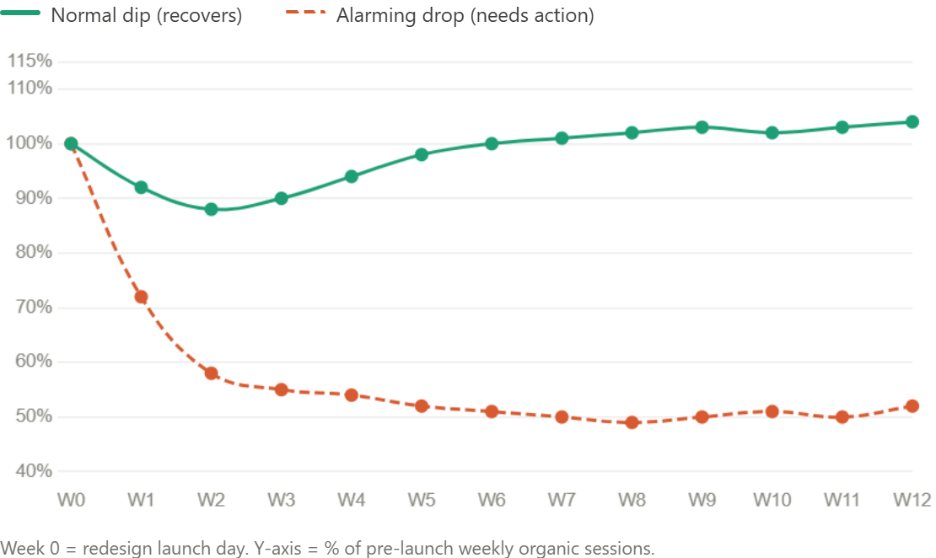
A small drop of 5% to 15% in the first two to three weeks after launch is completely normal. Google needs time to recrawl and re-evaluate your updated pages. This kind of drop usually recovers on it’s own within four to six weeks as long as your redirects are in place and your content is intact.
A sustained drop of 30% or more that continues beyond the first month is a signal that something is structurally broken. This is when you need to act quickly because the longer broken URLs sit without redirects and the longer Google goes without a submitted sitemap then the harder the recovery becomes.
How to redesign a website without losing Leads and Traffic?
The best way to deal with a post redesign traffic is to prevent it from happening in the first place. If you are planning a redesign or helping a client through one then this checklist will save you from months of recovery work.
1) Run A Full SEO Audit
Document every URL that is currently indexed, every page that drives traffic and every keyword you currently rank for. This is your baseline. You cannot protect what you have measured.
2) Preserve Your Existing URL Structure Wherever Possible
The safest redesign keeps URLs exactly the same. If URLs must change then map every single old URL to it’s new destination before launch day.
3) Set Up 301 redirects
Every old URL that is changing needs a redirect in place from the moment the new site goes live. A redirect tells Google that the page moved and transfers it’s ranking value to the new address.
4) Benchmark Your Analytics Before Launch
Screenshot your top 20 landing pages by organic traffic, your total monthly sessions and your key conversions metrics. You need a clean comparison point for the weeks ahead.
5) Submit Your XML sitemap
Do not wait for Google to find it organically. Submit it manually so the recrawl starts as fast as possible.
6) Test The Structure
Keep track of things like every CTA and navigation link before the site goes live after the redesign. Have someone outside the project test every conversion path on both desktop and mobile.
7) Keep Analytics Tool Open For Sometime after the launch
Use Tools Like Google Search Console. Check weekly for spikes in 404 errors, drops in impressions or pages that disappeared from the index. Catching problems in week one is far easier than fixing them in month three.
8) Do Not Rewrite All Your Page Content During The Redesign
If a page currently ranks well, update the design and layout but leave the core content and keyword structure intact. Rewriting ranked content is one of the most common causes of post-redesign ranking drops.
| Traffic Change | What It Usually Means | Action Required |
|---|---|---|
| 0%–15% Drop | Normal Google re-crawling after redesign | Monitor only |
| 15%–30% Drop | Possible indexing or redirect issues | Run SEO audit |
| 30%–50% Drop | Significant technical SEO problems | Immediate investigation |
| 50%+ Drop | Major migration failure or deindexing issue | Emergency recovery plan |
Increase Qualified Leads by Up to 70% With SEO-Driven Optimization
A great-looking website should generate more business, not fewer leads. We help businesses recover lost traffic, improve conversions, and turn redesigned websites into growth engines through proven SEO and conversion optimization strategies.
👉 Request Your Free SEO Recovery ProposalWrapping Up
A website redesign is supposed to grow your business not shrink it. But when it is done without protecting the SEO foundations that were already working, it almost always leads to a traffic drop and a leads downfall that can last months.
The core problem is that most redesign projects focus entirely on how a website looks and almost never on how Google reads it. URLs change without redirects. Content gets rewritten and loses it’s keyword signals. Forms break in migration. Trust signals disappear in the name of clean design. The result is a site that looks modern but performs worse than the one it replaced.
Understanding how website design affects SEO, knowing how to analyze a traffic drop with the right tools and having a clear recovery plan in place puts you back in control. Also if you plan a redesign in the future then running an SEO audit before launch day is the single most important step you can take to protect what you have already built.
Important Questions About Website Redesign SEO
With redirects in place and a sitemap resubmitted, most sites begin recovering within 6 to 12 weeks, though full recovery can take up to 6 months depending on how many issues were created.
Yes, if broken URLs go unredirected for a long time, Google removes those pages from its index entirely and the backlinks pointing to them lose their value permanently.
Google will eventually discover the changes on its own, but you should always manually submit your updated XML sitemap in Google Search Console to speed up the recrawl process.
The CMS matters less than the process. Any platform can preserve SEO if you maintain URL structures, set up redirects, and carry over all existing meta tags and content correctly.
Paid ad traffic is not directly affected by the redesign, but if landing pages change URL or get removed, your ads will point to broken destinations, which will hurt your ad performance and quality scores.
Your website isn’t showing up in ChatGPT search results for many reasons like low authority, website blocking AI crawlers, weak content quality, poor structure and relying on traditional SEO only.
In today’s time, depending only on traditional SEO won’t do the work anymore. Generative Engine Optimization matters as much as traditional SEO does for your website to show up on ChatGPT search results.
If you want to show up on ChatGPT search results, then you will have to follow some tips like providing clear and valuable information which AI crawlers can verify. Along with that, you should take care of things like having good content structure including proper FAQ section and optimizing your content for AI readability.
In this blog, we will explore 9 reasons why your website is not appearing on ChatGPT and what you can do in order to fix your AI visibility to get cited by ChatGPT.
At SEO Circular, our AI SEO services help businesses stay highlighted on platforms like ChatGPT, Gemini, Claude, Perplexity, and many more. Get our free AI SEO Audit and see where your website’s AI visibility is stuck.
Not Sure Why ChatGPT Isn’t Showing Your Website?
Get a free AI SEO audit from our experts and discover what’s preventing your website from appearing in ChatGPT, Gemini, Claude, and Perplexity. We’ll identify crawlability issues, authority gaps, content weaknesses, and AI visibility opportunities.
👉 Get Your Free AI SEO Audit TodayKey Takeaways
- Blocking AI Crawlers in your robots.txt file is one of the most common and easily fixable reasons your website never shows up on ChatGPT.
- ChatGPT does not just read your website, it cross references your brand across trusted platforms like Reddit, Wikipedia and industry publications before deciding to cite you.
- According to a 2024 study by Semrush, over 80% of ChatGPT citations come from websites that already rank in the top 10 Google search results, meaning your traditional SEO foundation still directly impacts your AI visibility.
- Traditional SEO tracking is no longer enough, you need to separately audit and measure your website’s AI visibility to know where you actually stand.
- Adding structured elements like FAQ sections, bullet points, real data and case studies significantly increase your chances of getting cited by ChatGPT and other AI platforms.
Understanding How ChatGPT Search Citations Work
If you are thinking that ChatGPT works exactly like Google, then you are wrong.
In order for ChatGPT to find your website, the AI crawlers must be able to access your site for data extraction. Along with that, your website or brand must appear consistently in the authoritative sources which ChatGPT trusts like top ranking web pages, Reddit, Wikipedia, Wikidata and industry publications etc.
ChatGPT does not pull random information. It prioritizes information, which is more credible, structured and consistent.
See What’s Next: LLMO vs GEO vs SEO
9 Reasons Why Your Website Is Not Showing Up On ChatGPT Search Results
AI Crawlers are blocked By Your Website
robots.txt exists on every website. It is a plain text file placed on a website to communicate with automated web crawlers like search engine bots and AI scrappers. It signals bots which pages they are allowed to access. If the website was built a long time ago then some developers due to security concerns must have added some rules to avoid unnecessary data leaks. Due to that, all automated visitors, including ChatGPT crawlers can also get blocked by your website.
The Fix:
Check your robots.txt file (yourdomain.com/robots.txt). Ensure this line is NOT present:Disallow: /
Instead, you need:Allow: GPTBot
Invisible In ChatGPT Citations Due To Language Mismatch
You are not worried because your content on the website is expert level and informative but you have used complex and more technical type of language style on your website. Because of this, your website’s content often gets ignored because people prompting will usually search in simple and easy to understand language which will not be very complicated to understand. That’s why making sure your website’s content is in prompt ready language is essential.
Lack Of Authority
AI crawlers don’t just analyze and read your website. They also cross reference it. They look if your business name is appearing in other authoritative and top ranking verified pages on the internet like Trustpilot, Reddit, industry listings, local news mentions, social reviews and online social media profiles. Finding you there gives AI crawlers a signal that you are an authoritative brand and fit for citation.
But when they find you nowhere other than your own website, then they might not cite you at all.
Page Speed Slowing Crawl Priority
Most businesses often ignore the speed of the website. AI crawlers or any kind of crawlers due to limited budgets per domain cannot give extra time looking for information in slow loading pages. If the site speed of the website or the page of the website is slow, then this reason will definitely affect your overall brand’s visibility on AI including ChatGPT.
Not Showing Up On Reddit And Quora
If we talk about the most heavily indexed and highest trusted platform on the internet. ChatGPT have been trained on it too and will continue to crawl reddit responses and content extensively. Even showing up on Quora can make a big difference in boosting your brand’s overall AI visibility. Not showing up on these platform is costing you a good amount of reach and traffic.
Ignoring User Intent
AI search engines like ChatGPT look for intent oriented content. ChatGPT try to find pages that answer the specific type of question a user is asking for. If your content is not matching the user intent, then ChatGPT will never cite you no matter how authoritative your content and domain is.
Improper Schema Markup Which ChatGPT Ignores
Schema is a type of structured code which tells AI crawlers exactly what your page is about. A proper schema markup gives AI platforms a signal that the content is worth citing for. Without a proper schema markup, your brand can never come into AI visibility.
Not Using Prompt-Ready Language
If someone says “Why Is My Website Not Showing Up on ChatGPT?” and your post uses wording like Semantic SEO and data layering, then you are invisible due to the usage of complex words because AI will usually prefer the type content in which there is a conversational tone and easy to understand language.
You Are Not Measuring AI Visibility Or Reputation
Giving your website an AI audit and tracking check is really essential to see if you are showing up on ChatGPT or not and also which pages have the lowest indexation and AI citing.
Many businesses and startups usually track manual SEO rankings and traffic. They usually ignore AI answer tracking and because of this they stay unaware of their AI visibility.
Unlock More Insights: AI Startup SEO & Marketing Strategy
Things To Do To Make AI Notice your Content
Audit Your Content For AI Readability
Most businesses and startups do the traditional SEO audit and tracking, but they ignore the audit regarding AI citations, and it costs them their heavy traffic that they should be getting from GEO tools.
So simply auditing your content to track AI visibility of your brand’s website can help you see the fixes you have to do in order to get cited. You can use tools like Semrush AI which contains an AI crawlability report which shows if LLM crawlers are able to access your website or not.
Optimize Content For Structured Formatting
Keep your content optimized for prompt ready language. Also, here are some things you should consider in order to optimize your website’s content for structured formatting.
- Clear Sections
- Relevant Answers
- Structured FAQs section
- Bullet Points
- Up to date content
Fresh And Updated Content
Keeping your website’s content fresh and updated can increase your chances of getting cited by platforms like ChatGPT.
Content on your website will go outdated someday, so make sure to go back and update the existing content from time to time. You can do this only if needed.
FAQs Section
Your should add FAQ sections in your content and even on website pages whether it’s a blog post, web page or a case study.
Write the questions in a way a real person will search, not the way a business person or a marketer would phrase them.
AI tools are trained on conversational text. SO using conversational and easy to understand language is also the most important step to take for a business to show up on AI search results.
Get Mentioned On High Authority Sites
Get mentioned on high authority sites that AI models trust. Your website or brand must appear consistently in the authoritative sources which ChatGPT Ads trusts like top ranking web pages, Reddit, Wikipedia, Wikidata and industry publications etc.
Use Specific Data And Examples
Chat GPT is much more likely to cite a content on the website in which some stats and accurate research data is mentioned. Use things in your content like:
- Case Studies
- Timelines
- Real Examples
- Original Research
All of these increase your chances of appearing in AI citations.
| Schema Type | Why It Matters |
|---|---|
| Organization | Establishes your brand as a recognized entity for search engines and AI systems. |
| Article / BlogPosting | Identifies authorship, publish date, article topic, and content details for better visibility. |
| FAQ | Helps search engines and AI platforms surface question-and-answer content directly in results. |
| HowTo | Ideal for step-by-step guides, increasing the chances of appearing in AI-generated and rich search results. |
| BreadcrumbList | Clarifies your website structure and content hierarchy, improving navigation and indexing. |
| Person | Connects expert authors and contributors to your content, supporting authority and trust signals. |
See How AI Search Engines View Your Website
Get a personalized report covering:
✓ AI crawler accessibility
✓ ChatGPT citation opportunities
✓ Content optimization gaps
✓ Brand authority signals
✓ GEO (Generative Engine Optimization) recommendations
Conclusion
Getting your website cited by ChatGPT is not about cracking a secret algorithm. It is about making your brand easy to find, easy to trust and easy to understand for both people and AI crawlers.
The 9 reasons we covered in this blog are not complicated problems. Most of them come down to three simple gaps that businesses ignore. They block AI crawlers without realizing it, they write content that does not match how real people search and they never build a presence outside their own website.
The good news is that every single one of these problems is fixable.
Start by auditing your website for AI crawlability, update your content to match conversational search language, get your brand mentioned on platforms like Reddit and industry publications and add structured elements like FAQ sections along with real data to your pages.
Businesses that start working on their AI visibility today will have a strong head start over competitors who are still only focusing on traditional SEO.
At SEO Circular, we help businesses fix exactly these gaps through our AI SEO services. If you are unsure where your website stands right now then get your free SEO audit today and find out which pages are getting ignored by ChatGPT and what you need to do to fix that.
FAQs About Getting Your Website Cited By ChatGPT
Yes, it does help indirectly. A verified Google Business Profile adds to your brand’s credibility across the web. When AI crawlers look for signals that your business is real and trustworthy, a completed and active Google Business Profile acts as one of those signals. It is not a direct ranking factor for ChatGPT but it contributes to your overall online authority.
There is no fixed timeline. Unlike Google where you can track ranking changes in a few weeks, AI citation visibility can take anywhere from a few weeks to several months. It depends on how frequently AI crawlers revisit your content and how quickly your brand start appearing in trusted third party sources.
Yes, but it is harder without an established online presence. A new website with no backlinks, no mentions on third party platforms and no social proof will struggle to get cited. Focus first on getting mentioned in directories, niche forums and relevant publications before expecting AI citation visibility.
It plays a supporting role. ChatGPT does not directly pull from social media posts but consistent activity on platforms like LinkedIn or X builds brand presence. When people discuss your brand or link to your content publicly then it creates more touchpoints that AI models can cross reference while evaluating your authority.
Yes, and this distinction matters. A citation means ChatGPT pulls a specific piece of information from your page and references it as a source. A recommendation means ChatGPT mentions your brand as a solution when someone asks a broad question like “which SEO agency should i use.” Getting recommended requires stronger brand authority, more third party mentions and consistently appearing in category related conversations across the web.
If your enterprise has thousands of products, locations, and services, then writing a unique page for each one is not practically possible. That’s where programmatic SEO comes in. Programmatic SEO lets you build one intelligent template that generates thousands of optimized pages automatically targeting each keyword you want to focus on.
In simple terms, just feed data to the template and it will do the work for you by creating pages for every keyword or topic you wanted to focus on.
If done right, then it is one of the most powerful organic growth mediums available to enterprise teams. If done wrong, then it floods the search engines with thin, duplicate content and through that the entire site sections can get penalized.
This guide explains what separates the two outcomes and how enterprise brands are using programmatic SEO to dominate long-term search at scale.
Running an Enterprise Site with Thousands of Pages?
SEO Circular’s technical SEO and enterprise content teams build and govern programmatic systems that drive qualified pipelines, not just traffic.
Get A Free Proposal →Key Takeaways
- Templates plus data equals scale. Build one solid template and let your data do the rest.
- Long tail demand is where enterprise revenue hides. The more specific the search query, the closer the buyer is to a decision.
- Thin content at scale is the fastest path to a Google penalty. More pages mean nothing if each page has nothing worth ranking for.
- Crawl budget is a strategic asset. If Google cannot find your best pages, those pages simply do not exist in search.
- Templates need governance, not just a one-time build. The template left alone will decay. Review it, update it, and treat it as a living asset.
What is Programmatic SEO?
Programmatic SEO is the practice of using structured data and page templates to automatically generate large numbers of search optimized pages. Instead of writing each page manually, you build a system in which there is one template, and that pulls in unique data for each page and publishes them at scale.
Think of it like a mail merge for your website. You have a spreadsheet with hundreds of rows of data. Your template is the letter. Every row produces a unique, published page. The difference is that each page is designed to rank for a specific search query that a real buyer is typing into google right now.
Let’s also understand it through a simple example:
A hotel booking platform has 50,000 properties across 200 cities. Rather than writing 50,000 individual pages, they build one template with fields for property name, city, price range, and reviews. Every property gets its own URL and its own page with real, unique content pulled from its database. That is a programmatic SEO at work.
Why Are Enterprise Brands Turning To Programmatic SEO?
Enterprise brands are giving more importance to programmatic SEO because the amount of search demand online is simply too large to handle manually.
Here are some reasons why enterprise brands are turning to programmatic SEO:
1) It Help Brands Scale Beyond Manual Publishing
Large businesses often manage massive amounts of services and data.
For example:
- An E-commerce brand may have 80,000 products.
- A SaaS company may support hundreds of integrations.
- A staffing firm may target thousands of job titles across multiple cities.
Creating dedicated SEO pages manually for all of these would take years.
Programmatic SEO allows brands to create thousands of pages quickly using a scalable system instead of publishing every page individually.
2. It Captures Valuable Long-Tail Searches
Most high-converting searches are very specific.
For example:
- “Accounting software” is broad and highly competitive
- “Cloud accounting software for UK construction firms” is much more targeted
Although highly specific searches may have lower search volume individually, but they usually attract users who are much closer to making a purchase.
Programmatic SEO helps enterprise brands target thousands of these long-tail keyword combinations at scale.
3. It Keeps Thousands of Pages Consistent
When hundreds of pages are created manually, maintaining consistency becomes difficult and nearly impossible.
Different writers may:
- Use different tones
- Structure pages differently
- Miss important information
Programmatic SEO solves this by using templates that standardize:
- Page structure
- Formatting
- SEO elements
- Messaging
This ensures a consistent user experience across thousands of pages.
4. It Reduces The Cost Of Content Production
Traditional SEO requires time and resources for:
- Research
- Writing
- Editing
- Formatting
- Publishing
At enterprise scale, this becomes very expensive.
With Programmatic SEO, most of the investment goes into building the system upfront. Once the framework is ready, generating additional pages becomes far more cost-effective. Businesses can even use an SEO Cost Calculator to estimate the long-term cost savings of scaling content production through automation rather than manual publishing.
The more pages a company creates, the more efficient the system becomes.
5. It Speeds Up Expansion Into New Markets
Enterprise brands frequently launch:
- New products
- New services
- New locations
With traditional content workflows, publishing new SEO pages can take weeks or even months.
Programmatic SEO allows businesses to launch large numbers of pages almost instantly using existing templates and data sources.
This helps brands enter new markets faster and capture search traffic before competitors do.
Industries That Benefit Most From Programmatic SEO
Not every business is a good fit for programmatic SEO. The approach works best when a company has large amounts of structured data, multiple products, services, locations, or keyword variations that can be transformed into unique landing pages. Here are some industries where programmatic SEO consistently delivers strong results:
| Industry | Example Programmatic Pages |
|---|---|
| SaaS | Integration pages, feature pages, industry-specific solutions |
| Ecommerce | Product, category, brand, and location pages |
| Travel & Hospitality | Hotels, destinations, attractions, and city guides |
| Real Estate | Property listings, neighborhoods, and city pages |
| Job Boards | Job title + location combinations |
| Marketplaces | Service + city landing pages |
| Financial Services | Loan, insurance, and comparison pages |
| Education | Course, certification, and location pages |
How Can Enterprise Brands Get Started With Programmatic SEO?
Most brands understand the concept of programmatic SEO but very few know how to actually build a strategy that works. Here are some tips enterprise brands can use to scale pages efficiently.
1) Pick A Niche With Long Tail Variations
A good niche for programmatic SEO has hundreds or thousands of specific search variations not just two or three broad terms with most of the volume.
- Choose topics with many keyword variations (hundreds or thousands).
- Each variation should represent a different user intent (location, job, industry, product, etc.)
- Example: “Accounting software for restaurants in Chicago” and “Accounting software for law firms in Austin” are two different buyers with two different pages worth building.
- Validate demand using keyword tools.
- Avoid niches where traffic is limited to only a few broad keywords.
2) Collect Data From Sources Like APIs, Spreadsheets or Public Listings
Your pages are only as good as the data behind them. Weak or inconsistent data produces weak pages at scale.
- Internal data like your own product database, transaction history or customer records is the most valuable because competitors cannot access it.
- External sources like public APIs, government datasets or industry directories work but carry a risk. If competitors use the same source, your pages will look identical to theirs.
- Every field that appears on a page must exist as a clean, consistent column in your data source.
- A field that appears on a page must exist as a clean, consistent column in your data source.
- A field that says “New York” on one row and “NY” on another creates inconsistent pages that signal low quality to search engines.
- Structure and consistency in your data layer is non-negotiable before a single page gets built.
3) Map Out Content Templates With Clear SEO Elements
A template is the blueprint every generated page follows. Getting this right before you build saves you from fixing thousands of pages later.
- The title tag formula must include the primary variable for that page type in a natural position.
- The H1 should match or closely mirror the title tag, not duplicate it word for word.
- Meta descriptions should follow a consistent formula that reads naturally and includes main keyword phrase.
- Internal links must be defined inside the template itself, not added manually after launch.
- Every template should be built around one core question: what is the user searching for when they land on this page? Answer it clearly in the first visible section.
4) Automate content generation with scalable tools
The right tool depends on your team’s technical capability and the scale you are building toward. There is no single right answer but there are clear differences between options.
- Airtable combined with Webflow is the most accessible setup for teams without developer resources. Data lives in Airtable, Webflow generates and publishes pages through it’s CMS, no custom code required.
- Google Sheets combined with a plugin like WordPress works like a charm. All imports work well for moderate scale on WordPress typically up to tens of thousands of pages before performance becomes a concern.
- Custom scripts built by a developer give the most control over page structure, update frequency and crawl management and are the most reliable option at very large scale.
- Whichever tool you use, the connection between your data source and your CMS (content management system) must update automatically when new data is added, manual republishing not required.
- Test the full pipeline on a small batch before committing to a large-scale build.
5) Launch A Few Hundred Pages
Publishing hundreds and thousands of pages on day one is one of the most damaging mistakes in programmatic SEO.
- Launch a controlled first batch of a few hundred pages using your strongest data and clearest search intent.
- Monitor the first four to six weeks for three specific signals
- How many pages are indexed?
- How quickly does Googlebot crawl the sections?
- Whether any early rankings appear or not?
- These signals tell you whether your template quality and data depth are strong enough to scale before you commit to a larger build.
- When you scale, add pages in stages of a few thousand at a time rather than all at once.
- This approach makes it easy to identify problems because the variable that changes between batches is always obvious.
- Never scale a batch that has not yet shown acceptable performance from the previous one.
Also Read: Top Strategies to Improve Brand Visibility in AI Search Engines
6) Prioritize Multilingual Keyword Clusters
For enterprise brands in more than one country or language, localization built into the architecture from the beginning is far less expensive than retrofitting it later. That’s why giving priority to multilingual keyword clusters and localized variations is essential.
- Keyword research for each target language must be done independently, not translated from your primary language.
- Search behavior varies significantly across languages and regions, a strong keyword cluster in English will not map cleanly to its literal translation in German, Japanese or Arabic.
- Each language version needs its own URL, correctly implemented hreflang tags and a data source with localized versions of every field on the page.
- A page that localizes the template language but keeps product names, locations or pricing in English will not perform in that market.
- The data layer must be localized, not just the template wrapper.
- Brands that build multilingual support into the architecture from day one can enter each new market using the same system with a new data source rather than rebuilding from scratch every time.
Turn Structured Data Into Revenue
From SaaS and ecommerce to marketplaces and directories, we build programmatic SEO frameworks designed to generate qualified traffic and measurable business outcomes.
Schedule a Free Strategy CallWrapping UP
Programmatic SEO has become one of the most powerful ways for enterprise brands to scale organic growth. Instead of creating pages manually one at a time, businesses can use structured data, templates and automation to build thousands of search optimized pages far more efficiently.
However, successful programmatic SEO is not about generating pages at scale alone. The brands that see real results focus on building useful, high-quality pages backed by reliable data, strong SEO structure, and clear search intent. They also invest in proper internal linking, crawl management and consistent page quality across the entire system.
When executed correctly, programmatic SEO allows enterprise brands to capture valuable long tail search traffic, expand into new markets faster and create a long-term competitive advantage that is difficult for competitors to replicate.
Programmatic SEO for Enterprises: Expert Answers
Common choices include headless CMS platforms like Contentful or Sanity connected to custom data pipelines, alongside tools like Airtable or BigQuery as the data layer and frameworks like Next.js for templating.
Most enterprise builds begin seeing indexation and early ranking signals within 60 to 90 days, with meaningful traffic growth typically appearing in months four through six as Google establishes trust in the new pages.
Ecommerce, SaaS, travel and hospitality, real estate, job boards, and financial services see the strongest results because they naturally have large structured datasets and high volume long tail search demand.
Yes, the template and data logic can be automated, but quality review of template output, monitoring for data errors, and periodic refreshes based on SERP changes all require human oversight.
The clearest measure is incremental organic leads and revenue attributed to programmatic pages versus the cost to build and maintain the system, tracked against what equivalent paid traffic for those queries would have cost.
Hire us as your Enterprise Programmatic SEO Agency.
The difference between 500 pages and 50,000 pages is not content. It is architecture, crawl management, automation, and governance. We help enterprise brands build systems that continue generating search visibility long after launch.
→ Get a free SEO assessment | Schedule a 15-minute call
You open Google Search Console on a Monday morning, and the graph looks like someone pulled the floor out. Traffic is down 40% overnight. Rankings you spent months building have quietly vanished. No warning email. No error message. Just a number that makes everything stop.
According to Google Search Central and multiple industry studies, technical SEO errors, algorithm updates, and content quality issues account for more than 80% of sudden organic traffic losses. For businesses relying on organic search, even a 20% traffic drop can significantly impact leads, sales, and revenue.
The 40% overnight drop in traffic on your website can happen due to many reasons like Site redesign or migration, large scale content update, technical issue, and Google algorithm updates etc.
This happens more often than most people realize and in almost every case, the cause is traceable and fixable. The problem is that most site owners skip straight to making changes without understanding what actually went wrong which makes recovery take three time as long.
This guide walks you through every likely cause of a sudden traffic drop, A step by step process to diagnose it correctly and what to do to bring your traffic back and keep it stable.
SEO Circular provides free SEO audit along with a strategy plan which helps startups and businesses regain their lost traffic. If you need expert help recovering faster, SEO Circular’s Enterprise SEO and Technical SEO team has done exactly this for 500+ global brands.
Want To Regain Your Lost Traffic And Scale More?
Every day your traffic remains down is a day your competitors gain ground. Our SEO experts can identify the real cause of your traffic loss, fix critical issues, and create a recovery strategy that restores rankings, leads, and revenue. Get a free SEO audit and discover the fastest path back to growth.
→ Get a Free SEO Audit & Recovery Plan TodayKey Takeaways
- A sudden traffic drop almost always has one specific, traceable cause which is to diagnose before making any changes.
- Technical issues are the fastest to fix and the first thing you should rule out after checking for manual penalties.
- Algorithm updates require content quality improvements, not quick SEO workarounds.
- Documenting every change, you make during recovery is essential for connecting your actions to results.
- Proactive monitoring and pre-deployment SEO checklist will prevent most traffic drops before they happen.
What Caused Your Traffic Drop?
Before you touch anything on your site, you need to understand what you are dealing with. Traffic drop can signal many things. Either you were creating backlinks which were spammy, you changed and updated your content or your site hits some penalties. Let’s dive deep into the reasons behind your traffic drop:
Change In Website
This is the most overlooked cause of sudden traffic drops because the people who made the changes and the people watching the traffic numbers are often not the same person.
Site Redesigns Or Migrations
Website redesign means you are changing the visual appearance, layout and user experience of a website without necessarily changing it’s underlying platform or structure. On the other hand, website migration includes changing your website from one environment to another like changes in platform, domain, hosting, or structure.
Both can be reasonable behind your traffic drop. That is why choosing between website redesign vs migration is a decision that should be rooted in a clear understanding of your goals.
Large scale content updates
Bulk content changes carry the same risk as migration. Deleting thin or underperforming pages without redirecting them, merging multiple articles into one without preserving the original URLs or removing content sections to “clean up” the site can all trigger significant traffic losses.
Content that seems useless from a business perspective often carries SEO value through backlinks, internal link equity or search demand you had not mapped. Removing it without a proper audit can take rankings with it.
URL Structure
Changing URL slugs, restructuring category paths or moving pages to a different subdirectory breaks the signals Google has built around those URLs over time. Even with redirects in place, there is always some loss when URLs change. Without redirects, the loss is severe and immediate.
Technical Implementations
Technical changes can also have serious SEO consequences when pushed without checking their impact on crawlability and indexation. The most common technical causes of overnight traffic drops include a robots.txt update that blocks Googlebot from crawling key sections of the site, a no index tag that was meant for staging but got pushed to production, canonical tag changes that accidentally point pages away from themselves and JavaScript rendering issues that prevent search engines from reading page content correctly.
A single line of code pushed to the wrong environment can remove thousands of pages from Google’s index within days.
For example, a single line in your robots.txt file can accidentally block Google from crawling your entire website:
User-agent: *
Disallow: /


Similarly, a noindex tag intended for a staging environment can prevent important pages from appearing in Google:
<meta name="robots" content="noindex, nofollow">
If either of these configurations is pushed to a live website by mistake, search engines may stop crawling or indexing critical pages, leading to significant traffic losses within days.
Algorithm updates
If nothing changed on your site and your traffic still dropped sharply, a Google algorithm update is most likely the cause.
Google runs thousands of algorithm changes every year. The major ones, called Core Updates can shift rankings significantly across large portions of the web. These updates do not always penalize bad content. Sometimes they simply reward competitors who have stronger content, better user experience signals or more authoritative backlinks than you do. The result looks the same on your end but the fix is completely different.
Core Updates tent to affect content quality signals most heavily, looking at things like depth of information, author expertise, trustworthiness of claims and whether a page genuinely serves the person searching. If your content is thin, generic or has not been updated in years, a Core Update is likely the cause of your drop.
Other algorithm level updates target specific issues like page experience, product review quality, spam and helpful content. Knowing which type of update hit you tells you exactly what to improve.
Backlinks, Spammy Links and Penalties
Your backlink profile directly affects your site’s authority and rankings. Here are some things that can go wrong here:
Losing High-Quality Backlinks
If a publication that linked to you removed that link, went offline or changed their page then you lose the authority that link was passing. If several of those links disappear at once such as after a major site closes or a linking page gets deleted then your rankings can drop noticeably within weeks.
Spammy or Toxic Links
If someone pointed a large number of low quality, irrelevant or manipulative links at your site, either through a negative SEO attack or through past link-building practices that no longer meet Google’s guidelines, Google may devalue those links or take action against your site because of them.
Manual Penalties
A manual penalty is issued by a human reviewer at Google not an algorithm. It appears in the manual actions section of Search Console and comes with a specific description of what was found to be in violation. Manual penalties can remove specific pages or an entire site from search results entirely. They require you to fix the underlying issue and submit a reconsideration request before rankings can return.
What To Do After Losing Your Traffic?
Now that you understand the most likely causes, here is the step-by-step process to find your specific cause and start recovering.
1) Is The Drop Real Or A Tracking Issue?
Before diagnosing an SEO problem, confirm the drop is actually happening in search and not a measurement error.
Check these first:
- Did your Google Analytics 4 tracking code get removed or break during a recent site update?
- Was a date filter or segment accidentally applied to your dashboard that is hiding traffic?
- Did a referring traffic source dry up, for example a social campaign ending which is not an SEO issue at all?
- Is the drop in all channels or only organic search?
If organic search is the only channel affected and the tracking code is intact, then the drop is real and you move to the next step.
2) Analyze Google Search Console For Any Errors
Google Search Console is your most direct source of truth. Open it and check the following in this order.
- Manual Actions Check this first. If a manual penalty has been issued then it will be listed here with a clear description. This changes your entire recovery plan.
- Coverage Report Look for a sudden spike in pages listed as “Excluded,”Noindex”, or “Crawl anomaly”. A large increase here means pages dropped out of the index.
- Security Issues If Google detected malware or hacked content then it will be flagged here. This can cause rankings to vanish within days.
- Performance Report Set the date range to compare the period before and after the drop. Sort by biggest decline in clicks to identify which pages and queries were affected the most.
Note: Give yourself at least 48 to 72 hours after a drop before drawing conclusions from this data, as Search Console have a processing delay.
3) Check For Algorithm Updates
If Search Console shows no manual action and no indexing issues, check whether a Google algorithm update rolled out around the time your traffic dropped.
- Visit the Google Search Central blog to check for any officially announced updates near your drop date.
- Check third-party volatility trackers like Semrush Sensor, Mozcast or RankRanger which measure ranking volatility across millions of search results and will clearly show spikes when a major update hits.
- Cross-reference the type of pages that lost traffic with the known focus of recent updates.
4) Check For Technical Issues
Go through your deployment logs and ask your development team whether any code, plugin, theme, or configuration changes went live in the 48 to 72 hours before the drop.
Then run these checks:
- Open your robots.txt file at yourdomain.com/robots.txt and confirm no important sections are being blocked.
- Use the URL Inspection tool in Search Console to check how Google last rendered your most important pages.
- Run a crawl using Screaming Frog or a similar tool and filter for pages returning 4xx errors, redirect chains, or missing canonical tags.
- Check whether your XML sitemap is up to date and submitted correctly in Search Console.
5) Identify Which Pages Lost Traffic
Understanding whether this is a site wide or a page level drop is critical because each requires a different solution.
In Search Console’s performance report, go to the Pages tab, compare the last 28 days to the previous period and sort by the biggest decline in clicks. Look for these patterns:
- If one page or a small cluster of pages is responsible for most of the drop then the issue is likely specific to that content, template or URL.
- If the drop is spread evenly across the entire site, it points to a technical issue or broad algorithm signal.
- If the pages that dropped share a content type, section or template issue or a broad algorithm signal.
- If the pages that dropped share a content type, section or template that is your starting point for the fix.
6) Check For Competitor Changes
Search the keywords you lost rankings for and look at who moved into the positions you previously held. Then ask:
- Did a competitor publish significantly more detailed, better structured content on the same topic?
- Did a major publication or authority site enter the results for your core keywords?
- Did a competitor earn a strong cluster of new backlinks recently?
- Did Google introduce a new SERO feature like an AI Overview of a featured snippet that now absorbs clicks before they reach your result?
Use Semrush or Ahrefs to check which domains gained visibility in the same window you lost it. If a competitor’s domain grew while yours shrank, your recovery plan needs to focus on producing content that is genuinely better, not just longer.
7) Run Quick Diagnostics
You do not need a paid enterprise platform to run a solid first-pass diagnosis. These free tools cover the most critical areas:
1) Google Search Console — Errors, coverage, manual actions, performance data.
2) Google PageSpeed Insights — Check if Core Web Vitals scores dropped after a recent update.
3) Google’s Mobile-Friendly Test — Confirm your site is still rendering correctly on mobile.
4) Google’s Rich Results Test — Check whether structured data on key pages is still valid.
5) Screaming Frog (free up to 500 URLs) — Crawl errors, redirect chains, missing tags.
6) Ahrefs Webmaster Tools (free) — Recently lost backlinks and referring domains
7) Google Alerts — Set alerts for your domain name to catch any public discussion about issues.
8) Document Everything
This step is skipped constantly and it always creates problems during recovery. When traffic drops and urgency sets in, people make changes without tracking them which means they cannot connect their actions to any improvements or regression they see later.
Document the following from the moment you identify the drop:
- The exact date the drop started and the percentage declined.
- Which pages and keywords lost the most traffic.
- Any site changes made in the 7 days before the drop.
- Every diagnostic check you ran and what it showed.
- Every fix you implemented and the exact date it went live.
- Weekly traffic and ranking numbers after each fix.
| Step | Check | Tool |
|---|---|---|
| 1 | Verify the traffic drop is real | Google Analytics 4 |
| 2 | Check for manual penalties | Google Search Console |
| 3 | Review indexing and coverage issues | Google Search Console |
| 4 | Look for recent algorithm updates | Google Search Central |
| 5 | Audit technical SEO changes | Screaming Frog |
| 6 | Analyze affected pages and keywords | Google Search Console |
| 7 | Review backlink losses | Ahrefs Webmaster Tools |
| 8 | Compare competitor movements | Semrush / Ahrefs |
How Long Website Traffic Recovery Takes?
This depends entirely on what caused the drop
1) Technical Issues
Usually it takes time to handle Issues such as noindex tag, robots.txt block or broken redirects. Once the fix is deployed and Google recrawls the affected pages then the recovery takes 1 to 3 weeks.
2) Manual Penalty
After resolving the violation and submitting a reconsideration request, Google usually responds within a few weeks. Full recovery can take 1 to 3 months.
3) Algorithm Update
This is the longest recovery path. Google has confirmed that recovery from a core update often comes only with the next Core Update, which can be several months away. Content quality improvements made during this time lay the groundwork for that recovery.
4) Lost Backlinks
Recovery depends on how authoritative the lost links were and how quickly you can earn comparable replacements. In competitive niches, this can take 3 to 6 months.
Read Something Similar: AI Startup SEO & Marketing Strategy
How To Avoid Future Drops?
The best recovery strategy is one you never need. Building proactive monitoring and governance into your SEO operations is what separates sites that bounce back quickly from those that stay down.
Here is what to put in place:
- Set up automated weekly crawls with alerts for sudden increases in crawl errors, 404 pages or noindex tags.
- Monitor Core Web Vitals continuously not just after something breaks.
- Build a pre-deployment SEO checklist that every development push goes through before going live.
- Track your share of voice monthly across your 20 to 30 most important keywords so you catch competitor movement before it becomes a crisis.
- Audit your content every 6 months for accuracy, depth and alignment with current search intent.
- Maintain a healthy backlink profile with diverse referring domains rather than relying on a small number of sources.
- Follow the Google Search Central blog and trusted SEO news sources, so algorithm updates are never a surprise.
Bonus Tip
Even the errors you catch are just the surface. The ones you are not familiar with, the crawl misconfigurations, algorithm signals, and indexation issues you do not know how to look for, are quietly doing the most damage. Hiring an experienced SEO company means nothing gets missed.
Conclusion
A sudden traffic drop is stressful, but it is almost never the end of the story. The sites that recover fastest are the ones that diagnose before they act, document what they find, and make focused improvements rather than scattered reactive changes. Start with Search Console, rule out technical issues, identify whether an algorithm update or competitor shift is involved, and build the monitoring systems that catch the next problem before it becomes a crisis.
The longer you wait to act with clarity, the more ground a competitor gains. Every day without direction is a day the gap widens. Treat the drop as a reason to build something more resilient than what existed before.
Traffic drops are signals, not a death sentence.
Frequently Asked Questions
Yes, Algorithm updates and competitor improvements can reduce your rankings even when your site has not changed at all.
No, Penalties are one of the less common causes. Algorithm updates, technical errors, and content quality issues are far more frequent.
Only if you have clear evidence of a toxic or manipulative link profile. Disavowing clean backlinks can remove authority and worsen your rankings.
Check the Google Search Central blog and third-party volatility trackers for update announcements that coincide with your drop date.
Only if that content is genuinely more useful, accurate, and authoritative than what already exists. Publishing thin content in bulk will not help and may make things worse.
Corporate climate buyers are actively looking for verified carbon removal partners right now. The problem is that most carbon capture startups are invisible to them online. No matter how strong your technology or how credible your removal methodology is, if your platform does not show up when a sustainability officer searches for solutions, you are losing deals to competitors who invested in being found.
This blog breaks down exactly how carbon capture startups can use SEO, content, paid ads, and digital authority to get in front of the right corporate buyers and turn that visibility into real offtake conversations.
At SEO Circular, we often help CleanTech companies align their messaging with buyer intent through SEO-driven content strategies, executive thought leadership, and B2B positioning frameworks designed for enterprise audiences. This helps climate startups become more discoverable during the research and evaluation stage. Explore our Enterprise SEO and Consulting Services to start showing where decisions are actually made.
Build Trust Before The First Buyer Conversation
Corporate buyers want proof, credibility, and expertise before engaging with a carbon capture provider. Strong search visibility, authoritative content, and industry recognition help establish that trust at scale. SEO Circular helps carbon removal companies become the brands buyers discover, research, and remember.
→ Speak With Our CleanTech Marketing ExpertsWhy Corporate Climate Buyers Cannot Find You Without SEO?
Here is what actually happens before a corporate buyer contacts a carbon capture platform. Their sustainability team gets assigned a research task. Someone opens Google and starts typing. They search for verified carbon removal solutions, carbon capture platforms for enterprises or how to buy high quality carbon credits for net zero. If your platform is not ranking on the first page for these searches then you simply do not exist in their consideration set.
SEO is not a nice to have for carbon capture startups. It is the difference between being in the room and being unknown. Corporate buyers do not cold call vendors. They research, shortlist, and then reach out. Your SEO is what gets you on that shortlist.
A well optimized carbon capture platform will rank for the searches that corporate buyers are already doing, build credibility through content before the first conversation and reduce the cost of acquisition compared to relying entirely on events, referrals or paid outreach.
Importance Of International SEO For Carbon Capture Platforms
Corporate climate buyers are not confined to one country. The biggest buyers are spread across North America, Europe, and increasingly the Asia Pacific region. A carbon capture startup that only optimizes one market is leaving a significant portion of its total addressable market completely unreached.
International SEO For Carbon structuring your website so it ranks in multiple countries and languages, using hreflang tags to signal the right version of your content to the right audience, and building backlinks from climate and sustainability publications across different regions. European buyers in particular are operating under stricter regulatory frameworks like the EU Taxonomy and CSRD, which means they search with more specific compliance driven language. Optimizing those regional search variations puts you directly in front of the highest intent buyers in the world.
Keyword Research for Carbon Capture Startups
| Keyword Type | Example Keywords | Buyer Intent |
|---|---|---|
| Transactional | Buy verified carbon removal credits | High |
| Transactional | Enterprise carbon removal solutions | High |
| Transactional | Carbon capture offtake agreement platform | High |
| Informational | How to meet Scope 3 targets with carbon removal | Medium |
| Informational | Carbon removal standards explained | Medium |
| Comparison | Carbon removal platform comparison | High |
| Comparison | Best carbon capture registries for enterprises | High |
The goal is not high-volume keywords. It is high intent of keywords that corporate buyers with real purchasing intent are actually using. Split your keyword strategy into three layers.
1) Transactional keywords for service and product pages. Examples: buy verified carbon removal credits, enterprise carbon removal solutions, carbon capture offtake agreement platform
2) Informational keywords for blog and resource content. Examples: how to meet Scope 3 targets with carbon removal, best carbon removal standards for corporate buyers
3) Comparison keywords for dedicated landing pages. Examples: carbon removal platform comparison, best carbon capture registries for enterprises
Explore Related CleanTech Marketing Resources: How to Sell Carbon Credits & Make Money?
Paid Ads for Carbon Capture Startups
SEO builds long term visibility but paid ads put you in front of corporate buyers immediately. For startups that need pipeline now while organic rankings are being built, paid ads are a smart parallel investment.
1) Google Search Ads capture buyers who are actively searching with intent. Target high intent keywords with ad copy that speaks directly to verification and compliance concerns.
2) LinkedIn Ads reach decision makers by job title, company size, and industry. Sponsored content targeting Chief Sustainability Officers and ESG Directors at companies with active net zero commitments performs well when it leads with insight rather than a hard sell.
3) Retargeting keeps your platform top of mind through the research and decision process since most corporate buyers will not convert on their first visit.
| Factor | SEO | Paid Ads |
|---|---|---|
| Time to Results | 3-12 Months | Immediate |
| Long-Term ROI | High | Medium |
| Brand Authority | Strong | Limited |
| Lead Cost Over Time | Lower | Higher |
| Scalability | Excellent | Budget Dependent |
| Corporate Buyer Trust | High | Moderate |
On Page SEO Strategies That Work For Carbon Capture Platforms
On page SEO tells Google exactly what your platform is about and who it is for. Most climate tech websites are built for investors and scientist, not for corporate buyers with procurement intent. That is where rankings suffer.
How To Optimize Your Service Pages For Corporate Buyer Intent?
Every core service page needs to be built around a specific search query a corporate buyer would use. The page title, meta description, H1 and opening paragraph should all reflect that intent clearly. Pages should address verification standards, delivery timelines and co-benefits directly and end with a clear next step.
Technical SEO Basics Carbon Capture Websites Get Wrong
The most common technical issues include slow page speed due to uncompressed images, missing canonical tags causing duplicate content, poor internal linking leaving important pages undiscovered and no structured data markup. Fix these fundamentals before investing heavily in content or link building.
Off page For Carbon Capture Startups
Off-page SEO covers everything outside your website that signals credibility and authority to Google. The core is earning backlinks and mentions from websites that corporate climate buyers and the sustainability industry already trust.
Being cited on platforms like Carbon Brief, Greenbiz and Environmental Finance builds domain authority and puts your brand directly in front of your target buyers at the same time. Partnerships with climate consultancies, sustainability rating agencies and net zero advisory firms also generate valuable off page signals that compound over time.
Content Strategy That Attracts Corporate Buyers Organically
Content builds trust at a scale. A corporate buyer who has read two or three useful pieces from your platform before reaching out is already halfway through their decision process before the first conversation.
Content types that work best include detailed guides on carbon removal standards and corporate reporting, case studies written from the buyer’s perspective, comparison content between removal methodologies and carbon market pricing reports that give buyers real intelligence.
Every piece should target a specific keyword, answer a specific question, and end with a clear next step.
Social Media
Social media does not directly impact rankings but amplifies content reach in ways that support SEO. When your content gets shared widely on LinkedIn by sustainability professionals, it earns more backlinks, more branded searches, and more direct traffic, all positive signals to search engines.
LinkedIn is the highest priority channel for carbon capture platforms because that is where corporate sustainability decision makers are most active.
Link Building And Domain Authority For Climate Tech Startups
Domain authority determines how fast and how high your content ranks. Ten backlinks from respected sustainability publications are worth more than a hundred links from generic directories.
The most effective link building approaches for carbon capture platforms include publishing original research that journalists want to reference, contributing expert commentary to climate media with a link back to your platform, getting listed on sustainability association resource pages, and earning links through partnerships with universities and climate policy organizations.
Domain authority compounds over time. A platform that has been consistently earning quality backlinks for twelve months will significantly outrank a newer competitor with no link profile.
Helpful Guides You Shouldn’t Miss: Carbon Trading Platforms: Business Model & Revenue Streams
Guest Posting And PR
Guest posting means publishing expert content on external publications your target buyers already read. For carbon capture platforms, this means pitching to GreenBiz, Carbon Pulse, Environmental Finance and ESG focused business media. Each guest post builds a backlink and puts your brand in front of a relevant audience.
PR generates media coverage that corporate buyers notice and trust. A well-placed feature in a respected sustainability team pay close attention to what is being written in their industry. Being part of that conversation positions your platform as an established player rather than an unknown startup.
SEO Mistakes To Avoid
- Targeting the wrong keywords means optimizing generic high-volume terms instead of the specific transactional keywords corporate buyers actually use.
- Ignoring technical SEO means your content never reaches it’s ranking potential no matter how good it is.
- Writing content for investors instead of buyers attracts funding interest but not corporate purchasing conversations.
- Neglecting International SEO means you are only visible to a fraction of your potential market.
- Failing to measure SEO performance through analytics and conversion tracking.
- Skipping link building leaves your domain authority low indefinitely and your content buried below competitors.
- Publishing content without a keyword strategy produces a blog that generates no organic traffic at all.
Need More Corporate Climate Buyers?
SEO Circular helps carbon capture startups improve visibility, attract sustainability decision-makers, and generate qualified enterprise leads through SEO, content marketing, digital PR, and paid acquisition strategies.
→ Book a Free Strategy CallConclusion
Carbon capture startups have the solutions corporate climate buyers need. The gap between them is almost always visibility and trust not technology. SEO closes that gap by making your platform discoverable at every stage of the buyer journey, from early research to final decision. When your keyword strategy, on-page optimization, content, link building and paid ads all work together, corporate buyers find you before they find your competitors and they arrive already trusting what you offer.
Frequently Asked Questions About Carbon Capture SEO
Most carbon capture platforms start seeing measurable organic traffic improvements within three to six months of consistent SEO work, with significant ranking gains typically appearing between six and twelve months.
Both serve different stages. Google Ads captures buyers who are actively searching while LinkedIn reaches decision makers before they start searching. The strongest results come from running both together.
Your core service or product page targeting enterprise buyers is the highest priority. It needs to rank for transactional keywords and convert visitors into inquiries more than any other page on your site.
International SEO requires additional technical setup including hreflang tags, region specific content variations, and link building from publications in target markets to signal relevance to buyers across different countries.
Yes, focusing on a narrow set of high intent keywords, publishing consistent long form of content, and earning a small number of high-quality backlinks from relevant publications is more effective than spreading a large budget thinly across too many channels.
Today over 40% of users are now using AI tools as a primary starting point for research instead of traditional search engines showing a clear shift toward AI -first discovery behavior.
So, getting your business cited by AI search engines has become equally important. Your business needs to show up where users are getting answers in seconds, inside AI generated content itself.
When it comes to getting a brand cited by AI platforms like ChatGPT, Gemini and Perplexity then the brand needs to make sure to have a clear structure of the website like high quality content, digital PR, technical optimization and industry authority. Having this type of structure can increase the brand’s chances of getting mentioned by AI platforms.
SEO Circular helps enterprise brands build the content authority, Digital PR presence, and AI-ready digital visibility needed to get cited in AI-generated answers. Whether you want your brand mentioned by ChatGPT, Gemini, Perplexity, or improve visibility through our ChatGPT Ads Agency services, we create strategies focused on AI search visibility, authority, and long-term growth.
Want Your Brand To Be Recommended By ChatGPT, Gemini, and Perplexity?
AI search engines are changing how buyers discover and compare brands. If your competitors are getting cited in ChatGPT, Gemini, or Perplexity while your business is missing, you are losing valuable visibility and trust. At SEO Circular, we help brands improve AI visibility through Digital PR, semantic SEO, topical authority, and AI-ready content strategies built for long-term growth.
→ Book Your Free AI Visibility Strategy CallKey Takeaways
- AI search engines like ChatGPT, Gemini, and Perplexity are now primary discovery tools for buyers, making AI citations as valuable as page one Google rankings.
- The brands that get cited most are those with consistent third-party mentions across trusted platforms, not just strong websites.
- Answer-ready content that directly addresses specific questions is far more likely to be pulled into AI-generated responses.
- Digital PR, original research, and author credibility are among the highest-leverage activities for building AI citation authority.
- Getting cited by AI is a compounding process. Brands that start building presence now will have a structural advantage that grows over time.
What Does AI Citation really mean?
In simple terms, AI citation is the direct credit or reference a generative AI model like ChatGPT, Perplexity gives to a source inside it’s result or answer which the model used for research regarding the user’s query.
For businesses, this means visibility is no longer limited to traditional blue link rankings. If your brand gets cited inside an AI generated answer, then you gain exposure at the exact moment users are researching solutions, services or products.
Why AI Citation Matters For Your Business?
AI citation is not just a visibility metric. It directly changes how users discover, trust and choose your brand in the buying journey.
Here is what shifts when ChatGPT, Gemini or Perplexity start citing your business:
- You get discovered by buyers who never use traditional search engines like Google especially in early-stage research.
- Your brand gets an implicit trust signal because AI generated answers are already perceived as credible by users.
- You enter the shortlist phase instantly since AI often presents only a few recommended options instead of long lists.
- Your acquisition becomes less dependent on paid ads, since citations drive organic visibility without per-click costs.
- Your competitors cannot simply outbid you because AI citations are earned through authority, relevance and consistency rather than paid placement.
- Your brand recognition compounds over time ad repeated AI mentions reinforces familiarity and preference across different queries.
Start Growing Your Visibility: LLMO vs GEO vs SEO
How ChatGPT, Gemini, and Perplexity Actually Decide What to Cite?
Each AI search engine has it’s own logic but the underlying signals are more similar.
How ChatGPT Picks Sources?
ChatGPT (especially with browsing enabled) looks for content that is authoritative, well-structured and widely referenced. It gives weight to:
- Content that directly answers specific, defined questions.
- Brands that appear across multiple trusted third-party sources.
- Pages with strong internal logic (clear headings, defined terms and logical flow).
- Content on domains with strong backlink authority.
How Gemini Picks Sources?
Gemini is Google’s AI, so it inherits Google’s trust signals. It leans heavily on:
- E-E-A-T (Experience, Expertise, Authoritativeness, Trustworthiness) signals.
- Google’s Knowledge Graph, meaning structured data and schema markup matter.
- Brand mentions in publications Google already ranks highly.
- Author credibility and clear expert attribution on content.
If your brand ranks well in traditional Google search, Gemini is more likely to know you and cite you. The two are deeply connected.
How Perplexity Picks Sources?
Perplexity is the most transparent of the three. It shows its sources directly in the answer. It tends to prefer:
- Content from high-authority domains (news sites, industry publications, review platforms).
- Pages that answer questions in a direct, quote-ready format.
- Brands that appear in recent coverage and fresh content.
- Pages that are crawlable, fast, and well-structured.
Perplexity updates more frequently than ChatGPT’s training data, which means recent content and fresh mentions matter more here.
Discover More Strategies: B2B Leads Using Perplexity AI
Guide To Get Your Brand Cited By AI Search Engines (ChatGPT, Gemini, Perplexity)
E-E-A-T Structure
E-E-A-T stands for Experience, Expertise, Authoritativeness and Trustworthiness. Google introduced it as a quality standard but AI engines across the board have adopted the same logic. ChatGPT, Gemini, and Perplexity all favor sources that demonstrate real-world credibility not just keyword-stuffed pages.
What This Looks Like In Practice?
1) Every piece of content should be attributed to a named author with visible credentials.
2) Include first-hand experience in your content like case studies, client result, original observations and real outcomes your brand has produced.
3) Get your brand mentioned on authoritative third-party sites. A quote in Forbes carries more E-E-A-T weight than ten blog posts on your own domain.
4) Add author bio pages that clearly list qualifications, professional background and past publications.
5) Display trust signals prominently like client logos, certifications, awards.
Use Real Numbers Which AI Tools Verify
Vague content does not get cited. Specific, data – backed content does. This is one of the clearest patterns across how AI search engines select sources to reference.
When you write “companies that invest in content marketing see better results” an AI has no reason to cite you. When you write “companies that invest in content marketing generate 3x more leads at 62% lower cost per acquisition than paid channels”, an AI has a concrete, quotable fact to work with.
Here is why real numbers matter so much for AI citation:
- AI engines are trained to surface credible, verifiable information and Numbers signal credibility.
- Specific statistics make your content quote ready, which is exactly the format AI prefers when constructing answers.
- Original data or proprietary research earn backlinks which in turn increase your domain authority and citation likelihood.
- Numbers give readers a reason to reference your content elsewhere, building the web of mentions AI engines look for.
Note: You can use your own client results your internal analytics, published industry reports from Gartner, Forrester, HubSpot, Statista and similar sources. Always cite your sources when referencing external data.
Add Schema Markup For Citation
Schema is the structured code which tells AI exactly what your page is about. A proper schema markup gives AI platforms a signal that the content is worth citing for. Schema also explains the content to AI in a language that they interpret and understand. Google Gemini in particular relies heavily on structured data because it is also built on Google’s infrastructure.
Here are four schema types which matter the most in AI citation.
1) Organizational Schema
This tells AI who your brand is according to your niche. It includes your brand name, description, logo, social proofs, URL and founding date etc. Without it, AI platforms will have to guess and gather your brand’s information through scattered and weak signals. With it, they will have the verified source of truth which can increase the chances of AI citing your brand.
2) Article Schema
Add this to every blog post, guide or long-form content page. It tells AI engines the article title, the author, the publish date, the last modified date and the topic. This is especially important for Perplexity, which prioritizes recent and updated content.
3) FAQs Schema
FAQ schema structures your question and answer content in a format that AI engines can pull directly into their responses. If you have a page with well written answers to common industry questions, FAQ schema help AI to surface your brand and cite the content.
4) Product, Search Schema
Product schema is a structured data which sends signals to AI tools regarding your product and services. Through product schema, AI search engines can figure out the details of your product. Any user searching for product details in an AI platform will be able to clearly find your product through product and search schema.
5) Sitelink Search Schema
Sitelink search schema tells AI systems that users can search within your website. This helps improve your brand’s visibility overall.
Build Topical Authority In Your Niche
Topical authority means owning a subject area so completely that AI engines associate your brand name with that topic by default. It is one of the strongest long-term for AI citation.
In a study by Semrush found that websites with comprehensive topic coverage and strong internal linking ranked significantly higher across competitive keyword clusters compared to sites with thing or scattered content. The same principle applies to AI citation.
How to build topical authority:
- Map out every subtopic, question and angle within your core subject area.
- Create a content cluster: One comprehensive pillar page supported by multiple detailed supporting articles that link back to it.
- Cover every stage of the buyer journey within your topic not just top of funnel awareness content.
- Avoid publishing on topics outside your defined area of expertise. Depth beats breadth in AI citation signals.
- Aim for consistent publishing cadence. AI models see frequency of content within a topic as a signal of genuine expertise.
Show Up On Reddit And Quora
Reddit and Quora are two of the most heavily indexed, highest trust platforms on the internet. Both ChatGPT and Perplexity have been trained on and continue to crawl Reddit content extensively. Gemini also indexes Quora answers and surfaces them regularly in AI responses.
When your brand or your team members show up in genuine, helpful discussion on these platforms then you build citation authority in exactly the environments AU engines learn from.
What To Do On Reddit?
- Find the subreddits where your target audience genuinely asks questions related to your industry.
- Contribute real, helpful answers. Do not pitch, focus on being the most useful voice in the thread.
- When relevant and natural, reference your brand’s published content or data as a source within your answer.
- Engage consistently over time. A history of genuine contributions carries far more weight than one viral comment.
What To Do On Quora?
- Answer questions in your topic area with detailed, expert responses that include specific data points and practical steps.
- Complete your author profile with credentials, company affiliation and a link to your website.
- Link to your best performing content where it genuinely adds value to the reader’s question.
Keep Your Content Fresh and Updated
What keeping content fresh actually means:
- Add a “last updated” date to every major page and blog post. Make it visible and accurate.
- Set an audit schedule. Go through your top performing pages and update any outdated statistics, examples or recommendations.
- Add new sections to existing content as the topic evolves rather than publishing a brand new article every time something changes.
- When you update a page, make sure to update it’s internal links to reflect new content you have published since the original post went live.
- Refresh meta descriptions and title tags when you update content. The signals to crawlers that the page has genuinely changed.
Use Semantic SEO To Match How AI Thinks
Traditional keyword SEO focuses on exact phrases. Semantic SEO focuses on meaning, context, and the dull landscape of concepts surrounding a topic. AI engines are built on large language models that understand meaning, not just keywords. Writing for semantic depth is writing in the same language AI engines speak.
What does semantic SEO mean in practice?
- 1) Cover related subtopics, synonyms and adjacent concepts within each piece of content, not just the primary keyword.
- Use natural language that mirrors how your audience actually asks questions including conversational phrasing like “how do I”,”what is the best way to” and “why does”.
- Build internal links between related content pieces so AI crawlers can trace the conceptual connections across your site.
- Include definitions, context and explanations for technical terms. AI engines favor content assumes nothing and explains everything clearly.
- Semantic Content with logical heading hierarchies (H2, H3, H4) that reflect the natural flow of how someone would learn about a topic.
Match Your Content To User Intent
AI search engines are intent-matching machines. They do not just find pages about a topic. They find pages that answer the specific type of question a user is asking. If your content is optimized for the wrong intent then it will not get cited regardless of how authoritative your domain is.
There are four types of search intent:
| Search Intent Type | User Goal | Example Keywords & Queries |
|---|---|---|
| Informational Intent | The user wants to learn, research, or understand a topic. | “What is E-E-A-T?”, “How does AI SEO work?”, “What is semantic SEO?”, “How to get cited by ChatGPT”, “AI search engine optimization guide” |
| Navigational Intent | The user is searching for a specific brand, company, website, or page. | “SEO Circular case studies”, “SEO Circular AI SEO services”, “OpenAI ChatGPT”, “Ahrefs blog”, “Enterprise SEO agency website” |
| Commercial Intent | The user is comparing services, tools, or providers before making a decision. | “Best enterprise SEO agencies”, “Top AI SEO companies”, “Best Digital PR agencies”, “ChatGPT SEO vs traditional SEO”, “Best SEO services for SaaS companies” |
| Transactional Intent | The user is ready to take action, contact, buy, or book a service. | “Book enterprise SEO consultation”, “Hire AI SEO agency”, “Get Digital PR services”, “Request SEO audit”, “Buy enterprise SEO services” |
How to Match Intent Correctly?
- For every content piece, define the single primary intent it serves before you write a word.
- Look at the top AI-generated answers for your target query. Notice whether they are explanatory, comparative, or action oriented. Match that format.
- Do not blend multiple intents in one page. A page trying to both explain and sell at the same time often serves neither well.
- For commercial intent queries, include comparison frameworks, evaluation criteria, and honest assessments rather than pure promotion.
How Long Does It Take to Get Cited by AI ?
There is no instant switch. Getting cited by AI search engines is a complete process, not a one-time fix. Here is a realistic estimated timeline for a brand to get cited by AI :
| Timeline | What Happens |
|---|---|
| Months 1–3 | Build the foundation by improving content structure, launching Digital PR campaigns, updating schema markup, and increasing brand mentions across trusted third-party platforms. |
| Months 3–6 | Start seeing your brand appear in AI-generated answers for niche and industry-specific queries where you have developed strong topical authority. |
| Months 6–12 | With consistent SEO, PR, and authority-building efforts, your brand can begin appearing in a meaningful percentage of relevant AI search queries within your industry. |
Note: The brands that start AI Startups building this now will have a compounding advantage over those who wait. AI models favor brands they have “seen a lot.” The more history you build, the more naturally you get cited.
Build Your Brand Visibility Across AI Search Engines
Getting cited by ChatGPT, Gemini, and Perplexity is becoming essential for brands that want long-term digital visibility. Businesses building strong topical authority, Digital PR, and semantic SEO today are positioning themselves for AI-driven discovery tomorrow. At SEO Circular, we help brands improve AI visibility through enterprise SEO, Digital PR, structured content, and AI-ready SEO strategies built for sustainable growth.
Talk To SEO Circular About Your AI Citation Strategy →Conclusion
The search landscape is not shifting toward AI. It has already shifted. ChatGPT, Gemini, and Perplexity are not experimental tools anymore. They are where millions of buyers go to get answers, compare options, and make purchase decisions.
Getting your brand cited by AI is not about gaming a system. It is about building the kind of consistent, authoritative, and well-referenced brand presence that AI engines have been trained to trust. That means strong content, credible authors, third-party mentions, original research, and structured data working together as a system.
Every a month delay is a month your competitors get named instead of you.
When a buyer asks ChatGPT to recommend the best in your industry today, does the AI have enough reasons to say your name?
Questions About Getting Cited By ChatGPT
Yes, small businesses can absolutely get cited. AI engines favor topic depth and third-party credibility over company size. A small brand that dominates a niche with authoritative content and strong PR can outperform a larger brand that has spread itself thin.
Indirectly, yes. Social media amplifies your content and increases the chance of it being picked up by publications and platforms that AI engines do crawl and index.
You can manually search relevant queries in ChatGPT, Gemini, and Perplexity and note whether your brand appears. Tools that monitor AI search visibility are also emerging rapidly in the SEO space.
No, Paid ads do not influence whether organic AI systems cite your brand. Citations are earned through content authority, third-party mentions, and structured data, not paid placement.
The signals overlap significantly. Content structure, backlink authority, schema markup, and brand mentions all benefit both traditional SEO and AI citation likelihood at the same time.
Getting more tenders is not just about submitting the right documents. It starts much earlier, when the person looking for a water treatment company types something into Google and your name either shows up or it does not.
Any government body or client will search on Google first to find a contractor. So if your website is invisible then you are missing out on so much.
This is exactly the problem SEO and PPC solve for water treatment companies. SEO builds your long-term visibility, so the right buyers find you organically. PPC puts you in front of them immediately when timing matters. Together they work as a system that keeps your company visible, credible, and findable through the entire buying circle.
SEO Circular helps industrial and B2B companies build search strategies that go beyond traffic and directly impact how many qualified leads and tender inquires land in their pipeline every month.
Struggling to Get More Water Treatment Tenders?
Procurement teams are already searching online for water treatment vendors and industrial contractors. If your company is not appearing in those searches, you are losing valuable tender opportunities. At SEO Circular, we help water treatment companies improve Google visibility and generate more qualified tender inquiries through SEO and PPC strategies.
→ Talk to an Industrial SEO ExpertKey Takeaways
- Procurement teams research vendors online long before a tender is published making early SEO visibility a direct business development advantage.
- Technical SEO, on-page optimization, off-page authority and content strategy must all work together. Investing in only one of them limits results significantly.
- PPC is not a replacement for SEO in the water treatment sector. It is a complement that delivers speed when SEO is still building and fills gaps during time sensitive tender cycles.
- Location specific pages and local SEO are essential since most water treatment tenders are geography bound, and procurement teams search with city or state level intent.
- Success should be measured in qualified inquiries, tender shortlists, and pipeline value, not in keyword rankings or raw traffic numbers alone.
Start With An SEO Audit
Before any keyword strategy, content plan or PPC campaign, the first step is understanding where your website stands right now. An SEO audit tells you exactly what is working, what is broken, and what is stopping your company from showing up when procurement teams search for water treatment vendors online.
For water treatment companies, an audit typically uncovers issues like:
- Service pages that are not ranking because they are targeting the wrong keywords or no keywords at all.
- Location pages that are missing entirely, which means you are invisible in geography specific tender searches.
- Technical problems like slow page speed, crawl errors or duplicate content that are quietly pulling your rankings down.
- Gaps in content where your competitors are answering procurement questions that your website is not addressing at all.
- Weak or zero backlink profile which signals to Google that your company lacks industry authority.
Without an audit, you are essentially guessing. With one, you have a clear picture of exactly where to focus first to start generating more inquiries and tender leads.
SEO Circular offers a free SEO audit for water treatment and industrial companies. A senior strategist reviews your website and sends back a 30 day opportunity snapshot within one business day, showing you exactly what needs to be fixed and where your biggest growth opportunities are.
The Keywords That Actually Bring Tender Leads
Not every keyword brings the same kind of visitor. A water treatment company needs to target the phrases that procurement teams and project heads actually type into Google, not generic industry terms.
The strongest tender-generation keywords usually come from procurement-driven and industry-specific searches.
| Keyword Type | Example Keyword | Search Intent |
|---|---|---|
| Service + Location | Water treatment plant contractor in Dubai | Procurement/vendor search |
| Compliance Keywords | ISO certified wastewater treatment company | Trust & qualification validation |
| Problem-Based Keywords | Industrial wastewater discharge solution | Solution research |
| Tender Keywords | Government water treatment tender contractor | Tender/vendor discovery |
| Comparison Keywords | RO plant vs UF plant | Evaluation stage |
| Industry-Specific Keywords | Water treatment solution for textile industry | Industry-specific procurement |
| Local SEO Keywords | Wastewater treatment company near me | Regional vendor search |
| Commercial Keywords | Hire industrial water treatment contractor | High buying intent |
| Informational Keywords | How does ZLD water treatment work | Awareness & education |
| Brand Authority Keywords | Best water treatment company for municipalities | Vendor shortlist research |
These keyword categories target buyers at different stages of the procurement journey. Some users are researching treatment technologies, while others are actively comparing vendors or preparing tenders. A balanced SEO strategy targets all of these search intents together.
What Your Website Needs Before SEO Or PPC Works?
Before any keyword strategy or ad campaign delivers results, your website needs to be technically sound. A slow, poorly structured or mobile unfriendly website will waste every rupee and every hour you put into SEO and PPC.
Here is what the technical foundation must include:
- Fast loading speed on both desktop and mobile, ideally under 3 seconds
- Clean URL structure that reflects your services and locations clearly
- Proper crawlability so Google can index all your important pages without errors
- Secure HTTPS setup across the entire website
- Schema markup for your services, location and business details so Google understands what you do
- No duplicate content across service pages pr location pages
- XML sitemap submitted to Google Search Console
- Mobile responsiveness since a large share of industrial buyers now search on phone
On-Page SEO
On page SEO is about making sure each page of your website is built to rank a specific keyword and answer a specific question that your buyer is asking.
For water treatment companies, this means:
- Every service should have its own dedicated page, for example a separate page for ETP plants, STP plants, RO systems, ZLD solutions, and so on.
- Each page title should include the service name and location or industry where relevant.
- The first paragraph of every page should clearly state what the service is, who it is for, and what problem it solves.
- Use H2 and H3 headings to break content into sections that match what a procurement officer wants to know, such as technical specifications, compliance certifications, past project scale, and turnaround time.
- Include internal links between related service pages so Google understands how your offerings connect.
- Add client logos, project photos, and compliance certificates directly on service pages since this build immediate trust with procurement visitors.
Off Page SEO And Link Building For Water Treatment Companies
Off-page SEO is about building your company’s credibility and authority in the eyes of Google through mentions, references and links from other trusted websites.
For water treatment companies, this is especially important because Google treats link from industry relevant and high authority sources as a vote of confidence in your expertise.
Here is how off page SEO works for this industry:
- Get listed on government vendor portals, industry directories and procurement platforms since this carry strong authority and direct referral traffic.
- Earn backlinks from engineering publications, environmental compliance blogs and industrial trade websites by contributing useful technical content.
- Get featured in case studies or vendor lists published by project consultants and EPC contractors.
- Build citations by ensuring your company name, address and phone number are consistent across all online directories.
- Partner with associations like CII, FICCI affiliated environmental bodies or water industry groups that maintain online member directories.
Digital PR And Industry Authority
Building Digital PR goes beyond link building. It is about positioning your company as a name that procurement teams already recognize before they even reach your website.
When a facility manager has seen your company quoted in an environmental compliance article, mentioned in a water sector news piece or featured as a case study on an infrastructure portal, they arrive at your website with a level of trust already established.
Here is what a digital PR strategy looks like for water treatment companies:
- Publish original research or data about industrial water consumption, wastewater standards or ZLD adoption rates and pitch it to environmental and industrial media.
- Get your technical directors quoted in articles about new government regulations around water discharge norms.
- Issue press releases when you win a significant project, get a new certification, or expand into a new geography.
- Collaborate with EPC firms and project consultants who mention vendors in their own published content.
The cumulative effect of digital PR is that your company starts showing up not just in Google search but in the broader conversation that procurement teams follow before they even start a vendor search.
Content That Builds Trust
Procurement teams do not buy from companies they do not understand. Content is how you show them before any meeting or presentation that your company knows what it is doing.
The right content strategy for a water treatment company should include:
- Project case studies that show the scale of work you have handled, the compliance outcomes you achieved, and the timeline you delivered within. Procurement teams read these carefully.
- 2) Technical guides that explain how different treatment technologies work, when using ZLD versus conventional treatment or how to meet specific CPCB norms. This positions your team as experts, not just vendors.
- 3) Tender preparation content such as articles about how to evaluate water treatment vendors, what certifications to look for or how to write technical specifications for a treatment plant tender. These attract procurement officers at the exact moment they are preparing to float a tender.
- FAQ pages covering the most common concerns of industrial buyers such as maintenance costs, energy consumption, upgrade compatibility and after-sales support.
Content that answers real procurement questions earn trust faster than any sales pitch.
Local And Regional SEO For Municipal And Industrial Tenders
Most water treatment tenders are geographically specific. A municipal authority in Germany is not going to shortlist a contractor with no regional presence or project history in Europe. The same applies whether you are targeting contracts in the Middle East, Southeast Asia, Africa or North America.
Local and regional SEO ensures your company appears in searches tied to specific countries, cities or industrial zones where you operate or want to operate.
Here is what local and regional SEO looks like in practice for water treatment companies:
- Create dedicated location pages for every country, region or city where you have completed projects or are actively pursuing contracts.
- Optimize your Google Business Profile for every physical office or project location your company operates from.
- Target location plus service keywords such as “water treatment plant contractor in Dubai” or “industrial wastewater solution provider in Germany” or “municipal water treatment company in South Africa.
- Build citations on regional industrial directories, government vendor portals and procurement platforms specific to your target markets.
- Highlight international project experience and any region-specific compliance certifications such as EPA standards in the US, EU water framework directives in Europe or local environmental authority approvals in your target country.
- For companies targeting multiple countries, a hreflang and multilingual SEO strategy ensures your pages rank in the right language for the right geography.
For water treatment companies expanding across borders, a structured global location page strategy can significantly increase visibility in the tender related searches that matter most in each market.
When to Use PPC Alongside SEO for Faster Results?
SEO is a long term investment. It typically takes three to six months before rankings and organic leads start compounding. PPC fills that gap and serves a different but complementary purpose even after SEO is performing well.
Here is when and how PPC works best for water treatment companies:
- Use Google Search Ads to appear immediately for high intent keywords like “ETP plant manufacturer for pharmaceutical industry” while your SEO rankings are still building.
- Run PPC campaigns when a specific tender deadline is approaching, and you need visibility fast in that geography or sector.
- Target competitor brand keywords through PPC so buyers researching other companies also see your name.
- Use remarketing ads to stay visible to procurement officers who visited your website but did not inquire, since industrial buying decisions rarely happen on the first visit.
- Run LinkedIn ads targeting procurement managers, plant heads, and infrastructure consultants at companies in your target industries since many industrial buyers use LinkedIn for vendor research.
- Combine PPC data with SEO strategy by identifying which paid keywords are converting into inquiries and then building organic content around those same terms.
PPC without SEO burns budget. SEO without PPC moves slowly in a competitive tender cycle. Together they cover the full spectrum of where your buyer is and when they are ready to act.
Also Know: How ESG Consulting Firms Can Get Clients Through Google In 2026?
How to Measure Success
Winning more tenders through SEO and PPC is measurable, but only if you track the right numbers. Ranking on page one is not a success. An inquiry from a qualified procurement team is.
Here is what water treatment companies should measure:
- Number of organic leads generated each month from service and location pages
- Which keywords are driving actual form fills and calls, not just traffic
- Cost per lead from PPC campaigns broken down by service type and geography
- Tender inquiry to proposal conversion rate from organic versus paid traffic
- Time on page and scroll depth on case study and service pages since these indicate procurement level engagement
- Growth in branded search volume, meaning more people searching your company name directly, which shows increasing market awareness
- Backlink growth from industry relevant domains over time
- Google Business Profile actions such as calls, direction requests, and website visits from local searches
Review these numbers monthly. Adjust content, keywords, and ad targeting based on what is actually generating inquiries and not just impressions.
Turn Google Searches Into Tender Opportunities
Industrial buyers and procurement teams are already searching for water treatment vendors online. The question is whether they are finding your company or your competitors first. A strategic SEO and PPC approach helps increase visibility, build trust, and generate high-value inquiries consistently.
Get Free Consultation →Conclusion
Water treatment is a high stake, compliance driven industry where trust is built long before a tender is floated. The companies that win more contracts are not always the most technically advanced. They are the ones that show up first, communicate clearly, and look credible online before the first call is even made.
SEO and PPC together give water treatment companies a structured way to build that visibility, earn that trust, and stay in front of the right buyers throughout a long procurement cycle. From technical website foundations to content that speaks the language of procurement teams, every piece of a well-built search strategy compounds into more inquiries, more shortlists, and more contracts won.
Commonly Asked Questions: SEO For Water Treatment Companies
Most companies start seeing meaningful organic traffic improvements between months three and six, with lead volume compounding significantly by month nine to twelve depending on competition and content investment.
Yes. Many government and PSU procurement officers use Google to research vendors before approving a shortlist. Search ads targeting specific service and geography combinations can put your company in front of them at exactly that moment.
Absolutely, A single services page dilutes your ranking potential. Dedicated pages for ETP, STP, RO, ZLD, and other technologies each rank independently and bring in buyers searching for that specific solution.
Links from government portals, environmental compliance publications, engineering trade directories, EPC contractor websites, and industry association pages carry the most weight for this sector.
Yes, Large companies often have weak content strategies and poorly optimized location pages. A focused SEO strategy targeting specific geographies and niche service keywords can help smaller companies outrank larger ones for the searches that matter most.