LLMO vs GEO vs SEO: What Is The Difference And Which One Do You Need?
Search is evolving far beyond traditional Google rankings. In this guide, we explain the difference between SEO, GEO, and LLMO, how AI-powered search platforms like ChatGPT, Gemini, Perplexity, and Google AI Overviews are changing visibility, and what businesses must do to stay discoverable across modern search ecosystems.
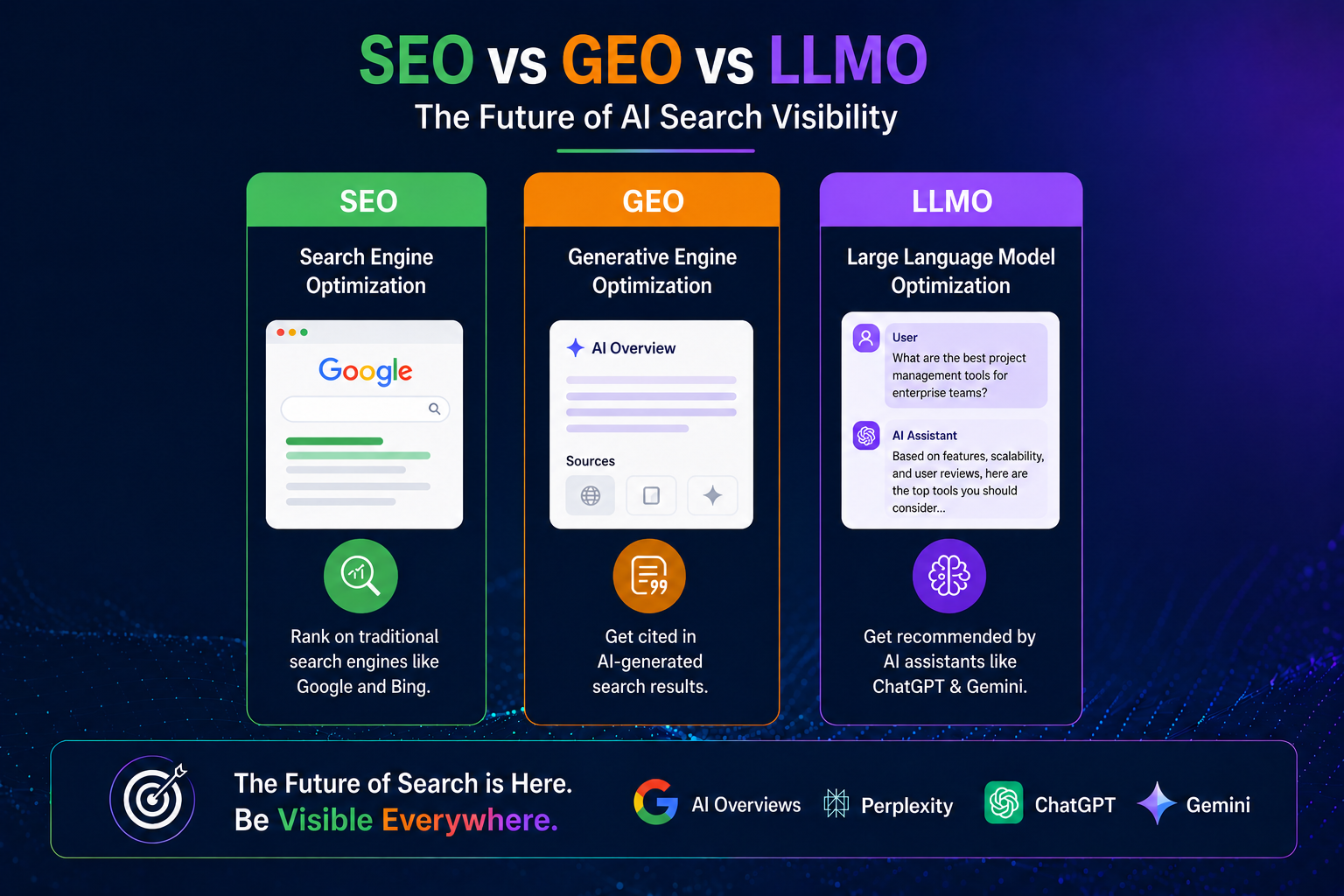
If you have been following digital marketing news lately then you have probably come across three terms being thrown around a lot: SEO, GEO, and LLMO. Some people use them interchangeably. Others treat them like completely separate disciplines. The truth is somewhere in between and understanding the difference could be one of the most important things you do for your brand’s visibility in 2026 and beyond.
Search is no longer just Google. People are now getting answers from AI chatbots like ChatGPT and Perplexity, from voice assistants and from AI generated summaries sitting right at the top of search results pages. Each of these surfaces plays by slightly different rules and that is exactly what these three terms are about.
At SEO Circular, we help enterprise brands build visibility across all these surfaces. Whether you need a traditional SEO strategy, content created to be cited by AI engines or a full search governance plan across global markets, our enterprise SEO services are built to get you there.
Want your brand to appear not just in Google rankings, but also inside AI-generated answers and ChatGPT recommendations?
At SEO Circular, we help enterprise brands build visibility across SEO, GEO, and LLMO through technical SEO, AI-ready content, digital PR, and authority-driven search strategies designed for the future of AI search. From safe search visibility to AI search optimization, we build SEO systems designed for long-term traffic, signups, and revenue growth.
Get Custom SEO, GEO & LLMO Solutions →
Key Takeaways
- SEO, GEO, and LLMO focus on three different surfaces: traditional search results, AI-generated search summaries, and conversational LLM outputs.
- GEO and LLMO are both new disciplines, but they are not the same. GEO is about AI search pages; LLMO is about what AI chatbots say in conversation.
- All three disciplines share a common foundation. Strong technical SEO, deep content, and brand authority benefit your performance across every surface simultaneously.
- Brand entity clarity is critical for LLMO. How your brand is described and referenced across the internet shapes what LLMs say about you in conversation.
- The most efficient strategy is not three separate programs. It is one unified content and authority program built to perform across SEO, GEO, and LLMO at the same time.
What Do SEO, GEO and LLMO Actually Mean?
Let’s have a look at of SEO, GEO and LLMO:
1) SEO
Search Engine Optimization is the practice of making your website rank higher on traditional search engines like Google and Bing. It has been around for over two decades and involves things like using the right keywords, earning backlinks from other websites, fixing technical issues on your site and writing content that matches what people are searching for. The end goal should be that more people find your website by searching and more of those people turn into customers.
2) GEO
Generative engine optimization is a newer discipline focused on getting your content cited or referenced inside AI-powered search results. Think of google AI Overviews, Perplexity or Microsoft Copilot. These tools generate a summarized answer instead of just listing ten blue links. GEO is about making sure your brand is one of the sources the AI trusts.
3) LLMO
Large language model optimization is about being referenced inside the outputs of large language models themselves, like ChatGPT, Claude or Gemini. When someone asks one of these tools “what is the best project management software” or “who are the top enterprise SEO agencies”, LLMO is what determines whether your brand gets named in that response. Unlike GEO, there is no search results page here. It is a conversation and the AI either knows your brand or it does not.
The Difference Between SEO, GEO, and LLMO
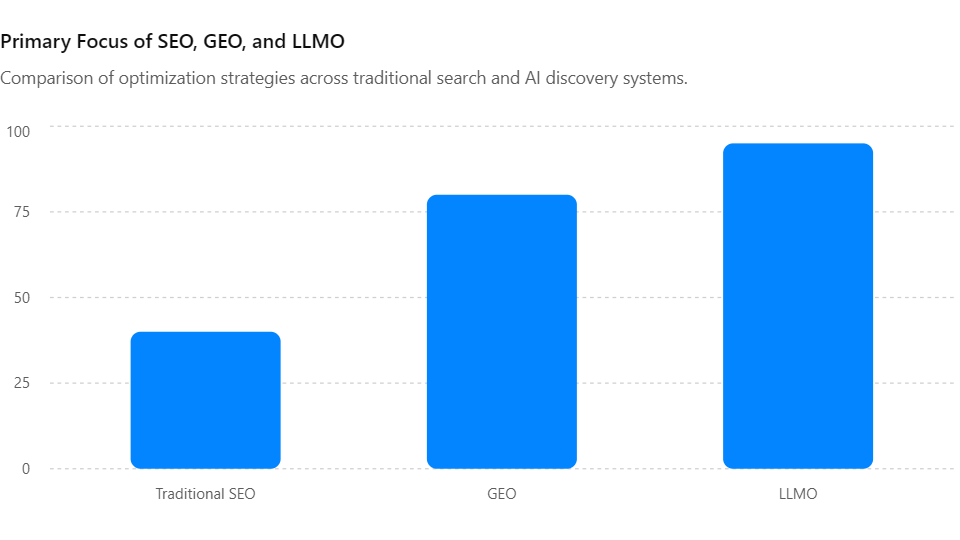
Here is a beginner friendly comparison of all three, so you can see exactly where they diverge.
| Factor | SEO | GEO | LLMO |
|---|
| What it targets? | Google, Bing search results | AI-powered search engines (Perplexity, Google AI Overviews) | AI chatbots (ChatGPT, Claude, Gemini) |
| What “ranking” means? | Appearing on page one of search results | Being cited as a source in an AI-generated answer | Being mentioned by name in an LLM response |
| Main signals used | Keywords, backlinks, technical health, page experience | Structured data, authority, source credibility, citation history | Brand mentions across the web, training data presence, trusted sources |
| Content goal | Match search intent, answer queries | Be a credible, citable source for AI summaries | Be a known, referenced entity in your category |
| How are results measured? | Rankings, organic traffic, conversions | Source citations in AI summaries, impression share | Brand name appearance in AI responses |
| How new is it? | 25+ years old, well established | 2 to 3 years old, rapidly evolving | 1 to 2 years old, still being defined |
| Who does it matter most for? | Almost every business with a website | Brands in research-heavy or informational industries | Brands competing for awareness and category ownership |
The key thing to notice here is that these are three different surfaces. Google’s traditional search results, Google’s AI Overview box, and ChatGPT conversation are three completely different places. Each one requires a slightly different approach to show up.
Read More Insights and Tips: AI Chatbot Marketing Strategy For B2B Businesses
How SEO, GEO and LLMO Work in Real Life
Let’s look at a practical example of how all three disciplines work together for a SaaS company selling enterprise project management software. While the customer intent stays the same, the discovery surface changes completely.
| Scenario | SEO | GEO | LLMO |
|---|---|---|---|
| User Behavior | User searches on Google | User searches on AI-powered search engines | User asks an AI chatbot directly |
| Example Query | “Best enterprise project management software” | “Top tools for enterprise project management” | “What project management software do you recommend for large remote teams?” |
| Platform | Google Search, Bing | Google AI Overviews, Perplexity, Copilot | ChatGPT, Gemini, Claude |
| What Happens | The SaaS company ranks organically in search results | The AI engine cites the company inside generated summaries | The AI assistant recommends the company conversationally |
| Main Optimization Focus | Keywords, backlinks, technical SEO | Structured content, authority, citations | Brand mentions, entity authority, web-wide trust signals |
| Success Metric | Organic traffic and rankings | AI citations and visibility | Brand mentions in LLM responses |
| User Experience | Clicking search results | Reading AI-generated summaries | Having a direct conversation with AI |
What This Means for Brands
In all three situations, users are searching for the same solution, but the path to discovery is different. Traditional SEO helps brands rank in search engines. GEO helps brands appear inside AI-generated search summaries. LLMO helps brands become part of AI conversations and recommendations.
The brands dominating search visibility in 2026 are not optimizing for just Google rankings anymore. They are building authority across traditional search, AI-powered search engines, and conversational large language models simultaneously.
Do You Need SEO, GEO, LLMO, or All Three?
The honest answer for most growing Robotics businesses and other businesses is eventually, all three. But where you start depends on your current situation.
- Start with SEO if you are not yet generating meaningful organic traffic from Google. Until you have a healthy technical foundation, strong content and a growing backlink profile, the other two disciplines will have limited overall impact.
- Add GEO to your strategy if you are in an industry where people research before buying. If your customers ask questions before making decisions and AI-powered search is giving them answers, you need to be one of the sources those answers come from.
- Give priority LLMO if your sales cycle involves buyers asking AI chatbots for recommendations. B2B buyers, enterprise decision-makers, and research-driven consumers increasingly ask LLMs to help them shortlist vendors and solutions.
- Pursue all three together if you are at an enterprise scale. At this level, your brand needs to be visible wherever your buyers are looking, whether that is a traditional Google search, an AI Overview, or a ChatGPT conversation.
The good news is that strong SEO provides a foundation that benefits GEO and LLMO too. High-authority content, a trusted domain and a clear brand entity all serve you across all three disciplines.
How SEO, GEO, and LLMO Work Together?
These three disciplines are not separate from each other. They share a common foundation and the work you do for one almost always lifts the other two. Here are the five most important things to understand about how they connect.
- SEO is the ground floor. Without it, GEO and LLMO have nothing to build on.
- One strong piece of content can rank on Google, get shown in AI Overviews and appear in ChatGPT responses all at once.
- Each discipline rewards different signals, so SEO, GEO and LLMO need slightly different content and authority techniques.
- The authority you build today is what LLMs learn from tomorrow, making off-page investment a long-term visibility asset.
- One unified program beats three separate ones. Build all three at once then fill gaps where needed.
Explore Complete Research: Generative AI Optimization Techniques to Increase AI Visibility
How to Optimize Content for Google AI Overviews, ChatGPT and Perplexity
Optimizing all three does not mean functioning three completely separate programs. It means building a unified content and authority strategy that is deliberately designed to perform across every surface. Here is how to approach it step by step:
1) Start with a strong technical SEO foundation
Before GEO or LLMO tactics make any meaningful difference, your site needs to be technically structured. This means fast load times, clean site architecture, proper crawlability, and no broken pages or duplicate content issues. AI-powered search tools and LLMs draw from the same web your site lives on. If Google cannot easily read and understand your site, neither can the AI systems layered on top of it.
2) Build topic authority through deep, structured content
Choose the topics your brand should own and go deep on them. That means detailed guides, original research, detailed case studies and content that answers questions at every stage of the buying journey. Structured content with clear headings, logical flow, and well-labeled sections is easier for AI systems to read and extract from. This directly serves SEO, GEO and LLMO at the same time.
3) Implement schema markup across key page types
Schema markup tells search engines and AI tools exactly what type of content is on a page, who wrote it, what it is about and what entity it belongs to. For GEO specifically, FAQ schema, HowTo schema, and Article schema are particularly valuable. They make your content machine-readable in a way that AI search engines can pull directly into their generated answers.
4) Build your brand entity across the open web
For LLMO, the single most important thing you can do is make your brand clearly and consistently described across as many trusted web sources as possible. This means keeping your website, LinkedIn profile, Crunchbase listing, industry directory entries, and press coverage all aligned on the same core description of who you are, what you do, and who you serve. LLMs build their understanding of your brand from these sources, and inconsistency or gaps in that picture will hurt you.
5) Invest in digital PR and authoritative external coverage
Being mentioned or cited in respected publications, industry reports, and editorial content does three things at once. It builds backlinks for SEO. It signals credibility to AI-powered search engines for GEO. And it adds your brand to the pool of web sources that LLMs reference, which is the core of LLMO. A single feature in a high-authority publication can move the needle across all three surfaces.
6) Create content that AI systems naturally want to cite
AI-powered search tools and LLMs favor content that is factually grounded, clearly attributed, and written with genuine depth. Content that includes original data, specific examples, named experts, and clear sourcing is far more likely to be extracted and cited than generic content that could have been written by anyone. Write with the goal of being the most credible, specific answer to a question in your space.
7) Monitor your presence across all three surfaces
Tracking performance means looking beyond Google rankings. Check regularly whether your brand is appearing in AI Overviews for your target topics. Ask ChatGPT Agency, Perplexity, and Gemini the questions your buyers are asking and see whether your brand comes up. Track citation share in AI-generated answers. This gives you a complete picture of where you are visible and where the gaps are, so you can adjust your strategy accordingly.
Wrapping UP
SEO, GEO, and LLMO are not three separate problems to solve. They are three surfaces of the same visibility challenge indeed. The brands that will win in 2026 and beyond are not running three disconnected programs. They are building one strong foundation of technical SEO, deep content, brand authority, and SEO for AI Startups that performs across traditional search, AI generated summaries, and LLM conversations at the same time. Searching is fragmenting fast. The brands that adapt now will be the ones buyers find, regardless of where or how they are searching.
Commonly Asked Questions
Is LLMO the same as AEO (Answer Engine Optimization)?
They overlap significantly. AEO broadly covers optimization for any system that generates direct answers, while LLMO is specifically focused on large language models like ChatGPT, Claude, and Gemini.
Does traditional SEO still matter if AI is changing search?
Yes. SEO remains the highest-volume organic channel and provides the trust signals that both GEO and LLMO rely on. A weak SEO foundation limits performance across all three disciplines.
Can a small business benefit from GEO and LLMO, or is it only for large brands?
Any brand can benefit, but larger brands with more existing authority tend to see faster results. Smaller brands should build their SEO foundation first before investing heavily in GEO and LLMO.
How do I know if my brand is being mentioned in LLM responses?
You can manually test by asking ChatGPT, Claude, Perplexity, and Gemini category-level questions relevant to your business. Tools that track LLM brand citations are also emerging, though the space is still developing.
Does social media presence help with LLMO?
Indirectly, yes. Social content that gets shared, embedded, or referenced in articles contributes to the broader web presence that LLMs are trained on, but direct social posts carry less weight than authoritative editorial coverage.
Ready to rank on Google and AI at the same time?
We help brands win across search and AI answers — technical SEO, content strategy and Generative Engine Optimization in one workflow. Tell us your goals and we’ll show you the plan.