My Website Has Traffic But Low Leads: What to Fix?
Your website is getting traffic, but the leads aren’t coming in? Discover the most common reasons behind low website conversions and learn practical ways to improve your CTAs, forms, page speed, trust signals, search intent, and overall user experience to turn more visitors into qualified leads.
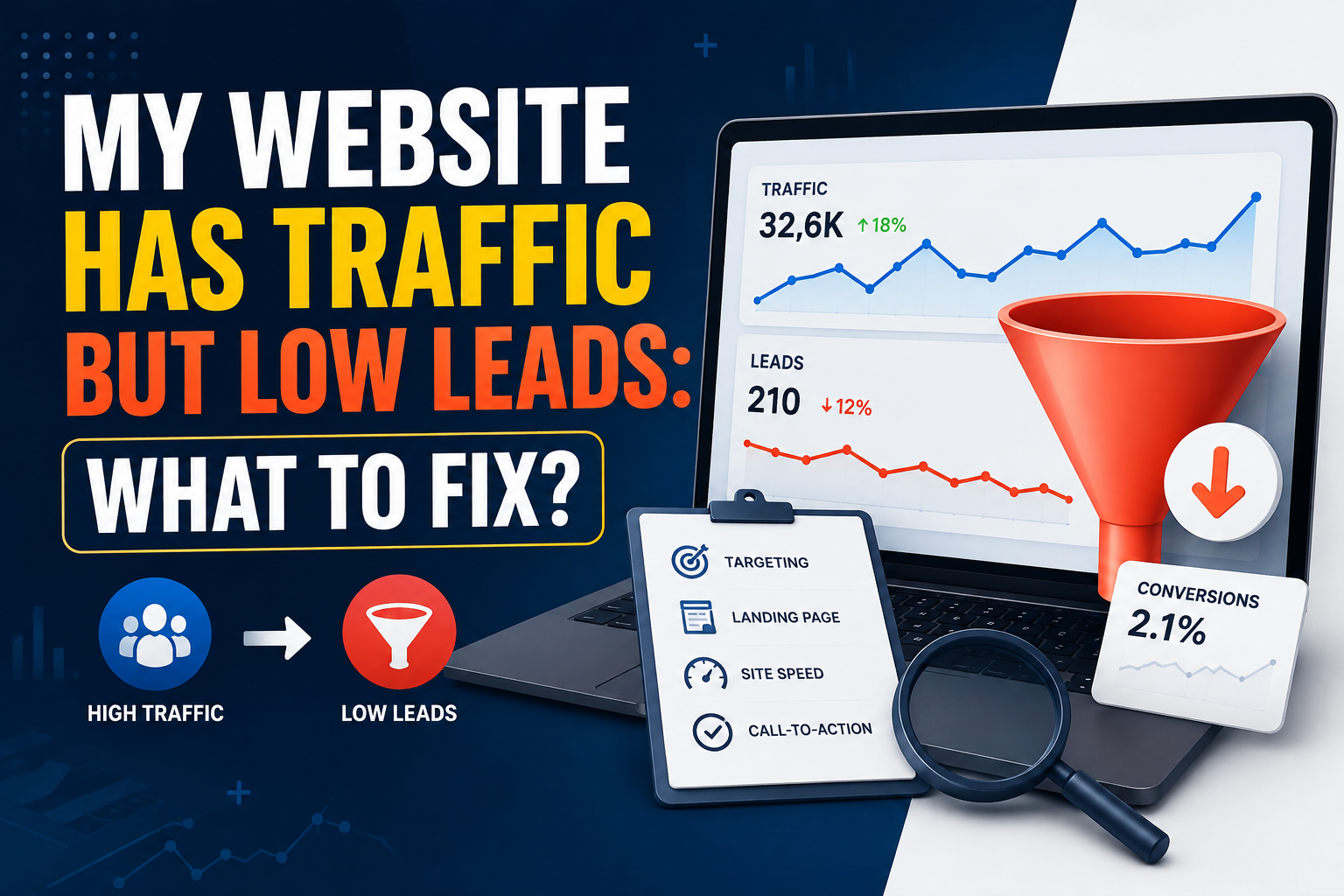
If you’re staring at your analytics dashboard watching visitor numbers climb while your inbox stays quiet, then this post is a must read for you.
And trust us you’re not alone in this…
High website traffic and low leads are among the most frustrating problems in digital marketing. If you’re facing these types of issues, then this could be due to;
- A mismatch between the visitors you’re attracting and what you’re actually selling
- A website experience that doesn’t build trust or guide people toward action
- Weak or confusing calls-to-action
- Slow load times
- Poor mobile experience
- Forms that ask for too much too soon
Sometimes it’s not one big problem but a combination of any two or three points that results in low website lead generation.
At SEO Circular, we work with businesses every day who come to us with this exact concern — solid traffic numbers, but leads that don’t match up. We help identify where the drop-off is happening, whether it’s in targeting, on-page experience, or conversion pathways, and put a structured plan in place to fix it.
The good news is that this is a fixable, well-understood problem, and the rest of this guide walks through exactly where to look and what to change. Let’s get into the details.
Getting Traffic but Not Enough Leads?
Find out exactly where your visitors are dropping off. Our team can analyze your website, traffic quality, CTAs, and conversion path to uncover opportunities for growth.
Improve My Lead GenerationWhy Traffic Doesn’t Automatically Mean Leads
Traffic is a vanity metric until it’s paired with intent and action. A website can pull in thousands of visitors a month and still generate almost no business if those visitors aren’t the right people, don’t trust what they see, or can’t figure out what to do next.
For better understanding, think of your website like a physical store.
A lot of customers are visiting your physical store, but if the shelves are disorganized, there’s no one to help, and the checkout counter is hidden in the back, people will walk out empty-handed.
If you understand what’s happening to the physical store, then the same logic applies online.
Common Reasons Websites Get Traffic but Few Leads and How to Fix
1. You’re Attracting the Wrong Audience
Getting more website traffic is often treated as the ultimate goal of SEO and digital marketing. However, traffic by itself does not guarantee business growth. You can have thousands of visitors every month and still generate very few leads if those visitors are not the right people. The quality and intent of your traffic matter far more than the raw number of sessions, which is why understanding AI search visibility is becoming increasingly important.
One of the most common reasons businesses struggle to generate leads is that their marketing attracts people who are interested in the topic but have no intention of purchasing a product or service. For example, a company selling professional accounting software may receive significant traffic from people searching for “how to calculate business expenses,” but many of those visitors may simply be students, researchers, or individuals looking for free information.
This can happen for several reasons:
- Ranking for broad, informational keywords instead of commercial or transactional keywords
- Running advertising campaigns with targeting that is too broad
- Attracting visitors from locations the business does not serve
- Creating content that appeals primarily to students, researchers, or hobbyists
- Optimizing for search volume instead of buyer intent
- Targeting keywords that are popular but poorly connected to the company’s actual services
For instance, someone searching for “what is digital marketing?” is probably still in the learning stage. Someone searching for “digital marketing agency for small business” is much closer to making a purchasing decision. Both searches can generate traffic, but their potential to produce a lead is very different.
The solution is not necessarily to eliminate informational content. Informational content is valuable for building authority, improving AI search brand visibility, and introducing your brand to potential customers. The important thing is to create a clear path from informational content toward commercially relevant pages.
How to fix?
Audit your top traffic-driving pages, keywords, and advertising campaigns. Separate informational traffic from commercial and transactional traffic. Review metrics such as conversion rate, engagement, geography, device, and lead quality—not just traffic volume. Your SEO and advertising strategy should be weighted toward the audience that has a genuine need for your product or service.
2. Your Value Proposition Isn’t Clear
A visitor should not have to investigate your website to figure out what your business actually does. People make quick judgments when they land on a website, and if the value proposition is unclear, they may leave before exploring further.
Your homepage or landing page should answer three basic questions almost immediately:
What do you offer? Who is it for? Why should someone choose you?
If those questions are difficult to answer, your website is likely creating unnecessary friction.
Many businesses make the mistake of writing headlines that describe their industry rather than communicating a specific benefit. A headline such as “Innovative Solutions for Modern Businesses” sounds professional, but it tells the visitor very little. A stronger headline would communicate the actual outcome, audience, and differentiator.
For example, instead of saying:
“Leading Technology Solutions for Businesses”
a company might say:
“Automate Your Finance Operations and Reduce Manual Reporting for Growing Businesses.”
The second version gives the visitor a much clearer understanding of the offer. A strong value proposition should also be supported by evidence. Visitors need a reason to believe the claims being made.
Important proof points can include:
- Client testimonials
- Case studies
- Customer logos
- Industry certifications
- Years of experience
- Number of customers served
- Quantifiable results
- Awards and recognitions
- Guarantees or clear service commitments
How to fix?
Rewrite the above-the-fold section so a first-time visitor can understand your offer within 10 seconds. Focus on the customer’s problem and desired outcome rather than simply describing your company. Pair the headline with a clear supporting statement, a strong CTA, and an immediate trust signal.
3. Weak or Missing Calls-to-Action (CTAs)
A website can have excellent content and still generate few leads if the conversion journey is not designed properly. This is where [marketers using AI to boost conversions] can also explore new approaches to improving conversion performance.
A call-to-action (CTA) provides direction. Without one, visitors may read an entire page, find the information useful, and then simply close the browser. This is particularly common on blogs, service pages, and educational resources.
Generic CTAs such as “Submit,” “Click Here,” or “Learn More” often fail because they do not communicate the value of taking action. The visitor should understand what will happen after clicking.
Instead of generic CTA, try using CTA buttons that communicate clearly, such as;
- “Request a Free Consultation”
- “Get Your Custom Quote”
- “Book a Strategy Call”
- “Download the Free Guide”
- “Talk to an Expert”
- “See How It Works”
Further, the placement of the CTA is equally important. The target audience visiting your website should not have to scroll through 2,000 words before discovering how to contact you.
Effective pages often use multiple CTAs:
- A primary CTA near the top of the page
- A contextual CTA in the middle
- A final CTA at the end
- Relevant CTAs within supporting content
Here’s a pro tip – More CTAs on your website do not automatically mean more conversions. If every section presents a different action, visitors can become confused.
How to fix?
Create one primary conversion goal for each important page. Use clear, benefit-driven CTA language and repeat the same core action at logical points throughout the page. Secondary actions can exist, but they should not compete with the primary conversion objective.
4. Your Forms Are Asking for Too Much
Forms are one of the biggest sources of conversion friction. Businesses often want as much information as possible before speaking to a prospect, so they create forms containing 10, 15, or even 20 fields.
The problem is that visitors do not necessarily see the form from the company’s perspective. They see it as work.
Someone who is just beginning to explore a service may be willing to provide their name and email address. They may not be willing to provide their phone number, annual revenue, company size, budget, address, job title, timeline, and detailed project requirements.
Every additional question creates another opportunity for the visitor to abandon the form.
Long forms can be especially problematic on mobile devices, where typing is slower and smaller fields can be difficult to use.
Businesses should also consider the stage of the buyer journey. A person downloading an educational guide should not necessarily be treated the same way as someone requesting a sales consultation.
How to fix?
Reduce your primary lead form to the information genuinely required at that stage. In many cases, this may be a name, email address, and one qualifying question. Collect additional information later through a sales conversation, email sequence, or progressive profiling.
For visitors who are not ready to speak with sales, offer lower-commitment options such as newsletters, guides, calculators, checklists, or educational resources.
5. Trust Signals Are Missing
Interest does not automatically create trust. A visitor may need your service badly but still refuse to contact you if your website does not look credible.
Trust is especially important when the product or service is expensive, complex, unfamiliar, or involves sharing personal or business information.
Imagine two websites offering the same service. One contains professional testimonials, recognizable client logos, detailed case studies, team information, a physical address, clear contact details, and an updated design. The other has vague claims, no customer evidence, outdated information, and a generic contact form.
Even if the second company provides excellent service, visitors have little reason to believe it. Useful trust signals include:
- Customer testimonials
- Video testimonials
- Client logos
- Case studies
- Reviews
- Industry certifications
- Awards
- Media mentions
- Team photographs and biographies
- Physical address and contact information
- Clear privacy policies
- Secure payment or data-handling information where relevant
Trust signals should not be hidden on a separate “Testimonials” page. They should appear close to conversion points.
How to fix?
Add relevant social proof throughout the customer journey. Place testimonials beside forms, client logos near service descriptions, case-study results near relevant offers, and reassurance about privacy close to contact forms.
While optimizing your webpage and adding relevant trust signals, keep in mind that you’re answering the visitor’s unspoken question: “Can I trust this company enough to take the next step?”
6. Page Speed and Technical Issues
A visitor cannot convert if they leave before the page finishes loading.
Website performance has a direct impact on the user experience. Slow-loading pages can create frustration, particularly for mobile users or people browsing on weaker connections. Technical problems can also make your business appear unreliable.
Common issues include:
| Issue | Impact on Leads |
| Page load time over 3 seconds | Increased abandonment and bounce rate |
| Non-responsive mobile design | Broken layouts, difficult navigation, lost leads |
| Broken links or 404 errors | Visitors lose confidence and leave |
| Intrusive pop-ups | Frustration and higher exit rates |
| Slow-loading forms | Abandoned submissions |
| Slow chat widgets | Delayed interaction |
| Oversized images | Longer page load times |
| Excessive scripts | Reduced performance |
Technical problems can also affect the conversion journey, especially when a website traffic dropped overnight because of technical or SEO issues. A visitor might click “Request a Quote,” but if the form takes several seconds to appear, the opportunity may already be lost.
Mobile optimization deserves special attention. It is not enough for a website to technically “fit” on a mobile screen. Buttons should be easy to tap, forms should be simple to complete, text should be readable, and important information should not be hidden behind awkward navigation.
Fix:
Test your website regularly using speed and performance tools. Compress images, remove unnecessary scripts, improve caching, optimize code, and address render-blocking resources. Most importantly, test the entire conversion journey on actual mobile devices—from landing on the page to successfully submitting a form. Technical website issues are at time hard to fix. We recommend connecting with our technical SEO experts for better results and swiftly fix issues impacting the website.
7. Content Doesn’t Match Search Intent
Search intent refers to what a person actually wants when they perform a search.
This is one of the most important concepts in SEO because ranking for a keyword does not guarantee that the resulting page will satisfy the person who searched for it.
Here’s an example for better understanding the mismatch of content intent.
Someone searching for “how to fix a leaking pipe” may want instructions. If they land on an aggressive sales page saying “Hire Our Plumbing Service Today,” they may immediately leave.
Likewise, someone searching for “best CRM software for small businesses” expects comparisons, features, pricing considerations, and recommendations. Sending that person to a generic homepage creates friction.
Common intent mismatches include:
- Informational searches leading to aggressive sales pages
- Product searches leading to vague company pages
- Commercial investigation searches without comparisons or proof
- Service pages that fail to answer basic buyer questions
- Blog posts with no relevant next step
- Landing pages that do not deliver what the advertisement promised
The solution is not to remove promotional messaging entirely. Instead, the content should meet the visitor where they are in the buying journey.
How to fix?
Map keywords and pages according to search intent. Informational content should educate first and then provide a relevant next step. Commercial pages should address objections, benefits, comparisons, pricing considerations, and proof. Transactional pages should make it extremely easy to take action.
When the content matches intent, visitors are more likely to stay, engage, trust the brand, and eventually convert.
8. No Retargeting or Nurture Strategy
One of the biggest mistakes businesses make is assuming that every visitor who does not convert immediately is lost forever.
In reality, many potential customers simply are not ready to take action during their first visit.
Someone may discover your company while researching a problem, compare several providers, discuss the purchase internally, wait for a budget approval, or simply get distracted. If you have no way to reconnect with that person, you lose an opportunity that may have become valuable later.
This is why retargeting and lead nurturing are important parts of a complete conversion strategy, alongside a strong AI chatbot marketing strategy.
Possible approaches include:
- Retargeting campaigns for previous website visitors
- Email newsletters
- Downloadable guides
- Industry reports
- Checklists
- Webinars
- Free consultations
- Product demonstrations
- Educational email sequences
- Case studies and customer success stories
The key is to provide value rather than repeatedly asking the prospect to buy.
For example, someone who downloads a guide about improving their sales process could receive a short sequence of useful emails explaining common problems, practical solutions, relevant case studies, and eventually an invitation to schedule a consultation.
How to fix?
Create at least one low-commitment conversion opportunity for visitors who are not ready to buy. Combine this with an appropriate retargeting and nurture strategy so your brand remains visible while prospects move through the decision-making process.
9. Live Chat or Contact Options Are Hard to Find
Not every visitor wants to complete a traditional lead form.
Some people prefer calling while others want to send a quick message. Some may have one question that needs to be answered before they are comfortable becoming a lead.
If the only contact option is buried inside the navigation, these visitors may leave.
Businesses should therefore provide multiple ways to initiate a conversation where appropriate.
Potential options include:
- Phone
- Live chat
- Contact forms
- Appointment scheduling
- Messaging platforms
- FAQ sections
- Callback requests
The important thing is not necessarily to use every possible channel. Instead, identify the communication method preferred by your target audience and make it easy to find.
A visitor should not need to click through several pages just to discover your phone number.
How to fix?
Make at least one direct contact method visible across important pages. Keep your primary CTA accessible while users scroll, particularly on mobile. If you use live chat, ensure it loads quickly and that someone is actually available to respond.
Also make sure your contact information is consistent across the website. An outdated phone number or inactive chat widget can damage trust instead of improving it.
10. Analytics Aren’t Set Up to Show the Full Picture
Sometimes the problem is not that your website is failing to generate leads. The problem is that you cannot accurately see what is happening.
Poor tracking can create misleading conclusions.
For example, a business might believe that Google Ads is producing no leads because its analytics platform is not correctly recording form submissions. Another company may have duplicate conversion events, causing certain actions to be counted multiple times.
Without accurate measurement, marketing decisions become guesswork.
Common tracking problems include:
- Form submissions not being recorded
- Phone calls not being tracked
- Thank-you page conversions missing
- Duplicate conversion events
- Incorrect attribution
- Cross-domain tracking issues
- CRM and analytics data not matching
- Offline sales not being connected to marketing sources
- Important CTA clicks not being measured
Traffic reports alone are not enough. You need to understand what happens after visitors arrive. For example, you should ideally be able to answer:
- Which channels generate the most qualified leads?
- Which landing pages convert best?
- Which keywords attract potential customers?
- Which campaigns generate leads that eventually become customers?
- Where do visitors abandon the conversion process?
How to fix?
Audit your analytics and conversion tracking before making major changes to your marketing strategy. Track important actions such as form submissions, calls, bookings, downloads, chat interactions, and qualified leads.
Where possible, connect website analytics with your CRM so you can move beyond measuring simple lead volume and understand actual business outcomes.
How SEO Circular Approaches This Problem
When we take on a client with this exact issue, we don’t jump straight to redesigning the website or rewriting every page. We start by separating traffic quality from conversion experience, because treating them as the same problem often leads to fixing the wrong thing.
Our process typically includes:
- Reviewing traffic sources and search intent to confirm the right audience is landing on the site
- Auditing the conversion path from landing page to form submission
- Checking technical performance, especially mobile load speed
- Reviewing trust signals and messaging clarity
- Verifying analytics and conversion tracking accuracy
- Recommending a prioritized action plan based on quick wins first, then structural improvements
This structured approach helps businesses stop guessing and start making changes that are backed by actual data from their own site.
Final Thoughts
Traffic without leads is rarely caused by one single mistake — it’s usually a combination of small friction points that add up quietly over time. Rather than chasing more traffic, the real fix lies in understanding exactly where your current visitors are dropping off and removing that friction step by step.
Start with the fundamentals: audience relevance, message clarity, CTA visibility, form simplicity, and page speed. Once those are dialed in, layer in trust signals and a nurture strategy to capture visitors who aren’t ready to convert on their first visit.
If you’ve worked through this list and still aren’t seeing results, the issue may be something that’s hard to catch from the inside — and that’s usually where a fresh, professional set of eyes makes the biggest difference.
Connect with our experts at SEO Circular. We’ll dig into your traffic, your site experience, and your conversion path to pinpoint exactly what’s holding your leads back — and put a clear, prioritized plan in place to fix it.
Ready to rank on Google and AI at the same time?
We help brands win across search and AI answers — technical SEO, content strategy and Generative Engine Optimization in one workflow. Tell us your goals and we’ll show you the plan.