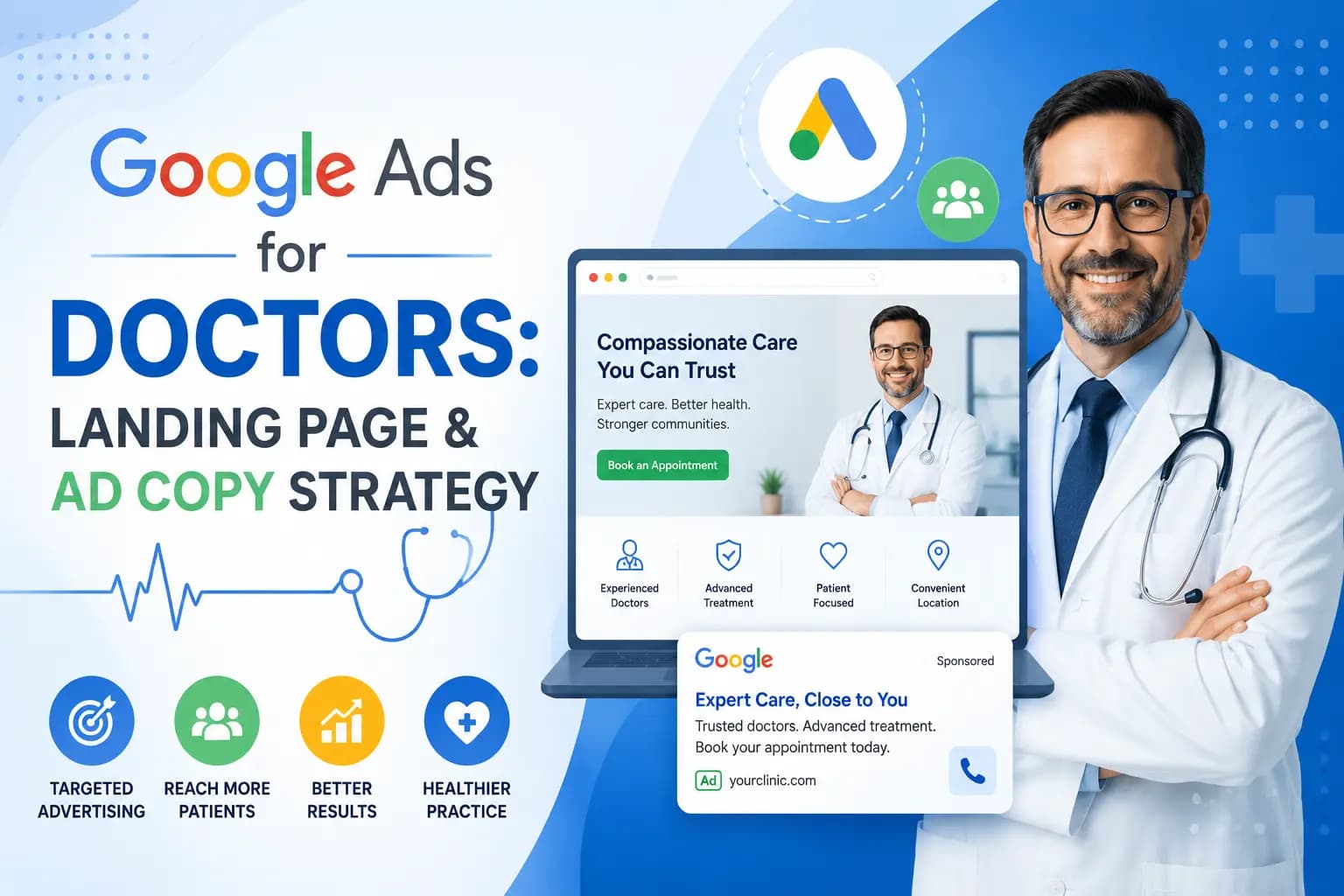
Most doctors are paying for clicks they never turn into patients
We’ll be honest with you: when a medical practice first hands us their Google Ads account, we usually already know what we’re going to find. Ads pointing at the homepage. Ad copy that’s one phrase away from a policy suspension. A budget quietly draining into clicks from people who were never going to book. It’s not that these practices did anything careless — it’s that healthcare is the single hardest vertical to advertise in, and nobody warned them.
Here’s the thing we want you to take away before anything else: for doctors, Google Ads works beautifully when it’s built correctly. The intent is unbeatable. When someone types “cardiologist near me” or “pediatrician accepting new patients,” they’re not browsing — they’re ready to call. Benchmark data for 2026 puts the average conversion rate for physicians and surgeons around 11.6%, with a cost per lead near $57 — roughly 19% below the all-industry average. The demand is right there. The problem is almost never the traffic. It’s what happens after the click.
And that gap is enormous. We’ve seen the same ad send patients to a generic homepage and convert around 2%, then send them to a dedicated, well-built landing page and convert above 11%. Same ad. Same budget. Five times the patients. That single decision — where you send the click — is worth more than almost any bid adjustment you’ll ever make.
So in this guide we’re going to walk you through the exact framework we use: the compliance rules that keep your account alive, the keyword and ad-copy strategy that attracts patients (not researchers), and — the heart of it — the section-by-section landing page outline we build every doctor campaign around. We’ve packed in the ad templates, the schema, and the wireframe so your team or your developer can act on it today.
The chain we’re optimizing: Search → Click → Call → Booked patient. Every practice we work with is really trying to move one metric down that chain — turning clicks into calls into patients. Everything below serves that chain, and nothing else.
Need More Patients from Google Ads?
Whether you’re a private clinic, specialist, dental practice, or multi-location healthcare group, we’ll show you exactly where your campaign is losing patients—and how to fix it.
Book Free ConsultationWhat is Google Ads for doctors?
Google Ads for doctors is a paid-search patient-acquisition channel where a medical practice bids on high-intent search terms — like “orthopedic surgeon near me” — to appear at the top of Google when prospective patients look for care. It combines three moving parts: intent-based keywords, policy-compliant ad copy, and a dedicated, conversion-optimized landing page that turns the click into a booked appointment.
Notice the three parts in that definition, because they map exactly to how we’ll structure the rest of this guide. Most doctors run Google Ads to fill appointment slots — not to sell a product — and that one distinction changes everything about how the campaign should be built. It’s why we treat the landing page and the ad copy as a single connected system, never as separate jobs.
Start here: the compliance layer that keeps your account alive
We’re putting this first on purpose. In most guides, compliance is an afterthought at the bottom. In our experience, it’s the thing that quietly ends campaigns — and once an account is suspended, everything else is academic. Healthcare is the only vertical where a well-meaning phrase in a headline can get your entire account banned. So before we write a single ad, we agree on the rules.
The lines we never cross (and neither should you):
- No unsubstantiated claims. “Guaranteed pain relief,” “cure your condition,” “100% effective” — any promise of a specific clinical outcome triggers disapproval. We keep ad language factual and let credentials do the persuading.
- No targeting on inferred health conditions. Google treats health conditions as sensitive. You can’t build audiences around someone’s diagnosis. We target what people search for, not who we assume they are.
- Careful with restricted categories. Prescription drug terms generally can’t appear in ad copy without certification (a rule Google tightened in a mid-2025 update). Mental health, addiction, and sexual-health services face additional restrictions on both targeting and wording.
- HIPAA governs your tracking. This is the one that surprises people. You can’t pass protected health information into Google’s standard tracking. We configure HIPAA-safe conversion tracking so you still measure results without leaking PHI.
A hard-won lesson we share with every clinic
Most healthcare policy violations give you a warning — often around 7 days — before suspension. But egregious ones (like advertising telehealth without the required certification, or a dangerous claim) can suspend an account instantly, with no warning and sometimes no way back. We’d rather leave a clever headline on the table than gamble your entire advertising channel on it. Compliance isn’t the cautious choice here; it’s the only choice.
Keyword strategy: attract patients, not researchers
The fastest way to waste a doctor’s budget is to bid on informational searches. Someone Googling “what causes lower back pain” is reading, not booking. Someone Googling “back pain doctor near me” is reaching for the phone. We organize every account around a simple intent hierarchy, and we spend where the intent is highest first.
| Intent tier | Example query | Converts? | How we treat it |
|---|---|---|---|
| Provider-intent (best) | “orthopedic surgeon near me” | Very high | Top priority, highest bids |
| Treatment-based | “dental implants cost” | High | Own ad group + matching page |
| Condition-based | “back pain doctor” | Medium | Nurture; separate messaging |
| Symptom / informational | “what is sciatica” | Low | Usually avoid in paid search |
Two rules we apply on top of that hierarchy. First, we target service-based keywords, not diagnosis-based ones — both because they convert better and because Google’s health policy restricts many symptom terms anyway. Second, healthcare is local: most new patients come from within about 5–10 miles of the clinic, so we set a tight geographic radius around the practice address rather than blanketing a whole metro. If you run several offices, the same discipline scales — it’s the core of doing local SEO for multiple locations without cannibalizing your own clinics.
And then there’s the lever almost everyone under-uses: negative keywords. This is where we stop paying for the wrong clicks. Here’s the starter list we add to nearly every medical account on day one.
# Negative keyword starter list (medical practices)
# Add as phrase/broad negatives at campaign level

free            jobs            salary
school          training        "how to become"
"what is"       symptoms        "home remedy"
DIY             wikipedia       reviews
lawsuit         malpractice     cheap
course          certification   "near me jobs"
Ad copy strategy: specific, credible, compliant
Good medical ad copy does three jobs at once: it earns the click, it stays inside policy, and it matches the landing page so tightly that Quality Score rewards you with a lower cost per click. We build every Responsive Search Ad (RSA) around specificity — because “Board-Certified Dermatologist in Austin” beats “Top Dermatology Services” every time. One is verifiable and local; the other is vague marketing noise. It’s the same specificity that makes a page like our SEO for dentists work — a named specialty in a named place.
How we structure a Responsive Search Ad
We give Google a strong asset mix but keep control where compliance matters. Our default recipe: at least three headlines with the specialty and city, two with trust signals (credentials, ratings, “accepting new patients”), and two with clear calls to action. Then we pin our most compliant, best-performing headline to Position 1 so Google can never assemble an awkward — or non-compliant — combination on its own.
RSA — ad group: "Knee Surgeon | Austin"

Headlines:
  [PIN 1] Board-Certified Knee Surgeon      ← pinned, compliant
          Knee Surgery in Austin, TX
          Same-Week Appointments
          Now Accepting New Patients
          Most Major Insurance Accepted
          Rated 4.9★ by 300+ Patients   (only if genuinely true)
          Schedule Your Consultation
          Treatment for Chronic Knee Pain

Descriptions:
  Board-certified orthopedic care in Austin. Same-week
  appointments and most major insurance accepted.
  Book your consultation online in under 2 minutes.
  Trusted by Austin families. Call or schedule today.
Why we pin — and why we never write “guaranteed”
Notice what’s missing: no “guaranteed relief,” no “best surgeon,” no outcome promises. Every headline is either verifiable (board-certified, city, insurance) or a plain call to action. That’s not timidity — it’s what keeps the account running. And we only ever put a star rating in copy if the practice can actually substantiate it.
Don’t forget the assets (ad extensions). We always add sitelinks (Services, About the Doctor, Insurance, Contact), callouts (“Same-Day Appointments,” “Online Booking”), a call asset with call tracking, and a location asset. In healthcare, roughly 40% or more of conversions happen by phone — so making the number one tap away is not optional.
The landing page SEO outline (the part that actually converts)
This is where the money is made or lost. We’ll say it plainly: never send paid traffic to your homepage. We build one dedicated landing page per ad group, and its headline mirrors the ad copy word-for-word — that “message match” is what lifts Quality Score, and landing page experience is weighted slightly higher than ad relevance in how Google scores you. Pages with above-average landing page experience routinely see CPCs well below average. Here’s the exact section-by-section outline we build every doctor page around.
1. Above the fold — answer “yes, you’re in the right place” in 3 seconds
Headline that mirrors the ad (“Board-Certified Knee Surgeon in Austin”). One-line subhead with the core promise. A prominent click-to-call button and a short booking form, both visible without scrolling. Trust signals right here: board certification, years in practice, “accepting new patients,” and a real review rating. On mobile, the phone number is a tap.
2. The booking form — three fields, no more
Every extra field costs you patients. We keep it to name, phone, and primary concern. That’s it. The goal is a booked call, not a complete medical history.
Appointment request

  • Full name        [______________]
  • Phone number     [______________]
  • Reason / concern [______________]   (optional dropdown)

  [ Request My Appointment ]   ← single, high-contrast CTA

  ☎  Prefer to talk now? (555) 123-4567   ← click-to-call
3. Trust & credibility — the reason they choose you
Board certifications and affiliations, the doctor’s photo and short bio, genuine patient reviews, insurance networks accepted, and any relevant recognitions. For a medical (YMYL) page, this section is doing double duty: it convinces the patient AND it signals E-E-A-T to Google and the AI search engines that increasingly answer health questions. Real credentials, presented clearly, are the whole game.
4. The service explained — briefly, in the patient’s language
A short, scannable explanation of the treatment or service, written the way a patient would ask about it. This is also your SEO layer: it’s where the keyword lives naturally, and where you answer the two or three questions every patient has before booking (“Does it hurt? How long is recovery? Do you take my insurance?”).
5. Social proof — specific, not generic
Real testimonials with a first name and a specific outcome beat a wall of five-star icons. We keep them honest and verifiable — never invented — because in healthcare, a claim you can’t back up is a liability, not an asset.
6. Second CTA + logistics
Repeat the booking prompt after the trust content, and add the practical details that remove friction: map and address, hours, parking, “we’ll call you back within X hours.” Then stop. A landing page has one job — don’t bury the CTA under a full-site navigation menu that lets people wander off. The same single-focus discipline is what makes local service pages like our SEO for medical spas convert.
The technical layer — speed, mobile, and local schema
A landing page that loads slowly loses patients and Quality Score at the same time. We target a load time under three seconds (ideally closer to one — that’s where we’ve seen conversion jump), design mobile-first, and hold Core Web Vitals in the green: LCP under 2.5s, INP under 200ms, CLS under 0.1. Then we add local structured data so Google understands exactly who and where you are.
<script type="application/ld+json">
{
  "@context": "https://schema.org",
  "@type": "Physician",
  "name": "Austin Orthopedic Associates",
  "medicalSpecialty": "Orthopedic",
  "address": {
    "@type": "PostalAddress",
    "streetAddress": "123 Health Way",
    "addressLocality": "Austin", "addressRegion": "TX"
  },
  "telephone": "+1-555-123-4567",
  "url": "https://yourclinic.com/knee-surgery"
  // add aggregateRating ONLY if it reflects real reviews
}
</script>
Conversion tracking & Quality Score: what we measure
We tell every client the same thing: if you’re not tracking conversions, every optimization you make is a guess. A conversion here is a completed appointment request or a tracked inbound call — not a click. We set this up before the first ad runs, using HIPAA-safe methods that keep protected health information out of the ad platform. Then we watch Quality Score, because it’s Google’s own scorecard for how well your keywords, ads, and landing page fit together — and a higher score directly lowers your cost per click. When the three line up (keyword → ad → page all about “knee surgery”), everything gets cheaper. When they drift apart, you pay a tax on every click.
A realistic timeline (so nobody panics in week one)
From our experience launching healthcare accounts: first leads typically arrive within 2–4 days, Smart Bidding needs about 2–4 weeks to learn, and cost per lead usually stabilizes around the 30–60 day mark. We don’t judge a campaign by its first weekend — and we ask clients not to either.
The mistakes we fix most often
- Sending ads to the homepage. The single most expensive error — it can cut your conversion rate by 4–5x versus a dedicated page.
- Outcome-promising ad copy. “Guaranteed results” feels persuasive and is a fast track to disapproval or suspension.
- Broad match with no negatives. The account bleeds budget on job seekers, students, and researchers who’ll never book.
- Chasing symptom keywords. High volume, low intent, and often policy-restricted. We’d rather have ten booking-ready clicks than a thousand curious ones.
- No conversion tracking (or non-compliant tracking). Either you’re flying blind, or you’re risking a HIPAA problem. Neither is acceptable.
- A form that asks for everything. Ten fields to “qualify” a lead is ten reasons to leave. Name, phone, concern — done.
Benchmarks & tools we work with
| What we track | Healthcare reference point (2026) |
|---|---|
| Avg. conversion rate (physicians/surgeons) | ~11.6% |
| Avg. cost per lead | ~$57 (about 19% below all-industry avg) |
| Homepage vs. dedicated landing page | ~2% vs. 11%+ conversion |
| Share of conversions by phone | 40%+ |
| Core Web Vitals targets | LCP <2.5s · INP <200ms · CLS <0.1 |
Tools we lean on: Google Ads (with proper conversion tracking), Google Business Profile for local, PageSpeed Insights and Chrome UX data for the landing page, and call-tracking that’s configured to stay HIPAA-safe. Benchmarks vary by specialty and city, so treat these as a compass, not a guarantee — and if you want a starting number for your own market, our SEO cost calculator is a fast way to sanity-check a budget before you commit.
Why bring in an expert instead of doing it yourself?
You could build all of this yourself — we’ve deliberately given you the outline, the templates, and the schema to do it. So we’ll be straight about where a partner actually earns their keep. It’s the compliance risk (one wrong phrase can suspend the account you depend on for patients), the prioritization (which fix moves cost per patient first on your account, not a generic one), and the HIPAA-safe tracking most generalist agencies get wrong. We’ve seen more than one practice lose its account to an agency that knew Google Ads but didn’t know healthcare. In this vertical, that distinction is everything — and it’s the same reason we built a healthcare-fluent team rather than treating medical like every other client.
Why practices work with SEO Circular
We built our healthcare practice around exactly this problem: turning high-intent medical searches into booked appointments, safely. We treat ad copy and landing page as one connected system, we configure compliant tracking from day one, and we report on the metric that matters to you — patients, not vanity clicks.
- Healthcare-fluent — we know Google’s health policy and HIPAA constraints cold, so your account stays live.
- Ad + landing page under one roof — message match, Quality Score, and conversion handled together, not in silos.
- Honest reporting — real, verifiable numbers. We never dress up results with invented case-study data.
- New York–based, global reach — our New York SEO team supports practices across markets, with a delivery team behind them.
We turn medical searches into booked patients — compliantly, and at a cost per lead you can actually grow on.
Let’s fill your schedule, not just your click count
You now have the full playbook — the compliance rules, the keyword and ad strategy, and the landing page outline we build every doctor campaign around. If you’d rather we build and run it with you, that’s exactly what we do. Send us your practice and target area, and we’ll audit your current setup and map the fastest path to booked patients.
Book your free Google Ads audit — talk today, book patients tomorrow.
Frequently Asked Questions
Can doctors even advertise on Google Ads?
Yes. General medical practice advertising is fully allowed. Google restricts specific categories — prescription drug terms, certain mental-health and addiction services, and targeting based on health conditions — and some ad types need certification. As long as you follow the Healthcare and Medicines policy and HIPAA, doctors can and do run very effective campaigns.
Why shouldn’t I send Google Ads traffic to my homepage?
Because it converts far worse. In our experience and across industry data, homepages convert medical paid traffic around 2%, while a dedicated landing page matched to the ad converts 11% or more. The homepage makes people hunt for the next step; a dedicated page makes booking the obvious action.
How much does Google Ads cost for a medical practice?
It varies by specialty and city, but 2026 benchmarks put the average cost per lead for physicians around $57 — roughly 19% below the all-industry average — at an average conversion rate near 11.6%. Competitive specialties in large metros cost more per click; a tight local radius and strong Quality Score bring the effective cost down.
What ad copy gets a doctor’s account suspended?
Unsubstantiated or outcome-promising language is the big one — “guaranteed relief,” “cure,” “100% effective.” Prescription drug names without certification and anything exploiting a health condition also trigger it. We keep copy factual and credential-led, and pin a compliant headline to Position 1.
How do I track conversions without breaking HIPAA?
You configure tracking so no protected health information reaches Google — tracking the appointment request or call as a conversion event without passing patient details. It takes deliberate setup, which is exactly why we do it before the first ad ever runs.
How fast will I see results?
Usually first leads within 2–4 days on a properly configured account, with Smart Bidding learning over 2–4 weeks and cost per lead stabilizing around 30–60 days. Early numbers are noisy — we optimize on the trend, not the first weekend.