In 2026, the Environmental, Social, and Governance (ESG) consulting market is projected to grow to $13.56 billion.
This data shows us how important the ESG consulting market is becoming every single day. ESG (Environmental, Social and Governance) framework is a set of standards for how a company operates in regard to the planet and its people.
On the other hand, ESG consulting firms help businesses understand their environmental, social, and governance aspects. But often, ESG consulting firms struggle to get clients due to factors like improper marketing.
To secure clients through Google, ESG firms must focus on high intent, technical and data driven search strategies, EEAT content strategy and alignment with regulations like CSRD and SEC rules etc.
SEO Circular works with B2B consulting firms including ESG consulting firms to build enterprise grade SEO strategies that turn organic search into a predictable client pipeline. If that is what your firm needs then book a strategy call and we will reach out to you.
Want ESG Consultants Rank, Grow & Convert?
We help ESG consulting firms increase visibility, attract high-intent clients, and turn Google search traffic into real business opportunities through enterprise SEO, GEO, and content-driven growth strategies.
Book ESG SEO Strategy Call
Key Takeaways
1) Most ESG consulting websites are not optimized, which makes this an early-mover opportunity for firms that act before their competitors do.
2) Keyword research must reflect how clients describe their problems, not how consultants describe their services.
3) Each core service needs its own dedicated, keyword-focused page rather than being grouped under a single generic services section.
4) Consistent content publishing on regulatory topics and industry-specific challenges is the fastest path to building topical authority in the ESG space.
5) A small number of high-quality backlinks from relevant ESG publications and industry associations will outperform hundreds of generic links in a niche consulting market.
What is ESG?
ESG means Environmental, Social, and Governance. It is a framework used by investors and businesses to acknowledge a company’s sustainability, ethical impact and risk management practices beyond traditional financial metrics. It also helps in evaluating how a company protects the planet, manages relationships, and governs itself. ESG is important because it is a set of standards for how a company operates in regard to the planet and it’s people.
Three Pillars Of ESG
1) Environmental
Focuses on the impact a certain company is doing on the planet. It also includes things like climate change, energy efficiency, carbon emissions and biodiversity.
2) Social
This aspect addresses how a company manages relationships with employees, suppliers, customers and communities covering labor practices, diversity, health safety and human rights.
3) Governance
Governance relates to a company’s leadership, internal audits, shareholder rights, and transparency ensuring accountability and ethical behavior.
These three pillars are essential to modern corporate strategy, helping to mitigate risks like regulatory penalties and reputational damage.
Strategies That Help ESG Consulting Firms To Get Clients Through Google
Let’s dive right into the strategies that can actually help ESG consulting firms in getting clients sooner and expanding their overall business.
Start With An Audit
Begin with SEO audit by analyzing what your ESG business website is lacking at the moment and identify those errors in order to work on them later. Look for errors and fixes in your website’s technical side along with on-page, off -page SEO to identify issues that are currently present.
High Value keywords For ESG Firms to target in 2026
High value keywords For ESG Firms to target in 2026
- “ESG reporting consultant” paired with your city, region and industry focus.
- “CSRD compliance consultant” which is seeing a sharp rise in searches due to new European regulations.
- “Sustainability consulting for (industry type)” such as real estate, logistics or manufacturing.
- “ESG due diligence services” for firms serving private equity or investment clients.
- “Net zero strategy consultant” for firms working on emissions and decarbonization goals.
The principle is simple. Match what your firm actually does to the exact language your clients use when they need it.
| SEO Area | Purpose | Business Impact |
|---|---|---|
| Technical SEO | Improve crawlability and site performance | Better Google rankings |
| Content Marketing | Build topical authority | More inbound leads |
| Local SEO | Rank in city-based searches | Regional client acquisition |
| GEO Optimization | Improve AI visibility | AI-generated mentions |
| Digital PR | Build authority and backlinks | Trust + higher rankings |
| Paid Search | Generate immediate leads | Faster pipeline growth |
On-Page SEO Basics That ESG Firms are getting wrong
On page SEO is about making each page on your site immediately clear to both Google and a first time visitor. For most ESG consulting websites, fixing this alone moves the table before anything else in the room.
Your homepage should answer three questions in the first two paragraphs:
- Who you help?
- What you help them with?
- Where you work?
Most ESG homepages lead with mission statements and values which tells Google very little about what the page is actually for.
Each core service on the website deserves it’s own dedicated page. Do not group ESG strategy, sustainability reporting, carbon reporting, carbon accounting and stakeholder engagement onto one generic services page. Each service page gets it’s own heading structure and it’s own explanation of who the service is for and what it involves.
Key Things To Check On Every Important Page:
- The page title should include the primary keyword near the front, for example “ESG Reporting Consultant For UK Businesses.”
- The meta description should summarize the page clearly and include a natural call to action.
- Headings should use H2 and H3 structure with keywords appearing naturally.
- Every page should link internally to at least one related service or piece of content.
- A clear contact option should appear on every service page, not just the contact page.
Helpful Resources for ESG Firms: Sell Carbon Credits & Make Money
Off Page
Off page SEO is everything that happens outside your own website that signals to Google your firm is credible, relevant and worth ranking. For ESG consulting firms this goes well beyond just getting backlinks.
The most important off-page signals to build in 2026:
Digital PR And Media Mentions
Getting your own firm or your consultants quoted in ESG publications, sustainability trade magazines or mainstream business media sends strong authority signals to Google even when the mention does not include a direct link. Unlinked brand mentions still contribute to how Google perceives your firm’s reputation.
Speaking engagement and event listings
When your firm presents at an ESG conference sustainability summit or industry webinar, event pages almost always link back to your website. These are highly relevant, editorially earned links that carry real weight.
Podcast Appearances
Sustainability and business podcasts regularly feature consulting experts. A guest appearance typically includes a link in the show notes and reaches an audience of exactly the decision makers you want to attract.
Client Reviews On Google Business Profile
Reviews are an off-page trust signal that directly influences local search rankings. Firms with consistent, detailed reviews from real clients rank higher in local ESG-related searches than firms with none.
Association And Directory Listings
Membership pages of ESG bodies, sustainability networks and professional associations pass genuine relevance signals because Google already trusts these domains.
Community Contributions
Thoughtful contributions to ESG forums, LinkedIn groups and sustainability communities build brand citations and drive branded searches over time. When people search your firm’s name directly then Google reads that as a authority signal.
Content Strategy For ESG Firms
Google rewards websites that demonstrate consistent, genuine expertise on a topic over time. But in 2026, it is not about publishing regularly.
Google uses a framework called E-E-A-T which stands for Experiences, Expertise, Authoritativeness and Trustworthiness. For ESG consulting firms, this framework matters more than in most industries because Google treats regulatory and sustainability content with higher scrutiny.
What E-E-A-T Means Practically For Your ESG Firm?
Every piece of content should have a named author with a proper bio that lists their ESG credentials, years of experience and a link to their LinkedIn profile. Generic “admin” authored content signals nothing to Google. Cite real sources. Reference government regulations, official reporting frameworks like TCFD and CSRD and credible third party data. This tells Google that content is based on facts and is grounded not an opinion.
Avoid thin content that gives surface level answers. A 400 words blog on “what is ESG” written without depth will hurt your authority more than help it. Publish original insights where possible. Survey data related to property, client outcomes trends or your firm’s own framework for approaching ESG strategy earns both the trust and backlinks naturally.
The content Types That Work Best For ESG Firms in 2026
Explainers
Regulatory explainers covering frameworks like CSRD, TCFD, and SEC climate disclosure rules. Finance, legal and operations teams across industries are searching for these topics in large numbers. A clear, practical explainer on each one written by a name ESC professional position your firm as the expert they eventually hire.
Guides
Industry specific guides that speak directly to a segment of your ideal client. A piece like “ESG Compliance Checklist For Real Estate Developers” or “How Logistics Companies Can Prepare for Scope 3 Reporting” ranks faster because competition is lower and the reader feels it was written specifically for them.
Discover More Growth Strategies: Carbon Trading Platforms Model & Revenue Streams
Case Based Content Or Case Studies
Case based content written without naming clients where confidentiality is needed. Describe the type of problem, your approach and the outcome. This builds trust with readers and reinforces your E-E-A-T signals with Google at the same time.
One thing most ESG firms miss
Publishing two blogs and waiting does not work. Firms that publish consistently even once or twice a month build a compounding advantage. Every piece you add makes your existing content stronger, and your competitors fall behind.
Paid Search for ESG Consulting Firms
Paid search means running ads on Google so that your firm appears at the top of search results immediately for keywords your ideal clients are already searching for.
For ESG consulting firms it works like this. You bid on high-intent keywords like “ESG strategy consultant” or “CSRD compliance services”, and your ad appears above organic results when someone searches those terms. You pay only when someone clicks.
It is the fastest way to get in front of decision makers while your organic SEO is still getting structured in the background. Instead of waiting six months to rank organically for a competitive keyword, a paid campaign puts you there from day one.
The most effective way ESG firms use paid search is to run targeted campaigns around their highest-value services, test which messaging drives the most enquiries and then use those learnings to strengthen their organic content and service pages at the same time.
Used this way, paid search and SEO work together rather than compete for the same budget.
Estimate the SEO budget required to grow your ESG consulting firm through Google, AI search optimization, and enterprise SEO strategies.
Local SEO
If your firm serves clients in a specific country, region or city, local SEO matters more than most ESG consulting firms realize.
Start with your Google Business Profile. Even if your work primarily remotely or nationally, a complete and accurate profile increases visibility for searches like “ESG consultant in London”, “sustainability consulting firm near me”, or “carbon credit consulting company“. Your profile should clearly list your services, include a keyword-informed description, and have a handful of genuine client reviews.
International SEO For ESG Consulting Firms
If your firm works with clients across multiple countries, then international SEO ensures that Google shows the right version of your website to the right audience in the right location.
For ESG consulting firms, this matters because regulations vary significantly by region. A client in the URL searching “TCFD reporting consultant” and a client needs to understand your firm serves both.
Key Points To Know
- Use hreflang tags to tell Google which pages are meant for which country and language. Without this, Google may show the wrong page to the wrong audience.
- Create region-specific service pages where relevant , for example a dedicated page for ESG consulting in the EU versus the UK versus the US.
- Target region specific regulatory keywords because ESG compliance requirements differ by geography and so do the search terms clients use.
- Build backlinks from publications and associations in each target market, not just your home country.
Technical Fix
You need to have these technical fixes in your website in order to provide better user experience and overall optimization. Consider these important factors while doing technical fix of your website:
- Your website should load in under three seconds on mobile. Google measures this directly and it affects your ranking.
- Every important page should be indexable, meaning Google can find and read it properly.
- Check Google Search Console for any crawl errors or blocked pages.
- Your site should run on HTTPS. Without it, browsers warn visitors and Google treats the site as less trustworthy.
- Your site structure should be clean with each services reachable within two clicks from the homepage.
Building Backlinks Without a Big Budget
Backlinks from other websites pointing to yours remain one of Google’s strongest ranking signals. For ESG consulting firms, this is more achievable than it sounds because the ESG space has a strong ecosystem of publications, associations, and professional networks.
Practical ways ESG firms earn relevant backlinks in 2026:
- Guest articles in ESG-focused publications and sustainability trade magazines. Many actively seek practitioner contributions, and a byline usually includes a link to your website.
- Directory and association listings through ESG industry bodies, sustainability network hubs, and professional association member pages. These are often free, quick to get, and carry genuine relevance.
- Expert source contributions on platforms where journalists look for quotes from subject matter experts. A quote in a relevant article often comes with a backlink and adds credibility beyond SEO value alone.
- One or two linkable assets such as a downloadable ESG framework comparison, a reporting checklist, or a glossary of sustainability acronyms. Reference-style resources attract links passively over time without ongoing effort.
- Partnerships with complementary service providers like law firms, audit companies, or investor relations consultancies. Firms serving similar clients often share audiences and a mutual mention or resource link benefits both sides.
In a niche like ESG consulting, fifteen to twenty highly relevant backlinks can outperform hundreds of generic ones. Quality and relevance matter far more than volume.
GEO for ESG Consulting Firms
GEO stands for Generative Engine Optimization. It is the practice of optimizing your content so that AI-powered tools like ChatGPT, Google AI Overviews, and Perplexity mention and recommend your firm when someone asks them a question related to ESG consulting.
In 2026, a growing number of ESG decision makers are skipping traditional search and asking AI tools directly. Questions like “which ESG consulting firms specialize in CSRD compliance” or “best sustainability consultants for manufacturing companies” are being answered by AI, not just Google. If your firm is not optimized for this, you are invisible to an increasingly large segment of your target audience.
Key points to know:
- Structure your content in a clear question and answer format. AI tools pull answers from content that directly addresses specific questions, so writing in this format increases the chance of being cited.
- Build topical authority across the full ESG subject area. AI engines favor sources that cover a topic comprehensively, not firms with one or two pages on the subject.
- Earn mentions from credible third party sources. AI tools are more likely to recommend firms that are referenced by trusted publications, associations, and industry bodies.
- Keep your firm’s information consistent across all platforms. Your website, LinkedIn, directories, and media mentions should all describe your services in the same clear language so AI tools can confidently surface your firm as a relevant answer.
Build Long-Term Visibility Before Competitors Catch Up
The ESG consulting market is becoming more competitive every year, and firms that invest in SEO, GEO, AI search optimization, and authority building today will dominate search visibility tomorrow. From technical SEO and ESG content strategy to digital PR and enterprise SEO execution, SEO Circular helps consulting firms turn Google into a scalable client acquisition channel.
→ Get Custom ESG SEO RoadmapConclusion
Getting clients through Google in 2026 comes down to showing up clearly and credibly when the right person is searching. Most ESG consulting firms have not done the foundational work, which means there is still a real opportunity for firms that act now.
Fix your service pages, get the keyword targeting right, publish content consistently, resolve any technical issues, and build backlinks from sources your clients already trust. Each of these compounds over time. Firms that start this process today will be the ones competitors are trying to catch up with by 2027.
Top Questions About ESG Lead Generation
Most firms see meaningful ranking movement between three and six months, with results compounding strongly through the twelve-month mark.
Firms with a regional or country-specific client base should prioritize local SEO first, then expand to broader terms as authority builds.
Google treats ESG and sustainability content under its expertise and trustworthiness guidelines, which means demonstrating real credentials and consistent quality matters more than in general industries.
Service pages are important, but blog content helps ESG consulting firms build topical authority and rank for more competitive Google searches. Educational articles also attract decision-makers researching ESG compliance, reporting, and sustainability solutions, helping generate qualified leads organically.
In-house works well once a firm has a clear strategy in place. An experienced agency typically builds the foundation faster and avoids the trial-and-error phase that costs early-stage SEO programs months of progress.
If you have been following digital marketing news lately then you have probably come across three terms being thrown around a lot: SEO, GEO, and LLMO. Some people use them interchangeably. Others treat them like completely separate disciplines. The truth is somewhere in between and understanding the difference could be one of the most important things you do for your brand’s visibility in 2026 and beyond.
Search is no longer just Google. People are now getting answers from AI chatbots like ChatGPT and Perplexity, from voice assistants and from AI generated summaries sitting right at the top of search results pages. Each of these surfaces plays by slightly different rules and that is exactly what these three terms are about.
At SEO Circular, we help enterprise brands build visibility across all these surfaces. Whether you need a traditional SEO strategy, content created to be cited by AI engines or a full search governance plan across global markets, our enterprise SEO services are built to get you there.
Want your brand to appear not just in Google rankings, but also inside AI-generated answers and ChatGPT recommendations?
At SEO Circular, we help enterprise brands build visibility across SEO, GEO, and LLMO through technical SEO, AI-ready content, digital PR, and authority-driven search strategies designed for the future of AI search. From safe search visibility to AI search optimization, we build SEO systems designed for long-term traffic, signups, and revenue growth.
Get Custom SEO, GEO & LLMO Solutions →
Key Takeaways
- SEO, GEO, and LLMO focus on three different surfaces: traditional search results, AI-generated search summaries, and conversational LLM outputs.
- GEO and LLMO are both new disciplines, but they are not the same. GEO is about AI search pages; LLMO is about what AI chatbots say in conversation.
- All three disciplines share a common foundation. Strong technical SEO, deep content, and brand authority benefit your performance across every surface simultaneously.
- Brand entity clarity is critical for LLMO. How your brand is described and referenced across the internet shapes what LLMs say about you in conversation.
- The most efficient strategy is not three separate programs. It is one unified content and authority program built to perform across SEO, GEO, and LLMO at the same time.
What Do SEO, GEO and LLMO Actually Mean?
Let’s have a look at of SEO, GEO and LLMO:
1) SEO
Search Engine Optimization is the practice of making your website rank higher on traditional search engines like Google and Bing. It has been around for over two decades and involves things like using the right keywords, earning backlinks from other websites, fixing technical issues on your site and writing content that matches what people are searching for. The end goal should be that more people find your website by searching and more of those people turn into customers.
2) GEO
Generative engine optimization is a newer discipline focused on getting your content cited or referenced inside AI-powered search results. Think of google AI Overviews, Perplexity or Microsoft Copilot. These tools generate a summarized answer instead of just listing ten blue links. GEO is about making sure your brand is one of the sources the AI trusts.
3) LLMO
Large language model optimization is about being referenced inside the outputs of large language models themselves, like ChatGPT, Claude or Gemini. When someone asks one of these tools “what is the best project management software” or “who are the top enterprise SEO agencies”, LLMO is what determines whether your brand gets named in that response. Unlike GEO, there is no search results page here. It is a conversation and the AI either knows your brand or it does not.
The Difference Between SEO, GEO, and LLMO
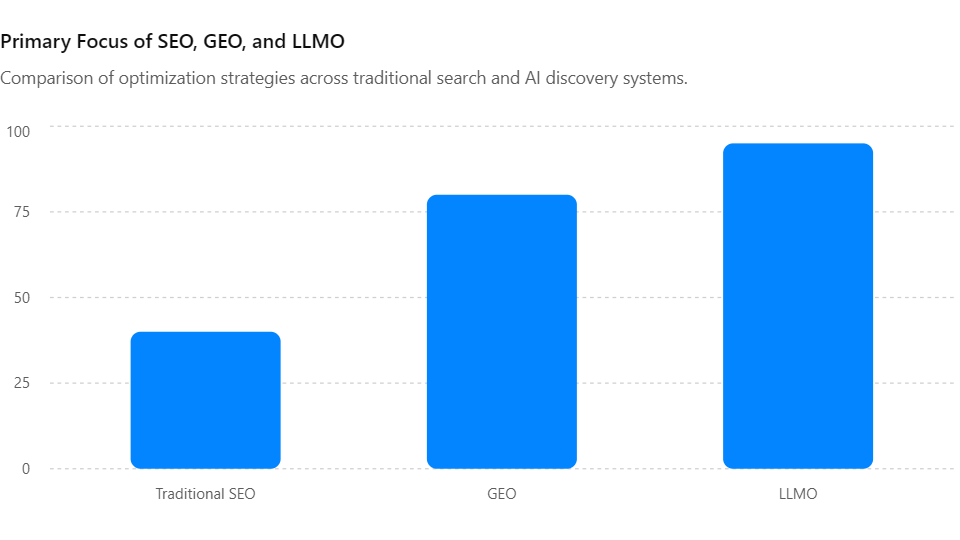
Here is a beginner friendly comparison of all three, so you can see exactly where they diverge.
| Factor | SEO | GEO | LLMO |
|---|
| What it targets? | Google, Bing search results | AI-powered search engines (Perplexity, Google AI Overviews) | AI chatbots (ChatGPT, Claude, Gemini) |
| What “ranking” means? | Appearing on page one of search results | Being cited as a source in an AI-generated answer | Being mentioned by name in an LLM response |
| Main signals used | Keywords, backlinks, technical health, page experience | Structured data, authority, source credibility, citation history | Brand mentions across the web, training data presence, trusted sources |
| Content goal | Match search intent, answer queries | Be a credible, citable source for AI summaries | Be a known, referenced entity in your category |
| How are results measured? | Rankings, organic traffic, conversions | Source citations in AI summaries, impression share | Brand name appearance in AI responses |
| How new is it? | 25+ years old, well established | 2 to 3 years old, rapidly evolving | 1 to 2 years old, still being defined |
| Who does it matter most for? | Almost every business with a website | Brands in research-heavy or informational industries | Brands competing for awareness and category ownership |
The key thing to notice here is that these are three different surfaces. Google’s traditional search results, Google’s AI Overview box, and ChatGPT conversation are three completely different places. Each one requires a slightly different approach to show up.
Read More Insights and Tips: AI Chatbot Marketing Strategy For B2B Businesses
How SEO, GEO and LLMO Work in Real Life
Let’s look at a practical example of how all three disciplines work together for a SaaS company selling enterprise project management software. While the customer intent stays the same, the discovery surface changes completely.
| Scenario | SEO | GEO | LLMO |
|---|---|---|---|
| User Behavior | User searches on Google | User searches on AI-powered search engines | User asks an AI chatbot directly |
| Example Query | “Best enterprise project management software” | “Top tools for enterprise project management” | “What project management software do you recommend for large remote teams?” |
| Platform | Google Search, Bing | Google AI Overviews, Perplexity, Copilot | ChatGPT, Gemini, Claude |
| What Happens | The SaaS company ranks organically in search results | The AI engine cites the company inside generated summaries | The AI assistant recommends the company conversationally |
| Main Optimization Focus | Keywords, backlinks, technical SEO | Structured content, authority, citations | Brand mentions, entity authority, web-wide trust signals |
| Success Metric | Organic traffic and rankings | AI citations and visibility | Brand mentions in LLM responses |
| User Experience | Clicking search results | Reading AI-generated summaries | Having a direct conversation with AI |
What This Means for Brands
In all three situations, users are searching for the same solution, but the path to discovery is different. Traditional SEO helps brands rank in search engines. GEO helps brands appear inside AI-generated search summaries. LLMO helps brands become part of AI conversations and recommendations.
The brands dominating search visibility in 2026 are not optimizing for just Google rankings anymore. They are building authority across traditional search, AI-powered search engines, and conversational large language models simultaneously.
Do You Need SEO, GEO, LLMO, or All Three?
The honest answer for most growing Robotics businesses and other businesses is eventually, all three. But where you start depends on your current situation.
- Start with SEO if you are not yet generating meaningful organic traffic from Google. Until you have a healthy technical foundation, strong content and a growing backlink profile, the other two disciplines will have limited overall impact.
- Add GEO to your strategy if you are in an industry where people research before buying. If your customers ask questions before making decisions and AI-powered search is giving them answers, you need to be one of the sources those answers come from.
- Give priority LLMO if your sales cycle involves buyers asking AI chatbots for recommendations. B2B buyers, enterprise decision-makers, and research-driven consumers increasingly ask LLMs to help them shortlist vendors and solutions.
- Pursue all three together if you are at an enterprise scale. At this level, your brand needs to be visible wherever your buyers are looking, whether that is a traditional Google search, an AI Overview, or a ChatGPT conversation.
The good news is that strong SEO provides a foundation that benefits GEO and LLMO too. High-authority content, a trusted domain and a clear brand entity all serve you across all three disciplines.
How SEO, GEO, and LLMO Work Together?
These three disciplines are not separate from each other. They share a common foundation and the work you do for one almost always lifts the other two. Here are the five most important things to understand about how they connect.
- SEO is the ground floor. Without it, GEO and LLMO have nothing to build on.
- One strong piece of content can rank on Google, get shown in AI Overviews and appear in ChatGPT responses all at once.
- Each discipline rewards different signals, so SEO, GEO and LLMO need slightly different content and authority techniques.
- The authority you build today is what LLMs learn from tomorrow, making off-page investment a long-term visibility asset.
- One unified program beats three separate ones. Build all three at once then fill gaps where needed.
Explore Complete Research: Generative AI Optimization Techniques to Increase AI Visibility
How to Optimize Content for Google AI Overviews, ChatGPT and Perplexity
Optimizing all three does not mean functioning three completely separate programs. It means building a unified content and authority strategy that is deliberately designed to perform across every surface. Here is how to approach it step by step:
1) Start with a strong technical SEO foundation
Before GEO or LLMO tactics make any meaningful difference, your site needs to be technically structured. This means fast load times, clean site architecture, proper crawlability, and no broken pages or duplicate content issues. AI-powered search tools and LLMs draw from the same web your site lives on. If Google cannot easily read and understand your site, neither can the AI systems layered on top of it.
2) Build topic authority through deep, structured content
Choose the topics your brand should own and go deep on them. That means detailed guides, original research, detailed case studies and content that answers questions at every stage of the buying journey. Structured content with clear headings, logical flow, and well-labeled sections is easier for AI systems to read and extract from. This directly serves SEO, GEO and LLMO at the same time.
3) Implement schema markup across key page types
Schema markup tells search engines and AI tools exactly what type of content is on a page, who wrote it, what it is about and what entity it belongs to. For GEO specifically, FAQ schema, HowTo schema, and Article schema are particularly valuable. They make your content machine-readable in a way that AI search engines can pull directly into their generated answers.
4) Build your brand entity across the open web
For LLMO, the single most important thing you can do is make your brand clearly and consistently described across as many trusted web sources as possible. This means keeping your website, LinkedIn profile, Crunchbase listing, industry directory entries, and press coverage all aligned on the same core description of who you are, what you do, and who you serve. LLMs build their understanding of your brand from these sources, and inconsistency or gaps in that picture will hurt you.
5) Invest in digital PR and authoritative external coverage
Being mentioned or cited in respected publications, industry reports, and editorial content does three things at once. It builds backlinks for SEO. It signals credibility to AI-powered search engines for GEO. And it adds your brand to the pool of web sources that LLMs reference, which is the core of LLMO. A single feature in a high-authority publication can move the needle across all three surfaces.
6) Create content that AI systems naturally want to cite
AI-powered search tools and LLMs favor content that is factually grounded, clearly attributed, and written with genuine depth. Content that includes original data, specific examples, named experts, and clear sourcing is far more likely to be extracted and cited than generic content that could have been written by anyone. Write with the goal of being the most credible, specific answer to a question in your space.
7) Monitor your presence across all three surfaces
Tracking performance means looking beyond Google rankings. Check regularly whether your brand is appearing in AI Overviews for your target topics. Ask ChatGPT Agency, Perplexity, and Gemini the questions your buyers are asking and see whether your brand comes up. Track citation share in AI-generated answers. This gives you a complete picture of where you are visible and where the gaps are, so you can adjust your strategy accordingly.
Wrapping UP
SEO, GEO, and LLMO are not three separate problems to solve. They are three surfaces of the same visibility challenge indeed. The brands that will win in 2026 and beyond are not running three disconnected programs. They are building one strong foundation of technical SEO, deep content, brand authority, and SEO for AI Startups that performs across traditional search, AI generated summaries, and LLM conversations at the same time. Searching is fragmenting fast. The brands that adapt now will be the ones buyers find, regardless of where or how they are searching.
Commonly Asked Questions
They overlap significantly. AEO broadly covers optimization for any system that generates direct answers, while LLMO is specifically focused on large language models like ChatGPT, Claude, and Gemini.
Yes. SEO remains the highest-volume organic channel and provides the trust signals that both GEO and LLMO rely on. A weak SEO foundation limits performance across all three disciplines.
Any brand can benefit, but larger brands with more existing authority tend to see faster results. Smaller brands should build their SEO foundation first before investing heavily in GEO and LLMO.
You can manually test by asking ChatGPT, Claude, Perplexity, and Gemini category-level questions relevant to your business. Tools that track LLM brand citations are also emerging, though the space is still developing.
Indirectly, yes. Social content that gets shared, embedded, or referenced in articles contributes to the broader web presence that LLMs are trained on, but direct social posts carry less weight than authoritative editorial coverage.
You spent months writing your book. You published it. And then, nothing.
No traffic, no new readers, no sales from users who do not already know you.
This is the reality for the majority of authors and book sellers today. With over 4 million books published every year, discoveries do not happen by accident. It requires a deliberate strategy to make your book findable online. According to industry reports, Amazon controls a massive share of the global eBook market, while Google remains the starting point for billions of discovery searches every day. Readers are actively searching for terms like “best fantasy books for beginners,” “books like Atomic Habits,” or “top psychological thriller novels.” Authors who optimize for these searches gain long-term visibility, recurring traffic, and higher book sales without depending entirely on paid promotions or social media algorithms.
This is exactly what SEO for book authors solves. Search Engines Optimization is the process of making your book, your author page and your listings show up when the right readers are searching for them. Unlike paid ads that stop working the moment your budget runs out, SEO compounds over time. A well-optimized page written today can bring readers to your book for years.
This guide covers everything you need to know as an author or book seller.
Need help making your book visible where it matters?
SEO Circular’s content and digital PR team helps authors and publishers build a searchable, rankable presence online.
Need Help Growing Your Book Visibility Online?
At SEO Circular, we help authors, publishers, and book-selling businesses improve organic visibility through SEO strategy, content marketing, technical optimization, and digital PR. From Amazon SEO optimization to authority link building and author website growth, our team builds long-term discoverability systems designed to generate recurring traffic and book sales. Whether you are launching your first title or managing a growing publishing brand, we help turn search visibility into measurable growth.
Book Your Free SEO Strategy Call Today
Key Takeaways
- SEO produces free traffic that grows over time unlike paid ads which stop the moment you stop paying.
- Your book description is your most important metadata. Optimize it everywhere it appears.
- Amazon has its own algorithm. Backend keywords, categories, and review velocity all affect where your book ranks on the platform.
- Off-page authority through backlinks, digital PR, and reviews is what makes Google trust and rank you above others.
- A blog updated consistently around your genre and subject matter is the highest-return SEO move most authors are completely ignoring.
How Do Search Engines Evaluate Your Book?
Before you can optimize anything, let’s understand what search engines are looking for. Whether it is Google evaluating your author’s website or Amazon ranking about your book listing, the goal should be the same to show the most relevant and trustworthy result to the person searching.
Book Title and Subtitle
Your book title is one of the first things search engines read. A vague title like “Wings” gives algorithm no signal at all. A title like “Wings: A Coming of Age Story About Loss and Belonging” communicates genre, theme and emotional context at the moment. Use your subtitle as a natural keyword placement opportunity and think about what your ideal reader would type into a search bar.
Book Description and Metadata Optimization
Your book description is the most important piece of metadata you control. On your website it becomes your meta description, the short text Google shows under your link in search results. On Amazon it decides whether a reader clicks buy or moves on.
Keep your meta description under 160 characters. Lead with an emotional hook in the first two lines since only these show before “read more.” Include genre keywords naturally, for example “A gripping psychological thriller for fans of Gone Girl” tells both the reader and the algorithm exactly where your book belongs. Never copy the same description across multiple book pages.
Reviews and Ratings
Reviews build trust with readers and act as ranking signals for both Google, Amazon, and other book publishing websites. On Amazon, review velocity meaning how quickly you collect reviews after launch directly impacts your ranking. On Google, star ratings from Goodreads can appear as rich snippets making your listing more clickable. Send Advance Review Copies before launch and ask readers to post on day one. Never buy fake reviews.
Backlinks and Mentions
When another website links to your book or author page, Google counts it as a vote of confidence. One link from a respected literary blog is worth more than fifty links from random directories. Even unlinked mentions of your book title online contribute to your authority in the algorithm.
Publication and Update Dates
Google favors content that is actively maintained. Adding new reviews, refreshing your description, or publishing a blog post every few weeks is enough to signal that your site is alive and relevant.
Keyword Research For Book Authors And Sellers
You cannot optimize your book for search without first knowing what words your readers are actually typing. Keyword research is the process of finding those phrases so you can use them in the right places across your website and listings.
Types Of Keywords To Target
- Genre keywords like “best psychological thriller novels” or “young adult fantasy books 2026” connect your book to the category readers already browsing.
- Comparison keywords like “books like Atomic habits” or “novels similar to Gone Girl” carry strong buyer intent because the reader already knows what kind of experience they want and is looking for a solution.
- Problem Based keywords like “books that help with anxiety” or “self-help books for new entrepreneurs” work especially well for non-fiction authors because they match the exact language a reader uses when looking for a solution.
- Author name keywords like “books by your name” or “your name new release” are important to claim early so your own name ranks for your own content.
- Long-tail keywords are longer and more specific phrases like “best self-help books for women in their 20s”. These have lower competition and higher conversion because the reader knows what they want before they even land on your page.
Ecommerce SEO for Book Authors and Sellers
Amazon is the world’s largest book search engine and most buyers go there before they go to Google. Amazon ranks books on relevance and sales performance. SEO gets you the initial visibility needed for sales to begin.
| Platform | Primary SEO Goal | Important Ranking Factors |
|---|
| Discovery & organic traffic | backlinks, content quality, authority | |
| Amazon | Book sales & conversions | reviews, sales velocity, backend keywords |
| Goodreads | Reader engagement | ratings, reading lists, activity |
| YouTube | Author visibility | watch time, keyword optimization |
| Long-term discovery | visual SEO, pins, keyword-rich boards |
Optimizing Your Amazon Listing
Use your subtitles as your primary keyword placement on Amazon. Only the first two lines of your description show before “read more” so those lines need to hook the reader and communicate your genre immediately. Including comparison phrases like “for fans of Brandon Sanderson” signals to the algorithm exactly which audience your book serves. Always end with a direct call to action.
Backend Keywords in KDP
Kindle Direct Publishing gives you 7 keyword fields of 50 characters each. Use all of them with phrases rather than single words since that is how readers actually search. Do not repeat anything already in your title as Amazon indexes those automatically. Use phrases like “books to read after Gone Girl” or “dark romance novels 2025” rather than generic terms.
Categories and Subcategories
Amazon lets you select two browse categories. Choosing a specific subcategory works heavily in your favor since it is far easier to earn a Best Seller badge in “Mystery > Indian Crime Fiction” than in “Mystery” alone. Research which subcategories your closest competitors are in and look for niches where top-ranked books have fewer reviews than your own.
Other Platforms
Goodreads has 150 million members and is essential for discovery even though it is not a purchase platform. Complete your author profile fully and engage with reading lists in your genre. For Indian authors, Flipkart follows the same principles as Amazon. For direct selling on Gumroad or Instamojo, treat your product page like an SEO landing page with a keyword-aware title and description. Amazon Author Central is a free SEO tool that brings all your books, bio and blog feed into one author page on Amazon and most authors never set it up.
Off-Page SEO for Authors
Off-page SEO is everything outside your website that signals trust and authority to Google.
Building Authority Online
Guest post on established literary websites like Reedsy, Writers Digest, and LitReactor to earn credible mentions and links. Start a newsletter on Substack since a growing subscriber base often attracts organic backlinks from readers who share your work. Participate in author panels and book fairs as these events are frequently covered online and generate both mentions and links. Become the go-to recommendation voice in your genre because topical authority builds trust with both readers and algorithms over time.
Earning Quality Backlinks
Reach out to book bloggers in your genre and offer a review copy. Pitch author interviews to literary websites and genre-specific blogs. Appear on podcasts relevant to your topic since podcast websites consistently link back to guests. Use HARO to respond to journalist queries and get quoted in news articles with a link back to your site. Submit your book to Goodreads, BookBub, and LibraryThing as each listing creates a web presence point Google indexes.
Book Reviews as an SEO Signal
Reviews on Amazon, Goodreads, and literary blogs create a network of mentions around your book title that Google tracks over time. Review velocity on Amazon meaning how fast you collect reviews after launch is a direct ranking factor. Coordinate with ARC readers before your launch date to maximize early reviews from day one.
Website SEO for Authors
Your author website is your owned SEO asset. Unlike Amazon, you control every element of it and Google indexes it independently of any third-party platform. Even a simple website with a few well-optimized pages gives you a significant advantage over authors who rely entirely on marketplace listings.
Key On-Page Elements and Metadata Optimization
| SEO Element | What It Is | Best Practice | Example |
|---|---|---|---|
| Title Tag | The blue clickable headline shown in Google search results. | Keep it under 60 characters and include the book title + genre + author name if possible. | The Silent Garden: Psychological Thriller by Sarah Mehta |
| Meta Description | The short description shown below the title in Google results. | Keep it under 160 characters. Write a compelling one-line hook and make every page description unique. | A gripping psychological thriller filled with secrets, betrayal, and unexpected twists by Sarah Mehta. |
| H1 Heading | The main heading displayed on the page. | Use only one H1 per page. It should usually be the book title or author name. | The Silent Garden |
| Clean URL Structure | The page URL format used for the website. | Use readable, keyword-friendly URLs instead of random IDs or numbers. | yoursite.com/books/the-silent-garden |
| Image Alt Text | Description added to book cover images for SEO and accessibility. | Clearly describe the image using the book title, genre, and author name. | The Silent Garden book cover, psychological thriller novel by Sarah Mehta |
Technical Basics
Mobile-friendly design: 63% of Google searches happen on mobile. A site that does not work on a phone loses rankings. Fast loading pages: Google uses page speed as a ranking signal so compress your book cover images and avoid heavy plugins. HTTPS: Google marks non-secure sites as untrusted and every modern hosting platform provides this for free. A blog section updated with one to two posts per month on topics related to your genre, writing process, or subject matter is enough to build topical authority gradually and consistently.
You Might Also Enjoy: Top Python Libraries for Technical SEO
Measuring Success: Book SEO Metrics
Check these five numbers once a month.
- Search rankings: are your pages appearing for your target keywords? Use Google Search Console, it is free.
- Organic traffic: how many visitors are arriving from Google without paid ads?
- Keyword coverage: how many relevant search terms is your site ranking for?
- Click-through rate: of people who see your link in results, how many clicks? A low rate means your title tag or meta description needs to work.
- Conversion rate: of visitors who land on your book page, how many buy or take action?
Many authors underestimate the resources needed to compete in organic search. An SEO Cost Calculator can help publishers and self-published authors estimate investment requirements based on keyword competition, content production, technical optimization, and digital PR needs.
Conclusion
SEO is not a one-time task. It is a long-term investment that compounds the longer you stay consistent with it. The author who optimizes their Amazon listing today, publishes one blog post this month, and earns a single quality backlink this quarter will quietly outrank the author who does nothing and hopes word of mouth does the work.
Start with the fundamentals covered in this guide: optimize your title and description with natural keyword language, set up your author pages on Amazon Author Central and Goodreads, make sure your website has proper on-page elements in place, and begin earning mentions and reviews wherever your ideal readers gather. Each of these steps is manageable on its own. Together they build a discovery engine that works for your book around the clock.
What People Want to Know
Typically, 3 to 6 months for a new site. Content you publish today continues building authority for years.
You can overlap genres and themes but the approach differs. Use your website for broader informational keywords and Amazon for buyer-intent phrases.
Not directly. But a large following increases share which leads to more backlinks which does affect rankings.
Core principles are the same. Add format-specific phrases like “psychological thriller eBook” or “self-help audiobook for commuting” for additional reach.
For one book, applying these fundamentals yourself is a solid start. For multiple titles or a publishing business, professional help accelerates results significantly.
Over 90% of online experiences begin with a search engine, while organic search drives more than 50% of trackable website traffic for many businesses. At the same time, paid acquisition costs for SaaS and AI startups continue to rise, making sustainable growth harder to maintain through ads alone.
Most AI startups put their first budget into paid ads, product launches, and influencer shoutouts. Organic search sits at the bottom of the list, and that is exactly why many stay invisible for years.
SEO for AI startups is not just about ranking for your product name. It is about showing up when a potential customer types “best AI tool for X” or “how to automate X with AI” and finding your product before they ever find your competitor. The startups that figure this out early build a compounding traffic engine that paid ads simply cannot replicate.
SEO Circular has worked with AI and SaaS companies like Candy.ai, helping them achieve 5.8x pipeline growth through search strategies built specifically for startups and businesses.
Book Your Free Demo – No Signups
If you are building an AI startup and want efficient search results and rankings then this guide is for you.
Key Takeaways
- Target use case and long tail keywords first before going after broad category terms.
- Trust and E-E-A-T signals matter more in the AI space than in almost any other category.
- Content that targets a specific buyer profile converts significantly better than general topic content.
- Original research and digital PR are the fastest ways to build domain authority in a competitive AI market.
- Measure SEO by pipeline contribution and CAC reduction, not just rankings and traffic.
AI Startup Growth Channel Comparison
| Growth Channel | Upfront Cost | Long-Term ROI | Scalability | Best For |
| Paid Ads | High | Medium | Stops when budget stops | Fast short-term traffic |
| Influencer Marketing | Medium to High | Medium | Campaign-based | Brand awareness |
| Product Launch Campaigns | Medium | Short-term | Limited burst impact | Initial traction |
| SEO for AI Startups | Medium | High | Compounding over time | Sustainable growth |
| Referral / Word of Mouth | Low | High | Depends on product quality | Trust-driven growth |
Why Is SEO Different For AI Startups?
If you have tried copying a standard SEO playbook for an AI product, you already know it does not work. Here is what makes the AI space different from every other category.
The biggest reasons AI Startup SEO plays by different rules:
- The space moves faster than any algorithm update. New tools launch every week, categories shift overnight and keywords that drove traffic six month ago can go cold by next quarter.
- Trust is a bigger barrier is AI. Buyers are not just looking for features. They want proof the product works and that their data is safe. Google holds AI content to a higher standard under it’s E-E-A-T guidelines.
- Keyword intent is ambiguous. Someone searching for “AI writing tool” could be a solo blogger or a VP of Marketing. Same keyword, completely different buyer. Without intent mapping, you attract the wrong traffic and convert almost none of it.
- Your competitors are not just other startups. You are competing against media publications, review platforms like G2 and Capterra and in many cases Google and Open AI themselves.
Content Strategy
Rankings mean nothing if the people landing on your pages are not signing up, booking a demo, or starting a free trial. Most AI startups either publish too broadly and attract the wrong audience, or they publish too technically and lose the buyer before they even scroll past the first paragraph.
Here is what a content strategy built for an AI startup needs to cover:
3 Types of content every AI startup needs:
1) Use case pages
These are dedicated pages built around the specific problems your product solves. “AI tool for email outreach,” “automate social media posts with AI,” “AI for customer support teams.” These pages target buyers who already know their problem and are actively looking for a solution.
2) Comparison and alternative content
Buyers always research before they commit. A page titled “Tool X vs Tool Y” or “Best alternatives to Tool X” puts you directly in front of someone who is already in decision mode.
3) Educational blog content
Top of funnel content that answers question your buyers are asking before they even know your product exists. “How to automate lead generation,” “best ways to speed up content production.” This builds trust and brings in early stage buyers consistently.
What makes AI startup content actually convert?
1) Write a specific buyer profile in every piece. A content manager and a startup founder have completely different problems even if they use the same tool.
2) Answer the question in the first two paragraphs. Readers and Google both reward content that gets to the point fast.
3) Include real examples, screenshots, and outcomes. AI buyers are skeptical by default. Showing results inside the content itself removes that barrier faster than any sales page.
4) End every piece with a clear next step. A free trial link, a demo booking button, or a relevant case study. Content without a CTA is just traffic with nowhere to go.
Also Read: Generative AI Optimization Techniques
Technical Fixes Your AI Product Website Needs
You can have the best keyword strategy and the sharpest content in your category but If the technical foundation of your website is broken, none of it will rank. For AI startups, technical SEO is not just a checklist item. It is the difference between Google crawling and indexing your most important pages or completely ignoring them.
Here are the most critical technical fixes AI startup websites need to get right:
Site speed and core web vitals
- AI product pages are often heavy. Demo embeds, animations, interactive features, and video all slow load time down significantly
- Google uses page experience as a ranking signal. A slow loading product page loses rankings and loses signups at the same time
- Compress images, lazy load heavy elements, and use a CDN to keep load times under three seconds across all devices
Crawlability and indexation
- Many AI startups build on JavaScript heavy frameworks like React or Next.js. If Google cannot render your JavaScript properly, your pages may never get indexed
- Audit your robots.txt and sitemap regularly. Blocking the wrong pages or leaving out key URLs is one of the most common and costly technical mistakes
- Make sure your most important pages, use case pages, comparison pages, and product pages, are not buried too deep in the site architecture. Three clicks from the homepage is the maximum
Structured Data
- Add schema markup to your product pages, blog content, and FAQ sections. This helps Google understand what your page is about and increases your chances of winning rich results and featured snippets
- FAQ schema is especially valuable for AI startups because your buyers ask a lot of questions before committing. Showing answers directly in search results builds trust before they even visit your site
Mobile Experience
More than half of early-stage product research happens on mobile. If your AI product demo or signup flow breaks on a phone, you are losing buyers before they ever see your value proposition
Don’t miss this important update: Libraries for Technical SEO Automation
Link Building and Authority
In the AI category, authority is everything. Google does not just rank the best content. It ranks the most trusted and relevant content. And trust in search is built through the quality and relevance of websites that link back to yours.
For AI startups, building that authority the right way is one of the most important and most misunderstood parts of the entire SEO strategy.
Here is what works for link building in the AI space:
Original research and data
- AI startups sit on unique data that journalists, analysts, and bloggers want to cite. Usage trends, benchmark results, performance comparisons, anonymized customer outcomes.
- Publishing an original research report or industry data study is one of the fastest ways to earn high quality backlinks from publications that your sales team would already love to be featured in.
- One strong data driven piece can earn more links in 30 days than a year of generic guest posting
Digital PR and media placements
- Getting featured in publications like TechCrunch, Wired, VentureBeat or even niche AI newsletters builds both domain authority and brand trust at the same time.
- The angle matters more than the pitch. Journalists covering AI are not interested in “we just launched a new feature.” They want a trend, a contrarian takes or a data point that surprises their readers.
- A single placement in a high authority publication can move your domain rating faster than dozens of low-quality links.
Product listing and review platforms
- Getting listed and reviewed on platforms like G2, Capterra, Product Hunt, and Futurepedia drives both referral traffic and authoritative backlinks.
- Encourage early users to leave detailed reviews. These platforms rank heavily for category and comparison keywords that your buyers are already searching.
Community and ecosystem links
- AI communities on Reddit, indie hacker forums, and niche Slack groups are where your early adopters live. Showing up genuinely in these spaces with useful content earns organic mentions and links that feel natural to Google.
- Partner integrations and co-marketing with complementary AI tools are also a strong source of relevant backlinks that carry real topical authority
What to avoid completely?
- Paid link schemes, PBN networks, and mass guest post farms may show short term gains but carry long term penalties that can wipe out months of ranking progress overnight.
- In the AI space specifically, one manual penalty from Google can destroy the credibility your product spent months building.
How to Measure SEO Success for an AI Startup?
Most AI startups measure SEO success by rankings and traffic. Those numbers feel good on a slide but they do not tell you whether SEO is actually growing your business. Here is what you should be tracking instead:
1) Marketing qualified leads from organic
1) How many people coming from search are actually signing up, booking a demo, or starting a free trial? This is the number that connects SEO directly to revenue.
2) Customer acquisition cost from organic vs paid
Organic leads cost significantly less over time than paid ads. Tracking this comparison shows your CFO exactly why SEO deserves continued investment.
3) Keyword rankings for intent driven pages
Track rankings specifically for your use case pages, comparison pages, and alternative pages. These are the pages closest to a buying decision.
4) Conversion rate by landing page
Traffic means nothing without conversions. Monitor which pages bring in visitors that actually convert and double down on that content format.
5) Pipeline contribution
How much of your booked revenue can be attributed to organic search. This is the single most important number for justifying and scaling your SEO investment.
Find valuable tips inside now: AI Chatbot Marketing Strategy
Why AI Startups Choose SEO Circular
AI startups move fast, but search growth often gets delayed until customer acquisition costs become too expensive. By that stage, competitors may already control the rankings that matter most. SEO Circular helps startups build organic visibility early with the help of white-label SEO services, so growth does not depend only on paid channels.
We understand that AI founders need more than rankings. They need qualified traffic, stronger brand trust, and predictable lead flow. Our strategies are built around commercial outcomes, not vanity metrics.
What Makes Our Approach Different
Built for Competitive Markets
AI is one of the fastest-moving industries online. We help startups compete against larger brands, directories, review sites, and established SaaS companies by targeting high-opportunity search gaps.
Focused on Revenue Intent
We prioritize keywords searched by real buyers, decision-makers, and teams actively looking for solutions.
Speed + Execution
Startups cannot wait 12 months for momentum. We focus on quick wins alongside long-term authority growth.
Aligned With Product Growth
As your startup launches new features, enters new markets, or changes positioning, we adapt your SEO strategy with it.
Results That Matter
Instead of reporting only impressions or clicks, we focus on:
- Demo requests
- Free trial signups
- Sales-qualified leads
- Lower CAC over time
- Brand visibility in core categories
- Pipeline contribution from organic search
Commonly Asked Questions
Most AI startups start seeing measurable traction between months 3 and 6. Compounding growth that impacts pipeline significantly typically happens between months 6 and 12.
Focus on product market fit first. Once you have a clear buyer profile and a repeatable value proposition, SEO becomes significantly more effective and less wasteful.
Quality matters more than volume. Ten highly targeted use case and comparison pages will outperform a hundred generic blog posts every single time.
Yes, by targeting specific use case and long tail keywords that larger competitors ignore. Niche relevance beats domain authority more often than most people expect.
A blog section on your main domain is always better than a separate subdomain. Keeping content on the same domain builds authority that directly benefits your product and landing pages.
Before you start reading how to do SEO for sexual wellness products, let me make one thing clear—we are not just another agency sharing generic tips. At SEO Circular, we have worked with some of the most competitive adult and sexual wellness brands and helped them rank on Google’s first page consistently. With experience across high-restriction niches, we understand what actually works when it comes to visibility, compliance and conversions.
In this blog on Sexual Wellness SEO Strategies, I will break down the real approaches we use to help brands grow traffic, build trust, and generate sales in a market where most businesses struggle to even get indexed properly.
Most sexual wellness brands have great products but an invisible digital presence and marketing style.
Google treats the sexual wellness space differently. Ad restrictions kick in before your campaign even gets a chance to breathe. Content sensitivity filters quietly push your pages down. So while other niches can throw money at ads and see immediate results, sexual wellness brands are often left looking for a smarter path.
You can absolutely build parts of your business through other marketing ways like affiliate marketing, influencer partnerships or community building. Those channels have real value. But without a strong SEO foundation, you will always be dependent on someone else’s platform.
Sexual wellness industry is growing faster than most people expect and so is the number of people openly searching for many things regarding sexual wellness.
That’s why SEO becomes important for a brand in this industry to get awareness and visibility.
Doing SEO for this industry is not an easy walk in the park. It includes steps like audit, right keyword strategy, on and off page optimization, content marketing, guest posting and PR.
Read This Before You Decide: Adult Sex Products Market Size 2026
Pre-Requisites For Sexual Wellness Businesses
- Your website must be technically optimized and fast before any SEO strategy can deliver real results.
- Paid ads are heavily restricted in this niche, making SEO your most reliable and sustainable growth channel.
- Basic content will not rank. Google rewards brands that genuinely educate and help their audience.
- SEO takes time. Brands that stay consistent for 6 to 12 months are the ones that see compounding results.
- This niche needs a specialist. A generalist agency without high-risk SEO experience will cost you more time than money.
SEO Strategies Guide For Sexual Wellness Brands
Getting your sexual wellness brand to rank on Google is about building a system where every part of your website works together to have good amount of traffic and visibility.
Let us walk through each strategy step by step.
Start With An SEO Audit
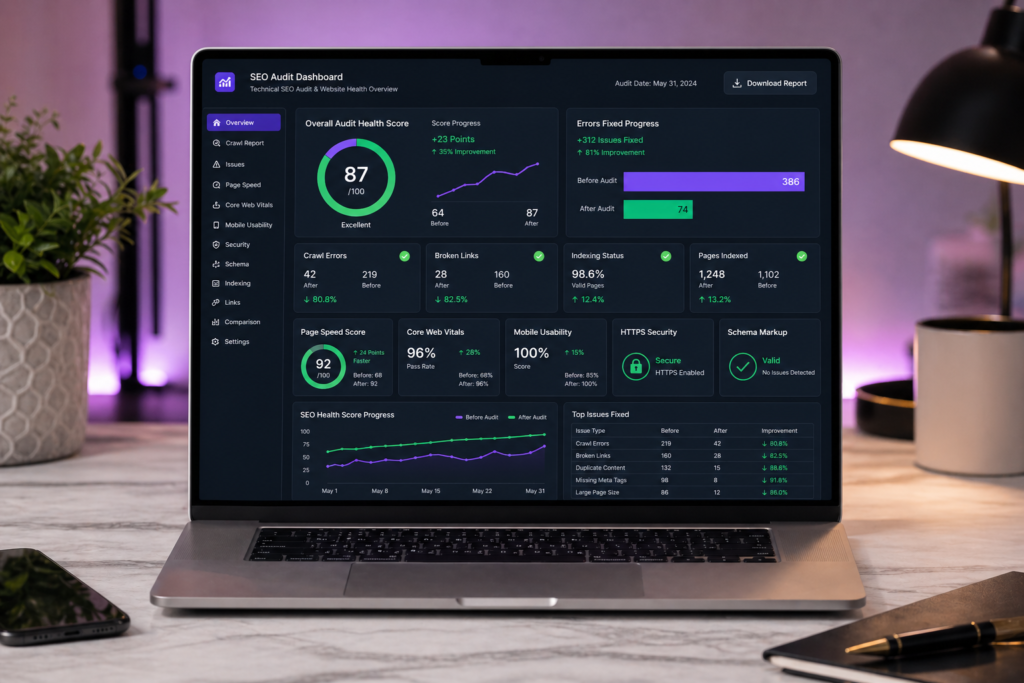
Before you build anything new, you need to understand what is already broken.
An SEO audit is like a healthy checkup for your website. It tells why your pages are not ranking, where your traffic is leaking and what google currently thinks about your site. For sexual wellness brands specifically, this step is even more critical because small technical issues or thin content can trigger sensitivity filters and quietly suppress your entire domain.
Here is what a solid audit should cover:
1) Check which pages are indexed and which are being ignored by Google.
2) Identify broken links, slow loading pages and crawl errors.
3) Look at your current keyword rankings and where you are losing ground.
4) Review your existing content for quality, relevance and any policy sensitive language that might be working against you.
5) Analyze your backlink profile to spot spammy or irrelevant links pointing to your site
At SEO Circular we provide an SEO audit for free which will help a business understand where their overall performance and where they stand in the digital market currently.
Build A Keyword Strategy That Actually Works For Your Niche
Keyword research is the process of finding valuable search queries that your target customers will type into search engines like Google to look for any kind of information, product and services.
The keyword strategy for sexual wellness brands is where most businesses either get it right and grow fast or get it wrong and stay off the track.
Here is how to approach it:
Start with what your audience is actually searching For. Think beyond product names. People search for solutions, feelings and questions. Someone looking for a lubricant might type “best lubricant for sensitive skin”. These are the kinds of searches that lead people to your brand when you have the right content in place.
Focus On Three Types Of Keywords:
- Informational keywords like “how to improve intimacy” or “what is a wellness vibrator” that attract people at the beginning of their journey.
- Commercial keywords like “best sexual wellness products for women” that signal buying intent.
- Brand keywords that protect your own name in search results
Do not ignore long tail keywords. In a sensitive niche like this, longer and more specific phrases often have less competition and higher buying intent. A phrase like “natural lubricant for menopause dryness” will bring you a smaller but far more targeted audience than just “lubricant”.
Use tools like Google Search Console, Ahrefs or Semrush to find what people are already searching for and map those keywords to specific pages on your website.
Fix Your Technical SEO part
Even the best content will not rank if your website has technical problems holding it back. Technical SEO is the foundation everything else is built on and for sexual wellness brands, it carries extra weight.
1) Site Speed Matters More Than Most Brands Realize
If your pages take more than three seconds to load, a large percentage of visitors will leave before they even see your content. Google knows this and factors it directly into rankings.
2) Make Sure Your Site Is Mobile Friendly
Most people searching for wellness products are doing it on their phones. A website that looks broken or loads slowly on mobile is losing customers ad rankings at the same time.
3) Use HTTPS
A secure website is non-negotiable in 2026 especially for a brand that handles personal and sensitive purchases. Google will not rank an insecure website the same way it ranks a trusted one.
4) Sort Out Your Site Structure
Your website should be easy for both users and google to navigate. Clear categories, logical URLs and a proper internal linking structure help Google understand what your site is about and which pages matter most.
5) Fix Crawl Errors And Canonical Issues
If Google is confused about which version of a page to index then it might just skip your content entirely. A clean technical setup removes that confusion and lets your content do it’s job.
On Page SEO: Make Every Page Count
On page SEO is everything you do directly on your web pages to help them rank. For sexual wellness brands, this is where you balance being clear and descriptive with being mindful of how Google interprets sensitive language.
Here is how to get it right:
1) Write Title Tags That Are Specific And Honest
Your title tag is the first thing Google and your potential customer reads. It should include your main keyword and make a clear promise. “Natural Lubricants for Women: Gentle, Body Safe Options” is far more effective than a vague brand name by a product category.
2) Use Your Keywords Naturally In Headings And Body Content
Do not stuff them in. Write for the person reading the page first. Google is smart enough to understand context, so use related words and phrases rather than repeating the same keyword over and over.
3) Write Meta Descriptions That Make People Want To Click
Your meta description does not directly affect rankings but it absolutely affects whether someone chooses your link over the one above or below it. Use it to speak directly to what the reader is looking for.
4) Optimize Your Product Pages Like Landing Pages
Too many sexual wellness brands treat product pages as just a photo and a price. Add real descriptions that answer questions, address concerns and help the customer feel confident about their choice.
5) Use Schema Markup
This is a small piece of code that helps Google understand your Content better. For Product pages, it can show ratings, prices and availability directly in search results making your listing stand out before anyone even clicks.
Off Page SEO
Off page SEO is about what happens outside your website that signals to Google that you are a trustworthy and authoritative brand.
The most important off-page signal is backlinks. When credible websites link to your content, Google treats it as a vote of confidence. But not all backlinks are equal. One link from a respected health publication is worth far more than fifty links from low quality directories.
Here is how to build off page authority the right way:
- Get listed in relevant health, wellness and lifestyle directories.
- Earn mentions from sex positive bloggers, health professional and women’s wellness communities.
- Encourage satisfied customers to leave reviews on Google and trusted third party platforms.
- Build a genuine social media presence that drives traffic and signals engagement even if social links themselves do not count as direct ranking factors.
- Collaborate with wellness-focused creators who have a real, engaged audience.
The goal of off-page SEO is simple. Make Google see your brand the same way a well-connected and respected person in your industry would be seen.
Guest Posting and PR: Borrow Credibility To Build Your Own
GP and digital PR are two of the most underused strategies in the sexual wellness space and brands that use them well consistently outrank those that do not.
Guest posting means writing articles for other websites in exchange for a link back to yours. For sexual wellness brands, the best targets are health and wellness blogs, women’s lifestyle publications, relationship advice platforms and mental health or body positivity communities. The key is to write content that genuinely helps their audience not just a thinly disguised advertisement for your product.
A well placed guest post on a high authority site does two things at once. It sends referral traffic directly to your website and it passes link authority that improves your overall domain strength.
Digital PR takes this further. It means getting your brand mentioned or featured in online news articles, podcasts, expert roundups and editorial pieces. This could look like:
- Pitching a sexual health expert from your team as a source for journalist writing about intimacy trends.
- Releasing a data driven study or survey about sexual wellness habits that media outlets want to cover.
- Responding to Journalist requests on platforms like quoted or featured where reporters are actively looking for expert sources
PR coverage from mainstream or niche media outlets gives you backlinks that are nearby impossible to buy and incredibly powerful for SEO.
Content Marketing Strategy
Content marketing is where sexual wellness brands have the biggest opportunity to separate themselves from the competition. Most brands in this space either play it too safe with bland product descriptions or go too far with content that triggers platform filters. The sweet spot is educational, empowering and genuinely useful content.
Here is how to build a content strategy that ranks and resonates :
Build A Content Pillar Structure
Choose three to five broad topics your brands own such as intimacy and relationships, body safety and ingredients, sexual health education or menopause and hormonal wellness. Then create long form of pillar pages around each topic and support them with shorter blog posts that go deeper into specific questions.
Answer real question people are searching for
Use Google’s “People Also Ask” section, forums like Reddit and tools like AnswerThePublic to find the actual questions your audience is typing in to search. Then answer those questions better than anyone else on the internet.
Use Different Content Formats
Blog posts are essential but do not stop there. How to guides, comparison articles, myth busting pieces, expert interviews and personal story led content all perform well in the wellness space and attract different kinds of readers.
Create Content For Every Stage Of The Buyer Journey
Someone reading “what is a pelvic floor trainer is not ready to buy yet. Someone searching “best pelvic floor trainer under $10” is very close. Your content strategy should speak to both and guide the first person toward becoming the second.
Be Consistent : One great article a month beats ten rushed ones. Search engines reward websites that publish quality content regularly over time, not just in bursts.
You Might Find This Helpful: How To Sell Sex Toys Online
Why Choose SEO Circular?
1. A full-service digital marketing agency with 5 plus years of industry experience, serving 500 plus satisfied clients across 30 plus industries worldwide.
2. Specializes in High-Risk SEO including adult SEO making It one of the few agencies equipped to handle sensitive niches like sexual wellness with the right strategies and compliance awareness.
3. Offers free SEO audit and free consultation along with a custom growth plan within 48 hours with no obligation.
4. A dedicated team of 50 plus SEO and marketing experts who go beyond consultancy and operate as your long-term strategic growth partner.
5. Over 1 million keywords ranked on Google across 1,000 plus successfully executed campaigns.
6. Trusted by clients across 40 plus countries, providing consistent and measurable results on a global scale.
7. NDA ready from day one ensuring complete confidentiality for every client engagement.
Conclusion
Sexual wellness is one of the fastest growing industries in the world and the brands that lead it are not the ones with the biggest budgets. They are the ones that show up consistently in search.
SEO is not just one option for your brand. It is the foundation that makes every other marketing channel work better.
At SEO Circular, we specialize in SEO strategies for restricted industries – helping businesses like yours generate consistent organic traffic without risking bans, penalties or platform restrictions.
Quick Answers to Common Questions
SEO is a long-term strategy. Most sexual wellness brands start seeing noticeable improvements in rankings and traffic within 3 to 6 months, depending on the competitiveness of their niche and the current state of their website.
Google has strict ad policies for sexual wellness products, which means many brands face restrictions or outright bans on paid campaigns. This is exactly why SEO becomes the most reliable and sustainable channel for consistent long-term visibility.
Yes, educational blog content helps your brand rank for the informational searches your audience makes before they are ready to buy. It builds trust, drives organic traffic and positions your brand as a credible voice in the wellness space.
Focus on earning links through guest posts on health and wellness publications, digital PR, expert contributions and genuine community mentions. Avoid buying links or using private blog networks as these can result in Google penalties.
Social media does not directly impact rankings but it drives traffic, builds brand awareness and increases the chances of earning natural backlinks. A strong social presence supports your overall digital presence and makes your SEO efforts more effective.
As an OnlyFans SEO agency, we’ve worked closely with creators who are trying to turn their content into a stable income stream—but often struggle with inconsistent growth. It usually doesn’t feel like a serious issue at first. You’re posting content regularly, experimenting with different ideas, staying active on platforms like Twitter or Reddit, and expecting that consistency will eventually pay off.
And sometimes it does, but not in a stable way. One week you see a spike in subscribers, the next week things slow down again. That inconsistency is what frustrates most creators. With the creator economy now valued at over $250 billion globally, the OnlyFans space has become far more competitive than it looks from the outside. Simply being active is no longer enough to stand out.
At SEO Circular, we see this pattern very often. Creators put in real effort, create quality content, and still struggle to build predictable growth. The problem usually isn’t the content itself, it’s the lack of a structured system behind it. Most creators rely on short-term traffic sources, hoping for viral moments instead of building something that works consistently.
Over time, this leads to burnout, unstable income, and constant pressure to keep promoting. This is exactly why finding a trusted OnlyFans marketing team becomes important—because the right team doesn’t just bring traffic, they build a system that keeps your growth stable.
Are you putting in effort but not seeing results?
SEO Circular builds proven growth systems so your work actually converts into revenue.
→ See How It Works
Key Takeaways
- A trusted OnlyFans marketing team helps scale growth, not just manage tasks
- Always verify results, not promises
- Choose between agency, freelancer, or in-house based on your stage
- Understand pricing clearly before signing
- Never ignore compliance and platform rules
- Avoid agencies that promise instant results
See How It Actually Works
Before we go deeper, it’s important to understand what actually works in real situations, not just theory. We’ve shared a detailed breakdown of how a structured approach improved growth for a creator. Explore how we help creators build sustainable OnlyFans growth systems:
Why OnlyFans Creators Need a Marketing Team
Let’s be honest. Running an OnlyFans account is a full-time business. It’s not just posting content. It includes:
- Promotion
- Fan engagement
- Messaging
- Analytics
- Content planning
Most creators try to manage everything alone and quickly burn out or see their growth slow down. This is where a professional OnlyFans marketing team comes in. We’ve seen this pattern many times. When creators offload operational work to experts, they get more time to focus on content, which directly improves earnings. A good team doesn’t just “promote”. They build a system.
What Services a Good OnlyFans Marketing Team Offers
A trusted OnlyFans marketing agency should provide structured, result-driven services, not random promotion. Here’s what you should expect from a good marketing team:
- Content Strategy
A good team should plan your content calendar, define themes, and structure monetization angles. This includes proper PPV planning designed to increase conversions, not just content output.
- Subscriber Growth
They should focus on building consistent traffic systems through multiple channels, managing collaborations, and optimizing funnels so visitors convert into paying subscribers instead of just viewers.
- Social Media Marketing
You should expect structured promotion across Twitter, Reddit, and Instagram, with a clear strategy to redirect traffic toward your OnlyFans profile, not just random posting.
- Paid Advertising
A reliable team should run campaigns on adult-friendly platforms, test creatives, and optimize performance regularly to ensure traffic quality stays high and conversion-focused.
- Fan Engagement
They should manage DMs, handle conversations, and apply upselling strategies that increase revenue per subscriber while maintaining a natural, human-like interaction style.
- Analytics & Reporting
You should receive clear tracking of revenue, subscriber behavior, and traffic sources, helping you understand what’s working instead of relying on assumptions or vanity metrics. - PR & Brand Collaborations
A strong team should create opportunities for influencer deals and cross-promotions, helping expand your reach and bring in new audiences from relevant niches.
Another Useful Guide for You: Promote OnlyFans Profile on Google
Agency vs Freelancer vs In-House Team
One of the biggest confusion creators face is choosing the right type of marketing support. Let’s break it down in a practical way.
1. Agency Model
- Full-service team
- Handles everything end-to-end
- Best for creators who want hands-off growth
Best for: Scaling creators
2. Freelancer Model
- Hire individuals for specific tasks
- Lower cost
- Requires more coordination
Best for: Beginners or budget-conscious creators
3. In-House Team
- Build your own internal team
- Full control
- High cost and management effort
Best for: High-earning creators
Quick Comparison
| Factor | Agency | Freelancer | In-House |
| Expertise | High | Medium | Depends |
| Cost | High | Flexible | Very High |
| Control | Low | Medium | High |
| Scalability | High | Medium | Low |
| Effort Required | Low | High | Very High |
We usually suggest creators start with freelancers or hybrid models, then move to agencies when scaling.
How to Evaluate an OnlyFans Marketing Agency
This is where most creators make mistakes. They choose based on price or promises. Instead, here’s what actually matters:
1. Proven Results
Ask for:
- Case studies
- Growth metrics
- Real creator examples
No proof = No trust.
2. Clear Strategy
A good agency should explain:
- Where your traffic will come from
- How subscribers will convert
- What channels they will use
If strategy is unclear, results will be too.
3. Transparent Communication
You should get:
- Regular reports
- Clear KPIs
- Honest updates
We see many agencies hide behind vanity metrics like impressions. That’s not growth.
4. Realistic Expectations
Avoid agencies that say:
- “Guaranteed 10K subscribers in 1 week”
- “Instant growth”
Growth takes time. Anyone saying otherwise is usually selling shortcuts.
Red Flags You Should Never Ignore
This is critical.
Here are the biggest warning signs:
- No case studies or fake testimonials
- Vague contracts
- Hidden fees
- Poor communication
- No reporting structure
- Asking for full control without transparency
- Over-promising unrealistic growth
Also, be careful with agencies that push aggressive or unsafe promotion methods. These can get your account flagged or banned.
Pricing Models and What You Should Expect
OnlyFans marketing pricing varies a lot, but most agencies follow a few standard models. Here’s a clear comparison to help you understand what to expect:
| Pricing Model | Cost Structure | Typical Range | Best For | Key Benefit |
| Revenue Share | Commission on earnings | 25% – 45% | Growth-focused creators | Low upfront risk, performance-based |
| Monthly Retainer | Fixed monthly fee | $1K – $10K+ | Predictable budgeting | Consistent support and planning |
| Hybrid Model | Fixed fee + commission | Varies | Balanced growth approach | Aligns performance with stability |
| Freelancer Pricing | Hourly or per-task payment | $20 – $100+ / hour | Small tasks or beginners | Flexible and budget-friendly |
We usually recommend understanding exactly what’s included in each model before committing, especially how commissions are calculated and what services are covered.
Legal, Compliance and Platform Safety
This is often ignored, but very important.
OnlyFans has strict policies:
- Age Verification – Everyone shown in content must be legally adult and properly verified. Consent
- Requirements – All people involved in content must clearly agree to participate. Proof of consent may be required.
- Content Guidelines – Some types of content are restricted or banned. Users must follow platform rules carefully
Violating these can result in account suspension.
Also consider:
- Payment Processor Rules – Banks and payment companies also have rules. Violations can cause payout delays or blocked payments.
- Tax Compliance – Income earned may need tax reporting depending on country and location.
- Data Privacy – Personal details, customer data, and private content must be handled securely
A trusted marketing team should understand these areas properly.
If they don’t, it’s a risk.
Don’t Miss This Helpful Guide: SEO Cost For Subscription-Based Businesses
How to Verify Reputation Before Hiring
Before signing anything, do this:
Research Checklist
- Check reviews on Trustpilot or Google
- Look at LinkedIn profiles of team members
- Ask for client references
- Review case studies carefully
- Verify business registration
Payment Safety Tips
- Avoid paying full upfront
- Use milestone-based payments
- Prefer monthly contracts
This reduces your risk significantly.
Conclusion
Finding a trusted OnlyFans marketing team is not about choosing the cheapest option or the fastest promise. It’s about finding a partner who understands growth, compliance, and long-term strategy.
At SEO Circular, we see this very often. Creators don’t fail because of content. They fail because they rely on inconsistent promotion and unstructured growth methods.
The right marketing team changes that.
When you combine strong content with a structured marketing system, growth becomes predictable, scalable, and much more stable.
And that’s what actually builds long-term income.
You Asked, We Answered
In most cases, initial improvements can be seen within a few weeks, but consistent growth usually takes 2 to 4 months depending on strategy and competition.
Yes, if you choose the right one. A good agency can increase revenue and save time by managing promotion and engagement professionally.
Yes, but beginners should start with freelancers or small teams before investing in full-service agencies.
Hybrid models or revenue share are generally safer because they align agency incentives with your growth.
Yes, if proper security measures like limited access and two-factor authentication are used. Always include privacy clauses in your contract.
SEO costs for subscription-based businesses typically starts within from $500 to $3,000+ per month for standard services with comprehensive national campaigns often costing $3,000–$5,000+ monthly. Pricing also depends on industry competition, content needs and backlink strategies with hourly rates ($15–$20) and projects free audits for your website are also available.
Most subscription businesses ask the wrong question when it comes to SEO. They ask “how much does SEO cost?” – when the question they should be asking is “what is SEO worth to a business where every customer pays monthly for years?”
That second question changes everything – your budget, your agency negotiations, your content priorities and the patience you extend before expecting results. It reframes SEO from an expense into a capital allocation decision.
Seo for SaaS platforms, B2B tools and recurring revenue businesses demands its own cost framework not a guide built for e-commerce or one-time service businesses. The stakes, the timelines, the content requirements and the competitive dynamics are entirely different.
In this guide, we break down exactly what SEO costs at every stage of a subscription-based business, what drives those costs up or down, where to allocate spend for maximum long term value impact and how to make the investment defensible to any leadership team or board.
Turn SEO into Your Highest ROI Channel 🚀
Struggling to generate consistent leads from SEO? We help subscription businesses attract qualified traffic and convert it into trials, signups, and recurring revenue.
Pre-Requisites For Subscription Based Businesses
- A clearly defined ideal customer profile — know exactly who you are targeting before a single keyword is researched.
- A conversion-ready website — SEO drives traffic, your site needs to be capable of converting it.
- A consistent content operation — the pipeline for briefing, writing and publishing must already be moving.
- Proper analytics and conversion tracking — trial signups and MRR contributions must be measurable from day one.
- A 12-month commitment from leadership — SEO compounds over time, teams that pull budget early never see the return.
- A realistic budget allocation — subscription businesses should plan for a minimum of $1,500/month at early stage, scaling to $5,000–$8,000/month as the channel matures and competition demands it.
What Does SEO Cost for Subscription-Based Businesses?
SEO spend for subscription businesses breaks into four distinct phases each with its own cost profile, strategic focus and expected output. These are not aspirational estimates. They reflect what competitive subscription businesses are actually allocating in 2025-2026. Let’s explore the cost below
| Stage | Monthly SEO Spend | Key Focus | Expected Output |
|---|
| Startup / Pre-PMF | $500 – $800 | Technical setup, keyword mapping, basic content, early link outreach | Indexing, initial rankings, topical relevance |
| Growth (Seed – Series A) | $800 – $1,000 | Competitive content, landing pages, conversion-focused keywords | Qualified traffic, early conversions, improved visibility |
| Scale (Series B+) | $1,000 – $3,000 | Authority building, link acquisition, product-led SEO, international expansion | Strong rankings, consistent traffic growth, market positioning |
| Enterprise SaaS | $3,000+ | Digital PR, programmatic SEO, multi-language content, technical scaling | Market dominance, high-volume traffic, sustained growt |
What Factors Determine Your SEO Cost As a Subscription Business?
SEO pricing is not arbitrary, it is a direct output of your business’s complexity, competitive environment and growth stage. These are the factors that move the number and why two subscription business in the same category can come with a big cost difference.
1. Competitive Density Of Your Category
Category competition is one of the single largest cost drivers in B2B subscription SEO. It determines how much domain authority you need to rank, how long it takes to get there and how much content and link acquisition investment is required to close the gap.
Consider two SaaS businesses: one selling project management software in a market with Asana, Monday.com and notion and another selling niche compliance automation for a single regulated industry. The first is competing against companies with figure SEO budgets. The second has a manageable competitive landscape. Their SEO costs will differ by 3-5x even if their product pricing and team size are identical.
High Competition (CRM.HRMS<Marketing tools)
$800 – $1,000/month to compete
Niche vertical SaaS
$1,000-$1,500/month to compete
To assess your competitive density before setting a budget, look at the domain authority of the top 5 organic results for your core keywords. If those pages consistently show domain authority around 70+ then you are in a high-cost category and need to plan accordingly – particularly for link acquisition.
Low Competition
$500-$900/month Niche verticals, emerging categories, undeserved industries
Medium Competition
$1,000-$1,200/month Established but not saturated. Mid-tier SaaS, regional B2B tools
High Competition
$2,000 – $3,000/month Established but not saturated. Mid-tier SaaS, regional B2B tools
2. Content Volume And Funnel Coverage Required
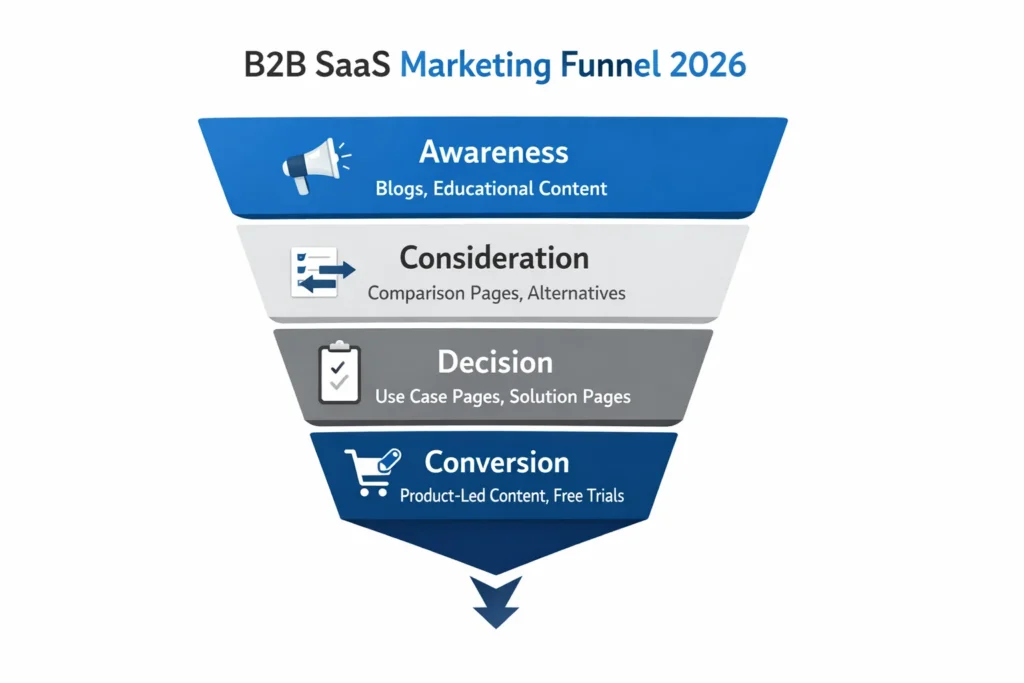
Content is typically the largest ongoing SEO cost for subscription businesses and the requirement is significantly heavier than for transactional or local businesses. A subscription buyer goes through a multi-week research process spanning awareness, evaluation, comparison and decision stages. Each stage needs content optimised to capture and advance that intent.
Here is the breakdown of the content types required and their approx. production costs.
Awareness Articles
$300 – $500 Per 1,500-2,500 word article. Top-of-funnel educational content.
Comparison Pages
$500-$700 Per page. High conversion value
Use-Case/ Solution Pages
$600-$800 Per page. Directly maps your product to a buyer’s specific workflow problem.
Product-Led Content
$700-$1,000 Per piece. Integrates product demonstrations into how-to content. Highest trial conversion rate.
The volume of content needed depends heavily on your subscription model type. A SaaS platform targeting multiple industries and uses cases may need 8-12 pieces per mouth to build topical authority. A niche B2B data subscription can often achieve strong results with 4-6 highly targeted pieces. A content or strong results with 4-6 highly targeted pieces. A content or newsletter subscription may need 10-15 shorter editorial pieces to maintain organic visibility.
3. Technical Complexity of your Platform
Technical SEO is where subscription businesses – particularly software platforms face costs that have no equivalent in simpler business models. Your product’s architecture introduces SEO challenges that require specialist expertise to resolve and maintain.
The most common and costly issues specific to subscription platforms include:
- JavaScript rendering issues
- Login-gated content not indexing
- Multi-tenant subdomain structure
- Duplicate meta across plan tiers
- App vs. marketing site architecture
- Page speed on feature-heavy Uls
For SaaS and API subscription businesses, a one-time technical SEO audit conducted by a specialist who understands JavaScript – rendered applications typically costs $1,000-$2,000 and almost always uncovers issues that are silently suppressing rankings. Ongoing technical maintenance runs $800 -$2,000/month.
For content subscriptions and membership platforms, technical SEO is considerably simpler. A WordPress or Webflow-based site can often be maintained technically for $300-$600/month with a lighter initial audit for free.
1.High Technical Cost
SaaS platforms, API subscription, multi-product suites with complex app architecture.
Initial audit: $200-$500.
Ongoing: $300-$500/monthly
2. Standard Technical Cost
Content subscription, newsletters, membership communities on standard CMS platforms.
Initial audit $300-$600
Ongoing: $400-$600/month
5. Link Acquisition
Backlinks remain one of the strongest ranking signals in competitive B2B search categories. For subscription businesses, organic link velocity – links earned without active effort is typically very low. Publications and websites do not naturally link to SaaS tools or membership platforms the way they link to research, news or freely accessible resources.
This means link acquisition has to be proactive and budget – allocated. The cost is driven by the domain authority you are targeting and the category you are operating in.
1) Niche Outreach
$600-$800/month
8-15 quality links/month from relevant but mid-tier publications and directories
2) Authority-Tier Links
$800-$1,000/month
5-10 links/month from DA 60+ publications in your industry vertical.
3) Digital PR Campaigns
$1,000m – $2,000 Per campaign
Data-led PR designed to earn 20-50 links from mainstream and trade press.
The subscription model type significantly affects link acquisition strategy. SaaS platforms can leverage integration directories (G2, Capterra, Product Hunt), partner ecosystem and developer communities for natural link sources. Data and API subscriptions often earn links through original research and datasets. B2B membership platforms benefit from speaker citations and industry publication mentions. Content subscriptions typically need to invest more actively in outreach since their product itself does not generate actively in outreach since their product itself does not generate natural link sources.
5. Target Market Scope – Geographic and ICP (Ideal Customer Profile) Breadth
Two subscription businesses with identical products can have SEO costs that differ by 2-3x purely on the scope pf their market. Scope has two dimensions:
- Geographic reach
- Ideal customer profile breadth
Geographical scope
It is the more straightforward cost driver. A subscription business targeting a single English-speaking market (US, UK,) has a contained SEO program. One targeting multiple languages or regional markets requires localised content, hreflang implementation and in some cases entirely separate link acquisition programs per region. International SEO typically adds 40-80% to a program’s total cost.
ICP breadth
It refers to how many distinct buyer personas, industries or company sizes your product addresses. A SaaS platform that serves HR teams, finance teams and operations teams across small and medium size businesses, mid-market and enterprise segments needs separate content tracks for each – multiplying content volume and the complexity of keyword strategy. A focused tool built exclusively for a single persona in a single industry can execute SEO with far greater efficiency.
1) Single Market, Single ICP
Base Cost – The most efficient SEO configuration. Focused keyword strategy, one content track.
2) Multi-Persona, Single Market
1.5-2x Base
Separate content strategies per persona. Higher volume, more complex internal linking.
3) Multi-Market, Multi-Language
2-3x base
Localised content, regional link building, technical hreflang configuration and separate rank tracking per market.
You Should Also Check Out: SEO Cost For Small Businesses
SEO Pricing Models for Subscription-Based Businesses — Which One Actually Fits You
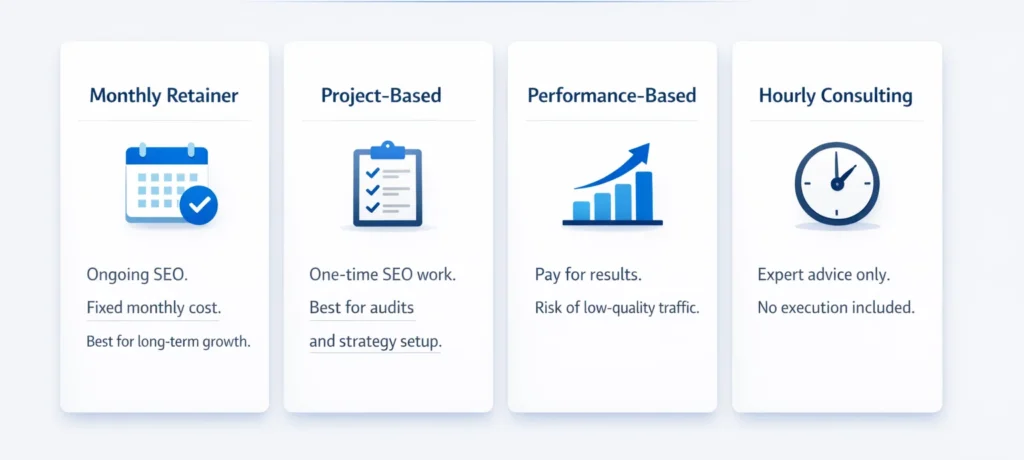
Before signing any SEO contract or hiring anyone, you need to understand how SEO is priced because the model you choose affects not just what you spend but what you get, when you get it and how accountable your provider is for results.
There are usually four primary pricing models used in B2B SEO today. Each suits a different stage and type of subscription business.
1. Monthly Retainer
This is the most common model for subscription businesses and for good reason — SEO itself is a recurring, ongoing activity. You pay a fixed amount every month in exchange for a defined scope of work: strategy, content production, link building, technical maintenance and reporting.
Typical range: $1,000 – $2,000/month depending on scope and provider level.
This model works best for SaaS platforms, B2B membership tools, and data subscription products that need sustained, compounding SEO activity. The consistency of effort is what builds domain authority over time. The risk is that retainers can become passive — you pay monthly but output and accountability drift if there is no clear deliverables framework tied to the contract.
2. Project-Based Pricing
Here you pay a one-time fixed fee for a specific, defined piece of work — most commonly a technical SEO audit, a keyword strategy, a content architecture plan or a site migration. There is no ongoing commitment.
Typical range: $1,500 – $3,000 per project depending on scope and complexity.
For subscription businesses, project pricing makes the most sense at two points: at the very beginning (to build the strategic foundation before committing to a retainer) and at specific inflection points (a platform rebuilds, an international expansion or a significant algorithm recovery). A SaaS company rebuilding its marketing site should commission a technical SEO project before going live not after.
3. Performance-Based Pricing
In this model you pay based on results typically on rankings achieved, organic traffic delivered or leads generated. It sounds appealing because it appears to remove risk from the buyer.
In practice, it rarely works well for subscription businesses. The metrics that get optimised (keyword rankings, raw traffic) are often misaligned with the metrics that matter (trial signups, MRR, organic CAC). An agency can rank you for high-volume keywords that bring zero qualified subscribers and still collect full payment. Additionally, reputable SEO providers rarely agree to pure performance-based models because SEO outcomes depend on factors outside their direct control — your product, your conversion rate, your sales cycle.
Where it can work as a hybrid model where a base retainer covers core activity and a performance bonus is tied to clearly defined conversion outcomes like organic trial signups.
4. Hourly Consulting
You pay a senior SEO consultant by the hour for strategy, advice, audits or training. No execution is included, just expertise.
Typical range: $10 – $20/hour for a qualified B2B SEO consultant.
This model is underused by early-stage subscription businesses and overused by growing ones. For a pre-seed SaaS or content subscription that cannot afford a retainer, a 10–15 hour engagement with the right consultant can deliver a keyword strategy, a technical priority list and a 6-month content plan giving you a roadmap to execute with internal resource. The mistake is relying on hourly consulting past the point where you need full execution not just direction.
Why the SEO Team Behind Your Subscription Business Matters More Than the Budget?
Most subscription businesses that struggle with SEO do not have a strategy problem or a budget problem. They have a people problem. The wrong team — or no dedicated team at all — is the single most common reason SEO spend produces no meaningful return.
SEO for subscription businesses is not a set-and-forget task. It requires consistent execution across content, technical health, and link acquisition — simultaneously, every month. That demands people who understand not just SEO mechanics, but the specific dynamics of recurring revenue: how to target buyers mid-research, how to write content that converts to trials, and how to report performance in terms of MRR and CAC rather than just traffic.
What a capable SEO team actually does for your business
A properly structured SEO team does four things that no tool or one-off agency engagement can replicate. Maintains your technical foundation, so rankings are not silently lost to crawl errors or platform updates. It builds topical authority through consistent, high-quality content that earns trust with both search engines and your buyers. It acquires links that signal credibility in your category. Also it connects every activity back to revenue — so the investment is always justified and always directionally correct.
Without that team in place, even the right strategy degrades quickly. Content gets published without a brief. Technical issues go unresolved for months. Link building stops the moment a freelancer moves on. The compounding nature of SEO — its greatest advantage — only works when the effort is continuous.
Where SEO Circular comes in
At SEO Circular, we work exclusively with subscription-based businesses — SaaS platforms, B2B membership tools, data products, and recurring-revenue brands that need SEO built around LTV, not just traffic. Our team handles the full execution stack: technical audits, content strategy and production, link acquisition, and performance reporting tied directly to your growth metrics.
You do not need to hire, train or manage an in-house team from day one. You need the right partner who already understands your model, your buyer and what good SEO results actually look like for a subscription business.
That is what SEO Circular is built to be.
The Cost Of Hiring SEO Circular For Your Subscription Business
Hiring the right SEO team is an investment decision and like any investment, the number only makes sense when you understand what it buys and what it returns. Here is what working with SEO Circular practically costs based on real market rates for the scope of work involved.
Starter Engagement – 600 to $1,000/month
Built for early-stage subscription businesses and startups that need a strong foundation without overextending budget. This covers a full technical SEO audit, keyword and competitor research, a content strategy mapped to your ICP and two of your published articles per month.
Link outreach is included at a baseline level. At this tier your get a clear roadmap, consistent execution and monthly reporting tied to organic traffic and trail metrics.
Best fit for pre-seed to seed stage SaaS, niche B2B tools and content or newsletter subscription getting SEO off the ground.
Growth Engagement – $1,000 to $2,000/month
Designed for subscription businesses post product market fit that are ready to compete seriously in their category. This includes full technical maintenance, six to eight pieces of content per month, active link acquisition targeting DA 50+ publications and competitive tracking across your core keyword set. Reporting at this tier to MRR contribution and organic CAC- not just rankings.
Best fit for Series A SaaS platforms, B2B membership communities and data subscription products scaling their organic channel.
Scale Engagement – $2,000 to $3,000/month
For subscription businesses where SEO is a primarily acquisition channel and the competitive environment demand sustained authority-building. This covers the full execution stack – technical SEO, high volume content production, digital PR and link campaigns, programmatic SEO where applicable pipeline and revenue benchmarks.
Best fit for Series B+ SaaS companies, multi-product subscription platforms, and enterprise B2B SEO agencies competing in high-density markets.
Every engagement fits your stage and goals, get in touch with SEO Circular directly.
The Right SEO Investment Turns Subscribers Into a Compounding Growth Engine
SEO for subscription businesses is not complicated but it is specific. The cost is real, the timeline is longer than most businesses expect, and the factors that drive your number are different from every other business model. What makes it worth it is equally specific: a single ranked page delivering qualified trials every month for years, an organic CAC that drops while your paid CAC climbs and a customer acquisition channel that does not switch off the moment you stop paying for it.
The businesses that win with SEO are not necessarily the ones with the biggest budgets. They are the ones that understand their model, invest at the right stage, choose the right pricing structure and commit long enough to let the compounding effect do its work.
If you are a subscription business ready to build that engine — SEO Circular is built to help you exactly do that.
Commonly Asked Questions
Yes — freemium models can leverage product-led SEO by indexing user-generated content, public project pages, and feature-specific landing pages, creating organic surface area that paid-only models cannot. The content strategy and keyword targeting differ significantly between the two.
SEO and paid ads serve different stages of the funnel and different timeframes. Paid fills the pipeline immediately while SEO builds the long-term organic base. Running both simultaneously is the most effective approach, with the expectation that organic gradually reduces dependency on paid spend over 18 to 24 months.
A domain migration without proper SEO planning can wipe out years of accumulated authority overnight. 301 redirects, canonical tags, and a structured crawl validation process are non-negotiable before any migration goes live. Businesses should expect a temporary rankings dip of 20 to 40 percent even with a well-executed migration.
Entering a new vertical requires treating it as a separate SEO program — distinct keyword research, dedicated landing pages, and new content tracks built around that segment’s specific pain points. Trying to rank for a new vertical by repurposing existing content rarely works and dilutes topical authority.
Yes, but only with the right constraints. A single in-house SEO manager can effectively own strategy, technical maintenance, and content oversight — provided content production is outsourced to freelance writers and link acquisition is handled by a specialist. Trying to do everything in-house with one person typically results in either content or technical SEO being neglected entirely.
You have a small business. You built a website. Maybe you even paid someone to design it nicely. But months later – no traffic, no calls and no leads.
The problem is simple: your customers are searching on Google but they are finding your competitors instead of you.
That’s exactly what SEO fixes and the first question every small business owner asks is – “How much does it cost?”
Here’s the honest answer: small business SEO packages start from around $600/month. For that you get things like keyword research, on-page fixes, local SEO and monthly reporting. It’s not glamorous but if done right then it works.
But not every business pays the same. A local bakery in a specific area competes very differently than an online casino or a crypto exchange. The more competitive or more regulated your industry is, the more SEO costs. Some industries like Adult and Casino SEO can go up to $1,500-$2,000/month or more and there are real reasons for that.
In this guide, we break down real SEO package costs for small businesses including why certain industries like Casino, Adult and Crypto pay significantly more.
Key Takeaways:
- SEO packages for small businesses can range up to $600 – $2,000 depending on several factors.
- SEO packages can differ based on the type and level of industry. For example SEO can cost a little extra for a law firm because of the type and level of work.
- An affordable SEO package involves things like keyword research, on-page fixes, local SEO and monthly reporting.
- You should choose the suitable agency in order to save time and accelerate growth.
Get Right SEO Package Before You Waste Your Budget
SEO pricing isn’t one-size-fits-all. A local business, a crypto brand, and a casino site all require different strategies and budgets. At SEO Circular, we help you invest in the right SEO plan based on your industry, competition, and growth goals.
Get the Right SEO Plan for Your Business
What To Expect From SEO Circular?
Let’s be straightforward with you.
There are hundreds of SEO agencies out there promising page one rankings in 30 days, guaranteed traffic and overnight results. You have probably seen those pitches already.
That’s not us.
At SEO Circular, we believe good SEO doesn’t have to be complicated or overpriced. Our affordable SEO packages for small businesses ranging from $600 to $2,000/month and include everything your business actually needs to grow online. No fluff, no hidden cost, just quality results.
What Exactly Do You Get?
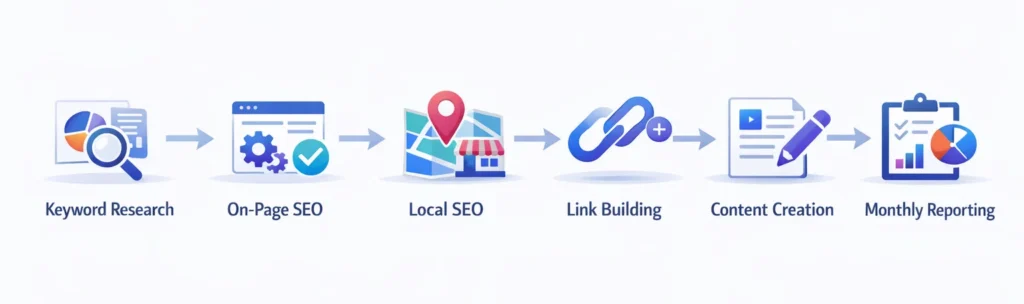
Here’s everything that comes with an SEO Circular small business package:
1) Keyword Research
We find the exact words your customers are typing into Google. Not guesswork – actual data. We target keywords that are realistic to rank for at your budget level and bring in the right kind of traffic.
2) On-Page SEO
We fix what’s already on your website – titles, headings, meta descriptions, image tags, internal links. Think of it as cleaning up your shop before customer walk in.
3) Local SEO & Google Business Profile
If you serve customers in a specific city or area, this is your biggest opportunity. We set up and optimize your Google Business Profile, so you show up when someone for your service.
4) Link Building
Every month we build quality backlinks to your website from relevant, trusted sources. This tells Google your website is worth ranking. At an affordable cost you get 3-5 solid backlinks every single month – no shortcuts, no spammy links.
5) Content Support
We help you post quality content on your website. Whether it’s a service page, a blog post or a landing page – content that’s written for both Google algorithm and users.
6) Monthly Reporting
Every month you get a clear, easy to read report. Rankings, traffic, what improved and what we are working on next. You will know exactly where you are investing your money.
Why it’s Expensive?
You can even approach an agency which is offering services at lower rates in the market.
But at a lower price range, most agencies automate everything, build spammy links and disappear after 3 months. Then your website ends up worse than when started.
At $600/month, we do the work properly. It takes time usually around 4-6 months to see actual results that are long lasting. Rankings that stick, traffic that grows and leads that actually convert.
And if your business is in a competitive industry. We scale with you. Our Industry specific packages go from $1,000 all the way to $2,000/month for niches like Crypto, Casino, Finance, Legal and adult where the competition demands more firepower.
Start your journey at SEO Circular by choosing $600/month starter pack.
Industry Specific SEO Package Costs: Why Some Businesses Pay More ?
| Business Type / Industry | Monthly SEO Cost | What You Get |
|---|---|---|
| Small Businesses (Local) | $600 – $800 | 10–15 keywords, basic on-page SEO, Google Business Profile, 3–5 backlinks |
| Crypto SEO | $1,000 – $1,500 | High-traffic keywords, frequent updates, finance backlinks, trust signals |
| Legal / Law Firms | $1,200 – $2,000 | Local + high-value keywords, authority links, E-E-A-T focused content |
| Finance & Lending | $1,000 – $1,600 | Product-based keywords, high-authority backlinks, compliance-focused SEO |
| Casino SEO | $1,000 – $1,500+ | 30–50 keywords, 10–15 backlinks, weekly content, compliance monitoring |
| Adult SEO | $1,000 – $2,000+ | Expensive niche backlinks, strict compliance, specialized SEO strategy |
| Cannabis SEO | $1,500 – $3,000+ | Local SEO, compliance content, niche backlinks, restricted marketing support |
Not every business competes on the same playing field. A local grocery store and an online casino are both businesses but their SEO battles are completely different.
Here’s a simple rule: the more competitive or restricted your industry, the more you pay for SEO.
Let’s have a detailed look at it
1) Small Business SEO – Starting at $600/month
This is the entry point. At $600/month, small businesses – local service providers, retail shops, restaurants, clinics can build a solid SEO foundation.
For $600, you’re getting:
- 10-15 targeted keywords
- Basic on-page optimization
- Google Business Profile management
- 3-5 backlinks per month
- 1 monthly performance report
Is $600 enough to compete? For local and small markets – yes. If you are an adult site owner or looking to promote your Casino site online, $600/month done consistently for 6 months can put you on page one of Google.
You May Also Be Interested In: SEO Cost For a Nonprofit Business
Casino SEO – Starting At $1,500/month
Now the numbers jump and for good reason.
Casino SEO starts at $1,500 /month because gambling is one of the most competitive niches on the internet. Thousands of casino websites are fighting for the same keywords – “best online casino”, “casino bonus 2026”.
At $1,500/month, here’s what changes compared to $600:
- Keyword targets increase to 30-50 highly competitive terms
- Link building moves to 10-15 gambling approved backlinks per month – these domains are harder to find and more expensive to acquire
- Content production increases – casino audiences need fresh content weekly
- Compliance checks are added – casino content is monitored heavily by Google, one policy violation can drop your entire site
In simple terms, you are not just paying for SEO at $1,500. You are paying for SEO in a warzone.
Adult SEO – Starting at $2,000/month
The highest price point on this list and the most misunderstood.
Adult SEO starts at $2,000/month not because it’s twice as hard as small business SEO but because the restrictions are unlike any other industry.
Here’s where the $2,000 goes:
- Link building alone can consume $800-$1,000 of that budget. Why? Because mainstream websites refuse to link to adult content. Every backlink has to come from adult approved domains which are limited, competitive and expensive.
- Payment processors, hosting provisors and ad networks all treat adult businesses differently – SEO has to work harder to compensate
- Content moderation and compliance is a full-time job inside the SEO workflow
- Google restricts adult content from appearing in certain search features – so technical SEO has to be sharper to capture the traffic that is available
At $2,000/month, you are paying for a specialist – not a generalist. Anyone quoting you $600 for adult SEO either doesn’t understand the industry or will disappear in 3 months.
Read More: SEO for Adult Chatbots
Crypto SEO – $1,000 to $1,500/month
Crypto sits right in the middle and the price range of $1,000 to $1,500 reflects exactly that.
At $1,000/month you are targeting broader crypto terms – “what is Bitcoin”, “best crypto wallet.” “How to buy Ethereum”. These are high traffic but slightly less competitive.
At $1,500/month you move into the serious territory – “best crypto exchange 2025”, “low fee Bitcoin trading”, “crypto staking returns. “These keywords have money behind them which means real competition.
What makes Crypto SEO unique:
- The industry changes every month – new coins, new regulations, new competitors. SEO content needs constant updating
- Google has restricted crypto ads in the past – organic SEO becomes even more valuable as a result
- Trust signals matter enormously – backlinks from finance and tech domains carry extra weight and they cost more to acquire
Whether you’re at $1,000 or $1,500 – crypto SEO is a long game. But the businesses that invest early own the rankings when the next bull run hits.
Law Firm & Legal SEO – $1,200 to $2,000/month
Legal SEO sits in the $1,200 to $2,000/month range and if you’ve ever googled “best lawyer near me “you already understand why. SEO for this industry might be a little expensive due to the rigidness and complexity of this industry.
Every click in the legal space is worth hundreds – sometimes thousands of dollars to a law firm. A personal injury lawyer who ranks on page one for the right keyword can close one case and recover their entire annual SEO investment.
That’s exactly why competition is brutal.
At $1,200/month, smaller firms- family lawyers, property dispute attorneys can compete in their city with:
- 15-25 location based legal keywords
- Google Business Profile optimization
- 6-10 authoritative backlinks from legal directories and news sites
- Monthly blog content targeting common legal questions
At $2,000/month, the strategy shifts to high-value practice areas – personal injury, corporate law, immigration. These keywords carry massive commercial intent and require:
- 40-60 competitive keywords across multiple practice pages
- 12-18 backlinks per month from bar association sites, legal publications and high authority domains
- Schema markup for legal entities which helps Google display your firm in rich results
- Reputation management layered into the SEO workflow
One important thing about legal SEO is that Google holds legal content to an extremely high standard under it’s E-E-A-T guidelines (Experience, Expertise, Authority, Trust). Content written by or attributed to a qualified lawyer ranks significantly better than generic legal articles.
At $1,200 to $2,000/month – you are not just buying rankings. You are buying credibility that Google can verify.
Finance & Lending SEO – $1,000 to $1,600/month
Finance SEO falls between $1,000 and $1,600/month – sitting close to Crypto SEO but with its own unique challenges.
At $1,000/month, local loan agents and smaller brokers can target product-specific and city-level keywords with steady link building and optimized landing pages.
At $1,600/month, fintech companies need backlinks from Forbes and Business Insider- level domains – expensive and hard to earn. Add constant content updates for changing rates and regulations, plus Google’s YMYL scrutiny and every dollar is accounted for.
Finance SEO compounds. The rankings you build today will pay off 12 to 18 months from now on.
SEO For Cannabis Marketing
Cannabis is one of the most restricted industries on the internet — and that restriction is exactly what makes SEO so valuable for it.
Google Ads, Facebook Ads, and Instagram Ads all have strict limitations on cannabis advertising. Most paid channels are either blocked or heavily restricted. That means organic SEO isn’t just important for cannabis businesses — it’s often their only reliable source of online traffic.
That’s why cannabis brands invest anywhere from $1,500 to over $3,000/month in SEO — and why getting it right matters more here than in almost any other industry.
At $1,500/month, cannabis dispensaries and CBD brands targeting local or state-level audiences can build solid visibility with:
- Location-based keywords like “dispensary near me” or “CBD store in [city]”
- Google Business Profile optimization — one of the few Google tools cannabis businesses can freely use
- Educational content strategy — blogs around cannabis benefits, usage guides, and product comparisons
- 6–8 backlinks from health, wellness, and lifestyle publications
At $1,500 to $3,000/month, cannabis e-commerce brands and multi-location dispensaries need a more aggressive approach:
- 40–50 keywords spanning products, locations, and educational topics
- 12–15 backlinks/month from cannabis-specific publications and directories
- Compliance-aware content written carefully to avoid triggering Google’s sensitive content filters
- Technical SEO focused on product pages, category structure, and schema markup
At $3,000+/month, large cannabis brands operating across multiple states or countries are running full-scale SEO operations:
- 100+ keywords across every product line, location, and content category
- Dedicated content teams producing weekly blogs, guides, and landing pages
- 20+ high-authority backlinks/month from mainstream health and lifestyle publications
- Ongoing legal compliance reviews built directly into the SEO workflow
- Full technical audits every month across multiple websites or subdomains
One thing that makes Cannabis SEO uniquely challenging is constantly shifting regulations. Laws change state by state, country by country — sometimes month by month. Your SEO strategy and content needs to always reflect current legal standing or risk serious penalties.
From $1,500 to $3,000+ — the range is wide because the industry itself is wide. A single CBD shop and a multi-state cannabis brand are completely different businesses with completely different SEO needs.
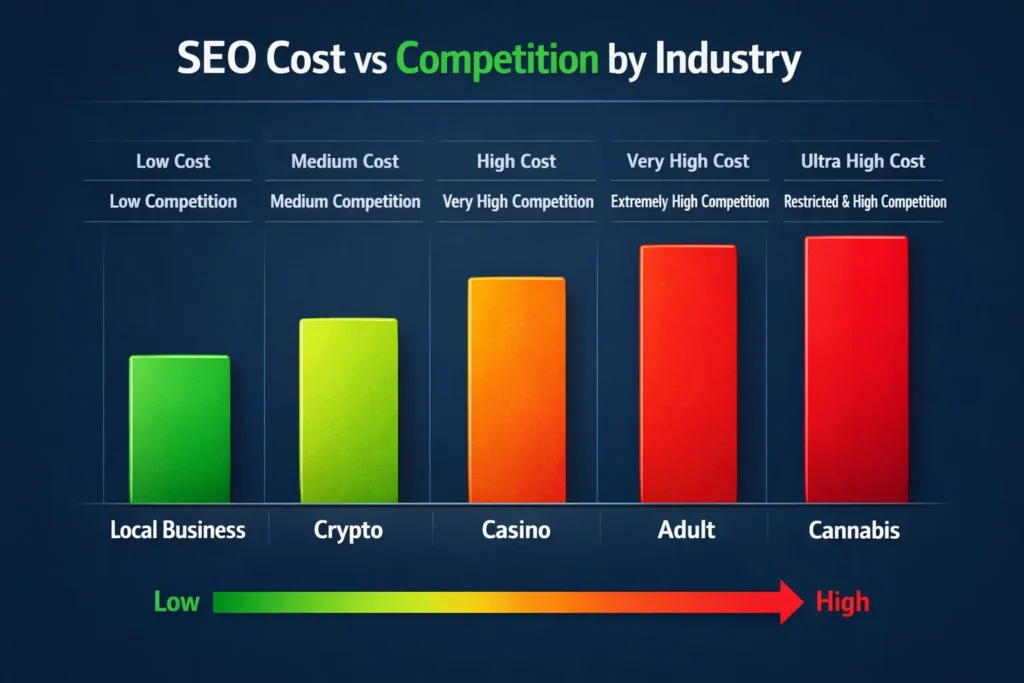
How Small Businesses Can Choose the Right SEO Agency?
Not every agency that looks good on paper delivers results. Here’s what actually matters when making your decision:
1) Pricing should be transparent
A reliable agency clearly tells you what’s included in their package before you sign anything. If they can’t explain it simply, they can’t deliver it either.
2) Industry experience matters
Casino SEO and local business SEO are completely different jobs. Always ask if they’ve worked in your specific industry before.
3) Ask about link building
This is where most cheap packages cut corners. You should always know exactly how many backlinks you’re getting and where they’re coming from.
4) Monthly reporting is non-negotiable
Rankings, traffic, and backlinks built should be reported to you clearly — every single month without fail.
5) Avoid guaranteed rankings
SEO takes time for real results. Anyone promising page one in 2 weeks is either lying or using tactics that will eventually hurt your website.
6) No long lock-in contracts
Good agencies let results do the talking. Give it a few months of honest effort and the numbers will tell you everything.
Conclusion
SEO is no longer optional for small businesses – it is the difference between being found and being invisible online.
The numbers are clear. Small businesses can start building real online presence by choosing affordable SEO packages including the “Starter Pack” which is offered by us.
What matters most is not how much you spend – it is who you spend it with.
The right agency is transparent about pricing, clear about deliverables and accountable through monthly reporting. They don’t promise overnight results and they don’t lock you into contracts you can’t exit.
At SEO Circular, that is exactly how we operate. Whether you are a local business taking your first step or an established brand ready to dominate a competitive niche – we build SEO strategies that are built to show results and also to last longer.
Additional Insights For Businesses
SEO is an ongoing monthly process, not a one-time fix. Search rankings constantly change — competitors improve, Google updates its algorithm and your website needs consistent work to stay ahead.
Basic SEO like updating your Google Business Profile or writing blog posts can be done yourself. However, technical SEO, link building, and competitive keyword strategy require expertise and tools that most business owners simply don’t have time to learn.
Google looks at three things — relevance of your content, authority of your website through backlinks, and technical health of your site. SEO works on all three simultaneously to improve your position over time.
Not necessarily. A good SEO agency works with what you have and improves it gradually. A complete redesign is only recommended if your website has serious technical issues that are actively blocking Google from reading it.
Your rankings don’t disappear overnight but they will slowly decline. Competitors who keep investing will outrank you over time — which is why consistency matters more than short bursts of SEO activity.
At SEO Circular, we have worked with 15+ globally popular AI companion chatbots, including platforms like SugarLab AI, CandyAI, and MyDreamCompanion, and based on our real implementation experience, we have identified and fixed many common, technical, and even some very unusual SEO issues that most developers and founders do not notice until their website stops performing in search.
Over time, we have seen that AI companion platforms are growing rapidly and will continue to stay in demand beyond 2026, because user behavior clearly shows strong adoption of personalized AI interaction across the US, Europe, and emerging markets, where people are actively engaging with these platforms for real-time and customized digital companionship.
The most important thing to understand here is that building an AI companion platform today requires a modern and complex tech stack that usually includes
- AI models (LLMs or fine-tuned systems)
- API-driven response layers
- Backend systems like Node.js or Python
- Frontend frameworks such as Next.js
- Rendering approaches like Server-Side Rendering (SSR), Client-Side Rendering (CSR), or hybrid setups
While this stack is powerful from a product and engineering point of view because it supports real-time responses, scalability, and a smooth user experience, it also creates serious technical SEO challenges that are very different from those of traditional websites.
Because of this complexity, we have seen many cases where platforms had a strong product, active users, and good engagement, but still failed to generate organic traffic simply because search engines were not able to properly crawl, render, or index their content. This is where an effective AI Chatbot Marketing Strategy becomes important, as it aligns technical SEO with user engagement and discoverability.
So in this guide, we are going to explain everything in detail based on real project experience, covering the technical SEO issues that affect AI companion platforms and the practical ways to fix them, but before you continue, one thing is important to keep in mind: this is not a basic SEO article, and it demands patience, because we are going deep into real technical problems and their solutions.
Fix Your AI Companion SEO Before It Kills Your Growth
If your AI platform is not getting indexed or ranking despite having a strong product, then the issue is not your idea but your technical SEO. At SEO Circular, we have already fixed these problems for 15+ global AI companion platforms, and we can do the same for you with a clear, result-driven strategy.
Get Your AI Companion SEO Strategy Today
Modern AI Companion Platforms Use Complex Tech Stacks
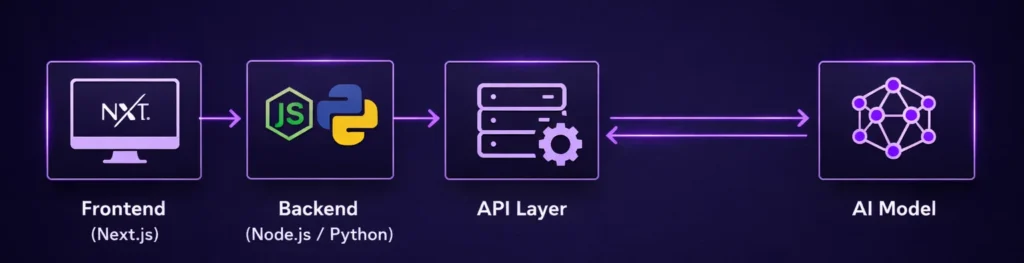
- AI companion platforms look perfect for users, but search engines often receive empty or incomplete HTML, which directly impacts indexing and ranking.
- Heavy reliance on JavaScript, APIs, and dynamic rendering makes it difficult for Googlebot to access and understand real content during the first crawl.
- Issues like BAILOUT_TO_CLIENT_SIDE_RENDERING, JS chunk loading, and streaming responses delay or block content visibility for search engines.
- Dynamic and session-based AI content does not create stable, indexable pages, which weakens keyword targeting and SEO structure.
- From Googlebot’s perspective, many pages appear as “Loading page…” without keywords, structure, or meaningful signals required for ranking.
- Without fixing rendering, content delivery, and crawlability, even strong AI platforms fail to generate organic traffic and remain dependent on paid acquisition.
What Makes NSFW AI Companion Websites SEO-Difficult?
Dynamic AI-Generated Content Creates Indexing Gaps
In AI companion platforms, most of the content is generated based on user interaction, which means there is no fixed or pre-defined content available for search engines to crawl and understand.
- Content is generated after user input : This means pages do not have static text that can be indexed during the initial crawl, and search engines may not wait for interaction-based content.
- Responses vary for each user : Since AI replies are personalized, there is no consistent version of content that can be indexed and ranked.
- No stable keyword targeting : Because content changes dynamically, it becomes difficult to optimize pages for specific keywords in a controlled way.
Login Walls and Session-Based Content Block Crawling
Most AI companion platforms require users to log in before accessing core features, and this creates a major barrier for search engines. Important pages are behind authentication. Search engines cannot access content that requires login, which means valuable pages remain invisible.
Heavy JavaScript Dependency Reduces Visibility
Modern frameworks rely heavily on JavaScript, and while this improves user experience, it creates challenges for search engines that depend on initial HTML.
- Content loads after JavaScript execution
If rendering happens on the client side, search engines may not see full content immediately.
- Delayed rendering affects indexing
Even if Google eventually renders JavaScript, delays can reduce crawl efficiency and indexing priority.
- Resource-heavy pages impact crawl budget
Large JS files and API calls consume more resources, which can limit how many pages get crawled.
Restricted and Sensitive Content Handling (NSFW Factor)
NSFW AI companion platforms face an additional layer of complexity because content must be controlled and compliant while still being indexable.
Age Gate Blocking Crawlers (Wrong Implementation)
AI companion platforms, especially NSFW ones, often implement age verification systems, but as per our experience, many websites implement this in a way that blocks search engines completely instead of just controlling user access.
- Full-screen age gate blocks HTML content
When age validation is implemented as a blocking layer before page load, search engines are unable to access the actual page content, which results in zero indexable data.
- JavaScript-based age verification hides content
If the main content is loaded only after age confirmation via JavaScript, then crawlers may never see the actual content because they do not interact like real users.
- Incorrect bot handling leads to deindexing
When bots are treated the same as users without a fallback mechanism, important pages fail to get indexed or lose rankings over time.
Correct SEO Approach for Age Gate
Age gate should be implemented in a way where HTML content is still accessible to crawlers, using techniques like server-side rendering, conditional rendering, or bot-friendly fallbacks while still maintaining compliance.
Too Many Similar Character Pages Create Low-Quality Index
We saw many AI companion platforms allow users or admins to create unlimited character profiles, but over time this leads to thousands of similar pages with very little differentiation, and this directly affects SEO quality because search engines start treating the site as low-value or spam-like.
- Multiple pages with similar intent and structure
When character pages follow the same template with minor changes like name, image, or personality, search engines see them as near-duplicate content instead of unique value pages.
- Thin content with no real informational depth
Most character pages do not contain enough structured or meaningful content, which reduces their chances of ranking and increases the risk of being ignored or deindexed.
- Crawl budget gets wasted on low-value pages
Instead of focusing on important pages, search engines spend time crawling thousands of similar URLs, which affects indexing efficiency of high-priority content.
- Overall domain quality signal gets impacted
When a large portion of the website contains low-value or duplicate-like pages, it can reduce trust and authority in the eyes of search engines over time.
This Correct approach are as below
If you are planning to create large-scale character pages, then you should control indexing by blocking unnecessary pages using robots.txt and meta noindex tags, so only high-quality and important pages are indexed.
How to Control Indexing Using robots.txt
You can prevent search engines from crawling low-value character pages by disallowing specific URL patterns in your robots.txt file.
User-agent: *
Disallow: /characters/
Disallow: /ai-characters/
Disallow: /profile/
This ensures that crawlers do not waste time accessing bulk-generated pages that are not useful for SEO.
How to Use Meta Noindex for Character Pages
In cases where pages should be accessible but not indexed, you can use the noindex meta tag inside the page head section.
<meta name="robots" content="noindex, follow"> This allows search engines to:
- crawl the page
- follow links inside the page
- but avoid adding it to search results
Next.js & Rendering Deep Dive: Why Most AI Companion Websites Fail in SEO
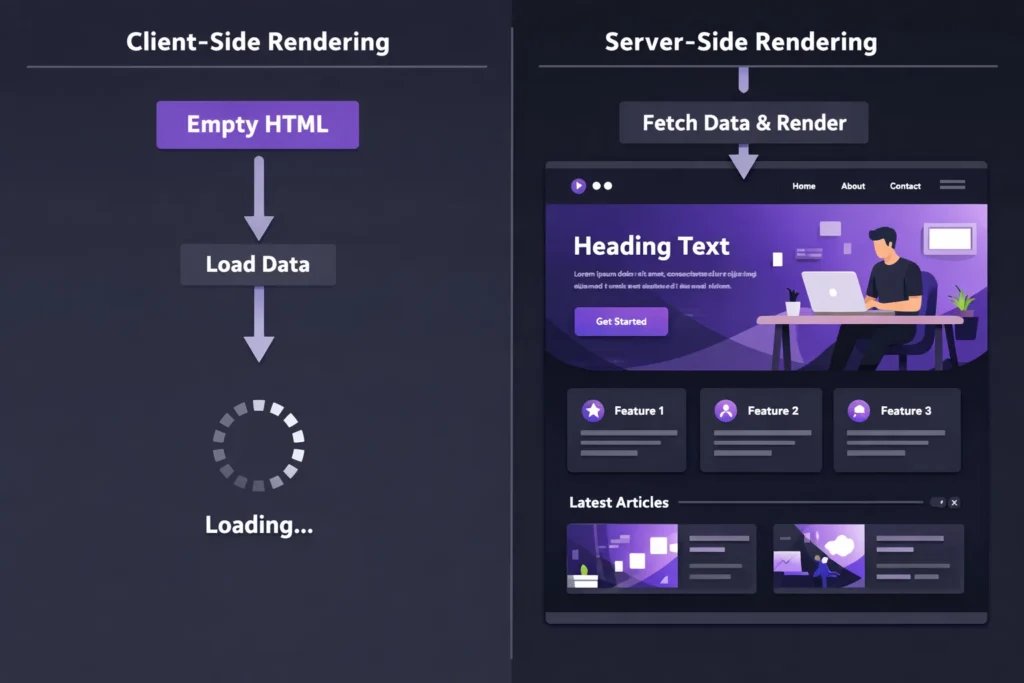
As per our experience at SEO Circular, most AI companion platforms today are built using modern frameworks like Next.js, and while these frameworks are excellent for performance and user experience, they can silently break your SEO if rendering is not handled correctly from the beginning.
The biggest mistake we have seen is that developers optimize for speed and interactivity, but ignore how HTML is delivered to search engines, and this is where issues like non-indexing, partial indexing, or delayed indexing start appearing.
Client-Side Rendering (CSR) — The Root Cause of Indexing Failures
In many AI companion platforms, developers rely heavily on client-side rendering because it makes the application feel fast and interactive, but this approach creates serious problems for search engines.
- Initial HTML response is empty or minimal
When a page is loaded, the server sends almost no content, and the actual data is fetched later through JavaScript, which means search engines do not immediately see meaningful content.
- Content depends on JavaScript execution
If Googlebot does not fully execute JavaScript or delays rendering, then important content may never be indexed.
- Common Next.js issue: BAILOUT_TO_CLIENT_SIDE_RENDERING
This happens when the framework falls back to CSR, and instead of sending pre-rendered HTML, it pushes rendering to the browser.
JavaScript Chunk-Based Rendering (__next_f.push Issue)
Another issue we have frequently observed is content being delivered via JavaScript chunks instead of being embedded in HTML.
- Data is injected using __next_f.push
Instead of having full HTML, the content is dynamically pushed through JS chunks, which delays visibility for crawlers.
- HTML does not contain actual content
Search engines rely on initial HTML for indexing, and if content is missing there, indexing becomes unreliable.
- Rendering depends on hydration
Until hydration completes, the page does not contain usable content, which creates a gap between user view and crawler view.
👉 Result:
Search engines may partially index or completely skip such pages.
Also Read: AI Startup SEO Budget Early Stage
Server-Side Rendering (SSR) — The Correct Foundation for SEO
From an SEO perspective, server-side rendering is one of the most reliable approaches because it ensures that content is available in the initial HTML response.
- Full HTML is sent from the server
This allows search engines to immediately read and index the content without waiting for JavaScript execution.
- Faster indexing and better crawlability
Since content is already present, Google can process pages efficiently.
- Ideal for landing pages and SEO content
Pages that target keywords should always use SSR to ensure maximum visibility.
👉 Example (Next.js SSR):
export async function getServerSideProps() {
 const data = await fetch('https://api.example.com/data').then(res => res.json());

 return {
   props: { data },
 };
}
This ensures that content is rendered on the server before being sent to the browser.
Incremental Static Regeneration (ISR) — Best Balance for AI Platforms
In many cases, AI platforms need both performance and SEO, and this is where ISR becomes very powerful.
- Pages are pre-rendered and updated periodically
This allows you to serve static HTML while still keeping content fresh.
- Reduces server load
Unlike SSR, ISR does not require rendering on every request.
- Works well for programmatic SEO pages
Character pages, landing pages, and category pages can benefit from ISR if structured correctly.
👉 Example (Next.js ISR):
export async function getStaticProps() {
 const data = await fetch('https://api.example.com/data').then(res => res.json());

 return {
   props: { data },
   revalidate: 60, // Re-generate page every 60 seconds
 };
}
Streaming & Partial Rendering — Hidden SEO Risk
Modern Next.js versions support streaming and partial rendering, which improves performance but introduces SEO risks if not handled carefully.
- Content loads in parts instead of full HTML
Search engines may capture only the initial part of the page.
- Important content may be delayed
If key sections load later, they may not be indexed properly.
- Requires careful prioritization
Critical SEO content should always be included in the first HTML response.
Best Rendering Strategy for AI Companion Platforms
As per our experience at SEO Circular, the most effective approach is not choosing one rendering method, but combining them strategically.
- Use SSR for SEO landing pages
Ensure all important pages are fully indexable.
- Use ISR for scalable content pages
Handle large volumes of pages efficiently.
- Avoid CSR for indexable content
Keep CSR limited to app-level interactions only.
- Separate app and SEO layers
Your chatbot interface and SEO pages should not depend on the same rendering logic.
Know About: Python Libraries for Technical SEO Automation 2026
How to Fix Indexing Issues in AI Companion Platforms (Step-by-Step)
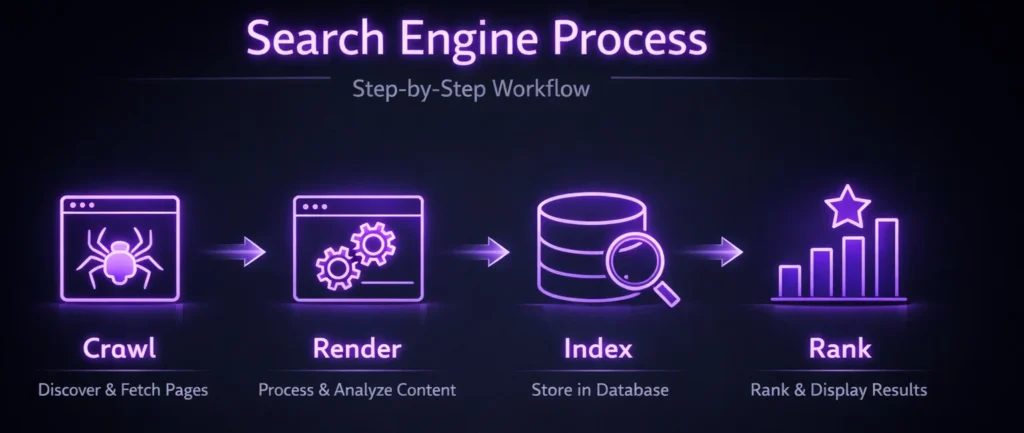
As per our experience at SEO Circular, most indexing issues in AI companion platforms are not because of Google, but because of how content is delivered, and once you fix rendering and structure properly, indexing improves much faster than expected.
Use Server-Side Rendering for Important Pages
If your key pages are not rendered on the server, then search engines will struggle to understand them, so always ensure that SEO-focused pages return proper HTML in the initial response.
- Convert landing pages to SSR
This ensures that content is visible to crawlers without waiting for JavaScript execution.
- Avoid CSR for indexable URLs
Keep client-side rendering limited to app interactions, not SEO pages.
Create Static SEO Pages Separate from Chat App
AI chat interfaces are not designed for indexing, so you should not rely on them for SEO, and instead create dedicated pages that target search queries.
- Build landing pages for each use case
These pages should explain features, scenarios, and benefits in a structured way.
- Do not index chat session URLs
Since they are dynamic and user-specific, they should be excluded from search results.
Ensure Content Exists in Initial HTML Response
Search engines depend on the first HTML response, so if your content is not present there, indexing will fail.
- Avoid loading critical content via API after page load
Important text should already be part of the HTML.
- Test pages without JavaScript
If content is not visible without JS, then Google may also struggle to see it.
Optimize Sitemap and Crawl Flow
Search engines need clear signals to discover and prioritize pages, so your sitemap and internal linking should guide them properly.
- Include only indexable pages in sitemap
Avoid adding low-value or blocked URLs.
- Use internal linking to highlight important pages
This improves crawl efficiency and page importance.
Control Low-Quality Pages Properly
If your platform generates large-scale pages like character profiles, then controlling their indexing is critical to maintain SEO quality.
- Use robots.txt to block unnecessary crawling
This saves crawl budget for important pages.
- Apply noindex on low-value pages
This prevents them from appearing in search results.
Handle Age Gate and Restrictions Smartly
Compliance is important, but it should not block search engines completely, so implementation must balance both.
- Ensure bots can access content
Do not fully block HTML behind age validation.
- Use bot-friendly rendering approach
Keep content visible while controlling user access separately.
Monitor Indexing Using Search Console
Fixing issues is not enough, you also need to track whether Google is actually indexing your pages.
- Check “Crawled but not indexed” issues
This helps identify content visibility problems.
- Monitor coverage and indexing trends
This shows whether fixes are working or not.
You Might Want to Check This Out: Sexual Wellness SEO Strategies
Site Architecture for AI Companion SEO (How to Structure Your Platform for Ranking)
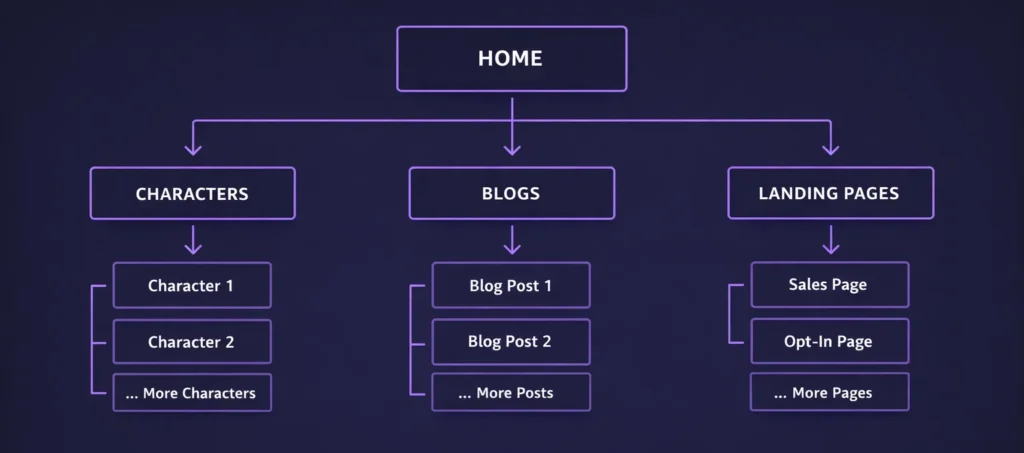
In most AI platforms, everything is built around the app interface, but that approach fails in SEO because search engines cannot navigate dynamic systems easily, so you need to create a separate SEO-friendly architecture layer that organizes your content into clear categories.
Recommended URL Structure (SEO-Friendly)
Your URL structure should clearly reflect hierarchy so that both users and search engines can understand the relationship between pages.
/image-generator/
/image-generator/nsfw-ai-images/
/characters/
/characters/anime-ai-girlfriend/
/blogs/
/blogs/technical-seo-ai-platforms/
/landing/ai-companion-app/
/chatbots/ai-roleplay-chat/
This structure ensures that:
- categories build topical authority
- pages are grouped logically
- crawl paths are clear and efficient
Separate App Layer from SEO Layer
One critical thing we always implement is separating the actual product interface from SEO pages, because mixing both creates indexing issues.
- Keep chat interface under app routes
Example: /app/chat or /dashboard
- Do not rely on app pages for SEO
These are user-specific and not designed for indexing.
- Build dedicated SEO pages outside app flow
These pages should be crawlable, static or server-rendered, and optimized for search.
Internal Linking Strategy for Better Crawlability
Search engines depend on internal links to discover and prioritize pages, so linking should not be random but structured.
- Link categories to subpages
This helps search engines understand hierarchy.
- Connect blogs to landing pages
This improves conversion flow and keyword relevance.
- Avoid orphan pages
Every important page should be reachable within 2–3 clicks.
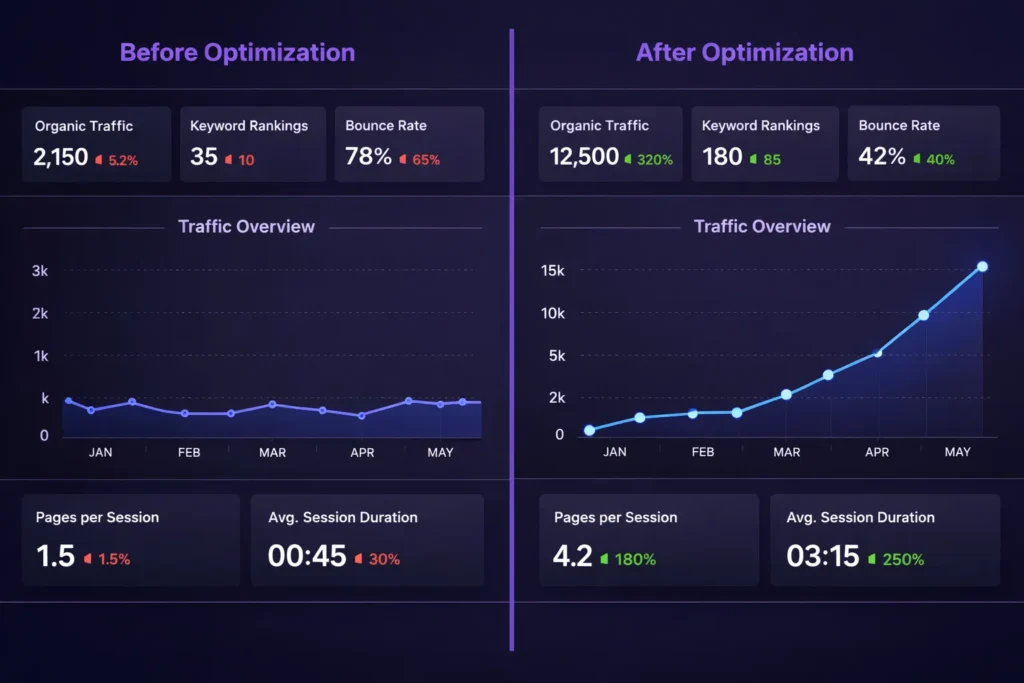
Conclusion
AI companion platforms are built on powerful and modern technologies, but as we have seen across multiple real-world projects at SEO Circular, the same tech stack that delivers a great user experience can silently break your SEO if rendering, content delivery, and crawlability are not handled correctly from the beginning.
- Technical SEO in AI platforms is not optional, because search engines need structured, visible, and consistent content to understand and rank your website.
- Issues like client-side rendering, JavaScript-based content loading, and dynamic responses can prevent Google from accessing real content, even if users see everything perfectly.
- Uncontrolled scaling, such as thousands of similar character pages or blocked content through login and age gates, can weaken overall domain quality and indexing efficiency.
- Proper implementation of SSR, ISR, structured site architecture, and controlled indexing can completely change how your platform performs in search results.
- Most importantly, SEO and development must work together, because technical decisions directly impact visibility, rankings, and long-term growth.
As per our experience, once these core technical issues are fixed, AI companion platforms not only start getting indexed properly but also build sustainable organic traffic that reduces dependency on paid acquisition and improves overall growth efficiency.
FAQs: Technical SEO for NSFW AI Companion Platforms
Recovery time depends on the severity of the issue and how quickly fixes are implemented. In most cases, once rendering and crawlability problems are resolved, initial improvements can be seen within 2–4 weeks, while full recovery may take 2–3 months.
Yes, but only if you create a controlled layer of static or semi-static content. Dynamic responses alone are not reliable for SEO, so you need structured landing pages that target specific keywords and intents.
The biggest mistake is prioritizing product functionality over crawlability, especially relying heavily on client-side rendering without considering how search engines process content.
Page speed is important, but not at the cost of rendering quality. A fast-loading page with no indexable content is worse than a slightly slower page with proper HTML content.
A hybrid approach works best. High-value pages should be manually optimized, while scalable pages can be generated programmatically with strict quality controls.
Over 70,000 health related searches happen every single minute, yet most healthcare startups have no clear idea what it costs to show up for even a fraction of them. That disconnect is expensive.
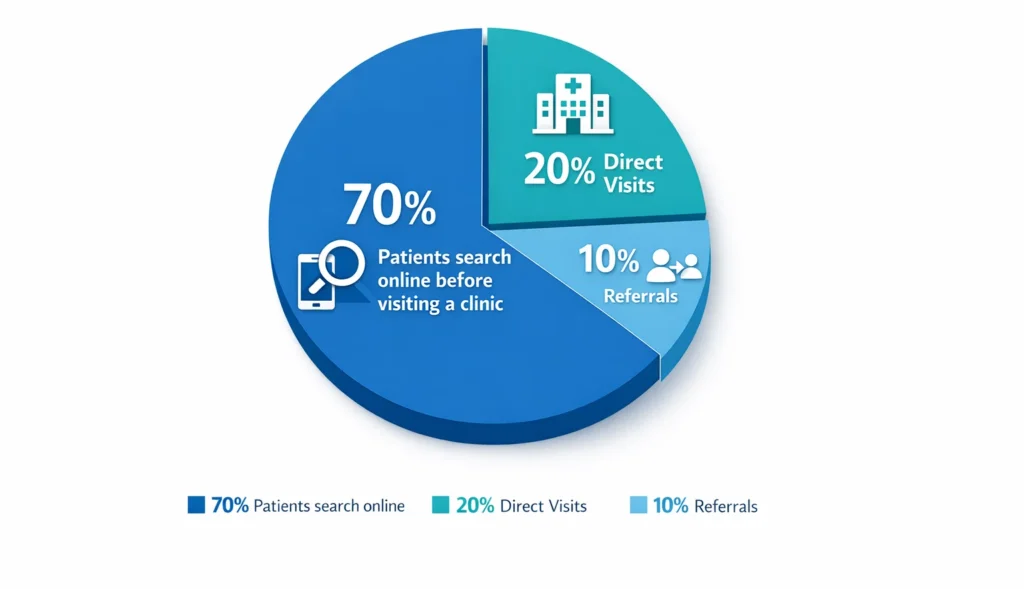
Healthcare SEO typically runs between $1,000 and $2,500 per month for medical practices with a range wide enough to confuse even the most budget – savvy founding team. And yet boutique packages suited for startups with budgets under $1,000 exist, while enterprise level campaigns can exceed up to $2500 per month. The spectrum is vast and without a clear framework, it’s easy to overspend on the wrong things or underspend where it matters the most.
For healthcare startups, the stakes are uniquely high. Patients now search for providers, read reviews, compare options and decide who to trust, all before ever stepping into a clinic. That means your digital visibility isn’t just a marketing metric but a direct driver of patient acquisition and revenue.
But healthcare SEO isn’t like optimizing a retail website. It demands compliance with strict regulations and a deep understanding of competitive local markets and the ability to build trust online that all of which influence how much you’ll need to invest and where.
This guide breaks down exactly what healthcare SEO costs in 2026, what drives those costs up or down and how startups and clinics can make smart, strategic investments from day one.
Ready to Grow Your Healthcare Practice With SEO?
Healthcare SEO isn’t just about rankings — it’s about building trust, attracting the right patients, and creating a long-term growth engine. At SEO Circular, we combine strategy, technical expertise, and healthcare-specific compliance to help you scale faster without wasting budget.
Get Your Custom SEO Strategy Today
Key Takeaways
- Healthcare SEO typically runs between $1,000 and $2,500 per month for medical practices
- By 2026, healthcare websites are evaluated not just on what content says but on how responsibly it communicates information. E-E-A-T – Experience, Expertise, Authoritativeness and Trustworthiness – has moved an optional enhancement to an essential requirement.
- HealthCare SEO is not a cost – it is a compounding asset. The earlier a startup invests the greater the long-term advantage over competitors who wait.
- Pricing is not one size fits all. Your speciality, location, competition level and growth stage all determine what you should realistically spend and what model makes the most sense for you.
- Cheap SEO in healthcare is a liability. YMYL compliance, EEAT standards and patient trust demand a level of expertise that low-cost providers simple cannot deliver.
How Much Does Healthcare SEO Actually Costs?
In the field of healthcare, understanding how healthcare SEO is priced requires looking beyond a single number. Healthcare SEO can cost anywhere from $1000 to $2,500.
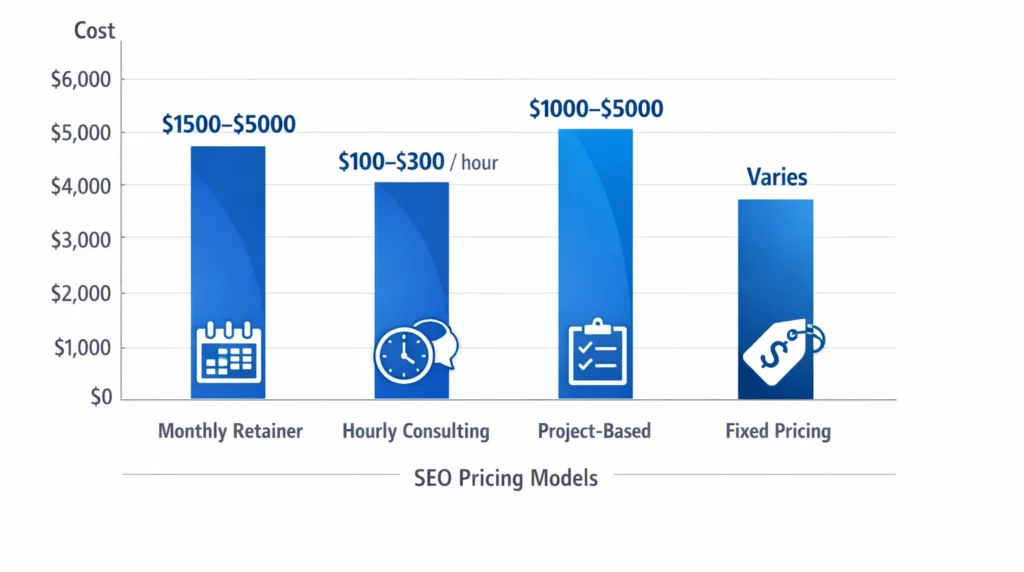
The cost is shaped by the pricing model you choose including the scope of services and the type of provider you work with. Here is a clear breakdown of each section related to the pricing models in healthcare SEO.
Pricing Models In Healthcare
| Model | Cost Range | Best For | Risk Level |
|---|
| Monthly | $1500–$5000 | Long-term growth | Low |
| Project | $1000–$5000 | One-time fixes | Medium |
| Hourly | $100–$300/hr | Strategy | Medium |
| Performance | Variable | Risky | High |
The primary pricing models in healthcare SEO are monthly retainers ranging from $1,500 to $5,000, hourly rates between $100 and $300, project-based pricing from $3,000 to $5,000 and fixed price vary by task such per word content rates.
For startups, monthly retainers are the most practical entry point since they provide predictable spend and ongoing optimization rather than one-time fixes.
Monthly Retainer:
The monthly retainer is the most common pricing model in healthcare SEO, typically ranging from $1,500 to $5,000 per month. Under this model you pay a fixed fee each month in exchange for an ongoing scope of work that usually includes content creation, technical maintenance, local SEO, link building and monthly reporting.
Most agencies in 2026 require a minimum commitment of around 30 to 60 days exit clause after the initial term. This is not arbitrary – SEO compounds over time and meaningful results take months to build.
For healthcare startup focused on long term patient acquisition the retainer model is almost the most strategic choice.
One important point worth knowing is that if an agency is quoting you $200 a month for full SEO then that is a red flag. Real healthcare SEO requires YMYL- complaint content, HIPAA – safe practices, medical schema markup, physician attributed content and deep local optimization none of which is achievable at that price point.
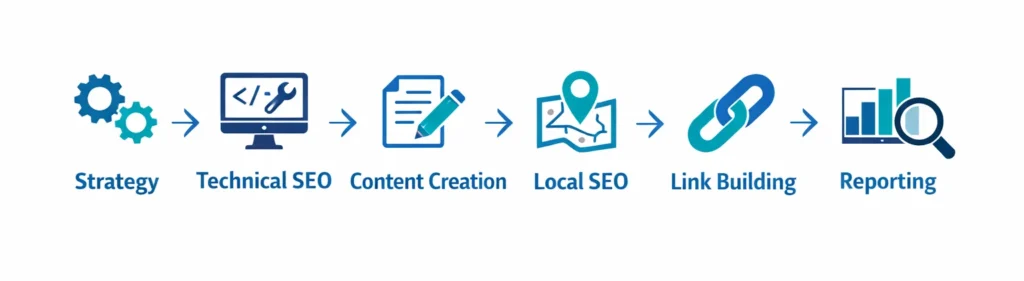
Project Based Pricing
Project based pricing works well for one time website overhauls or technical migrations typically ranging from $1,000 to $2,500 per project.
However, without ongoing maintenance following a project engagement, rankings will eventually decay as competitors pushing forward.
This model makes the most sense for startups that need a strong foundation built before committing to a retainer. Common project types include technical SEO audits, website relaunches, penalty recovery and competitive gap analysis. A smart approach for startups is to begin with a project-based audit to address immediate needs then transition into a monthly retainer for a sustained growth.
Hourly Consulting
Hourly rates for healthcare SEO consultants typically fall between $100 and $300 per hour. This model is best suited for startups that already have an in-house marketing team and need expert strategic guidance rather than the full execution. It is commonly used for one off tasks like keyword strategy sessions, content reviews or E-E-A-T compliance assessments.
The trade-off is predictability. Hourly offers flexibility but can become expensive and unpredictable for large or ongoing needs. For most early-stage healthcare startups without a dedicated marketing team, hourly consulting alone is rarely sufficient.
Fixed Price Contracts
Fixed price contracts assign a set cost to specific deliverables for example, $0.15 to $0.50 per word for SEO copywriting, $500 to $2500 for a site content audit, $500 to $700 for a link profile audit and $500 to $3,000 for social media setup.
This model gives you maximum cost transparency and is a good option when you know exactly what you need and want to avoid open ended billing.
Performance Based Pricing
Performance based pricing ties payment to rankings or leads. While the model sounds appealing these agencies often rely on aggressive or risky tactics that can permanently damage a healthcare website under Google’s strict YMYL scrutiny. For healthcare startups, this model is best avoided.
Pure pay for rankings models is increasingly rare in 2026. Where they do exist, hybrid versions are common a base retainer combined with performance bonuses tied to traffic milestones which creates more balanced incentives for both sides.
Which Model Is Right For A Healthcare Startup?
Healthcare agencies typically charge a 20 to 30 percent premium over general SEO providers due to HIPAA compliance requirements, privacy regulations and the specialized knowledge the industry demands. Given that reality the most practical path for most startups is to begin with a projects-based audit, transition into a monthly retainer once the foundation is set and use hourly consulting selectively for strategic input. This approach allows you to build equity without overcommitting budget in the early stages.
Factors That Influence Your Overall Healthcare SEO Cost
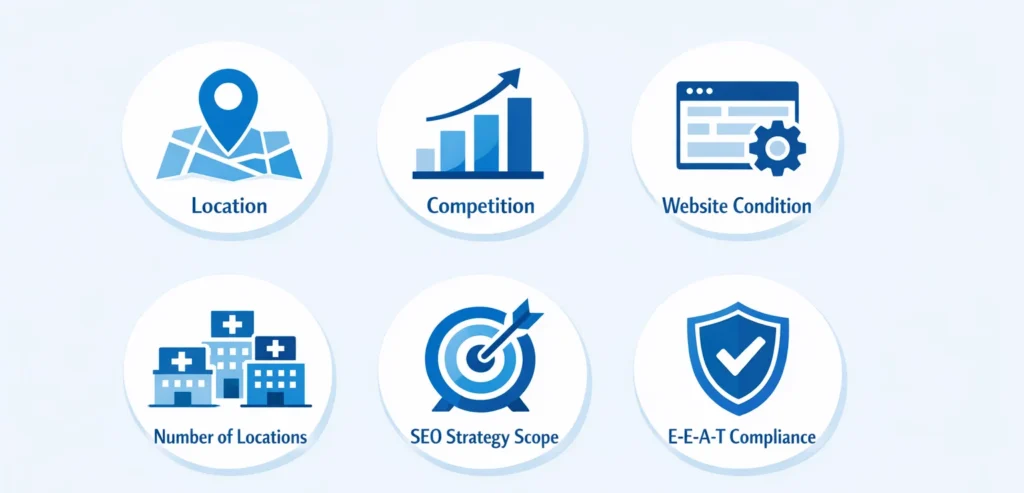
No two healthcare will pay the same for SEO and that is by design. Pricing is determined by a combination of factors that are unique to your practice, your market and your growth ambitions. Understanding these variables helps you interpret any quote you receive and avoid paying for services that do not match your actual needs.
Agency Expertise And Specialization:
The more experience an SEO provider has in healthcare, the more they are likely to charge but given the complexity of the industry, this extra cost is often a worthwhile investment. A generalist agency may quote you a lower rate but without clinical understanding, HIPAA compliance awareness and patient journey expertise the strategy they build is unlikely to perform in a heavily scrutinized search environment.
Competitiveness Of Your Speciality And Location
Healthcare is among the most competitive industries for SEO, sitting alongside finance, legal and e-commerce. Highly competitive specialities demand more aggressive strategies, more content, stronger link profiles and higher budgets. A cosmetic surgery startup in Manhattan will likely require a fundamentally different investment than a general practitioner in a mid-sized city with fewer direct competitors.
Your Current SEO Standing
If your practice has a consistent presence in local directories and a robust backlink profile, your SEO provider will have less upfront work to do. Startups launching from scratch, on the other hand, need foundational work completed before optimization can begin which naturally drives up the initial cost.
Number Of Locations
If you invest in local healthcare SEO, the number of locations you wish to target directly impacts your price because your provider will need to complete SEO tasks for every area you serve. Each location requires its own Google Business Profile management, local citations, GEO-targeted content and review strategy.
Scope And Aggressiveness Of The Strategy
How aggressive you want your SEO strategy to be matters significantly. A plan that targets more keywords, more content and broader reach will cost more than a focused local campaign built around a narrow set of high intent searches. For most startups, starting with a tightly scoped strategy and expanding as revenue grows is the smarter financial decision.
E-E-A-T And Regulatory Compliance Requirements
By 2026, healthcare websites are evaluated not just on what content says but on how responsibly it communicates information. E-E-A-T – Experience, Expertise, Authoritativeness and Trustworthiness – has moved an optional enhancement to an essential requirement. Meeting this standard means physician reviewed content, properly attributed authorship, credible backlinks from medical publications and HIPAA properly attributed authorship, credible backlinks from medical publications and HIPAA safe configurations – all of which add legitimate cost to any campaign.
Technical Complexity Of Your Website
Medical websites often have complex site architectures with dozens of service pages, doctor profiles and location pages. Getting this structure right is essential for both user experience and search engine visibility and ongoing which directly affects what you pay.
The Right Way To Think About Your Cost
The smartest approach is to start with clear objectives, assess competitive reality honestly and match your budget to your business stage and goals. Do not expect a $1,000 monthly investment to compete in markets where successful competitors are investing $7,000. But also, do not overspend on enterprise strategies when simpler, focused tactics would suffice. For healthcare startups, cost should always be evaluated relative to the patient acquisition value it generates – not as a standalone expense.
Growing Your Practice: The Real Return On Healthcare SEO Investment
For healthcare startups, SEO is not simply a marketing expense it is an investment that compounds in value over time. Understanding what that return looks like helps you make confident budget decisions from the start.
Healthcare providers investing in SEO report a 280% ROI within the first 12 months and the numbers only improve from there. Dental and medical SEO delivers between 5x and 12x ROI over time, driven by the high lifetime value of returning patients, referrals and ongoing care.
Meaningful results typically arrive within 6 to 12 months with peak performance in the second or third year of a campaign. Unlike paid advertising where costs reset with every campaign, SEO builds equity that keeps delivering returns long after the initial investment.
SEO leads also carry a 14.6 percent close rate compared to just 1.7 percent for outbound efforts a difference in lead quality that fundamentally changes the economics of patient acquisition for any healthcare startup.
The takeaway is simple: the earlier you start, the greater the compounding advantage over competitors who wait.
Start Your Healthcare SEO Journey With Us
Knowing what healthcare SEO costs is only half the equation. The other half is finding the right partner especially when you are a startup working with limited time, budget and room for error.
SEO Circular works with healthcare startups at every stage of growth, bringing 5+ years of experience, a 98% client retention rate and 500+ global brands served. From building your SEO foundation from scratch to scaling patient acquisition as you grow, they handle everything – custom strategy, technical optimization, content and authority building and clear transparent reporting.
No fluff, no wasted budget. Just a focused, data driven approach built around your goals from day one.
Ready to get started? Contact us at sales@seocircular.com
Conclusion
Healthcare SEO is not a luxury reserved for large hospital systems or well-funded networks. For startups, it is one of the most strategic investments you can make early and one that pays dividends long after the initial spend.
The cost will vary based on your specialty, market and growth stage. But the real question was never how much it costs. It was always whether you can afford to be invisible while your competitors are not.
Start with the right foundation, choose a partner who understands the healthcare space, and commit to the long game. The startups that do will own their markets. The ones that wait will spend twice as much catching up.
Commonly Asked Questions
Healthcare SEO typically takes 3 to 6 months to show early traction and 6 to 12 months for meaningful patient acquisition. Startups should treat it as a long-term investment, not a quick-win channel.
It is possible but rarely practical given the compliance, technical, and content demands involved. Hiring a specialist agency is almost always more cost-efficient than building that expertise in-house from scratch.
Focus on core conversion events like appointment bookings and patient inquiries, then connect that data to your CRM to measure full-funnel ROI. Rankings and traffic matter, but patient acquisition cost is the number that truly counts.
Healthcare SEO operates under strict medical accuracy standards, HIPAA compliance requirements, and E-E-A-T scrutiny that most industries never face. It also means competing directly with authority sites like WebMD and Mayo Clinic for visibility.
Yes and increasingly so. Patients regularly use voice queries like “clinic near me” or “urgent care open now,” making local voice search optimization a practical priority for any startup targeting nearby patient acquisition.