SEO Cost For Subscription-Based Businesses: Complete Guide 2026
SEO costs for subscription-based businesses typically range from $500 to $5,000+ per month, depending on factors like competition, content production, technical complexity, and link-building needs. Unlike one-time purchase models, subscription businesses require long-term SEO strategies focused on recurring revenue and customer lifetime value. This guide breaks down SEO pricing across different growth stages, explains the key cost drivers, and explores the most common pricing models used in B2B SEO.

SEO costs for subscription-based businesses typically starts within from $500 to $3,000+ per month for standard services with comprehensive national campaigns often costing $3,000–$5,000+ monthly. Pricing also depends on industry competition, content needs and backlink strategies with hourly rates ($15–$20) and projects free audits for your website are also available.
Most subscription businesses ask the wrong question when it comes to SEO. They ask “how much does SEO cost?” – when the question they should be asking is “what is SEO worth to a business where every customer pays monthly for years?”
That second question changes everything – your budget, your agency negotiations, your content priorities and the patience you extend before expecting results. It reframes SEO from an expense into a capital allocation decision.
Seo for SaaS platforms, B2B tools and recurring revenue businesses demands its own cost framework not a guide built for e-commerce or one-time service businesses. The stakes, the timelines, the content requirements and the competitive dynamics are entirely different.
In this guide, we break down exactly what SEO costs at every stage of a subscription-based business, what drives those costs up or down, where to allocate spend for maximum long term value impact and how to make the investment defensible to any leadership team or board.
Turn SEO into Your Highest ROI Channel 🚀
Struggling to generate consistent leads from SEO? We help subscription businesses attract qualified traffic and convert it into trials, signups, and recurring revenue.
Pre-Requisites For Subscription Based Businesses
- A clearly defined ideal customer profile — know exactly who you are targeting before a single keyword is researched.
- A conversion-ready website — SEO drives traffic, your site needs to be capable of converting it.
- A consistent content operation — the pipeline for briefing, writing and publishing must already be moving.
- Proper analytics and conversion tracking — trial signups and MRR contributions must be measurable from day one.
- A 12-month commitment from leadership — SEO compounds over time, teams that pull budget early never see the return.
- A realistic budget allocation — subscription businesses should plan for a minimum of $1,500/month at early stage, scaling to $5,000–$8,000/month as the channel matures and competition demands it.
What Does SEO Cost for Subscription-Based Businesses?
SEO spend for subscription businesses breaks into four distinct phases each with its own cost profile, strategic focus and expected output. These are not aspirational estimates. They reflect what competitive subscription businesses are actually allocating in 2025-2026. Let’s explore the cost below
| Stage | Monthly SEO Spend | Key Focus | Expected Output |
|---|
| Startup / Pre-PMF | $500 – $800 | Technical setup, keyword mapping, basic content, early link outreach | Indexing, initial rankings, topical relevance |
| Growth (Seed – Series A) | $800 – $1,000 | Competitive content, landing pages, conversion-focused keywords | Qualified traffic, early conversions, improved visibility |
| Scale (Series B+) | $1,000 – $3,000 | Authority building, link acquisition, product-led SEO, international expansion | Strong rankings, consistent traffic growth, market positioning |
| Enterprise SaaS | $3,000+ | Digital PR, programmatic SEO, multi-language content, technical scaling | Market dominance, high-volume traffic, sustained growt |
What Factors Determine Your SEO Cost As a Subscription Business?
SEO pricing is not arbitrary, it is a direct output of your business’s complexity, competitive environment and growth stage. These are the factors that move the number and why two subscription business in the same category can come with a big cost difference.
1. Competitive Density Of Your Category
Category competition is one of the single largest cost drivers in B2B subscription SEO. It determines how much domain authority you need to rank, how long it takes to get there and how much content and link acquisition investment is required to close the gap.
Consider two SaaS businesses: one selling project management software in a market with Asana, Monday.com and notion and another selling niche compliance automation for a single regulated industry. The first is competing against companies with figure SEO budgets. The second has a manageable competitive landscape. Their SEO costs will differ by 3-5x even if their product pricing and team size are identical.
High Competition (CRM.HRMS<Marketing tools)
$800 – $1,000/month to compete
Niche vertical SaaS
$1,000-$1,500/month to compete
To assess your competitive density before setting a budget, look at the domain authority of the top 5 organic results for your core keywords. If those pages consistently show domain authority around 70+ then you are in a high-cost category and need to plan accordingly – particularly for link acquisition.
Low Competition
$500-$900/month Niche verticals, emerging categories, undeserved industries
Medium Competition
$1,000-$1,200/month Established but not saturated. Mid-tier SaaS, regional B2B tools
High Competition
$2,000 – $3,000/month Established but not saturated. Mid-tier SaaS, regional B2B tools
2. Content Volume And Funnel Coverage Required
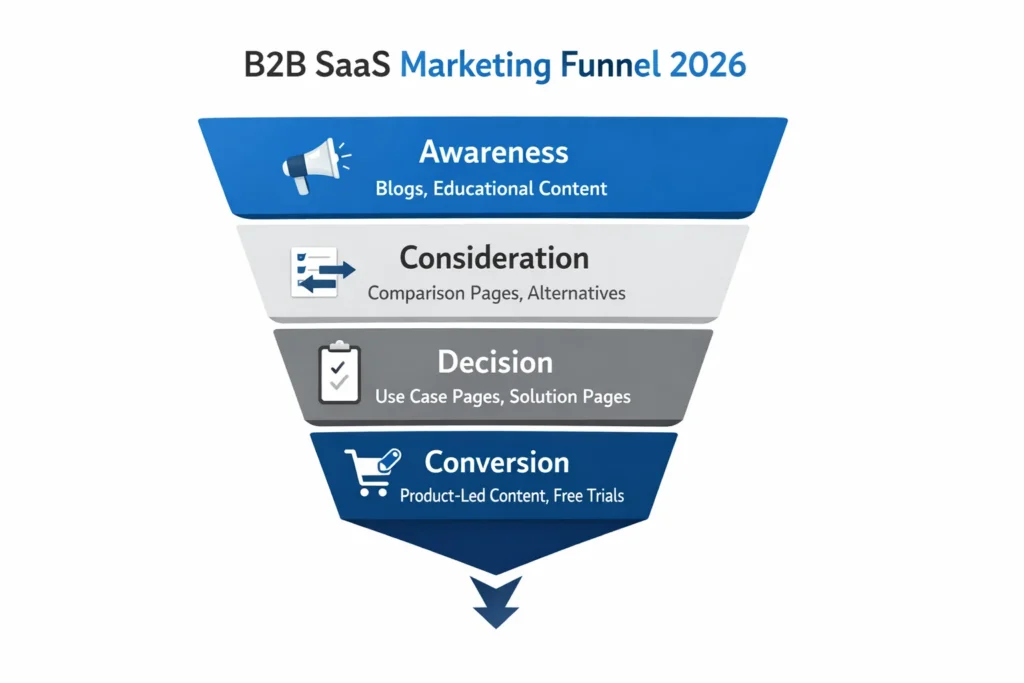
Content is typically the largest ongoing SEO cost for subscription businesses and the requirement is significantly heavier than for transactional or local businesses. A subscription buyer goes through a multi-week research process spanning awareness, evaluation, comparison and decision stages. Each stage needs content optimised to capture and advance that intent.
Here is the breakdown of the content types required and their approx. production costs.
Awareness Articles
$300 – $500 Per 1,500-2,500 word article. Top-of-funnel educational content.
Comparison Pages
$500-$700 Per page. High conversion value
Use-Case/ Solution Pages
$600-$800 Per page. Directly maps your product to a buyer’s specific workflow problem.
Product-Led Content
$700-$1,000 Per piece. Integrates product demonstrations into how-to content. Highest trial conversion rate.
The volume of content needed depends heavily on your subscription model type. A SaaS platform targeting multiple industries and uses cases may need 8-12 pieces per mouth to build topical authority. A niche B2B data subscription can often achieve strong results with 4-6 highly targeted pieces. A content or strong results with 4-6 highly targeted pieces. A content or newsletter subscription may need 10-15 shorter editorial pieces to maintain organic visibility.
3. Technical Complexity of your Platform
Technical SEO is where subscription businesses – particularly software platforms face costs that have no equivalent in simpler business models. Your product’s architecture introduces SEO challenges that require specialist expertise to resolve and maintain.
The most common and costly issues specific to subscription platforms include:
- JavaScript rendering issues
- Login-gated content not indexing
- Multi-tenant subdomain structure
- Duplicate meta across plan tiers
- App vs. marketing site architecture
- Page speed on feature-heavy Uls
For SaaS and API subscription businesses, a one-time technical SEO audit conducted by a specialist who understands JavaScript – rendered applications typically costs $1,000-$2,000 and almost always uncovers issues that are silently suppressing rankings. Ongoing technical maintenance runs $800 -$2,000/month.
For content subscriptions and membership platforms, technical SEO is considerably simpler. A WordPress or Webflow-based site can often be maintained technically for $300-$600/month with a lighter initial audit for free.
1.High Technical Cost
SaaS platforms, API subscription, multi-product suites with complex app architecture.
Initial audit: $200-$500.
Ongoing: $300-$500/monthly
2. Standard Technical Cost
Content subscription, newsletters, membership communities on standard CMS platforms.
Initial audit $300-$600
Ongoing: $400-$600/month
5. Link Acquisition
Backlinks remain one of the strongest ranking signals in competitive B2B search categories. For subscription businesses, organic link velocity – links earned without active effort is typically very low. Publications and websites do not naturally link to SaaS tools or membership platforms the way they link to research, news or freely accessible resources.
This means link acquisition has to be proactive and budget – allocated. The cost is driven by the domain authority you are targeting and the category you are operating in.
1) Niche Outreach
$600-$800/month
8-15 quality links/month from relevant but mid-tier publications and directories
2) Authority-Tier Links
$800-$1,000/month
5-10 links/month from DA 60+ publications in your industry vertical.
3) Digital PR Campaigns
$1,000m – $2,000 Per campaign
Data-led PR designed to earn 20-50 links from mainstream and trade press.
The subscription model type significantly affects link acquisition strategy. SaaS platforms can leverage integration directories (G2, Capterra, Product Hunt), partner ecosystem and developer communities for natural link sources. Data and API subscriptions often earn links through original research and datasets. B2B membership platforms benefit from speaker citations and industry publication mentions. Content subscriptions typically need to invest more actively in outreach since their product itself does not generate actively in outreach since their product itself does not generate natural link sources.
5. Target Market Scope – Geographic and ICP (Ideal Customer Profile) Breadth
Two subscription businesses with identical products can have SEO costs that differ by 2-3x purely on the scope pf their market. Scope has two dimensions:
- Geographic reach
- Ideal customer profile breadth
Geographical scope
It is the more straightforward cost driver. A subscription business targeting a single English-speaking market (US, UK,) has a contained SEO program. One targeting multiple languages or regional markets requires localised content, hreflang implementation and in some cases entirely separate link acquisition programs per region. International SEO typically adds 40-80% to a program’s total cost.
ICP breadth
It refers to how many distinct buyer personas, industries or company sizes your product addresses. A SaaS platform that serves HR teams, finance teams and operations teams across small and medium size businesses, mid-market and enterprise segments needs separate content tracks for each – multiplying content volume and the complexity of keyword strategy. A focused tool built exclusively for a single persona in a single industry can execute SEO with far greater efficiency.
1) Single Market, Single ICP
Base Cost – The most efficient SEO configuration. Focused keyword strategy, one content track.
2) Multi-Persona, Single Market
1.5-2x Base
Separate content strategies per persona. Higher volume, more complex internal linking.
3) Multi-Market, Multi-Language
2-3x base
Localised content, regional link building, technical hreflang configuration and separate rank tracking per market.
You Should Also Check Out: SEO Cost For Small Businesses
SEO Pricing Models for Subscription-Based Businesses — Which One Actually Fits You
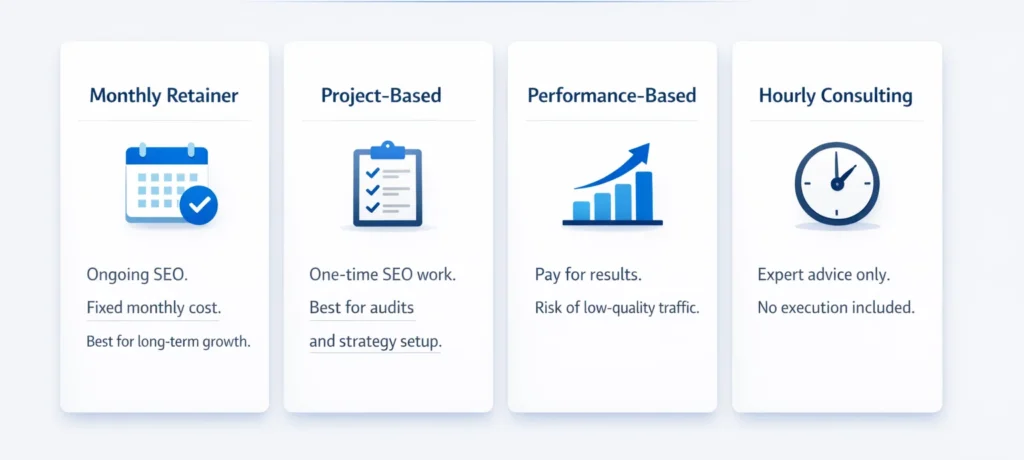
Before signing any SEO contract or hiring anyone, you need to understand how SEO is priced because the model you choose affects not just what you spend but what you get, when you get it and how accountable your provider is for results.
There are usually four primary pricing models used in B2B SEO today. Each suits a different stage and type of subscription business.
1. Monthly Retainer
This is the most common model for subscription businesses and for good reason — SEO itself is a recurring, ongoing activity. You pay a fixed amount every month in exchange for a defined scope of work: strategy, content production, link building, technical maintenance and reporting.
Typical range: $1,000 – $2,000/month depending on scope and provider level.
This model works best for SaaS platforms, B2B membership tools, and data subscription products that need sustained, compounding SEO activity. The consistency of effort is what builds domain authority over time. The risk is that retainers can become passive — you pay monthly but output and accountability drift if there is no clear deliverables framework tied to the contract.
2. Project-Based Pricing
Here you pay a one-time fixed fee for a specific, defined piece of work — most commonly a technical SEO audit, a keyword strategy, a content architecture plan or a site migration. There is no ongoing commitment.
Typical range: $1,500 – $3,000 per project depending on scope and complexity.
For subscription businesses, project pricing makes the most sense at two points: at the very beginning (to build the strategic foundation before committing to a retainer) and at specific inflection points (a platform rebuilds, an international expansion or a significant algorithm recovery). A SaaS company rebuilding its marketing site should commission a technical SEO project before going live not after.
3. Performance-Based Pricing
In this model you pay based on results typically on rankings achieved, organic traffic delivered or leads generated. It sounds appealing because it appears to remove risk from the buyer.
In practice, it rarely works well for subscription businesses. The metrics that get optimised (keyword rankings, raw traffic) are often misaligned with the metrics that matter (trial signups, MRR, organic CAC). An agency can rank you for high-volume keywords that bring zero qualified subscribers and still collect full payment. Additionally, reputable SEO providers rarely agree to pure performance-based models because SEO outcomes depend on factors outside their direct control — your product, your conversion rate, your sales cycle.
Where it can work as a hybrid model where a base retainer covers core activity and a performance bonus is tied to clearly defined conversion outcomes like organic trial signups.
4. Hourly Consulting
You pay a senior SEO consultant by the hour for strategy, advice, audits or training. No execution is included, just expertise.
Typical range: $10 – $20/hour for a qualified B2B SEO consultant.
This model is underused by early-stage subscription businesses and overused by growing ones. For a pre-seed SaaS or content subscription that cannot afford a retainer, a 10–15 hour engagement with the right consultant can deliver a keyword strategy, a technical priority list and a 6-month content plan giving you a roadmap to execute with internal resource. The mistake is relying on hourly consulting past the point where you need full execution not just direction.
Why the SEO Team Behind Your Subscription Business Matters More Than the Budget?
Most subscription businesses that struggle with SEO do not have a strategy problem or a budget problem. They have a people problem. The wrong team — or no dedicated team at all — is the single most common reason SEO spend produces no meaningful return.
SEO for subscription businesses is not a set-and-forget task. It requires consistent execution across content, technical health, and link acquisition — simultaneously, every month. That demands people who understand not just SEO mechanics, but the specific dynamics of recurring revenue: how to target buyers mid-research, how to write content that converts to trials, and how to report performance in terms of MRR and CAC rather than just traffic.
What a capable SEO team actually does for your business
A properly structured SEO team does four things that no tool or one-off agency engagement can replicate. Maintains your technical foundation, so rankings are not silently lost to crawl errors or platform updates. It builds topical authority through consistent, high-quality content that earns trust with both search engines and your buyers. It acquires links that signal credibility in your category. Also it connects every activity back to revenue — so the investment is always justified and always directionally correct.
Without that team in place, even the right strategy degrades quickly. Content gets published without a brief. Technical issues go unresolved for months. Link building stops the moment a freelancer moves on. The compounding nature of SEO — its greatest advantage — only works when the effort is continuous.
Where SEO Circular comes in
At SEO Circular, we work exclusively with subscription-based businesses — SaaS platforms, B2B membership tools, data products, and recurring-revenue brands that need SEO built around LTV, not just traffic. Our team handles the full execution stack: technical audits, content strategy and production, link acquisition, and performance reporting tied directly to your growth metrics.
You do not need to hire, train or manage an in-house team from day one. You need the right partner who already understands your model, your buyer and what good SEO results actually look like for a subscription business.
That is what SEO Circular is built to be.
The Cost Of Hiring SEO Circular For Your Subscription Business
Hiring the right SEO team is an investment decision and like any investment, the number only makes sense when you understand what it buys and what it returns. Here is what working with SEO Circular practically costs based on real market rates for the scope of work involved.
Starter Engagement – 600 to $1,000/month
Built for early-stage subscription businesses and startups that need a strong foundation without overextending budget. This covers a full technical SEO audit, keyword and competitor research, a content strategy mapped to your ICP and two of your published articles per month.
Link outreach is included at a baseline level. At this tier your get a clear roadmap, consistent execution and monthly reporting tied to organic traffic and trail metrics.
Best fit for pre-seed to seed stage SaaS, niche B2B tools and content or newsletter subscription getting SEO off the ground.
Growth Engagement – $1,000 to $2,000/month
Designed for subscription businesses post product market fit that are ready to compete seriously in their category. This includes full technical maintenance, six to eight pieces of content per month, active link acquisition targeting DA 50+ publications and competitive tracking across your core keyword set. Reporting at this tier to MRR contribution and organic CAC- not just rankings.
Best fit for Series A SaaS platforms, B2B membership communities and data subscription products scaling their organic channel.
Scale Engagement – $2,000 to $3,000/month
For subscription businesses where SEO is a primarily acquisition channel and the competitive environment demand sustained authority-building. This covers the full execution stack – technical SEO, high volume content production, digital PR and link campaigns, programmatic SEO where applicable pipeline and revenue benchmarks.
Best fit for Series B+ SaaS companies, multi-product subscription platforms, and enterprise B2B SEO agencies competing in high-density markets.
Every engagement fits your stage and goals, get in touch with SEO Circular directly.
The Right SEO Investment Turns Subscribers Into a Compounding Growth Engine
SEO for subscription businesses is not complicated but it is specific. The cost is real, the timeline is longer than most businesses expect, and the factors that drive your number are different from every other business model. What makes it worth it is equally specific: a single ranked page delivering qualified trials every month for years, an organic CAC that drops while your paid CAC climbs and a customer acquisition channel that does not switch off the moment you stop paying for it.
The businesses that win with SEO are not necessarily the ones with the biggest budgets. They are the ones that understand their model, invest at the right stage, choose the right pricing structure and commit long enough to let the compounding effect do its work.
If you are a subscription business ready to build that engine — SEO Circular is built to help you exactly do that.
Commonly Asked Questions
Does SEO Work Differently For Freemium Subscription Models Compared To Paid-Only Subscriptions?
Yes — freemium models can leverage product-led SEO by indexing user-generated content, public project pages, and feature-specific landing pages, creating organic surface area that paid-only models cannot. The content strategy and keyword targeting differ significantly between the two.
How Does SEO Interact With Paid Acquisition For Subscription Businesses — Should They Run Simultaneously?
SEO and paid ads serve different stages of the funnel and different timeframes. Paid fills the pipeline immediately while SEO builds the long-term organic base. Running both simultaneously is the most effective approach, with the expectation that organic gradually reduces dependency on paid spend over 18 to 24 months.
What Happens To SEO Performance When A Subscription Business Rebrands Or Migrates To A New Domain?
A domain migration without proper SEO planning can wipe out years of accumulated authority overnight. 301 redirects, canonical tags, and a structured crawl validation process are non-negotiable before any migration goes live. Businesses should expect a temporary rankings dip of 20 to 40 percent even with a well-executed migration.
How Should A Subscription Business Approach SEO When Launching In A New Vertical Or Industry Segment?
Entering a new vertical requires treating it as a separate SEO program — distinct keyword research, dedicated landing pages, and new content tracks built around that segment’s specific pain points. Trying to rank for a new vertical by repurposing existing content rarely works and dilutes topical authority.
Can A Subscription Business With A Small Team Realistically Manage SEO In-house Without An Agency?
Yes, but only with the right constraints. A single in-house SEO manager can effectively own strategy, technical maintenance, and content oversight — provided content production is outsourced to freelance writers and link acquisition is handled by a specialist. Trying to do everything in-house with one person typically results in either content or technical SEO being neglected entirely.
Ready to rank on Google and AI at the same time?
We help brands win across search and AI answers — technical SEO, content strategy and Generative Engine Optimization in one workflow. Tell us your goals and we’ll show you the plan.