Getting found on Google is one problem. Getting cited in AI search results is a completely different one. Most brands have spent years building traditional SEO equity but when someone asks an AI tool a question in their industry then their brand is nowhere in the answer. That gap is growing fast and the companies closing it now are building an organic advantage that compounds over time.
If you want your brand to show up in AI-generated answers and not just on page one of Google, SEO Circular AI SEO services are built exactly for this. Schedule a free strategy call and get a 30-day opportunity snapshot within one business day.
Want to Know How Often AI Search Engines Mention Your Brand?
SEO Circular helps businesses track AI citations, improve AI Overview visibility, and build authority across ChatGPT, Gemini, Perplexity, and Google AI Search.
Get My AI Visibility ReportKey Takeaways
- AI search visibility is now a separate layer of organic discovery that sits alongside traditional Google rankings and requires its own strategy.
- Content depth and topical authority matter far more to AI citation systems than keyword volume or backlink count alone.
- Structuring content to answer questions directly, using clear headings and FAQ formats, significantly improves the chances of being cited in AI-generated responses.
- Off-site brand presence across credible publications, directories, and editorial mentions is a major trust signal for AI models deciding what to cite.
- Most brands currently have no clear picture of how much traffic AI search is sending them, making baseline measurement an urgent first step.
What AI Search Visibility Actually Means?
AI search visibility refers to how often and how prominently your brand, content, or website gets cited or mentioned when AI tools generate answers to search queries.
When someone types a question into ChatGPT or Perplexity, those tools do not show ten blue links. They generate a direct answer, and somewhere inside that answer, they may or may not cite a source. You are invisible to that user, no matter how well you rank on Google.
Google AI Overviews work similarly. A user sees a generated summary at the top of the page before they ever scroll to organic results. If your content does not feed that summary, you lose the attention of users who never make it past the fold.
AI search visibility is about being the source these tools trust enough to quote.
Why Is Your Current SEO Not Enough?
Traditional SEO was built around signals like backlinks, keyword frequency, and page authority. AI models use a different set of signals when deciding what content to surface and cite. Here is what breaks down:
- Keyword stuffing and thin content get deprioritized by AI models that are trained to reward depth and factual accuracy not repetition.
- Backlink volume alone does not tell an AI model whether your brand is credible in a specific topic area.
- Content without a clear structure makes it harder for AI systems to extract a clean, citable answer.
- Generic blog posts that cover a topic broadly without genuine insights are less likely to be pulled into AI-generated responses.
- If your brand has little presence outside your own website, AI models have fewer signals to confirm that you are a trustworthy source.
This does not mean traditional SEO becomes useless. It means traditional SEO is now the floor, not the ceiling. AI visibility requires a layer of strategy on top of what most teams are already doing.
Strategies for Growing AI Search Visibility
Growing your visibility in AI search is not about chasing algorithm updates or finding shortcuts. It is about building the kind of content, structure, and brand presence that AI tools are trained to trust and cite. These strategies work together and the brands seeing real results are the ones applying them consistently across all three areas.
1) Build Content That Answers Questions With Authority
AI tools are retrieval systems at their core. They look for content that answers a question cleanly, accurately and with enough depth too be useful. Content that hedges on every point, avoids taking a position, or simply repeats what is already widely available is rarely what gets cited. Build content that takes a clear stance, explains the reasoning behind it and leaves the reader with something they could not have found in five other places.
2) Establish Topical Depth Over a Focused Subject Area
Covering one topic area deeply is more valuable than publishing broadly across many categories. AI models develop a sense of what your website is about based on the consistency and depth of your content. A brand that publishes ten genuinely expert pieces on enterprise SEO is more likely to be cited on that topic than a brand with a hundred posts spread across marketing, design, HR and finance.
3) Earn Mentions Across Credible Third-Party Sources
Your own website is only one data point. AI tools are trained on content from across the internet, which means editorial mentions, Expert quotes, industry publications and digital PR placements all contribute to how AI systems perceive your brand authority. The more your brand appears in credible, independent contexts, the more confident an AI tool becomes in surfacing you as a source.
4) Optimize Your Content Structure For AI Extraction
AI tools extract answers from content the same way a careful reader would skim for the most relevant passage. Clear headings, direct answers at the top of each section and well formatted lists make it easier for AI systems to pull your content into a generated response. Treat every major section of your content as a potential standalone answer.
5) Maintain Consistency In Brand Voice And Factual Accuracy
AI models encounter your content in many places over time. Inconsistency across your content library, whether in the facts you state, the positions you take or the quality of your writing, creates noise that works against you. A consistent, accurate and recognizable voice across your website and all external content builds the kind of trust signal that improves AI citations over time.
The Content Signals AI Search Engines Actually Look For
This is where most of the work happens. AI tools are trained on large amounts of text, and they learn to prefer certain types of content when generating answers. The patterns are consistent enough that you can reverse engineer them.
Write With A Genuine Point Of View
AI models favor content that takes a clear position or provides original analysis. A post that simply lists facts already available elsewhere is less useful to an AI tool than one that offers a real perspective, draws a conclusion or explains the why behind something.
Structure Content To Answer Questions Directly
One of the clearest ways to get cited by AI tools is to write content that directly answers the questions your audience is typing. This means leading with the answer, not building it. Think about how your reading would read if someone asked that exact question to an AI tool.
Go Deep On Fewer Topics Rather Than Wide On Many
Topical authority matters more than volume. A site that covers ten subtopics in real depth signals expertise to AI models far more clearly than a site with two hundred Surface-level posts across twenty categories.
Use Credible Sources Within Your Content
When your content cites data, studies or named authorities, it signals that your writing is grounded in facts. AI tools are tuned to recognize this kind of rigor. It also makes your content more quotable.
Stay Consistent In Voice And Factual Accuracy
AI models that encounter your content repeatedly across different contexts learn to associate your brand with reliable information. Inconsistency, factual errors or contradictory claims across your content library will work against you.
Technical And Structural Changes That Improves AI Visibility
Beyond the content itself, how your site is built matters. AI crawlers and the systems that index content for AI tools care about structure and clarity.
- Use schema markup to make your content type, authorship and topic clear to automated systems. FAQ schema, How To schema and Article schema are all useful starting points.
- Keep your site architecture clean. Deep nesting, redirect chains and orphaned pages make it harder for AI systems to index and trust your content.
- Format content with clear H2 and H3 headings that reflect the actual questions your audience asks. This mirrors the way AI tools break up and extract answers.
- Create dedicated FAQ and Q&A pages where appropriate. These formats match the query patterns AI tools use when generating responses.
- Ensure pages load cleanly and are fully crawlable. If a bot cannot access your content, it cannot be trained on it or cited from it.
Building Brand Presence Outside Your Own Website
AI models do not only learn from your website. They learn from the broader internet, which means your brand presence across third-party publications, forums, directories, and media coverage all contribute to your AI search visibility.
The most effective external signals include:
- Coverage in high authority publications in your industry. When credible outlets write about your brand or cite your data then it reinforces your authority in AI training and retrieval systems.
- Digital PR that earns genuine editorial mentions, not paid placements or low-quality guest posts.
- Appearances in podcast transcripts and video content that get indexed online.
- Listings and reviews on established third party directories and review platforms.
- Wikipedia entries and references on encyclopedic or reference sites where AI models draw heavily for factual grounding.
The underlying principle is that AI tools verify trust through corrobation. If your brand appears in multiple independent, credible sources saying consistent things, the confidence an AI model has in citing you goes up.
How To Track Whether AI Search Is Sending You Traffic?
Most analytics setups do not capture AI search traffic cleanly. Users arriving from ChatGPT or Perplexity often show up as direct traffic in Google Analytics, which makes it hard to know how much of your organic growth is actually coming from AI referrals.
Here is how to get a clearer picture:
- Check your referral traffic for domains like perplexity.ai, chatgpt.com and bing.com (which powers several AI tools) on a regular basis.
- Monitor direct traffic trends alongside your content publishing activity. Spikes in direct traffic after publishing well-structured content may indicate AI referral activity that is not being categorized correctly.
- Use tools like Semrush, Ahrefs or AI visibility platforms that are beginning to track share of voice in AI generated results specifically.
- Run manual tests. Regularly ask ChatGPT, Perplexity and Google AI Overviews questions in your industry and track whether your brand appears in the answers over time.
- Set up Google Search Console alerts for branded query growth. If your AI visibility is improving, you will often see branded search volume increase as more people look you up after seeing your brand mentioned in an AI response.
Tracking this space is still evolving but the brands that establish a measurement baseline now will have a significant advantage when more sophisticated tools become standard.
Conclusion
AI search is not replacing Google but it is adding a second layer of discovery that most brands are not showing up in yet.
The strategies that build AI search visibility including structured authoritative content, strong off site presence, clean technical foundations and consistent topical depth also make you better at traditional SEO. The investment compounds in both directions.
The window to build an early position in AI search is still open. The brands that move now will be much harder to displace once this space matures.
Frequently Asked Questions
Not entirely, it builds on strong SEO foundations but adds a layer of content depth, structure and off-site authority that traditional SEO alone does not fully address.
There is no fixed timeline but brands that invest consistently in authoritative content and off site presence typically see early signals within three to six months.
No, Topical depth matters more than site size. A focused website with genuine expertise in a narrow area can outperform larger sites with broad, thin content.
Each platform uses slightly different retrieval methods but the underlying signals, authoritative content, credible sources and strong external presence are consistent across all three.
Each platform uses slightly different retrieval methods, but the underlying signals, authoritative content, credible sources, and strong external presence, are consistent across all three.
Search is no longer just blue links on a results page. ChatGPT answers questions. Perplexity summarizes topics. Google surfaces AI Overviews before a single organic result loads. In this environment, knowing where your brand appears and where it hasn’t become one of the most important signals your SEO team can track is essential.
An AI search monitoring platform gives you visibility. It watches how AI-powered search tools reference your content, track shifts in search intent and surfaces the content gaps your competitors are quietly filling. The result is an SEO strategy that reacts faster and compounds harder over time.
If you want your brand to show up every time a buyer asks an AI tool a question in your niche, SEO Circular’s SEO service is built for exactly that. We help enterprise brands rank across classic SERPs and get cited by ChatGPT, Perplexity and Google AI, all under one strategy.
Want to know whether ChatGPT, Perplexity, and Google AI Overviews are citing your brand?
SEO Circular provides AI SEO audits, AI visibility tracking, and enterprise SEO strategies that help brands earn citations across modern AI search platforms.
Get Free AI Visibility AuditKey Takeaways
- AI search monitoring platforms track how your content is cited across ChatGPT, Perplexity, Google AI Overviews and other AI-powered search surfaces, giving you visibility that traditional rank tracking cannot provide.
- The biggest SEO blind spot today is not your keyword rankings but whether AI tools are answering buyer questions using your content or a competitor’s.
- Content Gaps identified through AI monitoring can be acted on weeks earlier than those found through traditional keyword volume trends.
- Connecting AI citation data to pipeline metrics is the clearest way to demonstrate the business value of SEO to CFOs and senior leadership.
- Turning monitoring insights into action requires a clear sprint trigger system, not just a dashboard. The teams that win are the ones that move on signals quickly.
What Is An AI Search Monitoring Platform?
An AI search monitoring platform is a tool that tracks how your brand, your content and your competitors appear inside AI generated responses across search engines and large language model tools. Think of it as a listening layer sitting on top of traditional rank tracking.
Where a standard rank tracker tells your position on SERP of Google, an AI search monitoring platform tells you whether ChatGPT mentions your brand when someone asks a relevant question, whether Google’s AI Overview pulls from your content, and whether Perplexity cites a competitor instead of you.
This kind of monitoring turns invisible data into a strategy. Without it, you are optimizing a version of search that represents a shrinking share of how buyers find information.
Why Traditional SEO Monitoring Falls Short Today?
For years, tracking keyword rankings and organic traffic was enough. But the way people search has changed significantly. A growing share of search queries now returns AI-generated answers that do not require the user to click through to any website at all.
Traditional monitoring tools were not built for this. They do not track:
- Whether your content is mentioned inside AI-generated answers.
- How AI tools interpret your brand’s authority compared to competitors.
- Which questions in your niche are being answered entirely by AI, removing organic click opportunities.
This creates a blind spot. You can rank number one for a keyword and still lose the buyer to a competitor whose content was cited in the AI answer above your result. AI search monitoring closes that gap.
Key Ways An AI Search Monitoring Platform Improves SEO Strategy
Here are some of the important ways through which an AI search monitoring platform improves SEO strategy:
Tracks How AI Tools Like ChatGPT And Perplexity Cite Your Brand
One of the most direct benefits of AI search monitoring is knowing when and how your brand appears in AI-generated responses. If a prospect asks ChatGPT to recommend the best enterprise SEO agency, your monitoring platform tells you whether your brand is named, what context it surrounds, and how often it surfaces across different types of queries.
This data shapes your content strategy in a concrete way. When you know which topics generate citations and which do not, you can:
- Invest more deeply into the content formats that AI tools pull from most frequently.
- Identify the specific claims and data points that earn citations.
- Spot the competitor content being cited so you can produce a stronger, more authoritative version.
Surfaces Content Gaps Before Your Competitors Fill Them
AI search monitoring platforms do not just track what exists. They also reveal what is missing. They also reveal what is missing. When an AI tool generates an answer in your niche using third-party sources because no strong first-party content exists, that is a gap your platform will flag.
Finding these gaps early is a significant competitive advantage. Most brands only discover a content gap after a competitor has already claimed the topic. AI monitoring surfaces the opportunity before the race starts.
Monitors Search Intent Shifts Real Time
Search intent is not static. What users mean when they type a query changes as industries evolve, new products launch, and public conversation shifts. Traditional tools track the slowly through keyword volume changes. AI monitoring platforms detect it much faster because they watch how AI-generated answers evolve in real time.
When an AI tool starts answering a query differently, that is an early signal that intent has shifted. Your SEO team can act on that signal weeks before it shows up in traditional keyword data.
Connects Keyword Performance To Actual Pipeline
The most persistent gap in SEO reporting is the one between rankings and revenue. AI search monitoring platforms help bridge that gap by showing you which queries and citations are driving research-stage buyer behavior, not just clicks.
When you can trace a buyer’s first AI assisted search query to a later branded search and then to a form fill, your SEO strategy stops being a cost center and starts being a pipeline driver. This is the kind of attribution that CFOs and CMOs need to justify and scale SEO investment.
What To Look For In An AI Monitoring Platform?
Not every tool in this category offers the same depth. When evaluating an AI search monitoring platform for enterprise use, look for these capabilities:
1) Coverage Across AI Tools
The platform should monitor Google AI Overviews. ChatGPT, Perplexity, Bing Copilot and any emerging AI search surfaces relevant to your audience.
2) Competitor Citation Tracking
You need to see who else is being cites not just whether you are.
3) Intent And Topic Alerts
Real time notifications when intent around a tracked query shift.
4) Integration With Your Existing Stack
Data should feed into whatever reporting or analytics systems your team already uses.
5) History Comparison
Seeing how AI citation patterns change over time is as important as knowing today’s snapshot.
How Do AI Search Monitoring Platforms Track ChatGPT Citations?
AI search monitoring platforms continuously test thousands of prompts related to your industry and analyze how ChatGPT and other AI SEO tools respond. They identify whether your brand, website, products, or content are mentioned in AI-generated answers and compare your visibility against competitors.
| Tracking Area | What the Platform Monitors |
|---|---|
| Brand Mentions | Whether ChatGPT references your brand in responses |
| Content Citations | Which pages or articles are used as sources |
| Competitor Visibility | Brands appearing instead of yours |
| Topic Coverage | Queries where your content is cited |
| Citation Trends | Changes in visibility over time |
| Sentiment & Context | How your brand is described in AI answers |
Can AI Search Monitoring Improve AI Overview Visibility?
Yes. While monitoring tools do not directly influence rankings, they provide valuable insights that help improve your visibility in Google AI Overviews and other AI-powered search experiences.
| Insight Provided | SEO Action |
|---|---|
| Missing Topic Coverage | Create content around unanswered questions |
| Competitor Citations | Build more authoritative content assets |
| Query Intent Shifts | Update pages to match evolving search behavior |
| Citation Opportunities | Add expert insights, statistics, and original research |
| Content Performance Trends | Prioritize pages with the highest AI visibility potential |
| Structured Answer Formats | Improve content formatting for AI consumption |
How To Turn Monitoring Data Into SEO Action?
Collecting monitoring data without acting on it is a common trap. Here is how high performing SEO teams convert platform insights into measurable strategy improvements:
1) Rebuild Thing Pages That Are Losing AI Citations To Competitors
If a rival is being cites instead of you, the monitoring data tells you exactly which page to improve and which claims to substantiate with original data.
2) Create Content Specifically Designed For AI Answer Formats
Long form pages are not always what AI tools cite. Concise, well structured answers to specific questions often perform better. Use your monitoring data to identify which format works for your niche.
3) Set Up Topic Cluster Sprints Triggered By Intent Shifts
When your platform detects a shift in how an AI tool is answering a category of queries, that is a sprint trigger not a quarterly review item.
4) Share Citation Data In Executive Reporting
Showing leadership how often the brand is cited in AI answers alongside traditional ranking data builds the case for sustained SEO investment more effectively then traffic numbers alone.
Conclusion
AI search monitoring is not a replacement for traditional SEO. It is a layer on top of it that keeps your strategy aligned with how search actually works today. Brands that know where they appear in AI-generated answers, where they do not and what it would take to change that have structural advantage over brands still optimizing only for the blue links.
If your enterprise brand needs both the monitoring and the strategy to act on it, SEO Circular works with you across both layers. We help 500+ enterprise clients stay visible across classic search and AI powered discovery, tied to real pipeline outcomes. Reach out for a free AI SEO visibility snapshot and see exactly where your brand stands.
Stay Visible in AI Search
Every day, potential customers ask ChatGPT, Perplexity, and Google AI Overviews for recommendations. If your brand is not being cited, your competitors are gaining that visibility. SEO Circular helps businesses track AI search presence, uncover missed opportunities, and improve AI-driven discoverability.
Request a Free AI SEO Visibility Audit and see how your brand performs across modern AI search platforms.FAQs
1) Does AI search monitoring replace traditional keyword rank tracking?
No, it works alongside it. Rank tracking covers classic SERPs while AI monitoring covers how your content surfaces in AI generated answers.
2) How often do AI search monitoring platforms refresh their data?
Most enterprise grade platforms update daily, with some offering near real-time alerts for significant changes.
3) Can small businesses benefit from AI search monitoring or is it only for enterprises?
Any brand that relies on organic search can benefit, though the ROI is highest for businesses with larger content libraries and competitive niches.
4) Does being cited by AI tools directly improve your google rankings?
Not directly, but the same content quality signals that earn AI citations tend to correlate with stronger E-E-A-T signals that support organic rankings.
5) How is AI search monitoring different from brand mention monitoring?
Brand mention monitoring tracks where your name appears on the web. AI search monitoring specifically tracks where your name appears on the web. AI search monitoring specifically tracks how AI-powered search tools answer queries relevant to your business and whether your content is the source.
Your website isn’t showing up in ChatGPT search results for many reasons like low authority, website blocking AI crawlers, weak content quality, poor structure and relying on traditional SEO only.
In today’s time, depending only on traditional SEO won’t do the work anymore. Generative Engine Optimization matters as much as traditional SEO does for your website to show up on ChatGPT search results.
If you want to show up on ChatGPT search results, then you will have to follow some tips like providing clear and valuable information which AI crawlers can verify. Along with that, you should take care of things like having good content structure including proper FAQ section and optimizing your content for AI readability.
In this blog, we will explore 9 reasons why your website is not appearing on ChatGPT and what you can do in order to fix your AI visibility to get cited by ChatGPT.
At SEO Circular, our AI SEO services help businesses stay highlighted on platforms like ChatGPT, Gemini, Claude, Perplexity, and many more. Get our free AI SEO Audit and see where your website’s AI visibility is stuck.
Not Sure Why ChatGPT Isn’t Showing Your Website?
Get a free AI SEO audit from our experts and discover what’s preventing your website from appearing in ChatGPT, Gemini, Claude, and Perplexity. We’ll identify crawlability issues, authority gaps, content weaknesses, and AI visibility opportunities.
👉 Get Your Free AI SEO Audit TodayKey Takeaways
- Blocking AI Crawlers in your robots.txt file is one of the most common and easily fixable reasons your website never shows up on ChatGPT.
- ChatGPT does not just read your website, it cross references your brand across trusted platforms like Reddit, Wikipedia and industry publications before deciding to cite you.
- According to a 2024 study by Semrush, over 80% of ChatGPT citations come from websites that already rank in the top 10 Google search results, meaning your traditional SEO foundation still directly impacts your AI visibility.
- Traditional SEO tracking is no longer enough, you need to separately audit and measure your website’s AI visibility to know where you actually stand.
- Adding structured elements like FAQ sections, bullet points, real data and case studies significantly increase your chances of getting cited by ChatGPT and other AI platforms.
Understanding How ChatGPT Search Citations Work
If you are thinking that ChatGPT works exactly like Google, then you are wrong.
In order for ChatGPT to find your website, the AI crawlers must be able to access your site for data extraction. Along with that, your website or brand must appear consistently in the authoritative sources which ChatGPT trusts like top ranking web pages, Reddit, Wikipedia, Wikidata and industry publications etc.
ChatGPT does not pull random information. It prioritizes information, which is more credible, structured and consistent.
See What’s Next: LLMO vs GEO vs SEO
9 Reasons Why Your Website Is Not Showing Up On ChatGPT Search Results
AI Crawlers are blocked By Your Website
robots.txt exists on every website. It is a plain text file placed on a website to communicate with automated web crawlers like search engine bots and AI scrappers. It signals bots which pages they are allowed to access. If the website was built a long time ago then some developers due to security concerns must have added some rules to avoid unnecessary data leaks. Due to that, all automated visitors, including ChatGPT crawlers can also get blocked by your website.
The Fix:
Check your robots.txt file (yourdomain.com/robots.txt). Ensure this line is NOT present:Disallow: /
Instead, you need:Allow: GPTBot
Invisible In ChatGPT Citations Due To Language Mismatch
You are not worried because your content on the website is expert level and informative but you have used complex and more technical type of language style on your website. Because of this, your website’s content often gets ignored because people prompting will usually search in simple and easy to understand language which will not be very complicated to understand. That’s why making sure your website’s content is in prompt ready language is essential.
Lack Of Authority
AI crawlers don’t just analyze and read your website. They also cross reference it. They look if your business name is appearing in other authoritative and top ranking verified pages on the internet like Trustpilot, Reddit, industry listings, local news mentions, social reviews and online social media profiles. Finding you there gives AI crawlers a signal that you are an authoritative brand and fit for citation.
But when they find you nowhere other than your own website, then they might not cite you at all.
Page Speed Slowing Crawl Priority
Most businesses often ignore the speed of the website. AI crawlers or any kind of crawlers due to limited budgets per domain cannot give extra time looking for information in slow loading pages. If the site speed of the website or the page of the website is slow, then this reason will definitely affect your overall brand’s visibility on AI including ChatGPT.
Not Showing Up On Reddit And Quora
If we talk about the most heavily indexed and highest trusted platform on the internet. ChatGPT have been trained on it too and will continue to crawl reddit responses and content extensively. Even showing up on Quora can make a big difference in boosting your brand’s overall AI visibility. Not showing up on these platform is costing you a good amount of reach and traffic.
Ignoring User Intent
AI search engines like ChatGPT look for intent oriented content. ChatGPT try to find pages that answer the specific type of question a user is asking for. If your content is not matching the user intent, then ChatGPT will never cite you no matter how authoritative your content and domain is.
Improper Schema Markup Which ChatGPT Ignores
Schema is a type of structured code which tells AI crawlers exactly what your page is about. A proper schema markup gives AI platforms a signal that the content is worth citing for. Without a proper schema markup, your brand can never come into AI visibility.
Not Using Prompt-Ready Language
If someone says “Why Is My Website Not Showing Up on ChatGPT?” and your post uses wording like Semantic SEO and data layering, then you are invisible due to the usage of complex words because AI will usually prefer the type content in which there is a conversational tone and easy to understand language.
You Are Not Measuring AI Visibility Or Reputation
Giving your website an AI audit and tracking check is really essential to see if you are showing up on ChatGPT or not and also which pages have the lowest indexation and AI citing.
Many businesses and startups usually track manual SEO rankings and traffic. They usually ignore AI answer tracking and because of this they stay unaware of their AI visibility.
Unlock More Insights: AI Startup SEO & Marketing Strategy
Things To Do To Make AI Notice your Content
Audit Your Content For AI Readability
Most businesses and startups do the traditional SEO audit and tracking, but they ignore the audit regarding AI citations, and it costs them their heavy traffic that they should be getting from GEO tools.
So simply auditing your content to track AI visibility of your brand’s website can help you see the fixes you have to do in order to get cited. You can use tools like Semrush AI which contains an AI crawlability report which shows if LLM crawlers are able to access your website or not.
Optimize Content For Structured Formatting
Keep your content optimized for prompt ready language. Also, here are some things you should consider in order to optimize your website’s content for structured formatting.
- Clear Sections
- Relevant Answers
- Structured FAQs section
- Bullet Points
- Up to date content
Fresh And Updated Content
Keeping your website’s content fresh and updated can increase your chances of getting cited by platforms like ChatGPT.
Content on your website will go outdated someday, so make sure to go back and update the existing content from time to time. You can do this only if needed.
FAQs Section
Your should add FAQ sections in your content and even on website pages whether it’s a blog post, web page or a case study.
Write the questions in a way a real person will search, not the way a business person or a marketer would phrase them.
AI tools are trained on conversational text. SO using conversational and easy to understand language is also the most important step to take for a business to show up on AI search results.
Get Mentioned On High Authority Sites
Get mentioned on high authority sites that AI models trust. Your website or brand must appear consistently in the authoritative sources which ChatGPT Ads trusts like top ranking web pages, Reddit, Wikipedia, Wikidata and industry publications etc.
Use Specific Data And Examples
Chat GPT is much more likely to cite a content on the website in which some stats and accurate research data is mentioned. Use things in your content like:
- Case Studies
- Timelines
- Real Examples
- Original Research
All of these increase your chances of appearing in AI citations.
| Schema Type | Why It Matters |
|---|---|
| Organization | Establishes your brand as a recognized entity for search engines and AI systems. |
| Article / BlogPosting | Identifies authorship, publish date, article topic, and content details for better visibility. |
| FAQ | Helps search engines and AI platforms surface question-and-answer content directly in results. |
| HowTo | Ideal for step-by-step guides, increasing the chances of appearing in AI-generated and rich search results. |
| BreadcrumbList | Clarifies your website structure and content hierarchy, improving navigation and indexing. |
| Person | Connects expert authors and contributors to your content, supporting authority and trust signals. |
See How AI Search Engines View Your Website
Get a personalized report covering:
✓ AI crawler accessibility
✓ ChatGPT citation opportunities
✓ Content optimization gaps
✓ Brand authority signals
✓ GEO (Generative Engine Optimization) recommendations
Conclusion
Getting your website cited by ChatGPT is not about cracking a secret algorithm. It is about making your brand easy to find, easy to trust and easy to understand for both people and AI crawlers.
The 9 reasons we covered in this blog are not complicated problems. Most of them come down to three simple gaps that businesses ignore. They block AI crawlers without realizing it, they write content that does not match how real people search and they never build a presence outside their own website.
The good news is that every single one of these problems is fixable.
Start by auditing your website for AI crawlability, update your content to match conversational search language, get your brand mentioned on platforms like Reddit and industry publications and add structured elements like FAQ sections along with real data to your pages.
Businesses that start working on their AI visibility today will have a strong head start over competitors who are still only focusing on traditional SEO.
At SEO Circular, we help businesses fix exactly these gaps through our AI SEO services. If you are unsure where your website stands right now then get your free SEO audit today and find out which pages are getting ignored by ChatGPT and what you need to do to fix that.
FAQs About Getting Your Website Cited By ChatGPT
Yes, it does help indirectly. A verified Google Business Profile adds to your brand’s credibility across the web. When AI crawlers look for signals that your business is real and trustworthy, a completed and active Google Business Profile acts as one of those signals. It is not a direct ranking factor for ChatGPT but it contributes to your overall online authority.
There is no fixed timeline. Unlike Google where you can track ranking changes in a few weeks, AI citation visibility can take anywhere from a few weeks to several months. It depends on how frequently AI crawlers revisit your content and how quickly your brand start appearing in trusted third party sources.
Yes, but it is harder without an established online presence. A new website with no backlinks, no mentions on third party platforms and no social proof will struggle to get cited. Focus first on getting mentioned in directories, niche forums and relevant publications before expecting AI citation visibility.
It plays a supporting role. ChatGPT does not directly pull from social media posts but consistent activity on platforms like LinkedIn or X builds brand presence. When people discuss your brand or link to your content publicly then it creates more touchpoints that AI models can cross reference while evaluating your authority.
Yes, and this distinction matters. A citation means ChatGPT pulls a specific piece of information from your page and references it as a source. A recommendation means ChatGPT mentions your brand as a solution when someone asks a broad question like “which SEO agency should i use.” Getting recommended requires stronger brand authority, more third party mentions and consistently appearing in category related conversations across the web.
Today over 40% of users are now using AI tools as a primary starting point for research instead of traditional search engines showing a clear shift toward AI -first discovery behavior.
So, getting your business cited by AI search engines has become equally important. Your business needs to show up where users are getting answers in seconds, inside AI generated content itself.
When it comes to getting a brand cited by AI platforms like ChatGPT, Gemini and Perplexity then the brand needs to make sure to have a clear structure of the website like high quality content, digital PR, technical optimization and industry authority. Having this type of structure can increase the brand’s chances of getting mentioned by AI platforms.
SEO Circular helps enterprise brands build the content authority, Digital PR presence, and AI-ready digital visibility needed to get cited in AI-generated answers. Whether you want your brand mentioned by ChatGPT, Gemini, Perplexity, or improve visibility through our ChatGPT Ads Agency services, we create strategies focused on AI search visibility, authority, and long-term growth.
Want Your Brand To Be Recommended By ChatGPT, Gemini, and Perplexity?
AI search engines are changing how buyers discover and compare brands. If your competitors are getting cited in ChatGPT, Gemini, or Perplexity while your business is missing, you are losing valuable visibility and trust. At SEO Circular, we help brands improve AI visibility through Digital PR, semantic SEO, topical authority, and AI-ready content strategies built for long-term growth.
→ Book Your Free AI Visibility Strategy CallKey Takeaways
- AI search engines like ChatGPT, Gemini, and Perplexity are now primary discovery tools for buyers, making AI citations as valuable as page one Google rankings.
- The brands that get cited most are those with consistent third-party mentions across trusted platforms, not just strong websites.
- Answer-ready content that directly addresses specific questions is far more likely to be pulled into AI-generated responses.
- Digital PR, original research, and author credibility are among the highest-leverage activities for building AI citation authority.
- Getting cited by AI is a compounding process. Brands that start building presence now will have a structural advantage that grows over time.
What Does AI Citation really mean?
In simple terms, AI citation is the direct credit or reference a generative AI model like ChatGPT, Perplexity gives to a source inside it’s result or answer which the model used for research regarding the user’s query.
For businesses, this means visibility is no longer limited to traditional blue link rankings. If your brand gets cited inside an AI generated answer, then you gain exposure at the exact moment users are researching solutions, services or products.
Why AI Citation Matters For Your Business?
AI citation is not just a visibility metric. It directly changes how users discover, trust and choose your brand in the buying journey.
Here is what shifts when ChatGPT, Gemini or Perplexity start citing your business:
- You get discovered by buyers who never use traditional search engines like Google especially in early-stage research.
- Your brand gets an implicit trust signal because AI generated answers are already perceived as credible by users.
- You enter the shortlist phase instantly since AI often presents only a few recommended options instead of long lists.
- Your acquisition becomes less dependent on paid ads, since citations drive organic visibility without per-click costs.
- Your competitors cannot simply outbid you because AI citations are earned through authority, relevance and consistency rather than paid placement.
- Your brand recognition compounds over time ad repeated AI mentions reinforces familiarity and preference across different queries.
Start Growing Your Visibility: LLMO vs GEO vs SEO
How ChatGPT, Gemini, and Perplexity Actually Decide What to Cite?
Each AI search engine has it’s own logic but the underlying signals are more similar.
How ChatGPT Picks Sources?
ChatGPT (especially with browsing enabled) looks for content that is authoritative, well-structured and widely referenced. It gives weight to:
- Content that directly answers specific, defined questions.
- Brands that appear across multiple trusted third-party sources.
- Pages with strong internal logic (clear headings, defined terms and logical flow).
- Content on domains with strong backlink authority.
How Gemini Picks Sources?
Gemini is Google’s AI, so it inherits Google’s trust signals. It leans heavily on:
- E-E-A-T (Experience, Expertise, Authoritativeness, Trustworthiness) signals.
- Google’s Knowledge Graph, meaning structured data and schema markup matter.
- Brand mentions in publications Google already ranks highly.
- Author credibility and clear expert attribution on content.
If your brand ranks well in traditional Google search, Gemini is more likely to know you and cite you. The two are deeply connected.
How Perplexity Picks Sources?
Perplexity is the most transparent of the three. It shows its sources directly in the answer. It tends to prefer:
- Content from high-authority domains (news sites, industry publications, review platforms).
- Pages that answer questions in a direct, quote-ready format.
- Brands that appear in recent coverage and fresh content.
- Pages that are crawlable, fast, and well-structured.
Perplexity updates more frequently than ChatGPT’s training data, which means recent content and fresh mentions matter more here.
Discover More Strategies: B2B Leads Using Perplexity AI
Guide To Get Your Brand Cited By AI Search Engines (ChatGPT, Gemini, Perplexity)
E-E-A-T Structure
E-E-A-T stands for Experience, Expertise, Authoritativeness and Trustworthiness. Google introduced it as a quality standard but AI engines across the board have adopted the same logic. ChatGPT, Gemini, and Perplexity all favor sources that demonstrate real-world credibility not just keyword-stuffed pages.
What This Looks Like In Practice?
1) Every piece of content should be attributed to a named author with visible credentials.
2) Include first-hand experience in your content like case studies, client result, original observations and real outcomes your brand has produced.
3) Get your brand mentioned on authoritative third-party sites. A quote in Forbes carries more E-E-A-T weight than ten blog posts on your own domain.
4) Add author bio pages that clearly list qualifications, professional background and past publications.
5) Display trust signals prominently like client logos, certifications, awards.
Use Real Numbers Which AI Tools Verify
Vague content does not get cited. Specific, data – backed content does. This is one of the clearest patterns across how AI search engines select sources to reference.
When you write “companies that invest in content marketing see better results” an AI has no reason to cite you. When you write “companies that invest in content marketing generate 3x more leads at 62% lower cost per acquisition than paid channels”, an AI has a concrete, quotable fact to work with.
Here is why real numbers matter so much for AI citation:
- AI engines are trained to surface credible, verifiable information and Numbers signal credibility.
- Specific statistics make your content quote ready, which is exactly the format AI prefers when constructing answers.
- Original data or proprietary research earn backlinks which in turn increase your domain authority and citation likelihood.
- Numbers give readers a reason to reference your content elsewhere, building the web of mentions AI engines look for.
Note: You can use your own client results your internal analytics, published industry reports from Gartner, Forrester, HubSpot, Statista and similar sources. Always cite your sources when referencing external data.
Add Schema Markup For Citation
Schema is the structured code which tells AI exactly what your page is about. A proper schema markup gives AI platforms a signal that the content is worth citing for. Schema also explains the content to AI in a language that they interpret and understand. Google Gemini in particular relies heavily on structured data because it is also built on Google’s infrastructure.
Here are four schema types which matter the most in AI citation.
1) Organizational Schema
This tells AI who your brand is according to your niche. It includes your brand name, description, logo, social proofs, URL and founding date etc. Without it, AI platforms will have to guess and gather your brand’s information through scattered and weak signals. With it, they will have the verified source of truth which can increase the chances of AI citing your brand.
2) Article Schema
Add this to every blog post, guide or long-form content page. It tells AI engines the article title, the author, the publish date, the last modified date and the topic. This is especially important for Perplexity, which prioritizes recent and updated content.
3) FAQs Schema
FAQ schema structures your question and answer content in a format that AI engines can pull directly into their responses. If you have a page with well written answers to common industry questions, FAQ schema help AI to surface your brand and cite the content.
4) Product, Search Schema
Product schema is a structured data which sends signals to AI tools regarding your product and services. Through product schema, AI search engines can figure out the details of your product. Any user searching for product details in an AI platform will be able to clearly find your product through product and search schema.
5) Sitelink Search Schema
Sitelink search schema tells AI systems that users can search within your website. This helps improve your brand’s visibility overall.
Build Topical Authority In Your Niche
Topical authority means owning a subject area so completely that AI engines associate your brand name with that topic by default. It is one of the strongest long-term for AI citation.
In a study by Semrush found that websites with comprehensive topic coverage and strong internal linking ranked significantly higher across competitive keyword clusters compared to sites with thing or scattered content. The same principle applies to AI citation.
How to build topical authority:
- Map out every subtopic, question and angle within your core subject area.
- Create a content cluster: One comprehensive pillar page supported by multiple detailed supporting articles that link back to it.
- Cover every stage of the buyer journey within your topic not just top of funnel awareness content.
- Avoid publishing on topics outside your defined area of expertise. Depth beats breadth in AI citation signals.
- Aim for consistent publishing cadence. AI models see frequency of content within a topic as a signal of genuine expertise.
Show Up On Reddit And Quora
Reddit and Quora are two of the most heavily indexed, highest trust platforms on the internet. Both ChatGPT and Perplexity have been trained on and continue to crawl Reddit content extensively. Gemini also indexes Quora answers and surfaces them regularly in AI responses.
When your brand or your team members show up in genuine, helpful discussion on these platforms then you build citation authority in exactly the environments AU engines learn from.
What To Do On Reddit?
- Find the subreddits where your target audience genuinely asks questions related to your industry.
- Contribute real, helpful answers. Do not pitch, focus on being the most useful voice in the thread.
- When relevant and natural, reference your brand’s published content or data as a source within your answer.
- Engage consistently over time. A history of genuine contributions carries far more weight than one viral comment.
What To Do On Quora?
- Answer questions in your topic area with detailed, expert responses that include specific data points and practical steps.
- Complete your author profile with credentials, company affiliation and a link to your website.
- Link to your best performing content where it genuinely adds value to the reader’s question.
Keep Your Content Fresh and Updated
What keeping content fresh actually means:
- Add a “last updated” date to every major page and blog post. Make it visible and accurate.
- Set an audit schedule. Go through your top performing pages and update any outdated statistics, examples or recommendations.
- Add new sections to existing content as the topic evolves rather than publishing a brand new article every time something changes.
- When you update a page, make sure to update it’s internal links to reflect new content you have published since the original post went live.
- Refresh meta descriptions and title tags when you update content. The signals to crawlers that the page has genuinely changed.
Use Semantic SEO To Match How AI Thinks
Traditional keyword SEO focuses on exact phrases. Semantic SEO focuses on meaning, context, and the dull landscape of concepts surrounding a topic. AI engines are built on large language models that understand meaning, not just keywords. Writing for semantic depth is writing in the same language AI engines speak.
What does semantic SEO mean in practice?
- 1) Cover related subtopics, synonyms and adjacent concepts within each piece of content, not just the primary keyword.
- Use natural language that mirrors how your audience actually asks questions including conversational phrasing like “how do I”,”what is the best way to” and “why does”.
- Build internal links between related content pieces so AI crawlers can trace the conceptual connections across your site.
- Include definitions, context and explanations for technical terms. AI engines favor content assumes nothing and explains everything clearly.
- Semantic Content with logical heading hierarchies (H2, H3, H4) that reflect the natural flow of how someone would learn about a topic.
Match Your Content To User Intent
AI search engines are intent-matching machines. They do not just find pages about a topic. They find pages that answer the specific type of question a user is asking. If your content is optimized for the wrong intent then it will not get cited regardless of how authoritative your domain is.
There are four types of search intent:
| Search Intent Type | User Goal | Example Keywords & Queries |
|---|---|---|
| Informational Intent | The user wants to learn, research, or understand a topic. | “What is E-E-A-T?”, “How does AI SEO work?”, “What is semantic SEO?”, “How to get cited by ChatGPT”, “AI search engine optimization guide” |
| Navigational Intent | The user is searching for a specific brand, company, website, or page. | “SEO Circular case studies”, “SEO Circular AI SEO services”, “OpenAI ChatGPT”, “Ahrefs blog”, “Enterprise SEO agency website” |
| Commercial Intent | The user is comparing services, tools, or providers before making a decision. | “Best enterprise SEO agencies”, “Top AI SEO companies”, “Best Digital PR agencies”, “ChatGPT SEO vs traditional SEO”, “Best SEO services for SaaS companies” |
| Transactional Intent | The user is ready to take action, contact, buy, or book a service. | “Book enterprise SEO consultation”, “Hire AI SEO agency”, “Get Digital PR services”, “Request SEO audit”, “Buy enterprise SEO services” |
How to Match Intent Correctly?
- For every content piece, define the single primary intent it serves before you write a word.
- Look at the top AI-generated answers for your target query. Notice whether they are explanatory, comparative, or action oriented. Match that format.
- Do not blend multiple intents in one page. A page trying to both explain and sell at the same time often serves neither well.
- For commercial intent queries, include comparison frameworks, evaluation criteria, and honest assessments rather than pure promotion.
How Long Does It Take to Get Cited by AI ?
There is no instant switch. Getting cited by AI search engines is a complete process, not a one-time fix. Here is a realistic estimated timeline for a brand to get cited by AI :
| Timeline | What Happens |
|---|---|
| Months 1–3 | Build the foundation by improving content structure, launching Digital PR campaigns, updating schema markup, and increasing brand mentions across trusted third-party platforms. |
| Months 3–6 | Start seeing your brand appear in AI-generated answers for niche and industry-specific queries where you have developed strong topical authority. |
| Months 6–12 | With consistent SEO, PR, and authority-building efforts, your brand can begin appearing in a meaningful percentage of relevant AI search queries within your industry. |
Note: The brands that start AI Startups building this now will have a compounding advantage over those who wait. AI models favor brands they have “seen a lot.” The more history you build, the more naturally you get cited.
Build Your Brand Visibility Across AI Search Engines
Getting cited by ChatGPT, Gemini, and Perplexity is becoming essential for brands that want long-term digital visibility. Businesses building strong topical authority, Digital PR, and semantic SEO today are positioning themselves for AI-driven discovery tomorrow. At SEO Circular, we help brands improve AI visibility through enterprise SEO, Digital PR, structured content, and AI-ready SEO strategies built for sustainable growth.
Talk To SEO Circular About Your AI Citation Strategy →Conclusion
The search landscape is not shifting toward AI. It has already shifted. ChatGPT, Gemini, and Perplexity are not experimental tools anymore. They are where millions of buyers go to get answers, compare options, and make purchase decisions.
Getting your brand cited by AI is not about gaming a system. It is about building the kind of consistent, authoritative, and well-referenced brand presence that AI engines have been trained to trust. That means strong content, credible authors, third-party mentions, original research, and structured data working together as a system.
Every a month delay is a month your competitors get named instead of you.
When a buyer asks ChatGPT to recommend the best in your industry today, does the AI have enough reasons to say your name?
Questions About Getting Cited By ChatGPT
Yes, small businesses can absolutely get cited. AI engines favor topic depth and third-party credibility over company size. A small brand that dominates a niche with authoritative content and strong PR can outperform a larger brand that has spread itself thin.
Indirectly, yes. Social media amplifies your content and increases the chance of it being picked up by publications and platforms that AI engines do crawl and index.
You can manually search relevant queries in ChatGPT, Gemini, and Perplexity and note whether your brand appears. Tools that monitor AI search visibility are also emerging rapidly in the SEO space.
No, Paid ads do not influence whether organic AI systems cite your brand. Citations are earned through content authority, third-party mentions, and structured data, not paid placement.
The signals overlap significantly. Content structure, backlink authority, schema markup, and brand mentions all benefit both traditional SEO and AI citation likelihood at the same time.
AI purchasing agents are no longer a future concept. Tools like ChatGPT shopping, Perplexity, Google AI Mode and autonomous buyer agents are already scanning product pages, comparing options and either recommending or purchasing on behalf of real users. If your product page is not structured in a way these agents can read and trust then you are invisible to a growing share of buyer decisions.
According to Klaviyo’s 2025 Global AI Shopping Index, 78% of consumers used AI for shopping or product research in the past three months, showing that AI-assisted commerce is already becoming a mainstream part of the buying journey.
Optimizing your product pages for AI purchasing agents includes various steps like structured data, writing product descriptions, trust signals, technical fixes to make your product pages optimized for AI purchasing agents and also price listing and payment gateway verification.
This guide breaks down exactly what AI purchasing agents look for, how they evaluate product pages and what you need to change to show up in their recommendations.
SEO Circular helps enterprise brands and ecommerce businesses get found, read and recommended by AI search systems. Talk to a strategist to make your product pages AI agent already.
Prepare Your Product Pages for AI Shopping
SEO Circular helps ecommerce brands optimize product pages for AI purchasing agents, conversational search engines, and AI-powered shopping experiences.
Get AI SEO Strategy
Key Takeaways
- AI purchasing agents evaluate product pages on structured data, factual descriptions, and trust signals, not visual design or emotional copy.
- Schema markup using Product, Offer, and AggregateRating schemas is the highest leverage technical change you can make for AI agent visibility.
- Product descriptions must be fact-led and specific, answering buyer questions with measurable details that match agent query intent.
- Trust signals like review volume, verified payment gateways, return policy clarity and brand entity authority directly affect whether an AI agent recommends your product.
- Technical issues like JavaScript rendering, slow page speed, missing canonicals and crawl blocks can make even well optimized product pages invisible to AI agents.
What Are AI Purchasing Agents And Why Should You Care?
AI purchasing agents are software systems that act on behalf of a buyer. Instead of a person typing a search and clicking through ten tabs, the agent does the research, evaluates options and either makes a recommendation or completes the transaction directly.
Some well-known examples include:
Perplexity shopping which pulls product data and recommends items with direct buy links. ChatGPT with shopping plugins that read product listings and compare them. Also Google AI Mode that surfaces product answers before a user ever clicks. Autonomous agents built on tools like LangChain or AutoGPT that browse and transact on behalf of users.
These AI purchasing agents do not browse the way humans do. They parse structured information, evaluate trust signals, and prioritize clarity over creativity. A beautifully designed product page with vague copy and no schema markup will lose to a simple, well-structured competitor page every single time.
How AI Agents Read And Evaluate Your Product Pages?
Before you change anything on your pages, you need to understand what an AI purchasing agent is actually doing when it lands on one.
An AI purchasing agent is not admiring your hero image or reading brand story in the footer. It is scanning for specific data points that let it answer one question: “Is this the right product for the buyer I am serving?”
Here is what it is looking for:
- Clear product name that states exactly what the item is, no clever branding that hides the actual product.
- Visible and current price marked up with structured data, so the agent reads it directly.
- Explicit availability status like “In Stock” or “Ships in 3 days”, not vague phrases like “Get yours today.”
- Specific attributes that match buyer intent such as product life, weight, compatibility, or size.
- Schema marked up reviews and ratings for quick social proof verification.
- Return and shipping policy accessible at the product page level, not buried three clicks away.
Structured Data Is The Language That AI Agents for Purchasing Speak
Structured data is how you communicate with machines in a format they understand without having to interpret your copy. This is not optional anymore.
The schema types that matter the most :
- Product schema covering name, description, brand, SKU and category.
- Offer schema communicating price, currency availability and seller information.
- AggregateRating schema packaging your review score and count in machine readable format.
- BreadcrumbList schema helping agents understand where the product sits in your catalog.
- FAQPage schema on product pages so agents can extract and use common buyer answers directly.
A few things to check immediately:
- Nest “offers” within your product schema, not just product name and description.
- Aways keep the current price in schema. A mismatch between schema price and visible price is trust failure that AI purchasing agents are trained to detect.
- Use standard availability values like “In Stocks” or “Out of Stock” rather than free text.
Merchant Feed Optimization For AI Purchasing Agents
AI agents for purchasing do not depend only on the content and schema on your product pages. Many shopping systems ingest product feeds submitted through platforms like Google Merchant Center and ecommerce platforms such as Shopify. These feeds provide structured product information including titles, prices, availability, shipping details, and product identifiers.
To make your products easier to understand for AI purchasing agents to discover and evaluate, keep your product feed synchronized with the information shown on your website. Ensure titles are descriptive, prices and stock status are updated frequently, and shipping and tax data are accurate. Any mismatch between your feed and your product page can reduce trust and prevent your products from being recommended.
Product Identifiers
Standardize product identifiers such as GTIN, UPC, EAN, ISBN and MPN help AI systems make sure and confirm that your listing refers to a specific product sold across multiple retailers. This allows AI purchasing agents to compare prices, aggregate reviews and verify authentically with much greater confidence.
Whenever manufacturer-issued identifiers are available, then include them in your product schema, merchant feeds and catalog data. Without these identifiers, AI purchasing agents may struggle to match your product to equivalent listing, making it less likely to appear in recommendations or price comparisons.
Off-Page Brand Validation Increases Recommendation Trust
AI agents for purchasing do not evaluate your website in isolation. They cross-reference your brand against external sources such as LinkedIn, Crunchbase, industry directories, press coverage and third-party reviews.
Consistent business information across the web, strong customer ratings, and credible media mentions help establish your brand as a trustworthy entity. The stronger your off-page brand presence, the more confidence an AI purchasing agent has in recommending your products to buyers.
Also Read: AI Chatbot Marketing Strategy For B2B
Writing Product Descriptions That AI Can Understand And Recommend
Most product descriptions are written to persuade humans emotionally. AI agents are not persuaded by adjectives. They are persuaded by facts that match buyer’s intent.
What makes description AI purchasing agent friendly?
- Answers “what is this product” in the first sentence, not the third paragraph.
- Includes measurable specifications like weight, dimensions, battery life, material or compatibility.
- Uses the same language buyers use in their searches naturally within the copy.
- Answers common objections directly on the page such as compatibility, sizing or skill level required.
What kills AI purchasing agent readability in product copy?
- Opening with brand story or mission instead of product facts.
- Using adjectives like “revolutionary” or “industry leading” where specifications should be.
- Hiding key specs in collapsible tabs that agents may not parse.
- Publishing one generic description across multiple products instead of an accurate, unique copy per variant.
Trust Signals That AI Measures When Recommending Your Product
An AI purchasing agent is working on behalf of a real buyer. If it recommends a bad product, then the user stops trusting the agent. This makes agents conservative about trust.
The trust signals that carry the most weight:
- High review volume with recent dates, not just a handful of old reviews.
- Schema marked ratings, so the agent does not have to scrape stars visually.
- Specific return policy visible at the product page level, not linked away.
- Verified business information, contact details and brand entity markup.
- Clear shipping timelines like “Delivers in 2 to 4 business days” rather than vague statements like “fast shipping.”
One increasingly important signal is brand entity establishment. AI purchasing agents cross reference your product pages against what they already know about your brand. A Google Knowledge Panel and consistent structured information across the web all increase how much weight an agent places on your products.
Price Listing And Payment Gateway Verification
AI agents for purchasing check whether your store is safe to transact through not just whether your product is the right fit. An unclear price or an unverified payment process is a hard stop.
On pricing:
- Display the final price on the product page along with the checkout.
- Show all additional costs like taxes and shipping upfront.
- A price gap between the product page and checkout is flagged as deceptive by AI purchasing agents.
On Payments gateways
- Use authorized and regulated payment processors like, Stripe or PayPal. These carry PCI DSS compliance that AI systems are built to recognize and trust.
- Display payment gateway logos visibly on the product page and checkout.
- Ensure your checkout runs on HTTPS. An expired SSL or http checkout is an immediate trust failure.
- List all accepted payment methods clearly so agents can match them to buyer preferences.
The payment layer is the final checkpoint before purchase. A verified, transparent checkout setup directly affects whether an AI agent completes or abandons the transaction.
MCP ready Payment structure
MCP ready payment structure allows AI agents for purchasing to securely initiate transactions, handle subscriptions, and issue refunds by interacting directly with payment gateways through standardized APIs.
If your payment structure is not MCP ready, an AI purchasing agent cannot programmatically complete a purchase on your platform regardless of how well optimized your product page is.
What an MCP ready payment structure looks like?:
- Checkout exposes structured APIs that agents can call directly without simulating human clicks.
- Payment flows are tokenized so agents can pass pre-authorized tokens instead of entering card details each time.
- Gateway supports machine readable responses, so agents know in real time if a transaction succeeded or failed.
- Checkout steps are minimal and linear. Multi step JavaScript heavy flows break agent navigation entirely.
- Platform supports headless or API first checkout, which is the foundation MCP agents rely on to complete purchases autonomously.
Best Ecommerce Platforms For AI Agent Optimization
The ecommerce platform you choose directly affects how easily AI purchasing agents can crawl, interpret, and transact through your website. Platforms with strong API accessibility, structured data support, fast performance, and flexible checkout systems are better positioned for AI-assisted commerce and autonomous shopping experiences.
| Ecommerce Platform | Why It Works Well For AI Purchasing Agents | Potential Limitations |
|---|---|---|
| Shopify | Strong structured data ecosystem, fast hosting, app integrations, and merchant feed compatibility make Shopify highly AI-commerce friendly. | Heavy app usage can sometimes create JavaScript bloat and duplicate schema issues. |
| Magento (Adobe Commerce) | Enterprise-level customization allows advanced schema implementation, API integrations, and scalable product catalog management. | Requires strong technical management to avoid crawl inefficiencies and slow performance. |
| WooCommerce | Flexible SEO customization and plugin ecosystem help optimize product pages for AI search systems. | Plugin conflicts and poor hosting setups can negatively affect speed and crawlability. |
| Headless Commerce | API-first architecture supports AI agent interactions, structured commerce systems, and MCP-ready checkout experiences. | Requires advanced development resources and careful technical SEO management. |
Agent to Payment Security
This protocol forms a secure, open-source standard for AI purchasing agents to conduct authorized, traceable financial transactions. It mainly helps prevent fraud.
When an AI purchasing agent initiates a transaction, the security of the handoff between the agent and your payment gateway becomes critical.
What needs to be secured:
- All agent-initiated API calls must be authenticated using API keys or OAuth tokens. Unauthenticated requests should be rejected automatically.
- Your gateway should verify agent identity, confirming requests come from a trusted agent and not a malicious script mimicking one.
- Set transaction limits for agent-initiated purchases. Unusually large orders should trigger a secondary verification step.
- Use fraud detection layers that can handle automated transaction patterns without falsely flagging legitimate agent driven purchases.
- All agents to payment communication must run over encrypted channels with TLS 1.2 or higher.
- Maintain a separate transaction log for agent initiated purchases so you can audit and trace them when needed.
Technical Page Health That Affects AI Purchasing Agent Crawling
AI purchasing agents access you page through crawlers. If your pages are slow, broken or blocked then none of the optimization above matters.
Key technical checks for product pages:
- Page speed under 2.5 seconds on mobile. Slow pages signal poor site quality to agents.
- Clear descriptive URLs that include the product name or category, not parameter heavy strings.
- No accidental crawl blocks via robots.txt or noindex tags which is a common issue on large ecommerce catalogs.
- Correct canonical tags pointing to the right product URL especially for variant pages.
- Accurate image alt text describing the product since some AI agents process visuals.
- Accurate image alt text describing the product since some AI agents process visual content alongside text.
How To Test If AI Agents Can Read Your Product Pages
As AI shopping systems become more common, businesses need to verify whether AI purchasing agents can actually crawl, interpret, and trust their product pages. Traditional SEO audits alone are no longer enough. Testing AI readability helps identify technical barriers, missing structured data, rendering problems, and trust issues that may prevent your products from appearing in AI-generated recommendations. This is especially important for SEO for AI Startups, where visibility across search engines, AI summaries, and LLM-driven discovery platforms can directly impact growth and user acquisition.
| Test Area | What To Check | Why It Matters For AI Purchasing Agents |
|---|---|---|
| Crawlability | Test whether important product pages are blocked by robots.txt, noindex tags, or JavaScript rendering issues. | AI purchasing agents rely on crawler access. If pages cannot be crawled properly, products may never appear in AI recommendations. |
| Structured Data Validation | Use schema validation tools to confirm Product, Offer, AggregateRating, and FAQ schema are error-free. | Broken or incomplete schema reduces machine readability and lowers trust signals. |
| Mobile Page Speed | Measure Core Web Vitals and mobile loading speed. | Slow product pages can reduce crawl efficiency and signal poor user experience to AI systems. |
| Feed Consistency | Compare merchant feed data with live product page information. | Mismatched pricing, stock status, or shipping details can cause AI agents to distrust your listings. |
| JavaScript Rendering | Check whether important product details load only after JavaScript execution. | Many AI crawlers still struggle with JavaScript-heavy ecommerce pages. |
| Product Attribute Visibility | Ensure specifications, pricing, availability, and reviews are visible in HTML source. | AI agents prioritize directly accessible product information over visually hidden content. |
| AI Search Visibility | Search your products through AI shopping tools and conversational search systems. | This helps identify whether your product pages are discoverable and accurately interpreted by AI systems. |
Common Mistakes That Stop AI Purchasing Agents From Recommending Your Products
- JavaScript heavy product pages where key information only loads after page render, since many crawlers do not execute JavaScript fully.
- Duplicate product descriptions across variant pages, which agents treat as thin content.
- Outdated schema after a price or availability change.
- Reviews hidden behind a login wall or loaded in a way agents cannot access.
- Inconsistent product name across page title, H1, schema, and URL, which confuses agents about what the product actually is.
- Missing or generic meta descriptions, which are among the first data points an agent reads.
- Product pages that do not answer the most obvious buyer questions anywhere on the page.
Conclusion
AI purchasing agents are adding a new layer between your product page and the buyer. They are not replacing search entirely, but they are changing who makes the first evaluation. Optimizing these agents means being factually precise, structurally sound, and trustworthy at every layer from your schema to your checkout. The brands that get this right will capture a growing share of AI-influenced purchases. The ones that do not will become invisible to an audience that never clicks, only converts.
AI Shopping & Product Page Optimization FAQs
There is overlap in signals like structured data and page trust, but AI agents also weigh conversational query match and real time availability more heavily than traditional Google product ranking.
Yes, SaaS product pages need the same clarity around features, pricing, compatibility, and social proof that ecommerce pages do, especially as AI agents are increasingly used for software purchasing decisions.
Any time price, availability, or product specifications change, your schema should be updated at the same time. Stale schema is flagged as a trust failure by AI systems.
They are related but different. Voice search returns answers to spoken queries while AI purchasing agents actively compare options and can initiate transactions. Both benefit from the same structured, clear product page foundation.
Yes, AI agents cross reference your brand against external signals like press mentions, knowledge panels, and third-party reviews. Stronger off page brand authority increases the confidence an agent has in recommending your products.
If you have been following digital marketing news lately then you have probably come across three terms being thrown around a lot: SEO, GEO, and LLMO. Some people use them interchangeably. Others treat them like completely separate disciplines. The truth is somewhere in between and understanding the difference could be one of the most important things you do for your brand’s visibility in 2026 and beyond.
Search is no longer just Google. People are now getting answers from AI chatbots like ChatGPT and Perplexity, from voice assistants and from AI generated summaries sitting right at the top of search results pages. Each of these surfaces plays by slightly different rules and that is exactly what these three terms are about.
At SEO Circular, we help enterprise brands build visibility across all these surfaces. Whether you need a traditional SEO strategy, content created to be cited by AI engines or a full search governance plan across global markets, our enterprise SEO services are built to get you there.
Want your brand to appear not just in Google rankings, but also inside AI-generated answers and ChatGPT recommendations?
At SEO Circular, we help enterprise brands build visibility across SEO, GEO, and LLMO through technical SEO, AI-ready content, digital PR, and authority-driven search strategies designed for the future of AI search. From safe search visibility to AI search optimization, we build SEO systems designed for long-term traffic, signups, and revenue growth.
Get Custom SEO, GEO & LLMO Solutions →
Key Takeaways
- SEO, GEO, and LLMO focus on three different surfaces: traditional search results, AI-generated search summaries, and conversational LLM outputs.
- GEO and LLMO are both new disciplines, but they are not the same. GEO is about AI search pages; LLMO is about what AI chatbots say in conversation.
- All three disciplines share a common foundation. Strong technical SEO, deep content, and brand authority benefit your performance across every surface simultaneously.
- Brand entity clarity is critical for LLMO. How your brand is described and referenced across the internet shapes what LLMs say about you in conversation.
- The most efficient strategy is not three separate programs. It is one unified content and authority program built to perform across SEO, GEO, and LLMO at the same time.
What Do SEO, GEO and LLMO Actually Mean?
Let’s have a look at of SEO, GEO and LLMO:
1) SEO
Search Engine Optimization is the practice of making your website rank higher on traditional search engines like Google and Bing. It has been around for over two decades and involves things like using the right keywords, earning backlinks from other websites, fixing technical issues on your site and writing content that matches what people are searching for. The end goal should be that more people find your website by searching and more of those people turn into customers.
2) GEO
Generative engine optimization is a newer discipline focused on getting your content cited or referenced inside AI-powered search results. Think of google AI Overviews, Perplexity or Microsoft Copilot. These tools generate a summarized answer instead of just listing ten blue links. GEO is about making sure your brand is one of the sources the AI trusts.
3) LLMO
Large language model optimization is about being referenced inside the outputs of large language models themselves, like ChatGPT, Claude or Gemini. When someone asks one of these tools “what is the best project management software” or “who are the top enterprise SEO agencies”, LLMO is what determines whether your brand gets named in that response. Unlike GEO, there is no search results page here. It is a conversation and the AI either knows your brand or it does not.
The Difference Between SEO, GEO, and LLMO
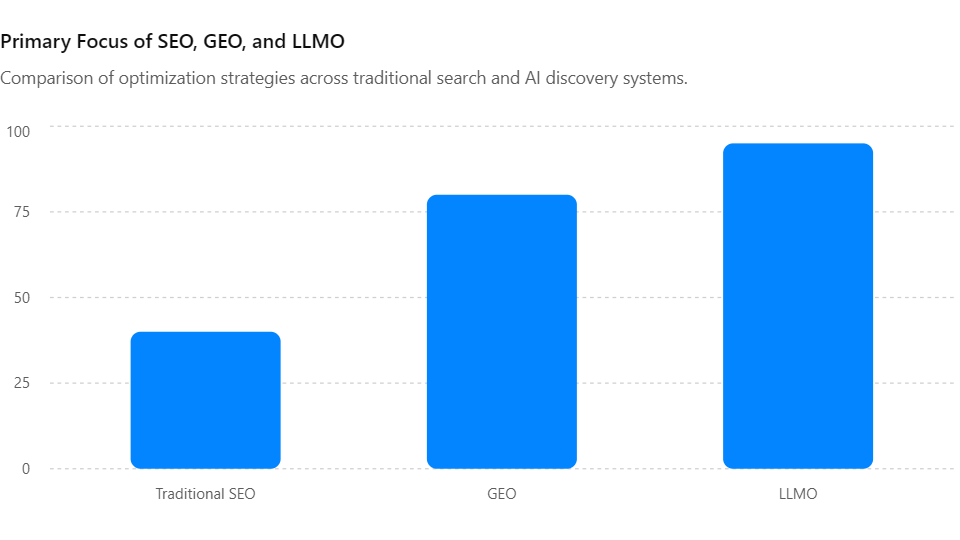
Here is a beginner friendly comparison of all three, so you can see exactly where they diverge.
| Factor | SEO | GEO | LLMO |
|---|
| What it targets? | Google, Bing search results | AI-powered search engines (Perplexity, Google AI Overviews) | AI chatbots (ChatGPT, Claude, Gemini) |
| What “ranking” means? | Appearing on page one of search results | Being cited as a source in an AI-generated answer | Being mentioned by name in an LLM response |
| Main signals used | Keywords, backlinks, technical health, page experience | Structured data, authority, source credibility, citation history | Brand mentions across the web, training data presence, trusted sources |
| Content goal | Match search intent, answer queries | Be a credible, citable source for AI summaries | Be a known, referenced entity in your category |
| How are results measured? | Rankings, organic traffic, conversions | Source citations in AI summaries, impression share | Brand name appearance in AI responses |
| How new is it? | 25+ years old, well established | 2 to 3 years old, rapidly evolving | 1 to 2 years old, still being defined |
| Who does it matter most for? | Almost every business with a website | Brands in research-heavy or informational industries | Brands competing for awareness and category ownership |
The key thing to notice here is that these are three different surfaces. Google’s traditional search results, Google’s AI Overview box, and ChatGPT conversation are three completely different places. Each one requires a slightly different approach to show up.
Read More Insights and Tips: AI Chatbot Marketing Strategy For B2B Businesses
How SEO, GEO and LLMO Work in Real Life
Let’s look at a practical example of how all three disciplines work together for a SaaS company selling enterprise project management software. While the customer intent stays the same, the discovery surface changes completely.
| Scenario | SEO | GEO | LLMO |
|---|---|---|---|
| User Behavior | User searches on Google | User searches on AI-powered search engines | User asks an AI chatbot directly |
| Example Query | “Best enterprise project management software” | “Top tools for enterprise project management” | “What project management software do you recommend for large remote teams?” |
| Platform | Google Search, Bing | Google AI Overviews, Perplexity, Copilot | ChatGPT, Gemini, Claude |
| What Happens | The SaaS company ranks organically in search results | The AI engine cites the company inside generated summaries | The AI assistant recommends the company conversationally |
| Main Optimization Focus | Keywords, backlinks, technical SEO | Structured content, authority, citations | Brand mentions, entity authority, web-wide trust signals |
| Success Metric | Organic traffic and rankings | AI citations and visibility | Brand mentions in LLM responses |
| User Experience | Clicking search results | Reading AI-generated summaries | Having a direct conversation with AI |
What This Means for Brands
In all three situations, users are searching for the same solution, but the path to discovery is different. Traditional SEO helps brands rank in search engines. GEO helps brands appear inside AI-generated search summaries. LLMO helps brands become part of AI conversations and recommendations.
The brands dominating search visibility in 2026 are not optimizing for just Google rankings anymore. They are building authority across traditional search, AI-powered search engines, and conversational large language models simultaneously.
Do You Need SEO, GEO, LLMO, or All Three?
The honest answer for most growing Robotics businesses and other businesses is eventually, all three. But where you start depends on your current situation.
- Start with SEO if you are not yet generating meaningful organic traffic from Google. Until you have a healthy technical foundation, strong content and a growing backlink profile, the other two disciplines will have limited overall impact.
- Add GEO to your strategy if you are in an industry where people research before buying. If your customers ask questions before making decisions and AI-powered search is giving them answers, you need to be one of the sources those answers come from.
- Give priority LLMO if your sales cycle involves buyers asking AI chatbots for recommendations. B2B buyers, enterprise decision-makers, and research-driven consumers increasingly ask LLMs to help them shortlist vendors and solutions.
- Pursue all three together if you are at an enterprise scale. At this level, your brand needs to be visible wherever your buyers are looking, whether that is a traditional Google search, an AI Overview, or a ChatGPT conversation.
The good news is that strong SEO provides a foundation that benefits GEO and LLMO too. High-authority content, a trusted domain and a clear brand entity all serve you across all three disciplines.
How SEO, GEO, and LLMO Work Together?
These three disciplines are not separate from each other. They share a common foundation and the work you do for one almost always lifts the other two. Here are the five most important things to understand about how they connect.
- SEO is the ground floor. Without it, GEO and LLMO have nothing to build on.
- One strong piece of content can rank on Google, get shown in AI Overviews and appear in ChatGPT responses all at once.
- Each discipline rewards different signals, so SEO, GEO and LLMO need slightly different content and authority techniques.
- The authority you build today is what LLMs learn from tomorrow, making off-page investment a long-term visibility asset.
- One unified program beats three separate ones. Build all three at once then fill gaps where needed.
Explore Complete Research: Generative AI Optimization Techniques to Increase AI Visibility
How to Optimize Content for Google AI Overviews, ChatGPT and Perplexity
Optimizing all three does not mean functioning three completely separate programs. It means building a unified content and authority strategy that is deliberately designed to perform across every surface. Here is how to approach it step by step:
1) Start with a strong technical SEO foundation
Before GEO or LLMO tactics make any meaningful difference, your site needs to be technically structured. This means fast load times, clean site architecture, proper crawlability, and no broken pages or duplicate content issues. AI-powered search tools and LLMs draw from the same web your site lives on. If Google cannot easily read and understand your site, neither can the AI systems layered on top of it.
2) Build topic authority through deep, structured content
Choose the topics your brand should own and go deep on them. That means detailed guides, original research, detailed case studies and content that answers questions at every stage of the buying journey. Structured content with clear headings, logical flow, and well-labeled sections is easier for AI systems to read and extract from. This directly serves SEO, GEO and LLMO at the same time.
3) Implement schema markup across key page types
Schema markup tells search engines and AI tools exactly what type of content is on a page, who wrote it, what it is about and what entity it belongs to. For GEO specifically, FAQ schema, HowTo schema, and Article schema are particularly valuable. They make your content machine-readable in a way that AI search engines can pull directly into their generated answers.
4) Build your brand entity across the open web
For LLMO, the single most important thing you can do is make your brand clearly and consistently described across as many trusted web sources as possible. This means keeping your website, LinkedIn profile, Crunchbase listing, industry directory entries, and press coverage all aligned on the same core description of who you are, what you do, and who you serve. LLMs build their understanding of your brand from these sources, and inconsistency or gaps in that picture will hurt you.
5) Invest in digital PR and authoritative external coverage
Being mentioned or cited in respected publications, industry reports, and editorial content does three things at once. It builds backlinks for SEO. It signals credibility to AI-powered search engines for GEO. And it adds your brand to the pool of web sources that LLMs reference, which is the core of LLMO. A single feature in a high-authority publication can move the needle across all three surfaces.
6) Create content that AI systems naturally want to cite
AI-powered search tools and LLMs favor content that is factually grounded, clearly attributed, and written with genuine depth. Content that includes original data, specific examples, named experts, and clear sourcing is far more likely to be extracted and cited than generic content that could have been written by anyone. Write with the goal of being the most credible, specific answer to a question in your space.
7) Monitor your presence across all three surfaces
Tracking performance means looking beyond Google rankings. Check regularly whether your brand is appearing in AI Overviews for your target topics. Ask ChatGPT Agency, Perplexity, and Gemini the questions your buyers are asking and see whether your brand comes up. Track citation share in AI-generated answers. This gives you a complete picture of where you are visible and where the gaps are, so you can adjust your strategy accordingly.
Wrapping UP
SEO, GEO, and LLMO are not three separate problems to solve. They are three surfaces of the same visibility challenge indeed. The brands that will win in 2026 and beyond are not running three disconnected programs. They are building one strong foundation of technical SEO, deep content, brand authority, and SEO for AI Startups that performs across traditional search, AI generated summaries, and LLM conversations at the same time. Searching is fragmenting fast. The brands that adapt now will be the ones buyers find, regardless of where or how they are searching.
Commonly Asked Questions
They overlap significantly. AEO broadly covers optimization for any system that generates direct answers, while LLMO is specifically focused on large language models like ChatGPT, Claude, and Gemini.
Yes. SEO remains the highest-volume organic channel and provides the trust signals that both GEO and LLMO rely on. A weak SEO foundation limits performance across all three disciplines.
Any brand can benefit, but larger brands with more existing authority tend to see faster results. Smaller brands should build their SEO foundation first before investing heavily in GEO and LLMO.
You can manually test by asking ChatGPT, Claude, Perplexity, and Gemini category-level questions relevant to your business. Tools that track LLM brand citations are also emerging, though the space is still developing.
Indirectly, yes. Social content that gets shared, embedded, or referenced in articles contributes to the broader web presence that LLMs are trained on, but direct social posts carry less weight than authoritative editorial coverage.
At SEO Circular, we have worked with 15+ globally popular AI companion chatbots, including platforms like SugarLab AI, CandyAI, and MyDreamCompanion, and based on our real implementation experience, we have identified and fixed many common, technical, and even some very unusual SEO issues that most developers and founders do not notice until their website stops performing in search.
Over time, we have seen that AI companion platforms are growing rapidly and will continue to stay in demand beyond 2026, because user behavior clearly shows strong adoption of personalized AI interaction across the US, Europe, and emerging markets, where people are actively engaging with these platforms for real-time and customized digital companionship.
The most important thing to understand here is that building an AI companion platform today requires a modern and complex tech stack that usually includes
- AI models (LLMs or fine-tuned systems)
- API-driven response layers
- Backend systems like Node.js or Python
- Frontend frameworks such as Next.js
- Rendering approaches like Server-Side Rendering (SSR), Client-Side Rendering (CSR), or hybrid setups
While this stack is powerful from a product and engineering point of view because it supports real-time responses, scalability, and a smooth user experience, it also creates serious technical SEO challenges that are very different from those of traditional websites.
Because of this complexity, we have seen many cases where platforms had a strong product, active users, and good engagement, but still failed to generate organic traffic simply because search engines were not able to properly crawl, render, or index their content. This is where an effective AI Chatbot Marketing Strategy becomes important, as it aligns technical SEO with user engagement and discoverability.
So in this guide, we are going to explain everything in detail based on real project experience, covering the technical SEO issues that affect AI companion platforms and the practical ways to fix them, but before you continue, one thing is important to keep in mind: this is not a basic SEO article, and it demands patience, because we are going deep into real technical problems and their solutions.
Fix Your AI Companion SEO Before It Kills Your Growth
If your AI platform is not getting indexed or ranking despite having a strong product, then the issue is not your idea but your technical SEO. At SEO Circular, we have already fixed these problems for 15+ global AI companion platforms, and we can do the same for you with a clear, result-driven strategy.
Get Your AI Companion SEO Strategy Today
Modern AI Companion Platforms Use Complex Tech Stacks
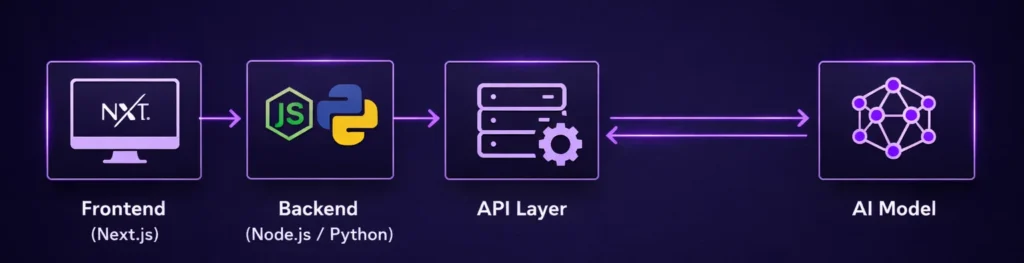
- AI companion platforms look perfect for users, but search engines often receive empty or incomplete HTML, which directly impacts indexing and ranking.
- Heavy reliance on JavaScript, APIs, and dynamic rendering makes it difficult for Googlebot to access and understand real content during the first crawl.
- Issues like BAILOUT_TO_CLIENT_SIDE_RENDERING, JS chunk loading, and streaming responses delay or block content visibility for search engines.
- Dynamic and session-based AI content does not create stable, indexable pages, which weakens keyword targeting and SEO structure.
- From Googlebot’s perspective, many pages appear as “Loading page…” without keywords, structure, or meaningful signals required for ranking.
- Without fixing rendering, content delivery, and crawlability, even strong AI platforms fail to generate organic traffic and remain dependent on paid acquisition.
What Makes NSFW AI Companion Websites SEO-Difficult?
Dynamic AI-Generated Content Creates Indexing Gaps
In AI companion platforms, most of the content is generated based on user interaction, which means there is no fixed or pre-defined content available for search engines to crawl and understand.
- Content is generated after user input : This means pages do not have static text that can be indexed during the initial crawl, and search engines may not wait for interaction-based content.
- Responses vary for each user : Since AI replies are personalized, there is no consistent version of content that can be indexed and ranked.
- No stable keyword targeting : Because content changes dynamically, it becomes difficult to optimize pages for specific keywords in a controlled way.
Login Walls and Session-Based Content Block Crawling
Most AI companion platforms require users to log in before accessing core features, and this creates a major barrier for search engines. Important pages are behind authentication. Search engines cannot access content that requires login, which means valuable pages remain invisible.
Heavy JavaScript Dependency Reduces Visibility
Modern frameworks rely heavily on JavaScript, and while this improves user experience, it creates challenges for search engines that depend on initial HTML.
- Content loads after JavaScript execution
If rendering happens on the client side, search engines may not see full content immediately.
- Delayed rendering affects indexing
Even if Google eventually renders JavaScript, delays can reduce crawl efficiency and indexing priority.
- Resource-heavy pages impact crawl budget
Large JS files and API calls consume more resources, which can limit how many pages get crawled.
Restricted and Sensitive Content Handling (NSFW Factor)
NSFW AI companion platforms face an additional layer of complexity because content must be controlled and compliant while still being indexable.
Age Gate Blocking Crawlers (Wrong Implementation)
AI companion platforms, especially NSFW ones, often implement age verification systems, but as per our experience, many websites implement this in a way that blocks search engines completely instead of just controlling user access.
- Full-screen age gate blocks HTML content
When age validation is implemented as a blocking layer before page load, search engines are unable to access the actual page content, which results in zero indexable data.
- JavaScript-based age verification hides content
If the main content is loaded only after age confirmation via JavaScript, then crawlers may never see the actual content because they do not interact like real users.
- Incorrect bot handling leads to deindexing
When bots are treated the same as users without a fallback mechanism, important pages fail to get indexed or lose rankings over time.
Correct SEO Approach for Age Gate
Age gate should be implemented in a way where HTML content is still accessible to crawlers, using techniques like server-side rendering, conditional rendering, or bot-friendly fallbacks while still maintaining compliance.
Too Many Similar Character Pages Create Low-Quality Index
We saw many AI companion platforms allow users or admins to create unlimited character profiles, but over time this leads to thousands of similar pages with very little differentiation, and this directly affects SEO quality because search engines start treating the site as low-value or spam-like.
- Multiple pages with similar intent and structure
When character pages follow the same template with minor changes like name, image, or personality, search engines see them as near-duplicate content instead of unique value pages.
- Thin content with no real informational depth
Most character pages do not contain enough structured or meaningful content, which reduces their chances of ranking and increases the risk of being ignored or deindexed.
- Crawl budget gets wasted on low-value pages
Instead of focusing on important pages, search engines spend time crawling thousands of similar URLs, which affects indexing efficiency of high-priority content.
- Overall domain quality signal gets impacted
When a large portion of the website contains low-value or duplicate-like pages, it can reduce trust and authority in the eyes of search engines over time.
This Correct approach are as below
If you are planning to create large-scale character pages, then you should control indexing by blocking unnecessary pages using robots.txt and meta noindex tags, so only high-quality and important pages are indexed.
How to Control Indexing Using robots.txt
You can prevent search engines from crawling low-value character pages by disallowing specific URL patterns in your robots.txt file.
User-agent: *
Disallow: /characters/
Disallow: /ai-characters/
Disallow: /profile/
This ensures that crawlers do not waste time accessing bulk-generated pages that are not useful for SEO.
How to Use Meta Noindex for Character Pages
In cases where pages should be accessible but not indexed, you can use the noindex meta tag inside the page head section.
<meta name="robots" content="noindex, follow"> This allows search engines to:
- crawl the page
- follow links inside the page
- but avoid adding it to search results
Next.js & Rendering Deep Dive: Why Most AI Companion Websites Fail in SEO
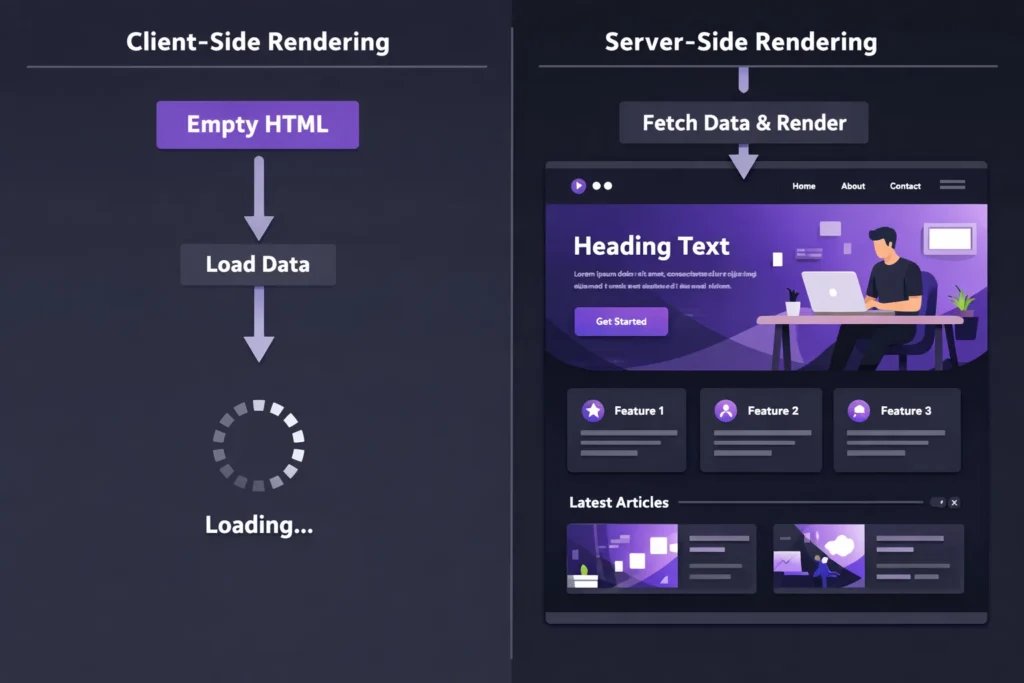
As per our experience at SEO Circular, most AI companion platforms today are built using modern frameworks like Next.js, and while these frameworks are excellent for performance and user experience, they can silently break your SEO if rendering is not handled correctly from the beginning.
The biggest mistake we have seen is that developers optimize for speed and interactivity, but ignore how HTML is delivered to search engines, and this is where issues like non-indexing, partial indexing, or delayed indexing start appearing.
Client-Side Rendering (CSR) — The Root Cause of Indexing Failures
In many AI companion platforms, developers rely heavily on client-side rendering because it makes the application feel fast and interactive, but this approach creates serious problems for search engines.
- Initial HTML response is empty or minimal
When a page is loaded, the server sends almost no content, and the actual data is fetched later through JavaScript, which means search engines do not immediately see meaningful content.
- Content depends on JavaScript execution
If Googlebot does not fully execute JavaScript or delays rendering, then important content may never be indexed.
- Common Next.js issue: BAILOUT_TO_CLIENT_SIDE_RENDERING
This happens when the framework falls back to CSR, and instead of sending pre-rendered HTML, it pushes rendering to the browser.
JavaScript Chunk-Based Rendering (__next_f.push Issue)
Another issue we have frequently observed is content being delivered via JavaScript chunks instead of being embedded in HTML.
- Data is injected using __next_f.push
Instead of having full HTML, the content is dynamically pushed through JS chunks, which delays visibility for crawlers.
- HTML does not contain actual content
Search engines rely on initial HTML for indexing, and if content is missing there, indexing becomes unreliable.
- Rendering depends on hydration
Until hydration completes, the page does not contain usable content, which creates a gap between user view and crawler view.
👉 Result:
Search engines may partially index or completely skip such pages.
Also Read: AI Startup SEO Budget Early Stage
Server-Side Rendering (SSR) — The Correct Foundation for SEO
From an SEO perspective, server-side rendering is one of the most reliable approaches because it ensures that content is available in the initial HTML response.
- Full HTML is sent from the server
This allows search engines to immediately read and index the content without waiting for JavaScript execution.
- Faster indexing and better crawlability
Since content is already present, Google can process pages efficiently.
- Ideal for landing pages and SEO content
Pages that target keywords should always use SSR to ensure maximum visibility.
👉 Example (Next.js SSR):
export async function getServerSideProps() {
 const data = await fetch('https://api.example.com/data').then(res => res.json());

 return {
   props: { data },
 };
}
This ensures that content is rendered on the server before being sent to the browser.
Incremental Static Regeneration (ISR) — Best Balance for AI Platforms
In many cases, AI platforms need both performance and SEO, and this is where ISR becomes very powerful.
- Pages are pre-rendered and updated periodically
This allows you to serve static HTML while still keeping content fresh.
- Reduces server load
Unlike SSR, ISR does not require rendering on every request.
- Works well for programmatic SEO pages
Character pages, landing pages, and category pages can benefit from ISR if structured correctly.
👉 Example (Next.js ISR):
export async function getStaticProps() {
 const data = await fetch('https://api.example.com/data').then(res => res.json());

 return {
   props: { data },
   revalidate: 60, // Re-generate page every 60 seconds
 };
}
Streaming & Partial Rendering — Hidden SEO Risk
Modern Next.js versions support streaming and partial rendering, which improves performance but introduces SEO risks if not handled carefully.
- Content loads in parts instead of full HTML
Search engines may capture only the initial part of the page.
- Important content may be delayed
If key sections load later, they may not be indexed properly.
- Requires careful prioritization
Critical SEO content should always be included in the first HTML response.
Best Rendering Strategy for AI Companion Platforms
As per our experience at SEO Circular, the most effective approach is not choosing one rendering method, but combining them strategically.
- Use SSR for SEO landing pages
Ensure all important pages are fully indexable.
- Use ISR for scalable content pages
Handle large volumes of pages efficiently.
- Avoid CSR for indexable content
Keep CSR limited to app-level interactions only.
- Separate app and SEO layers
Your chatbot interface and SEO pages should not depend on the same rendering logic.
Know About: Python Libraries for Technical SEO Automation 2026
How to Fix Indexing Issues in AI Companion Platforms (Step-by-Step)
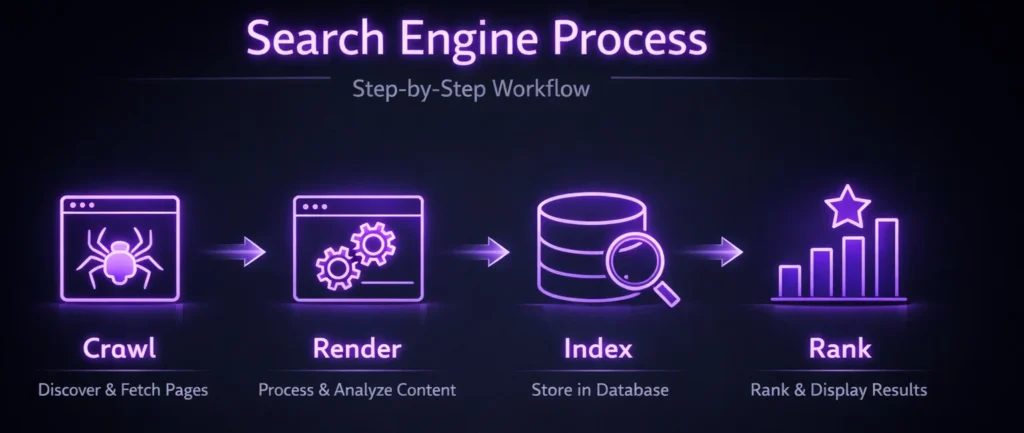
As per our experience at SEO Circular, most indexing issues in AI companion platforms are not because of Google, but because of how content is delivered, and once you fix rendering and structure properly, indexing improves much faster than expected.
Use Server-Side Rendering for Important Pages
If your key pages are not rendered on the server, then search engines will struggle to understand them, so always ensure that SEO-focused pages return proper HTML in the initial response.
- Convert landing pages to SSR
This ensures that content is visible to crawlers without waiting for JavaScript execution.
- Avoid CSR for indexable URLs
Keep client-side rendering limited to app interactions, not SEO pages.
Create Static SEO Pages Separate from Chat App
AI chat interfaces are not designed for indexing, so you should not rely on them for SEO, and instead create dedicated pages that target search queries.
- Build landing pages for each use case
These pages should explain features, scenarios, and benefits in a structured way.
- Do not index chat session URLs
Since they are dynamic and user-specific, they should be excluded from search results.
Ensure Content Exists in Initial HTML Response
Search engines depend on the first HTML response, so if your content is not present there, indexing will fail.
- Avoid loading critical content via API after page load
Important text should already be part of the HTML.
- Test pages without JavaScript
If content is not visible without JS, then Google may also struggle to see it.
Optimize Sitemap and Crawl Flow
Search engines need clear signals to discover and prioritize pages, so your sitemap and internal linking should guide them properly.
- Include only indexable pages in sitemap
Avoid adding low-value or blocked URLs.
- Use internal linking to highlight important pages
This improves crawl efficiency and page importance.
Control Low-Quality Pages Properly
If your platform generates large-scale pages like character profiles, then controlling their indexing is critical to maintain SEO quality.
- Use robots.txt to block unnecessary crawling
This saves crawl budget for important pages.
- Apply noindex on low-value pages
This prevents them from appearing in search results.
Handle Age Gate and Restrictions Smartly
Compliance is important, but it should not block search engines completely, so implementation must balance both.
- Ensure bots can access content
Do not fully block HTML behind age validation.
- Use bot-friendly rendering approach
Keep content visible while controlling user access separately.
Monitor Indexing Using Search Console
Fixing issues is not enough, you also need to track whether Google is actually indexing your pages.
- Check “Crawled but not indexed” issues
This helps identify content visibility problems.
- Monitor coverage and indexing trends
This shows whether fixes are working or not.
You Might Want to Check This Out: Sexual Wellness SEO Strategies
Site Architecture for AI Companion SEO (How to Structure Your Platform for Ranking)
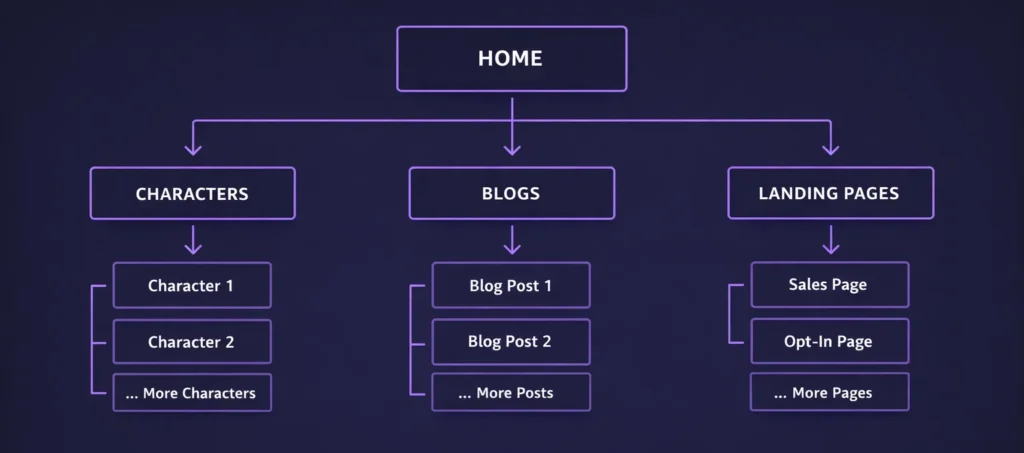
In most AI platforms, everything is built around the app interface, but that approach fails in SEO because search engines cannot navigate dynamic systems easily, so you need to create a separate SEO-friendly architecture layer that organizes your content into clear categories.
Recommended URL Structure (SEO-Friendly)
Your URL structure should clearly reflect hierarchy so that both users and search engines can understand the relationship between pages.
/image-generator/
/image-generator/nsfw-ai-images/
/characters/
/characters/anime-ai-girlfriend/
/blogs/
/blogs/technical-seo-ai-platforms/
/landing/ai-companion-app/
/chatbots/ai-roleplay-chat/
This structure ensures that:
- categories build topical authority
- pages are grouped logically
- crawl paths are clear and efficient
Separate App Layer from SEO Layer
One critical thing we always implement is separating the actual product interface from SEO pages, because mixing both creates indexing issues.
- Keep chat interface under app routes
Example: /app/chat or /dashboard
- Do not rely on app pages for SEO
These are user-specific and not designed for indexing.
- Build dedicated SEO pages outside app flow
These pages should be crawlable, static or server-rendered, and optimized for search.
Internal Linking Strategy for Better Crawlability
Search engines depend on internal links to discover and prioritize pages, so linking should not be random but structured.
- Link categories to subpages
This helps search engines understand hierarchy.
- Connect blogs to landing pages
This improves conversion flow and keyword relevance.
- Avoid orphan pages
Every important page should be reachable within 2–3 clicks.
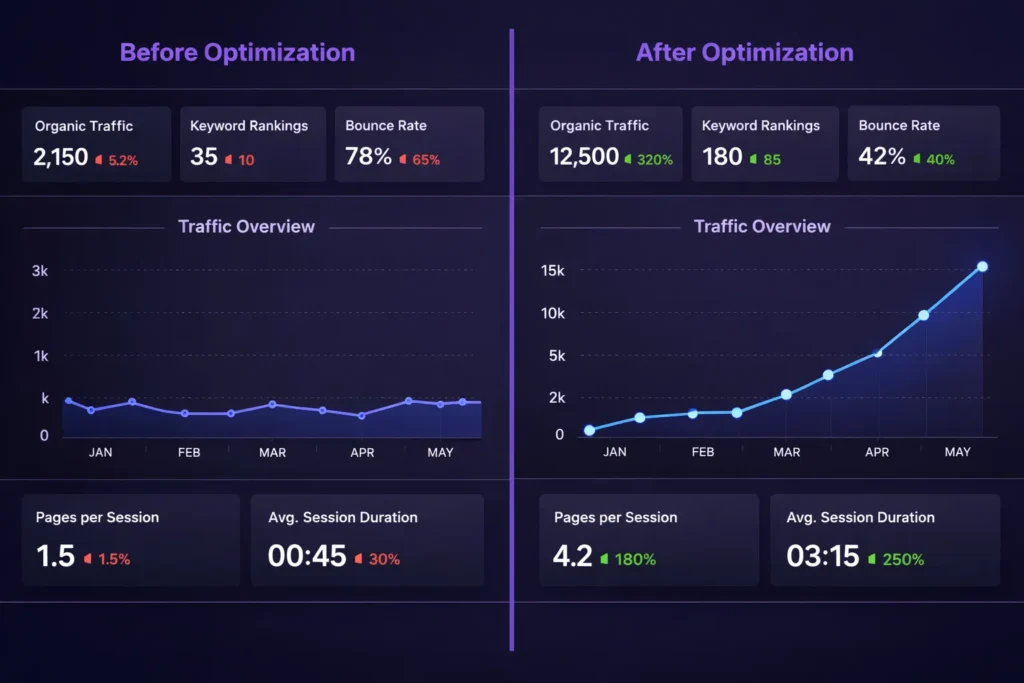
Conclusion
AI companion platforms are built on powerful and modern technologies, but as we have seen across multiple real-world projects at SEO Circular, the same tech stack that delivers a great user experience can silently break your SEO if rendering, content delivery, and crawlability are not handled correctly from the beginning.
- Technical SEO in AI platforms is not optional, because search engines need structured, visible, and consistent content to understand and rank your website.
- Issues like client-side rendering, JavaScript-based content loading, and dynamic responses can prevent Google from accessing real content, even if users see everything perfectly.
- Uncontrolled scaling, such as thousands of similar character pages or blocked content through login and age gates, can weaken overall domain quality and indexing efficiency.
- Proper implementation of SSR, ISR, structured site architecture, and controlled indexing can completely change how your platform performs in search results.
- Most importantly, SEO and development must work together, because technical decisions directly impact visibility, rankings, and long-term growth.
As per our experience, once these core technical issues are fixed, AI companion platforms not only start getting indexed properly but also build sustainable organic traffic that reduces dependency on paid acquisition and improves overall growth efficiency.
FAQs: Technical SEO for NSFW AI Companion Platforms
Recovery time depends on the severity of the issue and how quickly fixes are implemented. In most cases, once rendering and crawlability problems are resolved, initial improvements can be seen within 2–4 weeks, while full recovery may take 2–3 months.
Yes, but only if you create a controlled layer of static or semi-static content. Dynamic responses alone are not reliable for SEO, so you need structured landing pages that target specific keywords and intents.
The biggest mistake is prioritizing product functionality over crawlability, especially relying heavily on client-side rendering without considering how search engines process content.
Page speed is important, but not at the cost of rendering quality. A fast-loading page with no indexable content is worse than a slightly slower page with proper HTML content.
A hybrid approach works best. High-value pages should be manually optimized, while scalable pages can be generated programmatically with strict quality controls.
The AI chatbot market is experiencing explosive growth with industry reports estimating that it will surpass $20 billion by the end of this decade driven by increasing demand for automation, personalization and real time engagement.
But creating and developing a chatbot is not the final win. Many chatbots fail even if they have much advanced features and good user interface than other chatbots in the market.
But why it happens?
One of the main cause can be the unstructured and improper marketing of a chatbot. Many businesses and startups think that developing user relevant and overall better interface chatbots can stand out in the market.
They think that the development of a chatbot is the ultimate final goal until and unless they realize that the chatbot developed is not even reaching the market properly and then their final goal and strategy become their undeniable mistake.
The answer is simple. No chatbot can scale and grow if there is no proper marketing strategy for it. Along with the development of a chatbot, marketing of the chatbot also plays a highly crucial role. Marketing helps the chatbot reach it’s potential target audience along with standing out in the market.
Want more demos, leads, and paying customers for your AI chatbot?
Work with a team that understands both AI chatbot development and B2B marketing. We don’t just drive traffic we build systems that generate pipeline, close deals, and scale your growth.
Pre – Requisites For Startups & B2B Businesses
- Choose your category early — niche or multi category will define your entire growth plan and overall results.
- High-Intent customer targeting – You need to reach decision makers who are actively looking for solutions – not just generate random traffic.
- Conversion-Focused Funnel – Traffic alone is useless without a system that converts visitors into demos, signups or paying customers.
- Strong messaging that sells outcomes – If your messaging focuses on features instead of ROI (leads, revenue, automation), you will lose potential buyers.
- Multi channel distribution plan – Relying on one channel (like just ads or just SEO) limits growth, actual scaling requires a combination of channels.
- Data- tracking & Optimization Setup: Without tracking conversions, user behaviour and campaign performance, scaling becomes guesswork.
- The overall cost to hire our marketing team can vary around the price range of $1,800 to $2,500 also depending on the actual cost per feature.
Modern chatbot solutions come in various forms and types each designed to solve specific business problems. This includes customer support chatbots that automate queries at scale, lead generation and sales chatbots that convert website visitors into prospects, SaaS onboarding bots that improve user activation. Along with that, AI copilots that assist teams internally and more advanced solutions like AI companion-style chatbots focused on engagements and retention. Each type of chatbots have it’s own marketing strategy style.
Are you a startup or business looking to grow and scale your already developed ai chatbot. Choosing the right company can make a big difference in the overall growth your startup and business.
At SEO Circular, we have experience in developing and working with a wide range of AI chatbot solutions – from lead generation and automation bots to advanced platforms like Candy AI-style clones and soulmate inspired AI applications. This gives us a deep understanding of both the technical and marketing side of chatbot businesses.
We can develop advanced futuristic chatbots. Along with development, we also have efficient marketing strategies that businesses and startups can use to scale and promote chatbots.
Who Needs An AI Chatbot Marketing Strategy?
- B2B SaaS startups launching a chatbot product
- Enterprise adding AI chatbots to their product stack
- Agencies offering AI chatbot Services to clients
- Niche chatbot builders targeting specific industries
- Businesses struggling with low chatbot adoption
AI Chatbot Marketing Strategy Guide For Startups And B2B Businesses
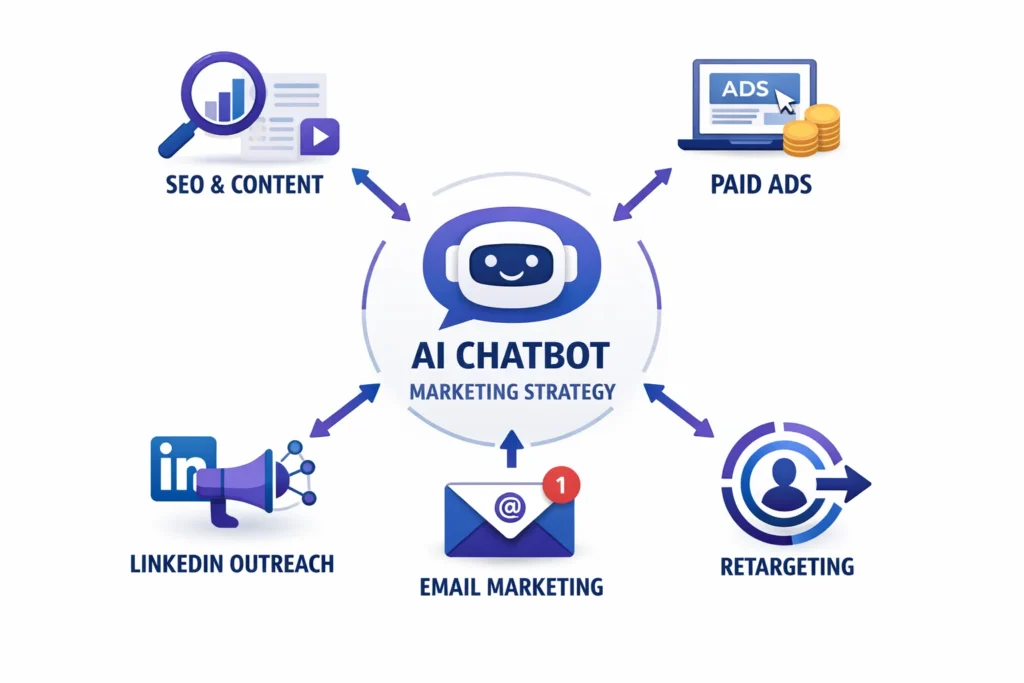
For B2B businesses, marketing an AI chatbot is not about running random campaigns and hoping for results. It requires a structured, multi-channel strategy that speaks directly to decision-makers, builds trust and drives measurable pipeline growth. Below is a breakdown of the core strategies a marketing team should execute.
1. Content & SEO Marketing
- Content and SEO these two are your long-term growth engine. It positions your chatbots as the go-to solution when decision-makers are actively searching for automation tools.
- Target high-intent keywords like “AI chatbot for B2B sales”, “customer support automation software” or “chatbot for lead generation” to attract buyers already in research mode.
- Create comparison and use-case content such as “TOP AI Chatbots For B2B Businesses in 2025” or “How AI Chatbots Reduce Support Costs by 40%” – these rank well and convert better than generic blogs.
- Publish ROI-driven case studies showing real numbers – leads generated, cost saved response time reduced.
- Build topic clusters around your niche so your website becomes an authority in the AI chatbot space, improving both rankings and credibility.
2) Paid Ads & Demand Generation
Paid ads accelerate what organic content builds slowly. For B2B chatbot marketing, precision targeting matters more than broad reach.
- Run Google Search Ads targeting bottom of funnel keywords where buyers are actively comparing solutions and ready to book a demo.
- Use LinkedIn Ads to target by job title, company size and industry – reaching CTOs operations heads and product managers who are the actual decision-makers.
- Launch retargeting campaigns for visitors who landed on your pricing or demo page but did not convert – these are your warmest leads.
- Promote gated assets like ROI calculators, chatbots audit templates or whitepapers through paid channels to capture high quality leads into your funnel.
3) Social Media & LinkedIn Outreach
For B2B chatbot marketing, LinkedIn is your most valuable social channel. It where your buyers spend their professional time.
- Post thought leadership content regularly – insights on AI trends, automation ROI, chatbot implementation tips to build authority and stay top of mind with your target audience.
- Run direct outreach campaigns where your team connects with ideal customer profiles, starts conversations and offers value before pitching not the other way around.
- Share client wins and product updates as short posts or carousels to build social proof and keep your audience engaged with real results.
- Engage in relevant LinkedIn groups and comment sections where your target buyers are already having conversations about automation and AI tools.
4) Email & Nurture Campaigns
Most B2B buyers do not convert on the first touchpoint. Email nurture keeps your chatbot top of mind through their entire decision-making journey.
- Segment your email list by industry, company size or buyer stage so every email feels relevant and personalised – not generic broadcast messaging.
- Build a lead nurture sequence that starts with education then moves to social proof and ends with a clear call to action like booking a demo or starting a free trial.
- Send behaviour triggered emails based on actions – if a lead visits your pricing page then send a case study. If they watch a demo video, follow up with a comparison guide.
- Run re-engagement campaigns for cold leads with a compelling hook – a new feature, a limited offer or a relevant industry stat that brings them back into the funnel.
Mistakes To Avoid While Marketing Your Chatbot
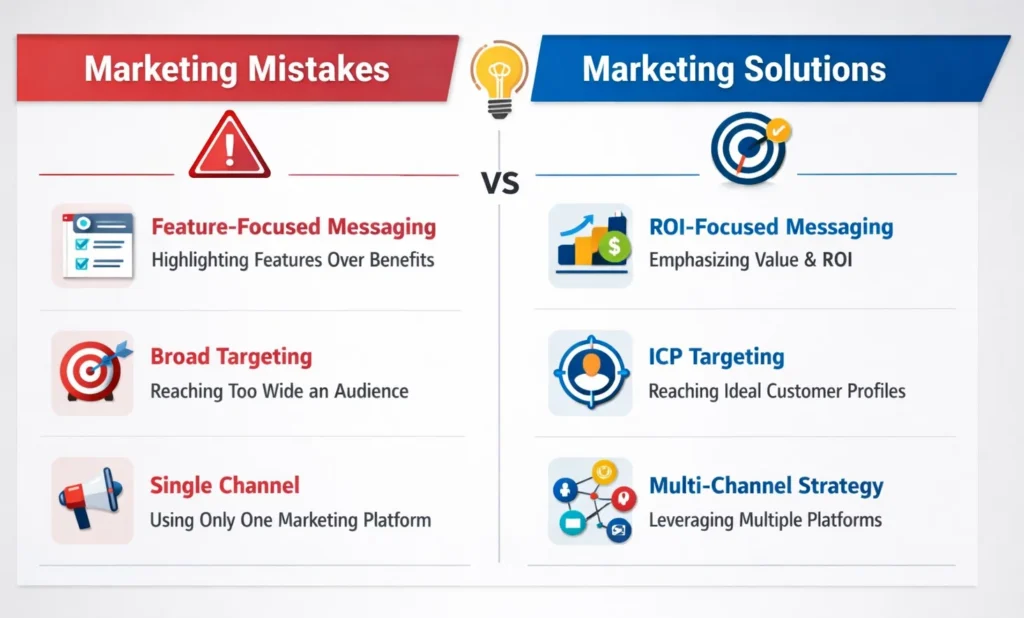
No matter how much advanced your AI chatbot is, It can fail if the marketing behind it is built on the wrong assumptions. Here are the five most common mistakes B2B Businesses and startups make and what to do instead.
1. Marketing Features Instead Of Outcomes
Talking about your chatbot’s NLP capabilities or integrations means nothing to a B2B buyer. What they actually care about is how many leads it generates, how much support cost it cuts and how fast it delivers ROI. Always lead with outcomes not features.
2. Targeting Everyone Instead Of The Right Decision Makers
Broad targeting wastes budget and attracts the wrong audience. If your chatbot is built for B2B then your market should be specifically focused on specific job titles, industries and company sizes – not generic audiences who will never convert.
3. Relying On A Single Marketing Channel
Betting everything on just SEO or just LinkedIn ads create a weak or fragile growth strategy. If that one channel dips, your entire pipeline dries up. A sustainable chatbot marketing strategy always runs multiple channels in parallel.
4. Skipping The Nurture Process
B2B buyers rarely convert on the first touchpoint. If your strategy ends at lead generation without a follow up nurture sequence – emails, retargeting, case studies – you are leaving the majority of your pipeline on the table.
5. Not Tracking The Right Metrics
Vanity metrics like impressions and followers do not generate or grow revenue. If your team is not tracking demo bookings, cost per qualified lead, conversion rates and pipeline value you are essentially scaling blind with no real direction.
What Does It Actually Cost To Have A Marketing Team?
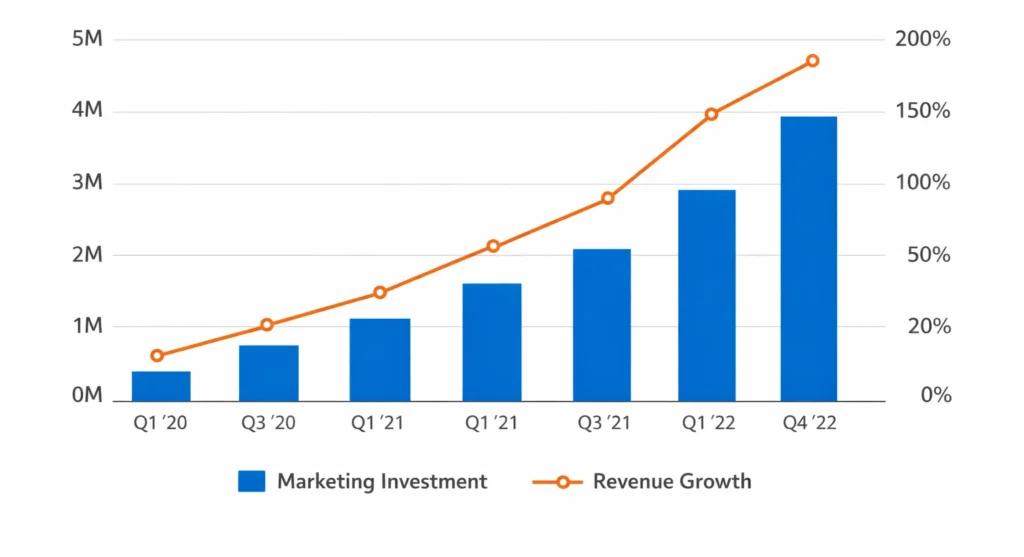
One of the most common questions B2B businesses ask before committing to a marketing strategy is simple — what will this actually cost us? The answer depends on the scope of work and the channels you are targeting also the resources involved in it. Here is a transparent and detailed breakdown of what you can expect when hiring a dedicated AI chatbot marketing team from SEO Circular.
Core Monthly Retainer
The foundational cost of having our full marketing team managing your chatbot’s growth — covering strategy, execution, content, campaigns and reporting — falls within a monthly range of $1,800 to $2,500. This covers your core team operations and is the base investment required to run a structured, multi-channel marketing strategy consistently.
Let’s have a look at the cost breakdown table in which you will get to know that how much SEO Circular will cost a startup while offering their marketing services and team.
Detailed Cost Breakdown Table
| Service | Cost | Timeline / Frequency |
| Core Marketing Team Retainer | $1,800 — $2,500 | Monthly |
| SEO Manager | $500 | Monthly (50 hours/month) |
| PR & Brand Visibility | $500 per resource | One-time yearly cost |
What Each Cost Covers
Core Marketing Team ($1,800 to $2,500/month) — This includes your full marketing operations — campaign management, content creation, paid ad execution, LinkedIn outreach, email nurture and performance reporting across all channels.
SEO Manager ($500/month) — Dedicated SEO management at 50 hours per month covering keyword research, on-page optimization, content planning, backlink strategy and monthly ranking reports to drive consistent organic growth.
PR & Brand Visibility ($500 per resource, One Time Yearly) — A one-time yearly investment per resource dedicated to public relations — securing media mentions, managing brand positioning, press outreach and building authority in the AI chatbot space.
Total Estimated Investment
| Plan | Monthly Cost | Yearly Cost |
| Core Team Only | $1,800 — $2,500 | $21,600 — $30,000 |
| Core Team + SEO Manager | $2,300 — $3,000 | $27,600 — $36,000 |
| Core Team + SEO + PR | $2,800 — $3,500 | $33,600 — $42,000 |
For B2B businesses serious about scaling their AI chatbot in a competitive market, this is not an expense — it is a revenue generating investment. The right marketing team pays for itself through qualified leads, demo bookings and closed deals.
Measuring The Success Of Your AI Chatbot Marketing Strategy
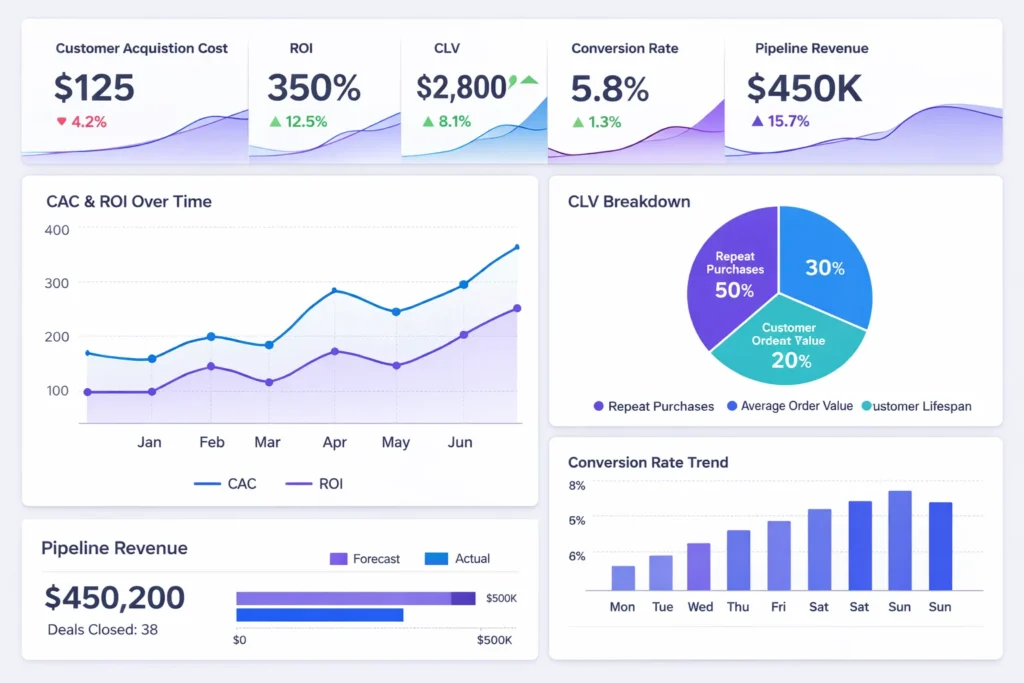
Spending on marketing without measuring the actual returns is like burning your overall budget with nothing to show for it. For B2B businesses, success is not measured in likes or impressions — it is measured in revenue, pipeline growth and return on every dollar spent. Here are the core ROI and revenue metrics your team must track consistently.
Customer Acquisition Cost
CAC tells you exactly how much you are spending to acquire one paying customer. Divide your total marketing spend by the number of new customers acquired in that period. If your CAC is higher than what a customer pays you, your strategy needs immediate restructuring.
Return On Investment
ROI is the most direct way to measure whether your marketing is working or not. Calculate it by subtracting your marketing investment from the revenue generated and dividing by the investment. A positive and growing ROI means your strategy is scaling profitably.
Pipeline Revenue Generated
Track the total value of deals that entered your sales pipeline directly as a result of your marketing efforts. This connects your marketing activity to actual business revenue and helps justify team and budget decisions.
Customer Lifetime Value (CLV)
CLV measures the total revenue a single customer brings over their entire relationship with your business. When your CLV is significantly higher than your CAC, it confirms that your marketing is attracting the right high-value customers worth investing in.
Revenue Per Channel
Not all marketing channels deliver equal returns. Tracking revenue generated per channel – SEO, paid ads, LinkedIn, email – tells you exactly where to increase investment and where to pull back making your overall spend far more efficient.
Tracking these metrics consistently gives marketing team a clear picture of what is working, what needs fixing and where the next phase of growth is coming from.
Future Trends In AI Chatbot Marketing
The AI chatbot space is evolving rapidly and the businesses that stay ahead of these shifts will have a significant edge over competitors still relying on outdated marketing approaches. Here are major trends shaping the future of AI chatbot marketing.
1. Hyper Personalisation At Scale
The next wave of chatbot marketing will move far beyond generic messaging. AI will enable marketing teams to deliver deeply personalised outreach tailored by industry, behaviour, buying stage and intent at a scale that was previously impossible without a massive team behind it.
2. Voice & Conversational Search Optimisation
As voice search and conversational AI continue to grow, chatbot marketing strategies will need to optimise for how buyers ask questions naturally not just type them. Businesses that adapt their SEO and content strategy for conversational search early will capture a significant share of organic traffic.
3. AI-Powered Performance Marketing
Paid advertising and demand generation will become increasingly automated and intelligent. From AI-driven ad copy testing to predictive audience targeting, marketing teams will rely more on machine learning to optimise campaigns in real time – reducing cost per lead while improving conversion rates.
Conclusion
Building a great AI chatbot is only half the battle. Without a structured marketing strategy behind it, even the most advanced chatbot will struggle to reach its potential audience and generate real revenue.
The businesses that win in this market are not just the ones with the best product — they are the ones that invest equally in marketing, positioning and the right team to execute it.
If you are ready to scale your AI chatbot the right way, the strategy starts here. Contact SEO Circular to scale your chatbot by having an efficient marketing strategy.
The chatbot market will not wait. Your strategy should not either.
Commonly Asked Questions: AI Chatbot Marketing Strategy
Most B2B businesses start seeing measurable results within 60 to 90 days of running a structured multi-channel strategy. Paid channels deliver faster results while SEO and content compounds over a longer period.
Basic marketing validation should begin early but heavy investment should wait until your chatbot solves a clear, proven problem for a defined audience. Marketing an unvalidated product accelerates burn without generating sustainable growth.
Case studies, ROI calculators and comparison guides consistently outperform generic blog content in B2B. Decision-makers need proof of results and clear differentiation before they commit to a demo or purchase.
Niche down your positioning, own a specific use case and build authority through hyper-targeted content and outreach. Trying to compete broadly against established players without a differentiated angle rarely works for new entrants.
Traditional influencer marketing has limited impact in B2B but partnering with industry thought leaders, analysts and niche community builders can significantly accelerate trust and visibility among your exact target audience.
In 2026, search is no longer just about ranking links, it’s about being selected, cited, and recommended by AI systems. Generative AI-powered search engines now answer questions directly, summarize sources, and guide user decisions without requiring a click.
According to industry studies, over 65% of searches are expected to end without a website visit by 2026, driven by AI overviews and answer engines. At the same time, more than 70% of users trust AI-generated answers for research, product comparison, and decision-making. This shift has fundamentally changed how brands gain visibility.
Traditional SEO tactics alone are no longer enough. AI models evaluate context, entities, topical depth, factual accuracy, and brand authority not just keywords and backlinks. If your brand is not structured in a way AI can understand and trust, it simply won’t appear in AI-generated answers.
At SEO Circular, we see Generative AI Optimization as the next evolution of search visibility. It’s about aligning your content, brand signals, and digital presence with how large language models interpret expertise and relevance. Brands that adapt now will dominate AI-driven discovery, while others risk becoming invisible even if they still rank on page one.
Key Takeaways
- Generative AI Optimization (GAIO) is about being cited and recommended, not just ranking
- AI search engines rely heavily on entity clarity and contextual trust
- Topical authority beats isolated, keyword-focused content
- Conversational and prompt-driven content performs best in AI answers
- Brand mentions and Digital PR influence AI visibility more than links alone
- Long-term consistency matters more than short-term SEO tactics
Struggling to Stay Visible in AI Search?
See how we help businesses adapt to generative AI search and build long-term authority beyond traditional SEO.
Learn How SEO Circular Optimizes for AI Search.
What Is Generative AI Optimization (GAIO)?
Generative AI Optimization (GAIO) is the process of optimizing your brand, content, and digital signals so AI-powered search engines can understand, trust, and recommend you in generating answers.
Unlike traditional SEO where the goal is to rank a webpage, GAIO focuses on becoming a reliable source for AI-generated responses. AI search systems don’t just scan keywords. They evaluate meaning, context, factual consistency, entity relationships, and authority across the web.
In simple terms, GAIO answers one critical question:
“Why should an AI model choose your brand as the best answer?”
At SEO Circular, we define GAIO as the intersection of:
- Entity-based optimization (brands, people, products, topics)
- Topical depth and clarity, not surface-level content
- Consistent brand mentions and citations across trusted sources
- Content structured for question-answer and conversational queries
GAIO also goes beyond websites. AI models learn from blogs, media mentions, reviews, documentation, PR coverage, and expert content. If your brand appears fragmented or inconsistent across these sources, AI engines hesitate to reference you.
This is why GAIO is not a replacement for SEO it’s an evolution of it. Strong technical SEO, high-quality content, and authority still matter, but they must now be aligned with how generative AI systems interpret knowledge.
Brands that invest in GAIO early don’t just gain visibility—they gain AI-driven trust, which is the real currency of search in 2026.
How Generative AI Search Engines Work in 2026
By 2026, generative AI search engines no longer function like traditional search systems that list blue links. They act as answer engines, powered by large language models that understand intent, context, and relationships between entities.
When a user asks a question, AI systems analyze multiple signals at once query intent, past user behavior, trusted data sources, topical authority, and real-world credibility. Instead of ranking pages, the AI synthesizes information from multiple sources and generates a single, consolidated response.
These systems prioritize:
- Clear entity identification (who you are, what you do, and why you matter)
- Factual accuracy and consistency across the web
- Depth over volume—comprehensive answers beat keyword-stuffed content
- Source reliability, including expert authorship and reputable mentions
AI models also learn continuously. Each interaction helps them refine which brands and sources are trustworthy. If your content is vague, outdated, or lacks authority signals, it gets ignored—even if it once ranked well on Google.
How Generative AI Search Engines Generate Answers
A simplified view of how AI systems interpret prompts, evaluate trust signals, and generate answers that cite authoritative brands.
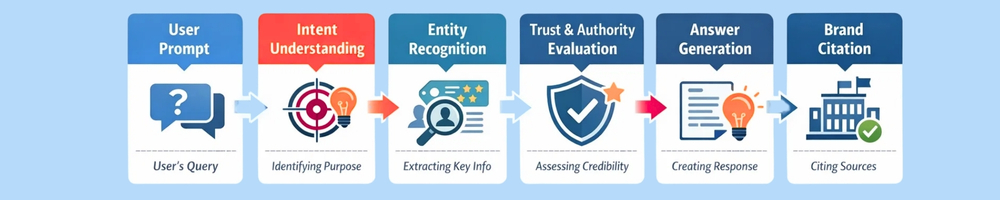
Key Differences Between SEO and Generative AI Optimization (GAIO)
| Aspect | Traditional SEO | Generative AI Optimization (GAIO) |
| Primary Goal | Rank webpages on search engine results pages (SERPs) | Be referenced, cited, or recommended inside AI-generated answers |
| How Visibility Is Earned | Driven by keywords, backlinks, and page-level optimization | Driven by entity clarity, topical authority, and trust signals across the web |
| How Systems Decide | Search engines ask: “Which page ranks best?” | AI systems ask: “Which source is most reliable to answer this question?” |
| Traffic & Exposure | Focuses on driving clicks to websites | Often delivers brand exposure without a click through AI summaries and responses |
| Measurement Focus | Rankings, traffic, and click-through rates | Brand recall, authority, and presence inside AI-generated answers |
| Optimization Approach | Optimizes for search engine algorithms | Optimizes for language models that reason, summarize, and contextualize information |
| Content Requirements | Keyword relevance and on-page optimization | Clear explanations, factual depth, consistency, and contextual accuracy |
| Strategic Role | Foundational visibility channel | Visibility multiplier for AI-driven search |
| SEO Circular’s View | Core framework for discoverability | Strategic layer that amplifies trust and long-term AI visibility |
Optimizing Content for AI Answer Engines
Optimizing content for AI answer engines requires a shift from writing for rankings to writing for clarity, completeness, and trust. AI models favor content that directly solves a user’s question in a structured, factual, and easy-to-understand way.
Instead of long introductions or promotional language, AI engines prioritize clear definitions, step-by-step explanations, and concise insights. Content that answers who, what, why, and how in a single place is far more likely to be selected.
Key elements AI answer engines look for include:
- Well-defined entities (brand, product, industry terms)
- Context-rich explanations, not surface-level commentary
- Consistent facts and terminology across sections
- Natural language that mirrors conversational queries
AI systems also cross-check information across multiple sources. If your content contradicts widely accepted data or lacks supporting context, it loses credibility fast.
Entity Optimization: The Core of AI Visibility
In generative AI search, entities are everything. An entity can be a brand, company, product, person, or concept. AI models rely on entities to understand who is trustworthy and what they are known for.
If your brand is not clearly defined as an entity, AI systems struggle to place you in relevant answers—even if your content is strong. This is why entity optimization has become a core Generative AI Optimization technique in 2026.
Effective entity optimization means:
- Clearly defining who your brand is and what problem you solve
- Maintaining consistent brand descriptions across your website, PR coverage, and third-party platforms
- Connecting your brand to relevant topics, industries, and use cases
- Reducing ambiguity by avoiding mixed messaging or unclear positioning
AI models build knowledge graphs internally. When your brand appears repeatedly in the right context, AI starts associating you with specific expertise areas.
How Generative AI Search Engines Evaluate Brand Trust in 2026
The pie chart below illustrates how generative AI search engines evaluate trust and select brands in 2026. Unlike traditional SEO, where
rankings and backlinks dominate, AI-driven search prioritizes entity clarity, topical authority, and brand credibility.
As shown, entity consistency and topical depth account for more than half of AI trust signals, while traditional SEO factors play a much smaller role. Brand mentions, citations, and content clarity also significantly influence whether a brand is cited inside AI-generated answers.
This visual highlights a critical shift: winning AI search is no longer about optimizing pages—it’s about building trust at the brand and knowledge level. Understanding these priorities helps brands focus their efforts on what actually drives visibility in AI-powered search experiences.
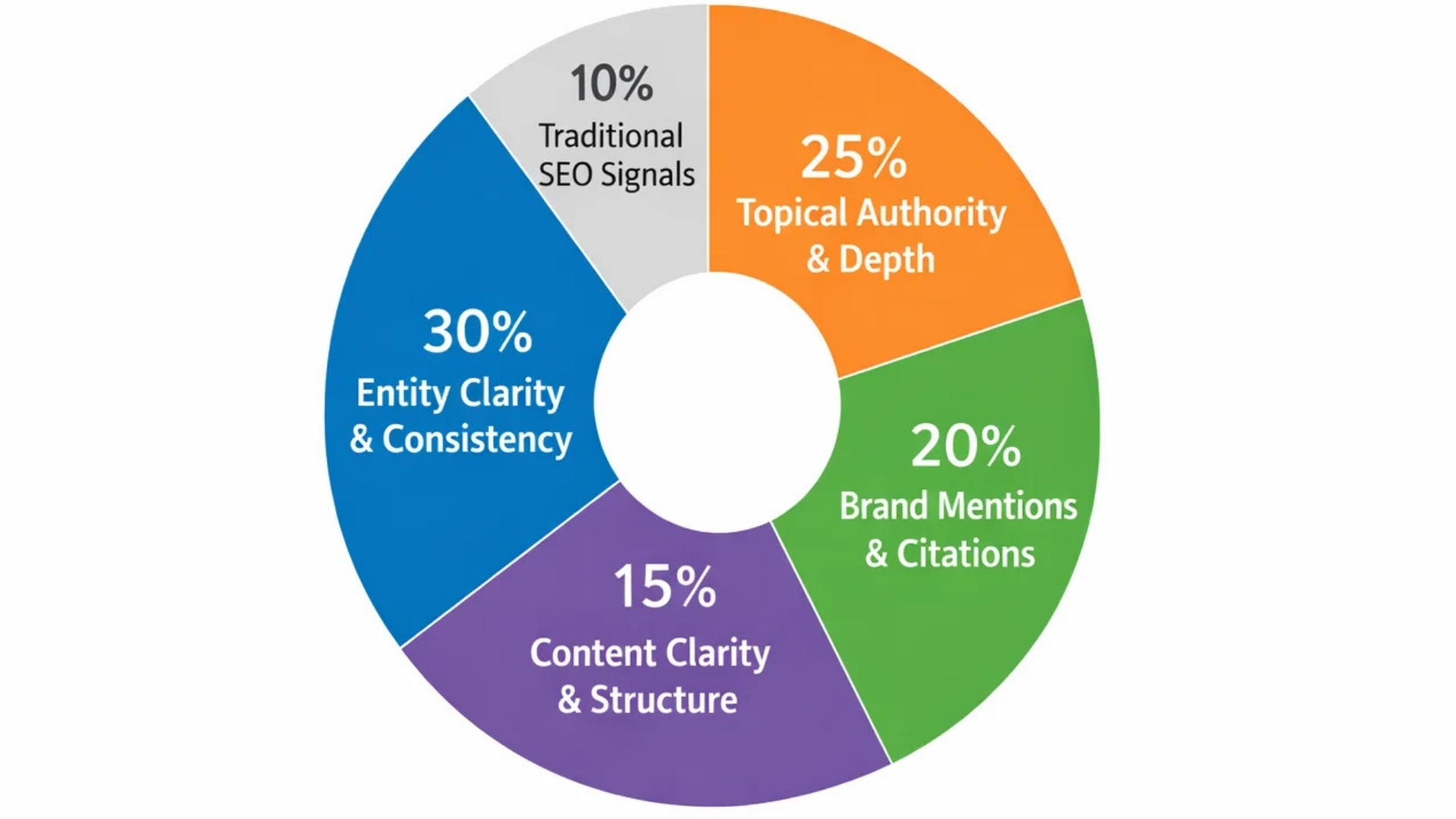
Topical Authority & Knowledge Graph Alignment
Topical authority is how generative AI systems decide who truly understands a subject. In 2026, AI doesn’t trust isolated articles—it trusts brands that consistently cover a topic in depth and from multiple angles.
When your content ecosystem answers related questions, explains subtopics, and uses consistent terminology, AI models begin mapping your brand into their internal knowledge graphs. This alignment helps AI understand not just what you say, but how deeply you know the topic.
Topical authority is built by:
- Covering core topics and supporting subtopics comprehensively
- Connecting concepts logically instead of publishing random content
- Updating content to reflect current data and trends
- Maintaining consistency in definitions, examples, and messaging
Generative AI prefers sources that show contextual continuity. One strong article helps, but a network of related, high-quality content builds trust faster.
Prompt-Driven Search & Conversational Query Optimization
Generative AI has changed how users search. Instead of short keywords, users now ask full questions, follow-ups, and multi-intent prompts. This shift has made conversational query optimization a critical Generative AI Optimization technique in 2026.
AI systems break prompts into intent layers—informational, comparative, and decision-driven. Content that matches these layers performs better than content written only for single keywords.
To optimize for prompt-driven search:
- Write content that answers questions naturally, as a human expert would
- Include follow-up explanations that anticipate the next question
- Use real-world examples, comparisons, and clarifications
- Structure content so answers appear early and clearly
AI engines favor content that feels like a conversation, not a blog post filled with SEO jargon. The clearer and more helpful your response, the more likely AI will reuse it in generated answers.
Brand Mentions, Citations & Digital PR for AI Search
In generative AI search, brand mentions matter as much as backlinks often more. AI models learn trust by observing how frequently and consistently a brand is referenced across credible sources.
Unlike traditional SEO, AI systems don’t rely solely on link equity. They analyze unlinked mentions, citations, expert quotes, media coverage, and contextual references to understand authority. If reputable publications repeatedly mention your brand in the right context, AI treats that as a strong trust signal.
Effective AI-focused digital PR includes:
- Mentions in authoritative industry publications
- Consistent brand descriptions across media outlets
- Expert commentary and data-backed insights
- Association with trusted topics and entities
AI also evaluates sentiment and relevance. Random mentions don’t help. Contextual mentions tied to your expertise do.
Optimizing for AI Overviews, SGE & Answer Engines
AI overviews and answer engines have become the primary visibility layer in search by 2026. Instead of ten blue links, users now see summarized answers generated from multiple trusted sources. If your brand isn’t optimized for these systems, you’re invisible at the moment decisions are made.
AI engines select content that is clear, factual, and immediately useful. They extract short explanations, definitions, comparisons, and steps—often without sending traffic back to the website.
To optimize for AI overviews:
- Provide direct answers early in the content
- Use simple language and unambiguous explanations
- Support claims with data, examples, or real-world context
- Maintain consistency across similar topics and pages
AI systems also favor brands that appear repeatedly across related queries. One optimized page helps, but consistent coverage across a topic area wins.
Measuring Generative AI Visibility & Performance
Measuring success in generative AI search requires a mindset shift. Traditional SEO metrics like rankings and clicks don’t fully reflect AI-driven visibility, especially when users get answers without visiting a website.
In 2026, brands need to track presence, citations, and influence inside AI-generated responses. This includes how often your brand is mentioned, quoted, or referenced across AI answer engines.
Key indicators we focus on include:
- Brand mentions in AI-generated answers
- Visibility across prompt-based and conversational queries
- Consistency of brand positioning in AI summaries
- Assisted conversions influenced by AI discovery
AI visibility measurement is less about volume and more about quality and authority. Being cited once in the right context can be more valuable than hundreds of low-intent clicks.
Common Mistakes Brands Make in Generative AI Optimization
One of the biggest mistakes brands make in Generative AI Optimization is treating it like traditional SEO. Keyword stuffing, thin content, and surface-level blogs may still rank—but AI systems rarely trust or cite them.
Another common issue is unclear brand identity. If your messaging, services, or expertise appear inconsistent across your website, PR mentions, and third-party platforms, AI models struggle to understand what your brand actually stands for.
Brands also fail by:
- Publishing content without topical depth or continuity
- Ignoring brand mentions and authority signals outside their website
- Over-promoting instead of educating
- Relying only on tools without validating how AI responds to real prompts
Many companies assume AI will “figure it out.” In reality, AI needs clear, repeated, and reliable signals to build trust.
Future-Proof Generative AI Optimization Strategies
Generative AI search will continue to evolve beyond 2026, but the foundations of visibility are already clear. Brands that focus only on short-term tactics will struggle as AI models become more selective and context-aware.
Future-proof GAIO strategies focus on durable signals, not quick wins. This includes building strong entities, consistent expertise, and long-term trust across the web.
Key strategies that will remain relevant include:
- Investing in deep topical authority, not isolated content
- Treating brand mentions and PR as core SEO assets
- Publishing expert-led, experience-driven insights
- Continuously updating content to reflect real-world changes
- Testing visibility directly inside AI tools and answer engines
AI models reward brands that behave like reliable knowledge sources, not marketers chasing algorithms. The more stable and consistent your signals, the more AI trusts you over time.
How SEO Circular Approaches Generative AI Optimization
At SEO Circular, we approach Generative AI Optimization as a business growth strategy, not a standalone SEO tactic. Our focus is on making brands understandable, credible, and preferred by AI-driven search systems.
We start by strengthening entity clarity—defining exactly who our clients are, what they do, and where they lead. From there, we build topical authority frameworks that align with how AI models organize knowledge. This ensures consistent visibility across multiple prompts, not just individual queries.
Our approach combines:
- AI-focused content architecture
- Entity and brand signal optimization
- Digital PR and authoritative mentions
- Prompt-based visibility testing and refinement
We integrate GAIO with enterprise SEO, content, and analytics so AI visibility translates into real business impact, not just exposure.
Because AI search evolves fast, we constantly test how brands appear inside generative answers and adapt strategies accordingly. This keeps our clients ahead as AI becomes the primary discovery layer.
Final Thought
Search in 2026 is no longer about who ranks first it’s about who AI trusts enough to recommend. Generative AI-powered search engines don’t scan pages; they interpret meaning, validate authority, and synthesize answers. If your brand is not structured for how AI understands expertise, it simply won’t appear—no matter how strong your traditional SEO looks.
Generative AI Optimization as the natural evolution of SEO. It shifts the focus from keywords to entities, topical authority, brand credibility, and conversational relevance. Brands that adapt early don’t just gain visibility—they become the default answers inside AI-driven discovery.
FAQs
Yes. Even websites that rank well can lose visibility in AI-driven search. Generative AI Optimization ensures our brand is trusted and cited inside AI-generated answers, not just listed in traditional search results.
Yes. AI search engines often display brand names, insights, and recommendations directly in answers. This improves brand recall, authority, and influence, even when users don’t click through to a website.
AI models evaluate trust using entity consistency, factual accuracy, topical authority, brand mentions across reputable sources, and contextual relevance rather than relying only on keywords or backlinks.
Industries like SaaS, B2B services, healthcare, finance, ecommerce, technology, and professional services benefit most, as users frequently rely on AI for comparisons, recommendations, and expert guidance.
Yes. AI prioritizes clarity, expertise, and authority over content volume. A smaller set of well-structured, expert-led content combined with strong brand signals can outperform high-volume publishing.
Brand mentions help AI models understand credibility and relevance. Consistent mentions across trusted publications reinforce authority, even when links are not present.
Generative AI Optimization works alongside SEO. SEO builds discoverability, while GAIO ensures our brand is selected, trusted, and cited inside AI-generated responses.
SEO for NSFW chatbots is fundamentally different from SEO for SaaS tools, blogs, or standard AI products. We are not operating in a neutral search environment. We are working inside a restricted, high-risk category where Google applies tighter quality checks, algorithmic filters, and manual scrutiny.
Most NSFW chatbot platforms sit at the intersection of adult content, AI-generated experiences, and sensitive user intent. That combination changes how search engines treat your website.
In practical terms, this means visibility is limited in ways many founders don’t anticipate. Pages are often filtered by SafeSearch. Paid ads are restricted or completely unavailable. Even well-researched keywords can be partially suppressed. In this space, authority and trust matter far more than publishing volume or chasing trends.
Despite these limitations, search demand is rising quickly.
The global AI chatbot market is projected to cross $27 billion by 2030, and adult or NSFW AI tools are becoming a visible segment of that growth. Users are actively searching for solutions using direct, intent-heavy terms such as NSFW AI chatbot, adult AI chat app, uncensored AI chatbot, and NSFW chatbot online. These are not casual searches. They reflect real demand and real usage intent.
This creates a genuine SEO opportunity.
But here is the reality we see repeatedly when NSFW chatbot platforms approach us. Without a focused and compliant SEO strategy, most sites fall into one of three patterns. They struggle to get indexed properly. They gain rankings briefly and lose them after core updates. Or they remain permanently stuck on page two or beyond, despite consistent content efforts.
At SEO Circular, we approach NSFW chatbot SEO as a technical, intent-driven, and trust-focused discipline, not a keyword placement exercise. In this guide, we break down what actually works in 2026 if your goal is to rank on Google and other search engines without triggering penalties or long-term visibility loss.
Key Takeaways
- Understand Search Behavior: Users search with intent—discovery, comparison, access, and privacy. Align your pages accordingly.
- Keyword Strategy Matters: Short-tail, long-tail, and exact-match keywords all play roles, but long-tail and problem-based keywords convert better.
- Technical SEO is Critical: Proper crawl control, rendering, site speed, and security are non-negotiable for indexing and ranking.
- Content Must Be Helpful and Compliant: Avoid thin AI content or sensational claims. Build content that educates, informs, and converts.
- International SEO Requires Care: Localized content, hreflang tags, and compliance with regional restrictions stabilize global visibility.
- Trust and Privacy Influence Rankings: Clearly communicate safety, privacy, and usage policies to reduce bounce rates and increase engagement.
- Sustainable Approach Wins: Avoid spammy links or shortcuts. Focus on authority, intent alignment, and long-term SEO health.
Need Help Ranking an NSFW Chatbot Safely?
At SEO Circular, we specialize in SEO for restricted and high-risk niches, including adult AI and NSFW chatbot platforms. We focus on stable indexing, intent-driven traffic, and long-term rankings — not shortcuts that disappear after the next update.
Talk to Our SEO Team and Get a Strategy Built for Visibility, Compliance, and Growth.
How People Search for NSFW Chatbots on Google in 2026
People searching for NSFW chatbots in 2026 are not browsing casually. In most cases, they already know what they want and are trying to find a platform that feels accessible, private, and reliable.
Unlike mainstream SaaS searches, NSFW chatbot queries are usually direct and descriptive. Users do not overthink phrasing. They type exactly what they are looking for, often in the simplest possible way.
For example, broad discovery searches still exist. Queries like nsfw chatbot, nsfw ai chatbot, or adult ai chatbot are common entry points. These terms indicate early-stage intent, where users are exploring what tools are available or comparing options at a high level.
As users move deeper into the funnel, searches become more specific. Many queries include modifiers that signal a concern or requirement rather than curiosity. Privacy is a major driver. So is freedom from filters. Access without friction is another recurring theme.
You see this reflected in searches such as anonymous nsfw ai chat, nsfw chatbot without login, uncensored ai chatbot, or private adult ai chatbot website. These are not informational searches. They are access-driven and action-oriented.
Another important shift in 2026 is how people adapt their searches based on restrictions. When users struggle to find results on Google due to SafeSearch or regional filters, they modify behavior. Add terms like safe, private, or online. They switch to Bing or DuckDuckGo. Search through Reddit threads, AI tool directories, or community recommendations before returning to search engines.
This behavior matters because it changes how pages should be structured. One generic landing page cannot satisfy all these intents. A page built for discovery will not convert access-driven users, and an access page without context often fails to rank.
Core SEO Challenges for NSFW & Adult AI Chatbot Platforms
Most NSFW chatbot platforms don’t fail at SEO because demand is low. They fail because the rules of visibility are different, and those rules are rarely explained clearly.
One of the biggest challenges is search suppression, not outright penalties. NSFW chatbot pages may be indexed, but their visibility is limited by SafeSearch, user account settings, and regional policies. This creates a situation where rankings look unstable, impressions fluctuate, and traffic never reaches its true potential.
Another common issue is how these platforms are built.
Many NSFW chatbots rely on JavaScript-heavy interfaces, dynamic URLs, and user-generated conversations. From a product standpoint, this makes sense. From a search engine perspective, it creates confusion. Google struggles to understand which pages represent value, which pages are duplicate, and which pages should never be indexed at all. As a result, crawl budget is wasted and important pages are ignored.
Content is another weak point.
Because these platforms are AI-driven, there is a temptation to scale AI-generated text aggressively. In adult niches, this backfires. Thin pages, repetitive descriptions, and auto-generated content without human oversight tend to lose trust quickly. Rankings may appear briefly and then disappear after updates.
Authority is harder to build as well.
Mainstream publishers, SaaS blogs, and high-authority websites rarely link to NSFW projects. This limits backlink opportunities and often pushes site owners toward risky link sources. Without a controlled strategy, link profiles become unnatural, which increases long-term SEO risk.
Finally, trust is not optional in this niche.
Users want to know how their data is handled, whether usage is anonymous, and whether the platform is safe. When this information is unclear or hidden, engagement drops. High bounce rates and low dwell time send negative signals back to search engines, even if the content itself is technically sound.
At SEO Circular, we plan around these constraints instead of fighting them. Every technical decision, content structure, and keyword target is designed to reduce risk while improving clarity, stability, and trust.
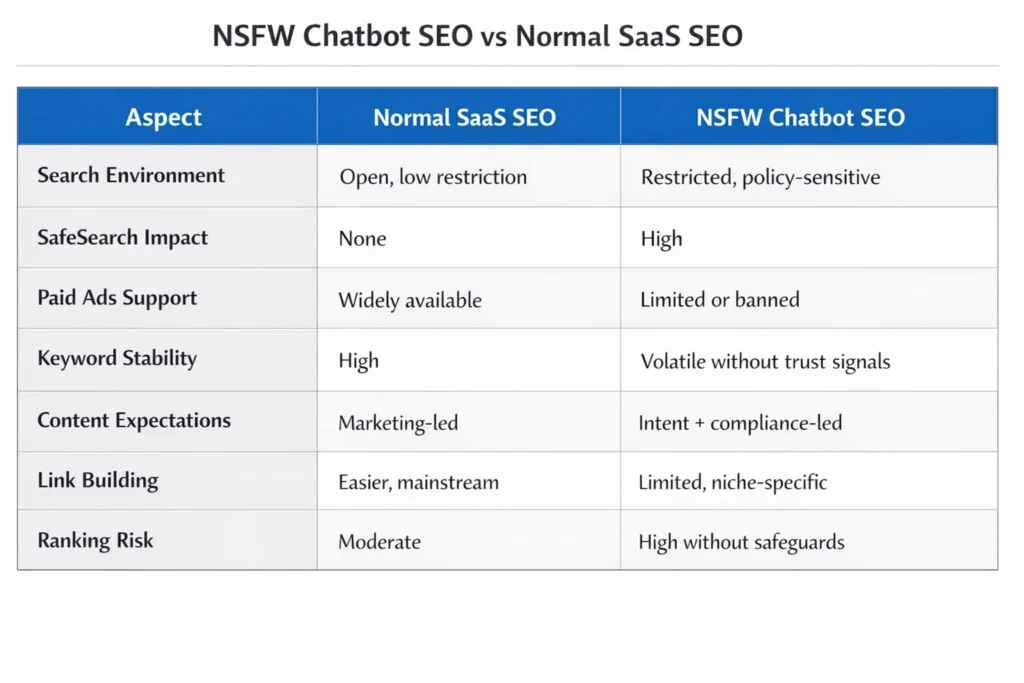
Keyword Research for NSFW Chatbots: Short-Tail, Long-Tail & Intent-Driven Queries
Keyword research for NSFW chatbots cannot be approached like normal SEO projects. High volume alone is not a signal of opportunity here. In many cases, the highest-volume keywords are also the most filtered, the most unstable, and the hardest to hold long-term.
We start by understanding why a user is searching, not just what they typed.
Some searches are broad and exploratory. Terms like nsfw chatbot, nsfw ai chatbot, or adult ai chatbot usually come from users who are discovering the space. These keywords are important for brand visibility, but they are competitive and often partially suppressed. We treat them as authority targets, not quick-win keywords.
The real performance comes from long-tail and requirement-based searches.
Users looking for NSFW chatbots often include constraints directly in their queries. They mention privacy, access, or limitations they want to avoid. Searches such as nsfw chatbot without login, anonymous nsfw ai chat, or uncensored ai chatbot reveal very clear intent. These users are not researching; they are trying to use something.
There is also a third layer that many platforms miss: problem-driven searches.
Instead of naming a product, users describe a frustration. Queries like ai chatbot with no filters, adult ai chatbot that remembers conversations, or nsfw ai that is safe to use fall into this category. These keywords may not show massive volume in tools, but they convert extremely well and face less competition.
At SEO Circular, we group NSFW chatbot keywords into:
- Discovery keywords for visibility and education
- Access keywords for usage and conversions
- Problem-solution keywords for high-intent traffic
Each group is mapped to a different page type. We avoid forcing all keywords onto one landing page because that dilutes relevance and weakens rankings.
In restricted niches, keyword research is less about scale and more about precision. When intent, content, and page purpose align, rankings become far more stable.
Search Intent Mapping for Adult AI & NSFW Chatbot Pages
Once keywords are identified, the real work begins. Ranking NSFW chatbots is not about placing keywords into content. It is about matching the page to the mindset of the searcher.
In adult and NSFW AI niches, intent mismatches are one of the fastest ways to lose rankings.
Some users are still learning. They are trying to understand what an NSFW chatbot is, how it works, or whether it is even legal to use. These searches require explanatory content, not sales-driven pages. When discovery-focused users land on a hard product pitch, they leave quickly, and that behavior hurts performance.
Other users are comparing options. They search for the best nsfw ai chatbot or alternatives to a tool they already know. These users want clarity. They want features, limitations, and use cases explained honestly. Overpromising or hiding restrictions usually leads to distrust.
Then there are users with access intent. These searches are the most direct. They include phrases like online, free, without login, or uncensored. When these users land on slow pages, gated flows, or vague descriptions, they abandon instantly.
There is also a fourth intent that is especially important for NSFW chatbots: privacy and safety.
Many users are not just looking for functionality. They want reassurance. Searches that include words like anonymous, private, or safe are signals that trust matters as much as features. Pages targeting this intent need transparency, not fluff.
At SEO Circular, we assign one dominant intent per page. We do not blend education, comparison, and access into a single URL. This makes the page clearer for users and easier for search engines to classify.
When intent mapping is done correctly, engagement improves naturally. Users stay longer, bounce less, and interact more. Over time, these behavioral signals reinforce rankings, even in restricted categories.
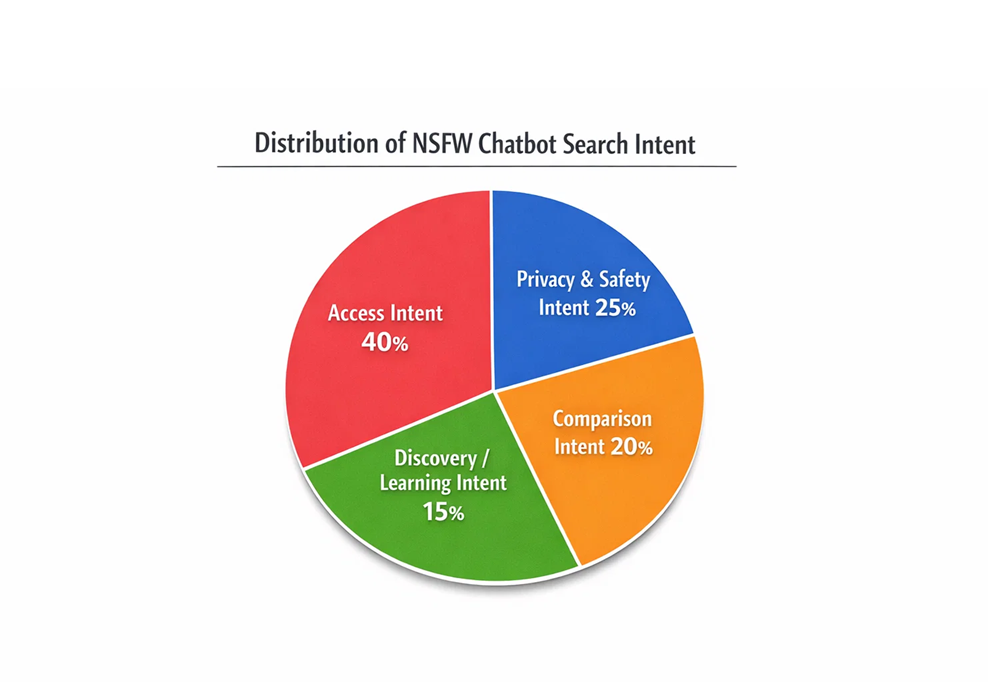
Keyword Intent Mapping for NSFW Chatbots
| Search Intent | Example Keywords | Best Page Type |
| Discovery | nsfw chatbot, adult ai chatbot | Educatioal blog |
| Comparison | best nsfw ai chatbot, alternatives | Comparison page |
| Access | nsfw chatbot online, without login | Core landing page |
| Privacy | anonymous nsfw ai chat, private ai chatbot | Trust / privacy-focused page |
Technical SEO Strategies That Keep NSFW Chatbots Indexed
In NSFW chatbot SEO, technical decisions often matter more than content itself. Many platforms publish good content but remain invisible because search engines struggle to crawl, render, or trust the site.
One of the first problems we see is uncontrolled URL generation.
Chatbots naturally create thousands of variations through sessions, parameters, and user interactions. If search engines are allowed to crawl all of these, crawl budget is wasted and important pages get ignored. The solution is not aggressive blocking, but selective control. Search engines should clearly understand which pages represent core value and which pages exist only for users.
Rendering is another major issue.
Most NSFW chatbots rely on JavaScript frameworks that load content dynamically. While modern search engines can process JavaScript, they still prefer clarity. When headings, descriptions, and core content are missing from the initial HTML, rankings suffer. We usually solve this by separating SEO-facing pages from the chat interface itself, allowing search engines to understand the product without needing to interact with it.
Performance also plays a larger role than many expect.
Users often access NSFW chatbot platforms in private browsing modes or on mobile devices. Slow load times, unstable layouts, or intrusive elements cause immediate exits. These behavioral signals compound visibility problems in an already sensitive niche.
Structured data requires restraint.
While schema can help clarify what a platform does, aggressive or misleading markup increases the chance of manual review. We apply structured data only where it improves understanding, not where it inflates claims.
Security is non-negotiable.
NSFW platforms are frequent targets for spam injections, malicious redirects, and negative SEO. A single security issue can remove a site from search results entirely. Clean hosting, HTTPS, and monitoring are foundational, not optional.
At SEO Circular, we treat technical SEO for NSFW chatbots as risk management. The goal is not to push boundaries, but to create an environment where search engines can index and rank the platform with confidence.
International SEO for NSFW Chatbot Platforms
NSFW chatbots attract users from all over the world, but search visibility does not behave the same way in every country. Regulations, cultural norms, and search engine enforcement vary widely, and ignoring these differences often leads to unstable rankings or complete suppression in certain regions.
The first step in international SEO for NSFW chatbots is market selection, not translation.
Some regions apply stricter filtering to adult AI content, even when SafeSearch is disabled. Others show more tolerance and consistent indexing. We analyze search behavior, visibility patterns, and competitor performance before expanding into a new market. This prevents wasted effort on regions where organic visibility is realistically limited.
Language targeting needs more than copied content.
Directly translating English pages into multiple languages usually creates duplicate intent without local relevance. Users in different regions search differently, even when they want the same thing. Keyword structure, modifiers, and expectations change by language. Without localized intent mapping, international pages fail to rank or cannibalize each other.
Compliance signals also play a role internationally.
Clear age disclaimers, privacy explanations, and usage boundaries are interpreted differently across regions. Search engines look for signals that the platform understands its audience and responsibilities. Localized legal and trust messaging helps reduce friction and improves stability.
Search engine diversity matters more outside the US.
In some countries, Bing, DuckDuckGo, or privacy-focused search engines drive a meaningful share of NSFW chatbot traffic. Optimizing only for Google creates unnecessary dependency. A multi-engine approach spreads risk and stabilizes growth.
At SEO Circular, international SEO for NSFW chatbots is built around control, clarity, and sustainability. The goal is not to rank everywhere at once, but to expand deliberately into markets where long-term visibility is achievable.
Conclusion
SEO for NSFW chatbots is challenging but entirely achievable with the right strategy. Success depends on intent-driven content, technical precision, and trust-building measures. Generic SEO tactics rarely work because search engines apply stricter rules to adult AI platforms, SafeSearch limits visibility, and users have unique expectations around privacy and access.
At SEO Circular, we focus on creating stable, scalable SEO strategies that align with user intent, comply with policies, and prioritize long-term growth over short-term hacks. By combining keyword research, structured content, technical safeguards, and international optimization, NSFW chatbot platforms can achieve sustainable visibility, higher engagement, and more conversions.
FAQs: SEO for NSFW Chatbots
Yes, but visibility will always be influenced by SafeSearch settings and region. The goal is not to bypass SafeSearch, but to structure content, intent, and technical SEO in a way that allows consistent indexing and exposure to users who actively search for NSFW chatbot solutions.
Yes. Separating pages by intent (education, comparison, access, privacy) improves relevance and engagement. One generic page rarely ranks well or converts in this niche.
Absolutely. For most NSFW chatbot platforms, SEO is the most reliable and scalable acquisition channel. Organic traffic compounds over time, while paid options remain limited or unavailable.
Treating NSFW SEO like normal SaaS SEO. Overusing AI content, ignoring crawl control, and mixing multiple intents on one page usually lead to unstable rankings and suppressed visibility.
SEO timelines vary, but most NSFW chatbot platforms start seeing measurable visibility within 3 to 6 months. Competitive keywords and international expansion usually take longer due to stricter filtering and authority requirements.