The AI chatbot market is experiencing explosive growth with industry reports estimating that it will surpass $20 billion by the end of this decade driven by increasing demand for automation, personalization and real time engagement.
But creating and developing a chatbot is not the final win. Many chatbots fail even if they have much advanced features and good user interface than other chatbots in the market.
But why it happens?
One of the main cause can be the unstructured and improper marketing of a chatbot. Many businesses and startups think that developing user relevant and overall better interface chatbots can stand out in the market.
They think that the development of a chatbot is the ultimate final goal until and unless they realize that the chatbot developed is not even reaching the market properly and then their final goal and strategy become their undeniable mistake.
The answer is simple. No chatbot can scale and grow if there is no proper marketing strategy for it. Along with the development of a chatbot, marketing of the chatbot also plays a highly crucial role. Marketing helps the chatbot reach it’s potential target audience along with standing out in the market.
Want more demos, leads, and paying customers for your AI chatbot?
Work with a team that understands both AI chatbot development and B2B marketing. We don’t just drive traffic we build systems that generate pipeline, close deals, and scale your growth.
Pre – Requisites For Startups & B2B Businesses
- Choose your category early — niche or multi category will define your entire growth plan and overall results.
- High-Intent customer targeting – You need to reach decision makers who are actively looking for solutions – not just generate random traffic.
- Conversion-Focused Funnel – Traffic alone is useless without a system that converts visitors into demos, signups or paying customers.
- Strong messaging that sells outcomes – If your messaging focuses on features instead of ROI (leads, revenue, automation), you will lose potential buyers.
- Multi channel distribution plan – Relying on one channel (like just ads or just SEO) limits growth, actual scaling requires a combination of channels.
- Data- tracking & Optimization Setup: Without tracking conversions, user behaviour and campaign performance, scaling becomes guesswork.
- The overall cost to hire our marketing team can vary around the price range of $1,800 to $2,500 also depending on the actual cost per feature.
Modern chatbot solutions come in various forms and types each designed to solve specific business problems. This includes customer support chatbots that automate queries at scale, lead generation and sales chatbots that convert website visitors into prospects, SaaS onboarding bots that improve user activation. Along with that, AI copilots that assist teams internally and more advanced solutions like AI companion-style chatbots focused on engagements and retention. Each type of chatbots have it’s own marketing strategy style.
Are you a startup or business looking to grow and scale your already developed ai chatbot. Choosing the right company can make a big difference in the overall growth your startup and business.
At SEO Circular, we have experience in developing and working with a wide range of AI chatbot solutions – from lead generation and automation bots to advanced platforms like Candy AI-style clones and soulmate inspired AI applications. This gives us a deep understanding of both the technical and marketing side of chatbot businesses.
We can develop advanced futuristic chatbots. Along with development, we also have efficient marketing strategies that businesses and startups can use to scale and promote chatbots.
Who Needs An AI Chatbot Marketing Strategy?
- B2B SaaS startups launching a chatbot product
- Enterprise adding AI chatbots to their product stack
- Agencies offering AI chatbot Services to clients
- Niche chatbot builders targeting specific industries
- Businesses struggling with low chatbot adoption
AI Chatbot Marketing Strategy Guide For Startups And B2B Businesses
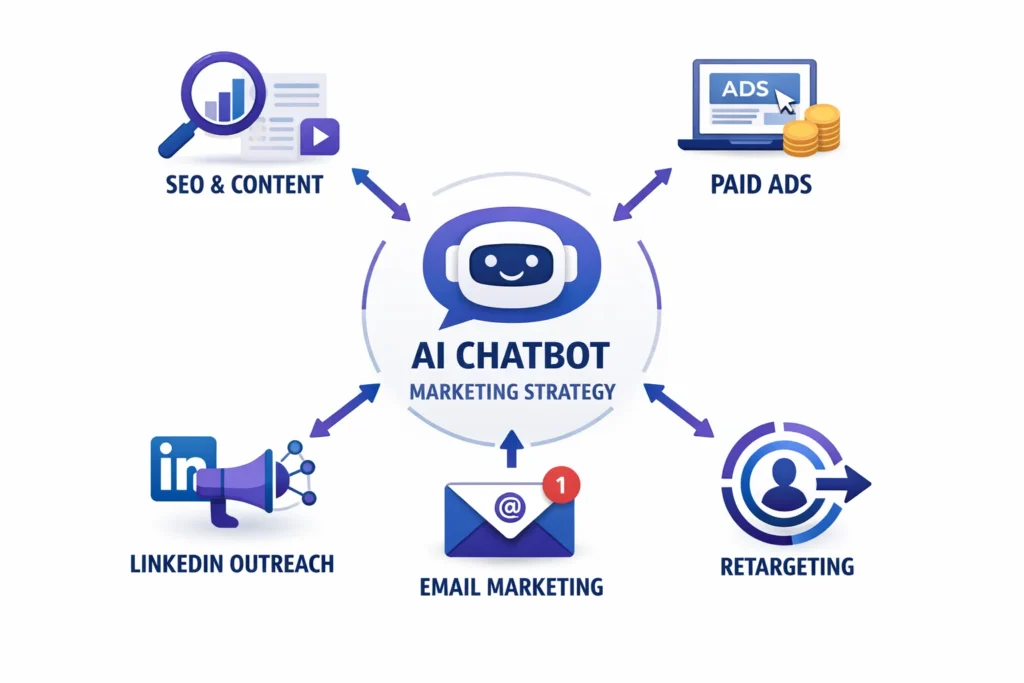
For B2B businesses, marketing an AI chatbot is not about running random campaigns and hoping for results. It requires a structured, multi-channel strategy that speaks directly to decision-makers, builds trust and drives measurable pipeline growth. Below is a breakdown of the core strategies a marketing team should execute.
1. Content & SEO Marketing
- Content and SEO these two are your long-term growth engine. It positions your chatbots as the go-to solution when decision-makers are actively searching for automation tools.
- Target high-intent keywords like “AI chatbot for B2B sales”, “customer support automation software” or “chatbot for lead generation” to attract buyers already in research mode.
- Create comparison and use-case content such as “TOP AI Chatbots For B2B Businesses in 2025” or “How AI Chatbots Reduce Support Costs by 40%” – these rank well and convert better than generic blogs.
- Publish ROI-driven case studies showing real numbers – leads generated, cost saved response time reduced.
- Build topic clusters around your niche so your website becomes an authority in the AI chatbot space, improving both rankings and credibility.
2) Paid Ads & Demand Generation
Paid ads accelerate what organic content builds slowly. For B2B chatbot marketing, precision targeting matters more than broad reach.
- Run Google Search Ads targeting bottom of funnel keywords where buyers are actively comparing solutions and ready to book a demo.
- Use LinkedIn Ads to target by job title, company size and industry – reaching CTOs operations heads and product managers who are the actual decision-makers.
- Launch retargeting campaigns for visitors who landed on your pricing or demo page but did not convert – these are your warmest leads.
- Promote gated assets like ROI calculators, chatbots audit templates or whitepapers through paid channels to capture high quality leads into your funnel.
3) Social Media & LinkedIn Outreach
For B2B chatbot marketing, LinkedIn is your most valuable social channel. It where your buyers spend their professional time.
- Post thought leadership content regularly – insights on AI trends, automation ROI, chatbot implementation tips to build authority and stay top of mind with your target audience.
- Run direct outreach campaigns where your team connects with ideal customer profiles, starts conversations and offers value before pitching not the other way around.
- Share client wins and product updates as short posts or carousels to build social proof and keep your audience engaged with real results.
- Engage in relevant LinkedIn groups and comment sections where your target buyers are already having conversations about automation and AI tools.
4) Email & Nurture Campaigns
Most B2B buyers do not convert on the first touchpoint. Email nurture keeps your chatbot top of mind through their entire decision-making journey.
- Segment your email list by industry, company size or buyer stage so every email feels relevant and personalised – not generic broadcast messaging.
- Build a lead nurture sequence that starts with education then moves to social proof and ends with a clear call to action like booking a demo or starting a free trial.
- Send behaviour triggered emails based on actions – if a lead visits your pricing page then send a case study. If they watch a demo video, follow up with a comparison guide.
- Run re-engagement campaigns for cold leads with a compelling hook – a new feature, a limited offer or a relevant industry stat that brings them back into the funnel.
Mistakes To Avoid While Marketing Your Chatbot
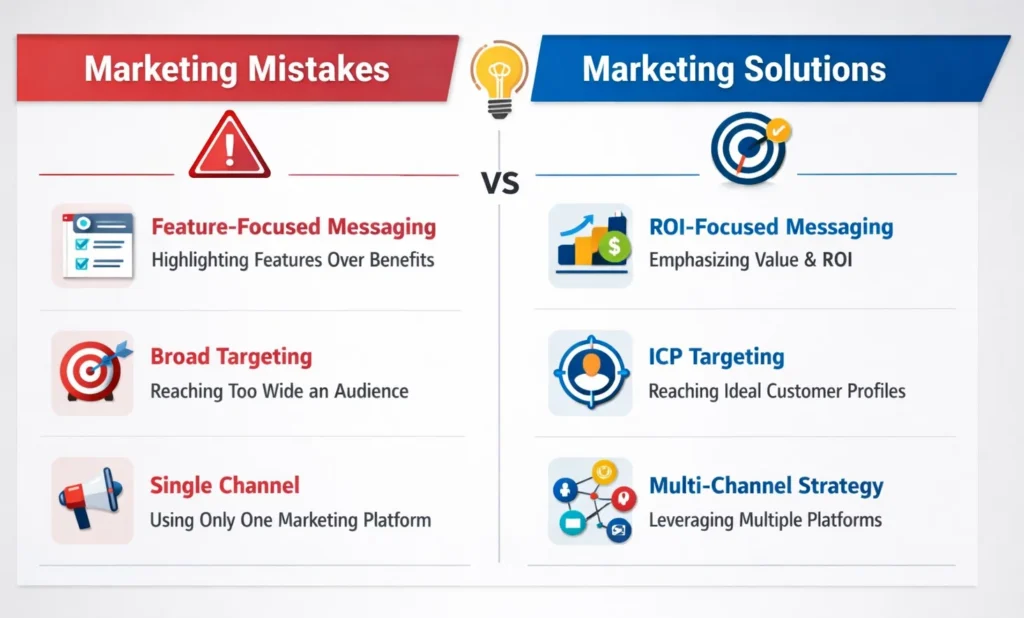
No matter how much advanced your AI chatbot is, It can fail if the marketing behind it is built on the wrong assumptions. Here are the five most common mistakes B2B Businesses and startups make and what to do instead.
1. Marketing Features Instead Of Outcomes
Talking about your chatbot’s NLP capabilities or integrations means nothing to a B2B buyer. What they actually care about is how many leads it generates, how much support cost it cuts and how fast it delivers ROI. Always lead with outcomes not features.
2. Targeting Everyone Instead Of The Right Decision Makers
Broad targeting wastes budget and attracts the wrong audience. If your chatbot is built for B2B then your market should be specifically focused on specific job titles, industries and company sizes – not generic audiences who will never convert.
3. Relying On A Single Marketing Channel
Betting everything on just SEO or just LinkedIn ads create a weak or fragile growth strategy. If that one channel dips, your entire pipeline dries up. A sustainable chatbot marketing strategy always runs multiple channels in parallel.
4. Skipping The Nurture Process
B2B buyers rarely convert on the first touchpoint. If your strategy ends at lead generation without a follow up nurture sequence – emails, retargeting, case studies – you are leaving the majority of your pipeline on the table.
5. Not Tracking The Right Metrics
Vanity metrics like impressions and followers do not generate or grow revenue. If your team is not tracking demo bookings, cost per qualified lead, conversion rates and pipeline value you are essentially scaling blind with no real direction.
What Does It Actually Cost To Have A Marketing Team?
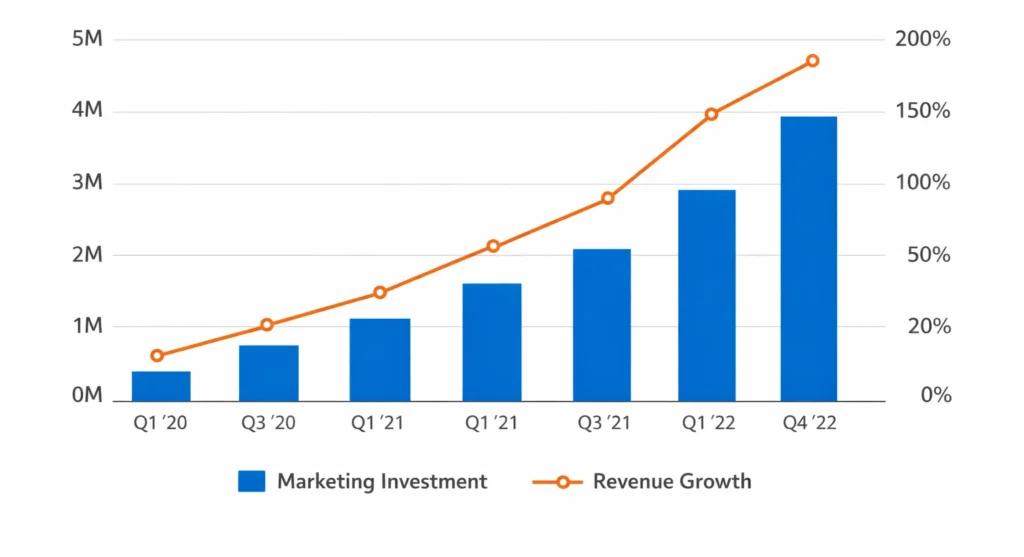
One of the most common questions B2B businesses ask before committing to a marketing strategy is simple — what will this actually cost us? The answer depends on the scope of work and the channels you are targeting also the resources involved in it. Here is a transparent and detailed breakdown of what you can expect when hiring a dedicated AI chatbot marketing team from SEO Circular.
Core Monthly Retainer
The foundational cost of having our full marketing team managing your chatbot’s growth — covering strategy, execution, content, campaigns and reporting — falls within a monthly range of $1,800 to $2,500. This covers your core team operations and is the base investment required to run a structured, multi-channel marketing strategy consistently.
Let’s have a look at the cost breakdown table in which you will get to know that how much SEO Circular will cost a startup while offering their marketing services and team.
Detailed Cost Breakdown Table
| Service | Cost | Timeline / Frequency |
| Core Marketing Team Retainer | $1,800 — $2,500 | Monthly |
| SEO Manager | $500 | Monthly (50 hours/month) |
| PR & Brand Visibility | $500 per resource | One-time yearly cost |
What Each Cost Covers
Core Marketing Team ($1,800 to $2,500/month) — This includes your full marketing operations — campaign management, content creation, paid ad execution, LinkedIn outreach, email nurture and performance reporting across all channels.
SEO Manager ($500/month) — Dedicated SEO management at 50 hours per month covering keyword research, on-page optimization, content planning, backlink strategy and monthly ranking reports to drive consistent organic growth.
PR & Brand Visibility ($500 per resource, One Time Yearly) — A one-time yearly investment per resource dedicated to public relations — securing media mentions, managing brand positioning, press outreach and building authority in the AI chatbot space.
Total Estimated Investment
| Plan | Monthly Cost | Yearly Cost |
| Core Team Only | $1,800 — $2,500 | $21,600 — $30,000 |
| Core Team + SEO Manager | $2,300 — $3,000 | $27,600 — $36,000 |
| Core Team + SEO + PR | $2,800 — $3,500 | $33,600 — $42,000 |
For B2B businesses serious about scaling their AI chatbot in a competitive market, this is not an expense — it is a revenue generating investment. The right marketing team pays for itself through qualified leads, demo bookings and closed deals.
Measuring The Success Of Your AI Chatbot Marketing Strategy
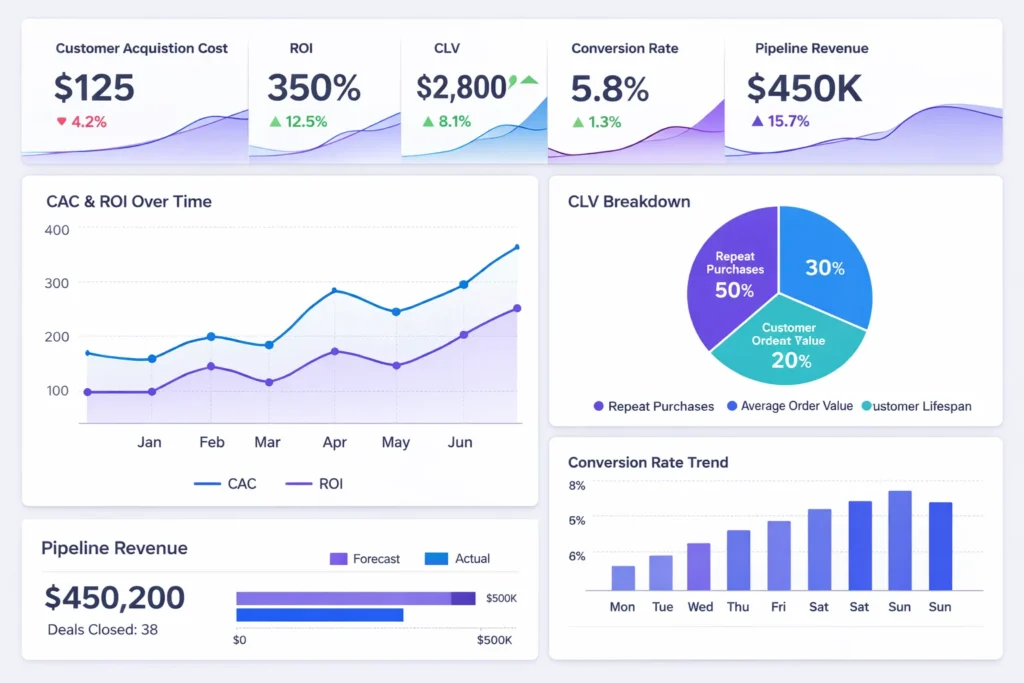
Spending on marketing without measuring the actual returns is like burning your overall budget with nothing to show for it. For B2B businesses, success is not measured in likes or impressions — it is measured in revenue, pipeline growth and return on every dollar spent. Here are the core ROI and revenue metrics your team must track consistently.
Customer Acquisition Cost
CAC tells you exactly how much you are spending to acquire one paying customer. Divide your total marketing spend by the number of new customers acquired in that period. If your CAC is higher than what a customer pays you, your strategy needs immediate restructuring.
Return On Investment
ROI is the most direct way to measure whether your marketing is working or not. Calculate it by subtracting your marketing investment from the revenue generated and dividing by the investment. A positive and growing ROI means your strategy is scaling profitably.
Pipeline Revenue Generated
Track the total value of deals that entered your sales pipeline directly as a result of your marketing efforts. This connects your marketing activity to actual business revenue and helps justify team and budget decisions.
Customer Lifetime Value (CLV)
CLV measures the total revenue a single customer brings over their entire relationship with your business. When your CLV is significantly higher than your CAC, it confirms that your marketing is attracting the right high-value customers worth investing in.
Revenue Per Channel
Not all marketing channels deliver equal returns. Tracking revenue generated per channel – SEO, paid ads, LinkedIn, email – tells you exactly where to increase investment and where to pull back making your overall spend far more efficient.
Tracking these metrics consistently gives marketing team a clear picture of what is working, what needs fixing and where the next phase of growth is coming from.
Future Trends In AI Chatbot Marketing
The AI chatbot space is evolving rapidly and the businesses that stay ahead of these shifts will have a significant edge over competitors still relying on outdated marketing approaches. Here are major trends shaping the future of AI chatbot marketing.
1. Hyper Personalisation At Scale
The next wave of chatbot marketing will move far beyond generic messaging. AI will enable marketing teams to deliver deeply personalised outreach tailored by industry, behaviour, buying stage and intent at a scale that was previously impossible without a massive team behind it.
2. Voice & Conversational Search Optimisation
As voice search and conversational AI continue to grow, chatbot marketing strategies will need to optimise for how buyers ask questions naturally not just type them. Businesses that adapt their SEO and content strategy for conversational search early will capture a significant share of organic traffic.
3. AI-Powered Performance Marketing
Paid advertising and demand generation will become increasingly automated and intelligent. From AI-driven ad copy testing to predictive audience targeting, marketing teams will rely more on machine learning to optimise campaigns in real time – reducing cost per lead while improving conversion rates.
Conclusion
Building a great AI chatbot is only half the battle. Without a structured marketing strategy behind it, even the most advanced chatbot will struggle to reach its potential audience and generate real revenue.
The businesses that win in this market are not just the ones with the best product — they are the ones that invest equally in marketing, positioning and the right team to execute it.
If you are ready to scale your AI chatbot the right way, the strategy starts here. Contact SEO Circular to scale your chatbot by having an efficient marketing strategy.
The chatbot market will not wait. Your strategy should not either.
Commonly Asked Questions: AI Chatbot Marketing Strategy
Most B2B businesses start seeing measurable results within 60 to 90 days of running a structured multi-channel strategy. Paid channels deliver faster results while SEO and content compounds over a longer period.
Basic marketing validation should begin early but heavy investment should wait until your chatbot solves a clear, proven problem for a defined audience. Marketing an unvalidated product accelerates burn without generating sustainable growth.
Case studies, ROI calculators and comparison guides consistently outperform generic blog content in B2B. Decision-makers need proof of results and clear differentiation before they commit to a demo or purchase.
Niche down your positioning, own a specific use case and build authority through hyper-targeted content and outreach. Trying to compete broadly against established players without a differentiated angle rarely works for new entrants.
Traditional influencer marketing has limited impact in B2B but partnering with industry thought leaders, analysts and niche community builders can significantly accelerate trust and visibility among your exact target audience.
You just closed your seed round. The pressure to grow is real. Someone on your team or an agency that slid into your inbox – is telling you that SEO is a long-term play and you need to start now. So, you budget $5,000 maybe $10,000 a month for content, backlinks and technical audits.
It feels responsible. Strategic and even.
But it’s probably a mistake.
Most early-stage AI startups spend heavily on SEO before they have nailed product market fit. Founders pour runway into keywords strategies and content calendars while their core product is still finding its footing. The result is months of spend, a spike in traffic that does not convert and a marketing channel that looks busy but delivers nothing meaningful to growth.
The data supports this. According to FirstPageSage, the average B2B SaaS company takes 9 to 18 months to see meaningful organic ROI from SEO. For an AI startup burning cash in its first 12 to 24 months and that timeline is not a strategy – it is a liability.
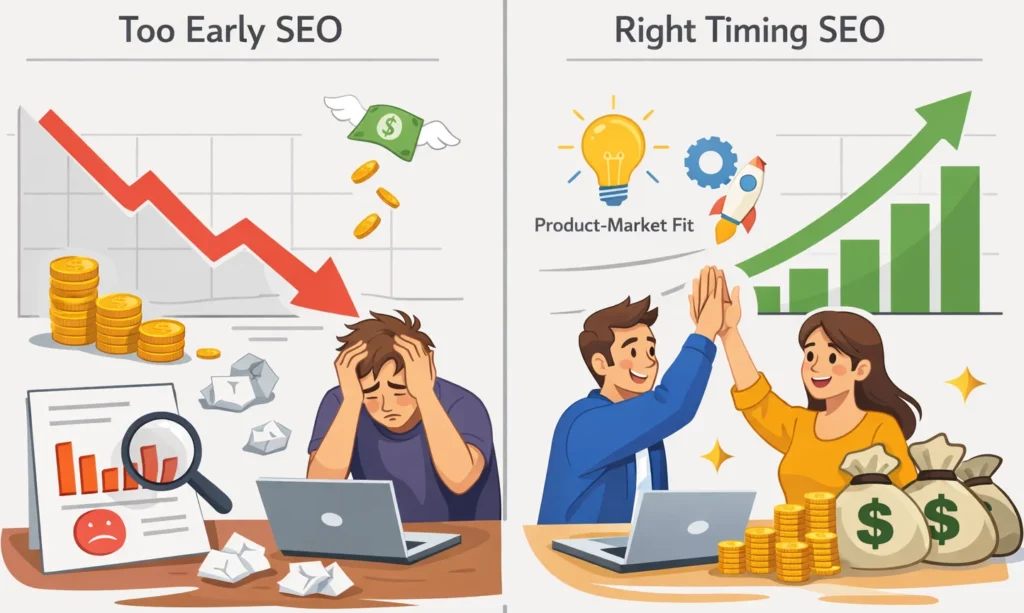
This does not mean SEO is irrelevant for AI startups. It means timing and allocation are everything. This blog breaks down exactly how much you should spend on SEO at the early stage, what you should get for that spend and the signals that tell you when it is time to scale up.
Key Takeaways
- Don’t spend heavily on SEO before product-market fit — it drains runway without delivering meaningful results.
- SEO pricing varies by model — from $50/hour for consulting to $20,000+ per month for enterprise campaigns.
- An in-house local SEO team costs $3,600 to $4,400 per month in salaries alone — add tools and training and the real cost is closer to $5,000 to $6,000 monthly.
- SEO ROI takes at least 6 months to materialize — at 12 months expect 2.6x and at 18 months expect 3.8x on average.
- Timing is everything — SEO is not a question of if, but when. Match your spend to your stage and scale only when your organic channel proves it can convert.
Build SEO That Drives Revenue — Not Just Traffic
Traffic without conversions is just noise. What your startup needs is a structured SEO approach tied to real business outcomes. At SEO Circular, we focus on what matters — growth, conversions, and long-term scalability. Ready to turn SEO into a growth engine?
👉 Get started with a custom SEO roadmap.
How Much Does SEO Costs For AI Startups And Businesses?
The cost of SEO has continuously changed over the years. Various factors affect the overall expense of SEO services regarding specific tasks. If we talk about the SEO pricing in 2025 then it usually comes between $1,000 to $1,500 per month along with some enterprise campaigns exceeding $10,000.
In 2026, the cost for AI startups and businesses should be between $2,000 to $2,500 per month for foundational SEO.
On the other hand, PR and authority building is also one of the crucial step for brand awareness and authority building. Businesses and startups should not ignore this important step. The cost of PR and authority building should be around $5,000 per year. If an AI startup or a business invests around $5,000 based on a year including tasks like PR, media mentions and brand positioning then it can help the business to create a strong credibility and visibility layer. This is really an important step for AI startups because users and investors both look for trust signals before engaging with new platforms.
So, if we explain this in simple terms then the cost for an early-stage startup must look like:
SEO: $2,000 – $2,500 (Monthly)
PR & Authority Building: $5,000 (Yearly)
This blend helps in forming both Higher visibility and authority at the same time.
Also we should keep in mind that this cost is not just a specific set of random numbers. They are actually based on what it will actually take in order to stand out in a kind of market where AI tools are launching every single year.
Many startups at first prefer investing less but they don’t know one major thing is that less investment can often lead to incomplete execution and will unlikely or rarely produce results.
At the same time, spending more without any kind of strategy will not help either. Our main objective is not to spend more but to spend in the right channels with a good strategy and a proper structure.
What affects the cost of SEO?
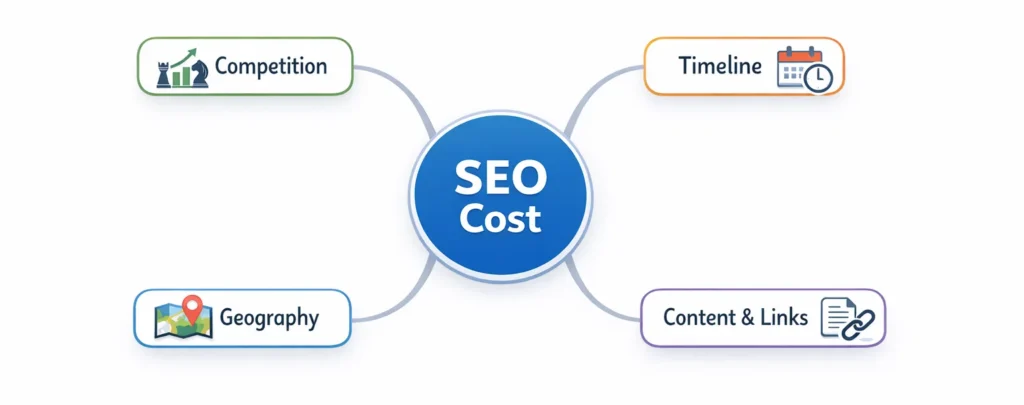
Usually, the cost of SEO ultimately depends on many factors including:
Industry And Keyword Competition
As the competition in any industry is increasing day by day, the need to have more efforts and resources in order to have higher ranking is also getting stronger. The more the competition is, the more you will have to put in the work to stand out in the industry. A space where the competition usually requires a larger scope including more aggressive content creation, extensive link building campaigns and deeper technical analysis. The scope directly affects the hours needed which in turn influences the price.
Time Span And Expertise
SEO strategy and execution take time but the desired speed can shift the overall cost. A more combative timeline demands more resources on time. An SEO team which is experienced with a proven track record in specific areas like advanced AI SEO will demand or need a higher rate than a generalist or a newcomer.
Geographic Targeting
Geo-targeting is essential in SEO because it matches the content of the website with the specific needs and preferences of the target audience. Geographical targeting majorly impacts SEO cost with Localized campaigns usually being cheaper and more efficient than national or international efforts due to lower competition. Cost increase with the number of target locations and the intensity of competition often ranging from $250 to $3,000 along with local services. While broader campaigns require higher more sustained investment.
Content Creation & Link Building:
When it comes to generating high quality content and obtaining high quality backlinks (often $100+per link) majorly raises the overall cost.
SEO Pricing Models For Startups Explained
Learning how SEO is priced is just as knowing how to spend. There is no single, universal pricing structure – agencies, consultants and freelancers use different models depending on the scope of work and your business needs. Here is a breakdown of the four main models and how much each one costs in 2026.
1. Monthly Retainer :
The monthly retainer is by far the most common SEO pricing model. You pay a fixed fee each month for an agreed upon set of services and the work compounds over time. This typically covers on page optimization content creation, link building, technical audits and monthly reporting.
Cost range in 2026
Most businesses in the USA pay between $1,500 and $5,000 per month with the national average for agency retainers sitting around $3,500 to $4,500 per month.
Best for
AI startups that have confirmed product market fit and are ready to invest in long term organic growth.
Watch Out For
Most agencies require a minimum commitment of 6 to 12 months often with 30-to-60-day exit clauses after the initial term. Do not sign a long retainer before your product and messaging are stable.
2. Project based Pricing :
Projects based pricing works best for businesses with well defined goals and a need for specialized, short term SEO services. Common projects include website audits site migrations content strategy build outs and penalty recovery.
Cost Range in 2026 :
Project based SEO typically costs between $5,000 and $30,000 for enterprise specific deliverables.
Best For
Early stage AI startups that need a one time technical audit or an initial SEO foundation before committing to an ongoing spend.
Watch Out For
Project based work delivers a snapshot in time. SEO is not a one-time fix, so use this model to establish a baseline not as a substitute for a long-term strategy.
Hourly Consulting
Hourly SEO services are ideal for businesses needing specific, limited tasks such as audits, consultation or training. This model is commonly used by startups within house marketing teams that need periodic expert guidance rather that full Service management.
Cost Range in 2026
Hourly SEO rates typically fall between $50 and $100 per hour globally with senior consultants in competitive markets charging $100 to $300 per hour.
Best for
Pre-revenue or early-stage AI startups that need strategic direction without committing to a full retainer.
Watch Out For
If a project becomes more complex, it is difficult to predict how many hours will be needed which can add up quickly. Always make sure to set up a cap on hours before engagement begins.
Performance-Based Pricing
Performance based SEO ties payment to measurable results such as keyword rankings, organic traffic growth or leads generated. It sounds attractive on paper but it comes with significant risks.
Cost Range In 2026
Costs vary widely depending on the agreed KPIs and outcomes. Hybrid models with a base retainer and performance bonuses are gaining traction as a more balanced alternative to pure pay for performance arrangements.
Best For
Startups with a stable, converting website that want to align agency incentives with business outcomes.
Watch Out For
Performance based pricing is the least popular model in SEO. Because SEO is a long-term game with considerable nuance, pay for performance is often incompatible with real business goals. Agencies my chase easy low intent keywords just to hit metrics. If an agency promises guaranteed page one rankings with no base fee, treat it is as a red flag.
Quick Comparison Table
| Model | Cost Range (2026) | Best For |
| Monthly Retainer | $1,500 – $5,000/month | Ongoing growth post product-market fit |
| Project-Based | $500 | One-time audits or SEO foundation setup |
| Hourly Consulting | $40 – $90/hour | Early-stage guidance with in-house teams |
| Performance-Based | Varies (hybrid recommended) | Conversion-ready sites with clear KPIs |
Benefits Of Setting Up An In-House SEO team
Sometimes managing SEO tasks altogether at once can become challenging. That’s where we need an experienced In-house SEO team who can help AI startups and businesses scale their SEO journey.
Let’s have a detailed analysis on the advantages of having an In-House SEO team.
Complete Control Over Strategy
An in-house team ensures that every decision aligns with your branding, mission, organizational goals and stakeholder opinions. When your SEO team sits inside your company, there are no approval delays, no miscommunication and no waiting faor your agency’s next scheduled call. You set the priorities and your team executes them directly.
Faster Collaboration Across Teams
Internal teams benefit from proximity. An Internal marketing team can collaborate closely with web development, product sales and leadership without formal handovers. Decisions happen faster, feedback loops are shorter and marketing managers do not need to translates context for external partners. For an AI startup where speed matters, this alone can be a significant competitive advantage.
Deeper Brand And Product Knowledge
Internal teams win on nuance and institutional insight especially for industries with technical or regulated content. AI products are complex. An in-house SEO professional will understand your audience, your use case and your competitive positioning far better than any agency that manages dozens of clients simultaneously.
Long-Term Institutional Knowledge
In-house management allows for complete control over brand voice , SEO strategy and marketing processes. For organizations focused on consistency rather rapid experimentation, this approach reduces reliance on external partners and builds institutional knowledge over time. Every campaign, every test and every insight stays within your organization- compounding in value as your startup scales.
What Does it Actually Cost to have an In-House local SEO Team?
Having an In-house SEO team is a recurring monthly commitment not a one time investment. Once your team is in place, you need a clear image of what it costs to keep them running effectively every single month. Here is a realistic role by role breakdown based on current market data.
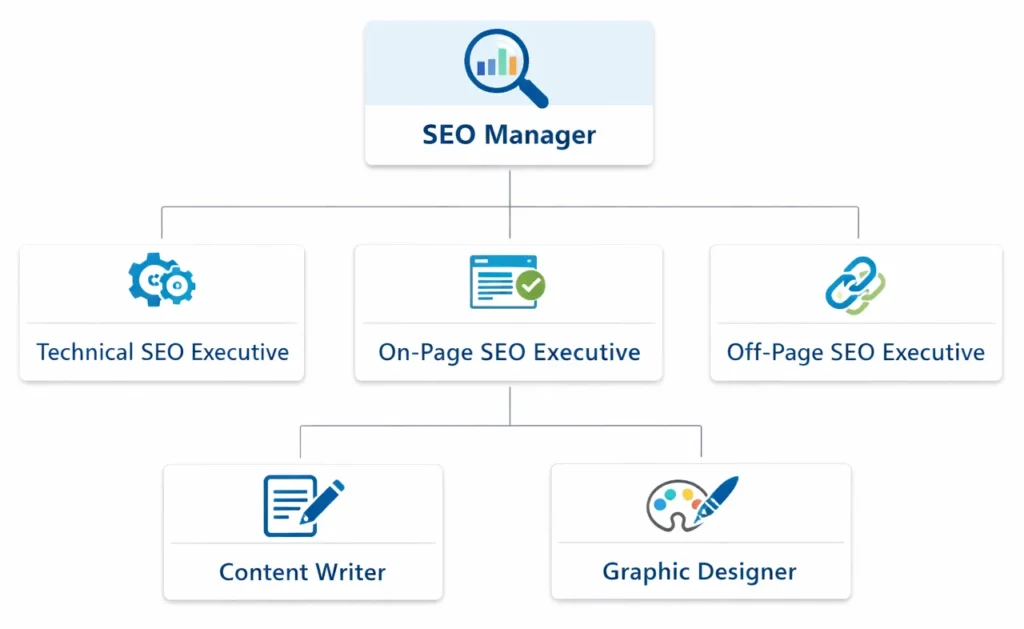
The Core Team Roles & Monthly Costs
1. SEO Manager
The SEO manager leads the entire SEO operation – owning the strategy, managing the team, reporting on performance and aligning SEO efforts with your broader business goals.
Monthly Costs – $1,200
2. SEO Executives
SEO executives are the hands-on operators of your team. Each executive typically owns a specific function including
1) One focused on technical SEO,
2) One on On-page optimization
3) one on off-page and link building
Ensuring all pillars of SEO are covered Simultaneously.
Monthly Cost – $1,200 – $1,800
3. Content Writer
A dedicated content writer produces the local landing page, blog posts and location specific content that drives organic visibility in your target market. Without consistent output, your SEO strategy stalls.
Monthly cost: $600 – $800
4. Graphic Designer
A graphic designer supports the team with blog visuals, infographics and landing page assets. Strong visuals improve user engagement, reduce bounce rates and increase the shareability of your content – all of which indirectly support SEO performance.
Monthly cost – $600
Total Monthly Cost of Maintaining Your In-House SEO Team
| Role | Monthly Cost |
| SEO Manager | $1,200 |
| SEO Executives (×3) | $1,200 – $1,800 |
| Content Writer | $600 – $800 |
| Graphic Designer | $600 |
| Total | $3,600 – $4,400/month |
What this does not include
These figures only cover salaries. Managing an effective in-house SEO team comes with additional monthly expenses that are easy to overlook. They include:
SEO Tools
Platforms like Ahrefs, SEMrush and Screaming Frog are non- negotiable for a functioning SEO team and can add $500 to $1,500 per month
Content tools
Tools like Surfer SEO, Grammarly or Jasper for content optimization carry their own recurring costs
Management Time:
The hours your leadership spends reviewing work, aligning strategy and conducting performance reviews represents a real and ongoing opportunity cost
Hiring & Training Costs
When team members leave or new tools emerge, recruitment and upskilling add expenses that recur unpredictably throught the year
When these additional costs are factored in, maintaining a fully operational in-house local SEO team realistically costs closer to $5,000 to $6,000 per month in total.
How to Measure SEO ROI for Your AI Startup
Without a clear ROI framework, SEO is impossible to justify or to scale. Here is what you actually need to know in order to measure the ROI
The Core Formula
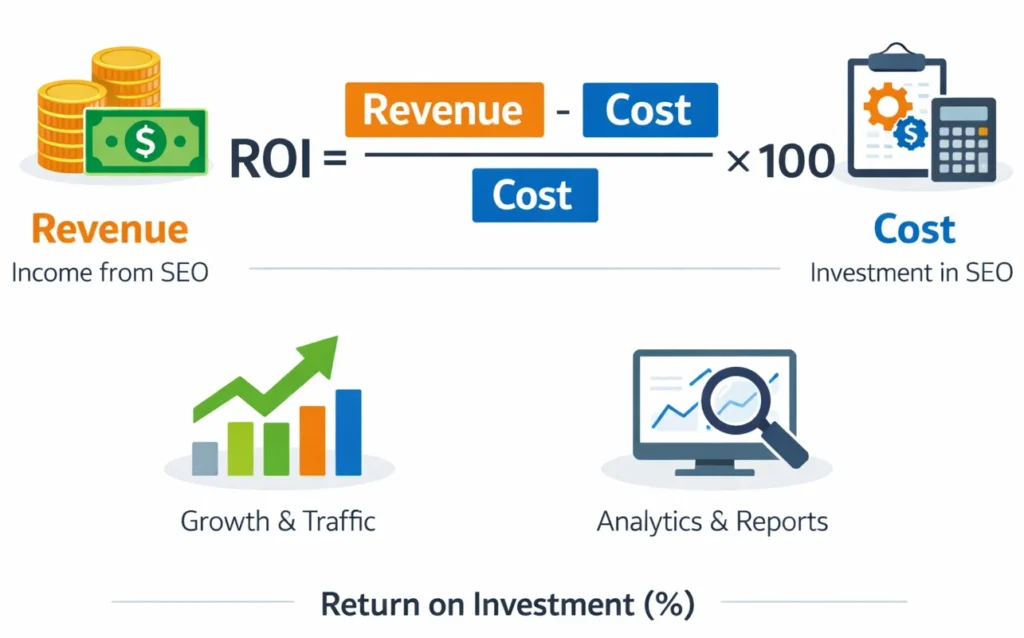
ROI = (Revenue Generated from SEO − Cost of SEO Investment) ÷ Cost of SEO Investment × 100
For example, if your SEO generates $150,000 in revenue against a $50,000 investment, your ROI is 200% — meaning every dollar spent returned $2 in revenue.
What ROI Should You Realistically Expect?
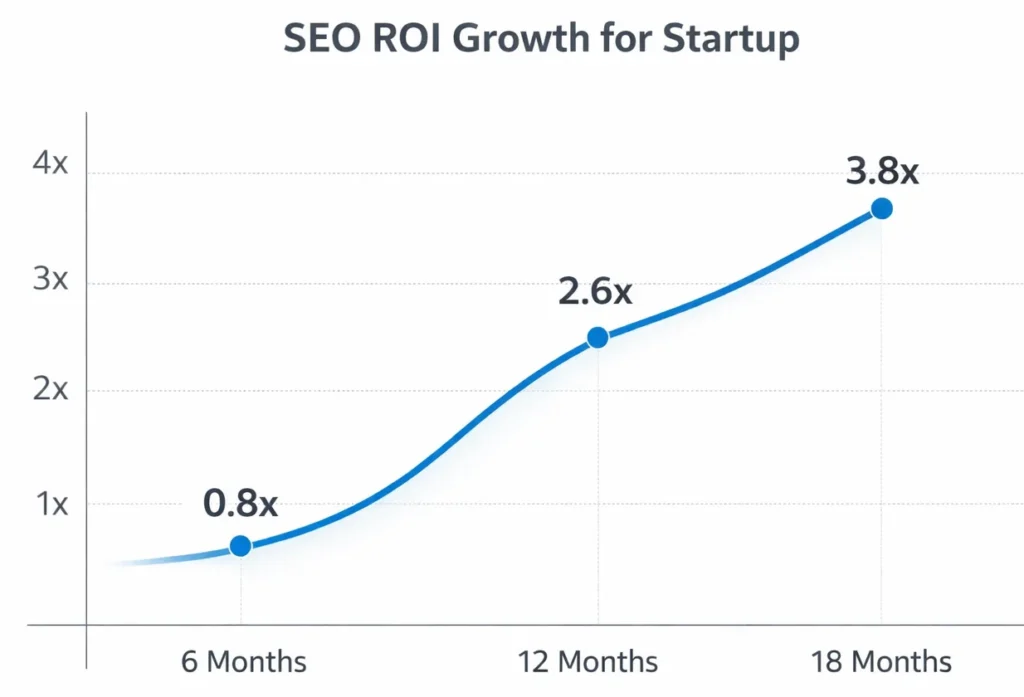
Here is how SEO ROI typically progresses over time:
| Time Period | Average ROI |
| 6 Months | 0.8x |
| 12 Months | 2.6x |
| 18 Months | 3.8x |
Most startups should aim for a 3:1 return or higher. Long-term SEO programs often reach 5:1 or more over time.
The 3 Metrics You Must Track
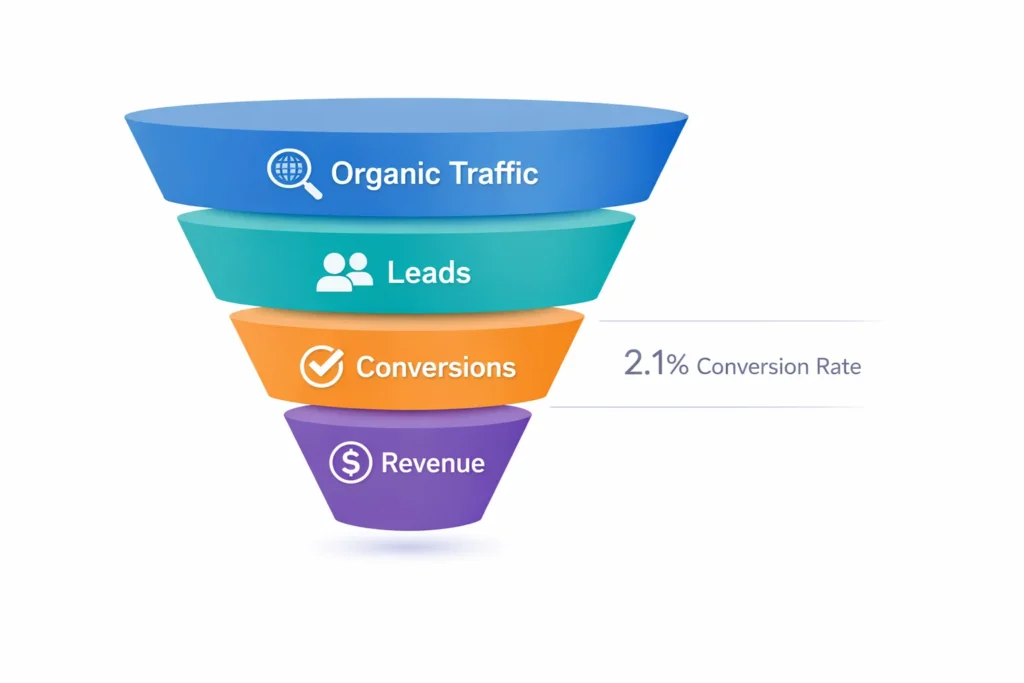
- Organic Revenue — Track organic visitors through to closed revenue in your CRM
- Conversion Rate — The average SEO conversion rate for B2B SaaS companies is 2.1% — use this as your baseline
- Cost Avoidance — Factor in the paid ad spend your organic traffic is replacing
One Important Rule
Never measure SEO return on investment before at least 6 months. Calculating it sooner will produce inaccurate and misleading results. Evaluate SEO year over year, not quarter to quarter.
Conclusion
SEO is not a question of if — it is a question of when and how much. Spending too early drains the runway. Spending too late hands organic growth to your competitors. The right move is timing your investment to match your stage and your overall revenue goals.
For most early-stage AI startups, the smartest first step is partnering with the right SEO agency. You get the strategy, execution and expertise without the overhead.
Ready to grow your organic presence the right way? SEO Circular specializes in helping AI startups build SEO strategies that are lean, focused, and built for results. Get in touch with us today.
Commonly Asked Questions: AI Startup Spend on SEO
Yes — in 2026, GEO is no longer optional. AI Overviews now appear on nearly half of all Google searches, meaning visibility on ChatGPT and Perplexity is just as critical as ranking on Google.
Generic content no longer works. Structure content with clear question-and-answer formatting, concise definitions, and citable statistics, AI models favour factually dense, well-attributed content over broad informational articles.
More than ever. Sites with over 32,000 referring domains are 3.5 times more likely to be cited by ChatGPT, strong backlink profiles now directly impact both Google rankings and AI search visibility.
It adds an overlooked layer of investment. Budget for founder bylines, original research, and verified reviews — a focused 90-day E-E-A-T sprint can close the trust gap against older, more established domains.
Only with a strong editorial layer. Over 82% of content marketers will integrate AI tools by 2026 but an AI-generated content without human oversight risks violating Google’s E-E-A-T principles and triggering ranking penalties.
Search engine optimization has never functioned at a faster rate and manual workflows are no longer keeping up. In 2026, the businesses pulling ahead in organic search aren’t simply hiring more SEO talent, they’re deploying Python-driven automation to do the work that used to take entire teams hours each week.
Python has firmly established itself as the language of choice for technical SEO. With a massive ecosystem of purpose-built libraries, it now handles everything from crawling millions of URLs and parsing structured data to monitoring and keeping track keyword shifts in real time and automating on-page audits at scale.
The result? Faster insights, lower operational costs and a measurable competitive edge.
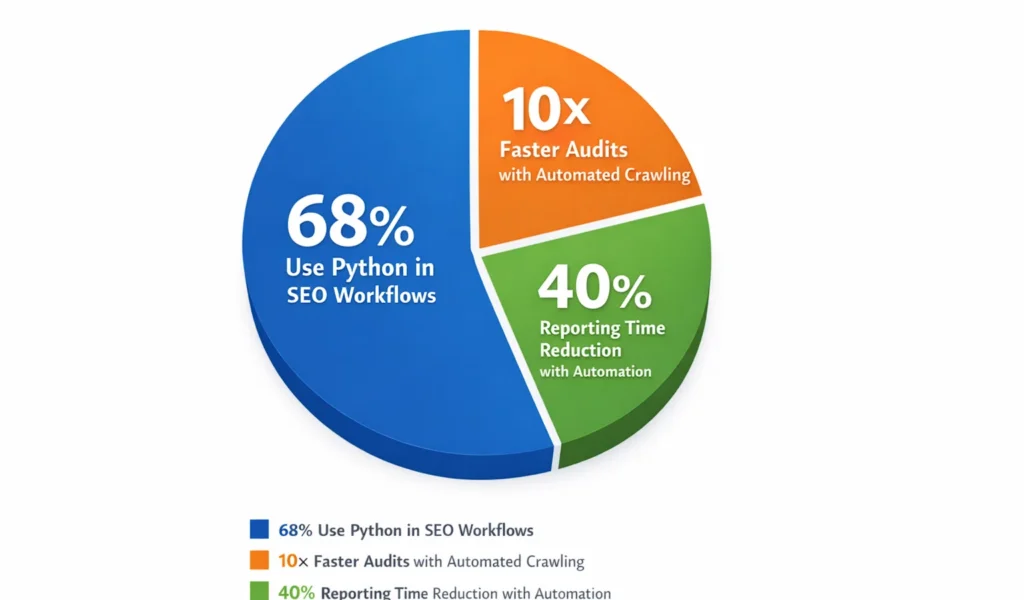
- 68% of enterprise SEO teams use Python in their workflows
- 10× faster audits with automated crawling vs manual review
- 40% reduction in reporting time reported by automation adopters
In this guide, the SEO Circular team breaks down the most powerful Python libraries which are available today, the ones that are actively shaping how forward-thinking business owners and their marketing teams automate repetitive SEO tasks, surface actionable data faster and build scalable search strategies without ballooning their headcount.
Whether you’re just beginning to explore Python for your SEO stack or looking to upgrade the tools you’re already using, this breakdown will give you a precise, data-informed view of what each library does, where it excels and which scenarios it’s built for.
Key Takeaways
- Python’s ecosystem in 2026 is purpose-built for SEO — not just adapted for it.
- Always define your SEO task first, let the task choose the library, not the other way around.
- BeautifulSoup and Requests are the smartest entry points for teams new to SEO automation.
- Pandas and Advertools together cover the bulk of any technical SEO audit workflow.
- spaCy-driven NLP is no longer optional for businesses competing in content-heavy verticals.
Scale Your SEO with Python Automation
At SEO Circular, we help businesses automate technical SEO, reporting, and data workflows using Python-driven systems that reduce manual effort and deliver faster, more accurate insights.
Partner with us to build powerful automation workflows.
Python Vs. Other Automation Options
Business owners are often presented with alternatives such as dedicated SEO platform, Google sheets macros or no-code tools like Zapier. here is how Python compares across the dimensions that matter most at scale.
| Capability | Python | SEO Platforms | No-Code Tools | Spreadsheets |
|---|---|---|---|---|
| Custom Crawling at Scale | Full control | Limited | Not supported | Not supported |
| API Data Orchestration | Unlimited | Platform APIs only | Connector-dependent | Manual only |
| Log File Analysis | Native | Some tools | Not supported | Limited rows |
| Cost at Scale | Low (open source) | High subscription | Mid-tier | Low |
| Reusable & Version-Controlled | Yes | No | Partial | No |
| ML & NLP Integration | Native | Rarely | Not supported | Not supported |
Parts Where Python Delivers The biggest ROI In SEO
Not every SEO task benefits equally from Python automation. The highest impact applications where the time and cost savings are most measurable fall into these categories:
Technical Site Auditing
Crawl millions of pages, identify broken links, redirect chains, duplicate content and missing metadata across your entire domain in minutes.
Keyword Clustering & SERP Analysis
Group thousands of keywords by intent, analyse SERP feature distribution and identify content gap opportunities automatically at a scale no analyst can match manually.
Log File Analysis
Parse server logs to understand how Googlebot is crawling your site revealing wasted crawl budget, overlooked pages and indexation bottlenecks invisible to standard tools.
Automated Reporting Pipelines
Pull data from Google Search Console, Analytics and third-party APIs into a single automated dashboard, eliminating hours of weekly manual reporting.
Content & NLP Optimisation
Use natural language processing libraries to analyse content at scale – scoring topical depth, entity coverage and semantic alignment against top-ranking pages.
The business case is clear: Python does not replace SEO expertise – it amplifies it.
The right library in the right workflow can turn a one-person operation into one that performs like a team of five, without the overhead. The following sections break down exactly which libraries to use and when.
How To Choose The Right Library
Not every library matches every use case. Here’s a structured framework to match the right and suitable tool to your specific SEO goals without wasting time on trial and error.
With the large number of Python libraries available for SEO related tasks, one of the most common mistakes business owners and their teams make is reaching for the most popular tool rather than the most appropriate and suitable one. Choosing wrong means lost setup time, limited output or rebuilding workflows from scratch months later.
The right library comes down to five core criteria. Evaluate any candidate against each of these before committing.
1) Define Your SEO Task First
Crawling, keyword analysis, log parsing, and content auditing each demand different capabilities. Start with the task, not the tool.
2) Assess Your Team’s Python Depth
Some libraries require advanced scripting knowledge. Others are beginner-friendly with clear documentation. Match complexity to capability.
3) Check Scale Requirements
A library that handles 10,000 URLs may break at 1 million. Know your data volume before selecting a crawling or processing tool.
4) Verify Active Maintenance
Abandoned libraries accumulate compatibility issues fast. Check GitHub for recent commits, open issues, and community activity.
5) Consider Integration Needs
Will it connect to Google Search Console, your CMS, or your reporting stack? Compatibility with your existing tools matters significantly.
Match Your Goal To The Right Library Type
Use this decision guide to quickly identify which category of library fits your immediate SEO priority.
| Your SEO goal | Library category | Best for | Complexity |
| Crawl & audit site structure | Web crawling | Technical audits, broken links, redirect chains | Intermediate |
| Extract on-page data at scale | HTML parsing | Meta tags, headings, schema, structured data | Beginner |
| Analyse keyword & SERP data | API wrappers | Rank tracking, SERP features, search volume | Intermediate |
| Process server log files | Data processing | Crawl budget, bot behaviour, indexation gaps | Advanced |
| Optimise content with NLP | NLP / ML | Entity analysis, topical depth, semantic scoring | Advanced |
| Automate reporting pipelines | Data viz & reporting | Dashboards, scheduled exports, stakeholder reports | Intermediate |
A Common Mistake To Avoid:
Don’t select a library based on popularity only. `Scrapy` is powerful but overkill for simple page audits. `BeautifulSoup` is elegant for parsing but it can’t replace a full crawler. Choosing the right tool for the right task is what separates efficient SEO automation from messy, unorganized scripts.
Quick Check Before You Commit
1) Run through this checklist before finalising any library for your SEO stack:
2) Does it have active GitHub commits within the last 6 months?
3) Is there clear documentation with practical examples – not just API references?
4) Has it been tested at the data scale your workflows require?
5) Does it integrate cleanly with your existing tools like GSC, Analytics, CMS)?
6) Is the learning curve realistic for your team’s current skill level?
7) Can it handle your task without requiring heavy third-party dependencies?
Top Python Libraries For SEO Automation In 2026
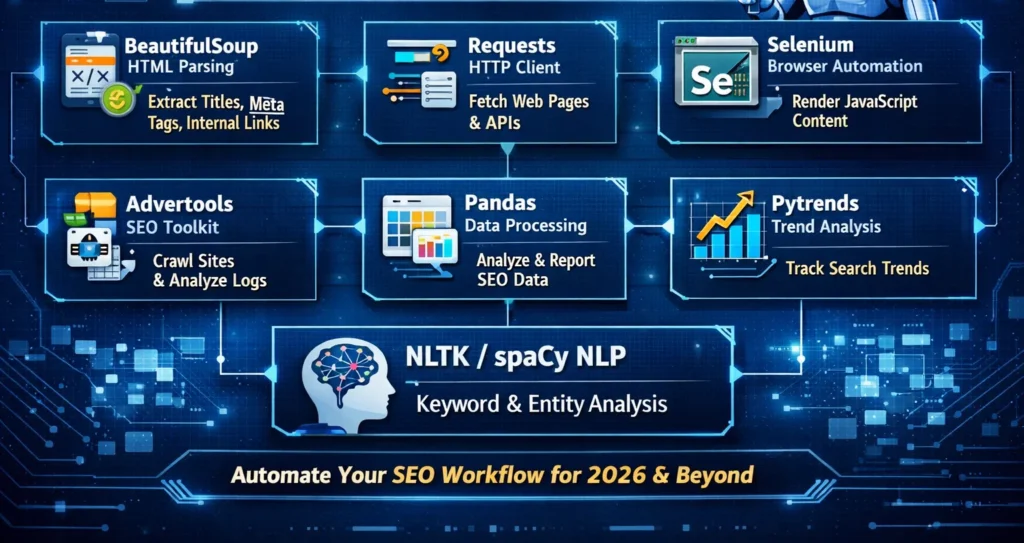
Seven battle-tested libraries covering the full breadth of SEO automation — from crawling and parsing to trend analysis and natural language processing.
1) BeautifulSoup – HTML Parsing
BeautifulSoup reads the raw HTML of any web page and lets you filter out exactly what you need including title tags, meta description, heading structures, canonical URLs and internal links – with precision and very little setup. It is one of the most readable libraries in the Python ecosystem making it a natural starting point for teams new to SEO automation.
Best For:
On-page audits, meta tag extraction, internal link mapping.
Limitations:
Cannot fetch pages on its own – needs Requests or Selenium to retrieve HTML first.
Complexity:
Low – most tasks require fewer 10 lines of logic.
How it helps your SEO :
Feed it a list of URLs and it will extract every on-page SEO element across your entire site in minutes, flagging missing meta descriptions, duplicate titles or broken heading hierarchies automatically without opening a single page manually.
2) Requests – HTTP Client
Requests is the foundational building block that almost every other Python SEO tool relies on. It handles the act of fetching web pages and calling external APIs – including Google Search Console, Ahrefs and Semrush managing response codes, redirects, headers and authentication behind the scenes so your scripts can focus on the SEO logic.
Best for:
API integration, page fetching, HTTP status audits, redirect chain analysis.
Limitation:
Cannot render JavaScript – dynamically loaded content requires Selenium.
Complexity:
Low- Intuitive syntax, extensive documentation
How it helps your SEO:
Run automated HTTP status check across thousands of URLs to Instantly surface 404 errors, redirect chains and server errors – tasks that would take hours in a crawler tool but run in seconds with Requests-powered script.
3) Selenium — Browser Automation
Selenium controls a real browser like Chrome, Firefox or Edge programmatically. This makes it the right and correct tool whatever Javascript rendering matters for SEO: auditing what Googlebot actually sees versus what your server sends, testing Core Web vitals triggers or scraping content that only appears after user interaction or page load events.
Best For :
JS-rendered page audits, Core Web Vitals testing, dynamic content extraction.
Limitation :
Significantly slower and more resource-intensive than Requests at scale.
Complexity :
Medium – requires browser driver setup and handling async behaviour.
How it helps your SEO :
Verify that your JavaScript heavy page render correctly for search engines, catch lazy loaded content that crawlers miss and automate repetitive browser-based SEO tasks such as checking hreflang rendering or structured data on dynamic pages.
4) Advertools – SEO Toolkit
Advertools is the most SEO specific library in this list – built by a practitioner for practitioners. it handles sitemap, robots.txt analysis, web crawling, server log processing and keyword manipulation all within a single, coherent package. For teams running technical SEO at scale, it removes the need to stitch together multiple libraries for the most common audit tasks.
Best For :
Sitemaps, robots.txt audits, crawling, log file analysis, keyword tools.
Limitation:
Smaller community and fewer third party integrations than general purpose libraries.
Complexity:
Medium – SEO specific functions are well documented with clear outputs.
How it helps your SEO:
Parse your entire sitemap in seconds, audit your robots.txt for crawl blocking errors and process server log files to understand exactly how Googlebot is spending its crawl budget across your domain – all without building custom tooling from scratch.
5. Pandas – Data Processing
Pandas is the data processing layer that sits underneath nearly every SEO automation pipeline. It handles bulk manipulation of crawl exports, keyword lists, Google Search Console data, rank tracking CSVs and log files – enabling filtering, grouping deduplication, merging and reporting at a scale and speed that spreadsheet tools simple cannot support.
Best For:
GSC analysis, Crawl data processing, keyword deduplication, automated reporting.
Limitation:
Memory intensive with very large datasets – consider polars for 10M=rows.
Complexity:
Medium – data frame concepts require an initial learning curve.
How it helps your SEO:
Load a full Google Search Console export and identify keyword cannibalisation, declining queries and click through rate anomalies across thousands of pages – in the time it would take to manually scroll through a spreadsheet.
6. Pytrends – Trend analysis
Pytrends is an unofficial Python wrapper for Google Trends, bringing real time and historical search interest data directly into your automation workflows. It lets you track how interest in specific keywords evolves over time, compare seasonal demand patterns and identify which geographies are driving search volume – all programmatically and at scale.
Best For:
Content timing, seasonal planning, GEO demand analysis, trend monitoring.
Limitation:
Unoffcial API with rate limits not suitable for continuous or high frequency polling.
Complexity:
Low- minimal setup, straightforward data outputs.
How It helps your SEO:
Identify the exact weeks when search demand for your target topics peaks so your content team publishes ahead of the curve rather than behind it, giving your pages time to index and rank before competitor volume spikes.
7. NLTK/spaCy – Natural Language Processing
NLTK and spaCy bring natural language processing into your SEO stack. They understand text the way a search engine does – recognising named entities, measuring semantic relationship between words, scoring topical coverage and clustering keywords by intent. In 2026, as Google’s understanding of language continues to mature, NLP-driven content optimisation has become a measurable ranking differentiator in competitive verticals.
Best For:
Entity extraction, keyword clustering, content gap analysis, intent mapping.
Limitation:
Requires NLP understanding – model configuration adds meaningful complexity.
Complexity:
High-best suited for teams with data science capability.
How it helps your SEO:
Analyse your existing content and competitor pages to identify missing entities, understand subtopics and semantic gaps – then use those insights to build content that more completely satisfies search gaps – then use those insights to build content that more completely satisfies search intent and signals topical authority to Google.
Conclusion
Python has fundamentally changed what is possible in SEO and in 2026 that shift is accessible to businesses of all sizes. Libraries like BeautifulSoup, Requests, Advertools, Pandas, Selenium, Pytrends, and spaCy make it practical to automate the technical, repetitive, and data-heavy sides of search optimisation without ballooning your team.
That said, knowing which libraries exist is only the first step. Implementing them correctly requires technical and strategic expertise that goes well beyond the tools themselves. At SEO Circular, we combine Python-driven automation with deep search expertise to surface the insights that actually move rankings. If you are serious about scaling your SEO without scaling your overheads, our team is ready to help.
Commonly Asked Questions: Python Libraries For SEO Automation
Yes, an aggressive crawl script without rate limiting can overload your server, and bulk changes pushed without a review stage can introduce errors at scale. Always test scripts in a staging environment first, and ensure every automation includes error handling and logging before it touches your live site.
Not for every task. Libraries like BeautifulSoup and Pytrends are approachable for analytically minded SEO professionals. However, advanced workflows involving log file analysis, NLP, or custom crawling pipelines will require genuine programming competence to build and maintain reliably.
It depends on the method. Calling official APIs such as Google Search Console or Google Ads API is fully compliant. Scraping Google search result pages directly violates their terms of service and risks IP blocking. Always collect data through official APIs, not by scraping search results.
At minimum, quarterly. Algorithm updates, site structural changes, and library version upgrades can all break existing scripts or produce inaccurate outputs. Building in logging and alerts from the start significantly reduces ongoing maintenance costs.
No, Smaller sites benefit too primarily through eliminating repetitive manual tasks like weekly reporting, keyword trend monitoring, and periodic on-page audits. Starting with one well-chosen automation task delivers immediate value and builds your team’s confidence before expanding the stack.
Promoting NSFW tools online offers strong revenue potential but comes with unique marketing challenges. Strict platform policies, higher payment processing fees, and advertising restrictions make traditional growth strategies difficult. Still, NSFW SaaS products, AI tools, creator platforms, and adult-tech businesses continue to scale by using compliant, data-driven digital marketing.
This guide explains how to promote NSFW tools online using a conversion-focused and policy-safe strategy built for long-term growth.
The global adult and NSFW technology market is projected to exceed $60 billion, with AI-powered tools driving much of this expansion. Studies also show that over 70% of users discover NSFW tools through organic search, and many adult SaaS brands see 30–50% higher conversions from SEO traffic compared to paid ads. These trends make SEO and trust-led content essential for safe, scalable growth in restricted industries.
Key Takeaways
- Promoting NSFW tools online requires a compliance-first, trust-led strategy
- SEO is the most reliable and scalable channel for NSFW and restricted products
- Educational content builds credibility and drives qualified traffic
- Programmatic SEO enables safe expansion across niches and regions
- Community, influencer, and PR strategies support long-term visibility
- Conversion optimization turns traffic into revenue
- Privacy-first analytics ensure compliance and sustainable growth
What Are NSFW Tools?
NSFW tools include software, platforms, or digital products that create, enhance, distribute, or manage adult or sensitive content. These often include:
- AI image and video generation tools
- Adult content creation platforms
- Dating and intimacy apps
- Chatbots and conversational AI
- Content moderation or filtering tools
- Creator monetization platforms
These devices cater solely to the B2B channel in these advanced, regulated digital systems, involving late-stage marketing inputs.
Why NSFW Marketing Requires a Different Strategy?
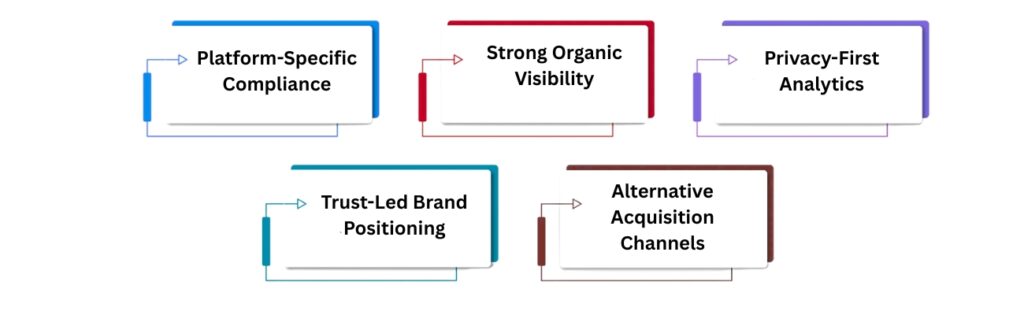
The marketing of the NSFW (Not Safe for Work) industry necessitates a unique practice different from the usual SaaS methods. The main elements that determine success in this sector are:
Platform-Specific Compliance
Promotional efforts must be compliant with the authorities and regulations of the various platforms in order to avoid limitations or fines.
Strong Organic Visibility
To effectively and efficiently penetrate the target audience without heavily relying on paid pushes, it is crucial to have a strong organic presence.
Privacy-First Analytics
Prioritizing user privacy when gathering and processing data is crucial for maintaining user confidence and adhering to privacy regulations.
Trust-Led Brand Positioning
Establishing a brand that emphasizes trust and credibility can significantly impact customer loyalty and engagement in the NSFW market.
Alternative Acquisition Channels
Unorthodox methods for attracting customers can sometimes be new growth avenues that are usually neglected by conventional marketing.
Here at SEO Circular, we consider NSFW tools as enterprise-level consumables needing sophisticated tactics, not just looking for easy ways or taking advantage of gaps.
SEO: The Most Important Channel for NSFW Tools
Why SEO Works Best for NSFW Tools
SEO delivers the most reliable and scalable growth for NSFW tools. Paid advertising platforms restrict or block adult-related products, which limits reach and increases acquisition costs. SEO removes this dependency and connects your product with users who already show strong intent.
When users search for NSFW tools, they actively look for a solution. This intent leads to higher conversion rates and stronger lifetime value.
SEO helps NSFW businesses achieve:
- Consistent, high-intent organic traffic
- Lower customer acquisition costs (CAC)
- Long-term search visibility
- Strong brand trust and topical authority
For most NSFW brands, SEO becomes the primary revenue-driving channel because it delivers qualified traffic without ongoing ad spend risk.
Keyword Research for NSFW SEO
To conduct keyword research for NSFW tools, it is imperative to have a professional, compliant, and intent-driven strategy. The aim remains to lure potential buyers without violating any search engine and platform regulations.
Best practices include:
- Target long-tail keywords that show buying intent.
- Highlight product features, use cases, and business benefits.
- Avoid unsafe or inappropriate terms.
- Check competitor keywords to find ranking opportunities.
Safe keyword examples include:
- “AI content creation tool for adults”
- “secure NSFW chatbot software”
- “creator monetization platform”
SEO Circular leverages Artificial Intelligence in certain categories of keyword-oriented investigation to come up with those attributes, which hold warrants high-ranking while inbound conversion, while matching the guidelines.
On-Page SEO for NSFW Websites
On-page SEO guarantees that search engines will easily recognize the content and its significance. It also enhances the user’s experience and the potential for conversion.
Key on-page optimization areas include:
- Clearly defined H1, H2, and H3 content hierarchy structure
- Simple, formal, and business-oriented language
- Improved meta descriptions and title tags
- Internal links between sites that are strategically placed
- URLs that are clear, understandable, and optimized for keywords
Avoid explicit visuals or language on public-facing pages. Keep all content informative, solution-oriented, and aligned with a B2B audience.
Technical SEO for NSFW Platforms
Technical SEO shields the rankings, enhances the performance, and it also supports the long-term scalability. The NSFW sites must be very secure and at the same time accessible.
Core technical SEO priorities include:
- Fast page load speed
- Mobile-first and responsive design
- Secure HTTPS implementation
- Proper indexing and crawl control
- Clean and scalable site architecture
SEO Circular builds fast, secure, and SEO-friendly websites specifically designed for NSFW and restricted-category businesses, ensuring compliance, performance, and sustainable growth.
Content Marketing That Builds Trust
Why Educational Content Works Best
NSFW tools, on the other hand, the educational content gives the brand credibility and sales, too. Not relying on shock value, brands are able to make it with the help of expert and informative content. Search engines also give priority to content that is good for users, increases trust, and shows expertise.
High-performing content types include:
- How-to guides
- Product comparisons
- Industry trend analyses
- Compliance and safety guides
- Feature explainers
Educational content positions NSFW tools as legitimate business solutions, helping brands attract serious users and decision-makers.
Blogging Strategy for NSFW Tools
An effective blog strategy focuses on clarity, intent, and relevance. Key elements include:
- Targeting one primary keyword per article
- Using simple, professional language
- Explaining user problems and solutions clearly
- Including internal links to product pages for conversion
SEO Circular creates SEO-optimized blogs that drive qualified traffic, educate audiences, and convert readers into leads or paying users.
Programmatic SEO for Scale
NSFW tools often serve multiple niches, regions, or use cases. Programmatic SEO enables large-scale content creation, targeting hundreds of landing pages safely.
Benefits include:
- Faster traffic growth
- Broader keyword coverage
- Increased visibility in niche searches
SEO Circular implements enterprise-level programmatic SEO systems that remain compliant, safe, and performance-focused.
Social Media and Influencer Marketing for NSFW Tools
Best Social Platforms for NSFW Brands
Not all social platforms are suitable for NSFW tools. Effective channels include:
- Twitter (X): Engages creators and facilitates discussions
- Reddit: Targets niche communities and forums
- Telegram & Discord: Builds private, loyal user groups
- LinkedIn: Positions your tool professionally for B2B audiences
Each platform requires a policy-aware content strategy to ensure safety and reach.
How to Stay Safe on Social Media
To maintain consistent visibility without risking bans:
- Use neutral, professional language
- Avoid explicit visuals or language
- Focus on features, benefits, and technology
- Direct traffic to age-gated or verified pages
SEO Circular ensures NSFW brands maintain compliance while building engagement.
Community Marketing for Growth
Private communities accelerate growth by:
- Educating users
- Collecting feedback
- Increasing retention
- Building brand loyalty
Community-led strategies reduce dependency on paid advertising while creating long-term engagement.
Influencer Marketing for NSFW Tools
Influencers already hold trust in NSFW niches, helping brands gain:
- Brand awareness
- Faster product adoption
- Enhanced credibility
Key practices include:
- Choosing influencers with relevant audiences and strong engagement
- Prioritizing content quality and compliance over follower count
- Running campaigns with clear guidelines, disclosures, and performance tracking
SEO Circular manages influencer outreach, compliance, and analytics to ensure measurable ROI and safe, effective promotions.
Paid Advertising, PR, CRO, and Analytics for NSFW Tools
Understanding Paid Ad Limits
Mainstream ad platforms restrict NSFW content, but paid growth remains possible through alternative channels. Safe options include:
- Native ad networks
- Adult-friendly advertising platforms
- Sponsored content placements
- Search ads using allowed, compliant keywords
- Smart PPC Strategy
Effective PPC campaigns target high-intent users while staying compliant. Focus areas include:
- Brand and feature-based keywords
- Clean, professional landing pages
- Accurate conversion tracking
- Continuous A/B testing
SEO Circular manages policy-safe PPC campaigns that prioritize quality leads and measurable ROI.
Digital PR and Brand Authority
PR strengthens visibility, credibility, and SEO rankings for NSFW tools. Effective strategies include:
- Thought leadership articles
- Industry insights and data-driven reports
- Product announcements and launches
By focusing on professional, credible placements, SEO Circular helps NSFW brands build authority without sensationalism.
Conversion Rate Optimization (CRO)
Traffic alone does not guarantee revenue. CRO converts visitors into sign-ups, trial users, and paying customers. Best practices include:
- Clear value messaging and benefits
- Strong, visible CTAs
- Privacy and security signals
- Simplified onboarding
SEO Circular integrates SEO and CRO, ensuring every visitor contributes to revenue growth.
Analytics and Privacy Compliance
NSFW tools must comply with global privacy regulations. Use:
- Consent-based tracking
- Server-side analytics
- Secure data handling
We implement privacy-first analytics systems that provide actionable insights while protecting user data and maintaining regulatory compliance.
This combined approach ensures safe, measurable, and scalable growth for NSFW businesses.
Advanced Tips for Promoting NSFW Tools Online
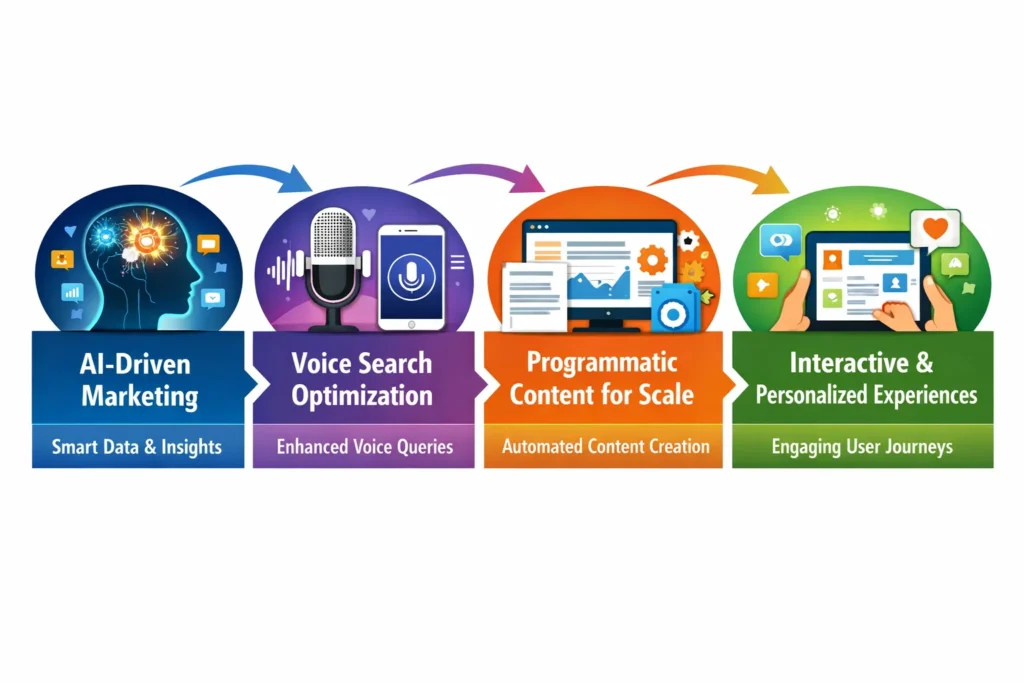
As the NSFW tools market evolves, staying ahead of digital marketing trends can give your brand a competitive edge. Advanced strategies help increase visibility, engagement, and conversions while maintaining compliance.
1. AI-Driven Marketing
AI tools can optimize campaigns, personalize user experiences, and improve content creation. For NSFW tools, AI can:
- Generate compliant, engaging content faster
- Analyze user behavior to target high-intent audiences
- Predict trends and optimize marketing spend
- Enhance email, chat, and in-app engagement
Leveraging AI ensures your marketing is data-driven, scalable, and highly efficient, even in restricted industries.
2. Voice Search Optimization
Voice search is becoming more prevalent, even in professional and niche markets. Optimizing your NSFW tool content for voice search can:
- Capture long-tail, conversational queries
- Improve local and global visibility
- Enhance mobile search performance
Focus on natural language keywords and concise, informative answers to rank for voice queries.
3. Programmatic Content for Scale
NSFW tools often target multiple niches, geographies, or use cases. Programmatic content allows brands to:
- Generate hundreds of landing pages efficiently
- Target intent-specific keywords
- Increase visibility in niche search results
SEO Circular implements enterprise-level programmatic SEO systems that scale content safely, improve rankings, and drive qualified traffic.
4. Interactive and Personalized Experiences
Engaging users through interactive and personalized content boosts conversions and retention for NSFW tools. Strategies include:
- Personalized product recommendations based on user behavior
- Interactive demos or calculators showcasing tool benefits
- Quizzes or surveys to guide users to the right solution
- Dynamic landing pages tailored to user segments
Common Mistakes to Avoid When Promoting NSFW Tools
Online promotion of NSFW tools tries to take a shortcut and, by doing so, creates common mistakes which, in turn, stop the flow of potential users, reduce conversion rates, or even cause the business to get into compliance trouble. The process of identifying and correcting these mistakes is necessary to gain safer and long-term marketing success.
1. Using Explicit Language in SEO
The use of explicit or provocative words can not only lower the position in the search results but also attract penalties and decrease the company’s trustworthiness. It is best to use a jargon-free, compliant language that conveys the tool’s features and benefits to the decision makers clearly.
2. Depending Only on Paid Ads
There is a danger in using paid campaigns as the only method of marketing because of the strictness of the rules concerning the ads and the possibility of account closure. However, you can create a steady, long-term traffic source by blending SEO, content marketing, social media, and community building.
3. Ignoring Compliance Rules
Violation of platform rules, privacy laws, or advertising regulations can result in the suspension of accounts, imposition of legal fines, or loss of reputation. To avoid these consequences, always adhere to the rules and industry practices that are the best ones.
4. Targeting Low-Quality Traffic
Infiltration of unfit or non-related users makes numbers look good, but does not result in important conversions. Concentrate on the audience with the highest intent that is likely to sign up, engage, or become a customer for a better return on investment (ROI).
5. Weak Website Trust Signals
Lack of security, professional design, and clear messaging reduces conversions. Include HTTPS, privacy assurances, testimonials, and transparent product information to build credibility.
The Future of Promoting NSFW Tools Online
The NSFW and adult-tech market is evolving rapidly due to changes in technology, regulations, and consumer behavior. Brands that adapt early will gain a strong competitive advantage.
| Future Trend | Impact on NSFW Tools | Strategic Opportunity |
|---|---|---|
| AI-Driven SEO & Content | Faster content production with compliance safeguards | Scale educational content and product pages safely |
| Privacy-First Analytics | Reduced reliance on third-party cookies | Build trust while gaining actionable insights |
| Voice & Conversational Search | Increase in long-tail, intent-based queries | Optimize content for natural, question-based searches |
| Programmatic SEO | Expansion across niches and global markets | Create scalable landing pages without policy risks |
| Creator Economy Growth | More creators monetizing niche audiences | Position tools as business solutions for creators |
| Community-Based Marketing | Stronger user retention and engagement | Build private, loyal user ecosystems |
| Regulation-Aware Marketing | Stricter content and ad policies | Gain advantage by staying compliant early |
How SEO Circular Helps NSFW Tools Grow?
Established in 2022, SEO Circular is a complete-service digital marketing and enterprise SEO agency that concentrates on NSFW and restricted-category businesses. We assist brands in their development, safely attract high-intent traffic, and convert the most through data-driven, compliant approaches.
Our services include:
- Enterprise SEO and content marketing to boost organic visibility
- Programmatic SEO for large-scale landing page creation
- Paid media and PPC with policy-safe campaigns
- Influencer marketing to build trust and awareness
- Digital PR for authority and backlinks
- Conversion-focused web design and development for secure, high-performing websites
With 500+ clients across 10+ countries, SEO Circular acts as a strategic growth partner, aligning digital initiatives with business goals for measurable, sustainable results.
Conclusion
Online promotion of NSFW tools demands a well-planned strategy, which would primarily focus on SEO, educational materials, and trust-building. Companies that successfully connect with the high-intent audience, plus, of course, compliance with the platform, can enjoy the advantages of long-term growth and a professional user experience.
If you are an NSFW tool aiming at safe and scalable growth, SEO Circular is there to provide you with the expert knowledge, systems, and implementation, which are essential for making your company more visible, leading it to measurable results, and thereby, establishing your brand as a market leader in a very competitive and restricted industry.
FAQs
Yes, promoting NSFW tools is legal in most regions if the business follows platform policies, privacy laws, and local regulations. Marketing efforts must remain compliant and avoid prohibited or misleading claims.
Most NSFW platforms see meaningful SEO traction within 3–6 months, depending on competition, content quality, and technical optimization.
Yes, when done correctly. Working with niche-relevant influencers, setting clear content guidelines, and maintaining transparency helps ensure compliance and measurable ROI.
Trust affects conversions, user retention, and platform longevity. Secure websites, transparent messaging, privacy signals, and professional content are critical in restricted industries.