Search is no longer just blue links on a results page. ChatGPT answers questions. Perplexity summarizes topics. Google surfaces AI Overviews before a single organic result loads. In this environment, knowing where your brand appears and where it hasn’t become one of the most important signals your SEO team can track is essential.
An AI search monitoring platform gives you visibility. It watches how AI-powered search tools reference your content, track shifts in search intent and surfaces the content gaps your competitors are quietly filling. The result is an SEO strategy that reacts faster and compounds harder over time.
If you want your brand to show up every time a buyer asks an AI tool a question in your niche, SEO Circular’s SEO service is built for exactly that. We help enterprise brands rank across classic SERPs and get cited by ChatGPT, Perplexity and Google AI, all under one strategy.
Want to know whether ChatGPT, Perplexity, and Google AI Overviews are citing your brand?
SEO Circular provides AI SEO audits, AI visibility tracking, and enterprise SEO strategies that help brands earn citations across modern AI search platforms.
Get Free AI Visibility AuditKey Takeaways
- AI search monitoring platforms track how your content is cited across ChatGPT, Perplexity, Google AI Overviews and other AI-powered search surfaces, giving you visibility that traditional rank tracking cannot provide.
- The biggest SEO blind spot today is not your keyword rankings but whether AI tools are answering buyer questions using your content or a competitor’s.
- Content Gaps identified through AI monitoring can be acted on weeks earlier than those found through traditional keyword volume trends.
- Connecting AI citation data to pipeline metrics is the clearest way to demonstrate the business value of SEO to CFOs and senior leadership.
- Turning monitoring insights into action requires a clear sprint trigger system, not just a dashboard. The teams that win are the ones that move on signals quickly.
What Is An AI Search Monitoring Platform?
An AI search monitoring platform is a tool that tracks how your brand, your content and your competitors appear inside AI generated responses across search engines and large language model tools. Think of it as a listening layer sitting on top of traditional rank tracking.
Where a standard rank tracker tells your position on SERP of Google, an AI search monitoring platform tells you whether ChatGPT mentions your brand when someone asks a relevant question, whether Google’s AI Overview pulls from your content, and whether Perplexity cites a competitor instead of you.
This kind of monitoring turns invisible data into a strategy. Without it, you are optimizing a version of search that represents a shrinking share of how buyers find information.
Why Traditional SEO Monitoring Falls Short Today?
For years, tracking keyword rankings and organic traffic was enough. But the way people search has changed significantly. A growing share of search queries now returns AI-generated answers that do not require the user to click through to any website at all.
Traditional monitoring tools were not built for this. They do not track:
- Whether your content is mentioned inside AI-generated answers.
- How AI tools interpret your brand’s authority compared to competitors.
- Which questions in your niche are being answered entirely by AI, removing organic click opportunities.
This creates a blind spot. You can rank number one for a keyword and still lose the buyer to a competitor whose content was cited in the AI answer above your result. AI search monitoring closes that gap.
Key Ways An AI Search Monitoring Platform Improves SEO Strategy
Here are some of the important ways through which an AI search monitoring platform improves SEO strategy:
Tracks How AI Tools Like ChatGPT And Perplexity Cite Your Brand
One of the most direct benefits of AI search monitoring is knowing when and how your brand appears in AI-generated responses. If a prospect asks ChatGPT to recommend the best enterprise SEO agency, your monitoring platform tells you whether your brand is named, what context it surrounds, and how often it surfaces across different types of queries.
This data shapes your content strategy in a concrete way. When you know which topics generate citations and which do not, you can:
- Invest more deeply into the content formats that AI tools pull from most frequently.
- Identify the specific claims and data points that earn citations.
- Spot the competitor content being cited so you can produce a stronger, more authoritative version.
Surfaces Content Gaps Before Your Competitors Fill Them
AI search monitoring platforms do not just track what exists. They also reveal what is missing. They also reveal what is missing. When an AI tool generates an answer in your niche using third-party sources because no strong first-party content exists, that is a gap your platform will flag.
Finding these gaps early is a significant competitive advantage. Most brands only discover a content gap after a competitor has already claimed the topic. AI monitoring surfaces the opportunity before the race starts.
Monitors Search Intent Shifts Real Time
Search intent is not static. What users mean when they type a query changes as industries evolve, new products launch, and public conversation shifts. Traditional tools track the slowly through keyword volume changes. AI monitoring platforms detect it much faster because they watch how AI-generated answers evolve in real time.
When an AI tool starts answering a query differently, that is an early signal that intent has shifted. Your SEO team can act on that signal weeks before it shows up in traditional keyword data.
Connects Keyword Performance To Actual Pipeline
The most persistent gap in SEO reporting is the one between rankings and revenue. AI search monitoring platforms help bridge that gap by showing you which queries and citations are driving research-stage buyer behavior, not just clicks.
When you can trace a buyer’s first AI assisted search query to a later branded search and then to a form fill, your SEO strategy stops being a cost center and starts being a pipeline driver. This is the kind of attribution that CFOs and CMOs need to justify and scale SEO investment.
What To Look For In An AI Monitoring Platform?
Not every tool in this category offers the same depth. When evaluating an AI search monitoring platform for enterprise use, look for these capabilities:
1) Coverage Across AI Tools
The platform should monitor Google AI Overviews. ChatGPT, Perplexity, Bing Copilot and any emerging AI search surfaces relevant to your audience.
2) Competitor Citation Tracking
You need to see who else is being cites not just whether you are.
3) Intent And Topic Alerts
Real time notifications when intent around a tracked query shift.
4) Integration With Your Existing Stack
Data should feed into whatever reporting or analytics systems your team already uses.
5) History Comparison
Seeing how AI citation patterns change over time is as important as knowing today’s snapshot.
How Do AI Search Monitoring Platforms Track ChatGPT Citations?
AI search monitoring platforms continuously test thousands of prompts related to your industry and analyze how ChatGPT and other AI SEO tools respond. They identify whether your brand, website, products, or content are mentioned in AI-generated answers and compare your visibility against competitors.
| Tracking Area | What the Platform Monitors |
|---|---|
| Brand Mentions | Whether ChatGPT references your brand in responses |
| Content Citations | Which pages or articles are used as sources |
| Competitor Visibility | Brands appearing instead of yours |
| Topic Coverage | Queries where your content is cited |
| Citation Trends | Changes in visibility over time |
| Sentiment & Context | How your brand is described in AI answers |
Can AI Search Monitoring Improve AI Overview Visibility?
Yes. While monitoring tools do not directly influence rankings, they provide valuable insights that help improve your visibility in Google AI Overviews and other AI-powered search experiences.
| Insight Provided | SEO Action |
|---|---|
| Missing Topic Coverage | Create content around unanswered questions |
| Competitor Citations | Build more authoritative content assets |
| Query Intent Shifts | Update pages to match evolving search behavior |
| Citation Opportunities | Add expert insights, statistics, and original research |
| Content Performance Trends | Prioritize pages with the highest AI visibility potential |
| Structured Answer Formats | Improve content formatting for AI consumption |
How To Turn Monitoring Data Into SEO Action?
Collecting monitoring data without acting on it is a common trap. Here is how high performing SEO teams convert platform insights into measurable strategy improvements:
1) Rebuild Thing Pages That Are Losing AI Citations To Competitors
If a rival is being cites instead of you, the monitoring data tells you exactly which page to improve and which claims to substantiate with original data.
2) Create Content Specifically Designed For AI Answer Formats
Long form pages are not always what AI tools cite. Concise, well structured answers to specific questions often perform better. Use your monitoring data to identify which format works for your niche.
3) Set Up Topic Cluster Sprints Triggered By Intent Shifts
When your platform detects a shift in how an AI tool is answering a category of queries, that is a sprint trigger not a quarterly review item.
4) Share Citation Data In Executive Reporting
Showing leadership how often the brand is cited in AI answers alongside traditional ranking data builds the case for sustained SEO investment more effectively then traffic numbers alone.
Conclusion
AI search monitoring is not a replacement for traditional SEO. It is a layer on top of it that keeps your strategy aligned with how search actually works today. Brands that know where they appear in AI-generated answers, where they do not and what it would take to change that have structural advantage over brands still optimizing only for the blue links.
If your enterprise brand needs both the monitoring and the strategy to act on it, SEO Circular works with you across both layers. We help 500+ enterprise clients stay visible across classic search and AI powered discovery, tied to real pipeline outcomes. Reach out for a free AI SEO visibility snapshot and see exactly where your brand stands.
Stay Visible in AI Search
Every day, potential customers ask ChatGPT, Perplexity, and Google AI Overviews for recommendations. If your brand is not being cited, your competitors are gaining that visibility. SEO Circular helps businesses track AI search presence, uncover missed opportunities, and improve AI-driven discoverability.
Request a Free AI SEO Visibility Audit and see how your brand performs across modern AI search platforms.FAQs
1) Does AI search monitoring replace traditional keyword rank tracking?
No, it works alongside it. Rank tracking covers classic SERPs while AI monitoring covers how your content surfaces in AI generated answers.
2) How often do AI search monitoring platforms refresh their data?
Most enterprise grade platforms update daily, with some offering near real-time alerts for significant changes.
3) Can small businesses benefit from AI search monitoring or is it only for enterprises?
Any brand that relies on organic search can benefit, though the ROI is highest for businesses with larger content libraries and competitive niches.
4) Does being cited by AI tools directly improve your google rankings?
Not directly, but the same content quality signals that earn AI citations tend to correlate with stronger E-E-A-T signals that support organic rankings.
5) How is AI search monitoring different from brand mention monitoring?
Brand mention monitoring tracks where your name appears on the web. AI search monitoring specifically tracks where your name appears on the web. AI search monitoring specifically tracks how AI-powered search tools answer queries relevant to your business and whether your content is the source.
AI purchasing agents are no longer a future concept. Tools like ChatGPT shopping, Perplexity, Google AI Mode and autonomous buyer agents are already scanning product pages, comparing options and either recommending or purchasing on behalf of real users. If your product page is not structured in a way these agents can read and trust then you are invisible to a growing share of buyer decisions.
According to Klaviyo’s 2025 Global AI Shopping Index, 78% of consumers used AI for shopping or product research in the past three months, showing that AI-assisted commerce is already becoming a mainstream part of the buying journey.
Optimizing your product pages for AI purchasing agents includes various steps like structured data, writing product descriptions, trust signals, technical fixes to make your product pages optimized for AI purchasing agents and also price listing and payment gateway verification.
This guide breaks down exactly what AI purchasing agents look for, how they evaluate product pages and what you need to change to show up in their recommendations.
SEO Circular helps enterprise brands and ecommerce businesses get found, read and recommended by AI search systems. Talk to a strategist to make your product pages AI agent already.
Prepare Your Product Pages for AI Shopping
SEO Circular helps ecommerce brands optimize product pages for AI purchasing agents, conversational search engines, and AI-powered shopping experiences.
Get AI SEO Strategy
Key Takeaways
- AI purchasing agents evaluate product pages on structured data, factual descriptions, and trust signals, not visual design or emotional copy.
- Schema markup using Product, Offer, and AggregateRating schemas is the highest leverage technical change you can make for AI agent visibility.
- Product descriptions must be fact-led and specific, answering buyer questions with measurable details that match agent query intent.
- Trust signals like review volume, verified payment gateways, return policy clarity and brand entity authority directly affect whether an AI agent recommends your product.
- Technical issues like JavaScript rendering, slow page speed, missing canonicals and crawl blocks can make even well optimized product pages invisible to AI agents.
What Are AI Purchasing Agents And Why Should You Care?
AI purchasing agents are software systems that act on behalf of a buyer. Instead of a person typing a search and clicking through ten tabs, the agent does the research, evaluates options and either makes a recommendation or completes the transaction directly.
Some well-known examples include:
Perplexity shopping which pulls product data and recommends items with direct buy links. ChatGPT with shopping plugins that read product listings and compare them. Also Google AI Mode that surfaces product answers before a user ever clicks. Autonomous agents built on tools like LangChain or AutoGPT that browse and transact on behalf of users.
These AI purchasing agents do not browse the way humans do. They parse structured information, evaluate trust signals, and prioritize clarity over creativity. A beautifully designed product page with vague copy and no schema markup will lose to a simple, well-structured competitor page every single time.
How AI Agents Read And Evaluate Your Product Pages?
Before you change anything on your pages, you need to understand what an AI purchasing agent is actually doing when it lands on one.
An AI purchasing agent is not admiring your hero image or reading brand story in the footer. It is scanning for specific data points that let it answer one question: “Is this the right product for the buyer I am serving?”
Here is what it is looking for:
- Clear product name that states exactly what the item is, no clever branding that hides the actual product.
- Visible and current price marked up with structured data, so the agent reads it directly.
- Explicit availability status like “In Stock” or “Ships in 3 days”, not vague phrases like “Get yours today.”
- Specific attributes that match buyer intent such as product life, weight, compatibility, or size.
- Schema marked up reviews and ratings for quick social proof verification.
- Return and shipping policy accessible at the product page level, not buried three clicks away.
Structured Data Is The Language That AI Agents for Purchasing Speak
Structured data is how you communicate with machines in a format they understand without having to interpret your copy. This is not optional anymore.
The schema types that matter the most :
- Product schema covering name, description, brand, SKU and category.
- Offer schema communicating price, currency availability and seller information.
- AggregateRating schema packaging your review score and count in machine readable format.
- BreadcrumbList schema helping agents understand where the product sits in your catalog.
- FAQPage schema on product pages so agents can extract and use common buyer answers directly.
A few things to check immediately:
- Nest “offers” within your product schema, not just product name and description.
- Aways keep the current price in schema. A mismatch between schema price and visible price is trust failure that AI purchasing agents are trained to detect.
- Use standard availability values like “In Stocks” or “Out of Stock” rather than free text.
Merchant Feed Optimization For AI Purchasing Agents
AI agents for purchasing do not depend only on the content and schema on your product pages. Many shopping systems ingest product feeds submitted through platforms like Google Merchant Center and ecommerce platforms such as Shopify. These feeds provide structured product information including titles, prices, availability, shipping details, and product identifiers.
To make your products easier to understand for AI purchasing agents to discover and evaluate, keep your product feed synchronized with the information shown on your website. Ensure titles are descriptive, prices and stock status are updated frequently, and shipping and tax data are accurate. Any mismatch between your feed and your product page can reduce trust and prevent your products from being recommended.
Product Identifiers
Standardize product identifiers such as GTIN, UPC, EAN, ISBN and MPN help AI systems make sure and confirm that your listing refers to a specific product sold across multiple retailers. This allows AI purchasing agents to compare prices, aggregate reviews and verify authentically with much greater confidence.
Whenever manufacturer-issued identifiers are available, then include them in your product schema, merchant feeds and catalog data. Without these identifiers, AI purchasing agents may struggle to match your product to equivalent listing, making it less likely to appear in recommendations or price comparisons.
Off-Page Brand Validation Increases Recommendation Trust
AI agents for purchasing do not evaluate your website in isolation. They cross-reference your brand against external sources such as LinkedIn, Crunchbase, industry directories, press coverage and third-party reviews.
Consistent business information across the web, strong customer ratings, and credible media mentions help establish your brand as a trustworthy entity. The stronger your off-page brand presence, the more confidence an AI purchasing agent has in recommending your products to buyers.
Also Read: AI Chatbot Marketing Strategy For B2B
Writing Product Descriptions That AI Can Understand And Recommend
Most product descriptions are written to persuade humans emotionally. AI agents are not persuaded by adjectives. They are persuaded by facts that match buyer’s intent.
What makes description AI purchasing agent friendly?
- Answers “what is this product” in the first sentence, not the third paragraph.
- Includes measurable specifications like weight, dimensions, battery life, material or compatibility.
- Uses the same language buyers use in their searches naturally within the copy.
- Answers common objections directly on the page such as compatibility, sizing or skill level required.
What kills AI purchasing agent readability in product copy?
- Opening with brand story or mission instead of product facts.
- Using adjectives like “revolutionary” or “industry leading” where specifications should be.
- Hiding key specs in collapsible tabs that agents may not parse.
- Publishing one generic description across multiple products instead of an accurate, unique copy per variant.
Trust Signals That AI Measures When Recommending Your Product
An AI purchasing agent is working on behalf of a real buyer. If it recommends a bad product, then the user stops trusting the agent. This makes agents conservative about trust.
The trust signals that carry the most weight:
- High review volume with recent dates, not just a handful of old reviews.
- Schema marked ratings, so the agent does not have to scrape stars visually.
- Specific return policy visible at the product page level, not linked away.
- Verified business information, contact details and brand entity markup.
- Clear shipping timelines like “Delivers in 2 to 4 business days” rather than vague statements like “fast shipping.”
One increasingly important signal is brand entity establishment. AI purchasing agents cross reference your product pages against what they already know about your brand. A Google Knowledge Panel and consistent structured information across the web all increase how much weight an agent places on your products.
Price Listing And Payment Gateway Verification
AI agents for purchasing check whether your store is safe to transact through not just whether your product is the right fit. An unclear price or an unverified payment process is a hard stop.
On pricing:
- Display the final price on the product page along with the checkout.
- Show all additional costs like taxes and shipping upfront.
- A price gap between the product page and checkout is flagged as deceptive by AI purchasing agents.
On Payments gateways
- Use authorized and regulated payment processors like, Stripe or PayPal. These carry PCI DSS compliance that AI systems are built to recognize and trust.
- Display payment gateway logos visibly on the product page and checkout.
- Ensure your checkout runs on HTTPS. An expired SSL or http checkout is an immediate trust failure.
- List all accepted payment methods clearly so agents can match them to buyer preferences.
The payment layer is the final checkpoint before purchase. A verified, transparent checkout setup directly affects whether an AI agent completes or abandons the transaction.
MCP ready Payment structure
MCP ready payment structure allows AI agents for purchasing to securely initiate transactions, handle subscriptions, and issue refunds by interacting directly with payment gateways through standardized APIs.
If your payment structure is not MCP ready, an AI purchasing agent cannot programmatically complete a purchase on your platform regardless of how well optimized your product page is.
What an MCP ready payment structure looks like?:
- Checkout exposes structured APIs that agents can call directly without simulating human clicks.
- Payment flows are tokenized so agents can pass pre-authorized tokens instead of entering card details each time.
- Gateway supports machine readable responses, so agents know in real time if a transaction succeeded or failed.
- Checkout steps are minimal and linear. Multi step JavaScript heavy flows break agent navigation entirely.
- Platform supports headless or API first checkout, which is the foundation MCP agents rely on to complete purchases autonomously.
Best Ecommerce Platforms For AI Agent Optimization
The ecommerce platform you choose directly affects how easily AI purchasing agents can crawl, interpret, and transact through your website. Platforms with strong API accessibility, structured data support, fast performance, and flexible checkout systems are better positioned for AI-assisted commerce and autonomous shopping experiences.
| Ecommerce Platform | Why It Works Well For AI Purchasing Agents | Potential Limitations |
|---|---|---|
| Shopify | Strong structured data ecosystem, fast hosting, app integrations, and merchant feed compatibility make Shopify highly AI-commerce friendly. | Heavy app usage can sometimes create JavaScript bloat and duplicate schema issues. |
| Magento (Adobe Commerce) | Enterprise-level customization allows advanced schema implementation, API integrations, and scalable product catalog management. | Requires strong technical management to avoid crawl inefficiencies and slow performance. |
| WooCommerce | Flexible SEO customization and plugin ecosystem help optimize product pages for AI search systems. | Plugin conflicts and poor hosting setups can negatively affect speed and crawlability. |
| Headless Commerce | API-first architecture supports AI agent interactions, structured commerce systems, and MCP-ready checkout experiences. | Requires advanced development resources and careful technical SEO management. |
Agent to Payment Security
This protocol forms a secure, open-source standard for AI purchasing agents to conduct authorized, traceable financial transactions. It mainly helps prevent fraud.
When an AI purchasing agent initiates a transaction, the security of the handoff between the agent and your payment gateway becomes critical.
What needs to be secured:
- All agent-initiated API calls must be authenticated using API keys or OAuth tokens. Unauthenticated requests should be rejected automatically.
- Your gateway should verify agent identity, confirming requests come from a trusted agent and not a malicious script mimicking one.
- Set transaction limits for agent-initiated purchases. Unusually large orders should trigger a secondary verification step.
- Use fraud detection layers that can handle automated transaction patterns without falsely flagging legitimate agent driven purchases.
- All agents to payment communication must run over encrypted channels with TLS 1.2 or higher.
- Maintain a separate transaction log for agent initiated purchases so you can audit and trace them when needed.
Technical Page Health That Affects AI Purchasing Agent Crawling
AI purchasing agents access you page through crawlers. If your pages are slow, broken or blocked then none of the optimization above matters.
Key technical checks for product pages:
- Page speed under 2.5 seconds on mobile. Slow pages signal poor site quality to agents.
- Clear descriptive URLs that include the product name or category, not parameter heavy strings.
- No accidental crawl blocks via robots.txt or noindex tags which is a common issue on large ecommerce catalogs.
- Correct canonical tags pointing to the right product URL especially for variant pages.
- Accurate image alt text describing the product since some AI agents process visuals.
- Accurate image alt text describing the product since some AI agents process visual content alongside text.
How To Test If AI Agents Can Read Your Product Pages
As AI shopping systems become more common, businesses need to verify whether AI purchasing agents can actually crawl, interpret, and trust their product pages. Traditional SEO audits alone are no longer enough. Testing AI readability helps identify technical barriers, missing structured data, rendering problems, and trust issues that may prevent your products from appearing in AI-generated recommendations. This is especially important for SEO for AI Startups, where visibility across search engines, AI summaries, and LLM-driven discovery platforms can directly impact growth and user acquisition.
| Test Area | What To Check | Why It Matters For AI Purchasing Agents |
|---|---|---|
| Crawlability | Test whether important product pages are blocked by robots.txt, noindex tags, or JavaScript rendering issues. | AI purchasing agents rely on crawler access. If pages cannot be crawled properly, products may never appear in AI recommendations. |
| Structured Data Validation | Use schema validation tools to confirm Product, Offer, AggregateRating, and FAQ schema are error-free. | Broken or incomplete schema reduces machine readability and lowers trust signals. |
| Mobile Page Speed | Measure Core Web Vitals and mobile loading speed. | Slow product pages can reduce crawl efficiency and signal poor user experience to AI systems. |
| Feed Consistency | Compare merchant feed data with live product page information. | Mismatched pricing, stock status, or shipping details can cause AI agents to distrust your listings. |
| JavaScript Rendering | Check whether important product details load only after JavaScript execution. | Many AI crawlers still struggle with JavaScript-heavy ecommerce pages. |
| Product Attribute Visibility | Ensure specifications, pricing, availability, and reviews are visible in HTML source. | AI agents prioritize directly accessible product information over visually hidden content. |
| AI Search Visibility | Search your products through AI shopping tools and conversational search systems. | This helps identify whether your product pages are discoverable and accurately interpreted by AI systems. |
Common Mistakes That Stop AI Purchasing Agents From Recommending Your Products
- JavaScript heavy product pages where key information only loads after page render, since many crawlers do not execute JavaScript fully.
- Duplicate product descriptions across variant pages, which agents treat as thin content.
- Outdated schema after a price or availability change.
- Reviews hidden behind a login wall or loaded in a way agents cannot access.
- Inconsistent product name across page title, H1, schema, and URL, which confuses agents about what the product actually is.
- Missing or generic meta descriptions, which are among the first data points an agent reads.
- Product pages that do not answer the most obvious buyer questions anywhere on the page.
Conclusion
AI purchasing agents are adding a new layer between your product page and the buyer. They are not replacing search entirely, but they are changing who makes the first evaluation. Optimizing these agents means being factually precise, structurally sound, and trustworthy at every layer from your schema to your checkout. The brands that get this right will capture a growing share of AI-influenced purchases. The ones that do not will become invisible to an audience that never clicks, only converts.
AI Shopping & Product Page Optimization FAQs
There is overlap in signals like structured data and page trust, but AI agents also weigh conversational query match and real time availability more heavily than traditional Google product ranking.
Yes, SaaS product pages need the same clarity around features, pricing, compatibility, and social proof that ecommerce pages do, especially as AI agents are increasingly used for software purchasing decisions.
Any time price, availability, or product specifications change, your schema should be updated at the same time. Stale schema is flagged as a trust failure by AI systems.
They are related but different. Voice search returns answers to spoken queries while AI purchasing agents actively compare options and can initiate transactions. Both benefit from the same structured, clear product page foundation.
Yes, AI agents cross reference your brand against external signals like press mentions, knowledge panels, and third-party reviews. Stronger off page brand authority increases the confidence an agent has in recommending your products.
The AI chatbot market is experiencing explosive growth with industry reports estimating that it will surpass $20 billion by the end of this decade driven by increasing demand for automation, personalization and real time engagement.
But creating and developing a chatbot is not the final win. Many chatbots fail even if they have much advanced features and good user interface than other chatbots in the market.
But why it happens?
One of the main cause can be the unstructured and improper marketing of a chatbot. Many businesses and startups think that developing user relevant and overall better interface chatbots can stand out in the market.
They think that the development of a chatbot is the ultimate final goal until and unless they realize that the chatbot developed is not even reaching the market properly and then their final goal and strategy become their undeniable mistake.
The answer is simple. No chatbot can scale and grow if there is no proper marketing strategy for it. Along with the development of a chatbot, marketing of the chatbot also plays a highly crucial role. Marketing helps the chatbot reach it’s potential target audience along with standing out in the market.
Want more demos, leads, and paying customers for your AI chatbot?
Work with a team that understands both AI chatbot development and B2B marketing. We don’t just drive traffic we build systems that generate pipeline, close deals, and scale your growth.
Pre – Requisites For Startups & B2B Businesses
- Choose your category early — niche or multi category will define your entire growth plan and overall results.
- High-Intent customer targeting – You need to reach decision makers who are actively looking for solutions – not just generate random traffic.
- Conversion-Focused Funnel – Traffic alone is useless without a system that converts visitors into demos, signups or paying customers.
- Strong messaging that sells outcomes – If your messaging focuses on features instead of ROI (leads, revenue, automation), you will lose potential buyers.
- Multi channel distribution plan – Relying on one channel (like just ads or just SEO) limits growth, actual scaling requires a combination of channels.
- Data- tracking & Optimization Setup: Without tracking conversions, user behaviour and campaign performance, scaling becomes guesswork.
- The overall cost to hire our marketing team can vary around the price range of $1,800 to $2,500 also depending on the actual cost per feature.
Modern chatbot solutions come in various forms and types each designed to solve specific business problems. This includes customer support chatbots that automate queries at scale, lead generation and sales chatbots that convert website visitors into prospects, SaaS onboarding bots that improve user activation. Along with that, AI copilots that assist teams internally and more advanced solutions like AI companion-style chatbots focused on engagements and retention. Each type of chatbots have it’s own marketing strategy style.
Are you a startup or business looking to grow and scale your already developed ai chatbot. Choosing the right company can make a big difference in the overall growth your startup and business.
At SEO Circular, we have experience in developing and working with a wide range of AI chatbot solutions – from lead generation and automation bots to advanced platforms like Candy AI-style clones and soulmate inspired AI applications. This gives us a deep understanding of both the technical and marketing side of chatbot businesses.
We can develop advanced futuristic chatbots. Along with development, we also have efficient marketing strategies that businesses and startups can use to scale and promote chatbots.
Who Needs An AI Chatbot Marketing Strategy?
- B2B SaaS startups launching a chatbot product
- Enterprise adding AI chatbots to their product stack
- Agencies offering AI chatbot Services to clients
- Niche chatbot builders targeting specific industries
- Businesses struggling with low chatbot adoption
AI Chatbot Marketing Strategy Guide For Startups And B2B Businesses
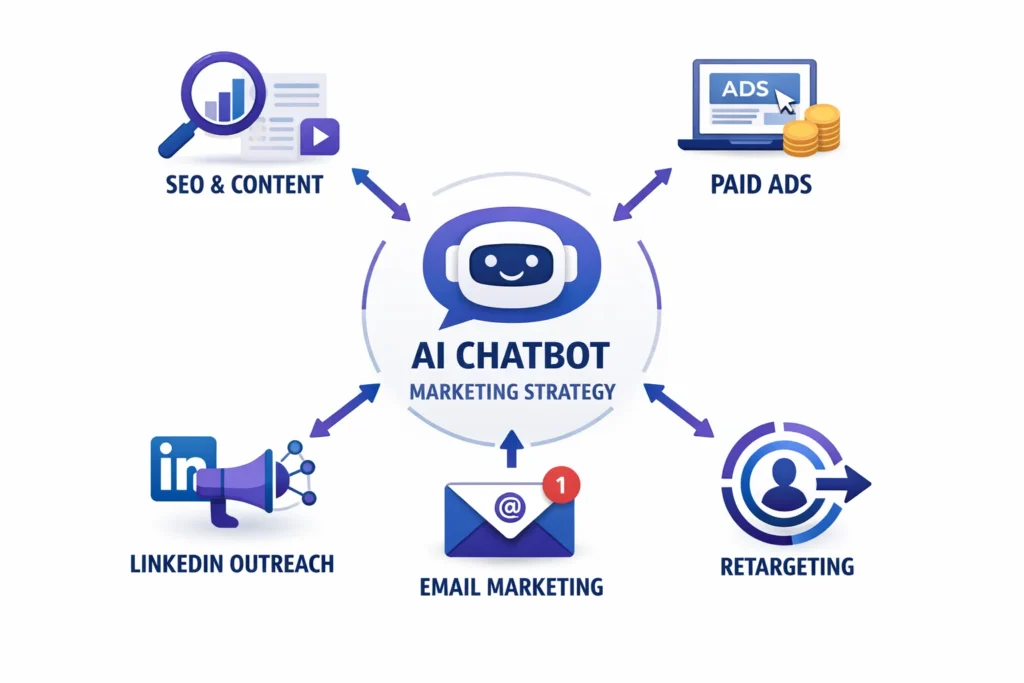
For B2B businesses, marketing an AI chatbot is not about running random campaigns and hoping for results. It requires a structured, multi-channel strategy that speaks directly to decision-makers, builds trust and drives measurable pipeline growth. Below is a breakdown of the core strategies a marketing team should execute.
1. Content & SEO Marketing
- Content and SEO these two are your long-term growth engine. It positions your chatbots as the go-to solution when decision-makers are actively searching for automation tools.
- Target high-intent keywords like “AI chatbot for B2B sales”, “customer support automation software” or “chatbot for lead generation” to attract buyers already in research mode.
- Create comparison and use-case content such as “TOP AI Chatbots For B2B Businesses in 2025” or “How AI Chatbots Reduce Support Costs by 40%” – these rank well and convert better than generic blogs.
- Publish ROI-driven case studies showing real numbers – leads generated, cost saved response time reduced.
- Build topic clusters around your niche so your website becomes an authority in the AI chatbot space, improving both rankings and credibility.
2) Paid Ads & Demand Generation
Paid ads accelerate what organic content builds slowly. For B2B chatbot marketing, precision targeting matters more than broad reach.
- Run Google Search Ads targeting bottom of funnel keywords where buyers are actively comparing solutions and ready to book a demo.
- Use LinkedIn Ads to target by job title, company size and industry – reaching CTOs operations heads and product managers who are the actual decision-makers.
- Launch retargeting campaigns for visitors who landed on your pricing or demo page but did not convert – these are your warmest leads.
- Promote gated assets like ROI calculators, chatbots audit templates or whitepapers through paid channels to capture high quality leads into your funnel.
3) Social Media & LinkedIn Outreach
For B2B chatbot marketing, LinkedIn is your most valuable social channel. It where your buyers spend their professional time.
- Post thought leadership content regularly – insights on AI trends, automation ROI, chatbot implementation tips to build authority and stay top of mind with your target audience.
- Run direct outreach campaigns where your team connects with ideal customer profiles, starts conversations and offers value before pitching not the other way around.
- Share client wins and product updates as short posts or carousels to build social proof and keep your audience engaged with real results.
- Engage in relevant LinkedIn groups and comment sections where your target buyers are already having conversations about automation and AI tools.
4) Email & Nurture Campaigns
Most B2B buyers do not convert on the first touchpoint. Email nurture keeps your chatbot top of mind through their entire decision-making journey.
- Segment your email list by industry, company size or buyer stage so every email feels relevant and personalised – not generic broadcast messaging.
- Build a lead nurture sequence that starts with education then moves to social proof and ends with a clear call to action like booking a demo or starting a free trial.
- Send behaviour triggered emails based on actions – if a lead visits your pricing page then send a case study. If they watch a demo video, follow up with a comparison guide.
- Run re-engagement campaigns for cold leads with a compelling hook – a new feature, a limited offer or a relevant industry stat that brings them back into the funnel.
Mistakes To Avoid While Marketing Your Chatbot
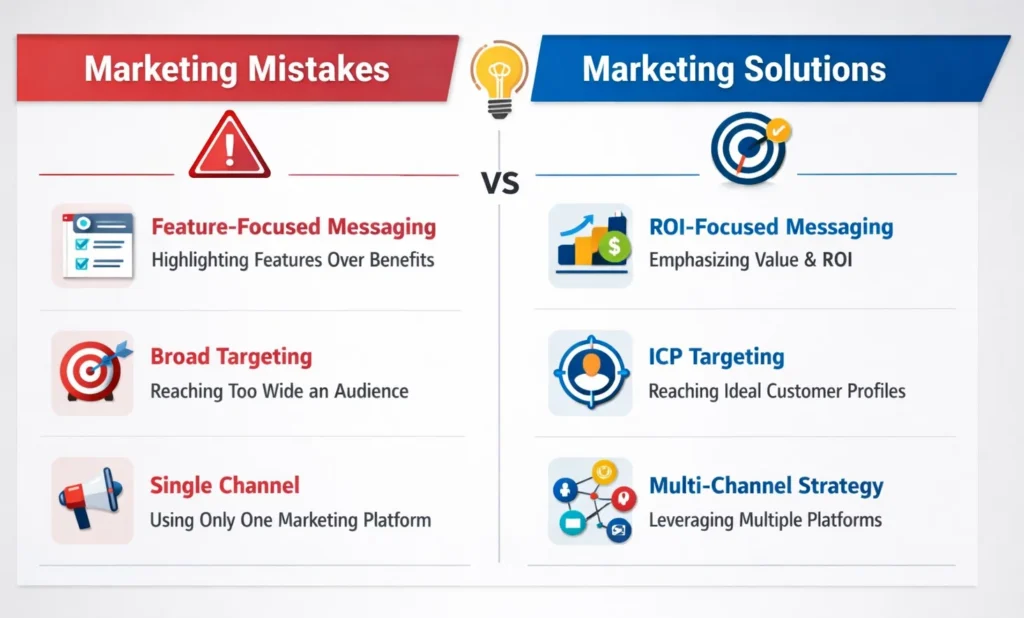
No matter how much advanced your AI chatbot is, It can fail if the marketing behind it is built on the wrong assumptions. Here are the five most common mistakes B2B Businesses and startups make and what to do instead.
1. Marketing Features Instead Of Outcomes
Talking about your chatbot’s NLP capabilities or integrations means nothing to a B2B buyer. What they actually care about is how many leads it generates, how much support cost it cuts and how fast it delivers ROI. Always lead with outcomes not features.
2. Targeting Everyone Instead Of The Right Decision Makers
Broad targeting wastes budget and attracts the wrong audience. If your chatbot is built for B2B then your market should be specifically focused on specific job titles, industries and company sizes – not generic audiences who will never convert.
3. Relying On A Single Marketing Channel
Betting everything on just SEO or just LinkedIn ads create a weak or fragile growth strategy. If that one channel dips, your entire pipeline dries up. A sustainable chatbot marketing strategy always runs multiple channels in parallel.
4. Skipping The Nurture Process
B2B buyers rarely convert on the first touchpoint. If your strategy ends at lead generation without a follow up nurture sequence – emails, retargeting, case studies – you are leaving the majority of your pipeline on the table.
5. Not Tracking The Right Metrics
Vanity metrics like impressions and followers do not generate or grow revenue. If your team is not tracking demo bookings, cost per qualified lead, conversion rates and pipeline value you are essentially scaling blind with no real direction.
What Does It Actually Cost To Have A Marketing Team?
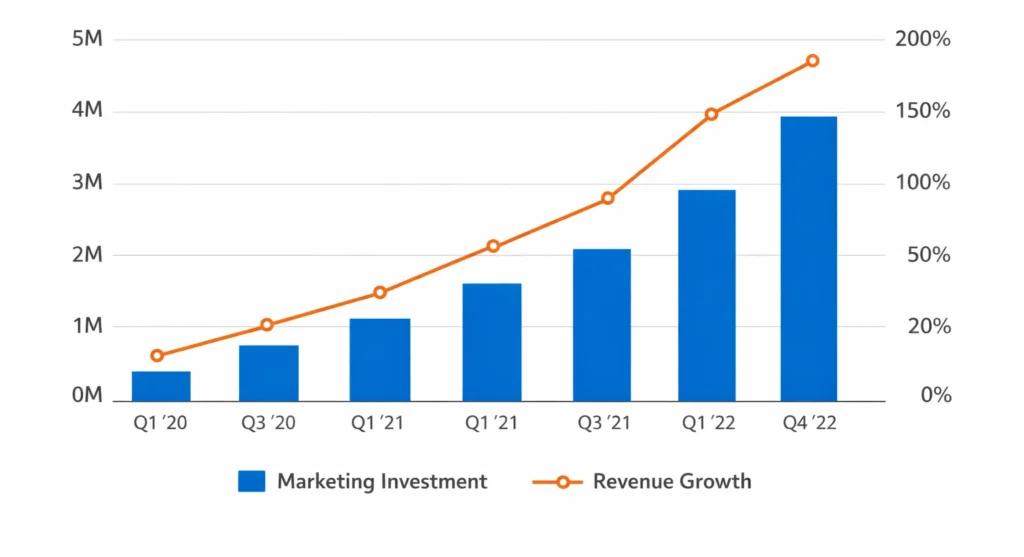
One of the most common questions B2B businesses ask before committing to a marketing strategy is simple — what will this actually cost us? The answer depends on the scope of work and the channels you are targeting also the resources involved in it. Here is a transparent and detailed breakdown of what you can expect when hiring a dedicated AI chatbot marketing team from SEO Circular.
Core Monthly Retainer
The foundational cost of having our full marketing team managing your chatbot’s growth — covering strategy, execution, content, campaigns and reporting — falls within a monthly range of $1,800 to $2,500. This covers your core team operations and is the base investment required to run a structured, multi-channel marketing strategy consistently.
Let’s have a look at the cost breakdown table in which you will get to know that how much SEO Circular will cost a startup while offering their marketing services and team.
Detailed Cost Breakdown Table
| Service | Cost | Timeline / Frequency |
| Core Marketing Team Retainer | $1,800 — $2,500 | Monthly |
| SEO Manager | $500 | Monthly (50 hours/month) |
| PR & Brand Visibility | $500 per resource | One-time yearly cost |
What Each Cost Covers
Core Marketing Team ($1,800 to $2,500/month) — This includes your full marketing operations — campaign management, content creation, paid ad execution, LinkedIn outreach, email nurture and performance reporting across all channels.
SEO Manager ($500/month) — Dedicated SEO management at 50 hours per month covering keyword research, on-page optimization, content planning, backlink strategy and monthly ranking reports to drive consistent organic growth.
PR & Brand Visibility ($500 per resource, One Time Yearly) — A one-time yearly investment per resource dedicated to public relations — securing media mentions, managing brand positioning, press outreach and building authority in the AI chatbot space.
Total Estimated Investment
| Plan | Monthly Cost | Yearly Cost |
| Core Team Only | $1,800 — $2,500 | $21,600 — $30,000 |
| Core Team + SEO Manager | $2,300 — $3,000 | $27,600 — $36,000 |
| Core Team + SEO + PR | $2,800 — $3,500 | $33,600 — $42,000 |
For B2B businesses serious about scaling their AI chatbot in a competitive market, this is not an expense — it is a revenue generating investment. The right marketing team pays for itself through qualified leads, demo bookings and closed deals.
Measuring The Success Of Your AI Chatbot Marketing Strategy
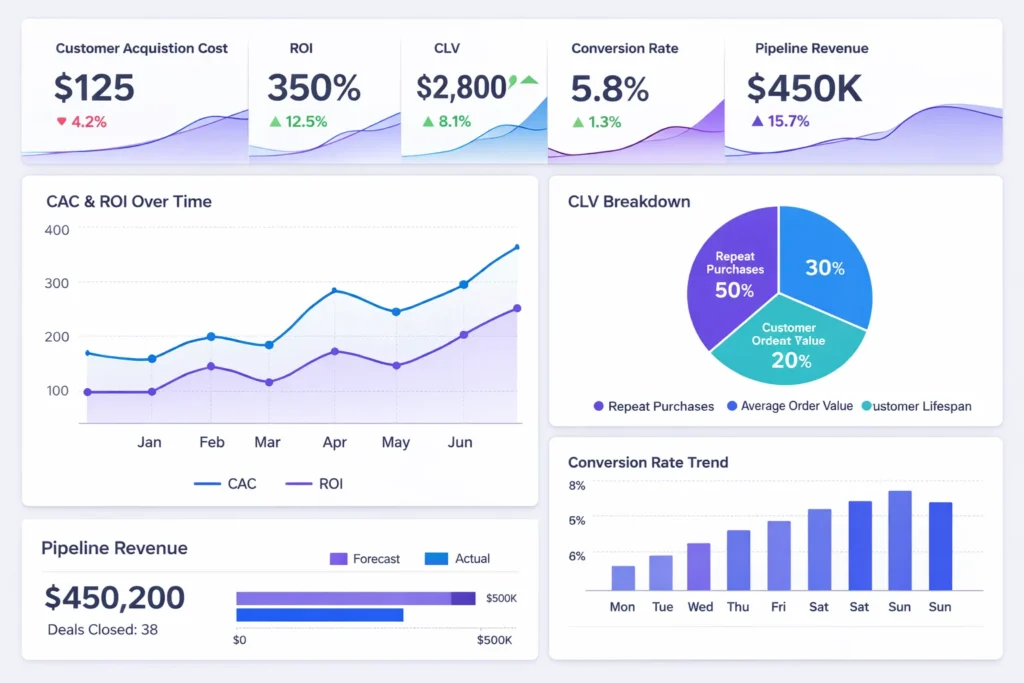
Spending on marketing without measuring the actual returns is like burning your overall budget with nothing to show for it. For B2B businesses, success is not measured in likes or impressions — it is measured in revenue, pipeline growth and return on every dollar spent. Here are the core ROI and revenue metrics your team must track consistently.
Customer Acquisition Cost
CAC tells you exactly how much you are spending to acquire one paying customer. Divide your total marketing spend by the number of new customers acquired in that period. If your CAC is higher than what a customer pays you, your strategy needs immediate restructuring.
Return On Investment
ROI is the most direct way to measure whether your marketing is working or not. Calculate it by subtracting your marketing investment from the revenue generated and dividing by the investment. A positive and growing ROI means your strategy is scaling profitably.
Pipeline Revenue Generated
Track the total value of deals that entered your sales pipeline directly as a result of your marketing efforts. This connects your marketing activity to actual business revenue and helps justify team and budget decisions.
Customer Lifetime Value (CLV)
CLV measures the total revenue a single customer brings over their entire relationship with your business. When your CLV is significantly higher than your CAC, it confirms that your marketing is attracting the right high-value customers worth investing in.
Revenue Per Channel
Not all marketing channels deliver equal returns. Tracking revenue generated per channel – SEO, paid ads, LinkedIn, email – tells you exactly where to increase investment and where to pull back making your overall spend far more efficient.
Tracking these metrics consistently gives marketing team a clear picture of what is working, what needs fixing and where the next phase of growth is coming from.
Future Trends In AI Chatbot Marketing
The AI chatbot space is evolving rapidly and the businesses that stay ahead of these shifts will have a significant edge over competitors still relying on outdated marketing approaches. Here are major trends shaping the future of AI chatbot marketing.
1. Hyper Personalisation At Scale
The next wave of chatbot marketing will move far beyond generic messaging. AI will enable marketing teams to deliver deeply personalised outreach tailored by industry, behaviour, buying stage and intent at a scale that was previously impossible without a massive team behind it.
2. Voice & Conversational Search Optimisation
As voice search and conversational AI continue to grow, chatbot marketing strategies will need to optimise for how buyers ask questions naturally not just type them. Businesses that adapt their SEO and content strategy for conversational search early will capture a significant share of organic traffic.
3. AI-Powered Performance Marketing
Paid advertising and demand generation will become increasingly automated and intelligent. From AI-driven ad copy testing to predictive audience targeting, marketing teams will rely more on machine learning to optimise campaigns in real time – reducing cost per lead while improving conversion rates.
Conclusion
Building a great AI chatbot is only half the battle. Without a structured marketing strategy behind it, even the most advanced chatbot will struggle to reach its potential audience and generate real revenue.
The businesses that win in this market are not just the ones with the best product — they are the ones that invest equally in marketing, positioning and the right team to execute it.
If you are ready to scale your AI chatbot the right way, the strategy starts here. Contact SEO Circular to scale your chatbot by having an efficient marketing strategy.
The chatbot market will not wait. Your strategy should not either.
Commonly Asked Questions: AI Chatbot Marketing Strategy
Most B2B businesses start seeing measurable results within 60 to 90 days of running a structured multi-channel strategy. Paid channels deliver faster results while SEO and content compounds over a longer period.
Basic marketing validation should begin early but heavy investment should wait until your chatbot solves a clear, proven problem for a defined audience. Marketing an unvalidated product accelerates burn without generating sustainable growth.
Case studies, ROI calculators and comparison guides consistently outperform generic blog content in B2B. Decision-makers need proof of results and clear differentiation before they commit to a demo or purchase.
Niche down your positioning, own a specific use case and build authority through hyper-targeted content and outreach. Trying to compete broadly against established players without a differentiated angle rarely works for new entrants.
Traditional influencer marketing has limited impact in B2B but partnering with industry thought leaders, analysts and niche community builders can significantly accelerate trust and visibility among your exact target audience.
To improve your brand’s visibility in AI search engines, you need to build answer-ready content, make your brand a clear entity, strengthen E-E-A-T signals across the whole web, deploy structured data, earn diverse media citations, and measure your AI visibility relentlessly. AI search rewards brands that are trusted and understood by machines — not just those that rank on Google.
Here’s the shift most marketers are only beginning to notice: your Google rankings no longer tell the full story of your brand’s presence. According to G2’s March 2026 survey of over 1,000 B2B decision-makers, 51% of buyers now start their research in an AI chatbot rather than Google — up from 29% a year earlier. ChatGPT reaches roughly 900 million weekly users, and Google’s AI Overviews appear on an expanding share of results. The rules of visibility have changed, and mastering this new landscape takes a different playbook than traditional SEO. Below are the nine strategies we’ve tested and validated across dozens of AI SEO campaigns.
Want to see where your brand stands in AI search today? Get a free audit before you invest.
Key Takeaways
- AI search is far more selective than Google: platforms recommend only ~1.2% of businesses on ChatGPT and 7.4% on Perplexity, vs 35.9% in Google’s local 3-pack (SOCi, 2026) — roughly 30x more selective.
- In traditional SEO you compete for a position; in AI search you compete for inclusion in a single generated answer.
- The three pillars of AI visibility: earned authority, entity clarity, and citation architecture.
- Being cited inside an AI Overview earns 35% higher CTR than a normal organic result — but overall clicks drop when an AI answer appears.
- Measure success with AI-specific KPIs (visibility score, share of voice, citation frequency), not just traffic.
Understanding AI Search: The New Landscape
An AI search engine processes a natural-language query and returns a synthesized, often cited answer rather than a ranked list of links. The major players — ChatGPT, Perplexity, Google AI Overviews, Gemini, and Copilot — each work slightly differently (Perplexity crawls the live web and cites sources; ChatGPT leans on training data plus live retrieval; AI Overviews use Google’s ranking infrastructure). But they share one behavior: they decide whether to mention your brand at all, and how prominently.
That’s what makes AI search fundamentally different. Bain & Company reports that brands failing to adapt risk losing 15–25% of their organic traffic and leads. And SOCi’s 2026 Local Visibility Index found AI platforms recommend just 1.2% of business locations on ChatGPT and 7.4% on Perplexity, versus 35.9% in Google’s local 3-pack — making AI search roughly 30 times more selective than traditional Google search.
What Are AI Ranking Factors?
AI ranking factors are the signals that influence whether an AI engine selects, cites, or recommends your brand. Where traditional SEO weighs keywords, backlinks, and domain authority, AI ranking factors weigh answer clarity, entity recognition, source authority, content extractability, and multi-platform presence. Cyrus Shepard’s May 2026 meta-analysis of 54 experiments identified 23 distinct AI citation factors, with search rank, content-format alignment, entity clarity, and citation frequency scoring highest.
We organize these into three pillars. Earned Authority is your traditional SEO strength, backlink profile, and trust signals. Entity Clarity is how clearly AI systems identify your brand as a distinct thing with specific products and expertise. Citation Architecture is the breadth and consistency of mentions you earn across independent, trusted sources. Brands that score well on all three appear in AI answers consistently.
The 9 Strategies
1. Build Answer-Ready, AI-Extractable Content
AI systems don’t read your content the way humans do — they scan, extract, and synthesize. If your answer is buried in the fourth paragraph, the AI may skip your page and pull from a competitor who leads with it. That’s the most common reason brands fail to get cited.
The fix: open every page with a 40–80 word direct answer, format for extraction (numbered lists, comparison tables, step-by-step guides, clear definitions), and keep each page to a single, well-defined topic. Format alignment matters — Zyppy’s scoring found content format matching query intent scored 8.9/10. Match the format to the query type (“best probiotics” wants a comparison; “how to build a birdhouse” wants steps). This one change has driven our largest citation gains; our guides to structuring content for LLM citation and SEO page content best practices go deeper on the mechanics.
2. Optimize for Entity Clarity and Knowledge Graph Presence
An entity is a thing with an identity — your brand, your flagship product, the problems you solve. Each has attributes and, ideally, a canonical identifier in Wikidata, the Google Knowledge Graph, or your own schema. Entity clarity is the bridge between traditional SEO (which targets keyword strings) and AI search (which targets meaning). If your entity signals are ambiguous, the AI struggles to connect you to a query like “best AI SEO agency.”
Execute it in three steps: keep NAP and brand description consistent across every touchpoint; implement comprehensive schema (Organization, Product, Service, FAQ, Person) with proper @id attributes; and earn references in authoritative sources like Wikipedia, Wikidata, and major publications. These reinforcing signals tell AI systems exactly who you are — the foundation of our LLM SEO work.
3. Strengthen E-E-A-T Signals Across Your Entire Digital Footprint
In AI search, E-E-A-T (Experience, Expertise, Authoritativeness, Trustworthiness) matters even more, because AI systems judge which sources to trust — and they evaluate your whole footprint, not just your site. When ChatGPT or Perplexity weighs whether to recommend you, it’s asking: do enough trusted, independent sources vouch for this company?
So the work goes beyond your website: named experts with visible LinkedIn and publication profiles, mentions and links from high-authority domains, and active, accurate profiles on review platforms. Author entities matter especially — in our testing, pages with clearly attributed expert authors earned 40% more AI citations than anonymous or brand-only content. Put real people behind your content, and make them findable.
4. Implement Strategic Structured Data Markup for GEO
In the AI era, structured data becomes a direct pathway to citation: it helps engines understand your identity, authority, and content structure so they can extract and cite you accurately. Google’s own generative-AI guidance notes structured data isn’t strictly required for AI features but recommends it as part of your strategy.
We deploy Organization schema with detailed attributes, Product/Service schemas with clear identifiers, FAQ schemas mirroring the questions users actually ask AI, and HowTo schemas for procedures. Two rules: markup must stay accurate and consistent with visible page content (AI cross-references the two, and discrepancies hurt), and it should be audited quarterly against current schema.org specs.
5. Execute Digital PR and Earned Media Campaigns
Earned media is one of the most powerful levers for AI citation. When reputable publications mention or quote your brand, those become signals AI systems use to judge authority. We’ve watched clients with strong SEO but weak press get passed over in AI answers, while competitors with stronger coverage get cited regularly.
Our digital PR focuses on Tier 1 publications, expert contributed articles, and independent review/comparison coverage (heavily weighted for product recommendations), plus podcasts and industry reports. The metric that matters isn’t raw mentions — it’s citation density across independent domains. An AI engine trusts a brand cited by ten different sources far more than one cited ten times by the same source.
6. Conduct Regular AI Search Visibility Audits
You can’t optimize what you can’t measure. An AI search visibility audit assesses where your brand appears across AI platforms, how often, how accurately, and from which sources. Our process: define scope (which platforms and branded/unbranded queries), benchmark current visibility, check accuracy and sentiment for hallucinations or outdated framing, test unbranded topic-level queries, identify which pages AI is citing, and compare against three to five competitors.
The output is a report with an AI visibility score, share-of-voice metrics, competitive benchmarking, content-gap analysis, and a prioritized action plan — the diagnostic foundation for everything else. You can start with a technical audit to see what’s holding your site back first.
7. Track and Improve Your AI Search Visibility Score
Your AI search visibility score is a 0–100 metric for how frequently and prominently your brand is cited across AI engines for your target queries. Tools from Semrush, Profound, and SE Ranking calculate it by tracking mentions across ChatGPT, Perplexity, AI Overviews, and Gemini. A 0 means you never appear; 50 means half of relevant answers; 80+ means you dominate your niche. Most brands we first audit score below 10.
The fastest quick win is usually fixing AI hallucinations — correcting how a platform describes your brand (via updated content, structured data, and third-party sources) can lift the score within 30–60 days. Longer term, content quality, authority, and digital PR compound. See our deeper playbook on growing AI search visibility.
8. Build a Multi-Platform Citation Architecture
Each AI engine has its own retrieval logic — Perplexity favors recent, well-sourced content; ChatGPT leans on training data plus live results; AI Overviews use Google’s quality signals — so a brand visible on one may be invisible on another. The answer is a multi-platform citation architecture: consistent, accurate, well-structured brand information everywhere AI might discover it (site, socials, directories, press, reviews, Knowledge Panel, Wikidata).
Pay attention to which domains each platform cites most. Conductor’s 7-month analysis found AI engines cite sources that resemble the sources they already trust — so mentions on Wikipedia, major news, and established industry publications give you an outsized advantage. Prioritize those high-value targets in outreach.
9. Prepare for 2027 with Agentic and Multimodal Optimization
Gartner predicts traditional search volume will drop 25% by 2026, accelerating into 2027, as AI agents absorb query volume. Three trends will define the 2027 ranking factors: agentic AI, multimodal search, and a “winner-take-more” dynamic.
Agentic AI acts on behalf of users — an agent that doesn’t just recommend your product but initiates a purchase or books a service. That means your product data, pricing, availability, and booking systems must be structured for agents to parse and act on. Multimodal search (image, voice, video plus text) means your brand signals must stay consistent and recognizable across every format. The brands that win will treat their entire online presence as an AI-readable knowledge base.
Limitations and Honest Caveats
A few things to be transparent about. First, this field evolves fast; platforms change their retrieval algorithms, so these strategies (best evidence as of mid-2026) need continuous adaptation. Second, AI visibility doesn’t translate to traffic the way rankings do — organic CTR has dropped 61% for queries where an AI Overview appears, though being cited inside that Overview earns 35% higher CTR than a normal result. Measure with AI-specific KPIs, not just traffic. Third, don’t over-optimize into robotic, formulaic pages; the best content for AI is also the best for humans — clear, direct, and genuinely useful. Finally, measurement tools are still maturing, so focus on directional trends across multiple tools rather than absolute precision.
Conclusion
The shift to AI search is happening now: 51% of B2B buyers start in AI chatbots, CTR is declining on AI-Overview queries, and AI platforms are ~30x more selective than Google about which brands they recommend. These nine strategies — answer-ready content, entity clarity, E-E-A-T amplification, structured data, digital PR, visibility audits, score tracking, multi-platform citation architecture, and agentic/multimodal readiness — work as one integrated system. No single tactic is enough; together they build durable presence across ChatGPT, Perplexity, AI Overviews, Gemini, and whatever comes next.
The question isn’t whether AI search becomes the dominant discovery channel — it’s whether your brand will be visible when it does. Ready to start? Explore our AI SEO services or see the results we’ve delivered.
Frequently Asked Questions
What is AI search visibility?
AI search visibility is how often and how prominently your brand is mentioned, cited, or recommended by AI answer engines like ChatGPT, Perplexity, Google AI Overviews, and Gemini for relevant queries. It’s measured with an AI visibility score (0–100) rather than keyword rankings.
How is optimizing for AI search different from traditional SEO?
Traditional SEO competes for a position on a results page; AI search competes for inclusion in a single generated answer. It weighs answer clarity, entity recognition, source authority, and multi-platform citations more than keywords and page speed alone.
How do I get my brand cited by ChatGPT and Perplexity?
Lead pages with a direct 40–80 word answer, make your brand a clear entity with consistent data and schema, build named-expert E-E-A-T, and earn mentions across many independent, trusted domains. No technique guarantees a citation, but structured, authoritative content materially improves the odds.
References
- G2 (2026) — B2B Buyer Behavior Survey, March 2026 (1,076 decision-makers).
- SOCi (2026) — 2026 Local Visibility Index (AI recommendation rates).
- Bain & Company (2025) — AI Search Readiness Report.
- Cyrus Shepard / Zyppy (2026) — AI Citation Ranking Factors (54-study meta-analysis).
- Conductor (2026) — How AI Citations Differ: A 7-Month Analysis.
- Gartner (2025) — Predicts 25% Drop in Traditional Search Volume by 2026.
- Google (2025) — Guide to Optimizing for Generative AI Features.
What if your local businesses could out-market national giants without a massive budget or a large team? What if you could understand customers faster, create better content, and launch smarter campaigns, all with less effort?
Small businesses using AI see up to 78% higher marketing efficiency because AI automates time-consuming tasks. AI personalization can boost conversions by 20–30%, while AI-powered ad tools help reduce wasted ad spend by up to 40%. Chatbots now handle 70% of customer queries instantly, improving service without extra staff. Overall, businesses using AI insights grow 2X faster, and 63% of small businesses say AI helps them compete directly with big brands.
Today, that’s possible thanks to AI for local businesses.
AI is not just a toy for big brands anymore. Businesses are also using AI search visibility strategies to increase online reach and customer acquisition. It’s a viable, cost-effective advantage for all companies. If you embrace the correct way, AI-powered marketing techniques will allow you to customize communication, forecast client trends, and even perfect the entire marketing process.
This blog explores how you can use AI for small business growth to strengthen your brand, win more customers, and out-market the giants in your industry without needing a huge budget or a large marketing team.
Key Takeaways
- AI helps local businesses compete with big brands by improving targeting, personalization, and speed.
- AI tools make small business digital marketing more efficient with automation and data-driven decisions.
- Local businesses can use AI for content creation, ads, customer insights, and chatbots without big budgets.
- AI-driven marketing strategies provide better accuracy than traditional marketing.
- Starting small with AI and scaling gradually helps small businesses grow faster and smarter.
Why AI Levels the Playing Field for Local Businesses?
AI levels the playing field because it gives local businesses powerful tools that used to be available only to big brands. With AI for small business growth, you can understand your customers better, save time on everyday marketing tasks, and create messages that fit each audience.
AI simplifies the digital marketing of small businesses by making their advertisements, content, and customer outreach better. This means that you can still go fast and get the right people without a huge team or money. In a saturated market, AI is the remedy that your small business needs to challenge larger competitors.
Key AI Marketing Tools Local Businesses Can Start Using Today
Local companies don’t need big budgets to benefit from modern marketing technology. Today, AI for local businesses makes it easier to automate tasks, improve targeting, and connect with customers at scale.
Below are practical tools you can start using right away to strengthen your marketing and stay competitive:
AI Content Creation Tools
AI content tools help AI for local businesses by quickly producing emails, social posts, and ads. They save time, keep your message consistent, especially when following modern content optimization best practices, and support small business digital marketing without needing a full marketing team.
AI Customer Insight Platforms
These tools use artificial intelligence for small businesses to reveal customer behaviour, top products, and local trends. With better insights, you can make smarter decisions and support AI for small business growth with data-backed marketing.
AI Ad Optimization Tools
Ad platforms powered by artificial intelligence enhance targeting, control budgets automatically, and at the same time increase sales. Customers are found quickly through the use of AI, which not only makes the marketing strategies even more effective but also more cost-effective for small groups of people.
AI Chatbots for Customer Service
Chatbots help local companies respond instantly to questions, similar to how businesses use AI therapist platforms and AI assistants to improve engagement, book appointments, and guide buyers. They boost customer experience and help you stay competitive, especially when competing with big brands using AI that offer 24/7 support.
AI Reputation Management Tools
These tools track reviews, customer comments, and online ratings. They help local businesses maintain a strong reputation, respond quickly to feedback, and strengthen trust in crowded markets.
AI Marketing Automation Platforms
Automation tools streamline follow-ups, email campaigns, and lead nurturing. They make small business digital marketing more effective by running tasks in the background, giving you more time to focus on growth and strategy.
How Local Businesses Can Use AI to Out-Market Big Brands?
Local businesses can compete with big brands using AI. Artificial intelligence enables small teams to act faster, personalize marketing, leverage data, and focus on agility and local customer connections.
Use AI to Personalize Every Message
Local companies can use AI to create highly personalized messages. This helps you connect faster with customers and build trust, something big brands often struggle to do on a local scale.
Target the Right Customer More Accurately
With artificial intelligence for small businesses, you can identify high-value audiences and target them precisely. This focus helps you spend less, reach better leads, and improve overall performance in small business digital marketing.
Respond Faster With AI Automation
AI automations let you respond quickly to customer questions, leads, and reviews. This speed helps when competing with big brands using AI, because your business can act faster and feel more personal.
Create Strong Local Content With AI Tools
AI content platforms help you produce blogs, ads, and social posts while supporting programmatic SEO for enterprise brands and local businesses alike. These tools support AI-driven marketing strategies and help you stay visible in your community.
Use AI Insights to Improve Local Offers
AI tools reveal buying trends and customer needs. This supports AI for small business growth, helping you create offers that match what your local audience wants more accurately than national brands.
Run Smarter Ads With AI Optimization
AI-powered ad systems adjust budgets, test variations, and target ideal customers. This gives you an edge when competing with big brands using AI, because your campaigns stay efficient and adaptable.
Strengthen Customer Loyalty With AI Tools
With AI, you can track customer behavior and create loyalty programs that feel more personal. This helps you keep customers longer and grow repeat business.
Automate Routine Marketing Tasks
AI platforms handle follow-ups, emails, and scheduling. This frees your team to focus on strategy and big-picture planning. It also supports digital marketing without stretching your resources.
How to Start: Practical AI Implementation Roadmap
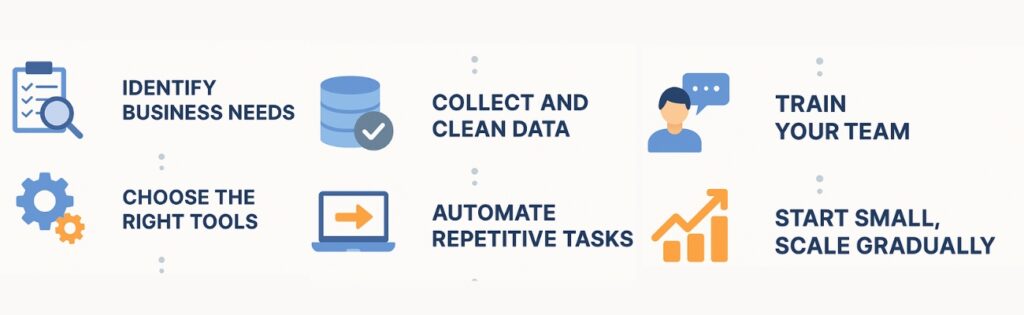
Getting started with AI may seem overwhelming, but with the right approach, local businesses can implement it effectively. Follow this roadmap to unlock AI’s potential and out-market larger competitors. Here are the steps to get started:
Identify Business Needs
Begin by identifying key business challenges where AI can deliver value, whether in marketing, customer insights, or personalized experiences. This helps focus AI efforts on solving specific problems and improving efficiency.
Choose the Right Tools
Pick AI tools that align with your business goals. Ensure the solutions are easy to use, integrate seamlessly with your systems, and offer scalability to grow alongside your business needs.
Collect and Clean Data
AI depends on quality data. Collect relevant data from sales, customer interactions, and marketing activities, then clean and organize it to ensure accuracy for effective analysis and decision-making.
Automate Repetitive Tasks
Use AI to automate repetitive tasks like email marketing, customer support, or inventory management. This saves time, increases productivity, and allows your team to focus on more strategic initiatives.
Train Your Team
Invest in training your team to use AI tools effectively. Ensure they understand how AI can support their roles and empower them with the skills to maximize its potential for business growth.
Start Small, Scale Gradually
Start with small AI pilot projects in areas like social media or customer service. Track results, optimize, and scale your AI applications across other business functions as you gain insights and confidence.
Common Myths About AI in Small Business Marketing
Several misconceptions about AI may prevent small businesses from adopting it. Here are some common myths debunked to help you better understand AI’s potential in marketing:
AI is only for Big Companies
AI isn’t exclusive to large enterprises. Small businesses can use affordable, accessible AI tools to automate tasks, enhance customer experiences, and stay competitive against large competitors.
AI Requires Technical Expertise
You don’t need to be a tech expert to use AI. Many AI tools are user-friendly, designed for non-technical users, and can easily integrate with your existing systems and processes.
AI Replaces Human Workers
AI doesn’t replace people. It enhances their work. It automates repetitive tasks, freeing up your team to focus on strategic decisions, creative initiatives, and building stronger customer relationships.
AI Tools are Expensive
AI solutions have become more affordable and scalable. Small businesses can find budget-friendly options that deliver significant value, helping to streamline operations, improve marketing efforts, and increase ROI.
AI Can’t Understand Small Business Needs
AI tools can be optimized to fit your business needs. With flexible solutions, AI can help you solve unique challenges, whether it’s improving customer service, generating insights, or optimizing marketing strategies.
AI Doesn’t Provide Tangible Results
AI offers measurable results, from better customer targeting to increased sales. By analyzing data and tracking key metrics, AI helps you refine strategies, improve engagement, and drive real growth for your business.
Real Examples
| Local Business Type | AI Used | What They Did | Result Achieved |
|---|---|---|---|
| Local Salon | AI Appointment Chatbot | Automated bookings, reminders, FAQs | 30% increase in monthly appointments and fewer missed calls |
| Small Café | AI Ad Optimization | Ran targeted local ads on a small budget | 2.1X increase in foot traffic within 45 days |
| Retail Clothing Store | AI Customer Insight Tool | Analyzed buying patterns to refine offers | 25% boost in repeat customers in 3 months |
| Local Gym | AI Content Generator | Produced daily social posts + email newsletters | 10 hours/week saved and 40% more engagement |
| Home Services Business (plumber, electrician) | AI Review & Reputation Management | Automated review replies and tracked ratings | Improved Google rating from 3.9 → 4.6 in 8 weeks |
| Real Estate Agent | AI Lead Scoring + Automation | Prioritized high-value leads with predictive AI | 35% increase in qualified leads and faster responses |
| Boutique Shop | AI Product Recommendation Tool | Suggested products based on customer behaviour | 18% increase in average order value |
Future of AI for Local Businesses
The future of AI for local businesses holds immense potential to level the playing field with larger competitors. As AI technology continues to evolve, small businesses can harness powerful tools for personalized marketing, customer service, and operational efficiency—at a fraction of the cost of traditional methods.
By leveraging AI-driven insights, local businesses can better understand customer preferences, predict trends, and deliver hyper-targeted ads or tailored recommendations. AI-powered chatbots, for instance, can offer 24/7 customer support while supporting broader AI SEO growth strategies, allowing local businesses to provide the kind of personalized experience that larger companies may struggle to match.
Additionally, AI can streamline administrative tasks like inventory management and pricing optimization, helping businesses improve their bottom line without adding extra overhead. By adopting AI solutions now, local businesses have an unprecedented opportunity to not only compete with but out-market the giants by offering more relevant, timely, and personalized experiences to their customers.
AI for Small Businesses: Compete with Big Brands
Looking to help your local business compete with national giants without breaking the bank?
Our latest blog dives into the power of AI for local businesses, showing how small companies can leverage artificial intelligence to drive growth, improve customer engagement, and out-market larger competitors.
From AI content creation tools that produce high-quality blogs, emails, and social posts, to AI-powered ad optimization platforms that target the right audience and maximize ROI, this guide covers practical solutions that fit any small business budget.
Learn how AI customer insight platforms reveal buying trends and local preferences, while chatbots and automation tools streamline customer service and routine marketing tasks. The blog also breaks down a step-by-step roadmap for implementing AI, from identifying business needs and choosing the right tools to training your team and scaling gradually.
Say goodbye to outdated traditional marketing and discover how AI-driven strategies can help your business save time, make smarter decisions, and build stronger customer loyalty in today’s competitive market.
Before investing in new AI marketing tools, businesses can use an SEO Cost Calculator to estimate the budget needed for sustainable online growth.
Conclusion
AI offers local businesses a powerful, cost-effective way to compete with larger brands. By leveraging AI-driven tools for personalized marketing, smarter ad targeting, and improved customer experiences, small businesses can operate more efficiently and make data-backed decisions.
AI helps automate tasks, optimize campaigns, and build customer loyalty, all without the need for a large team or a big budget. With the right tools and strategy, small businesses can out-market larger competitors, offering tailored, agile solutions that foster growth and success. Now is the perfect time to embrace AI and unlock its potential for your business.
Faqs
AI gives small businesses access to advanced tools—like automated marketing, customer insights, and personalized messaging—that used to be available only to large companies. With AI for local businesses, you can understand customers faster, improve targeting, and run smarter campaigns that help you compete with big brands using AI.
No. Many AI tools today are affordable and even offer free plans. Small businesses can start with cost-effective AI-driven marketing strategies such as automated email tools, chatbots, or AI ad optimization without stretching their budget.
AI vs traditional marketing is about speed, accuracy, and personalization. Traditional marketing relies on guesswork, while AI uses real data to target the right customers, predict behaviour, reduce costs, and improve ROI.
AI strengthens small business digital marketing by helping you:
Generate content faster
Run smarter ad campaigns
Personalize every message
Gain insights into customer behaviour
Automate follow-ups and customer service
These tools help you create effective campaigns even with a small team.
No. AI supports your team by handling repetitive tasks. Your team can then focus on creativity, strategy, and customer engagement—areas where humans outperform machines.