
You just closed your seed round. The pressure to grow is real. Someone on your team or an agency that slid into your inbox – is telling you that SEO is a long-term play and you need to start now. So, you budget $5,000 maybe $10,000 a month for content, backlinks and technical audits.
It feels responsible. Strategic and even.
But it’s probably a mistake.
Most early-stage AI startups spend heavily on SEO before they have nailed product market fit. Founders pour runway into keywords strategies and content calendars while their core product is still finding its footing. The result is months of spend, a spike in traffic that does not convert and a marketing channel that looks busy but delivers nothing meaningful to growth.
The data supports this. According to FirstPageSage, the average B2B SaaS company takes 9 to 18 months to see meaningful organic ROI from SEO. For an AI startup burning cash in its first 12 to 24 months and that timeline is not a strategy – it is a liability.
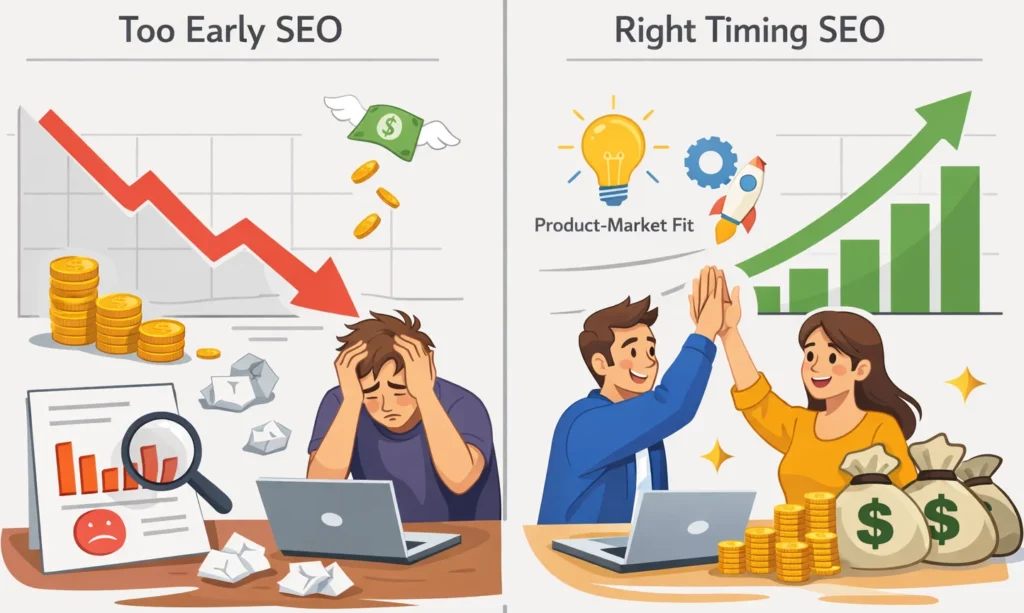
This does not mean SEO is irrelevant for AI startups. It means timing and allocation are everything. This blog breaks down exactly how much you should spend on SEO at the early stage, what you should get for that spend and the signals that tell you when it is time to scale up.
Key Takeaways
- Don’t spend heavily on SEO before product-market fit — it drains runway without delivering meaningful results.
- SEO pricing varies by model — from $50/hour for consulting to $20,000+ per month for enterprise campaigns.
- An in-house local SEO team costs $3,600 to $4,400 per month in salaries alone — add tools and training and the real cost is closer to $5,000 to $6,000 monthly.
- SEO ROI takes at least 6 months to materialize — at 12 months expect 2.6x and at 18 months expect 3.8x on average.
- Timing is everything — SEO is not a question of if, but when. Match your spend to your stage and scale only when your organic channel proves it can convert.
Build SEO That Drives Revenue — Not Just Traffic
Traffic without conversions is just noise. What your startup needs is a structured SEO approach tied to real business outcomes. At SEO Circular, we focus on what matters — growth, conversions, and long-term scalability. Ready to turn SEO into a growth engine?
👉 Get started with a custom SEO roadmap.
How Much Does SEO Costs For AI Startups And Businesses?
The cost of SEO has continuously changed over the years. Various factors affect the overall expense of SEO services regarding specific tasks. If we talk about the SEO pricing in 2025 then it usually comes between $1,000 to $1,500 per month along with some enterprise campaigns exceeding $10,000.
In 2026, the cost for AI startups and businesses should be between $2,000 to $2,500 per month for foundational SEO.
On the other hand, PR and authority building is also one of the crucial step for brand awareness and authority building. Businesses and startups should not ignore this important step. The cost of PR and authority building should be around $5,000 per year. If an AI startup or a business invests around $5,000 based on a year including tasks like PR, media mentions and brand positioning then it can help the business to create a strong credibility and visibility layer. This is really an important step for AI startups because users and investors both look for trust signals before engaging with new platforms.
So, if we explain this in simple terms then the cost for an early-stage startup must look like:
SEO: $2,000 – $2,500 (Monthly)
PR & Authority Building: $5,000 (Yearly)
This blend helps in forming both Higher visibility and authority at the same time.
Also we should keep in mind that this cost is not just a specific set of random numbers. They are actually based on what it will actually take in order to stand out in a kind of market where AI tools are launching every single year.
Many startups at first prefer investing less but they don’t know one major thing is that less investment can often lead to incomplete execution and will unlikely or rarely produce results.
At the same time, spending more without any kind of strategy will not help either. Our main objective is not to spend more but to spend in the right channels with a good strategy and a proper structure.
What affects the cost of SEO?
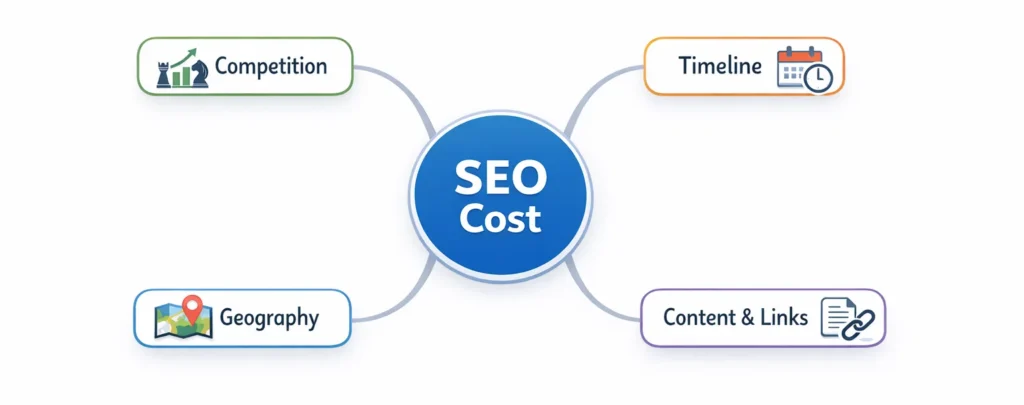
Usually, the cost of SEO ultimately depends on many factors including:
Industry And Keyword Competition
As the competition in any industry is increasing day by day, the need to have more efforts and resources in order to have higher ranking is also getting stronger. The more the competition is, the more you will have to put in the work to stand out in the industry. A space where the competition usually requires a larger scope including more aggressive content creation, extensive link building campaigns and deeper technical analysis. The scope directly affects the hours needed which in turn influences the price.
Time Span And Expertise
SEO strategy and execution take time but the desired speed can shift the overall cost. A more combative timeline demands more resources on time. An SEO team which is experienced with a proven track record in specific areas like advanced AI SEO will demand or need a higher rate than a generalist or a newcomer.
Geographic Targeting
Geo-targeting is essential in SEO because it matches the content of the website with the specific needs and preferences of the target audience. Geographical targeting majorly impacts SEO cost with Localized campaigns usually being cheaper and more efficient than national or international efforts due to lower competition. Cost increase with the number of target locations and the intensity of competition often ranging from $250 to $3,000 along with local services. While broader campaigns require higher more sustained investment.
Content Creation & Link Building:
When it comes to generating high quality content and obtaining high quality backlinks (often $100+per link) majorly raises the overall cost.
SEO Pricing Models For Startups Explained
Learning how SEO is priced is just as knowing how to spend. There is no single, universal pricing structure – agencies, consultants and freelancers use different models depending on the scope of work and your business needs. Here is a breakdown of the four main models and how much each one costs in 2026.
1. Monthly Retainer :
The monthly retainer is by far the most common SEO pricing model. You pay a fixed fee each month for an agreed upon set of services and the work compounds over time. This typically covers on page optimization content creation, link building, technical audits and monthly reporting.
Cost range in 2026
Most businesses in the USA pay between $1,500 and $5,000 per month with the national average for agency retainers sitting around $3,500 to $4,500 per month.
Best for
AI startups that have confirmed product market fit and are ready to invest in long term organic growth.
Watch Out For
Most agencies require a minimum commitment of 6 to 12 months often with 30-to-60-day exit clauses after the initial term. Do not sign a long retainer before your product and messaging are stable.
2. Project based Pricing :
Projects based pricing works best for businesses with well defined goals and a need for specialized, short term SEO services. Common projects include website audits site migrations content strategy build outs and penalty recovery.
Cost Range in 2026 :
Project based SEO typically costs between $5,000 and $30,000 for enterprise specific deliverables.
Best For
Early stage AI startups that need a one time technical audit or an initial SEO foundation before committing to an ongoing spend.
Watch Out For
Project based work delivers a snapshot in time. SEO is not a one-time fix, so use this model to establish a baseline not as a substitute for a long-term strategy.
Hourly Consulting
Hourly SEO services are ideal for businesses needing specific, limited tasks such as audits, consultation or training. This model is commonly used by startups within house marketing teams that need periodic expert guidance rather that full Service management.
Cost Range in 2026
Hourly SEO rates typically fall between $50 and $100 per hour globally with senior consultants in competitive markets charging $100 to $300 per hour.
Best for
Pre-revenue or early-stage AI startups that need strategic direction without committing to a full retainer.
Watch Out For
If a project becomes more complex, it is difficult to predict how many hours will be needed which can add up quickly. Always make sure to set up a cap on hours before engagement begins.
Performance-Based Pricing
Performance based SEO ties payment to measurable results such as keyword rankings, organic traffic growth or leads generated. It sounds attractive on paper but it comes with significant risks.
Cost Range In 2026
Costs vary widely depending on the agreed KPIs and outcomes. Hybrid models with a base retainer and performance bonuses are gaining traction as a more balanced alternative to pure pay for performance arrangements.
Best For
Startups with a stable, converting website that want to align agency incentives with business outcomes.
Watch Out For
Performance based pricing is the least popular model in SEO. Because SEO is a long-term game with considerable nuance, pay for performance is often incompatible with real business goals. Agencies my chase easy low intent keywords just to hit metrics. If an agency promises guaranteed page one rankings with no base fee, treat it is as a red flag.
Quick Comparison Table
| Model | Cost Range (2026) | Best For |
| Monthly Retainer | $1,500 – $5,000/month | Ongoing growth post product-market fit |
| Project-Based | $500 | One-time audits or SEO foundation setup |
| Hourly Consulting | $40 – $90/hour | Early-stage guidance with in-house teams |
| Performance-Based | Varies (hybrid recommended) | Conversion-ready sites with clear KPIs |
Benefits Of Setting Up An In-House SEO team
Sometimes managing SEO tasks altogether at once can become challenging. That’s where we need an experienced In-house SEO team who can help AI startups and businesses scale their SEO journey.
Let’s have a detailed analysis on the advantages of having an In-House SEO team.
Complete Control Over Strategy
An in-house team ensures that every decision aligns with your branding, mission, organizational goals and stakeholder opinions. When your SEO team sits inside your company, there are no approval delays, no miscommunication and no waiting faor your agency’s next scheduled call. You set the priorities and your team executes them directly.
Faster Collaboration Across Teams
Internal teams benefit from proximity. An Internal marketing team can collaborate closely with web development, product sales and leadership without formal handovers. Decisions happen faster, feedback loops are shorter and marketing managers do not need to translates context for external partners. For an AI startup where speed matters, this alone can be a significant competitive advantage.
Deeper Brand And Product Knowledge
Internal teams win on nuance and institutional insight especially for industries with technical or regulated content. AI products are complex. An in-house SEO professional will understand your audience, your use case and your competitive positioning far better than any agency that manages dozens of clients simultaneously.
Long-Term Institutional Knowledge
In-house management allows for complete control over brand voice , SEO strategy and marketing processes. For organizations focused on consistency rather rapid experimentation, this approach reduces reliance on external partners and builds institutional knowledge over time. Every campaign, every test and every insight stays within your organization- compounding in value as your startup scales.
What Does it Actually Cost to have an In-House local SEO Team?
Having an In-house SEO team is a recurring monthly commitment not a one time investment. Once your team is in place, you need a clear image of what it costs to keep them running effectively every single month. Here is a realistic role by role breakdown based on current market data.
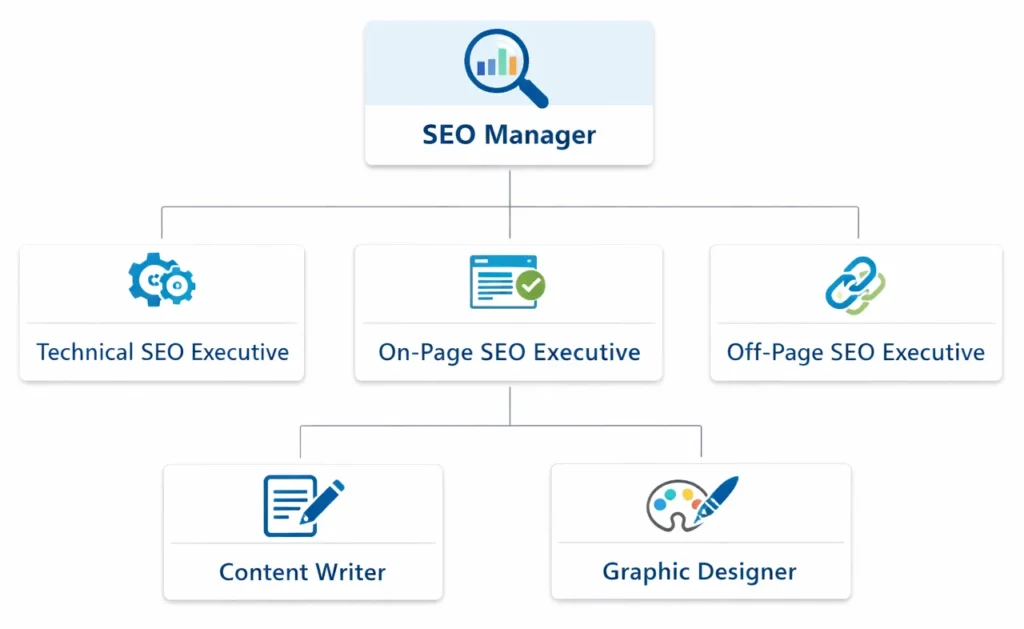
The Core Team Roles & Monthly Costs
1. SEO Manager
The SEO manager leads the entire SEO operation – owning the strategy, managing the team, reporting on performance and aligning SEO efforts with your broader business goals.
Monthly Costs – $1,200
2. SEO Executives
SEO executives are the hands-on operators of your team. Each executive typically owns a specific function including
1) One focused on technical SEO,
2) One on On-page optimization
3) one on off-page and link building
Ensuring all pillars of SEO are covered Simultaneously.
Monthly Cost – $1,200 – $1,800
3. Content Writer
A dedicated content writer produces the local landing page, blog posts and location specific content that drives organic visibility in your target market. Without consistent output, your SEO strategy stalls.
Monthly cost: $600 – $800
4. Graphic Designer
A graphic designer supports the team with blog visuals, infographics and landing page assets. Strong visuals improve user engagement, reduce bounce rates and increase the shareability of your content – all of which indirectly support SEO performance.
Monthly cost – $600
Total Monthly Cost of Maintaining Your In-House SEO Team
| Role | Monthly Cost |
| SEO Manager | $1,200 |
| SEO Executives (×3) | $1,200 – $1,800 |
| Content Writer | $600 – $800 |
| Graphic Designer | $600 |
| Total | $3,600 – $4,400/month |
What this does not include
These figures only cover salaries. Managing an effective in-house SEO team comes with additional monthly expenses that are easy to overlook. They include:
SEO Tools
Platforms like Ahrefs, SEMrush and Screaming Frog are non- negotiable for a functioning SEO team and can add $500 to $1,500 per month
Content tools
Tools like Surfer SEO, Grammarly or Jasper for content optimization carry their own recurring costs
Management Time:
The hours your leadership spends reviewing work, aligning strategy and conducting performance reviews represents a real and ongoing opportunity cost
Hiring & Training Costs
When team members leave or new tools emerge, recruitment and upskilling add expenses that recur unpredictably throught the year
When these additional costs are factored in, maintaining a fully operational in-house local SEO team realistically costs closer to $5,000 to $6,000 per month in total.
How to Measure SEO ROI for Your AI Startup
Without a clear ROI framework, SEO is impossible to justify or to scale. Here is what you actually need to know in order to measure the ROI
The Core Formula
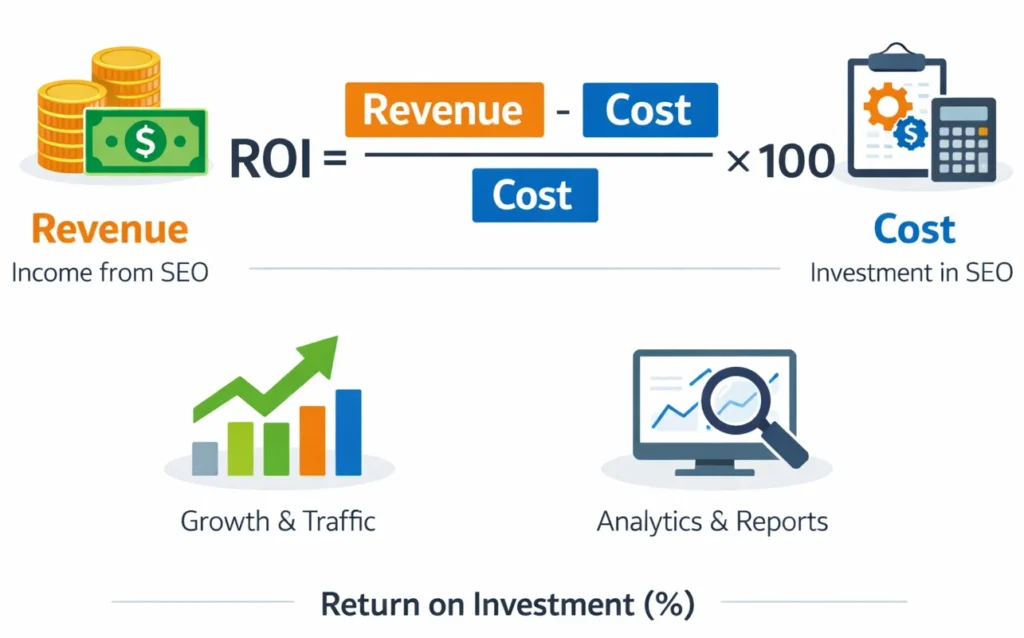
ROI = (Revenue Generated from SEO − Cost of SEO Investment) ÷ Cost of SEO Investment × 100
For example, if your SEO generates $150,000 in revenue against a $50,000 investment, your ROI is 200% — meaning every dollar spent returned $2 in revenue.
What ROI Should You Realistically Expect?
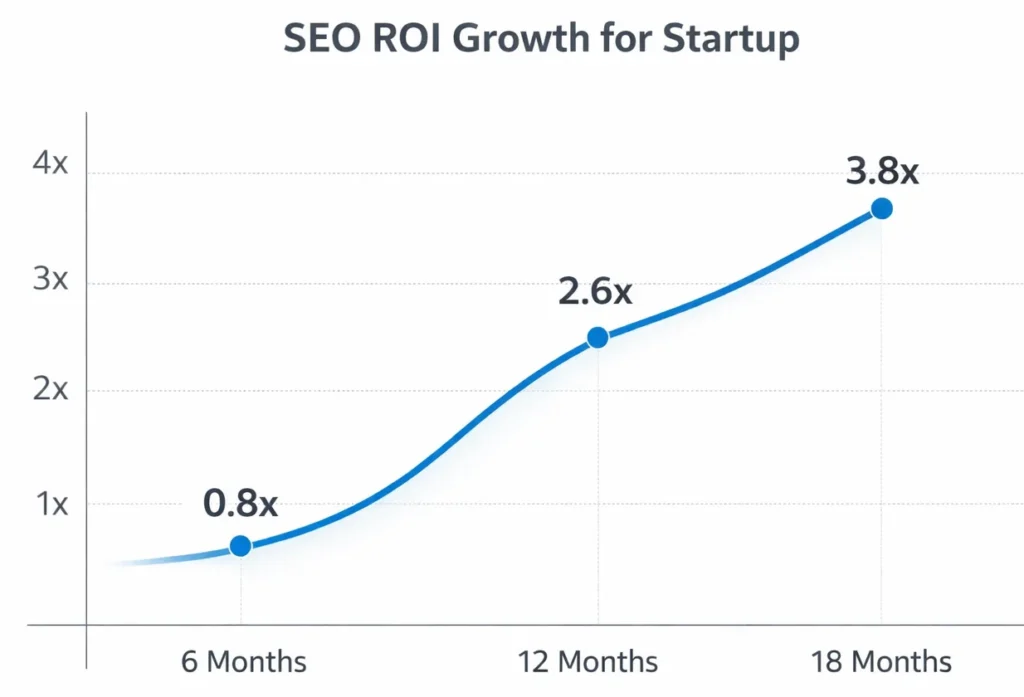
Here is how SEO ROI typically progresses over time:
| Time Period | Average ROI |
| 6 Months | 0.8x |
| 12 Months | 2.6x |
| 18 Months | 3.8x |
Most startups should aim for a 3:1 return or higher. Long-term SEO programs often reach 5:1 or more over time.
The 3 Metrics You Must Track
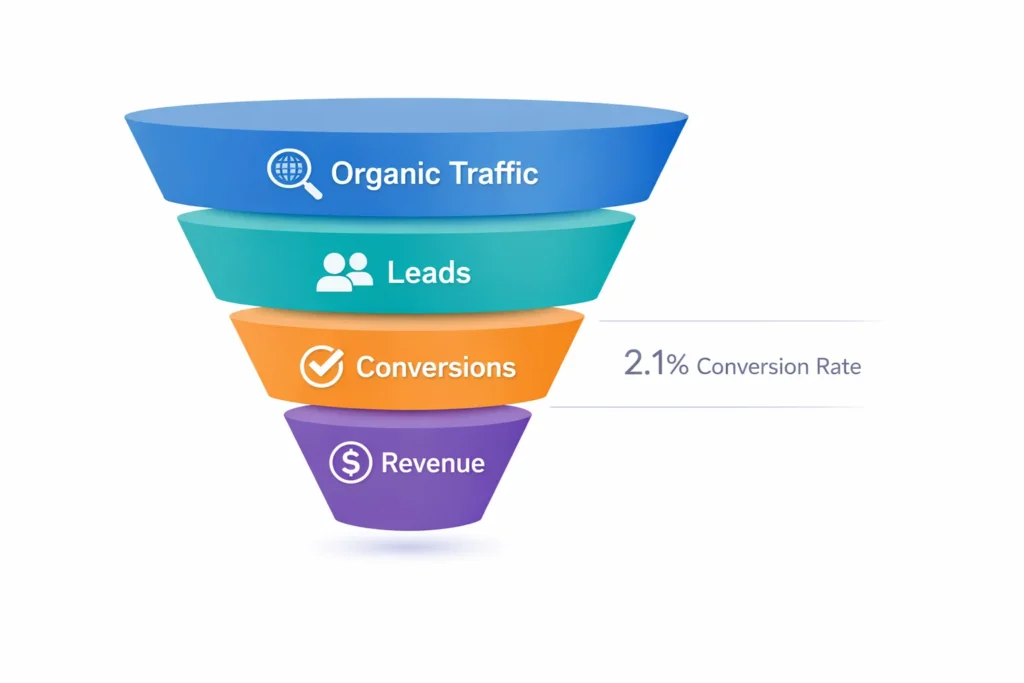
- Organic Revenue — Track organic visitors through to closed revenue in your CRM
- Conversion Rate — The average SEO conversion rate for B2B SaaS companies is 2.1% — use this as your baseline
- Cost Avoidance — Factor in the paid ad spend your organic traffic is replacing
One Important Rule
Never measure SEO return on investment before at least 6 months. Calculating it sooner will produce inaccurate and misleading results. Evaluate SEO year over year, not quarter to quarter.
Conclusion
SEO is not a question of if — it is a question of when and how much. Spending too early drains the runway. Spending too late hands organic growth to your competitors. The right move is timing your investment to match your stage and your overall revenue goals.
For most early-stage AI startups, the smartest first step is partnering with the right SEO agency. You get the strategy, execution and expertise without the overhead.
Ready to grow your organic presence the right way? SEO Circular specializes in helping AI startups build SEO strategies that are lean, focused, and built for results. Get in touch with us today.
Commonly Asked Questions: AI Startup Spend on SEO
Yes — in 2026, GEO is no longer optional. AI Overviews now appear on nearly half of all Google searches, meaning visibility on ChatGPT and Perplexity is just as critical as ranking on Google.
Generic content no longer works. Structure content with clear question-and-answer formatting, concise definitions, and citable statistics, AI models favour factually dense, well-attributed content over broad informational articles.
More than ever. Sites with over 32,000 referring domains are 3.5 times more likely to be cited by ChatGPT, strong backlink profiles now directly impact both Google rankings and AI search visibility.
It adds an overlooked layer of investment. Budget for founder bylines, original research, and verified reviews — a focused 90-day E-E-A-T sprint can close the trust gap against older, more established domains.
Only with a strong editorial layer. Over 82% of content marketers will integrate AI tools by 2026 but an AI-generated content without human oversight risks violating Google’s E-E-A-T principles and triggering ranking penalties.
Search engine optimization has never functioned at a faster rate and manual workflows are no longer keeping up. In 2026, the businesses pulling ahead in organic search aren’t simply hiring more SEO talent, they’re deploying Python-driven automation to do the work that used to take entire teams hours each week.
Python has firmly established itself as the language of choice for technical SEO. With a massive ecosystem of purpose-built libraries, it now handles everything from crawling millions of URLs and parsing structured data to monitoring and keeping track keyword shifts in real time and automating on-page audits at scale.
The result? Faster insights, lower operational costs and a measurable competitive edge.
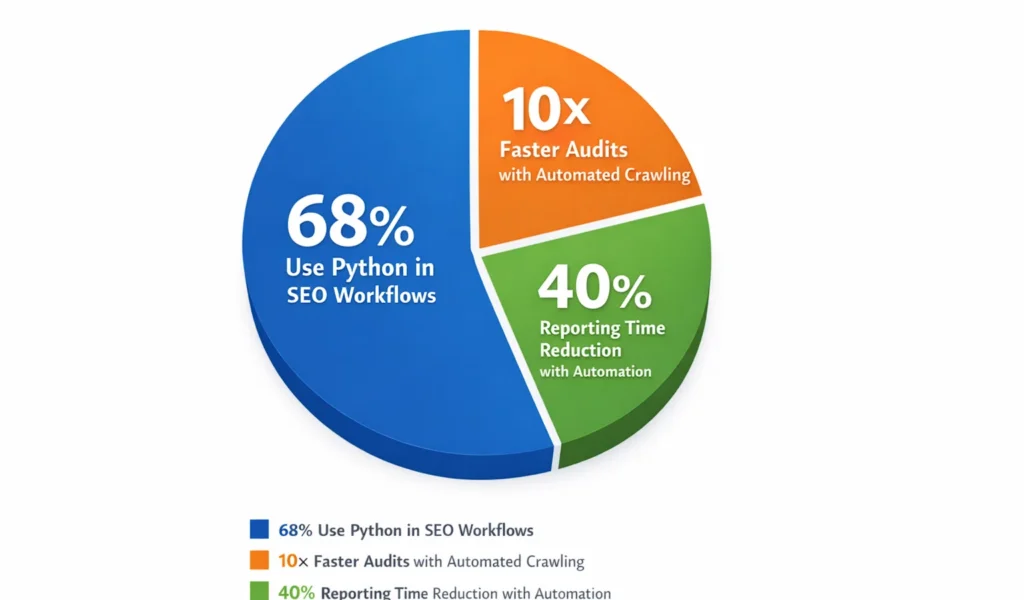
- 68% of enterprise SEO teams use Python in their workflows
- 10× faster audits with automated crawling vs manual review
- 40% reduction in reporting time reported by automation adopters
In this guide, the SEO Circular team breaks down the most powerful Python libraries which are available today, the ones that are actively shaping how forward-thinking business owners and their marketing teams automate repetitive SEO tasks, surface actionable data faster and build scalable search strategies without ballooning their headcount.
Whether you’re just beginning to explore Python for your SEO stack or looking to upgrade the tools you’re already using, this breakdown will give you a precise, data-informed view of what each library does, where it excels and which scenarios it’s built for.
Key Takeaways
- Python’s ecosystem in 2026 is purpose-built for SEO — not just adapted for it.
- Always define your SEO task first, let the task choose the library, not the other way around.
- BeautifulSoup and Requests are the smartest entry points for teams new to SEO automation.
- Pandas and Advertools together cover the bulk of any technical SEO audit workflow.
- spaCy-driven NLP is no longer optional for businesses competing in content-heavy verticals.
Scale Your SEO with Python Automation
At SEO Circular, we help businesses automate technical SEO, reporting, and data workflows using Python-driven systems that reduce manual effort and deliver faster, more accurate insights.
Partner with us to build powerful automation workflows.
Python Vs. Other Automation Options
Business owners are often presented with alternatives such as dedicated SEO platform, Google sheets macros or no-code tools like Zapier. here is how Python compares across the dimensions that matter most at scale.
| Capability | Python | SEO Platforms | No-Code Tools | Spreadsheets |
|---|---|---|---|---|
| Custom Crawling at Scale | Full control | Limited | Not supported | Not supported |
| API Data Orchestration | Unlimited | Platform APIs only | Connector-dependent | Manual only |
| Log File Analysis | Native | Some tools | Not supported | Limited rows |
| Cost at Scale | Low (open source) | High subscription | Mid-tier | Low |
| Reusable & Version-Controlled | Yes | No | Partial | No |
| ML & NLP Integration | Native | Rarely | Not supported | Not supported |
Parts Where Python Delivers The biggest ROI In SEO
Not every SEO task benefits equally from Python automation. The highest impact applications where the time and cost savings are most measurable fall into these categories:
Technical Site Auditing
Crawl millions of pages, identify broken links, redirect chains, duplicate content and missing metadata across your entire domain in minutes.
Keyword Clustering & SERP Analysis
Group thousands of keywords by intent, analyse SERP feature distribution and identify content gap opportunities automatically at a scale no analyst can match manually.
Log File Analysis
Parse server logs to understand how Googlebot is crawling your site revealing wasted crawl budget, overlooked pages and indexation bottlenecks invisible to standard tools.
Automated Reporting Pipelines
Pull data from Google Search Console, Analytics and third-party APIs into a single automated dashboard, eliminating hours of weekly manual reporting.
Content & NLP Optimisation
Use natural language processing libraries to analyse content at scale – scoring topical depth, entity coverage and semantic alignment against top-ranking pages.
The business case is clear: Python does not replace SEO expertise – it amplifies it.
The right library in the right workflow can turn a one-person operation into one that performs like a team of five, without the overhead. The following sections break down exactly which libraries to use and when.
How To Choose The Right Library
Not every library matches every use case. Here’s a structured framework to match the right and suitable tool to your specific SEO goals without wasting time on trial and error.
With the large number of Python libraries available for SEO related tasks, one of the most common mistakes business owners and their teams make is reaching for the most popular tool rather than the most appropriate and suitable one. Choosing wrong means lost setup time, limited output or rebuilding workflows from scratch months later.
The right library comes down to five core criteria. Evaluate any candidate against each of these before committing.
1) Define Your SEO Task First
Crawling, keyword analysis, log parsing, and content auditing each demand different capabilities. Start with the task, not the tool.
2) Assess Your Team’s Python Depth
Some libraries require advanced scripting knowledge. Others are beginner-friendly with clear documentation. Match complexity to capability.
3) Check Scale Requirements
A library that handles 10,000 URLs may break at 1 million. Know your data volume before selecting a crawling or processing tool.
4) Verify Active Maintenance
Abandoned libraries accumulate compatibility issues fast. Check GitHub for recent commits, open issues, and community activity.
5) Consider Integration Needs
Will it connect to Google Search Console, your CMS, or your reporting stack? Compatibility with your existing tools matters significantly.
Match Your Goal To The Right Library Type
Use this decision guide to quickly identify which category of library fits your immediate SEO priority.
| Your SEO goal | Library category | Best for | Complexity |
| Crawl & audit site structure | Web crawling | Technical audits, broken links, redirect chains | Intermediate |
| Extract on-page data at scale | HTML parsing | Meta tags, headings, schema, structured data | Beginner |
| Analyse keyword & SERP data | API wrappers | Rank tracking, SERP features, search volume | Intermediate |
| Process server log files | Data processing | Crawl budget, bot behaviour, indexation gaps | Advanced |
| Optimise content with NLP | NLP / ML | Entity analysis, topical depth, semantic scoring | Advanced |
| Automate reporting pipelines | Data viz & reporting | Dashboards, scheduled exports, stakeholder reports | Intermediate |
A Common Mistake To Avoid:
Don’t select a library based on popularity only. `Scrapy` is powerful but overkill for simple page audits. `BeautifulSoup` is elegant for parsing but it can’t replace a full crawler. Choosing the right tool for the right task is what separates efficient SEO automation from messy, unorganized scripts.
Quick Check Before You Commit
1) Run through this checklist before finalising any library for your SEO stack:
2) Does it have active GitHub commits within the last 6 months?
3) Is there clear documentation with practical examples – not just API references?
4) Has it been tested at the data scale your workflows require?
5) Does it integrate cleanly with your existing tools like GSC, Analytics, CMS)?
6) Is the learning curve realistic for your team’s current skill level?
7) Can it handle your task without requiring heavy third-party dependencies?
Top Python Libraries For SEO Automation In 2026
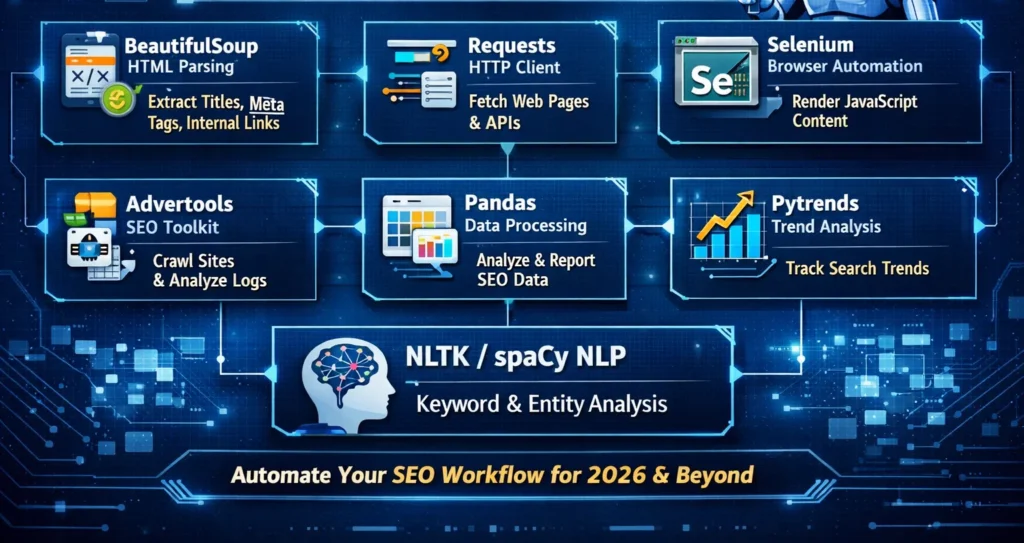
Seven battle-tested libraries covering the full breadth of SEO automation — from crawling and parsing to trend analysis and natural language processing.
1) BeautifulSoup – HTML Parsing
BeautifulSoup reads the raw HTML of any web page and lets you filter out exactly what you need including title tags, meta description, heading structures, canonical URLs and internal links – with precision and very little setup. It is one of the most readable libraries in the Python ecosystem making it a natural starting point for teams new to SEO automation.
Best For:
On-page audits, meta tag extraction, internal link mapping.
Limitations:
Cannot fetch pages on its own – needs Requests or Selenium to retrieve HTML first.
Complexity:
Low – most tasks require fewer 10 lines of logic.
How it helps your SEO :
Feed it a list of URLs and it will extract every on-page SEO element across your entire site in minutes, flagging missing meta descriptions, duplicate titles or broken heading hierarchies automatically without opening a single page manually.
2) Requests – HTTP Client
Requests is the foundational building block that almost every other Python SEO tool relies on. It handles the act of fetching web pages and calling external APIs – including Google Search Console, Ahrefs and Semrush managing response codes, redirects, headers and authentication behind the scenes so your scripts can focus on the SEO logic.
Best for:
API integration, page fetching, HTTP status audits, redirect chain analysis.
Limitation:
Cannot render JavaScript – dynamically loaded content requires Selenium.
Complexity:
Low- Intuitive syntax, extensive documentation
How it helps your SEO:
Run automated HTTP status check across thousands of URLs to Instantly surface 404 errors, redirect chains and server errors – tasks that would take hours in a crawler tool but run in seconds with Requests-powered script.
3) Selenium — Browser Automation
Selenium controls a real browser like Chrome, Firefox or Edge programmatically. This makes it the right and correct tool whatever Javascript rendering matters for SEO: auditing what Googlebot actually sees versus what your server sends, testing Core Web vitals triggers or scraping content that only appears after user interaction or page load events.
Best For :
JS-rendered page audits, Core Web Vitals testing, dynamic content extraction.
Limitation :
Significantly slower and more resource-intensive than Requests at scale.
Complexity :
Medium – requires browser driver setup and handling async behaviour.
How it helps your SEO :
Verify that your JavaScript heavy page render correctly for search engines, catch lazy loaded content that crawlers miss and automate repetitive browser-based SEO tasks such as checking hreflang rendering or structured data on dynamic pages.
4) Advertools – SEO Toolkit
Advertools is the most SEO specific library in this list – built by a practitioner for practitioners. it handles sitemap, robots.txt analysis, web crawling, server log processing and keyword manipulation all within a single, coherent package. For teams running technical SEO at scale, it removes the need to stitch together multiple libraries for the most common audit tasks.
Best For :
Sitemaps, robots.txt audits, crawling, log file analysis, keyword tools.
Limitation:
Smaller community and fewer third party integrations than general purpose libraries.
Complexity:
Medium – SEO specific functions are well documented with clear outputs.
How it helps your SEO:
Parse your entire sitemap in seconds, audit your robots.txt for crawl blocking errors and process server log files to understand exactly how Googlebot is spending its crawl budget across your domain – all without building custom tooling from scratch.
5. Pandas – Data Processing
Pandas is the data processing layer that sits underneath nearly every SEO automation pipeline. It handles bulk manipulation of crawl exports, keyword lists, Google Search Console data, rank tracking CSVs and log files – enabling filtering, grouping deduplication, merging and reporting at a scale and speed that spreadsheet tools simple cannot support.
Best For:
GSC analysis, Crawl data processing, keyword deduplication, automated reporting.
Limitation:
Memory intensive with very large datasets – consider polars for 10M=rows.
Complexity:
Medium – data frame concepts require an initial learning curve.
How it helps your SEO:
Load a full Google Search Console export and identify keyword cannibalisation, declining queries and click through rate anomalies across thousands of pages – in the time it would take to manually scroll through a spreadsheet.
6. Pytrends – Trend analysis
Pytrends is an unofficial Python wrapper for Google Trends, bringing real time and historical search interest data directly into your automation workflows. It lets you track how interest in specific keywords evolves over time, compare seasonal demand patterns and identify which geographies are driving search volume – all programmatically and at scale.
Best For:
Content timing, seasonal planning, GEO demand analysis, trend monitoring.
Limitation:
Unoffcial API with rate limits not suitable for continuous or high frequency polling.
Complexity:
Low- minimal setup, straightforward data outputs.
How It helps your SEO:
Identify the exact weeks when search demand for your target topics peaks so your content team publishes ahead of the curve rather than behind it, giving your pages time to index and rank before competitor volume spikes.
7. NLTK/spaCy – Natural Language Processing
NLTK and spaCy bring natural language processing into your SEO stack. They understand text the way a search engine does – recognising named entities, measuring semantic relationship between words, scoring topical coverage and clustering keywords by intent. In 2026, as Google’s understanding of language continues to mature, NLP-driven content optimisation has become a measurable ranking differentiator in competitive verticals.
Best For:
Entity extraction, keyword clustering, content gap analysis, intent mapping.
Limitation:
Requires NLP understanding – model configuration adds meaningful complexity.
Complexity:
High-best suited for teams with data science capability.
How it helps your SEO:
Analyse your existing content and competitor pages to identify missing entities, understand subtopics and semantic gaps – then use those insights to build content that more completely satisfies search gaps – then use those insights to build content that more completely satisfies search intent and signals topical authority to Google.
Conclusion
Python has fundamentally changed what is possible in SEO and in 2026 that shift is accessible to businesses of all sizes. Libraries like BeautifulSoup, Requests, Advertools, Pandas, Selenium, Pytrends, and spaCy make it practical to automate the technical, repetitive, and data-heavy sides of search optimisation without ballooning your team.
That said, knowing which libraries exist is only the first step. Implementing them correctly requires technical and strategic expertise that goes well beyond the tools themselves. At SEO Circular, we combine Python-driven automation with deep search expertise to surface the insights that actually move rankings. If you are serious about scaling your SEO without scaling your overheads, our team is ready to help.
Commonly Asked Questions: Python Libraries For SEO Automation
Yes, an aggressive crawl script without rate limiting can overload your server, and bulk changes pushed without a review stage can introduce errors at scale. Always test scripts in a staging environment first, and ensure every automation includes error handling and logging before it touches your live site.
Not for every task. Libraries like BeautifulSoup and Pytrends are approachable for analytically minded SEO professionals. However, advanced workflows involving log file analysis, NLP, or custom crawling pipelines will require genuine programming competence to build and maintain reliably.
It depends on the method. Calling official APIs such as Google Search Console or Google Ads API is fully compliant. Scraping Google search result pages directly violates their terms of service and risks IP blocking. Always collect data through official APIs, not by scraping search results.
At minimum, quarterly. Algorithm updates, site structural changes, and library version upgrades can all break existing scripts or produce inaccurate outputs. Building in logging and alerts from the start significantly reduces ongoing maintenance costs.
No, Smaller sites benefit too primarily through eliminating repetitive manual tasks like weekly reporting, keyword trend monitoring, and periodic on-page audits. Starting with one well-chosen automation task delivers immediate value and builds your team’s confidence before expanding the stack.
Selling sex toys online is not as simple as launching a store and running ads. This niche comes with strict legal, advertising, and payment restrictions, and if not handled properly, it can shut down growth very fast. At the same time, it’s a high-trust market. Users expect privacy, a discreet buying experience, and clear product understanding before they make a purchase. The global sexual wellness industry is growing faster than most people expect, with projections crossing $80 billion in the next few years, and a large portion of that demand is shifting online. More people now prefer buying sex toys privately from their phones instead of visiting physical stores. This shift has created a strong opportunity, but also more competition and stricter platform control.
We’ve seen this often. Many new stores focus only on products, but ignore compliance, visibility, and trust layers. That’s where problems start. New brands think good products are enough, but quickly face restrictions, payment issues, and traffic challenges. Platforms like Google and social media have strict policies around adult content, which makes traditional advertising unreliable.
What actually works in this space is a mix of smart positioning, trust-focused branding, and strong SEO. Customers in this niche care deeply about privacy, discreet shipping, and product clarity. If your store doesn’t communicate safety and trust within seconds, they leave. To build this business properly, we always recommend starting with the basics: understand local laws and avoid overly explicit marketing, implement strong 18+ age verification, and make privacy a core part of the experience through discreet shipping, plain packaging, and secure billing. Then focus on positioning by choosing a niche like eco-friendly, premium, or beginner-focused products, and build a secure, fast, trust-focused website where content and structure matter more than platform. We always say this, in adult eCommerce, compliance + trust + education is what drives real growth, not just product listings.
Also Check: Global Porn Industry Revenue
Ready to Grow Your Adult eCommerce Store the Right Way?
At SEO Circular, we help adult brands solve exactly these challenges using search-driven systems and safe SEO execution, and in this guide, we’ll break down how to build and scale a sex toy business the right way.
Let Grow Your Business with SEO Circular Today
Start Selling Sex Toys Online With a Search-Driven Strategy
If you’re serious about building a sex toy business that actually generates sales, you need more than just a website. You need visibility, trust, and a system that consistently brings buyers to your store.
At SEO Circular, we help adult brands grow through SEO-led strategies. Our team handles product SEO, category optimization, and content systems that drive high-intent traffic. We also support marketplace listings on platforms like Amazon, Etsy, and other channels, ensuring your products are optimized, compliant, and positioned to convert.
If you want to build a scalable adult eCommerce business without relying only on ads, let’s plan your growth strategy.
Key Takeaways
- Focus on one niche instead of selling everything
- SEO drives consistent, high-intent traffic
- Discreet shipping and privacy messaging boost trust fast
- Content educates users and directly increases sales
- Payment and compliance setup should be done early
- Trust signals matter more than discounts
- Organic growth is safer than relying on ads
- Clear positioning improves both ranking and conversions
- Adult SEO needs a specialized approach, not general tactics
- Long-term success comes from building a search-driven system
Before selling anything, we need to understand how this market actually works. It’s not driven by impulse alone. It’s driven by privacy, curiosity, and trust. This is a key difference from normal eCommerce categories. Buyers here don’t just land on a product and make a quick purchase. They take time. They research, compare options, read guides, and often hesitate before making a decision.
Understanding the Sex Toy Market
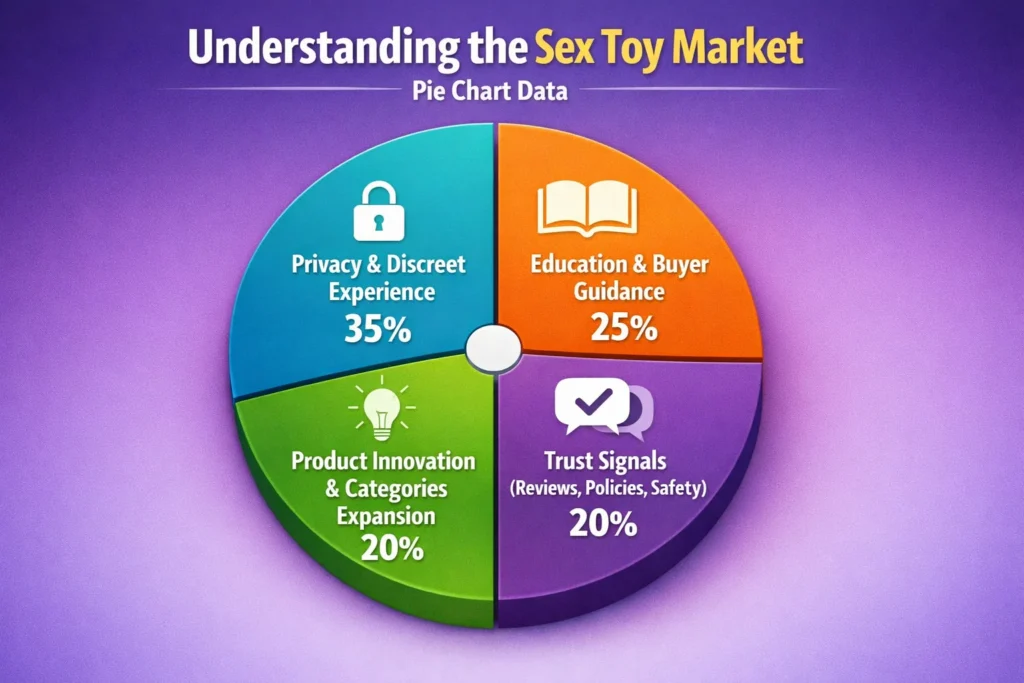
At SEO Circular, we see this behavior across almost every adult project. If your store is not aligned with how users think, even good products struggle to convert. So understanding buyer intent becomes the foundation of everything, from SEO to product pages. Here’s what really shapes buying behavior in this niche:
Privacy Comes First
Most customers are not worried about price in the beginning. Their first concern is privacy. They want to feel safe before they even consider buying.
They look for things like:
- Will this arrive in plain packaging?
- Will the billing show the product name?
- Is the checkout secure and private?
If your store clearly mentions discreet delivery, secure checkout, and no product disclosure, conversions increase instantly. We’ve seen small changes in privacy messaging create a noticeable lift in sales. In this niche, privacy is not just a feature, it’s a core part of the buying decision.
Education Drives Sales
A large portion of buyers are beginners or exploring something new. They don’t always know what product is right for them or how to use it safely.
That’s why they search:
- best vibrator for beginners
- safe sex toys for couples
- how to use a dildo properly
These are high-intent searches. Users are actively looking for guidance before making a purchase. This means content is not optional. It’s your sales engine. Blogs, guides, and educational pages bring users in, build trust, and then move them toward product pages. We often see stores skip this step and rely only on product listings, which limits both traffic and conversions.
You May Also Find This Useful: Sexual Wellness SEO Strategies
Trust Signals Matter More Than Discounts
We’ve seen stores fail even with lower prices. The reason is simple, lack of trust. In this niche, users are cautious. If something feels unclear, unsafe, or unprofessional, they leave immediately.
You need:
- Product descriptions that feel human and informative
- Real customer reviews that build credibility
- Clear return and refund policies
- Transparent information about body-safe materials
These elements reduce hesitation. Once trust is established, users are far more likely to complete the purchase, even if the price is slightly higher.
Categories Are Expanding Fast
This is no longer just about basic products. The market is evolving quickly and expanding into multiple segments.
It now includes:
- Sexual wellness and self-care products
- Tech-enabled and app-controlled toys
- Gender-inclusive and body-positive products
- Relationship-focused and intimacy products
This expansion creates more opportunity, but also more competition. And this is where many new businesses miss the mark. They try to sell everything instead of focusing on one category. Simple truth is the more focused your positioning, the easier it becomes to rank on Google and convert visitors. We always recommend understanding this market deeply before jumping into product listing. Because once you understand the buyer, their concerns, and their decision-making process, everything else becomes easier, from SEO strategy to conversion optimization.
Who Is the Target Audience for Sex Toys
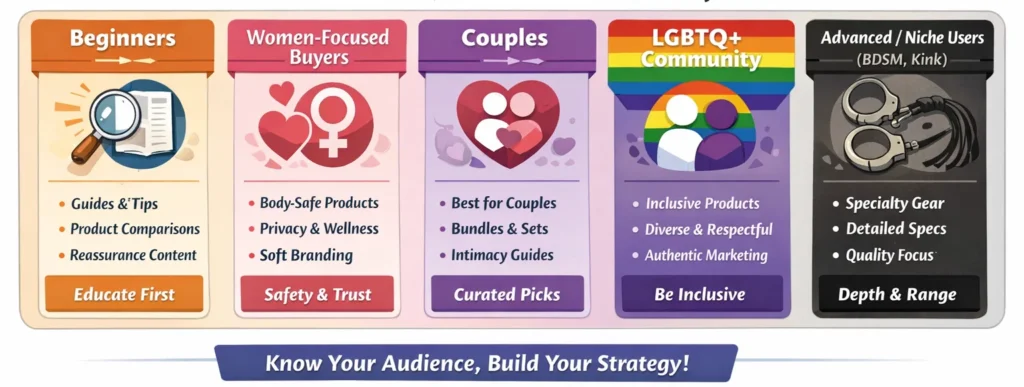
This is where most new businesses make a mistake. They assume the audience is “everyone.” It’s not. And this wrong assumption usually leads to weak branding, poor SEO targeting, and low conversions.
In reality, the audience in this niche is highly segmented. Each group searches differently, has different concerns, and makes buying decisions in a different way. If you try to speak to everyone, your messaging becomes too generic, and generic stores rarely convert in this space.
At SEO Circular, we always start with audience clarity before building SEO or content strategy. Because once you know who you’re targeting, everything else becomes easier, keywords, content, product positioning, even pricing.
Beginners (High Volume, High Opportunity)
This is one of the largest segments in the market. These are first-time buyers who are curious but also cautious.
They typically:
- Search for guides, safety tips, and product comparisons
- Don’t understand product differences clearly
- Need reassurance before making a purchase
For this audience, education is key. If your store helps them understand what to buy and why, conversions increase naturally. This is where blog content and beginner guides play a major role.
Women-Focused Buyers
This is one of the fastest-growing segments in the industry. Many modern brands are now building specifically for women, and it’s working.
This audience usually:
- Prioritizes body-safe materials and product quality
- Cares deeply about privacy and discreet experience
- Responds well to soft, educational, and wellness-focused content
Here, branding matters a lot. A clean, safe, and trust-focused presentation performs much better than aggressive or overly explicit marketing.
Couples
Couples are a high-value segment. They are not just buying a product, they are looking to improve intimacy or explore something new together.
They often:
- Search for recommendations like “best toys for couples”
- Prefer bundles or curated product sets
- Have higher average order value compared to individual buyers
This segment responds well to guides, curated collections, and suggestion-based content.
LGBTQ+ Community
This is a very important and growing audience, but also one that expects relevance and inclusivity.
They:
- Look for products designed for their specific needs
- Prefer brands that represent and understand their identity
- Trust stores that use inclusive language and positioning
Generic stores often fail here. But brands that position themselves correctly can build strong loyalty within this segment.
Advanced / Niche Users (BDSM, Kink)
This is a more experienced segment. These users already know what they want, so their behavior is different.
They typically:
- Search for specific products or features
- Need less education but more product depth
- Expect variety, quality, and detailed specifications
For this audience, product range and clarity matter more than basic education. They are less price-sensitive but more quality-focused.
How People Actually Buy Sex Toys Online
Understanding buying behavior is critical before jumping into SEO or product listing. Because in this niche, users don’t behave like typical eCommerce buyers. They don’t land on a product page and purchase instantly. The journey is slower, more thoughtful, and driven by research.
At SEO Circular, we see this again and again. Stores that align with this behavior grow steadily. Stores that ignore it struggle with both traffic and conversions.
This is how the buying journey usually works:
- User searches a problem or curiosity: It usually starts with a question or need. Not a product.
For example, users search things like “best vibrator for beginners” or “safe toys for couples.”
This is the entry point, and it’s where most businesses miss opportunity. - Finds a guide or blog: The user lands on an article, guide, or comparison page.
This is where they start understanding options and possibilities. - Learns about options: They read, compare, and try to figure out what suits them.
At this stage, they are not ready to buy yet. They are building confidence. - Clicks to product page: Once they feel informed, they move toward a product.
This transition only happens if your content builds enough trust. - Checks trust signals: Before buying, they validate the store.
They look for reviews, return policies, discreet shipping, and product clarity. - Decides to buy or leave: If everything feels safe and clear, they convert.
If not, they leave and often don’t come back.
This is not impulse buying. It’s a research-driven journey, and that changes how you should build your business.
Which means:
- Content brings traffic
- Trust converts users
- Structure connects both
If any one of these is missing, the system breaks.
For startups and new businesses, this is the biggest learning. Many stores skip the first step completely. They build a website, upload products, and expect sales. But without content, there is no entry point. Without trust, there is no conversion.
We usually explain it like this. Your blog brings users in, your product pages close the sale, and your website structure connects the journey smoothly.
If you build your store keeping this flow in mind from day one, growth becomes much more predictable. If not, you’ll keep struggling with traffic, even if your products are good.
Why Positioning Matters Before You Start Selling
One of the biggest mistakes we see is broad positioning. Many new businesses start with something like “online sex toy store,” thinking it will help them reach more people. In reality, it creates confusion. The brand looks generic, competition becomes extremely high, and there’s no clear reason for a user to choose that store over hundreds of others.
In this niche, being specific is not limiting, it’s powerful. When you position your store around a defined segment, everything starts to make sense. Instead of trying to serve everyone, you start attracting the right audience.
For example, a store focused on:
- Beginner-friendly toys
- Premium wellness-focused products
- Eco-friendly intimacy items
- Couple-focused solutions
These immediately communicates clarity. A user landing on such a store knows this is built for them. That clarity alone improves engagement and trust.
From an SEO perspective, positioning plays a huge role. When your niche is clear:
- You target more specific, lower-competition keywords
- Your content becomes more relevant to search intent
- Ranking on Google becomes easier and faster
Instead of competing for broad terms like “sex toys,” you start ranking for high-intent searches that are easier to win and more likely to convert.
Content also improves naturally. When you know your audience, you know what to write. Your blogs, guides, and product descriptions become more focused, more useful, and more aligned with what users are actually searching for. This directly impacts traffic and conversions.
User understanding is another big factor. When someone lands on your website and instantly understands what you offer and who it’s for, they are more likely to stay, explore, and eventually buy. If they have to figure it out, they usually leave.
Where to Sell Sex Toys Online (Platforms & Your Own Store)
One of the most common questions we get is where to actually sell these products. Should you rely on marketplaces, or build your own website?
The answer is not one-size-fits-all. But in adult eCommerce, platform choice directly affects your growth, control, and risk level.
Marketplaces (Easy Start, Limited Control)
You can list products on marketplaces like:
- Amazon (limited categories)
- eBay
- Some niche adult marketplaces
- Alibaba
These platforms can help you get initial visibility, but there are challenges:
- Strict adult content policies
- Product listing restrictions
- Risk of account suspension
- Limited branding opportunities
We see this often. Sellers start on marketplaces, get some traction, and then suddenly face restrictions or reduced visibility.
So while marketplaces can help you test products, they are not reliable for long-term growth.
Social & Community Platforms
Some sellers also use:
- Twitter (X)
- Niche forums
These platforms work more for promotion than direct selling. You can drive traffic from here, but you still need a proper website where users can actually buy.
Also, these channels require careful handling. Over-promotion can lead to bans or negative engagement.
Your Own Website (Best Long-Term Strategy)
This is what we always recommend at SEO Circular.
Building your own store gives you:
- Full control over branding
- No dependency on third-party policies
- Better SEO opportunities
- Direct customer data and retention
You can use platforms like:
- Shopify
- WooCommerce
But here’s the important part. Just creating a website is not enough. It needs to be:
- SEO-optimized
- Trust-focused
- Fast and mobile-friendly
- Structured for conversions
Your website becomes your main asset. It’s where content, traffic, and sales connect.
What Actually Works (Practical Approach)
For most businesses, the best approach is:
- Start with your own website as the core
- Use marketplaces for initial testing (optional)
- Use social platforms to drive traffic
- Build SEO for long-term growth
We’ve seen brands struggle when they rely only on third-party platforms. And we’ve seen consistent growth when they invest in their own SEO-driven website.
How to Sell Sex Toys Online as a Brand
Selling sex toys online is not only about uploading products to a website. In my experience, real sales come from building a system that brings the right visitors, answers their concerns, and moves them toward purchase. In this niche, people rarely buy instantly. They search privately, compare options, read educational content, and check whether the store feels safe and discreet. That means a brand needs more than products. It needs visibility, trust, and a clear conversion path.
From an SEO and growth perspective, I would say the process usually works like this: first, choose a focused niche so your store does not look generic. Then build category pages and product pages around real search demand. After that, create educational blog content that targets beginner questions, comparison intent, and privacy-related concerns. Once traffic starts coming in, your website must support conversions through discreet shipping messaging, trust-focused design, clear product descriptions, and mobile-friendly checkout flow. This is how online selling becomes sustainable.
At SEO Circular, we look at online selling as a full funnel. Search brings the visitor, content builds confidence, product pages answer final doubts, and trust signals help complete the sale. So if someone asks how to sell sex toys online, my answer is simple: you need a niche-focused brand, SEO-led traffic strategy, privacy-first website experience, and content that helps users make decisions without hesitation. That is what creates repeatable growth in this industry.
Why SEO Circular for Adult eCommerce Growth
At SEO Circular, we specialize in SEO for adult and high-risk niches. This is not general SEO. It requires a different approach, safer execution, and a deeper understanding of platform restrictions.
Here’s how we support sex toy brands:
Search-First Strategy
We build your entire growth around what people are already searching. This includes:
- High-intent keyword targeting
- Category page optimization
- Blog and content clusters
Safe SEO Execution
Adult niches come with higher risk of penalties. We ensure:
- Clean backlink profiles
- Proper on-page structure
- Compliance-friendly content
Conversion-Focused Content
Traffic alone is not enough. We create content that:
- Educates beginners
- Builds trust
- Moves users toward purchase
Long-Term Growth System
Instead of quick wins, we focus on:

This is how adult brands scale without depending on ads.
We’ve seen brands go from zero visibility to ranking for thousands of keywords by following this exact structure. And once rankings build, traffic becomes consistent.
Conclusion
Selling sex toys online is a high-opportunity business, but it’s also one of the most misunderstood eCommerce niches. Most people fail not because of product quality, but because they don’t understand how visibility and trust work in this space.
If you rely only on ads or random promotion, growth will always feel unstable. But when you build a strong SEO foundation, target the right niche, and focus on user intent, results become predictable.
At SEO Circular, we approach this differently. We help adult brands build systems that bring long-term traffic, not short-term spikes. Because in the end, sustainable growth in this industry comes from being discoverable, trusted, and consistent.
Today, YouTube is no longer just a platform for part-time creators, freelancers, or side gigs. It has evolved into a full-scale business model and, for many, a primary source of income. From independent creators to large production houses, YouTube is now replacing traditional media channels and becoming a core engine for both entertainment and business growth. Entire industries—from education and finance to lifestyle and digital products—are now being built and scaled through YouTube.
If you are planning to start something around content, media, or audience-driven business, then you are already stepping into one of the fastest-growing and most profitable digital spaces. But let’s be clear—starting a YouTube channel is easy, growing it is not. Just like any other business, YouTube also requires strategy, consistency, and most importantly, strong SEO to succeed.
At SEO Circular, we have worked closely with multiple YouTube channels across different industries, helping them grow visibility, increase watch time, and generate real revenue. Based on our hands-on experience, we understand what actually works on YouTube and what doesn’t.
In this blog, I will break down how you can start a YouTube channel the right way and apply the best YouTube SEO practices to build long-term growth and consistent results.
Key Takeaways
- YouTube SEO helps videos rank higher in search results and appear in recommended feeds, increasing visibility and views on YouTube.
- With 500+ hours of video uploaded every minute, proper optimization is essential to stand out.
- The algorithm focuses on watch time, audience retention, CTR (click-through rate), and viewer engagement.
- Optimized titles, descriptions, tags, thumbnails, and captions help YouTube understand and rank your content accurately.
- Keyword research helps target topics that users are actively searching for.
- Strong thumbnails and compelling titles improve click-through rates and overall performance.
- Engaging videos with a strong introduction increase watch time and viewer retention.
- Encouraging likes, comments, and shares sends positive signals to the algorithm.
- Consistent posting within a niche builds channel authority and long-term growth.
- The future of YouTube SEO will rely more on AI-driven recommendations, personalization, and audience behavior signals.
Turn Your YouTube Channel Into a Growth Engine
Get expert-driven SEO strategies from SEO Circular Enterprise SEO Agency and start ranking, growing, and monetizing faster.
Book Your Free Consultation TodayImportance Of YouTube SEO
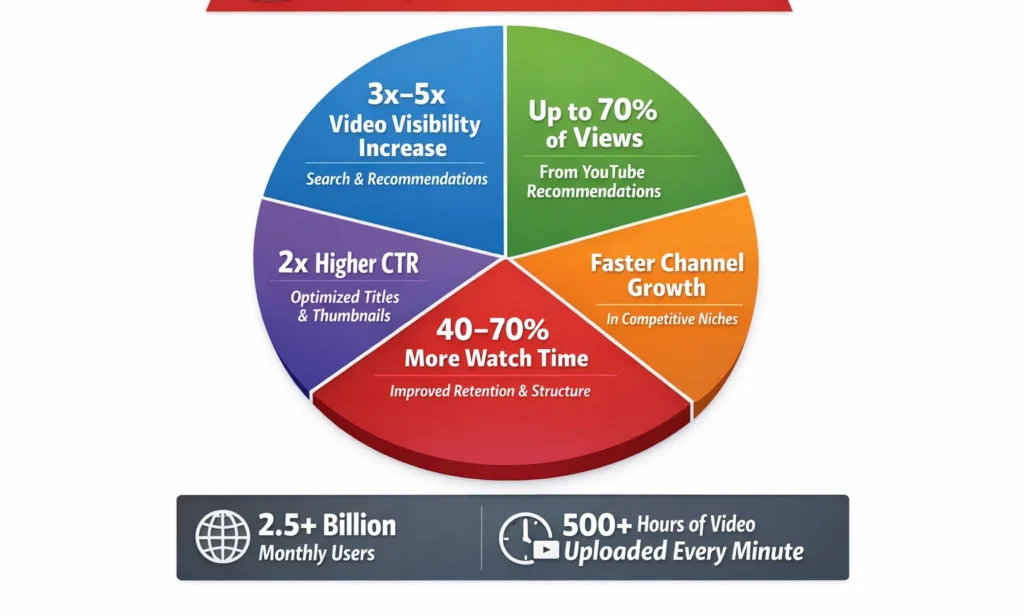
With the right YouTube SEO strategy, you can directly impact growth numbers:
- 3x–5x increase in video visibility through search + recommendations
- 2x higher click-through rate (CTR) with optimized titles & thumbnails
- 40–70% more watch time by improving retention and content structure
- Up to 70% of views can come from YouTube recommendations alone
- Faster channel growth in competitive niches with proper keyword targeting
YouTube currently has 2.5+ billion monthly users, with 500+ hours of video uploaded every minute. Without SEO, your content gets lost. With SEO, your videos get discovered, recommended, and scaled.
Breaking Down The YouTube Algorithm In 2026
| Factor | What It Means | Why It Matters | Optimization Tips |
|---|---|---|---|
| Click-Through Rate (CTR) | Percentage of people who click your video after seeing the thumbnail | High CTR signals strong interest | Use compelling thumbnails, strong titles, and curiosity-driven hooks |
| Watch Time | Total time viewers spend watching your video | Core ranking factor for YouTube | Create engaging content and keep viewers watching longer |
| Audience Retention | How much of your video people watch | Shows content quality and engagement | Use strong hooks in first 10 seconds and avoid drop-offs |
| Engagement (Likes, Comments, Shares) | User interactions with your video | Indicates value and relevance | Ask questions, encourage comments and shares |
| Session Time | Time a user stays on YouTube after watching your video | Boosts platform engagement | Create playlists and suggest related videos |
| Video Consistency | How often you upload content | Builds audience trust and algorithm favor | Maintain a regular posting schedule |
| Content Relevance | How well your video matches search intent | Helps YouTube rank your content correctly | Use proper keywords, tags, and descriptions |
| Channel Authority | Overall performance and trust of your channel | Strong channels rank faster | Focus on niche content and consistent quality |
| Personalization | Content shown based on user behavior | Drives individual recommendations | Target specific audience interests |
| Shorts & New Formats | Impact of YouTube Shorts and emerging formats | Expands reach and discovery | Use Shorts strategically to drive traffic to long videos |
The algorithm of YouTube has changed a lot over the years turning its focus from simple metrics like views to deeper indicators of viewer satisfaction and engagement. In 2026 the recommendation system of the platform is designed to analyse a large variety of signals to decide which videos should appear in search results, suggested videos and the homepage feed. The main goal is to show viewers the content that they are most likely to watch and enjoy.
One of the most important things that the algorithm looks at is metadata. In metadata we include things like video titles, descriptions and tags. Such type of elements in metadata help YouTube understand what the specific video is about and allow the platform to categorize it accurately. When creators use related and relevant keywords in their titles and also in descriptions then it becomes easier for the algorithm to match and relate the content with users searching for those topics. Captions and subtitles also play a major role also. They provide YouTube with additional context about the spoken content in a video also improving discoverability in both search and recommendations.
However metadata only is not enough. The algorithm of YouTube depends heavily on viewer engagement signals to know the quality and relevance of a video. Specific Metrics like watch time, audience retention, click-through rate (CTR), likes, comments and shares help the platform understand how viewers respond and interact with the content. For example, if viewers click on a video and watch a big part without leaving or skipping then the algorithm sees this as a strong sign that the content is valuable and worth recommending to more people.
User behaviour is another factor which is impossible to ignore. YouTube notices how viewers interact with videos on the platform. This also means including what they want to watch, how long they stay, what they skip and what they choose to watch next in content. These behavioural signals and signs help the recommendation system of the platform create personalized viewing experiences. If someone watches content about a specific topic then the algorithm will start suggesting more videos related to that interest. The platform also considers broader performance signals. If a video does well with a small group of viewers initially, generating good watch time, engagement and retention then it may be gradually shown to larger audience. This testing process helps YouTube decides whether the content deserves wider distribution or not.
The YouTube algorithm is no longer just about ranking videos for keywords in 2026. It focuses on understanding viewer satisfaction. Videos that keep audiences engaged, encourage interaction and align with viewer interests are much more likely to be recommended suggested. For creators this means that the successful growth on YouTube depends on a mix of strong metadata, engaging content and positive audience signals that show real value to viewers related to the overall content.
Key Ranking Factors That Influence YouTube SEO
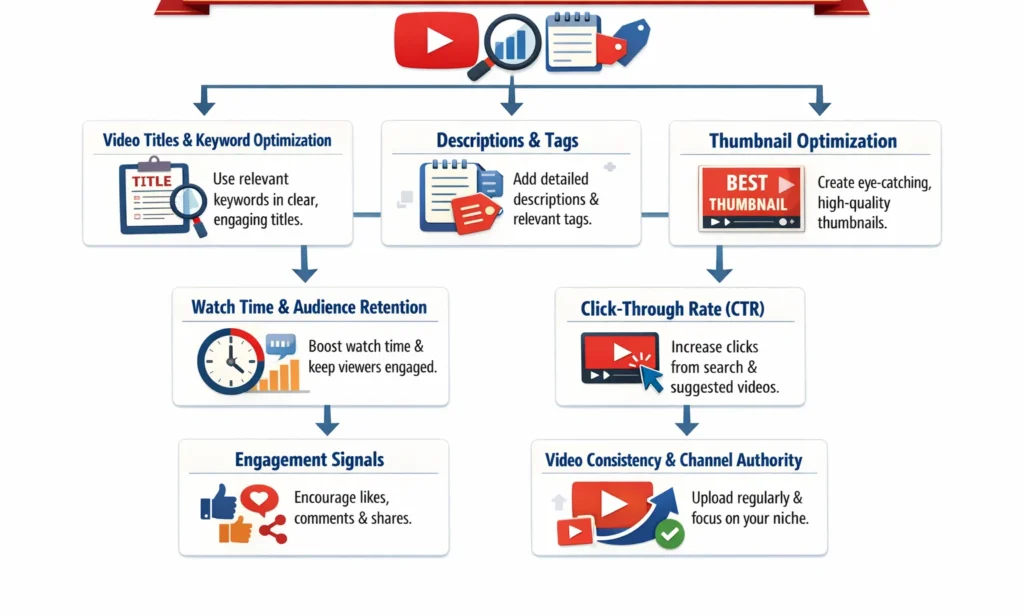
1) Video Titles and Keyword Optimization
Video titles are mainly for YouTube SEO. They help both viewers and the platform to actually understand the content of the video. By using relevant and related keywords in the title, it increases the chances of showing up in search results when users search for related topics. However the titles should not be overloaded with keywords. The best titles are clear, descriptive and naturally add the main keyword while leading viewers to click on the video.
2) Descriptions and Tags
Descriptions and tags give extra context to the platform which helps YouTube categorize and index a video. A well-written description explains what the video is about and can also add relevant keywords that support the topic including the niche. Through tags, YouTube understand related topics and improve the chances of the video appearing in search results or suggested videos along with similar content.
3) Thumbnail Optimization
Thumbnails also affect whether viewers click on a video majorly. A clear and visually enhanced thumbnail can highly boost click-through rate of the video. Thumbnails that use high contrast, readable text and expressive visuals are more likely to show in search results and recommendation feeds.
4) Watch Time and Audience Retention
Watch time notices how long viewers watch a video, while audience retention shows what percentage of the video viewers see. Videos that keep viewers engaged longer give signals to YouTube that the content is valuable. High watch time and strong retention usually improve the chances of a video being recommended to a larger audience.
5) Click-Through Rate (CTR)
Click-through rate shows how often viewers click on a video after seeing it in search results, on the homepage or in suggested video sections. A higher CTR shows that the title of the video and thumbnail appeal to viewers. When a video consistently attracts clicks, YouTube will promote it more often within its system recommendation.
6) Engagement Signals (Likes, Comments, Shares)
Engagement signals help YouTube see if the viewers are interacting with a video or not. Likes, comments and shares signal that the audience finds the content interesting. Videos that generate strong engagement often gain more visibility because the platform views these interactions as positive feedback from the viewers.
7) Video Consistency and Channel Authority
Consistency in uploading content affects the growth of the channel. Channels that regularly publish videos around a specific topic are more likely to build stronger authority in that niche. Over time YouTube becomes more confident in recommending content from channels that consistently produce relevant and engaging videos for targeted audience based on the specific niche.
Best YouTube SEO Practices For Ranking In 2026
Conducting YouTube Keyword Research
Keyword research matters a lot in YouTube SEO. It helps in understanding what the viewers are actively searching or watching on YouTube. Instead of choosing topics randomly through search behaviour creators can find subjects that are already on demand. One simple way to discover such keywords is by typing a topic into the YouTube search bar and then observing the auto suggested queries. These suggestions come directly from real user searches which makes them important indicators of what people want to watch.
Creators can analyse high performing videos in their niche to see what type of keywords appear in the titles, descriptions and tags. Choosing the suitable keywords make sure that the video matches with the intent of the audience and increases the chances of appearing in YouTube search results.
Optimizing Video Metadata
Metadata talks about the information attached to a video that helps YouTube understand its content. The most important metadata elements include titles, descriptions and tags. When these elements are optimized in a proper way then the algorithm can categorize the video more accurately and show it to the target audience.
The title should clearly explain what the video is about while naturally including the main keyword. Descriptions should also expand on the topic by summarizing what viewers will learn or see in the video. Tags provide additional context and help YouTube connect the video with related content all over the platform. Well-structured metadata improves discoverability and increases the chances of appearing in both search results and recommended videos.
Creating Engaging Thumbnails
Thumbnails play an important role in attracting viewers. While scrolling through search results or recommended videos, the thumbnail is often the first thing that they notice. A well-designed thumbnail can make the difference between a viewer clicking on a video or ignoring it.
Effective thumbnails are visually clear and relevant to the content. They often add bold visuals, strong contrast and easy to read text. The goal is to create a thumbnail that stands out while still accurately representing what the video is about. When thumbnails capture attention they can significantly improve the click through rate of the video.
Structuring Video Descriptions Properly
A well written video description provides important context for both viewers and the YouTube algorithm. The first few lines of the description are really important because they appear in search previews and help users quickly understand the content of the video.
Creators should start with a short summary explaining what the video covers and include relevant keywords naturally. More information such as links, timestamps and supporting details can be added later in the description. A detailed and informative description helps YouTube better understand the video and improves its chances of appearing in relevant searches.
Using Timestamps and Chapters
Timestamps and chapters allow viewers to go through different sections of a video easily. This feature is specifically helpful for longer videos that cover multiple topics. By dividing the video into clear sections viewers can jump directly to the part in which they are most interested.
From an SEO perspective, timestamps also help YouTube understand the structure of the video and the different topics discussed within it. This improves the overall user experience and can make the content more valuable for viewers who want to have quick access to specific information.
Adding Captions and Subtitles
Captions and subtitles enhance and improve accessibility and help huge audience understand the video. Many viewers watch videos without sound especially on mobile devices so captions make it easier for them to follow the content.
Captions also provide extra text that helps YouTube understand the spoken content within a video. This extra context can improve discoverability and allow the platform to match the video with related and relevant search queries more accurately.
Encouraging Viewer Engagement
Engagement signals such as likes, comments and shares help YouTube decide whether viewers find a video interesting. When viewers interact with content, it shows that the video is generating a response rather than being passively watched.
Creators can encourage engagement by asking questions, inviting viewers to share their opinions and encouraging them to leave feedback in the comments. Responding to comments can also help in building stronger connections with the audience and increase overall interaction.
Improving Watch Time with Better Video Structure
Watch time is one of the most important factors in YouTube SEO. It notices how long viewers stay on a video and show whether the content is engaging enough to hold their attention. Videos that keep viewers watching for longer periods are more likely to be recommended by the algorithm.
A strong video structure can significantly improve watch time. Starting with an engaging introduction, clearly explaining what viewers will gain from the video and managing a steady flow of useful information can help keep the audience interested. Avoiding long introductions and getting to the main point quickly also helps maintain viewer attention throughout the video.
Common SEO Mistakes That Can Hurt Your Ranking On YouTube
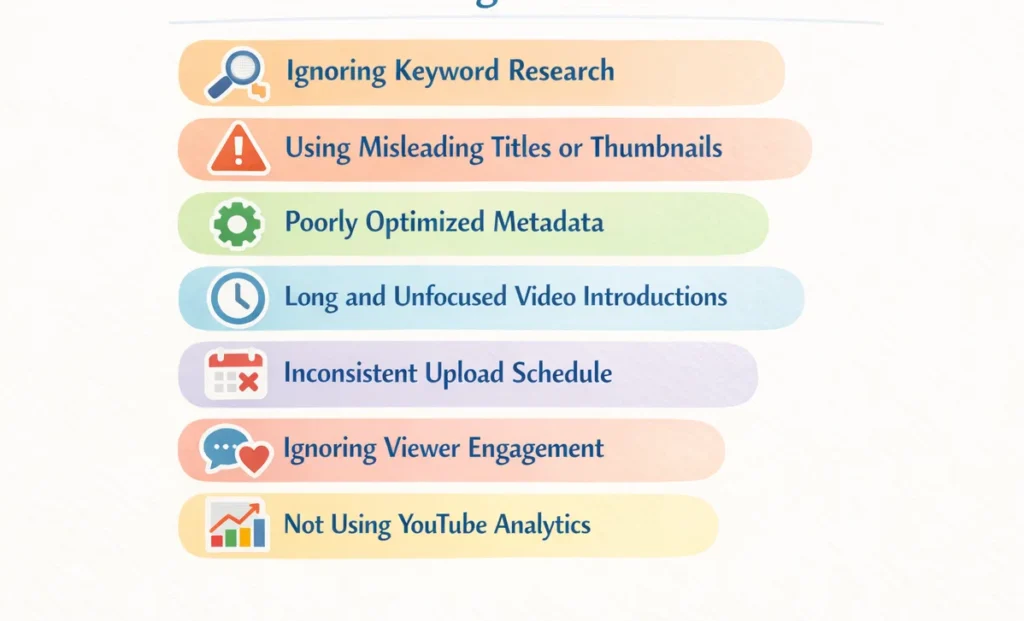
Even though creators follow many SEO practices, certain mistakes can prevent videos from performing well on YouTube. Understanding these common errors can help creators avoid problems that might reduce visibility, engagement and overall channel growth. By identifying and correcting these mistakes, creators can improve their chances of reaching a larger audience.
Ignoring Keyword Research
One of the most common mistakes are creating videos without researching what viewers are actually searching for. When creators choose topics without understanding search demand then their videos may not match the interests of the audience. Proper keyword research helps identify popular topics and make sure that the content aligns with real user queries.
Using Misleading Titles or Thumbnails
While attractive thumbnails and titles are important for gaining clicks, misleading viewers can harm a video’s performance and overall ranking. If viewers click on a video but quickly leave because the content does not match the title or thumbnail, audience retention will drop and will affect the content overall and also will give Low retention signals to the algorithm that the content may not be satisfying to viewers.
Poorly Optimized Metadata
Another common issue is neglecting or ignoring video metadata such as titles, descriptions and tags. If these elements are vague or there are missing relevant keywords, YouTube may struggle to understand the topic of the video. This can reduce the chances of the video appearing in search results or recommended feeds. This can drop the content overall in terms of visibility.
Long and Unfocused Video Introductions
Many creators lose viewers within the first few seconds of their videos because the introduction is too long or does not immediately capture the attention of the target audience. Since audience retention is an important ranking signal, failing to engage viewers early can negatively affect watch time and overall performance of the content.
Inconsistent Upload Schedule
Uploading videos irregularly can make it difficult to build a consistent audience. Channels that publish content regularly are more likely to gain or attract stronger viewer engagement and long-term growth. Consistency helps viewers know when to expect new content and strengthens the channel’s presence within a specific niche.
Ignoring Viewer Engagement
Some creators focus only on views and overlook the importance of audience interaction. Engagement signals such as likes, comments and shares signal that viewers find the content valuable. Not doing enough engagement can reduce the overall interaction level of a video and limit its overall potential reach.
Not Using YouTube Analytics
Another major mistake is not measuring or analysing performance data. YouTube provides detailed insights through its analytics tools, including metrics like watch time, audience retention and click-through rate. Ignoring these insights makes it harder to understand what works well and what needs improvement in future videos.
Conclusion
YouTube SEO plays an essential role in helping videos gain visibility in an increasingly competitive platform. With millions of videos being uploaded regularly, creators need to go beyond simply publishing content and focus on optimizing their videos so that YouTube can understand and recommend them to the right and relevant audience.
By applying key SEO practices such as proper keyword research, optimized metadata, engaging thumbnails and improving watch time and audience retention, creators can significantly improve their chances of ranking on YouTube. At the same time avoiding common mistakes and focusing on consistent, high-quality content helps build long-term channel growth.
Ultimately successful YouTube SEO is about combining smart optimization with valuable content that keeps viewers engaged. Creators who understand their audience and follow these practices will be better positioned to grow their presence and reach wider audiences on YouTube.
Important YouTube SEO Insights for Creators
Consistency matters more than quantity on YouTube. Uploading videos on a regular schedule whether weekly or biweekly helps the algorithm understand your channel activity and encourages viewers to return for new content.
Yes. Longer videos often produce more watch time which is a major ranking signal. However the main factor is keeping viewers engaged throughout the video rather than simply making it longer.
Hashtags help categorize videos and make them discoverable through hashtag searches. Using 10 –12 relevant hashtags related to your video topic is usually enough for better identification and discoverability.
YouTube SEO results can take a few days to several weeks, depending on competition, engagement and how well the video matches and aligns with the user search intent.
End screens and cards guide viewers to other videos or playlists on YouTube. They help keep viewers on the platform longer, increasing overall watch time and session duration.
The Adult Industry in today’s times has become one of the most used industry in the world. The industry played an important role in our understanding of sexuality and rights. In 2021 alone the growth of this industry was around $300 to 400 million according to the market report. The shift from using physical market advertisement strategies to switching into the digital world has become one of the most important factors in the overall growth of this industry on global basis.
The Global adult industry has become an important source for porn stars, adult performers, adult content creators, cam models, OnlyFans creators, adult influencers, erotic content creators to promote their content online.
In previous times, human made content was dominating the internet. For example: Manuel Ferrara was dominating the internet around 2010-2014 in the industry. He is considered as one of the most popular male porn star of all times. He appeared in 2,000+ adult content in the industry.
But now with the rise of AI, human made content is not the only type of content which is taking over the internet. AI porn content is also rising and coming on demand. Tools like Gork is becoming trendy nowadays. Gork is an ai tool which can generate sexual content far more sensual and graphic than what is on X. Along with that AI chatbots are rapidly increasing and coming on demand. Users can simply interact with such AI adult chatbots. With AI a new wave of content came into the adult market which completely changed the industry. With proper advertising and SEO strategies, porn content can get viral within few hours.
Key takeaways
- In 2021 alone the growth of this industry was around $300 to 400 million according to the market report.
- AI porn content is also rising and coming on demand in the adult industry. Tools like Gork is becoming trendy nowadays. Gork is an ai tool which can generate sexual content far more sensual and graphic than what is on X.
- SEO helps with the growth of adult chatbot platforms. Advertising restrictions make organic search one of the most efficient user acquisition channels.
- A major turning point occurred in the adult industry between 2008 and 2012, labelled in the chart as the “Rise of Tube Sites.”
- Understanding search intent helps you decide what type of content and landing pages your website needs.
- Keyword research is the pillar of SEO for adult chatbot platforms. Because the niche is competitive, focusing only on broad keywords may not be enough.
- Compliance and content policies matter. Adult websites must manage indexing, safe-search filtering and platform guidelines carefully.
Understanding Adult Market
The chart below will help you understand how much the market has grown over the years and how AI companion platforms are contributing to the overall growth of the global porn industry.
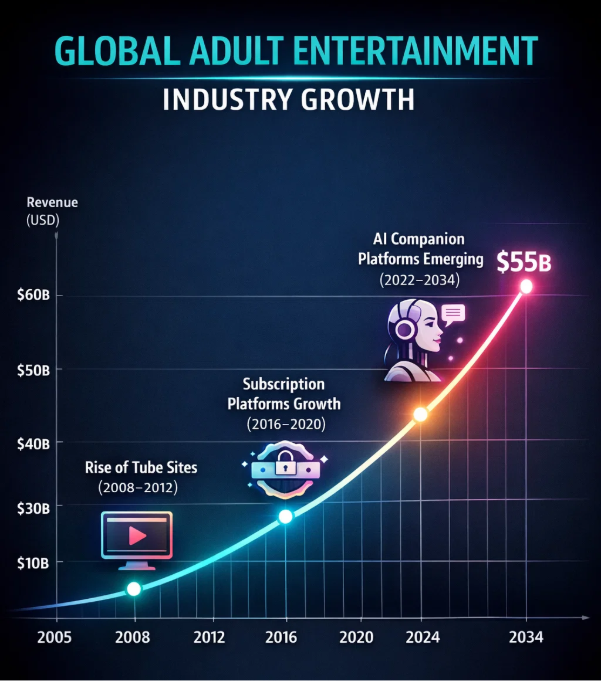
The chart illustrates the steady growth of the global adult entertainment industry from 2005 to 2034, highlighting and indicating several technological shifts that influenced the expansion of the market. Over time the industry has evolved from traditional media formats to highly interactive digital experiences supported by artificial intelligence.
Ready to Dominate Search Results in the Adult AI Industry?
Launching an AI companion platform is only the first step. To reach real users, your website needs powerful SEO strategies that improve rankings and drive organic traffic.
Contact Us Today and Start Growing Your Platform with SEO.Early Digital Growth (2005–2012)
The timeline starts around 2005 when the adult entertainment industry was still from DVDs and traditional production studios to online distribution. During this time, levels of revenue were relatively modest compared to later years.
A major turning point occurred between 2008 and 2012, labelled in the chart as the “Rise of Tube Sites.” Platforms that allowed free streaming of adult videos became extremely popular during this period. These websites dramatically increased accessibility and global traffic, allowing millions of users to watch content instantly online. As a result, the industry experienced important growth and reached roughly around $10 billion in digital revenue during this phase.
Growth of Subscription Platforms (2016–2020)
The next major phase shown in the chart occurs between 2016 and 2020 which is marked as “Subscription Platforms Growth” in the chart. During this period, the business model of adult content began shifting toward creator-driven platforms and subscription-based services.
Instead of depending entirely on free streaming sites, creators started monetizing their content directly through paid memberships and exclusive content offerings. This model allowed performers and creators to build their own audiences while generating more consistent revenue streams. The industry’s digital revenue increased significantly during this stage, reaching approximately $30 to 40 billion.
Rise of AI Companion Platforms (2022–2034)
The most recent stage highlighted in the chart begins around 2022 when artificial intelligence technologies began entering the adult entertainment space. This phase is labelled as “AI Companion Platforms Emerging.”
AI-driven platforms focus on interactive experiences rather than passive content consumption. Instead of simply watching videos now users can interact with virtual characters, AI companions or conversational chatbots. These systems are designed to simulate personalized conversations, roleplay scenarios, and ongoing interactions.
Because of this shift toward interactive engagement the industry is projected to continue growing rapidly. According to the chart, global revenue could reach approximately $55 billion by 2034, reflecting strong interest in AI-powered adult platforms and personalized digital experiences.
Here’s Something That May Help: Sexual Wellness SEO Strategies
Contribution Of AI Chatbots In Adult Industry
AI chatbots are becoming one of the most growing and demanding technological developments all over the digital world globally. AI chatbots allow users to interact with virtual characters. These chatbots also allow users to enjoy roleplay, storytelling, fantasy interaction. In this digital world where we are becoming very isolated. AI chatbots provide companionship, conversation and emotional engagement which is leading users to shift from video based content to AI companionship platforms.
In the table below we will understand the overall growth of AI chatbots and companionship platforms over the years.
Growth Of AI Companionship Platforms And Chatbots
| Year | Industry Event | Market Size (Approx.) |
| 2022 | Generative AI research accelerates and large language models start gaining industry attention | ~$6–7 billion |
| 2023 | Explosion of generative AI tools and chatbot adoption across businesses | $10.57 Billion |
| 2024 | Conversational AI becomes mainstream in enterprise and digital services | $13.6 Billion |
| 2025 | Rapid growth of AI chatbots and automation platforms | $19.21 Billion |
| 2026 | Strong expansion expected as AI assistants and chatbots integrate into more platforms | ~$23–25 billion (growth trend based on market CAGR forecasts) |
| 2030 (Projected) | Conversational AI and AI companions become major global technology sector | ~$60–90 billion market forecast (various research estimates) |
The table shows the rapid growth of the conversational AI and chatbot industry over the past few years.
In 2022 the market was still relatively small, valued at around $6–7 billion as most chatbots were limited to simple automated responses. However with the rise of advanced generative AI technologies the industry began expanding quickly.
By 2023, the market reached approximately $10.57 billion as businesses and digital platforms increasingly adopted AI chatbots to automate customer service, improve user engagement and provide interactive experiences.
The growth continued in the following years with the market reaching about $13.6 billion in 2024 and around $19.21 billion in 2025. This rapid expansion shows the rising demand for AI-driven communication tools across industries such as e-commerce, banking, healthcare and digital entertainment.
By 2026 the market is expected to grow even further as AI systems become more advanced and capable of handling complex conversations. Looking ahead the projections suggest the industry could reach $60–90 billion by 2030, highlighting the long-term potential of AI chatbots as a major technology sector.
How AI Chatbots Function In The Adult Industry?
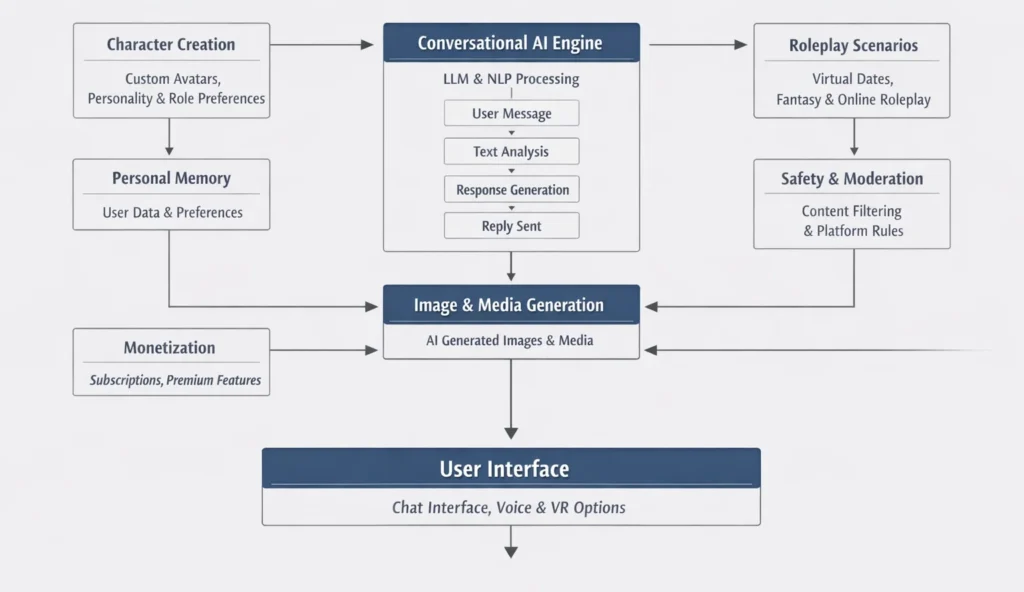
Users are liking AI chatbots more because they provide experience way beyond from the traditional way of consuming porn content online. Let’s have a detailed look at how AI chatbots work in adult industry.
Character Creation or Avatar Design:
AI chatbots can crate character that will have a unique voice style, overall clothing style, appearance and personality traits like romantic, dominant, friendly and possessive. Users can create avatars based on their preferences and interests. Even they can decide guidelines for the roleplay part and also the type of relationship they want to have with the AI chatbot or companion. One well known example we can have is Replika.
Conversational AI Engine:
The key technology feature behind AI chatbots is Large Language Model (LLM). These chatbots are trained on heavy datasets including:
1) Books
2) Websites
3) Conversations
4) Articles
5) Online Forms
6) Research reports
By using statistical language models, AI chatbot provide the most suitable and relevant answer whenever user sends a message. The process generally works in a way in which in the first step, the user sends a message. After that the system processes the text using natural language processing (NLP). The response afterwards is converted into numerical representations. Then the AI model analyses the context and predicts the most relevant response. In the end after processing and generating the response, AI model sends the message back as the final response.
Personalisation and Memory System:
Every AI chatbot model have this feature of saving some of the valuable and user relevant information like favourite colour, movie preference or username etc. So whenever the user asks something, the AI models can craft the response based on those memories which he saved about the user regarding their preferences, basic details and interests.
Roleplay System
Instead of having just a simple Q&A session, AI chatbots can provide different roleplay scenarios in a storytelling way. Like:
1) Going on a virtual date
2) Playing a fantasy character
3) Online dating
This works well because large learning models are trained heavily on Storytelling and dialogue structure. Through this the AI models can narrate the response based on the specific roleplay and situation.
Image And Media Generation
Many AI chatbots integrate AI generated images alongside the ongoing story to make the conversation or storytelling more interesting and engaging. Whenever the user asks for visuals of the ongoing story then AI model uses image generation models. These model work using a technology called diffusion models.
Monetization System
Most AI chatbots and companionship platforms function on a subscription based buisness model. Common revenue models include:
1) Subscription plans
2) Message limits
3) Image generation credits
4) Premium characters
5) Custom Character Creation
Safety Guidelines and Platform Rules
Adult platforms like AI chatbots must maintain content moderation systems. These systems filter out the content which violates legal regulations and platform policies. Moderation must involve main things like ethics, AI safety models and keyword filtering.
Interface and User experience:
The final and main component is user interface. Many AI chatbots use interface similar to social media platforms and messaging apps. The features in the interface include features like:
- chat windows
- character avatars
- typing animations
- voice responses
- media sharing
Some advanced platforms are also experimenting with:
1) Voice AI companions
2) VR integration
3) Animated characters
Users are liking AI chatbots more because they provide experience way beyond from the traditional way of consuming porn content online. Let’s have a detailed look at how AI chatbots work in adult industry.
Character Creation or Avatar Design:
AI chatbots can crate character that will have a unique voice style, overall clothing style, appearance and personality traits like romantic, dominant, friendly and possessive. Users can create avatars based on their preferences and interests. Even they can decide guidelines for the roleplay part and also the type of relationship they want to have with the AI chatbot or companion. One well known example we can have is Replika.
Conversational AI Engine:
The key technology feature behind AI chatbots is Large Language Model (LLM). These chatbots are trained on heavy datasets including:
1) Books
2) Websites
3) Conversations
4) Articles
5) Online Forms
6) Research reports
By using statistical language models, AI chatbot provide the most suitable and relevant answer whenever user sends a message. The process generally works in a way in which in the first step, the user sends a message. After that the system processes the text using natural language processing (NLP). The response afterwards is converted into numerical representations. Then the AI model analyses the context and predicts the most relevant response. In the end after processing and generating the response, AI model sends the message back as the final response.
Personalisation and Memory System:
Every AI chatbot model have this feature of saving some of the valuable and user relevant information like favourite colour, movie preference or username etc. So whenever the user asks something, the AI models can craft the response based on those memories which he saved about the user regarding their preferences, basic details and interests.
Roleplay System
Instead of having just a simple Q&A session, AI chatbots can provide different roleplay scenarios in a storytelling way. Like:
1) Going on a virtual date
2) Playing a fantasy character
3) Online dating
This works well because large learning models are trained heavily on Storytelling and dialogue structure. Through this the AI models can narrate the response based on the specific roleplay and situation.
Image And Media Generation
Many AI chatbots integrate AI generated images alongside the ongoing story to make the conversation or storytelling more interesting and engaging. Whenever the user asks for visuals of the ongoing story then AI model uses image generation models. These model work using a technology called diffusion models.
Monetization System
Most AI chatbots and companionship platforms function on a subscription based buisness model. Common revenue models include:
1) Subscription plans
2) Message limits
3) Image generation credits
4) Premium characters
5) Custom Character Creation
Safety Guidelines and Platform Rules
Adult platforms like AI chatbots must maintain content moderation systems. These systems filter out the content which violates legal regulations and platform policies. Moderation must involve main things like ethics, AI safety models and keyword filtering.
Interface and User experience:
The final and main component is user interface. Many AI chatbots use interface similar to social media platforms and messaging apps. The features in the interface include features like:
- chat windows
- character avatars
- typing animations
- voice responses
- media sharing
Some advanced platforms are also experimenting with:
1) Voice AI companions
2) VR integration
3) Animated characters
As we see that AI chatbots depend heavily on advanced technologies such as character customization, user interface and large language models. But the success of these platforms heavily depends on how many users these platforms are able to reach. With hundreds of AI chatbots and companion websites launching every year, simply creating the chatbot is not enough.
An adult business should also focus on brand discovery and the overall visibility. This is where SEO (Search Engine Optimization) for adult AI chatbot becomes essential.
At SEO Circular we specialize in helping digital platforms improve their search rankings and attract massive targeted traffic. From in depth keyword research and technical SEO optimization to content marketing and strategic link building. Our services are designed to help AI chatbot platforms build long-term organic growth and online authority.
The Importance Of SEO For AI Chatbot Platforms:
With the rise of AI chatbot industry, more platforms are entering the market with innovative features, interactive characters, and personalized user experiences. While developing advanced AI technology is Important, attracting users to the platform is equally important. Many AI chatbot websites struggle to gain visibility simply because potential users are unaware that these platforms exist.
This is where search engine optimization (SEO) becomes an essential growth strategy. SEO helps AI chatbot platforms appear in search engine results when users look for conversational AI tools, virtual companion platforms or interactive chatbot experiences. By optimizing website content, targeting relevant keywords, and improving technical performance, businesses can increase their chances of ranking higher on search engines.
For platforms functioning in competitive niches, including the adult AI chatbot industry, SEO can provide a consistent source of organic traffic without depending entirely on paid advertising. A strong SEO strategy allows platforms to attract users who are actively searching for AI-driven conversations and interactive digital experiences. Over time, this helps in building brand authority, increase user engagement and support long-term growth.
Step 1: Identify the Right Audience and Search Intent
Before starting any SEO strategy, it is important to understand who your target audience is and what they are searching for.
For adult AI chatbot platforms, users typically search for:
- AI companion platforms
- virtual AI girlfriend chat
- AI roleplay chatbots
- conversational AI experiences
- AI dating or relationship simulators
Understanding search intent helps you decide what type of content and landing pages your website needs.
For example:
- Informational searches – blog articles explaining AI chatbots
- Comparison searches – “best AI chatbot platforms”
- Transactional searches – landing pages for signing up
When you understand search behaviour then it becomes easier to build an effective SEO strategy.
Step 2: Perform Niche Keyword Research
Keyword research is the pillar of SEO for adult platforms. Because the niche is competitive, focusing only on broad keywords may not be enough.
A strong strategy includes three keyword layers:
Primary Keywords
These define the focus of your platform.
Examples:
- AI chatbot platform
- AI companion chatbot
- conversational AI chat
Supporting Keywords
These help expand the topical relevance of your content.
Examples:
- virtual AI chat
- AI chatbot features
- benefits of AI chatbots
- AI companion technology
Long-Tail Keywords
These are more specific queries that often have lower competition but strong user intent.
Examples:
- how AI companion chatbots work
- best AI chatbot platforms online
- AI chatbots for interactive conversations
Targeting long-tail keywords helps attract highly relevant traffic.
Step 3: Create SEO-Focused Content
Content is one of the most powerful ways to attract organic traffic.
For adult AI chatbot platforms, useful content topics may include:
- how AI chatbots work
- benefits of AI companions
- comparison guides of AI chatbot platforms
- future of AI relationships and digital companions
Educational content helps bring in users who are researching conversational AI technologies.
High-quality blog posts also increase topical authority, which improves overall search rankings.
Step 4: Optimize Landing Pages for Conversions
Adult chatbot platforms usually have sign-up or interaction pages where users start chatting with AI characters.
These pages should be optimized for both SEO and user experience.
Important elements include:
• clear keyword-optimized titles
• strong meta descriptions
• structured headings
• fast page loading speed
• clear calls-to-action
Landing pages should also clearly explain:
- platform features
- chatbot capabilities
- user experience
This helps search engines understand the page while also encouraging users to interact with the platform.
Step 5: Focus on Technical SEO
Technical SEO ensures that search engines can properly crawl and index your website.
Important technical factors include:
- mobile-friendly design
- fast loading speed
- secure HTTPS connection
- optimized site structure
- clean URLs
Adult chatbot platforms often use complex scripts and AI interfaces, so technical optimization is important to stop slow loading speeds or indexing issues.
A technically optimized website improves both search rankings and user experience.
Step 6: Build Authority with Backlinks
Backlinks are one of the most important ranking factors in SEO.
For adult AI chatbot platforms, backlinks may come from:
- technology blogs
- AI industry websites
- digital marketing blogs
- niche review platforms
High-quality backlinks signal to search engines that your website is trustworthy and relevant.
However, quality matters more than quantity. A few strong backlinks from authoritative websites can significantly improve search rankings.
Step 7: Build Topical Authority in the AI Niche
Search engines prefer websites that shows expertise in a specific topic.
To build topical authority, you should publish content covering different aspects of AI chatbots such as:
- conversational AI technology
- chatbot development trends
- AI companion psychology
- AI relationship simulations
The more related topics your website covers, the more likely search engines are to recognize it as an authority in the AI chatbot niche.
Step 8: Improve User Experience and Engagement
User behaviour signals play an important role in modern SEO.
Search engines analyse metrics such as:
- time spent on a page
- click-through rates
- bounce rates
- navigation behaviour
Adult chatbot platforms should create an engaging user experience through:
- intuitive interface design
- easy navigation
- fast chatbot responses
- visually appealing layouts
Better user engagement often leads to improved rankings.
Step 9: Track SEO Performance
SEO is not a one-time process. Platforms need to continuously monitor their performance.
Important metrics to track include:
- organic traffic growth
- keyword rankings
- search impressions
- click-through rates
Analysing this data helps identify which pages perform well and which areas require improvement.
Step 10: Scale the SEO Strategy
Once a website begins ranking for certain keywords, the next step is scaling the strategy.
This may involve:
- publishing more content
- targeting additional keywords
- building more backlinks
- optimizing older articles
Consistent optimization helps maintain long-term search visibility.
Conclusion
SEO is the most effective way to do the proper marketing and ranking of adult companionship platforms and adult chatbots. In this space, adult SEO marketing plays a crucial role. By doing proper target audience research, search intent and keyword research we can rank our website by doing SEO audit. A well planned SEO strategy can help attract better visibility, massive traffic and long term brand authority.
Success in this space depends on several key factors: choosing the right keywords, creating valuable content, maintaining strong technical performance and building authority through backlinks. When these elements work together, along with a strong adult SEO marketing approach, they help search engines understand the platform and rank it for relevant queries.
By following a structured SEO approach from keyword research and on-page optimization to content strategy and performance tracking adult chatbot platforms can steadily increase traffic, reach the right audience and strengthen their presence in a competitive market.
Commonly asked questions
SEO helps adult AI chatbot platforms attract organic traffic from users searching for conversational AI experiences, especially since many advertising networks restrict adult promotions.
Most mainstream ad networks limit or prohibit adult content advertising. Because of this, many adult chatbot platforms rely heavily on SEO, affiliate marketing, and niche promotions.
SEO typically takes several months to show noticeable results, but once rankings improve, adult chatbot platforms can receive consistent organic traffic.
Many users find adult AI chatbots through search engines, review websites, comparison blogs, and affiliate recommendations.
Yes, a large percentage of users access adult chatbot platforms through mobile devices, making mobile-friendly design essential for both user experience and SEO.
Advances in artificial intelligence and conversational technology are expected to make adult AI chatbots more realistic, personalized, and interactive.
The global porn industry has evolved into one of the largest digital entertainment economies in the world. Market estimates from multiple industry analyses show that the broader adult entertainment economy was already generating tens of billions in annual revenue by the mid-2010s. As digital distribution expanded and mobile consumption accelerated globally, the industry experienced steady financial growth. By 2024, the global porn industry revenue was estimated at around $90 billion, rising to approximately around $97 billion in 2025. Current projections place the market close to $100 billion in 2026, with continued expansion expected throughout the decade.
Unlike mainstream businesses, Porn platforms face :
1) Strict advertising restrictions
2) Payment compliance hurdles
3) Algorithm sensitivity
These hurdles make user acquisition far more difficult. Many new porn startups and adult platforms launch with strong content or innovative ideas but struggle to gain consistent search rankings and organic traffic in an increasingly competitive industry.
This is where SEO audit done in a strategic way becomes important.
At SEO Circular, we are helping adult brands, subscription platforms, and adult tech startups build sustainable visibility through search-driven growth strategies. By focusing on :
1)Ranking stability,
2)Niche keyword targeting
3)Traffic ownership
Adult businesses can move beyond unpredictable traffic sources and build long-term revenue pipelines.
Global Carbon Credit Market Snapshot
- Market size expected to cross $100 billion by 2030
- Demand driven by corporate net-zero commitments
- USA and Europe are the largest buyers
- Voluntary carbon market growing fastest
Key Takeaways
• The global adult industry is projected to reach $100B in revenue by 2026.
• Subscription platforms has become the most stable revenue model.
• Important tube sites like Pornhub and XVideos dominate the global traffic.
• Platforms like OnlyFans changed the industry toward direct fan monetization.
• Live cam platforms like Chaturbate and Stripchat generate revenue through tipping and tokens especially in cam live sessions.
• Mobile devices drive most adult content consumption worldwide.
• AI companion platforms are emerging as a fast-growing segment.
• SEO has become the primary traffic channel due to advertising restrictions.
Ready to Scale Your Porn Platform?
If you are planning to launch or scale an adult platform, search visibility is the key to long-term success. At SEO Circular, we specialize in SEO strategies designed specifically for adult websites.
Reach Out Today and Learn How We Can Help Your Platform Grow Through Organic Traffic.What Is Fueling The Global Adult Industry’s Rapid Growth?
The global adult industry did not reach the $90B–$100B revenue range by accident. Its growth is the result of several shifts in how adult content is produced, distributed, and monetized in the digital economy.
One of the biggest factor is the subscription-based creator economy. Platforms that allow creators to sell exclusive content directly to fans have transformed the traditional studio model. Instead of depending only on advertising or studio distribution, creators now generate recurring income through monthly memberships, premium content, and private communities.
Another major factor is the excessive usage and growth of mobile consumption. Today, a significant majority of adult traffic comes from smartphones. Faster internet speeds improved streaming infrastructure, and mobile-optimized platforms have made adult content more accessible than ever before.
The live cam industry has also played a major role in revenue expansion. Interactive platforms allow users to engage with performers in real time through tipping systems, tokens, and private sessions. This model generates higher user spending compared to passive video consumption.
Technology innovation is creating additional revenue streams as well. AI-driven adult platforms, virtual companions, and personalized fantasy experiences are starting to attract new audiences while increasing user retention on subscription platforms.
Finally the industry benefits from global digital reach. Emerging markets in Asia, Latin America, and Eastern Europe continue to contribute growing traffic volumes, while localization and regional payment solutions make monetization easier for platforms expanding internationally.
Together, these factors are changing the adult industry into a technology-driven, platform-based economy, where recurring subscriptions, user engagement, and global accessibility drive sustained revenue growth.
The Digital Giants Behind The Adult Content Economy
| Industry Segment | Major Platforms / Examples | Revenue Model | Estimated Share of Global Industry | Growth Trend |
| Tube & Free Content Networks | Pornhub, XVideos, XNXX, Men.com | Advertising, premium memberships, traffic partnerships | 30–35% | Stable growth driven by massive global traffic and advertising demand |
| Creator Subscription Platforms | OnlyFans, Fansly | Monthly subscriptions, pay-per-view content, tips | 25–30% | Fast growth as independent creators monetize directly |
| Live Cam & Interactive Platforms | Chaturbate, Stripchat, LiveJasmin | Token systems, private shows, tipping | 15–20% | High engagement model with consistent revenue growth |
| Adult Dating & Social Platforms | AdultFriendFinder and similar networks | Paid subscriptions, premium messaging, matchmaking | 10–12% | Moderate growth driven by niche communities |
| Premium Studio Content Platforms | Brazzers, Reality Kings, Men.com | Paid memberships and content licensing | 5–8% | Slower growth due to competition from free and creator platforms |
| AI-Powered Adult Platforms | Candy AI, CrushOn AI | AI companions, chat subscriptions, virtual experiences | 3–5% (rapidly growing) | One of the fastest-growing segments due to AI personalization |
The global porn industry has evolved from traditional studios into a platform-dominated digital ecosystem. Today, revenue and traffic are largely controlled by a handful of large-scale platforms that manage distribution, user engagement, and subscription systems.
Below are some of the most influential figures and players shaping the modern adult industry.
Free Content Networks and sites
The industry is functioning because of platforms like Pornhub, XVideos, and XNXX dominate the free adult content market. Also, premium brands like Men.com play a major role in this industry. These sites attract billions of monthly visits, producing revenue mainly through advertising, traffic partnerships, and premium upgrades.
Their huge traffic reach allows them to influence search visibility, content discovery, and global consumption trends.
Creator-Driven Subscription Platforms
The biggest important change in the adult industry came with platforms such as OnlyFans and Fansly, where individual creators monetize directly through paid subscriptions, private content, and tipping systems.
This model has transformed the industry by shifting power from studios to independent creators building their own subscriber communities.
Live Cam & Interactive Platforms
Real-time interaction platforms like Chaturbate, Stripchat, and LiveJasmin generate billions in revenue through token systems, tipping, and private shows.
These platforms rely on engagement-based monetization, where users pay for direct interaction rather than passive viewing.
Adult Dating & Social Platforms
Platforms such as AdultFriendFinder and other adult dating platforms survive on subscription tiers, premium messaging features, and matchmaking services, contributing significantly to the vast adult digital economy.
AI-Powered Adult Platforms
A new category is emerging with AI companion platforms like Candy AI and CrushOn AI. Such platforms provide personalized digital interaction through chat, roleplay, and voice experiences.
These platforms represent one of the fastest-growing segments of the adult market due to their recurring subscription models and high user engagement.
Brazzers Revenue 2026: Estimated Earnings & Growth Outlook
Brazzers, one of the most recognized premium adult content platforms, operates under the larger Aylo (formerly MindGeek) network. While the company does not publicly disclose exact financial data, industry estimates suggest a strong and stable revenue position.
By 2026, Brazzers is expected to generate hundreds of millions of dollars in annual revenue, primarily through its subscription-based model. Unlike free adult platforms, it focuses on paid memberships, exclusive content, and brand licensing, which provide consistent and predictable income.
The platform’s revenue is supported by:
- A strong global brand reputation
- High-quality studio-produced content
- A loyal subscriber base
- Integration with a broader adult content ecosystem
As the global adult industry approaches $100 billion in value by 2026, premium platforms like Brazzers continue to maintain a profitable niche. Ongoing trends such as mobile consumption, personalized content, and subscription-driven models are expected to further support its long-term growth.
The Emergence Of AI-Powered Adult Platforms
One of the newest developments reshaping the adult industry is the rise of AI-driven companion platforms and interactive adult applications. While traditional adult content has historically relied on video streaming and studio production, artificial intelligence is now introducing personalized digital experiences.
AI platforms allow users to interact with virtual companions through chat, voice interaction, and customizable personalities. Instead of passive content consumption, these systems create two-way engagement, increasing session time and user retention.
Several platforms have already built large user bases by offering subscription-based AI interaction models. These services typically operate on monthly memberships, allowing users to access personalized conversations, fantasy simulations, and private digital experiences.
From a business perspective, this model has several advantages:
• Lower production costs compared to studio content
• Strong recurring subscription revenue
• Higher user engagement and retention
• Global scalability without geographic limitations
Industry analysts are increasingly watching this segment closely because it represents a technology-driven expansion of adult entertainment, rather than a replacement of existing platforms. As artificial intelligence continues to improve, AI-powered companionship and interactive entertainment are expected to become a significant niche within the broader adult digital economy.
Where The Money Actually Comes From In The Adult Industry?
Despite massive traffic across adult platforms, revenue in the industry does not come from a single source. Instead, it is distributed across multiple monetization models that support different types of platforms and user behaviours.
One of the largest revenue streams comes from subscription-based platforms, where users pay monthly to access exclusive content or interact directly with creators. Platforms operating on membership models benefit from predictable recurring income and stronger user retention.
Another major revenue channel is live cam interaction, where viewers purchase tokens to tip performers, request private shows, or unlock premium experiences. This real-time engagement model generates billions annually through micro-transactions.
Advertising-based tube platforms also contribute significant revenue by monetizing enormous traffic volumes through display ads, affiliate promotions, and partner traffic distribution networks.
Beyond content platforms, the adult eCommerce market adds another large revenue layer through the sale of toys, wellness products, and lingerie. These businesses benefit from high purchase-intent traffic driven by adult content ecosystems.
More recently, AI-driven adult applications have introduced a new monetization model built around digital companionship and personalized interaction subscriptions.
Together, these revenue streams create a complex digital economy where traffic, engagement, and recurring billing determine long-term profitability.
Regional Markets Powering The Growth Of The Global Porn Industry
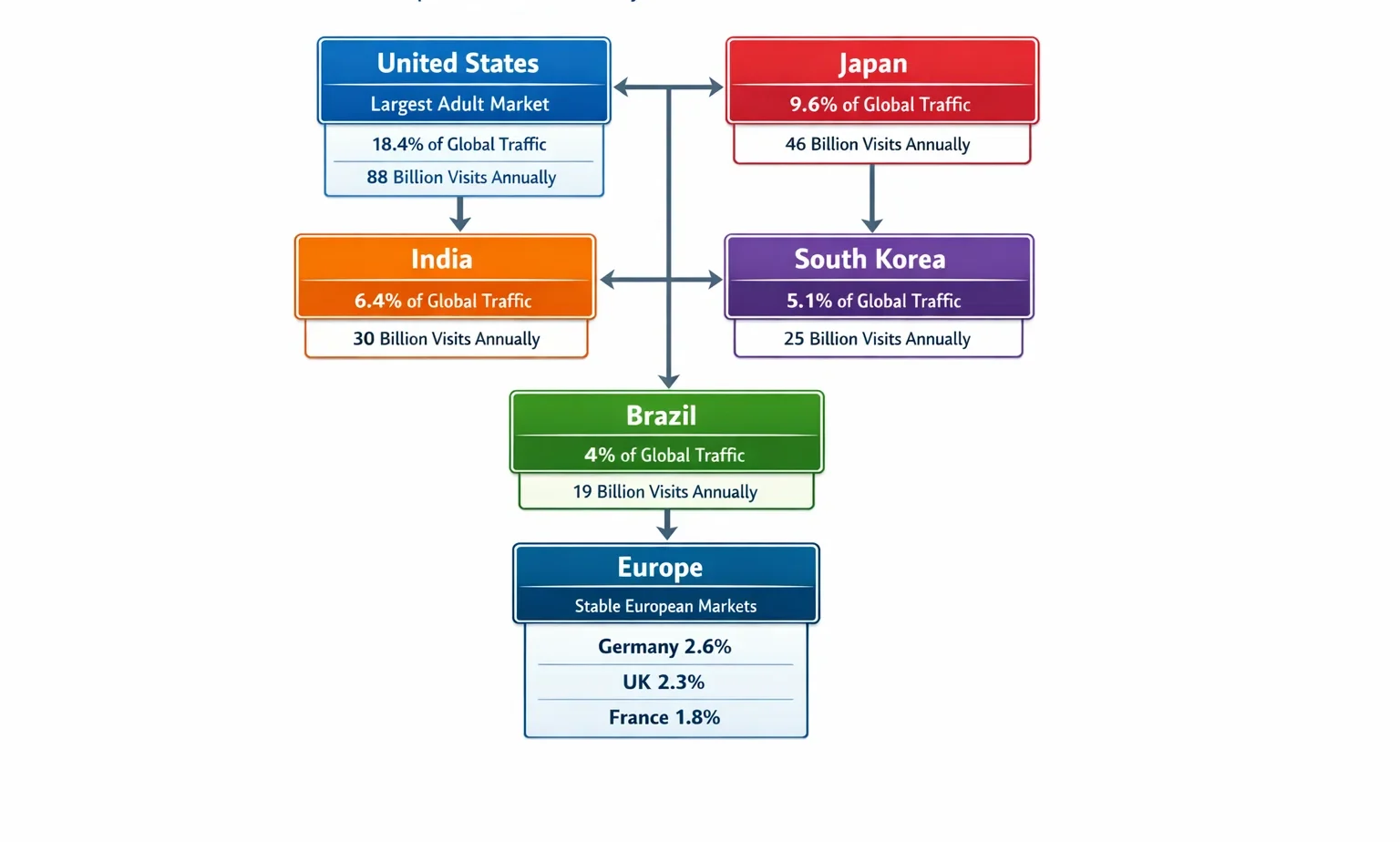
The global adult industry is powered by massive traffic from a handful of high-consumption regions. Recent market analysis shows that the top 19 countries account for nearly 70% of global adult website traffic, highlighting how concentrated demand is worldwide.
Below are the regions and countries generating the largest share of global traffic.
United States – The Largest Adult Market
The United States remains the biggest contributor to global adult traffic, accounting for about 18.4% of worldwide visits, or roughly 88 billion annual visits to adult platforms.
High disposable income, subscription adoption, and creator platforms like OnlyFans have made North America one of the most profitable regions for adult platforms.
Japan – One Of The Strongest Asian Markets
Japan ranks second globally, generating around 9.6% of total adult website traffic, equivalent to 46 billion visits annually.
Japan’s long-established adult entertainment industry and strong digital infrastructure contribute to consistent user engagement across both video platforms and subscription services.
India – Massive Traffic From A Mobile-First Audience
India represents around 6.4% of global adult traffic, with over 30 billion visits annually. Rapid smartphone adoption, cheaper mobile internet, and a large digital population make India one of the fastest-growing traffic sources in the global adult market.
South Korea – High Engagement And Rapid Growth
South Korea contributes approximately 5.1% of worldwide adult traffic, nearly 25 billion visits annually.
Strong broadband penetration and high digital engagement levels have helped the country become one of the most active adult content markets in Asia.
Brazil – Leading Adult Market In Latin America
Brazil generates roughly 4% of global adult traffic, representing around 19 billion annual visits.
Brazil’s large online population and high mobile consumption have made it the largest adult content market in Latin America.
Europe – Stable And High-Value Markets
Several European countries consistently rank among the top global consumers:
- Germany: ~2.6% of global traffic (12.7B visits)
- United Kingdom: ~2.3% of global traffic (11.3B visits)
- France: ~1.8% of global traffic (nearly 9B visits)
Europe is considered one of the most stable revenue regions, driven by subscription platforms, premium content services, and adult eCommerce.
Why Regional Markets Matter For The Industry?
These regional patterns reveal a clear trend:
Adult industry growth is increasingly driven by mobile-first global audiences.
As internet penetration expands and payment systems improve worldwide, platforms that localize content, language, and payment options are better positioned to capture the next wave of international growth.
Regional Porn Industry Market Distribution By Country (Traffic Share)
The Chart below will explain the regional market share of each country and how much they are contributing in the porn industry on global basis.
The regional adult industry chart highlights how global traffic and revenue potential are distributed across the world’s largest digital markets. A small group of countries generates the majority of visits to adult platforms, making them the most influential regions for industry growth.
Below is a simplified breakdown based on estimated traffic share from major adult platforms.
| Country | Estimated Global Traffic Share | Key Market Insight |
| United States | 18–19% | Largest revenue-generating market with strong subscription adoption |
| Japan | 9–10% | One of Asia’s most established adult entertainment markets |
| India | 6–7% | Massive mobile-first audience and rapidly growing traffic |
| South Korea | 5% | High internet penetration and strong user engagement |
| Brazil | 4% | Leading adult market in Latin America |
| Germany | 2.5–3% | Strong European subscription and premium content market |
| United Kingdom | 2–2.5% | High spending audience across multiple adult platforms |
| France | 1.5–2% | Consistent traffic from mature digital consumers |
What the Chart Reveals?
The chart shows a clear geographic pattern. North America and Asia dominate total traffic volume, while Europe contributes stable high-value users. Emerging markets such as India and Brazil are driving large increases in global traffic due to expanding mobile internet access.
For adult platforms, these regions represent the most important markets for user acquisition, content localization, and long-term revenue growth.
Why Organic Search Traffic Is The Lifeline Of Adult Websites?
For most adult platforms, organic search traffic is the most reliable and scalable way to acquire users. Because paid advertising options are heavily restricted, search engines remain the primary gateway through which users discover adult content, platforms, and services.
Every day, millions of users search for adult videos, cam platforms, dating services, and AI companion experiences. Websites that appear on the first page of search results capture the majority of this traffic, which directly translates into subscriptions, ad revenue, and product sales.
Unlike paid campaigns that stop generating traffic once the budget runs out, SEO-driven visibility creates long-term traffic assets. A well-optimized website can continue attracting users for months or even years through high-ranking pages.
Another advantage of organic traffic is high intent. Users searching specific keywords such as niche content, platforms, or services are already looking for solutions. This makes them more likely to subscribe, engage, or purchase compared to users reached through generic advertising.
However, ranking in the adult niche requires more than basic SEO practices. Technical optimization, content structure, domain authority, and compliance with search guidelines all play a crucial role in maintaining stable rankings.
For adult businesses looking to compete in this highly restricted environment, organic search visibility is not just a marketing channel, it is the foundation of sustainable growth.
This is where working with specialists makes a real difference. At SEO Circular, we help adult platforms overcome ranking barriers, build search authority, and turn organic traffic into scalable growth.
What Startups Should Know Before Entering the Adult Industry?
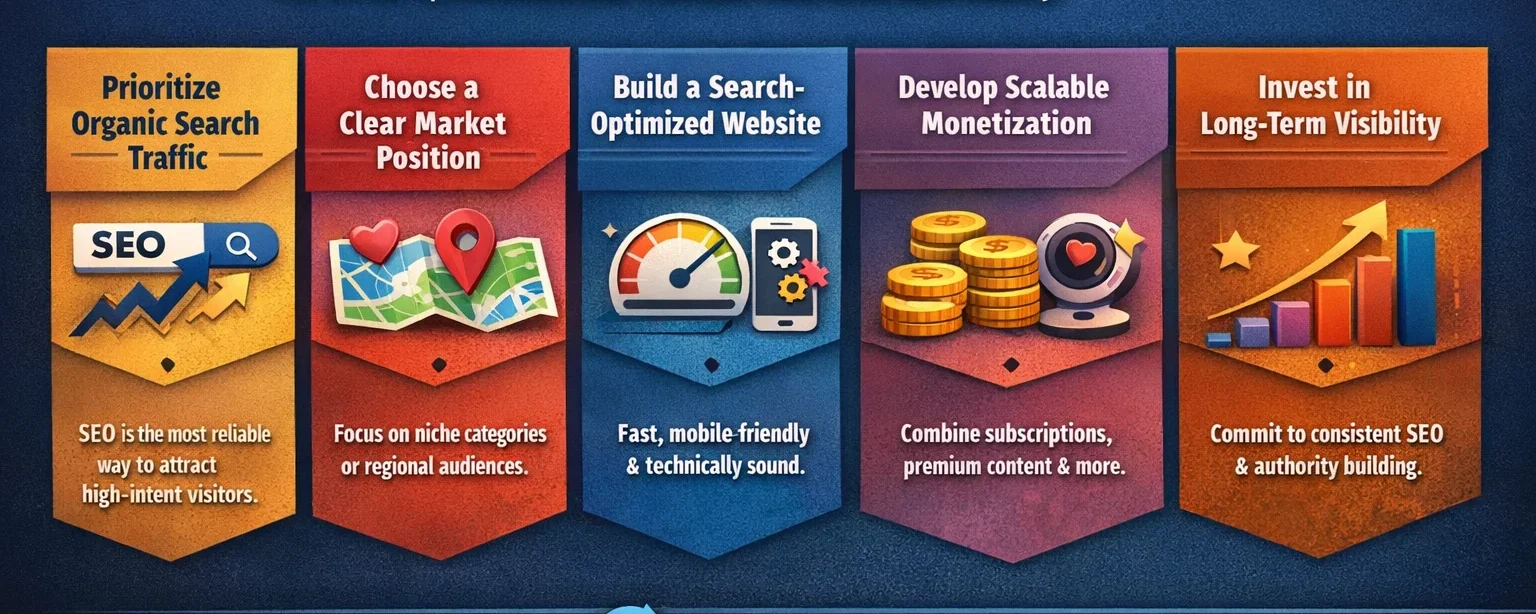
The global adult industry generates billions in revenue, but entering the market successfully requires more than launching a website or publishing content. The real challenge is attracting consistent traffic and turning visitors into paying users.
For entrepreneurs planning to launch or promote an adult platform, understanding how the industry operates online is critical.
Based on our experience working with adult websites at SEO Circular, we usually advise new brands to focus on the following:
1. Prioritize Organic Search Traffic
Paid ads are heavily restricted in the adult niche. SEO becomes the most reliable way to attract long-term, high-intent traffic.
2. Choose a Clear Market Position
Instead of competing directly with massive tube sites, new businesses should focus on niche categories, regional audiences, or specialized platforms.
3. Build a Search-Optimized Website Structure
Fast loading speed, mobile optimization, and strong technical SEO are essential for ranking adult websites.
4. Develop Scalable Monetization Models
Successful platforms combine subscriptions, premium content, affiliate partnerships, or live interaction systems to generate revenue.
5. Invest in Long-Term Visibility Strategy
Ranking in the adult industry is highly competitive. Platforms that invest early in SEO and authority building gain a major advantage.
At SEO Circular, we help adult startups and established platforms build strong search visibility, attract targeted traffic, and scale their websites in one of the most competitive digital markets.
Where The Global Adult Industry Is Headed Next?
The global adult entertainment industry has grown dramatically over the past decade. Industry estimates suggest that in the mid-2010s the market was valued around $40–$50 billion, driven largely by tube platforms and studio-produced content. By 2024, global adult industry revenue had already crossed roughly $90 billion, reflecting the massive shift toward digital subscriptions, live streaming, and creator-driven platforms.
Growth continued in 2025 with the market approaching $95 billion, and projections indicate the industry could reach around $100 billion during 2026. This steady expansion highlights how adult entertainment has evolved from a traditional media niche into a large-scale digital platform economy.
One of the biggest structural changes behind this growth is the rise of creator-driven subscription ecosystems. Direct fan subscription platforms have collectively paid over $10 billion to creators, proving that direct monetization models are reshaping how revenue flows across the industry.
Consumer behaviour has also shifted significantly toward mobile-first content consumption. Today, more than 70% of global adult traffic comes from mobile devices, allowing platforms to reach new audiences in emerging markets while improving user engagement and streaming accessibility.
Another emerging trend is the demand for niche and personalized digital experiences. Instead of competing only for massive traffic volumes, many platforms are building premium ecosystems around targeted communities, memberships, and interactive services that generate higher lifetime customer value.
Looking ahead, the future of the industry will depend on technology adoption, platform innovation, and regulatory adaptation. As infrastructure, payment systems, and compliance frameworks evolve, businesses that control their audience relationships and organic visibility will be best positioned to capture the next wave of industry growth.
Conclusion
The global adult entertainment industry has evolved into a multi-billion-dollar digital ecosystem, growing from an estimated $40–$50 billion market in the mid-2010s to nearly $100 billion by 2026. Platforms driven by subscriptions, live interaction, creator monetization, and emerging AI experiences are continuing to reshape how revenue flows across the industry.
However, growth in market size does not automatically translate into easy opportunities. Competition for visibility is intensifying as a small group of high-authority platforms dominate traffic, while advertising restrictions and compliance requirements make user acquisition increasingly complex.
For startups and new platforms entering the market, the real challenge is not just building a product but building discoverability and trust at scale. Strong search visibility, niche positioning, and sustainable traffic systems are becoming critical for long-term success.
At SEO Circular, we believe that the brands that focus on strategic SEO, targeted audience acquisition, and compliance-ready infrastructure will be the ones most likely to capture meaningful market share in the years ahead. we help adult startups and established platforms build strong search visibility, attract targeted traffic related to the target audience, and scale their websites in one of the most competitive digital markets.
Helpful Answers to Popular Questions
The global porn industry is projected to reach around $100 billion in 2026, driven by subscription platforms, live cam services, adult eCommerce, and emerging AI-driven companion platforms.
The adult entertainment market has grown from roughly $40–$50 billion in the mid-2010s to nearly $90 billion by 2024, showing consistent annual growth fueled by digital platforms and mobile consumption.
Major revenue-generating platforms include tube sites, creator subscription platforms, live cam networks, adult dating apps, and adult product eCommerce stores.
Most advertising platforms restrict adult content promotion. Because of these limitations, organic search traffic becomes one of the most reliable ways for adult websites to attract visitors and grow sustainably.
Yes. AI companion platforms and virtual interaction services are emerging as a fast-growing segment of the adult industry by offering personalized experiences and subscription-based revenue models.
If you search “how to promote brothel on Google,” the first thing you will see is a very clear answer: it is banned, restricted, or not allowed. And yes, direct Google Ads promotion for compensated sexual services is prohibited under Google’s advertising policies. But here is what most business owners misunderstand. While you cannot promote a brothel through Google Ads directly, you absolutely can promote a brothel business online using structured organic and inorganic marketing strategies. In 2026, the global sexual wellness and adult services market is valued between USD 58 to 60 billion and is expected to cross USD 75 billion before 2030. More than 60 percent of adult service discovery now starts online. That means visibility still drives revenue. The difference is not whether promotion is possible. The difference is how it is executed.
At SEO Circular, we work with adult brands operating in policy-sensitive environments. We see this confusion very often. Business owners assume “Google banned ads” means marketing is impossible. That is not true. Brothel promotion works through two structured paths: inorganic marketing and organic marketing. Inorganic channels include PPC on compliant networks, paid media, affiliate marketing, third-party display ads, influencer collaborations, and native platforms like Taboola or Outbrain where policies permit traffic redirection. Organic channels include SEO, content marketing, local search optimization, social media strategy, Reddit visibility, and community engagement. In this guide, we explain what Google blocks, what it allows, and how to build a compliant adult marketing strategy that protects your business while still driving traffic and revenue.
Key Takeaways
- Google Ads does not permit brothel advertising or compensated sexual services
- Violations result in immediate and often permanent suspension
- We can use organic as well as inorganic marketing strategies within guidelines
- Adult ad networks can be used within their own rules
- Legal compliance must come before any marketing effort
- Policy aware strategy protects business reputation and revenue
60% of Adult Discovery Starts Online?
Are You Visible? If your business is not ranking organically, competitors are capturing your bookings. We specialize in policy-aware adult SEO that protects accounts, domains, and long-term revenue.
👉 Request a Free Visibility Audit
Does Google Allow Brothel Advertising?
No. Google Ads strictly prohibits advertising content that promotes sexual acts in exchange for compensation. This falls under their adult content and sexual services restrictions. Businesses that attempt to promote brothels, escort services offering explicit transactions, or similar compensated sexual services will face immediate account suspension.
And in most cases, suspension happens without warning.
We have seen businesses lose not just one campaign, but entire ad accounts permanently.
What Google’s Sexual Content Policy Actually Prohibits
Google’s advertising policies are clear and enforced globally. The following categories are explicitly banned from Google Ads:
- Sexually explicit content
- Content involving minors or non-consensual themes
- Promotion of sexual acts in exchange for payment
- Ads or landing pages targeting minors
- Graphic adult content in ad creatives or destination pages
Even indirect wording can trigger automated review flags.
This is where many adult business owners make mistake. They assume subtle language will bypass policy. It rarely works long term.
Why Violations Lead to Immediate Suspension
Google categorizes compensated sexual services as egregious violations.
That means:
- No warning notice
- No temporary suspension
- Immediate account shutdown
- Possible blacklisting of associated domains
Once flagged, recovery is extremely difficult.
We always tell our clients this clearly. Trying to bypass Google Ads rules is not strategy. It is short term risk with long term damage.
Sustainable adult SEO requires legal awareness, platform policy understanding, and structured risk control. Below is a simplified framework we follow to keep businesses safe and scalable.
| Focus Area | What It Involves | Why It Matters |
| Legal Compliance | Following local laws, licensing rules, and age verification | Prevents fines, shutdowns, or legal trouble |
| Google & Platform Policies | Respecting Google Ads and content guidelines | Avoids account suspension and domain bans |
| Safe Content Strategy | Using compliant wording and structured pages | Protects rankings and prevents de-indexing |
| Secure Hosting & Data Protection | SSL, privacy policies, secure servers | Builds trust and avoids data issues |
| Payment Compliance | Using adult-friendly, approved payment processors | Prevents sudden payment freezes |
| Clean Link Building | Building quality backlinks only | Avoids SEO penalties |
| Long-Term SEO Planning | Organic growth instead of risky ads | Creates stable traffic and revenue |
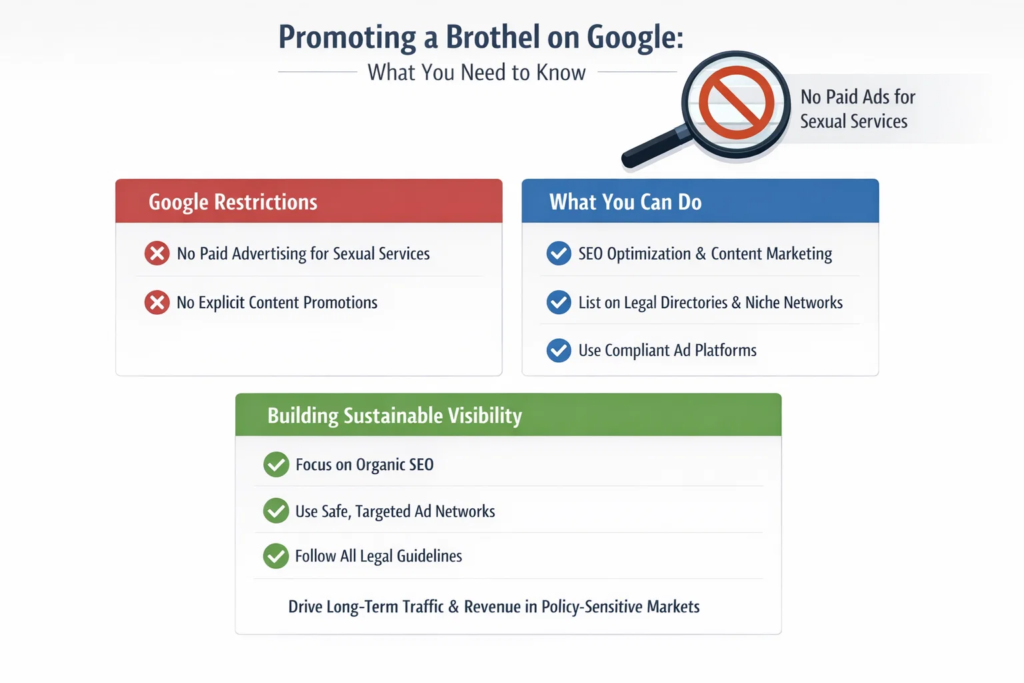
Organic vs Inorganic Brothel Promotion Strategy
Once we understand that direct Google Ads promotion is restricted, the real question becomes: how do brothel businesses actually market online?
The answer lies in dividing strategy into two clear categories.
1. Inorganic Promotion (Paid Channels)
Inorganic marketing refers to paid visibility channels outside standard Google Ads.
This can include:
• Adult-friendly PPC networks
• Third-party display advertising
• Banner ads on niche adult websites
• Affiliate marketing partnerships
• Influencer collaborations
• Native advertising platforms like Taboola and Outbrain where policy permits
These channels can generate faster traffic. However, they require:
Higher budget
Strict platform compliance
Constant monitoring
We often see businesses rush into paid traffic without understanding platform rules. In adult niche, one violation can shut down traffic overnight.
2. Organic Promotion (Long-Term and Safer)
Organic marketing focuses on building sustainable visibility without relying on paid ads.
This includes:
• Adult SEO
• Location-based landing pages
• Blog and content marketing
• Local SEO
• Reddit and Quora engagement
• Social media presence with age restrictions
• Authority-based content clusters
Organic traffic takes longer to build. But once rankings stabilize, it creates consistent revenue without ad account risk.
At SEO Circular, we usually prioritize organic SEO first. Paid traffic can support growth, but organic authority protects long-term stability.
Here’s a simplified breakdown presented in table format for easier understanding:
| Factor | Inorganic Promotion (Paid) | Organic Promotion (SEO & Content) |
| Traffic Speed | Fast results | Slow but steady growth |
| Cost Structure | Ongoing ad spends required | Investment in content & SEO |
| Risk Level | Higher (policy violations can suspend accounts) | Lower (no ad account dependency) |
| Sustainability | Stops when budget stops | Long-term and compounding |
| Compliance Monitoring | Constant monitoring required | Lower risk once optimized |
| Best For | Quick exposure & scaling | Stable long-term revenue |
Traffic Strategy Distribution for Adult Businesses
When promoting a brothel or legal adult service business online, traffic should never depend on a single channel. Sustainable growth comes from balanced distribution. Based on our experience working with policy-sensitive industries, we recommend allocating traffic focus as follows:
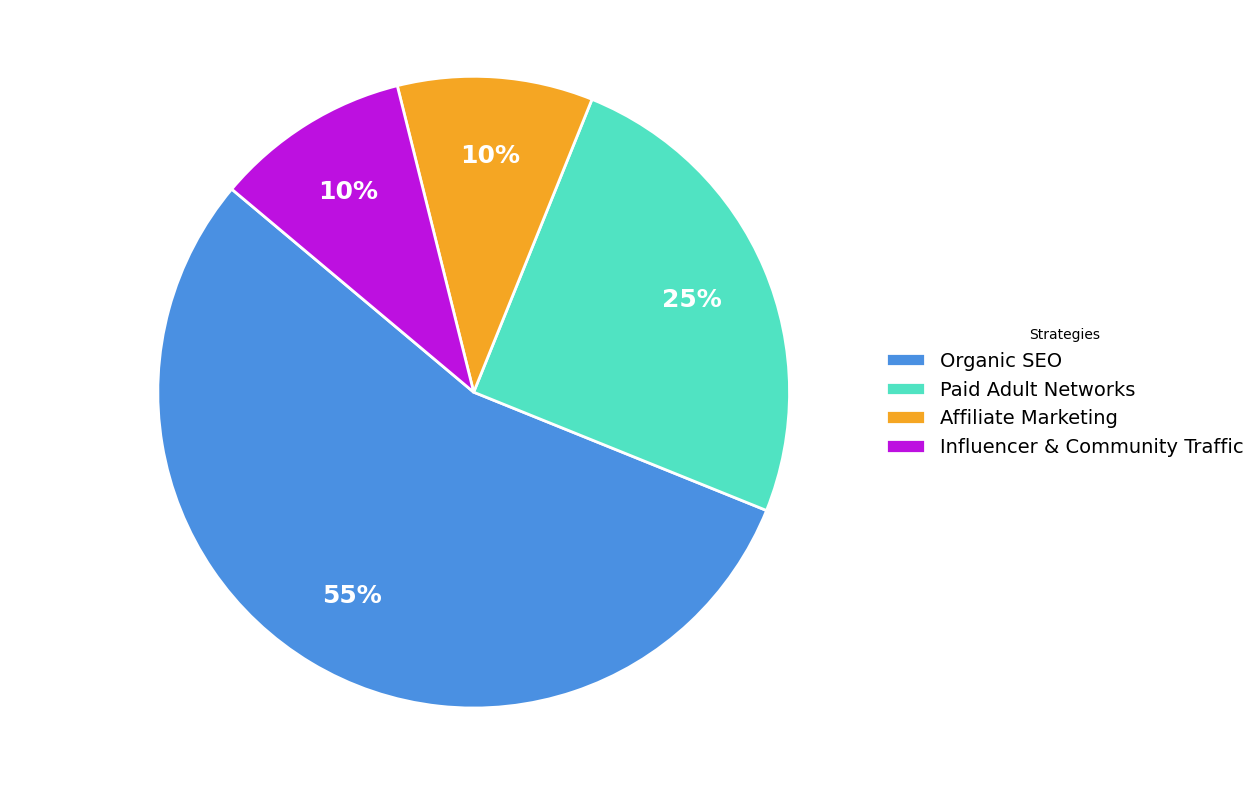
Why Organic SEO Should Lead (55%)
Organic search remains the most stable channel. Once rankings are established, traffic continues without daily ad spend. It also reduces dependency on platforms that may suspend accounts.
SEO builds:
- Long-term visibility
- Location-based discovery
- Brand authority
- Sustainable bookings
Paid Adult Networks (25%)
Adult-friendly PPC networks and display platforms can generate faster exposure. However, traffic stops when budget stops. Compliance monitoring is also critical.
Paid traffic should support growth, not replace organic foundations.
Affiliate Marketing (10%)
Affiliate partnerships with niche publishers and adult directories can expand reach. This model works well when commissions are structured correctly and tracking is transparent.
Influencer & Community Traffic (10%)
Reddit communities, adult forums, and influencer collaborations drive trust-based traffic. While volume may be smaller, conversion intent can be high.
Strategic Insight
The biggest mistake adult businesses make is over-relying on paid ads. A traffic model weighted toward organic SEO creates long-term revenue stability. Paid and affiliate channels should amplify visibility, not control it.
This balanced structure reduces risk, protects brand reputation, and supports sustainable growth even in restricted advertising environments.
Matching Search Intent to Increase Rankings and Bookings
Search intent means understanding what a person truly wants when they type a query into Google. They are not just entering keywords. They are expressing their goals. In adult service marketing, search intent mainly falls into two clear categories, and each requires a different type of page structure.
1. Informational Intent
This is when someone is researching and looking for answers, not booking immediately. Common examples include searches like “Is brothel legal in Nevada?” or “What to expect at a licensed brothel?”
Users at this stage want:
• Clear explanations about laws and regulations
• Safety and privacy information
• Guidance on how services work
• Differences between service types
If your website provides detailed, easy to understand answers, Google sees it as helpful and trustworthy. This builds authority, increases organic visibility, and attracts top of funnel traffic that may convert later.
2. Transactional Intent
This is when someone is ready to take action. They search terms like “Legal brothel near me” or “Book VIP escort Las Vegas.”
Users at this stage want:
• Exact location details
• Pricing clarity
• Availability information
• Strong call to action
• Direct contact or booking options
If your page does not immediately provide these elements, users leave and conversions drop. Transactional pages must be direct, mobile friendly, and focused on booking. Many adult websites fail because they mix these two intents incorrectly. They publish blog content targeting booking keywords or try to rank service pages for research questions. When content does not match intent, rankings decline. The right approach is structured and simple. Informational pages attract and educate. Transactional pages convert. When both are built correctly, traffic grows steadily and bookings increase naturally.
The Importance of Legal Compliance
This is critical. Adult services laws vary significantly between countries and even cities.
Before marketing:
- Confirm business legality in your jurisdiction
- Register business properly
- Follow tax regulations
- Implement age verification systems
- Use clear consent and privacy policies
Marketing cannot fix a compliance problem.
We often advise clients to consult legal professionals before launching large campaigns. It protects the business in the long term.
How SEO Circular Helps Adult Businesses Grow Safely
At SEO Circular, we focus on sustainable adult SEO and compliant digital growth strategies.
We do not push risky shortcuts.
Here is how we support adult brands:
Policy Aware SEO Strategy
We structure content in a way that ranks but avoids policy triggering language.
This balance is very important.
Risk Controlled Link Building
Adult backlinks require careful placement. We audit every domain before building authority.
This prevents toxic signals that harm rankings.
Technical SEO for Adult Sites
Many adult websites suffer from:
- Slow loading speeds
- Hosting instability
- Poor indexing
- Thin content
We fix these foundational issues first.
Reputation Management
Search results shape public perception. We help control branded search visibility through structured content strategies.
Long Term Organic Growth
Instead of chasing ad loopholes, we build:
- Location pages
- Informational clusters
- Conversion optimized landing pages
- Structured metadata
This creates traffic that is stable and scalable.
This is where most adult sites struggle. They try aggressive marketing first without building strong foundation.
We reverse that.
Restricted Industry. Complex Policies. Zero Room for Mistakes.
We help adult brands scale using structured SEO, risk-controlled paid media, and long-term authority building. No shortcuts. No policy violations. No unstable tactics.
👉 Book a Confidential Strategy Consultation TodayConclusion
Promoting a brothel directly on Google Ads is not allowed. The platform’s policies are clear and strictly enforced.
However, legal adult businesses can still grow online using compliant methods like SEO, structured content marketing, and adult specific advertising networks.
At SEO Circular, we help adult brands navigate these restrictions intelligently. We understand how to position websites, structure content, and build rankings without triggering penalties or violating platform policies.
Growth in this sector is possible. But it must be done correctly, legally, and strategically.
Shortcuts almost always cost more later.
FAQs
No. Google prohibits advertising sexual acts in exchange for compensation.
Yes. Organic SEO is allowed as long as content complies with search engine guidelines and local laws.
Many are, depending on jurisdiction. Always verify local laws and platform policies.
For egregious violations, suspension is immediate and often permanent.
We provide policy aware SEO, technical optimization, compliant content strategy, and safe backlink building tailored specifically for adult industry websites. If you operate in a high risk niche, strategy matters more than ever.
OnlyFans is not just a content platform anymore. It is a full-scale, multi-billion dollar creator economy. Recent industry reports show that OnlyFans has paid out over $10+ billion to creators, with more than 3 million creators and 200+ million users worldwide. And in 2026, the competition is not just high, it’s serious. The platform has matured. The audience has matured. And the creators who are winning today are operating very differently than they did a few years ago. So here’s the simple truth.
Just posting content is no longer enough to grow.
If you want to build a profitable OnlyFans marketing strategy in 2026, you need more than consistency. You need structure. That means building:
- Traffic from Google and social media
- Clear personal brand positioning
- A proper conversion funnel setup
- Subscriber lifetime value growth strategies
- Smart automation systems that reduce burnout
We’ve seen a clear shift in the market. The highest earning creators are not just posting and hoping for subscriptions. We are building predictable traffic sources. They are growing communities outside OnlyFans. They are using structured upsell systems to increase revenue per subscriber. In short, they treat their OnlyFans like a real business, not a side hustle. At the same time, promotion in this space must be handled carefully. Running ads without understanding platform rules can quickly lead to rejected campaigns or account suspensions. One wrong step can block major traffic sources and slow growth instantly. This is where safe marketing becomes critical.
At SEO Circular, we provide specialized and compliant OnlyFans search engine optimization services designed specifically for high-risk niches. Our promotion strategies follow advertising policies and platform guidelines strictly. We understand compliance, ad restrictions, and search visibility challenges in the adult industry. Our focus is simple. Build safe, scalable promotion systems that bring real subscribers, not just empty clicks.
When people search on Google:
- “how to promote onlyfans”
- “onlyfans marketing strategy 2026”
- “how to get more subscribers on onlyfans”
- “onlyfans promotion tips”
They are not looking for vague advice. They want clear, actionable systems that help them grow safely and consistently. In this guide, we’re going to break down a complete OnlyFans growth strategy for 2026. Not hacks. Not shortcuts. A real business model approach to building predictable subscribers, increasing lifetime value, and scaling like a brand.
🚀 Ready to Build a Scalable OnlyFans Growth System?
If you’re serious about turning your OnlyFans into a scalable revenue asset, it’s time to move beyond trial and error. At SEO Circular, we build compliant, performance-driven marketing systems that deliver predictable, sustainable growth.
👉 Book a Strategy Consultation and Start Scaling with Structure.
Key Takeaways
- OnlyFans growth in 2026 depends on building strong external traffic sources.
- SEO, Reddit, and Twitter (X) bring high-intent subscribers who convert better.
- Retention and conversion matter more than going viral.
- AI and automation help increase revenue while reducing burnout.
- Paid ads only work when backed by a proper funnel system.
- Reputation management protects your long-term brand and income.
OnlyFans Market Growth & Revenue Opportunity (2023–2026)
Before you build a strong OnlyFans marketing Team, you need to understand one thing first -the platform is growing fast, and it’s evolving just as quickly. OnlyFans is not some small creator app anymore. It has become a serious part of the global creator economy, and that economy keeps expanding every single year. More users are joining. Lot of creators are entering. Make money is flowing through the platform. If you’re planning to grow in 2026, you’re stepping into a competitive but massive opportunity. To give you a clear picture, here’s a simple breakdown of how OnlyFans has grown over the past few years.
| Year | Total Users (Estimated) | Active Creators | Creator Payouts | Market Trend |
| 2023 | 170+ Million | 2.5+ Million | $8 Billion+ | Rapid Expansion |
| 2024 | 190+ Million | 2.8+ Million | $9 Billion+ | Competitive Growth |
| 2025 | 210+ Million | 3+ Million | $10 Billion+ | Market Maturity |
| 2026 (Projected) | 230+ Million | 3.3+ Million | $12 Billion+ | Enterprise-Level Competition |
What This Data Shows
- The number of users on OnlyFans keeps increasing every year, which means the audience is still expanding.
- More creators are joining the platform, so competition is becoming more intense.
- The overall revenue potential is rising, with higher payouts and bigger spending across the platform.
- The market is becoming more professional, with creators operating like structured digital brands.
The opportunity is still massive, but easy and effortless growth is no longer realistic.
Revenue Breakdown Potential
| Creator Level | Monthly Traffic Needed | Avg Conversion | Estimated Monthly Revenue |
| Beginner | 5,000 Visitors | 3% | $3,000–$5,000 |
| Intermediate | 20,000 Visitors | 4% | $15,000–$25,000 |
| Advanced | 50,000+ Visitors | 5% | $50,000+ |
Why Most Creators Fail at OnlyFans Marketing
Most creators don’t struggle because their content is bad. They struggle because they treat OnlyFans like it runs on autopilot. There’s this old mindset of “post daily and the fans will come.” Maybe that worked back in 2020 when competition was lower and the platform felt new. In 2026, it’s a different game. Competition is intense. Platforms are stricter. Attention spans are shorter. The market is more mature and more strategic.
Simply uploading content is not a marketing strategy anymore. The biggest mistake we see? Creators focus only on making content, not on building a growth system around it. They spend hours shooting and posting but almost no time thinking about distribution, conversion, or retention. But OnlyFans today is performance-driven. It rewards creators who think beyond content and focus on numbers. To grow sustainably, you need a system that combines:
- Clear niche positioning that makes you stand out
- Social media traffic growth that brings consistent visitors
- SEO-driven discovery from Google search
- Conversion funnel optimization that turns visitors into subscribers
- Automated upsell flows that increase revenue per fan
- Long-term retention strategies that keep subscribers paying
Another big mistake is relying only on internal OnlyFans traffic. The platform does not promise exposure. If you are not bringing in external traffic from Twitter (X), Reddit, or Google, your growth will always feel random and unstable. We also see many creators ignore data completely. Don’t track conversion rates. Also don’t monitor churn. They don’t calculate lifetime value. Without analytics, scaling becomes guessing. And guessing is expensive. The truth is simple. Content matters, but content alone will not scale you. Growth in 2026 comes from structure, systems, and consistent optimization.
Take a Look at This Helpful Resource: Sexual Wellness SEO Strategies
Understanding the OnlyFans Algorithm
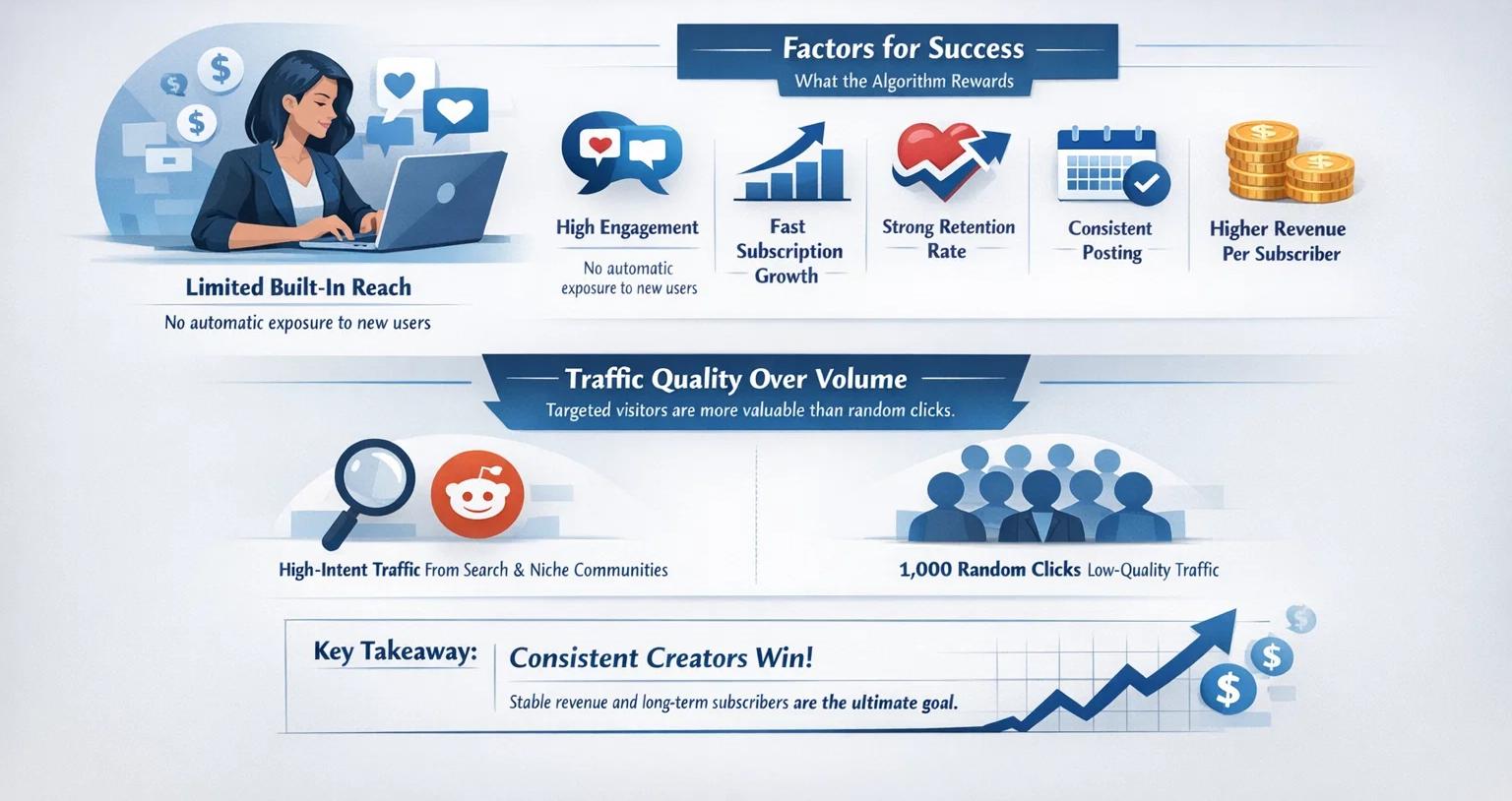
OnlyFans does not work like Instagram or TikTok where you can rely heavily on internal discovery. There is limited built-in reach. The platform will not automatically push your content to thousands of new users just because you posted. But that does not mean there is no algorithm. There is. And it pays attention to performance. OnlyFans SEO Agency rewards accounts that show strong signals such as:
- High engagement rate through likes, comments, and messages
- Fast and steady subscription growth
- Strong retention rate
- Consistent posting behavior
- Higher revenue per subscriber
In simple terms, the platform favors creators who make money consistently and keep subscribers active. This is why traffic quality matters more than traffic volume. Ten high-intent visitors from Google or a niche Reddit community can be more valuable than 1,000 random clicks. When you bring in users who are already searching for your niche, they engage more. They stay longer. They spend more. That improved engagement feeds back into the platform signals. Better engagement improves internal visibility. The algorithm ultimately rewards creators who generate stable revenue and maintain long-term subscribers, not just short bursts of activity.
Personal Brand Positioning & Niche Strategy for OnlyFans
OnlyFans is crowded. Millions of creators are competing for the same attention. The creators who win are not the most explicit — they are the most positioned.
Positioning answers one simple question:
Why should someone subscribe to you instead of thousands of others?
We always advise creators to define three things clearly:
Micro-Niche Identity
Instead of “model” or “fitness girl,” define a search-based niche like:
- “Cosplay OnlyFans creator”
- “MILF OnlyFans model”
- “Goth gamer OnlyFans”
- “Luxury lifestyle OnlyFans”
These are actual keywords users type on Google.
Audience Persona
Who is your ideal subscriber?
- Age group
- Income level
- Fetish or interest category
- Spending behavior
High-ticket creators know their audience deeply.
Value Proposition
What makes your page different?
- Daily exclusive drops?
- Custom content?
- VIP Snapchat access?
- Girlfriend experience?
Branding is everything. Banner, bio, pinned posts, welcome message — all must communicate a clear theme.
Creators who treat their OnlyFans like a business — not random content posting — see higher subscription conversions and longer retention.
SEO for OnlyFans Creators
Most creators ignore the biggest traffic source in the world: Google.
If your goal is to promote OnlyFans profile on Google, you must build assets outside the platform that search engines can properly index and rank.
Every month, thousands of users search:
- “how to promote onlyfans”
- “best onlyfans creators 2026”
- “free onlyfans leaks”
- “Ai onlyfans model”
- “onlyfans discount link”
This is high-intent traffic. These users are already looking.
Step 1: Build a Traffic Asset
OnlyFans pages do not rank well on Google alone. That’s why serious creators build:
- Personal website
- Landing page with blog content
- Link hub optimized with keywords
- SEO-optimized Reddit threads
A simple WordPress site targeting keywords like:
- “OnlyFans marketing strategy”
- “how to get more subscribers on OnlyFans”
- “[your niche] OnlyFans creator”
can bring consistent organic traffic.
Step 2: Target Long-Tail Keywords
Long-tail keywords convert better than broad terms.
Instead of targeting “OnlyFans model,” target:
- “tattoo blonde OnlyFans creator”
- “cosplay anime OnlyFans page”
- “fitness Latina OnlyFans subscription”
These are exact-match search terms users type.
Step 3: Authority & Backlinks
Google ranks trust. Creators who get featured in niche blogs, Reddit communities, or digital PR platforms gain authority faster.
This is where structured SEO matters. At SEO Circular, we build enterprise-level SEO systems that turn search visibility into revenue, not just traffic
About SEO Circular
. Our approach includes technical SEO, keyword mapping, authority link building, and performance tracking
SEO Circular Services
— the same framework creators can adapt to scale their brand.
SEO is not optional. It is a growth multiplier.
Twitter (X), Reddit & Telegram Funnel Strategy
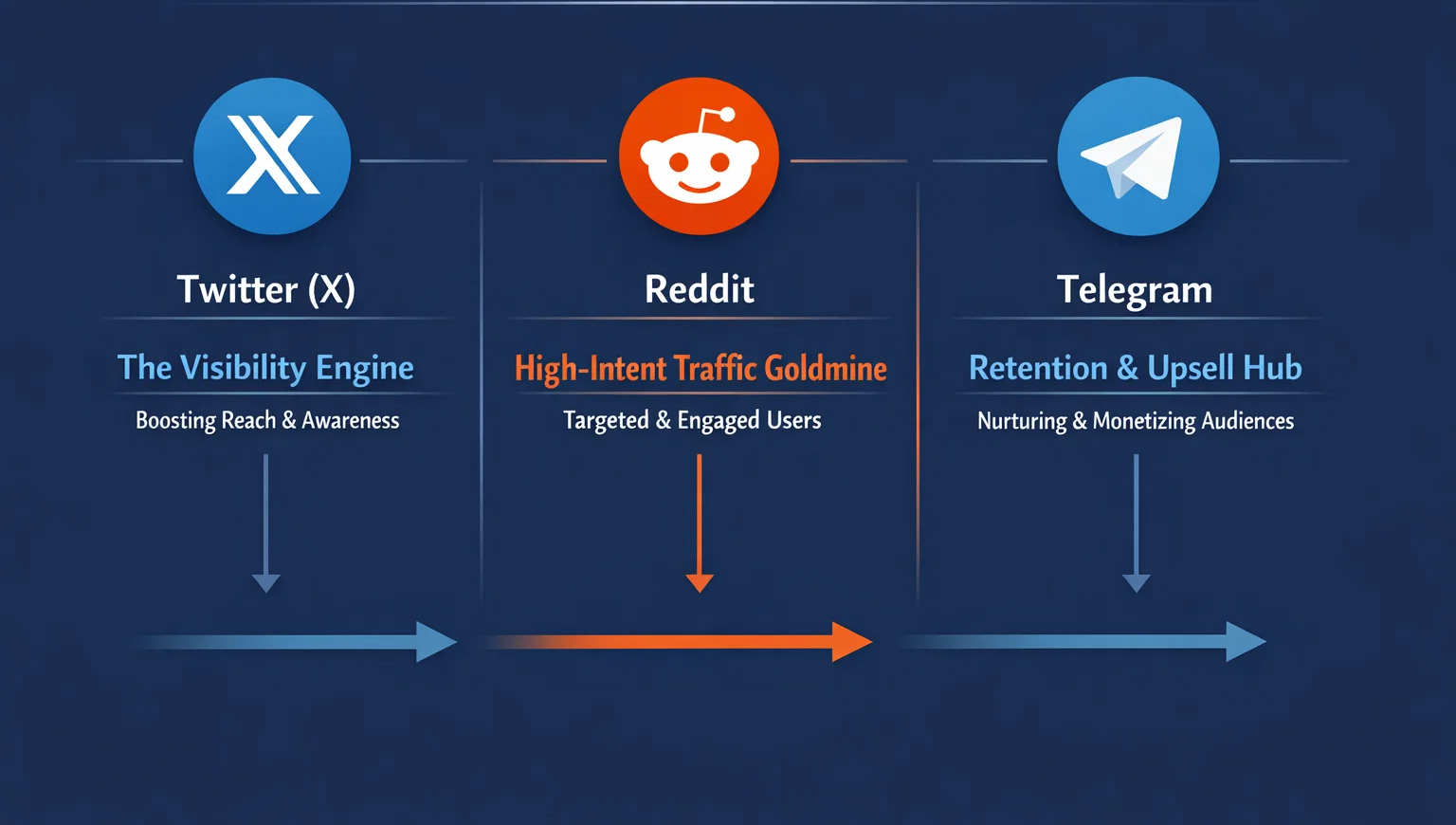
Social platforms are not for “posting.” They are for building a conversion funnel.
Top creators do not rely on OnlyFans internal traffic. They build external ecosystems that push high-intent users into paid subscriptions.
Twitter (X): The Visibility Engine
Twitter (X) remains the #1 traffic driver for adult and creator niches.
What works in Upcoming Years:
- Consistent posting (3–5 times daily)
- Thread-style storytelling
- Teaser clips with soft CTA
- Pinned tweet with limited-time offer
- Profile bio optimized with keywords like “OnlyFans creator” or your niche
The goal is not likes. The goal is profile clicks → link clicks → subscription.
Creators who treat Twitter like a content distribution channel — not a random posting space — see higher conversion rates.
Reddit: High-Intent Traffic Goldmine
Reddit converts extremely well when done correctly.
Strategy:
- Identify niche-specific subreddits
- Follow each subreddit rule strictly
- Post value-driven content, not spam
- Add subtle CTA in comments (not aggressive promotion)
Search-based subreddits aligned with your niche bring users who are already interested.
Reddit traffic often converts 2–3x better than viral social traffic.
Telegram: Retention & Upsell Hub
Telegram is not just for traffic. It’s for:
- VIP community access
- Daily teaser drops
- Flash discount announcements
- High-ticket custom content offers
Creators who build private communities increase subscriber lifetime value significantly.
Social media builds attention.
Telegram builds loyalty.
OnlyFans monetizes it.
Automation, Conversion & Revenue Growth Systems
The biggest difference between average creators and high earners is systems. Automation directly improves conversion rate and overall revenue. Instead of managing everything manually, successful creators use structured processes that control how traffic turns into paying subscribers and how subscribers turn into long-term profit.
Top creators build systems around:
- Content scheduling
- Direct message automation
- Fan segmentation
- Upsell timing
- Smart pricing strategy
A simple automated flow may look like this:
- New subscriber → Immediate welcome message
- Day 2 → Premium content offer
- Day 5 → Bundle or package offer
- Weekly → High-value upsell message
This structured approach increases conversion rate and raises average revenue per user.
Retention is part of the same system. Keeping a subscriber for three months is far more profitable than constantly searching for new subscribers.
Strong retention systems focus on:
- Personalized messages
- Exclusive content drops
- Limited-time special offers
- Interactive posts and polls
When automation, conversion, and retention work together, revenue becomes more stable and predictable.
Traffic brings users.
Conversion turns them into subscribers.
Retention turns them into long-term profit.
Paid Ads & Traffic Arbitrage Strategy
Organic traffic alone is slow. Top creators now combine SEO + social + paid traffic to scale faster.
But here’s the truth:
You cannot directly run ads to OnlyFans on most platforms.
That’s where traffic arbitrage and funnel structuring come in.
Step 1: Use a Landing Page Buffer
Instead of linking ads directly to OnlyFans, creators use:
- A personal website
- A link-in-bio landing page
- An email capture page
- A Telegram join page
This avoids ad policy violations and warms up traffic before conversion.
Step 2: Paid Traffic Sources That Work
Creators experiment with:
- Twitter (X) ads (where allowed)
- Reddit ads
- Native advertising networks
- Push traffic networks
- Influencer shoutouts
- Affiliate partnerships
The key is not cheap clicks — it’s profitable subscribers.
If you spend $500 on ads and generate $2,000 in subscription + upsell revenue, that’s scalable.
Step 3: Retargeting for Higher ROI
Most visitors don’t subscribe immediately.
Smart creators install:
- Meta Pixel (on website buffer)
- Google Tag Manager
- Retargeting ads
This allows them to bring visitors back with:
- Discount offers
- Limited-time bundles
- Exclusive VIP drops
Paid traffic works only when funnel + retention is optimized.
Risk Management, Compliance & Reputation Control
Scaling an OnlyFans brand is not just about growth — it is also about protection.
Many creators lose accounts, payment access, or brand value because they ignore compliance, platform rules, and online reputation management.
If you are treating OnlyFans like a business, you must protect it like one.
Platform Policy & Content Compliance
Every creator should regularly review OnlyFans terms and payment processor policies.
Common risks include:
- Copyright violations
- Using restricted keywords in ads
- Third-party content misuse
- Inconsistent age verification
- Chargeback disputes
A single violation can result in demonetization or account suspension.
Smart creators diversify income streams and build external assets (website, email list, Telegram community) so they are not 100% dependent on one platform.
Payment & Chargeback Protection
High chargeback rates can trigger financial restrictions.
To reduce risk:
- Clearly communicate content type
- Avoid misleading previews
- Maintain professional customer interaction
- Document custom content agreements
Trust reduces refund requests.
Online Reputation Management
Google visibility matters.
If someone searches your name + “OnlyFans,” what appears?
Creators with strong SEO presence, branded websites, and controlled search results protect long-term brand value.
Reputation control is not optional. It is brand insurance.
The Future of OnlyFans Marketing Beyond 2026
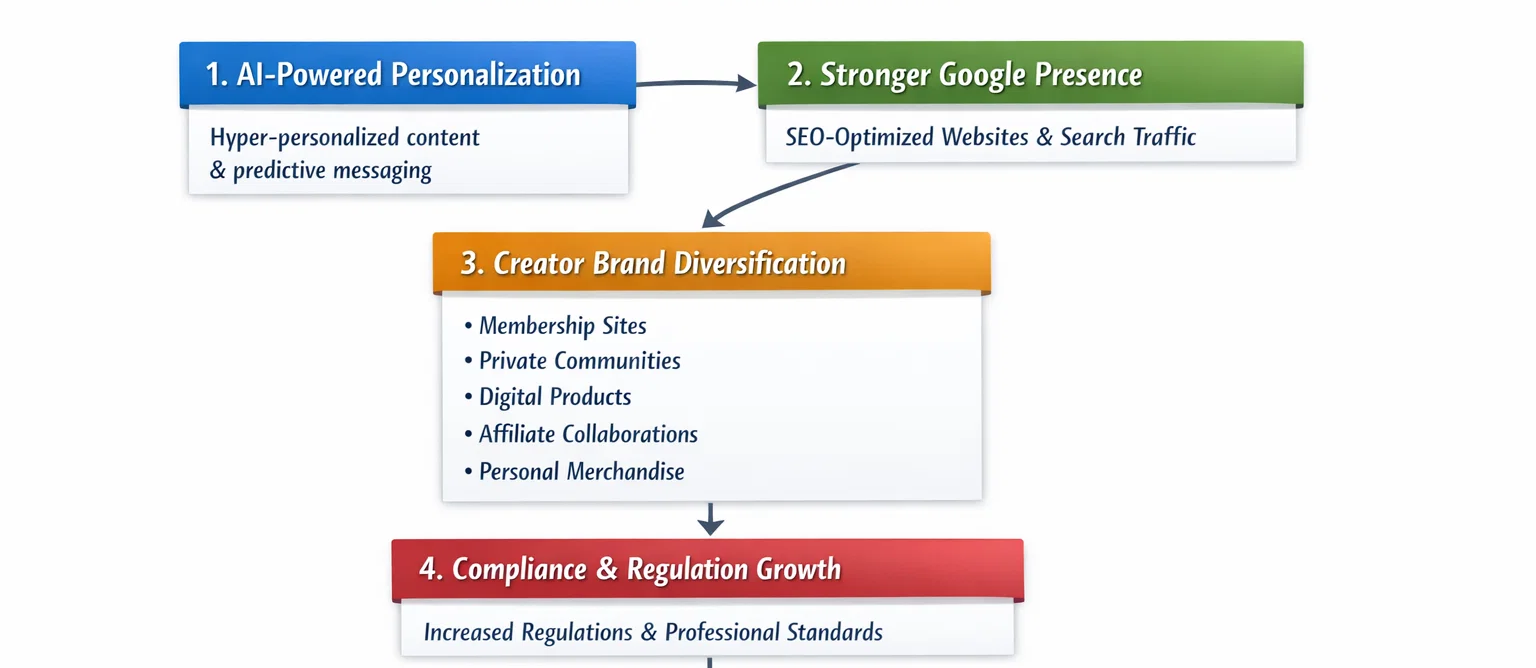
AI, personalization, and search dominance will shape the next evolution of OnlyFans marketing.
Here’s what we expect:
1. AI-Powered Personalization
Subscribers will expect hyper-personalized content recommendations. Automated segmentation and predictive messaging will become standard.
2. Stronger Google Presence
Creators with SEO-optimized websites will outperform platform-dependent creators. Search-based traffic will become the most stable income source.
3. Creator Brand Diversification
Smart creators will expand into:
- Membership websites
- Private communities
- Digital products
- Affiliate collaborations
- Personal brand merchandise
Relying on one platform will be considered risky.
4. Compliance & Regulation Growth
As the creator economy expands, regulations will increase. Professional structure and brand control will become essential.
The future belongs to creators who think beyond today’s posts and build assets that compound over time.
OnlyFans beyond 2026 belongs to those who build systems.
How SEO Circular Help Scale OnlyFans Brands with Structured Marketing Systems
Scaling an OnlyFans brand today requires more than content ideas and social posting. It requires the same enterprise-grade SEO, funnel optimization, digital PR, and analytics frameworks we implement for global clients.
Most creators struggle not because of effort — but because they lack structured growth systems. Traffic is inconsistent. Conversion tracking is missing. Retention is unmanaged. Revenue becomes unpredictable.
That’s where advanced marketing infrastructure changes everything.
At SEO Circular, we operate as a specialized Adult SEO Agency, helping high-risk and creator-led brands build compliant, scalable marketing systems. We approach OnlyFans growth like a performance-driven digital brand.
We apply structured systems across:
- Technical SEO & keyword mapping
- Competitor and search intent analysis
- Authority link building & digital PR
- Conversion rate optimization (CRO)
- Funnel tracking & analytics integration
- Online reputation management
These are not experimental tactics. They are the same frameworks behind our enterprise-level execution across industries, adapted specifically for creator-led brands that want scalable, long-term revenue.
Instead of chasing viral spikes, we build:
Traffic Asset → Conversion Funnel → Retention Engine → Predictable Revenue Growth.
Because sustainable growth is never random.
It is engineered.
🚀 Ready to Dominate the OnlyFans Market in 2026?
The creators who dominate in 2026 don’t rely on luck. They rely on data, systems, and optimization. If you want enterprise-grade SEO, conversion engineering, and compliant growth infrastructure working behind your brand, we should talk.
👉 Let’s Build Your OnlyFans Growth Framework Together.Conclusion:
The OnlyFans landscape in 2026 is more competitive, more advanced, and more strategic than ever before.
Creators who rely only on posting content struggle with slow growth and inconsistent income. But creators who treat their page like a digital brand — with SEO, funnel systems, paid traffic strategy, automation, and retention models — build predictable and scalable revenue.
The winning formula is clear:
- Build external traffic assets (SEO + social funnels)
- Optimize conversion like a landing page
- Increase lifetime value with upsells
- Protect your brand with compliance and reputation management
- Automate operations to avoid burnout
OnlyFans is no longer just about content. It is about positioning, systems, and long-term brand building. Those who think like entrepreneurs will dominate 2026.
FAQs
It really depends on how you approach it. If someone is just posting consistently and hoping for discovery, growth can take several months. But when there’s a proper plan behind it — things like SEO, social funnels, and sometimes paid promotion — progress tends to happen much faster. Most creators who treat it like a business start seeing clearer traction within a couple of months. The key isn’t going viral. It’s building steady traffic and converting it properly.
Yes, and the difference is noticeable. Agencies usually treat OnlyFans like a performance-based business. They look at data, test different approaches, refine funnels, and focus heavily on retention and upsells. It’s less about guessing and more about tracking what works. Solo creators often rely on instinct, while agencies build repeatable systems. That structured mindset is what allows larger operations to scale.
They can, but not in a straightforward way. Most advertising platforms don’t allow direct linking to adult content. Because of that, creators typically send traffic to a landing page or community first. From there, users are guided toward the subscription. Paid traffic only becomes profitable when the funnel behind it is strong. Without that structure, ads usually just waste budget.
Anyone serious about growth should understand their numbers. That includes how many visitors turn into subscribers, how long subscribers stay, and how much each one spends over time. If running ads, knowing the cost per subscriber also matters. When creators understand these basics, decisions become strategic instead of emotional.
Not on its own. Social platforms are unpredictable. Algorithms change, accounts get restricted, and reach can drop overnight. Relying on a single platform is risky. Creators who build multiple traffic sources — search traffic, niche communities, email lists — create more stability. The more control you have over your traffic, the safer your income becomes.
Retention often matters more. Bringing in new subscribers takes time, effort, or money. Keeping existing ones engaged is usually far more profitable. When subscribers feel valued and consistently receive quality interaction or exclusive content, they stay longer. Over time, that makes a bigger impact on revenue than constantly chasing new sign-ups.
Content creation on OnlyFans is one of the most popular ways to make money online today, but it’s not as easy as it seems. You cannot just post content and wait for income to appear. It requires a clear strategy, smart promotion and consistency in efforts to actually grow.
The biggest challenge is traffic generation as OnlyFans doesn’t provide strong discovery features or an internal search system like Instagram or YouTube. If people don’t already know you, chances are high that they won’t find your profile. This limits your audience to only those who are already aware of you. To get traffic and earn well, creators need to understand their audience, plan what they post and promote themselves on platforms like Instagram and YouTube to bring in Traffic. Some creators also try random methods like spamming Reddit, running risky ads, buying fake traffic and even posting links on Twitter. But this probably can turn out risky and lead to account warning, ad rejections and wasted revenue.
The real problem is this: If there’s no strategy guiding your account, even top-quality content can stay invisible.
And when creators try to fix this by running paid ads, another problem appears. Platforms like Google Ads have strict policies around adult content. Directly promoting your OnlyFans links can result in ad disapprovals or even account suspensions. One wrong move can block your access to a powerful traffic source. Promotion is not just about paying money to run paid ads, it’s about doing everything right way. Policy safe marketing methods are what separate growth from risky shortcuts. At SEO circular, we offer specialized and safe OnlyFans SEO services with promotion strategies that work within the platform rules. We understand compliance requirements, advertising restrictions and safe promotion systems that bring real subscribers, not just empty clicks. To help you understand the process clearly, let’s go through the most common questions first:
- Can you promote OnlyFans on Google?
- What ad networks allow adult marketing?
- How to drive organic traffic from Google?
- How to avoid bans and ad suspensions?
- When to hire a professional marketing team?
In this blog, we’ll break it down from the basics for more understanding.
Ready to Launch a Policy-Safe Growth Funnel?
If you want to promote your OnlyFans the correct way — without risking ad bans or account suspension — our bridge-page strategy is built to protect and convert. 🚀 Let SEO Circular build your compliant funnel today.
Book a Consultation and Start Scaling Safely.
Key Takeaways
• Promoting OnlyFans on Google safely requires a proper funnel, not direct linking
• Organic SEO traffic brings more stable and high intent subscribers than ads
• A personal website is essential for long term growth and control
• Targeting niche keywords helps you reach the right audience faster
• Content and backlinks together build authority and improve rankings
• Technical SEO ensures your site is trusted and visible on Google
What Is OnlyFans Promotion Today?
OnlyFans promotion these days is no longer about dropping your link everywhere and hoping something clicks. That approach rarely works now. Today, successful creators focus on building a simple, structured system that brings the right people from Google, ad networks, and social platforms – and then guides them step-by-step toward becoming paying subscribers. A few years ago, things were easier. Many creators relied on platforms like Twitter or Reddit for traffic. Posts could reach thousands of people organically, accounts were less likely to get flagged, and sharing direct links was common. But the landscape has changed as of 2026.
Today’s reality:
- Ad platforms have strict rules around adult content
- Direct OnlyFans links often get rejected
- Social platforms limit explicit promotion
- Organic reach keeps dropping
So what actually works now?
Three Step Strategy for OnlyFans Promotion in 2026
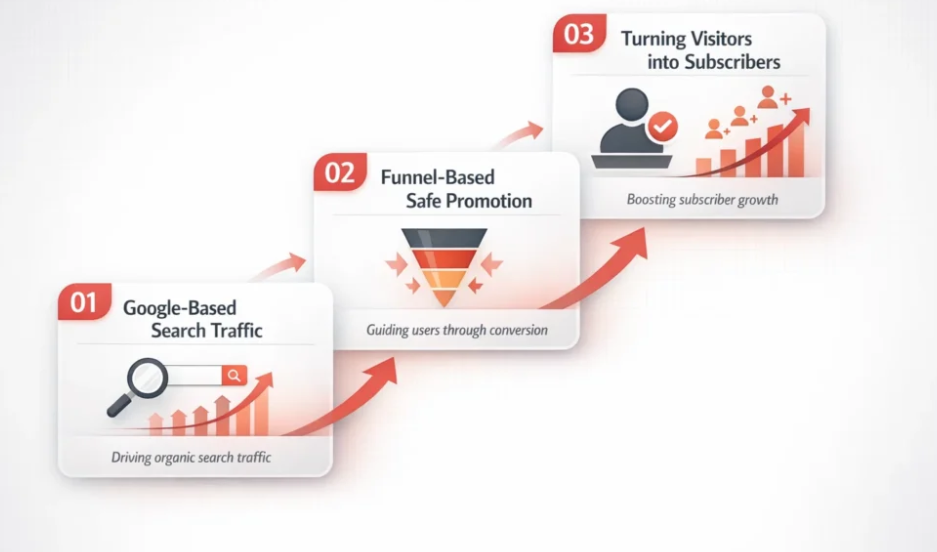
1) Google-Based Search Traffic
Instead of promoting your profile directly, creators now build search-friendly pages that appear on Google when people look for specific content. These pages act like a safe bridge – helping interested users discover you while staying within platform rules. And this is important: landing pages in this industry are very different from normal websites. They need the right structure, wording, and compliance setup to actually convert visitors into subscribers.
2) Funnel-Based Safe Promotion
Sending ads straight to OnlyFans is risky. Smart promotion sends people first to safer destinations like:
- Landing pages
- Age-verified profiles
- Email signup pages
- Blog-style content pages
This protects ad accounts and keeps your traffic sources stable.
3) Turning Visitors into Subscribers
Getting clicks is only half the job. What really matters is converting visitors into paying fans.
This involves:
- Tracking what users are interested in
- Showing follow-up promotions to warm audiences
- Positioning your content in a way that builds curiosity and trust
Most creators stop at “getting traffic,” which is why they struggle to grow.
Can You Promote OnlyFans on Google?
One of the most common questions creators ask is, “Can I promote my OnlyFans on Google Ads?” The honest answer is: Not directly. Platforms like Google Ads have strict rules about adult and subscription-based content. If you send people straight to your OnlyFans profile, your ad will most likely get rejected. If it keeps happening, your ad account can also get suspended. Direct promotion usually gets blocked because of:
- Adult or suggestive words in the ad
- Linking straight to adult subscription platforms
- Content that breaks sexual content rules
- Trying to redirect users to bypass policies
That said, promotion is still possible. Creators who grow successfully use safe landing pages and simple funnels instead of sending traffic directly to their profile.
Why Google Rejects Direct OnlyFans Promotion
Google allows some adult advertising, but explicit content and direct links to adult subscription sites are heavily restricted. If you try to:
- Run ads directly to your OnlyFans page
- Use explicit language in your ads
- Promote adult subscriptions openly
Your ads will likely be disapproved. Repeated violations can lead to:
- Ad account suspension
- Business account restrictions
- Your website domain getting flagged
Losing a Google Ads account can seriously hurt your ability to grow because it removes a major traffic source.
Is OnlyFans Advertising Completely Banned?
No, but there are strict rules. Google allows limited adult-related ads if they follow guidelines such as:
- No explicit images
- No sexual wording in ad copy
- Proper age targeting
- No direct links to adult subscription pages
This is where many creators go wrong. They try shortcuts instead of using safe methods that work within the rules. Creators who grow long term focus on compliant promotion strategies that bring real subscribers without risking their accounts.
The Correct Way to Promote OnlyFans Using Google
At SEO Circular, we use a safe bridge-page approach to promote OnlyFans profiles. Instead of sending people directly to an OnlyFans link, we guide them to a compliant page that follows Google Ads policies first. This reduces the risk of ad suspension while still keeping conversions strong. Our process focuses on building a funnel that feels natural to users and safe for ad platforms.
- Google-compliant landing page: We create a clean, policy-friendly page that introduces the creator without explicit content, making it suitable for advertising platforms.
- Neutral branding and safe language: The page uses wording and visuals that stay within guidelines while still attracting the right audience.
- SEO and intent optimization: We structure the page so it can rank on search engines and match what users are actually looking for.
- Traffic directed to the landing page: Paid ads send visitors to this safe page instead of directly to OnlyFans, which protects the ad account.
- User-controlled transition to OnlyFans: Visitors can then choose to continue to the subscription platform, which keeps the process compliant.
This approach protects your advertising assets while bringing in visitors who are genuinely interested and more likely to subscribe.
Tired of Ad Rejections and Warnings?
Build a growth system that keeps your ad account safe while increasing real subscriptions.
👉 Get Your Compliant OnlyFans Marketing Plan Today.Why SEO Is More Powerful Than Ads for OnlyFans
Paid ads can deliver quick traffic, but they stop the moment you pause your budget. Search visibility works differently. When your pages rank on Google, they can bring consistent visitors every day without ongoing ad spend. For example, when someone searches for terms like “private exclusive content creator,” “premium cosplay subscription,” or “VIP fitness content membership,” they already have interest. If your page appears at that moment, the chances of conversion are much higher. This is why SEO plays a major role in long-term growth. We focus on building a strong foundation that keeps working over time:
- Search-focused content pages: Pages built around what people are actively searching for.
- Authority backlinks: Trusted links that improve credibility and rankings.
- Technical improvements: Optimizations that help pages load faster and perform better.
- Conversion-focused structure: Layouts designed to turn visitors into paying subscribers.
The goal is steady, long-term visibility instead of short traffic spikes that disappear once ads stop.
How to Grow your OnlyFans Profile with Google SEO
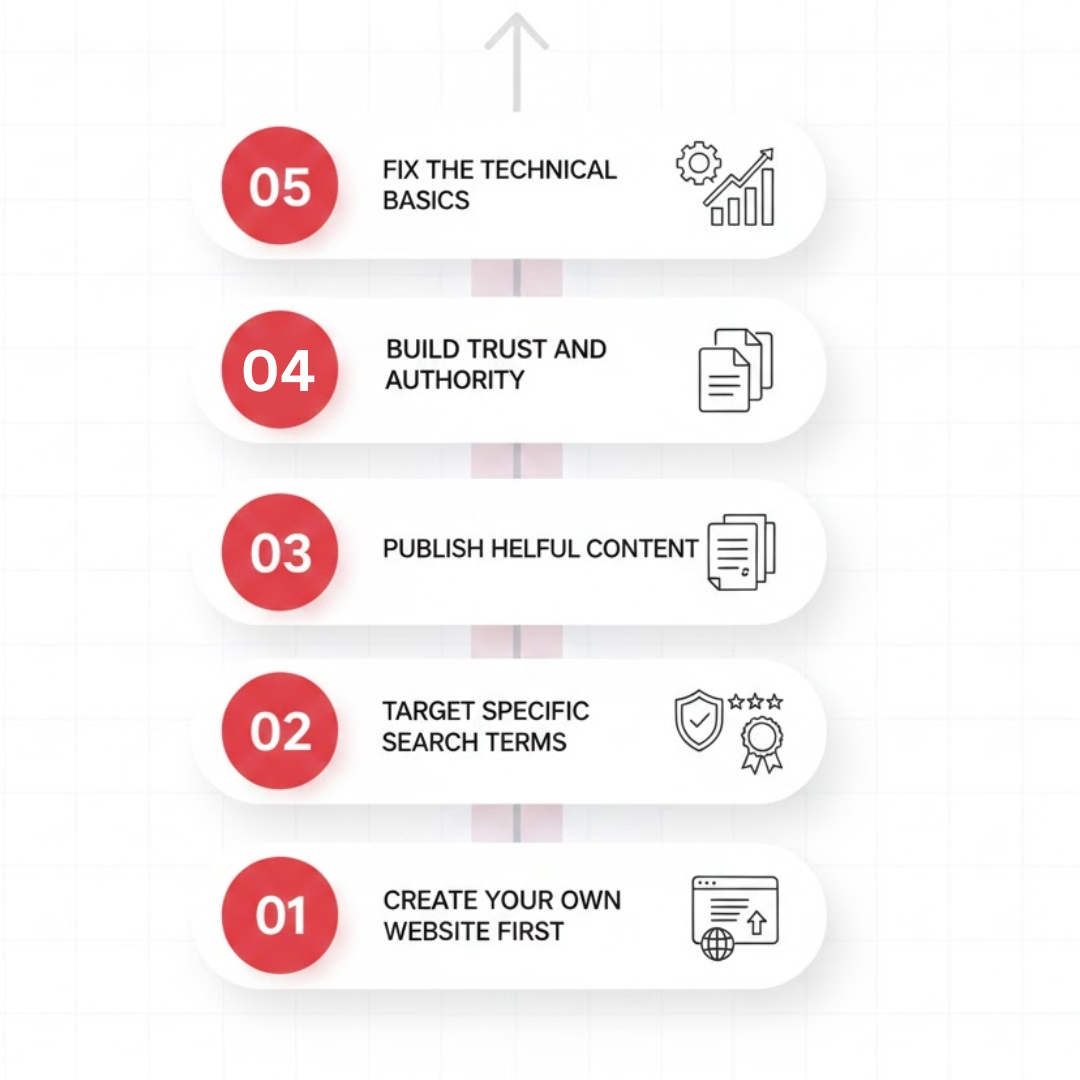
If you want steady, long-term traffic to your OnlyFans profile, SEO is the safest way to achieve it. Unlike ads that stop the moment you stop paying, organic traffic from Google can bring visitors to you every day. The biggest advantage is intent. People coming from search are already looking for something specific. You are not interrupting them. You are showing up exactly when they need what you offer. However, you cannot rank an OnlyFans profile directly on Google. To grow through search, you need a simple funnel that guides people from search results to your profile in a compliant way.
Step 1: Create Your Own Website First
The most important rule of OnlyFans SEO is Never rely solely on your OnlyFans link. To grow on Google, you need something you own and control, such as:
- A personal domain (for example, yourname.com)
- A blog-style website introducing your content
- An age-verified landing page
- A structured bio-link page
This gives you major advantages. You control your content, you can track visitors, and you have something Google can actually rank. It also makes your brand look more professional and trustworthy. Without your own website, scaling through search is extremely difficult.
Step 2: Target Specific Search Terms
Many creators try to rank for broad terms like “OnlyFans creator” or “hot OnlyFans.” These are highly competitive and rarely bring quality subscribers. A smarter approach is targeting specific searches that describe what you offer.
For example:
- fitness exclusive content membership
- premium cosplay fan club
- private VIP lifestyle content
- behind-the-scenes workout content
These searches may have fewer people, but they bring the right audience. Visitors who search this way usually know what they want and are more likely to subscribe. At SEO Circular, keyword research focuses on understanding what your ideal audience is actually searching for, not just chasing popular terms.
Step 3: Publish Helpful Content, Not Just Promotion
Google ranks useful content, not subscription pages. Instead of only saying “Subscribe to my OnlyFans,” your site should include pages that attract interest, such as:
- Blog posts related to your niche
- Fan experience pages
- Preview content or teasers
- Informational or lifestyle content connected to your brand
Each page should be structured clearly so search engines understand it and visitors find it easy to read. When done right, your website starts to look like a real brand, not just a subscription link.
Step 4: Build Trust and Authority
Google is more likely to rank websites that appear trustworthy. One way this happens is when other websites mention or link to you. In adult niches, this must be done carefully and professionally. Effective methods include:
- Listings on relevant directories
- Mentions on niche blogs
- Digital PR placements
- Profile links from trusted platforms
- Guest articles on related sites
These signals show search engines that your website is legitimate, which helps your pages move up in rankings over time.
Step 5: Fix the Technical Basics
Many creators overlook the technical side of their website, but it plays a big role in rankings. Google looks at factors such as:
- How fast your site loads
- Whether it works well on mobile
- Security of the website
- Overall structure and ease of navigation
If a site feels slow, broken, or spammy, it will struggle to rank no matter how good the content is. Professional OnlyFans SEO treats your website like a real online business, with clean design, smooth navigation, and pages built to turn visitors into subscribers.
Using Landing Pages to Advertise OnlyFans Safely
If you want to promote your OnlyFans profile through ads or even organic search, one thing is essential. A properly structured bridge landing page.
Sending people directly to an OnlyFans link is risky. Most major ad platforms flag it quickly. Even if an ad gets approved once, it can be rejected later or lead to account issues. A landing page solves this problem by acting as a safe middle step.
What Is a Bridge Landing Page?
A bridge page is a neutral, policy-friendly page that introduces you and guides visitors before they reach your OnlyFans profile.
It usually does four important things:
- Introduces you as a creator and your niche
- Builds curiosity about your content
- Confirms the visitor is 18+
- Lets users choose to continue to OnlyFans
Think of it as a protective layer between ad platforms and adult content. Instead of directly promoting your subscription page, you promote a clean, professional page that explains what you offer.
For example, instead of saying “Subscribe to my OnlyFans,” the page might say “Access exclusive VIP content and private membership.” The wording makes a big difference for both compliance and conversions.
Structure of a High-Converting Landing Page
At SEO Circular, adult funnels are designed carefully so they feel trustworthy to users and safe for advertising platforms.
Clean Branding
The page should look like a personal brand, not explicit advertising. Use professional photos, simple design, and clear niche positioning such as fitness, cosplay, lifestyle, or gaming.
Age Verification
Before any redirection to adult content, the page should include an age confirmation, disclaimer, and privacy notice. This protects compliance and builds credibility.
Value-Focused Messaging
Instead of focusing on adult content, highlight the experience users will get. For example, talk about community access, exclusive membership, behind-the-scenes content, or VIP interaction. This approach builds curiosity and reduces the risk of ad rejection.
Soft Call to Action
Avoid aggressive wording. Phrases like “Join my private membership,” “Access exclusive content,” or “Enter the VIP area” feel safer and often convert better.
Ad Networks That Allow Adult Promotion
If direct promotion on platforms like Google Ads is limited, many creators wonder where they can advertise safely.
Different ad networks have different rules. Understanding this can prevent costly mistakes.
Adult-Friendly Networks
Some platforms are designed for adult traffic and are generally safer for this niche.
- TrafficJunky offers banner and video advertising for adult audiences.
- ExoClick supports native ads and display campaigns with flexible targeting.
- JuicyAds is often more budget friendly and easier for beginners.
Even on these platforms, creative quality and landing page structure still matter.
Partially Restricted Platforms
Mainstream social platforms have stricter rules.
- Meta Platforms does not allow direct OnlyFans promotion, but compliant landing pages may be used.
- TikTok has very strict policies and high risk.
- Twitter is more flexible but still reviews ads carefully.
Using clean branding and a strong funnel is essential on these platforms.
High-Risk Approach to Avoid
Some creators try direct linking, URL masking, or redirect tricks. These may work briefly, but once flagged, account bans can be permanent. Paid promotion should never rely on loopholes.
Where Most OnlyFans Creators Waste Money
Many creators spend on ads without a proper system. Common issues include sending cold traffic directly to OnlyFans, not tracking results, or skipping landing page optimization.
Professional campaigns focus on targeting the right audience, testing creatives, and tracking cost per subscriber. Traffic alone does not equal revenue. Subscribers do.
Common Promotion Mistakes
After working on many campaigns, the same problems appear repeatedly.
Relying Only on Social Media
Platforms like Instagram or Twitter can change algorithms anytime. Accounts may get restricted or lose reach overnight. Without your own website or SEO, income becomes unstable.
Accounts get:
- Shadowbanned
- Suspended
- De-ranked
- Restricted
Not Owning a Website
Using only bio links or link-in-bio tools limits growth. Without a personal site, you cannot rank on Google, build authority, or collect useful data.
Targeting the Wrong Audience
Trying to rank for:
- “OnlyFans girl”
- “Hot model OnlyFans”
- “Best OnlyFans”
These are:
- Extremely competitive
- Broad
- Hard to convert
Instead, you need niche positioning.
Example:
- “Luxury lifestyle membership content”
- “Exclusive fitness transformation club”
- “Cosplay VIP subscriber access”
Intent-driven keywords convert better.
Unsafe Advertising
Running explicit ads or direct links often leads to bans. Compliance should always come first.
No Funnel Strategy
They send cold traffic directly to subscription page.
But users need:
- Warm-up
- Trust building
- Branding
- Value positioning
Without this, conversion rates stay low.
A proper funnel includes:
- Landing page
- Email capture (optional)
- Content preview
- Clear positioning
Retargeting setup
Ignoring SEO
SEO takes time but brings consistent, high-intent traffic and reduces dependence on ads.
Focusing Only on Clicks
Real success comes from tracking subscribers, retention, and long-term value, not just traffic numbers.
Step-by-Step OnlyFans Marketing Blueprint
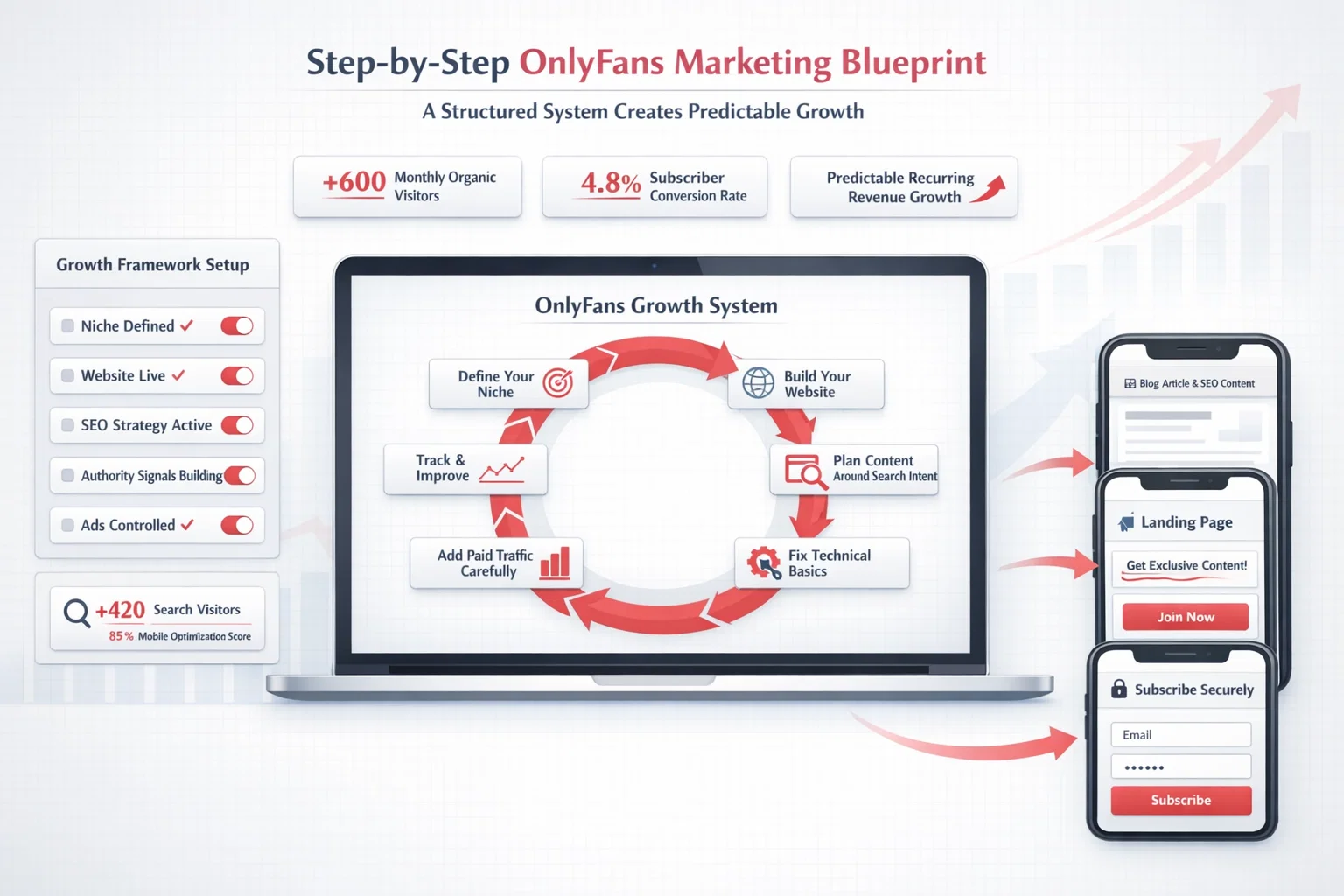
Now let’s combine everything into one clear system.
This is the structured framework we use at SEO Circular when building an OnlyFans growth strategy for creators who want predictable subscriber growth — not random spikes.
Step 1: Define Your Niche Positioning
Before traffic, clarity matters.
You must define:
- Your niche (fitness, cosplay, luxury lifestyle, gamer, etc.)
- Your target audience
- Your brand tone
- Your value proposition
If your positioning is vague, your marketing will also be vague.
Clear niche = higher conversion.
Step 2: Build Your Website Asset
Purchase a domain.
Create:
- Homepage
- About page
- 3–5 niche-focused content pages
- One optimized landing page (bridge page)
This becomes your SEO foundation.
Without this step, scaling on Google is nearly impossible.
Step 3: Keyword Research & Content Strategy
Target long-tail, intent-based keywords.
We structure content into:
- Educational blog posts
- Niche authority pages
- Experience-focused pages
- Search-optimized landing pages
Each page must include:
- Primary keyword in H1
- Optimized meta title
- Structured headings
- Internal linking
- Soft CTA
SEO is structure + consistency.
Step 4: Technical SEO Setup
Many creators ignore this part.
But technical setup determines ranking speed.
You must ensure:
- Fast loading speed
- Mobile optimization
- SSL security
- Clean URL structure
- Proper indexing
This increases trust signals.
Step 5: Authority & Backlink Building
Google ranks authority.
You need:
- Niche directories
- Guest blog mentions
- Contextual backlinks
- Profile links
- Digital PR placements
Authority accelerates visibility.
Without backlinks, ranking becomes slow.
Step 6: Paid Traffic Funnel (Optional but Scalable)
Once SEO foundation is live:
You can scale using:
- Adult-friendly ad networks
- Safe social campaigns
- Retargeting campaigns
Never send traffic directly to OnlyFans.
Always use:
Landing page → Value positioning → Voluntary click → Subscription.
This increases compliance and conversion.
Step 7: Conversion Tracking & Optimization
Most creators skip analytics.
You must track:
- Traffic source
- Click-through rate
- Landing page conversion
- Subscriber acquisition cost
This turns marketing from guessing into data-driven scaling.
Step 8: Diversify Traffic Sources
Never depend on one platform.
Healthy growth structure:
- SEO (stable long-term)
- Adult ad networks (volume)
- Social presence (brand building)
- Retargeting (conversion boost)
Diversification protects income.
Conclusion
Organic promotion on Google is not about quick tricks or shortcuts. It is about building a strong foundation that keeps bringing the right audience to you month after month. When your website, content, and SEO strategy work together, you stop chasing traffic and start attracting it naturally. This is how creators turn their profiles into real brands instead of relying on unstable promotion methods. This is exactly the approach we follow at SEO Circular, where we focus on building safe, scalable, and long term growth systems that help creators gain visibility, trust, and consistent subscribers from Google without depending on paid ads.
FAQs
Yes, by using a compliant landing page and SEO strategy instead of direct ads to your profile.
SEO delivers consistent long term traffic, while ads stop the moment you stop paying.
Yes, a personal website allows you to rank on search engines and control your traffic.
Most creators start seeing noticeable improvements within a few months, depending on competition and consistency.
If you want faster growth, better strategy, and safer promotion, working with experts like SEO Circular can make the process much easier and more effective.
A few years ago, most people would never openly talk about buying intimate wellness products. Today, that conversation has completely changed. The global adult sex products market has moved from being something private and rarely talked about into a widely accepted part of the sexual wellness industry. Now in 2026, the sexual wellness industry is moving close to the USD 60 billion range. Just two years ago, in 2024, the market size stood between USD 42- 45 billion, and since then it has continued expanding at a steady 7- 9% annual growth rate. Looking ahead, projections suggest the industry may surpass USD 75 billion by 2030. Another clear sign of this shift more than 60% of buyers in developed countries now prefer purchasing through online platforms.
“This is exactly why website optimization plays such a critical role in this market. When most demand is online buying, visibility on search engines directly impacts revenue, brand trust, and long- term growth. “
Now, let’s talk about the expansion of this market, which is about far more than product sales – it signals a broader shift in how society understands and prioritizes sexual wellbeing. Today, “sexual wellness” goes beyond traditional adult products to include education, emotional connection, intimacy support, and overall health. It covers everything from safe- sex practices, condoms, and lubricants to reproductive health, consent awareness, and building a confident, respectful relationship with one’s own body. As conversations around these topics become more open and normalized, stigma continues to fade, allowing new demographics and previously hesitant consumers to enter the market with confidence.
Rising awareness around sexual health, driven by healthcare professionals, STD prevention campaigns, and government- led education programs, is further fueling market demand. The COVID- 19 pandemic also acted as a turning point, accelerating online purchases as consumers increasingly chose private, at home shopping experiences. For startups, this category has evolved from a discreet niche into a high- margin digital business opportunity. However, strict advertising policies and payment processing barriers make scaling more challenging which is why long- term, SEO- driven visibility has become one of the most reliable growth channels in this space.
At SEO Circular, we help adult brands build compliant and scalable SEO ecosystems tailored for hig risk industries. Our approach centers on revenue focused rankings, global expansion strategies, and sustainable authority building because in this market, organic visibility isn’t just another marketing channel. It is the long- term advantage that strengthens brand dominance year after year.
Ready to Position Your Brand for Long-Term Growth in the USD 60B Market?
The adult sex products market is expanding fast but scaling in a restricted and competitive industry requires precision, compliance, and strategic visibility.
Let’s Build Your Organic Growth Engine Today.
Key Takeaways
- The global sexual wellness market is rapidly moving toward the USD 60 billion mark, with strong long-term growth projected through 2030.
- Online purchasing now dominates consumer behavior, making search visibility a primary revenue driver.
- Female consumers, couples, and wellness-focused buyers are expanding the industry beyond its traditional audience.
- Technology integration, including app-controlled and smart devices, is reshaping product innovation.
- Advertising restrictions and payment limitations make SEO and organic authority the most sustainable growth channels.
- Startups that invest early in structured digital infrastructure gain a long-term competitive advantage.
The Shift From Taboo Category to Accepted and Popular Market
What we’re seeing now isn’t just more sales – it’s a complete mindset change. Sexual wellness is no longer treated as something hidden; it’s increasingly seen as part of overall health, just like fitness, mental wellbeing, and preventive care. Buyers today are more aware, more selective, and more focused on safety and credibility. They want products made from safe materials, backed by medical guidance, and supported by brands that educate rather than stay secretive.
Key factors driving this shift include:
- Greater awareness of sexual health as part of overall wellbeing
- More open conversations led by healthcare experts and educators
- Rising demand for body-safe and medically approved products
- Brands repositioning around wellness instead of stigma
For startups, this means trust is everything. Brands that focus on safety, education, and empowerment don’t just sell more – they build loyal customers who stay long term.
High-Growth Adult Products Startups Should Watch
Not every product category is growing at the same pace. Some areas are expanding much faster because they match what modern consumers actually want – privacy, comfort, thoughtful design, and inclusivity.
The fastest-growing areas include:
- Women-focused products designed for safety and comfort
- Couples-oriented solutions that support relationship wellness
- Lubricants and intimate care products attracting first-time buyers
- Smart and app-enabled devices creating premium categories
For startups, focusing on a clear niche usually works better than trying to offer everything at once. Specialization helps you stand out and build authority faster.
Why Is This Market Growing?
This market isn’t expanding by chance. Several long-term forces are shaping consumer behavior and pushing demand forward across the world.
Adult Sex Products Market Growth Year-by-Year
| Year | Estimated Market Size (USD) | Growth Trend Insight |
|---|---|---|
| 2022 | ~USD 38 Billion | Recovery phase post-pandemic with steady e-commerce expansion. |
| 2023 | ~USD 41 Billion | Increased digital adoption and normalization of sexual wellness. |
| 2024 | ~USD 43–45 Billion | Growth driven by D2C brands, premium positioning, and tech-enabled devices. |
| 2025 (Est.) | ~USD 52 Billion | Accelerated expansion fueled by mobile commerce and subscription models. |
| 2026 (Projected) | ~USD 58–60 Billion | Strong global demand, international market penetration, and higher average order value. |
| 2030 (Forecast) | ~USD 75+ Billion | Long-term structural growth supported by AI integration, wellness branding, and recurring revenue models. |
This steady year-over-year increase reflects structural demand, not temporary trends. The CAGR remains strong at approximately 7–9%, with online sales growing even faster.
For startups, this growth signals opportunity — but only for those who build sustainable digital visibility. Because paid advertising options are limited in this industry, organic search, technical SEO, and authority-driven content become essential growth levers.
Key Growth Drivers Include:
Rising awareness of sexual health and wellbeing
Education from healthcare professionals, wellness brands, and online platforms has made conversations around intimacy more normal. People increasingly see these products as part of self-care, not something taboo.
Expansion of e-commerce and private shopping experiences
Online shopping solved the biggest barrier – embarrassment. Discreet packaging, private browsing, and home delivery allow people to buy comfortably.
Technological innovation in products
Smart features, app connectivity, and personalization are turning traditional products into modern wellness tools that appeal to tech-savvy buyers.
Changing demographics and expectations
Younger generations value openness, inclusivity, and personal wellbeing, which is expanding demand across new product categories.
For startups, understanding these drivers helps you invest in areas that will keep growing instead of chasing temporary trends.
Market Blockers: What Is Holding this Market Back?
Even with strong growth, challenges still exist. Startups entering this space need to be realistic and prepared.
Major Restraints Include:
Cultural and societal taboos
In some regions, conservative attitudes still limit acceptance and open discussion, which affects sales channels and marketing options.
Regulatory and legal complexities
Different countries have different rules for advertising, labeling, and distribution. Compliance can slow expansion and increase costs.
Platform and payment restrictions
Advertising limitations and payment processing barriers make customer acquisition harder for online businesses.
For startups, success often depends on planning for these obstacles early and adapting strategies for each region.
Category-Wise Analysis: Where Demand Is Focused
Understanding where demand is strongest helps startups choose smarter entry points instead of competing everywhere.
Adult Sex Products Market Segmentation Analysis
The adult sex products market is not evenly distributed across categories. Certain product segments dominate revenue, while others are emerging rapidly due to innovation and changing consumer preferences.
Here is the approximate revenue share by segment:
| Segment | Revenue Share | Growth Rate (Est. CAGR) | Margin Potential | Consumer Behavior Insight | Strategic Opportunity for Startups |
|---|---|---|---|---|---|
| Adult Toys & Smart Devices | ~45% | 8–10% | High (40–65%) | Premium buyers prefer tech-enabled, app-controlled, body-safe products. Strong online dominance (70%+ sales). | Focus on innovation, smart features, and premium branding. Strong SEO demand for product-based keywords. |
| Lubricants & Intimate Care | ~20% | 6–8% | Moderate–High | High repeat purchase rate. Subscription-friendly. Strong D2C growth. | Ideal for recurring revenue models and bundle cross-selling strategies. |
| Condoms & Safety Products | ~18% | 5–6% | Moderate | High-volume category. Strong retail presence in emerging markets. | Opportunity in subscription packs and wellness repositioning. |
| Lingerie & Relationship Products | ~10% | 6–7% | Moderate | Often purchased alongside toys. Emotional & gifting-driven demand. | Effective for upsell bundles and seasonal marketing campaigns. |
| Educational & Digital Wellness Services | ~7% | 12–15% (Fastest Growing) | Very High (Digital Model) | Growing demand for intimacy coaching, courses, and subscription communities. | Scalable digital model with low overhead and strong lifetime value potential. |
Technology-enabled and wellness-oriented products are currently seeing the highest growth rates because they attract premium buyers, support personalization, and encourage repeat purchases. For startups, aligning with these high-growth segments improves both positioning and long-term scalability.
Sales Channel Type
Distribution happens through both online and offline channels:
- Online platforms dominate due to privacy and convenience
- Offline specialty stores still attract customers who want guidance
For startups, digital-first models usually scale faster and cost less to operate.
Customer Type
Main buyer groups include:
- Individual users
- Women-focused audiences
- Couples
- First-time wellness buyers
Women and couples are among the fastest-growing customer groups, influencing product design and branding.
End User Type
Demand comes from:
- Personal users
- Commercial buyers such as hotels and wellness businesses
Individuals generate most revenue, but commercial partnerships can open additional growth opportunities.
Strong Online Presence to Grow Faster
This industry runs on online discovery. Most customers prefer private browsing, discreet delivery, and secure payments, which makes the website the center of the entire buying journey. Your site isn’t just a store – it’s your salesperson, educator, and trust builder combined.
Before purchasing, people research, compare, and read reviews. If your brand isn’t visible during that stage, you lose customers before they even consider buying.
A strong digital foundation should include:
- Privacy-focused user experience
- Secure and discreet checkout
- Educational content that builds trust
- SEO-driven visibility
- Mobile-first performance
- Fast site speed
Because paid ads are restricted, organic search becomes the most reliable growth channel. Strong rankings build authority and consistent revenue over time.
Trust also plays a huge role. Clear information, professional design, authentic reviews, and transparent policies make customers feel safe purchasing sensitive products.
What Startups Should Know Before Entering This Market
For startups, success often depends on digital readiness. Many new brands focus on product development but underestimate visibility and infrastructure. In this space, if customers can’t find you, you don’t exist.
Key insights for startups:
- Plan compliance early
- Start with a focused niche
- Invest in SEO from day one
- Build strong trust signals
- Design discreet experiences
- Understand research-driven buying behavior
From our experience at SEO Circular, startups that treat search visibility as core infrastructure – not just marketing – grow more sustainably.
We usually advise new brands to focus on:
- A scalable website structure
- Content that answers real customer questions
- Technical optimization
- Authority building through valuable information
These steps create a long-term growth engine that keeps working even as competition increases.
Strategic Advice for Startups Scaling in 2026
Startups entering this market should think long term. The winners aren’t chasing quick sales – they’re building visibility, credibility, and trust.
Recommended approach:
- Focus on a clear product niche first
- Build content that supports the buyer journey
- Target high-intent search queries
- Strengthen credibility through education
- Prepare for international expansion
Businesses that treat their website as a long-term asset – not just an online shop – achieve more stable growth.
Regional Market Insights
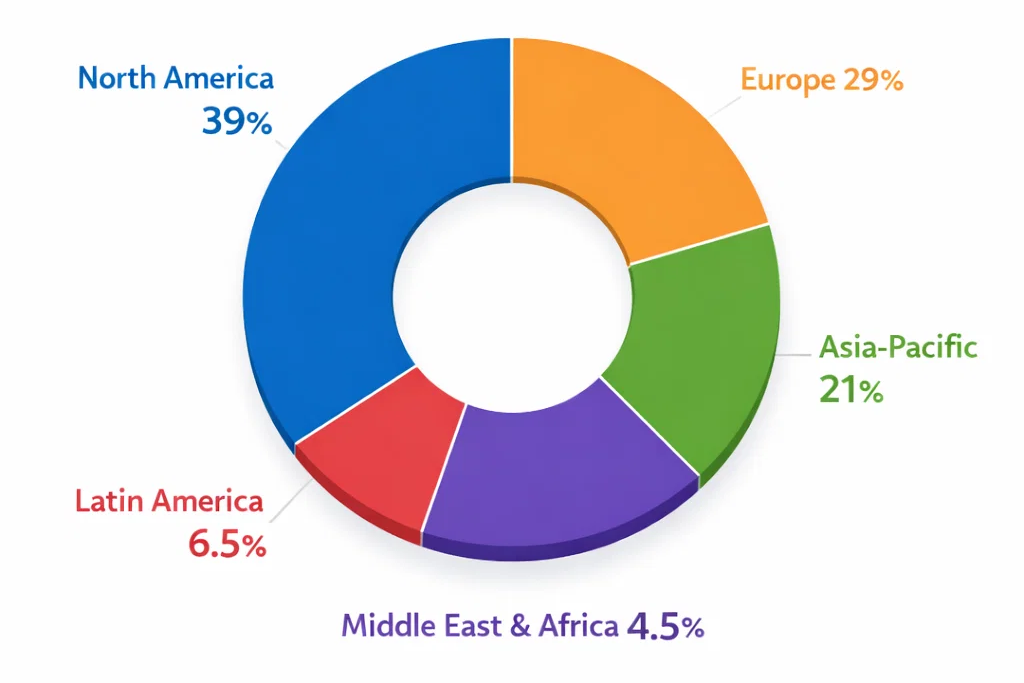
Growth varies by region based on culture, digital adoption, and purchasing power.
North America accounts for approximately 38–40% of global market revenue, led by the United States.
Europe holds around 28–30% market share, with Germany, the UK, and France as key contributors.
Asia-Pacific is the fastest-growing region, projected to grow at over 10% CAGR, driven by China, Japan, India, and South Korea.
Latin America represents about 6–7% of the market, while Middle East & Africa together account for roughly 4–5% but show strong future potential.
For global expansion, localization and cultural understanding matter more than copying the same strategy everywhere.
Stats by Key Countries
| Country | Market Position | Estimated Market Insight | Key Growth Drivers |
|---|---|---|---|
| United States | Largest Single Market | Contributes over USD 15 Billion annually | Strong D2C ecosystem, high online penetration, premium product demand, subscription adoption. |
| China | Rapidly Growing Market | Expanding domestic consumption alongside manufacturing strength | E-commerce dominance, rising disposable income, growth of local brands. |
| Germany | Leading European Market | High per-capita spending | Established adult retail network, wellness positioning, strong purchasing power. |
| United Kingdom | Major European Contributor | Strong online-driven sales | Progressive consumer attitudes, high digital adoption, subscription-friendly market. |
| India | Emerging High-Growth Market | Fast CAGR growth | Increasing internet penetration, younger demographic, discreet online buying behavior. |
| Japan | Tech-Driven Market | Strong premium device demand | Innovation in smart devices, cultural openness to product experimentation. |
| South Korea | Premium Growth Market | Rising demand for smart & wellness products | High smartphone usage, tech adoption, modern consumer trends. |
Competitive Landscape and Differentiation
The market includes established global brands and fast-moving startups. Competition revolves around innovation, trust, and branding.
Key competitive factors include:
- Product safety and quality
- Wellness-focused brand positioning
- Technological innovation
- Educational marketing
- Strong digital visibility
Niche brands that serve specific audiences – such as women, couples, or wellness-focused consumers – often grow faster than general retailers because they solve clearer problems for their customers.
How SEO Circular Helps Your Brand Win
At SEO Circular, we help brands in sensitive and competitive industries build long-term organic visibility. Our approach integrates:
- Market research & competitor intelligence
- Search intent-based keyword mapping
- International SEO frameworks
- CRO and analytics for revenue tracking
- Digital PR and authority building
The adult sex products market size in 2026 signals growth. But scalable success will belong to startups that combine product innovation with structured digital execution.
Ready to Enter the USD 60B Adult Products Market With Clarity and Confidence?
We help startups build enterprise-level SEO strategies, authority-driven content ecosystems, and high-converting digital funnels designed for long-term growth.
Partner with SEO Circular and Turn Market Growth into Measurable Revenue.Conclusion
The adult sex products market in 2026 isn’t just growing it’s exploding with opportunity. But here’s the reality: this isn’t a “launch a product and hope it sells” kind of industry. The brands that win are the ones that understand how to move smart, stay compliant, and build visibility before competitors do. This space rewards strategy, not guesswork. The difference between businesses that scale and those that struggle usually comes down to one thing having a clear plan and executing it at the right time.
If you treat your website, search visibility, and brand trust as long-term assets instead of quick wins, the growth potential here is massive. Plan smart, build authority early, and the market will work in your favor. At SEO Circular, we work with brands in high-restriction industries every day, so we’ve seen what actually moves the needle. The businesses that think ahead, optimize early, and play the long game are the ones that dominate later.
FAQs
Industry forecasts suggest the market could surpass USD 75 billion globally by 2030, driven by e-commerce growth and increasing consumer acceptance.
Advertising restrictions limit paid promotion options, making organic search visibility the most reliable way to attract high-intent customers consistently.
Female consumers and couples represent some of the fastest-growing segments, influencing product innovation and branding strategies.
Yes. Despite regulatory challenges, the market offers high margins, recurring demand, and strong scalability for brands with a clear strategy.
Key factors include brand trust, product quality, compliance, digital visibility, and the ability to adapt to changing consumer expectations.
In 2026, the global porn industry is growing at an estimated 5%–8% annual growth rate, driven mainly by online subscriptions, premium content platforms, mobile consumption, and AI-powered personalization technologies.