Many businesses come to us when they need to move their existing website to a new domain. The reason varies from business to business. It could be a rebrand, business expansion, a domain upgrade, or simply choosing a name that better represents their company.
While their objective is clear, many don’t realize the impact a domain migration can have on search engine rankings and organic traffic if it isn’t handled correctly.
The good news is that changing your domain doesn’t have to mean losing your SEO. With a well-planned migration strategy, you can help search engines transfer your website’s authority to the new domain while ensuring a seamless experience for your visitors.
Without proper planning, however, a domain migration can lead to broken pages, lost backlinks, crawling and indexing issues, declining organic traffic, and temporary or even permanent drops in search rankings.
This uncertainty often leaves business owners hesitant to make the move.
That’s where we come in.
At SEO Circular, we’ve helped more than 100 businesses worldwide successfully migrate their websites to new domains while preserving their rankings and organic traffic. In this guide, we’ll walk you through the exact step-by-step process we use to move a website to a new domain without losing SEO.
Before you begin the migration, however, there are a few essential preparations you should complete. These steps help minimize risks, prevent common SEO issues, and ensure the transition goes as smoothly as possible.
Planning a Website Domain Migration?
Changing your domain doesn’t have to cost you years of SEO progress. Let our migration specialists handle everything—from SEO audits and URL mapping to redirects and post-launch monitoring—so your rankings and traffic stay protected.
Get a Free Website Migration SEO AuditThings to Do Before Moving to a New Domain
Preparation is one of the most important stages of a successful domain migration. Taking the time to audit your existing website and document its current performance makes it much easier to identify issues and measure the migration success.
Back Up Your Entire Website
Before making any changes, create a complete backup of your website. Make sure your backup includes website files, database, media, theme, template, plugin / extension, configuration files, and more.
Keeping the entire website is like having a lifeboat, as it allows you to restore your website quickly if something goes wrong during the migration.
Perform a Complete SEO Audit or Ask Experts
Understanding your website’s current SEO performance or reach out to us as we do it for free. A detailed website audit service can act as a benchmark for comparison after the migration. Make sure your SEO audit cover these important metrics such as – total indexed pages, organic traffic, ranking keywords, top-performing pages, backlink profile, page speed, crawl errors, and core web vitals. Save this data before the migration so you can identify any unexpected changes afterward.
Record Your Most Valuable Pages
Not every page contributes equally to your website’s performance. So before you start moving to a new domain, create a list of pages that generate the most:
Organic traffic
Leads
Sales
Backlinks
Conversions
These pages should receive extra attention during testing to ensure they function correctly after the migration.
Create a URL Mapping Document
Next, you need to prepare a detailed URL mapping document in which every old url matches the new one. For your convenience, we have shared an example of how to create the document and place old & new URLs. Creating this document before migration reduces redirect errors and prevents missing pages.
| Old URL | New URL |
| olddomain.com/about | newdomain.com/about |
| olddomain.com/services/seo | newdomain.com/services/seo |
| olddomain.com/blog/domain-guide | newdomain.com/blog/domain-guide |
Prepare the New Domain
Before launching, make sure your new domain is fully configured.
Check that:
SSL certificate is installed
HTTPS works correctly
Hosting is stable
Website loads properly
Mobile responsiveness is working
Page speed is acceptable
Launching an incomplete website can create unnecessary SEO problems.
Choose the Right Time for Migration
When it comes to business, the timing is important. And this same logic applies to the website migration as well. Avoid migrating your website during:
Major marketing campaigns
Seasonal sales
Product launches
High-traffic periods
Choose a period when website traffic is relatively stable so any issues can be resolved with minimal business impact if website traffic dropped overnight after migration.
Once you’ve completed these preparation steps, you’ll have everything needed for a smooth and well-organized domain migration. With your website backed up, SEO benchmarks documented, URL mapping ready, and the new domain properly configured, you can move forward with confidence.
Now it’s time to execute the migration carefully, ensuring every step is performed correctly to preserve your rankings, traffic, and overall SEO performance.
Step-by-Step Guide to Move a Website to a New Domain Without Losing SEO
Once you’ve completed the planning phase, it’s time to begin the migration. This stage requires careful execution because even small mistakes can affect your website’s visibility in search results. The following steps will help you migrate your website while preserving as much SEO value as possible.
Step 1: Set Up Your New Domain
Before transferring your website, make sure the new domain is fully configured and ready to go live. Install an SSL certificate, verify that the domain loads securely over HTTPS, and check that your hosting environment is functioning correctly.
If you’re moving to a different hosting provider as part of the migration, test the server configuration beforehand to ensure it can handle your website without performance issues. Slow loading speeds, server downtime, or security warnings can negatively affect both user experience and search engine crawling, impacting future AI search visibility as well.
It’s also worth confirming that the new domain isn’t blocking search engines through a robots.txt file or a noindex tag. These settings are commonly used during website development, but forgetting to remove them before launch can prevent your new website from appearing in search results.
Step 2: Move Your Website Files and Database
With the new domain ready, migrate your website files, database, media assets, and configurations to the new server or hosting environment. The exact process depends on the platform you’re using, but the goal is the same: create an identical version of your existing website on the new domain.
Once the migration is complete, thoroughly test the website before making it publicly accessible. Browse through key pages, submit contact forms, test navigation menus, and verify that images, videos, and downloadable files are loading correctly. This allows you to fix any technical issues before users and search engines start visiting the new domain.
Step 3: Implement 301 Redirects
Redirects are one of the most important components of a successful domain migration and are critical if you later need to recover SEO rankings. A 301 redirect tells search engines that a page has permanently moved to a new location and that the SEO value associated with the old URL should be transferred to the new one.
Ideally, every important page on the old domain should redirect to its exact equivalent on the new domain. Take the help of the old and new URL document you have created before beginging the website migration.
Avoid redirecting every page to the homepage simply because it’s easier to implement. This creates a poor user experience and makes it difficult for search engines to understand where the original content has moved.
After configuring your redirects, manually test a selection of URLs to confirm they lead users to the correct pages without errors.
Step 4: Update Internal Links
Although redirects help users reach the correct pages, your website should not rely on them for internal navigation. Every internal link should point directly to the new domain.
Review your navigation menu, footer links, blog posts, landing pages, and call-to-action buttons to ensure they reference the updated URLs. This improves crawl efficiency and prevents unnecessary redirect hops that can slow down both users and search engines.
If your website contains hundreds of pages, consider using a search-and-replace tool or your CMS’s built-in functionality to update internal links more efficiently.
Step 5: Update Canonical Tags
Canonical tags tell search engines which version of a page should be treated as the primary version. During a domain migration, these tags should be updated to reference the new URLs instead of the old domain.
Leaving canonical tags unchanged sends conflicting signals to search engines. While your redirects indicate that the content has moved, outdated canonical tags may continue pointing to the old domain, making it more difficult for search engines to understand which version should be indexed.
After updating the canonical tags, inspect a few pages to confirm they reference the correct URLs.
Step 6: Generate and Submit a New XML Sitemap
An XML sitemap helps search engines discover and crawl your website more efficiently. After the migration, generate a fresh sitemap containing only the URLs from your new domain.
Before submitting the sitemap, verify that it doesn’t include old URLs, redirecting pages, or broken links. A clean sitemap makes it easier for search engines to identify your new website structure and prioritize indexing as part of a long-term enterprise SEO marketing agency strategy.
Once verified, submit the updated sitemap through Google Search Console and any other webmaster tools you use.
Step 7: Review Your Robots.txt File
The robots.txt file controls which parts of your website search engines can access. During development, many websites temporarily block search engines to prevent unfinished pages from being indexed. Forgetting to remove these restrictions after launch is a surprisingly common mistake.
Review your robots.txt file to ensure important sections of your website are accessible. It should also reference the new XML sitemap to help search engines discover your updated URLs more efficiently.
Step 8: Verify Your New Domain in Google Search Console
Google Search Console plays an important role during a domain migration. Add and verify the new domain as a separate property so you can monitor its performance independently.
Once verified, submit the updated XML sitemap and use the URL Inspection tool to request indexing for important pages. This encourages Google to crawl the new URLs sooner and speeds up the migration process.
If you’re moving the entire website to a new domain, use the Change of Address feature available within Google Search Console. This provides Google with an additional signal that your website has permanently moved.
Step 9: Update Analytics and Tracking Codes
Your analytics platform should continue collecting data without interruption after the migration. Verify that tracking codes are installed correctly on the new domain and that important events, conversions, and goals are functioning as expected.
If you use advertising platforms or marketing tools, update the destination URLs so campaigns continue sending visitors to the correct pages. Overlooking these updates can result in broken ads, inaccurate reporting, and missed conversion opportunities.
It’s also a good idea to annotate the migration date in your analytics platform. This creates a clear reference point when reviewing traffic or ranking changes in the future.
Step 10: Test the Entire Website
Before considering the migration complete, conduct a comprehensive review of your website. Test every major section, including service pages, blog posts, contact forms, login areas, downloadable resources, and checkout processes if applicable.
Pay particular attention to pages that previously generated significant traffic or conversions. These pages are often the most valuable from an SEO perspective, so ensuring they work correctly should be a priority.
Using a website crawler after the migration can also help identify broken links, redirect errors, duplicate content, and missing metadata that may have been introduced during the move.
Step 11: Update External Links and Business Profiles
While 301 redirects pass most of the SEO value from your old URLs to the new ones, it is still beneficial to update important external links whenever possible.
Start by updating links on platforms you control, such as your Google Business Profile, social media accounts, email signatures, newsletters, online directories, and marketing campaigns. These updates ensure visitors reach the correct domain directly instead of passing through a redirect.
If your website has earned backlinks from trusted websites, consider contacting the site owners and requesting that they update their links to your new domain. Although not every website will make the change, updating high-authority backlinks can strengthen your new domain over time.
Remember to update any branded materials that display your website address, including brochures, presentations, business cards, invoices, and downloadable PDFs.
How Long Does It Take to Recover SEO Rankings?
One of the most common concerns after a domain migration is how long it will take for rankings to recover. Unfortunately, there is no universal timeline because every website is different. Factors such as website size, crawl frequency, backlink profile, and migration quality all influence how quickly search engines process the changes.
For smaller websites with only a few hundred pages, search engines may recognize the migration within a few weeks. Larger websites containing thousands of pages often require several months before indexing and rankings fully stabilize, especially for websites implementing programmatic SEO for enterprise brands.
It is important not to panic if rankings fluctuate shortly after launch. Search engines need time to crawl the old URLs, follow redirects, and transfer ranking signals to the new domain. As long as the migration has been implemented correctly and technical issues are resolved promptly, rankings generally recover over time.
Conclusion
Moving a website to a new domain is a complex process, but it doesn’t have to result in lost rankings or declining traffic. With careful planning, accurate redirects, and ongoing monitoring, you can preserve the SEO value your website has built while successfully transitioning to a new online identity.
The most successful domain migrations begin long before the website goes live. Auditing your existing website, mapping URLs, testing every redirect, and monitoring performance after launch all contribute to a smoother transition for both users and search engines.
While some temporary fluctuations are expected, following the best practices outlined in this guide will help minimize disruption and support a faster recovery. Rather than rushing the migration, take the time to complete each step carefully. A well-executed migration not only protects your current rankings but also provides a solid foundation for your website’s future growth.
If you’re planning to migrate your website and want to avoid costly SEO mistakes, the team at SEO Circular is here to help. From pre-migration SEO audits and migration planning to redirect implementation, technical SEO, and post-migration monitoring, we handle every stage of the process to ensure a smooth transition. Whether you’re rebranding, changing domains, or restructuring your website, our experts can make the entire migration process simpler, safer, and more successful. Fill out the form and our subject matter experts will get in touch with you ASAP.
Frequently Asked Questions
Temporary ranking fluctuations are normal because search engines need time to crawl and index your new URLs. If your migration is planned properly, 301 redirects are set up correctly, and all SEO settings are updated, your rankings should recover over time.
It depends on your website’s size and crawl frequency. Smaller websites may be indexed within a few days, while larger ones can take several weeks. Submitting an XML sitemap and requesting indexing through Google Search Console can speed up the process.
Yes. Your old domain must remain active so 301 redirects continue working. If it expires too soon, users may encounter broken links and search engines may lose the connection between your old and new URLs. Keep it for at least 12 months.
A 301 redirect permanently sends users and search engines from an old URL to a new one. It transfers most of the page’s SEO value, including backlinks and ranking signals, while preventing broken links and 404 errors.
It is possible but not recommended. Making multiple major changes at once makes it difficult to identify the cause of SEO issues. Migrate your domain first, then redesign your website later if possible.
Yes. Update internal links to point directly to the new URLs. This improves crawl efficiency, reduces unnecessary redirects, and helps search engines discover your pages faster.
Yes. With proper 301 redirects, backlinks continue passing visitors and most of their SEO value to the new domain. Updating important backlinks is still recommended whenever possible.
Most home improvement businesses we have worked with have a similar story. They deliver exceptional results, earn glowing reviews, and generate a steady stream of referrals from satisfied clients. Yet despite doing everything right on the job site, they still struggle to scale.
The reason is simple. Homeowners no longer rely solely on word-of-mouth recommendations. They search online.
In today’s digital-first world, a strong online presence isn’t a competitive advantage. It’s a business requirement.
If your home improvement business doesn’t appear when homeowners are searching for the services you offer, you’re invisible during one of the most important stages of the buying process. It doesn’t matter how skilled your team is, how long you’ve been in business, or how many referrals you’ve earned over the years.
That’s the reality of local SEO for home improvement businesses. It presents both a challenge and an opportunity.
By the end of this guide, you’ll understand how local SEO works for home improvement contractors and why a professional website audit service is often the first step toward better rankings. It’s one of the highest-ROI marketing channels for local service businesses, and the exact steps you can take to build a search presence that consistently attracts qualified leads in your target market.
At SEO Circular, we provide home improvement SEO services that help contractors, remodelers, and renovation companies increase their online visibility, attract qualified local leads, and grow their business through organic search. Get your free website audit today and take the first step toward transforming your home improvement business.
Get More Local Leads
Find out why your home improvement business is not ranking locally. Get a free SEO audit from our experts.
Get Free SEO AuditWhat Is Local SEO and Why Is It Different for Home Improvement Businesses?
Search Engine Optimization (SEO) is the practice of improving your business’s visibility in organic (unpaid) search results. Local SEO is the specific application of that discipline to businesses that serve customers in a defined geographic area.
Local SEO matters more for home improvement businesses as;
Nobody in Chicago hires a kitchen remodeler based in Houston. Nobody in Manchester books a bathroom fitter from London. The entire commercial value of your online presence is concentrated in the local geography you actually serve. And that’s why local SEO holds more value for home improvement businesses.
Here’s how local SEO services are different for home improvement businesses;
1. The Map Pack Drives Most Local Clicks
When people search for “contractor near me” or “remodeler in [city],” Google shows the Map Pack before organic results. These top three business listings include ratings, addresses, and call buttons. Ranking here often brings more leads than being first in organic search.
2. Reviews Improve Rankings and Build Trust
Reviews help your business rank higher in local search. Google looks at review count, quality, and freshness when ranking businesses in the Map Pack. Strong reviews also give homeowners confidence to contact your business.
3. Every Service and Location Can Rank
Each service in every city is a separate ranking opportunity. If you offer four services across three cities, you have twelve chances to appear in local search. Creating optimized pages for each service and location helps your visibility grow over time through a scalable programmatic SEO approach.
The Core Elements of Local SEO for Home Improvement Businesses
Local SEO relies on a few essential elements that help your business rank higher in local searches. Optimizing each one improves visibility, builds trust, and attracts more qualified leads from your service area. Here are eleven core elements of local SEO for home improvement businesses;
Google Business Profile: Your Single Most Important Local SEO Asset
For home improvement businesses, your Google Business Profile (GBP) is what powers your Map Pack listings. It is the most important single asset in your local SEO arsenal, and it is free.
Most home improvement businesses either have not claimed their GBP, have claimed it but left it half-finished, or have filled it out once and never touched it again. All three scenarios leave significant visibility on the table.
Apple Business Connect deserves a place in your local SEO strategy too.
While Google dominates local search, thousands of homeowners use Apple Maps every day to find nearby contractors and home improvement services. A complete and up-to-date Apple Business Connect profile helps your business appear in those searches, giving you another way to reach potential customers.
At SEO Circular, we treat both Google Business Profile and Apple Business Connect as essential digital storefronts that keep your business visible wherever homeowners are searching.
Local Keyword Research: Understanding How Your Customers Search
Homeowners do not search the way contractors think they do. They rarely search your business name or your specific trade terminology. Rather, they search the way they talk and often use keywords with geographic specificity.
Understanding these local keyword patterns is the foundation of our entire local SEO strategy for home improvement businesses. Here are the four keyword categories that matter for contractors;
- Service + Location searches are the highest-converting terms like “kitchen remodeler in [city]” or “bathroom renovation contractor [area].” These users are ready to hire and are actively comparing businesses.
- Service + Near Me searches such as “contractor near me” come mostly from mobile users. These depend on your Google Business Profile and local signals, not the exact phrase on your website.
- Problem or project searches like “small kitchen ideas” or “how to add a room” come from homeowners still researching. These are best targeted with helpful blog content.
- Cost and comparison searches such as “kitchen remodel cost in [city]” show strong buying intent. Clear, local pricing guides help turn these searchers into leads.
Our SEO experts analyze all these keyword types and build a focused SEO strategy around them to help home improvement businesses rank where it matters most. By targeting high-intent local searches, we ensure your business shows up throughout the entire customer journey.
Your Website: The Foundation Everything Else Depends On
If your Google Business Profile gets homeowners to your door, then your website is the room they walk into. A slow, hard to navigate, or outdated website fails to convey credibility on a phone screen. And you end up losing leads that your GBP correctly earned.
Website fundamentals for home improvement contractors:
1. Mobile Performance Matters
Most local searches happen on mobile devices and Google uses the mobile version of a site’s content for indexing and ranking. In case the mobile version of your website loads slowly or is not user-friendly, this can impact your overall rankings and conversions.
2. Build Dedicated Service Pages
Create separate pages for each service like kitchen remodeling or bathroom renovation. These pages rank better, target specific keywords, and give homeowners the detailed information they are searching for.
3. Make Contact Details Easy to Find
Make sure your phone number and contact form are visible on every page. At times, most users decide within seconds, so make it simple for them to reach you for any home improvement need.
4. Show Real Project Work
Before-and-after photos build trust and drive inquiries; make sure they are visible on the home page. Label projects with service type and location to strengthen local relevance and credibility. As a diversified portfolio, boost your chances of converting users with different home improvement needs.
Building and Managing Your Online Reviews
Reviews are one of the most powerful yet underused tools in local SEO for home improvement contractors. They directly influence how high you rank in local search and how much trust new homeowners place in your business. Consistently requesting genuine reviews helps build a steady stream of social proof that compounds over time and drives more leads.
Think about it this way. If you had to choose between a contractor with 20 reviews and another with 200 reviews and a 4.9 rating, you would likely go with the one that feels more established and trusted.
That is exactly how your potential customers think too.
So, the sooner you start building reviews, the faster you strengthen your visibility and outperform competitors.
Local Citations and NAP Consistency
A local citation is any online mention of your business name, address, and phone number (collectively called NAP). Google uses local citations as a trust signal. And the more frequently your business information appears across reputable online directories, the more confident Google is that your business is legitimate, established, and accurately located.
For home improvement businesses, the most important citation sources include:
- General business directories: Google Business Profile (your primary citation), Bing Places, Apple Maps, Yelp, Facebook Business, Foursquare, and the Better Business Bureau.
- Home improvement-specific directories: Houzz, Angi (formerly Angie’s List), HomeAdvisor, Checkatrade, Rated People, TrustATrader, Thumbtack, and Bark.
- Local directories: Your local Chamber of Commerce directory, city business listings, regional trade association directories, and local newspaper business listings.
Our SEO team first audits your existing citations before building new ones. We search your business name on Google and check every listing for accuracy. We correct inconsistencies before creating new local citations and NAP profiles.
Invest in Content Marketing: Earning Trust Before the First Phone Call
Most home improvement businesses think about content marketing as blogging for the sake of blogging. That misses the point entirely.
Strategic content marketing for home improvement contractors is about being the most credible, most informative, most helpful source of information for homeowners who are planning the exact type of project you specialise in. This approach becomes even more powerful when combined with AI-driven local marketing tactics.
Homeowners are consuming more video and less written content. For home improvement businesses, video is one of the fastest ways to build trust before the first call. Simple videos explaining basic renovation tips, showing real project work, or walking through what you offer can make your expertise clear in seconds.
Posting this type of content on social media helps you reach local audiences and generate consistent leads. A strong video presence positions your business as helpful, credible, and easy to choose.
Building Local Backlinks
Backlinks from other sites are one of Google’s most important ranking signals. For local SEO, local backlinks carry particular weight because they signal geographic relevance alongside domain authority.
The good news for home improvement contractors is that the backlink opportunities in your local market are often significantly less competitive than in national categories.
You do not need links from major publications. You need links from locally-relevant, geographically-matched sources that confirm your business’s connection to your community and your trade.
Technical SEO: The Foundation That Holds Everything Together
Technical SEO is often the most overlooked part of local search optimization, yet it is what keeps everything else working. For many home improvement businesses, it is also the biggest hidden reason their website does not rank.
If your site has crawl errors, slow load speeds, broken pages, or poor mobile structure, Google cannot properly read or rank your content.
Even well-written service pages and strong content will struggle if the technical foundation is weak. A clean, fast, and properly structured website ensures every SEO effort actually performs as intended. We also offer a free website audit where our SEO experts review key technical issues that may be limiting your visibility. Contact us to get started.
Tracking, Measuring, and Improving Over Time
Local SEO is not a one-time task. It is an ongoing process that improves with consistent attention and steady refinement. Without tracking, even good efforts can become guesswork.
Measuring rankings, website traffic, calls, and lead sources helps you see what is driving results and what is not. With this data, you can make small, focused improvements that compound over time into stronger visibility and better quality leads.
AI Search Is Becoming the New “Word of Mouth”
Homeowners are no longer relying only on Google results to choose a contractor. They are asking AI tools for recommendations the same way they would ask a friend, expecting a short list of trusted options instead of hundreds of links.
In this new environment, AI becomes a digital referral system, making AI search visibility increasingly important for local businesses. AI search systems pull data from multiple sources before suggesting a contractor:
- Your website content and service pages
- Google Business Profile and Apple Business Connect listings
- Customer reviews and ratings across platforms
- Mentions of your business on other websites and directories
- Consistency of your business name, address, and phone number
If this information is incomplete, outdated, or inconsistent, AI systems are less likely to surface your business in recommendations.
How Long Does Local SEO Take to Produce Results?
This is the question every home improvement business asks before investing in local SEO, and it deserves an honest answer.
The truthful answer is: it depends on your starting point, your local competition, and the specific strategies being implemented.
For most home improvement businesses starting from a basic web presence in a mid-size local market, a realistic timeline looks roughly like this:
Month 1–2: Foundation work which includes – GBP optimisation, technical SEO fixes, citation cleanup, and on-page optimisation. You may see small early improvements in your GBP’s local search appearance, but significant ranking changes are unlikely this early.
Month 3–4: Meaningful improvements in Map Pack visibility and local keyword rankings typically begin to appear. Content published in months one and two begins to get indexed and drive initial organic traffic.
Month 5–6: Measurable increases in organic traffic and local search leads. Your GBP review profile has grown (assuming you have been systematically generating reviews), further improving your Map Pack ranking and conversion rate from Map Pack impressions.
Month 6–12: Compounding growth. Content published earlier in the campaign is now ranking for multiple keyword variations and driving consistent traffic. Your domain authority has grown through local link building. Your GBP is a well-established presence in your local Map Pack. New service and location pages are being indexed and beginning to rank.
Beyond month 12: The compounding nature of local SEO becomes its most valuable characteristic. Rankings achieved through genuine quality work are durable. Content assets keep generating traffic without additional investment. Your review profile continues to grow with each completed project. The return on each month of SEO investment improves over time.
In our experience, the home improvement contractors who benefit most from local SEO are the ones who treat it as a long-term investment rather than a quick fix.
Final Thoughts
Local SEO is the most sustainable and highest-ROI marketing channel available to most home improvement businesses. However, it requires patience, consistency, and a realistic understanding of how it works.
It will not produce instant results and is not an alternative to paid advertising in the short term for a business that needs leads immediately. Local SEO will only work if treated as a one-time setup task rather than an ongoing discipline.
What it will do, when approached correctly and sustained consistently, is build a compounding organic presence that generates qualified leads from homeowners in your service area month after month.
The home improvement contractors who will dominate their local markets over the next three to five years are the ones investing in local SEO today. The ones who wait will find themselves competing against well-established local search presences that are increasingly difficult and expensive to displace.
If you run a home improvement business and want to understand where your local search presence currently stands, we at SEO Circular offer a free local SEO audit. We will assess your Google Business Profile, your website’s technical health, your current local keyword rankings, your review profile, and your citation consistency, and give you a clear picture of where the gaps are and how to close them. Reach out to our subject matter experts today!
Frequently Asked Questions
Most businesses see early improvements within 3 to 6 months. Strong, consistent growth builds over time.
Yes. It is the main factor for appearing in the Map Pack and generating local calls and leads.
There is no fixed number. You need better and more recent reviews than your local competitors, along with a strong rating and regular review activity.
Yes. Dedicated location pages help you rank in each service area and capture more local searches.
Local SEO focuses on ranking in specific geographic areas, especially the Map Pack. Regular SEO targets broader, non-location-based search results.
Basic SEO can be done in-house, but advanced strategies like technical SEO, content planning, and scaling across locations usually perform better with expert support.
Getting found on Google is one problem. Getting cited in AI search results is a completely different one. Most brands have spent years building traditional SEO equity but when someone asks an AI tool a question in their industry then their brand is nowhere in the answer. That gap is growing fast and the companies closing it now are building an organic advantage that compounds over time.
If you want your brand to show up in AI-generated answers and not just on page one of Google, SEO Circular AI SEO services are built exactly for this. Schedule a free strategy call and get a 30-day opportunity snapshot within one business day.
Want to Know How Often AI Search Engines Mention Your Brand?
SEO Circular helps businesses track AI citations, improve AI Overview visibility, and build authority across ChatGPT, Gemini, Perplexity, and Google AI Search.
Get My AI Visibility ReportKey Takeaways
- AI search visibility is now a separate layer of organic discovery that sits alongside traditional Google rankings and requires its own strategy.
- Content depth and topical authority matter far more to AI citation systems than keyword volume or backlink count alone.
- Structuring content to answer questions directly, using clear headings and FAQ formats, significantly improves the chances of being cited in AI-generated responses.
- Off-site brand presence across credible publications, directories, and editorial mentions is a major trust signal for AI models deciding what to cite.
- Most brands currently have no clear picture of how much traffic AI search is sending them, making baseline measurement an urgent first step.
What AI Search Visibility Actually Means?
AI search visibility refers to how often and how prominently your brand, content, or website gets cited or mentioned when AI tools generate answers to search queries.
When someone types a question into ChatGPT or Perplexity, those tools do not show ten blue links. They generate a direct answer, and somewhere inside that answer, they may or may not cite a source. You are invisible to that user, no matter how well you rank on Google.
Google AI Overviews work similarly. A user sees a generated summary at the top of the page before they ever scroll to organic results. If your content does not feed that summary, you lose the attention of users who never make it past the fold.
AI search visibility is about being the source these tools trust enough to quote.
Why Is Your Current SEO Not Enough?
Traditional SEO was built around signals like backlinks, keyword frequency, and page authority. AI models use a different set of signals when deciding what content to surface and cite. Here is what breaks down:
- Keyword stuffing and thin content get deprioritized by AI models that are trained to reward depth and factual accuracy not repetition.
- Backlink volume alone does not tell an AI model whether your brand is credible in a specific topic area.
- Content without a clear structure makes it harder for AI systems to extract a clean, citable answer.
- Generic blog posts that cover a topic broadly without genuine insights are less likely to be pulled into AI-generated responses.
- If your brand has little presence outside your own website, AI models have fewer signals to confirm that you are a trustworthy source.
This does not mean traditional SEO becomes useless. It means traditional SEO is now the floor, not the ceiling. AI visibility requires a layer of strategy on top of what most teams are already doing.
Strategies for Growing AI Search Visibility
Growing your visibility in AI search is not about chasing algorithm updates or finding shortcuts. It is about building the kind of content, structure, and brand presence that AI tools are trained to trust and cite. These strategies work together and the brands seeing real results are the ones applying them consistently across all three areas.
1) Build Content That Answers Questions With Authority
AI tools are retrieval systems at their core. They look for content that answers a question cleanly, accurately and with enough depth too be useful. Content that hedges on every point, avoids taking a position, or simply repeats what is already widely available is rarely what gets cited. Build content that takes a clear stance, explains the reasoning behind it and leaves the reader with something they could not have found in five other places.
2) Establish Topical Depth Over a Focused Subject Area
Covering one topic area deeply is more valuable than publishing broadly across many categories. AI models develop a sense of what your website is about based on the consistency and depth of your content. A brand that publishes ten genuinely expert pieces on enterprise SEO is more likely to be cited on that topic than a brand with a hundred posts spread across marketing, design, HR and finance.
3) Earn Mentions Across Credible Third-Party Sources
Your own website is only one data point. AI tools are trained on content from across the internet, which means editorial mentions, Expert quotes, industry publications and digital PR placements all contribute to how AI systems perceive your brand authority. The more your brand appears in credible, independent contexts, the more confident an AI tool becomes in surfacing you as a source.
4) Optimize Your Content Structure For AI Extraction
AI tools extract answers from content the same way a careful reader would skim for the most relevant passage. Clear headings, direct answers at the top of each section and well formatted lists make it easier for AI systems to pull your content into a generated response. Treat every major section of your content as a potential standalone answer.
5) Maintain Consistency In Brand Voice And Factual Accuracy
AI models encounter your content in many places over time. Inconsistency across your content library, whether in the facts you state, the positions you take or the quality of your writing, creates noise that works against you. A consistent, accurate and recognizable voice across your website and all external content builds the kind of trust signal that improves AI citations over time.
The Content Signals AI Search Engines Actually Look For
This is where most of the work happens. AI tools are trained on large amounts of text, and they learn to prefer certain types of content when generating answers. The patterns are consistent enough that you can reverse engineer them.
Write With A Genuine Point Of View
AI models favor content that takes a clear position or provides original analysis. A post that simply lists facts already available elsewhere is less useful to an AI tool than one that offers a real perspective, draws a conclusion or explains the why behind something.
Structure Content To Answer Questions Directly
One of the clearest ways to get cited by AI tools is to write content that directly answers the questions your audience is typing. This means leading with the answer, not building it. Think about how your reading would read if someone asked that exact question to an AI tool.
Go Deep On Fewer Topics Rather Than Wide On Many
Topical authority matters more than volume. A site that covers ten subtopics in real depth signals expertise to AI models far more clearly than a site with two hundred Surface-level posts across twenty categories.
Use Credible Sources Within Your Content
When your content cites data, studies or named authorities, it signals that your writing is grounded in facts. AI tools are tuned to recognize this kind of rigor. It also makes your content more quotable.
Stay Consistent In Voice And Factual Accuracy
AI models that encounter your content repeatedly across different contexts learn to associate your brand with reliable information. Inconsistency, factual errors or contradictory claims across your content library will work against you.
Technical And Structural Changes That Improves AI Visibility
Beyond the content itself, how your site is built matters. AI crawlers and the systems that index content for AI tools care about structure and clarity.
- Use schema markup to make your content type, authorship and topic clear to automated systems. FAQ schema, How To schema and Article schema are all useful starting points.
- Keep your site architecture clean. Deep nesting, redirect chains and orphaned pages make it harder for AI systems to index and trust your content.
- Format content with clear H2 and H3 headings that reflect the actual questions your audience asks. This mirrors the way AI tools break up and extract answers.
- Create dedicated FAQ and Q&A pages where appropriate. These formats match the query patterns AI tools use when generating responses.
- Ensure pages load cleanly and are fully crawlable. If a bot cannot access your content, it cannot be trained on it or cited from it.
Building Brand Presence Outside Your Own Website
AI models do not only learn from your website. They learn from the broader internet, which means your brand presence across third-party publications, forums, directories, and media coverage all contribute to your AI search visibility.
The most effective external signals include:
- Coverage in high authority publications in your industry. When credible outlets write about your brand or cite your data then it reinforces your authority in AI training and retrieval systems.
- Digital PR that earns genuine editorial mentions, not paid placements or low-quality guest posts.
- Appearances in podcast transcripts and video content that get indexed online.
- Listings and reviews on established third party directories and review platforms.
- Wikipedia entries and references on encyclopedic or reference sites where AI models draw heavily for factual grounding.
The underlying principle is that AI tools verify trust through corrobation. If your brand appears in multiple independent, credible sources saying consistent things, the confidence an AI model has in citing you goes up.
How To Track Whether AI Search Is Sending You Traffic?
Most analytics setups do not capture AI search traffic cleanly. Users arriving from ChatGPT or Perplexity often show up as direct traffic in Google Analytics, which makes it hard to know how much of your organic growth is actually coming from AI referrals.
Here is how to get a clearer picture:
- Check your referral traffic for domains like perplexity.ai, chatgpt.com and bing.com (which powers several AI tools) on a regular basis.
- Monitor direct traffic trends alongside your content publishing activity. Spikes in direct traffic after publishing well-structured content may indicate AI referral activity that is not being categorized correctly.
- Use tools like Semrush, Ahrefs or AI visibility platforms that are beginning to track share of voice in AI generated results specifically.
- Run manual tests. Regularly ask ChatGPT, Perplexity and Google AI Overviews questions in your industry and track whether your brand appears in the answers over time.
- Set up Google Search Console alerts for branded query growth. If your AI visibility is improving, you will often see branded search volume increase as more people look you up after seeing your brand mentioned in an AI response.
Tracking this space is still evolving but the brands that establish a measurement baseline now will have a significant advantage when more sophisticated tools become standard.
Conclusion
AI search is not replacing Google but it is adding a second layer of discovery that most brands are not showing up in yet.
The strategies that build AI search visibility including structured authoritative content, strong off site presence, clean technical foundations and consistent topical depth also make you better at traditional SEO. The investment compounds in both directions.
The window to build an early position in AI search is still open. The brands that move now will be much harder to displace once this space matures.
Frequently Asked Questions
Not entirely, it builds on strong SEO foundations but adds a layer of content depth, structure and off-site authority that traditional SEO alone does not fully address.
There is no fixed timeline but brands that invest consistently in authoritative content and off site presence typically see early signals within three to six months.
No, Topical depth matters more than site size. A focused website with genuine expertise in a narrow area can outperform larger sites with broad, thin content.
Each platform uses slightly different retrieval methods but the underlying signals, authoritative content, credible sources and strong external presence are consistent across all three.
Each platform uses slightly different retrieval methods, but the underlying signals, authoritative content, credible sources, and strong external presence, are consistent across all three.
You are paying a monthly retainer. You are receiving a report every four weeks, but rankings are flat, traffic is not moving and every call sounds like the same update from last month. If this feels familiar, then you are not alone.
Most businesses never find out their SEO agency stopped doing meaningful work until six months of budget is already gone.
SEO Circular’s Enterprise SEO and AI visibility services are built around full transparency, named accountability and measurable pipeline contribution, so you always know exactly what shipped and what it produced. Get A Free AI SEO Audit and see what your current program is actually delivering.
Key Takeaways
- An active SEO agency produces a verifiable task log every month, not just a performance graph.
- Good reports connect organic activity directly to leads, pipeline and revenue
- Repeated account manager changes and recycled updates are signs of a disengaged agency.
- Asking direct, specific questions about completed work is your fastest way to assess performance.
- Accountability at the enterprise level means named people, transparent workflows and reporting tied to business outcomes.
Is Your SEO Investment Generating Real Business Results?
Traffic charts and ranking reports do not always tell the full story. If you’re unsure whether your agency is driving qualified leads, improving visibility, or contributing to revenue growth, it’s time for a deeper review. SEO Circular provides a comprehensive AI SEO Audit that reveals what’s working, what’s missing, and where your biggest growth opportunities exist.
Book Your Free AI SEO Audit TodayWhat A Working SEO Agency Actually Does Each Month?
A real SEO engagement is not a set and forget program. There should be visible, trackable activity happening every single week.
Think of it this way: if your agency went silent for two weeks and you had no idea, that is a problem. Here is what an active agency delivers monthly
Technical Fixes Are Being Closed, Not Just Flagged
Crawl errors, page speed issues, broken internal links and indexation problems should be going down month over month. If the same issues appear on every report, then no one is fixing them.
Content Is Being Published Against A Real Strategy
New pages should map to your buying funnel not just topics someone thought sounded interesting. Every piece of content should target a specific search intent and link to conversion path.
Backlinks Come With Receipts
A working agency shows you domain names, relevance scores and live URLs. Not a line that says, “link building ongoing.”
Keyword Movement Comes With An Explanation
Which terms moved, by how many positions and why. Not just a green arrow on the dashboard.
Competitor Gaps Are Being Tracked
Your agency should know where competitors are outranking you and have a plan to close that gap.
Explore Educational Content: Website Was Hacked Will My Rankings Ever Recover
Reports That Prove Work Is Happening
A good report does not just show you a graph. It tells you what the agency did, what changed because of it and what is planned next.
Here is what a trustworthy SEO report looks like:
1) A Completed Work Log
Every task that shipped in the reporting period should be listed. Briefs written, pages optimized, links acquired, fixes deployed.
2) Organic Traffic Broken Down by Page
Overall site sessions can be misleading. You want to see which specific page grew and why.
3) Keywords Changes With Context
Which terms moved, by how many positions and what action caused the movement.
4) Leads Or Conversions From Organic
Rankings without revenue contribution are just vanity. Your report should connect SEO activity to actual business outcomes.
5) A clear 30 day plan
Not a vague roadmap. Specific deliverables with names attached.
Here Is What A Bad Report Looks Like
- A PDF with a traffic graph.
- A list of keywords with green arrows.
- A note that says, “we continue to optimize your content.”
That tells you nothing about whether real work is happening.
Was This Information Helpful: Leads Stop After I Redesigned My Website
How to Read an SEO Report Like an Expert?
Most clients receive an SEO report, scroll through it for two minutes, and move on. The problem is not the report itself. It is knowing what to look for inside it. Here is how to read your next report the way an expert would.
Organic traffic needs context, not just direction
A 12% traffic increase sounds good. But if that growth is coming entirely from branded searches, people who already know your name, your agency has not grown your audience at all. Always check whether growth is coming from new non branded keywords.
Rankings should be filtered by buyer intent
200 keywords in the top 10 means nothing if none of them are searched by your actual buyers. Ask for movement specifically on commercial and transactional keywords, the terms people search when they are ready to make a decision.
Backlink reports need three columns, not one
Total link count tells you very little. You need the referring domain, the page it links to, and the relevance of the linking site to your industry. A link from a parked domain is worth nothing.
Impressions without clicks is a warning sign
Growing impressions but flat click through rates means your pages are appearing in results but not compelling anyone to visit. Your agency should already be fixing title tags and meta descriptions.
Conversion data should always be in the report
If there is no mention of leads or form fills tied to organic traffic, you are looking at half a report. Push your agency to include organic conversion data every single cycle.
Your SEO Agency Is Not Working: Signs They Are Doing It Wrong
Some of these signs are obvious. Others are easy to miss until the budget damage is already done.
The Same Update Arrives Two Months In A Row With A Different Date On It
This happens more than most clients realize. If the language in your reports is identical month after month, no one is paying attention to your account.
Your Account Manager Keeps Changing
Every new contact asks you to re-explain your goals. Institutional knowledge disappears with every handoff, and your program resets each time.
No One Has Ever Spoken To Your Sales
An SEO agency that has never asked about your pipeline, your buyers or what a qualified lead looks like to you is not building a strategy. It is building content in a vacuum.
Link Building Reports List Domains You Cannot Verify
If the URLs are dead, irrelevant, or buried on content farms, those links are not helping your rankings and could be actively hurting them.
Content Is Being Published But None Of It Converts
Publishing volume is not the same as publishing strategy. If organic content is driving impressions but zero leads, the targeting is wrong.
Technical Recommendations From Month One Are Still Open
If your agency flagged a site speed issue in the audit and it is still unresolved three months later, ask who is responsible for implementation and why it has not happened.
Get Expert Insights: My Website Traffic Dropped 40% Overnight — What Happened?
How SEO Circular Does It Differently?
Most agencies deliver a deck. SEO Circular plugs into your Jira, shares your Slack an shows up in your weekly standups.
Every enterprise engagement runs on a named pod model. You get a senior strategist, a technical lead and a content lead on every call. Same people, same Slack channel, every Sprint. No junior handoffs. No revolving account managers who need to be briefed on your business every quarter.
Reporting is built around the numbers your CFO actually tracks like qualified pipeline, customer acquisition cost and revenue attribution. Not vanity keyword rankings. Not monthly impressions.
When a core algorithm update drops, the response is already in motion before your next scheduled call. When a competitor publishes a wave of new landing pages, the counter strategy is ready before your Monday standup.
The model is built so you never have to worry whether work is happening because the evidence is always in front of you. If you want to see what that looks like applied to your program, the free AI SEO Services show exactly where your visibility stands and where the gaps are.
Unsure Whether Your SEO Agency Is Delivering?
Many businesses discover performance issues only after months of wasted budget. SEO Circular’s Enterprise SEO specialists provide a detailed AI SEO Audit that reveals completed work, visibility gaps, technical issues, content opportunities, and competitor advantages.
Request Your Free AI SEO Audit Today and uncover what your current SEO program is actually producing.Conclusion
Knowing whether your SEO agency is actually working comes down to one thing which is evidence.
Completed tasks, ranking movement with explanations, content tied to buying intent and backlinks from relevant domains.
If your agency cannot show you all of that on demand, the problem is not SEO itself. It is accountability. The right agency makes the work visible every single week not just on the day the invoice goes out.
Commonly Asked Questions: Enterprise SEO
Most reputable agencies show measurable movement in rankings and crawl health within 60 to 90 days with meaningful traffic and lead impact by month four to six.
At minimum a completed task log, new content published, backlinks acquired with live URLs and a technical fix list showing items closed.
No legitimate agency guarantees specific positions. Anyone who does is either manipulating metrics or misrepresenting how search engines work.
Organic traffic counts all visitors from search. Qualified organic traffic filters for visitors who match your buyer profile and show intent to convert.
Ask both for a sample deliverable. a completed task log from a current client and how they attribute organic work to a pipeline. The answers will tell you everything.
Around 77% Of patients search online before booking a doctor, making Google Ads one of the fastest ways for medical practices to reach high-intent patients.
Every day, thousands of patients open Google and type things like “orthopedic surgeon near me” or “best dermatologist for acne”. They are not browsing. They are ready to book. The question is whether they find your clinic or your competitor’s.
Most medical practices rely on word of mouth or a basic website and hope that is enough. In 2026, it is not. Patients research online before they call, compare clinics before they choose, and trust search results. If your practice is not visible on Google, then you will lose leads, clients both in paid ads and in organic search results.
A Google Ads for doctors SEO outline comes with the combination of SEO and paid ads including many strategies like smart location targeting, keyword research optimization for local queries and much more.
If you want a team that understands exactly how to grow a medical practice through search, then SEO Circular’s SEO for healthcare and clinics program is built for this. From patient-intent keyword strategy to technical SEO for clinic websites, the team stays until the end. Schedule a free strategy call to see what can work for you.
Need More Patient Appointments From Google?
Most clinics lose potential patients because they are not visible when people search online. Our healthcare SEO and Google Ads specialists help medical practices attract qualified patients, increase bookings, and improve local search visibility.
Book a Free Healthcare Marketing Strategy CallKey Takeaways
- Trust signals in both ad copy and on-page content are the single biggest factor in whether a patient books or bounces.
- Location targeting in Google Ads and local SEO are not optional, they connect the right patient to your specific clinic.
- Keyword research serves both channels: patient search language drives ad bids and SEO content strategy at the same time.
- Mobile usability, tap to call and tap to book directly determine whether a visit becomes an appointment.
- Technical SEO fixes improve both organic rankings and google Ads Quality Score simultaneously, making it one of the most cost-effective investments a clinic can make.
Build Trust With Your Clients
Before anything else, building trust through reviews and showing your work is really important. Your website should be optimized in a way in which you are showing your team and also adding reviews properly. Many patients while searching online will look for reviews and also seeing your expertise will create trust within them.
Set Smart location Targeting
Unlike an e-commerce store that can sell to anyone in the world, a medical practice serves patients within a specific geographic radius. A patient in one city will almost never travel two hours to see a general practitioner. This makes location targeting one of the most important settings in your entire Google Ads account.
In Google Ads, you have three main location targeting options for medical practices. Radius targeting lets you draw a circle around your clinic and only show ads to people within that distance. This works well for single location practices in cities where patients travel predictably. City or Zip code targeting is better for multi-location practices or those serving defined suburban areas. For specialists who draw patients from a wider region such as fertility clinic or a cancer treatment center, broader city or regional targeting makes more sense.
One the SEO side, location targeting means something different. It means optimizing your Google Business Profile completely, keeping your name, address and phone number consistent across every directory listings, earning local citations from health directories like Healthgrades and Zocodoc and creating location-specific pages on your website if you have multiple clinic branches.
3 location targeting mistakes that drain healthcare ad budgets
- Targeting too wide a radius and playing for clicks from patients who will never travel to your clinic.
- Forgetting to exclude nearby cities or suburbs where you have no physical presence.
- Running the same ads in multiple locations without adjusting a copy to reflect each location’s name or neighborhood.
Optimize For Local Healthcare Search Queries
There is a consistent gap between how doctors describe their services and how patients search for them. A cardiologist may offer “interventional cardiology”. A patient types “heart doctor near me”. A physiotherapy clinic lists “post-surgical rehabilitation”. A patient searches “physio after knee surgery”.
If your keywords and content only reflect clinical vocabulary, then you will stay invisible to patients who are ready to cook. For Google Ads, close this gap by using location specific keywords, location extensions, call extensions, and reviewing your search term report weekly. For SEO Longevity Clinics, or use natural patient language on services pages, add “near me” and location modified variations and implement local schema markup.
5 local query types of every medical practice should be targeting:
- Proximity queries: “dentist near me”, “General practitioner open near me”.
- Condition queries: doctor for back pain (city)”, “allergist for kids (city)”.
- Availability Queries: “same day doctor appointment (city)”, “walk-in clinic open Sunday”.
- Comparison queries: “best orthopedic surgeon in (city)” ,”top rated pediatrician (city)”.
- Insurance queries: “cardiologist accepting (insurance name)”, “private GP (city)”.
Keyword Research For Doctors: Finding What Your Patients Are Searching
Keyword research is the foundation of both your Google Ads and SEO strategy. In Google Ads, it tells you what content to create and which pages to optimize.
For Google Ads, use exact and phrase match keywords to control where your budget goes and build a negative keyword list before launching. Exclude terms like “free”, “jobs”, “how to become” and any condition unrelated to your specialty.
For SEO, keywords are split by intent. Informational keywords such as “what causes high blood pressure” attract patients researching a condition. Transactional keywords such as “book a dentist (city)” attract patients ready to act. Both matter but they serve different pages.
Keyword categories every medical practice should cover:
1) Specialty keywords: orthopedic surgeon (city)”, “ENT specialist (city)”.
2) Symptom keywords: Doctor for knee pain (city), “treatment for migraine (city)”.
3) Procedure Keywords: “root canal near me”, “Lasik eye surgery (city)”.
4) Appointment intent keywords: book GP appointment (city)”, “online doctor consultation”.
5) Comparison keywords: “best pediatrician in (city), “top-rated Mental Health doctor near me”.
Use Google Keyword Planner for search volumes and Google Search Console to see what queries are already bringing patients to your site.
Create Patient Centric Content
Content connects both channels. For SEO it earns organic rankings. For Google Ads the quality of your landing page content directly impacts your overall quality score which determines how much you pay per click and how prominently your ad appears.
Generic service pages that read like brochure do not rank and do not convert. Google applies medical quality guidelines strictly. A page written or reviewed by a qualified professional that answers real patient question will consistently outperform a keyword-stuffed page. Write for the person not searching for the algorithm.
5 content types every, medical practice website needs:
- Service pages: one page per specialty or treatment, in clear patient language with a booking call to action.
- Condition Pages: what is this condition, what are the treatment options when a patient should see a doctor.
- FAQ pages: real patient questions answered directly and simply.
- Doctor profile pages: qualifications, experience, approach and photo.
- Location Pages: One page per clinic branch with local keywords, address and hours.
AI tools like ChatGPT, Google AI Overviews and Perplexity increasingly cite authoritative medical content. Well-written, credible clinic stands a much higher chance of being referenced by these platforms which is fast becoming a major source of patient discovery in 2026.
How AI Search Engines Help Patients Find Doctors
The way patients discover healthcare providers is changing. Traditional Google searches are no longer the only path to finding a doctor. Today, AI-powered search platforms such as ChatGPT, Google AI Overviews, Perplexity, and Gemini are increasingly answering healthcare questions directly and recommending trusted sources.
For example, a patient searching for “best treatment for chronic knee pain” may receive an AI-generated answer that cites a clinic website, medical article, or physician profile. Instead of clicking through multiple search results, patients often rely on the information surfaced by these AI systems to guide their healthcare decisions.
Healthcare websites that publish accurate, trustworthy, and patient-focused content have a greater chance of being referenced by AI search engines. To improve AI visibility, medical practices should:
- Publish expert-written and medically reviewed content.
- Answer common patient questions clearly and directly.
- Build strong author profiles for doctors and specialists.
- Implement structured data and healthcare schema markup.
- Keep treatment, service, and physician information updated.
- Earn authoritative backlinks and online mentions.
Healthcare organizations optimize not only for traditional search engines but also for emerging AI search experiences. Our AI-ready SEO strategies are designed to increase visibility across Google Search, AI Overviews, ChatGPT, Perplexity, Gemini, and other next-generation discovery platforms, helping clinics attract patients wherever they search.
Also Read: Brand Cited By ChatGPT, Gemini And Perplexity
Build A User-Friendly Website That Turns Visitors Into Patients
Getting a patient on your website is only half the job. A slow or confusing experience loses the conversation your ad spend or SEO work just earned.
Mobile-friendly optimization
More than 60 percent of medical searches happen on mobile. If your site is slow to load or difficult to navigate on a small screen, patients leave within seconds. Mobile-friendly optimization means loading under three seconds, readable text without zooming and forms simple enough to complete on a phone. Google also uses mobile performance as a ranking factor so a poorly optimized site hurts your SEO as well.
Tap to call button
The phone call is still the primary conversion point for most medical practices. A tap to call button placed prominently at the top of your mobile page removes friction between a patient’s intent and their action. Connect it to Google Ads call tracking so you know exactly which keywords and campaigns are driving real calls.
Tap to book an appointment
For patients who prefer not to call, online booking is now expected. Keep the form short : name, contact number, preferred date and reason for visit. Every extra field reduces completion. If you use a third-party booking tool then make sure it loads fast and works smoothly on mobile.
Quick website checklist for doctors running Google Ads and SEO together:
| Checklist Item | Why It Matters |
|---|---|
| Page load speed under three seconds on mobile. | Faster websites improve user experience, reduce bounce rates, and support both SEO rankings and Google Ads performance. |
| Tap-to-call button visible above the fold on all mobile pages. | Makes it easy for patients to contact your clinic immediately, increasing phone inquiries and conversions. |
| Online booking form accessible in two taps or fewer. | Simplifies appointment scheduling and reduces friction in the patient journey. |
| HTTPS certificate active across the entire site. | Protects patient information, builds trust, and is a ranking factor for search engines. |
| Landing pages match the specific ad or keyword that brought the visitor. | Improves ad relevance, Quality Score, and conversion rates by meeting user expectations. |
| Patient reviews visible without scrolling on service pages. | Social proof builds credibility and encourages potential patients to take action. |
| Doctor name and credentials displayed on every page. | Increases trust, supports healthcare SEO expertise signals, and reassures potential patients. |
Top Google Ads and SEO Agencies For Doctors (2026)
Most general marketing agencies do not have the healthcare-specific knowledge medical practices need. When evaluating an agency, look for proven experience with healthcare clients, knowledge of Google’s Healthcare and Medicines ad policies, transparent reporting tied to actual appointment bookings and a clear local SEO process.
- SEO Circular operates a dedicated healthcare division working with hospitals, private practices and medical groups on paid search and SEO. Known for detailed reporting and a large in-house team.
- Intrepy Healthcare Marketing specializes exclusively in healthcare, focusing on practice growth through SEO, Google Ads and reputation management.
- Patient Gain combines healthcare marketing software with managed services including Google Ads, website design and local SEO tools built specifically for clinics.
- Victorious brings deep technical SEO experience to healthcare organizations and hospitals systems with strength in paid search, local SEO and patient acquisition at scale.
When reviewing any agency, ask to see results from a medical client with a similar practice size and specialty.
Check Informative Idea: Healthcare SEO Cost For Clinics and Startups
Get Your Technical SEO Right For A Medical Website
Technical SEO is the infrastructure that everything else sits on. A technically broken or slow website limits how high your pages can rank regardless of content quality. It also directly affects your Google Ads Quality Score meaning poor technical health raises the cost of every click you pay for.
Core technical SEO checklist for medical website:
- Site speed: pages load under three seconds on mobile and desktop.
- HTTPS: every page served over a secure connection.
- Crawlability: No broken links, blocked pages or redirect chains preventing Google from indexing your site.
- Core Web Vitals: Largest Contentful Paint, Interaction to Next Paint and Cumulative Layout Shift must all pass Google’s thresholds.
- Mobile usability: tested and confirmed on every key services and landing page.
- Schema markup: structured data helping Google understand your page precisely.
Medical schema types worth implementing:
1) Medical Organization: Identify your clinic as a medical entity to Google.
2) Physician: marks up doctor profile pages with name, specialty, and credentials.
3) Medical Clinic: provides structured clinic location, hours and services.
4) Review Schema: enables start rating to appear directly in search results.
Fixing technical Healthcare SEO improves both organic rankings and Google Ads performance simultaneously, making it one of the highest-return investments a medical practice can make.
Ready to Grow Your Medical Practice Online?
Whether you need more patient inquiries, better Google rankings, or higher-performing ad campaigns, our team can create a strategy tailored to your specialty, location, and growth goals.
Get Your Free Clinic Growth Audit TodayConclusion
Google Ads bring patients to your door immediately. SEO keeps them coming long after you stop paying per click. Trust signals, location targeting, patient-focused keywords, quality content, a fast mobile website, and clean technical foundations all work together toward one outcome: more patients finding your clinic and booking appointments.
Our SEO Services for Wellness Brands cover every layer of this, from patient-intent keyword strategy to technical SEO for the clinic website.
Schedule a free strategy call and get a clear picture of where your practice stands today.
FAQs About Ads For Doctors SEO Outline
Cost per click in healthcare ranges from $5 to $40 depending on specialty and location, making monthly budgets of $1,500 to $4,000 a realistic starting point for most practices.
Most specialties can advertise on Google but addiction treatment, clinical trials and certain pharmaceutical products require certification or are restricted in specific regions.
Most medical practices see meaningful ranking improvements within three to six months of consistent SEO work with results compounding steadily beyond that.
Yes, smaller practices can focus on hyper-local and specialty-specific keywords where competition is lower. Hospitals bid broadly, a focused clinic can own a specific neighborhood or condition category at a fraction of the cost.
No, Google Business Profile is a free listing that appears in local map and organic results. Google Ads is a paid system where you bid for top placement. Both work best when used together.
Yes, your search engine rankings can recover after a hack, so you need not worry much. But it can only happen if you act fast and follow the right steps.
A hacked website can lose visibility within days, but businesses that clean properly and rebuild trust signals often return to their pre-hack positions within 2 to 3 months. The longer you wait, the deeper the damage goes.
If your site has been compromised and your traffic has taken a hit, our technical SEO team has helped enterprise brands recover from exactly this kind of damage.
Find Out How Much SEO Damage the Hack Caused
Every hacked website is different. Some lose a few rankings, while others lose thousands of indexed pages, valuable backlinks, and months of SEO progress. The sooner you identify the damage, the faster you can begin recovery. Contact us and get a 30-day SEO recovery snapshot within one business day.
Get Your Free SEO Recovery AssessmentKey Takeaways
- A hacked website damages SEO through spam injection, blacklisting, malicious redirects and lost domain trust, not just security exposure.
- Google detects hacked sites quickly through crawling and issues either algorithmic filtering or manual actions, both of which require formal steps to resolve.
- Most sites that act immediately and clean up completely can recover their rankings within 2 to 3 months.
- A partial cleanup is worse than no cleanup because it gets your reconsideration request denied and leaves the vulnerability open for a second attack.
- Prevention through a web application firewall, regular malware scanning, and weekly GSC monitoring is far cheaper than recovering from an attack.
Valuable for Growing Businesses: My Leads Stop After I Redesigned My Website?
What A Hack Actually Does To Your Search Engine Ranking?
Many website owners think that a hack is just a security issue. But in reality, it is an SEO emergency.
When hackers enter your website then they rarely just steal data. They use your site as a tool. Here is what typically happens to your SEO the moment a hack occurs:
Spam Content Gets Injected
Hackers add hidden pages, foreign language text, or pharmaceutical links to your site. Google crawls notice that. Now the site looks like it is about multiple unrelated topics instead of your actual business. That confuses Google’s understanding of what you do and who you should rank for which causes your rankings to drop.
Your Site Gets Blacklisted
Google’s safe browsing technology flags thousands of hacked sites every day. Once flagged, Chrome shows a red warning screen to anyone who visits your site. Clicks disappear overnight.
Malicious Redirects Go Live
Visitors who land on your pages get silently redirected to gambling or adult websites. Your bounce rate spikes and Google registers this as a terrible user experience.
Your Backlink Profile Gets Poisoned
Hackers sometimes build spammy outbound links from your pages to boost their own sites. Google can penalize you for this even though you did not create those links.
Your Domain Authority Erodes
Every day your site remains compromised, and trust signals weaken. Google has no reason to rank an unsafe website.
Things To Check After Recovering Your Website From A Hack
Once your site is clean and the reconsideration request is submitted, do not assume everything is back to normal. Run through these checks to make sure your recovery is actually working.
- Search your website on Google Search Console to confirm the Security Issues report no longer shows any active flags or warnings against your domain.
- Check the Google Search Console coverage report to see which pages are indexed, which are excluded, and whether any spam pages the hackers created are still appearing.
- Check your email for any pending alerts or notifications from Google that may have arrived during the period your site was compromised and gone unread.
- Check how your site is appearing in search results by searching your brand name and key pages directly on Google to make sure no spam titles, hacked descriptions, or foreign language snippets are still showing in your listings.
How Google Detects And Responds To A Hacked Website?
Google does not wait for you to report a hack. Its crawlers find the problem often before you do.
Here is how the chain of events typically plays out:
Step 1: Googlebot crawls your site and finds spam content, hidden links or malware scripts.
Step 2: Google flags your site under one of two categories. “Hacked with spam” means injected pages exist. “Malware” means your site is actually pushing the harmful code of visitors.
Step 3: A warning appears in Google Search Console under the security Issues report. If you do not have GSC set up then you will likely miss this entirely.
Step 4: Your pages are either deranked or fully removed from search results. Google does not leave harmful pages ranking. If it deems your site dangerous, it pulls the listings.
Step 5: If the issue is severe, Google issues manual action. This is just a human-reviewed penalty, not just an algorithm signal. Manual actions require a formal reconsideration request to be lifted.
The critical takeaway here is that Google acts quickly but it also forgives quickly once you fix the problem the right way.
The Real Timeline For SEO Recovery After A Hack
This is the question every website owner asks first : how long will this take?
The honest answer is that it depends on how long the site was compromised, how severe the damage was and how thoroughly you cleaned it up. Here is a realistic framework :
Weeks 1 to 2:
Site cleaned, malware removed, security gaps closed, GSC reconsideration request submitted.
Weeks 3 to 6:
Google re-crawls the site. If the cleanup was thorough, the Safe Browsing flag clears. Pages begin to return to the index.
Month 2 to 3:
Rankings start stabilizing. Traffic recovers partially. Some pages may need fresh content or new links if hackers stripped authority from them.
Month 4 to 6:
For most sites that act quickly and do a complete cleanup then rankings return to or near their pre-hack levels. Some highly competitive keywords may take longer if competitors gained ground during the downtime.
Sites that delay cleanup, partially fix the issue or miss injected spam pages can take 12 months or more to recover. There are also cases where recovery never fully happens because the domain trust signals were permanently damaged.
See How It Can Help: Website Traffic Dropped 40% Overnight
Step-by-Step Guide On How To Recover Your SEO After A Hack?
Do not skip steps. Every item on this list matters.
1) Take The Site Offline Temporarily If The Hack Is Active
If visitors are currently being redirected or served malware, a brief maintenance page is better than sending thousands of users to a dangerous experience. Google treats a 503-maintenance response as temporary and will not deindex you.
2) Identify Exactly What Was Compromised
Use Google Search Console’s Security Issues report as your starting point. Also run your site through Google’s Safe Browsing Transparency Report and a dedicated malware scanner. You need to know whether the attack was spam injection, malware, redirect hacks or SQL injection before you can fix it.
3) Remove The Malicious Code And Content Completely
This is the step most people rush and get wrong. Every injected page, every hidden link, every malicious script must be identified and deleted. If you are not technical the bring in a developer or a specialist. A partial cleanup will get your reconsideration request rejected.
4) Close The Security Vulnerability That Allowed The Hack
Fixing the visible damage without fixing the entry point means you will be hacked again within weeks. Update your CMS, plugins, and themes. Change all passwords access keys. Enable two-factor authentication. Review your file permissions.
5) Submit A Reconsidered Request To Google
Log into Google search console, go to security issues and request a review. Tell Google exactly what happened, what you found and what you fixed. Vague requests get delayed. Detailed ones get processed faster.
6) Run A Full technical SEO Audit
Once the security issues are resolved, conduct a complete technical audit. Check for crawl errors introduced by the hack, broken internal links, pages that were deindexed and any canonical or redirect changes the hackers made to your URL structure.
7) Rebuild Backlink Trust And Content Authority
If hackers added outbound spammy links from your pages, use Google’s Disavow Tool to distance your site from the domains they linked to. If spam pages were created under your domain and indexed, submit them for removal through the URL Removal Tool before cleaning them up so they leave the index cleanly.
How To Protect Your Website From Future Attacks ?
Once you recover, the goal is to never go through this again. Here are the most important protections to put in place:
- Use a web application firewall to block malicious traffic before it reaches your server.
- Keep your CMS, plugins and themes updated within 48 hours of any security patch release.
- Set up automated malware scanning so you are notified of intrusions within hours, not weeks.
- Use strong, unique passwords and enable two factor authentication for every admin account.
- Regularly back up your full site and database to a secure off-server location.
- Limit admin access to only the people who genuinely need it and audit user roles every quarter.
- Monitor Google Search Console weekly not just when you suspect a problem.
Ready to Recover Your Rankings?
Recovering from a website hack requires more than removing malware. You need to restore Google’s trust, clean up indexing issues, fix technical SEO problems, and monitor recovery progress. Our team helps businesses accelerate recovery and protect their rankings from future attacks. Contact us for a complete website security and SEO recovery assessment.
Book Your Free Strategy Call TodayFeeling Discouraged?
Hacked website is not a death sentence for your SEO. Many big businesses like TELUS faced hacking incidents too. Rankings do recover, traffic does come back and many businesses come out of the process with stronger security and better technical foundations than they had before the attack. But recovery is not automatic. It requires a thorough cleanup, a formal review process with Google and complete technical audit to make sure nothing was missed.
The sites that recover fastest are the ones that treat the hack as an SEO issue from day one not just a security issue. If you are dealing with a compromised site right now or want to make sure your technical SEO foundation is solid before an attack ever happens that is exactly the kind of work SEO Circular handles for enterprise brands every day.
Expert Answers to Popular Questions
Permanent deindexing is rare and typically only happens to sites that repeatedly fail reconsideration reviews or remain compromised for an extended period. Most sites that clean up properly are restored to the index.
Yes, especially user data such as email addresses, passwords or payment information may have been accessed. Many regions have legal requirements around data breach notification.
Yes, Google can suspend ad accounts associated with sites that violate its malware or phishing policies. Your ad campaigns should be paused until the site is fully cleared.
Many hacks are invisible to regular visitors. Run your site through Google’s Safe Browsing Transparency Report and check the Security issues section of Google Search Console. Also search Google for “site:yourdomain.com” and look for unfamiliar pages in the results.
Yes, if your domain or server IP ends up on a spam blacklist because of hacker activity, then your marketing and transactional emails may start landing in spam folders. Check your domain against common email blacklists as part of your recovery process.
You spent weeks planning a new website. The design looks clean, the colors are fresh and the layout finally feels professional. You hit publish and waited for the leads to roll in.
Then nothing happened, fewer calls. The phone just stopped ringing.
If this sounds familiar, you are not alone. A website redesign is one of the most common reasons businesses quietly lose their search rankings, their traffic and their leads overnight. The good news is that every single one of these problems has a fix.
Are you worried about how you will get leads after redesigning your website?
SEO Circular’s technical SEO team finds exactly what broke and recovers at this scale. With around 500+ enterprise clients and 500M+ organic visits generated, they have experience regarding such types of issues.
Recover Lost Leads in 30 Days With a Professional SEO Audit
A website redesign should help your business grow, not reduce your leads and revenue. If your traffic has dropped, rankings have disappeared, or enquiries have slowed down since launching your new website, the problem is often technical and fixable. Our SEO specialists identify broken redirects, indexing issues, missing pages, content changes, and conversion roadblocks that may be costing you valuable customers. With experience supporting 500+ businesses across multiple industries, SEO Circular helps brands recover lost visibility, restore rankings, and improve lead generation through proven technical SEO strategies.
👉 Get Your Free Website Redesign SEO Audit & Recovery PlanKey Takeaways
- A website redesign is a high-risk SEO event — URL change, content rewrite, new images, and structural shifts have the potential to cost you rankings and leads.
- Setting up 301 redirects before launch day is the single most important technical step in any redesign project.
- Google Search Console, Google Analytics, and Bing Webmaster Tools together give you a complete picture of where your traffic drop came from and which pages to fix first.
- Not all lead drops are SEO problems — broken forms, missing CTAs, and removed trust signals are conversion issues that a ranking recovery will not fix on their own.
- Running a full SEO audit before a redesign begins is far less expensive and far less stressful than recovering from one that went wrong.
Reason Why Your Leads Vanished After You Redesigned Your Website?
A drop in leads after a website redesign almost always comes from one or more of these problems working together. Here are the ones you need to check first:
1) Broken URLs
Your old pages had rankings built over months or years. If those URLs changed in the redesign and no redirects were set up, every person clicking an old Google result lands on a dead page and leaves immediately.
2) Missing 301 Redirects
A 301 redirect tells Google and visitors that a page has permanently moved to a new address. Without them, all the SEO value built on the old URL is completely lost.
3) Removed Landing Pages
Sometimes key lead generation pages get cut during a redesign because the team did not realize how much traffic they were driving. If the page that ranked for your best keyword no longer exists, then neither does the leads.
4) Lost Or Broken Meta Tags
Title tags and meta descriptions often get wiped or left blank during a CMS migration. These tell Google what each page is about. Without them, rankings might fall.
5) Changed Keyword Content
Copywriters hired for the redesign often rewrite pages with fresh language that unintentionally removes the keywords Google was ranking you for.
6) Slow Page Speed
New design frameworks, video backgrounds, and uncompressed images add weight to pages. A page that loaded in 2 seconds before the redesign may now take 6 seconds which hurts both your rankings and conversions.
7) Broken Contact Forms
A redesign often involves changing plugins or moving to a new form builder. Forms break in the migration and nobody notices because internal testing only checks the front-end design.
8) Removed Trust Signals
Testimonials, review counts certifications and the case study links build trust with visitors. When these get dropped in a redesign, conversion rates fall even if the traffic stays the same.
9) Lost Backlinks
Other website linking to your old URLs now point to dead pages. Those backlinks were part of your domain authority. Losing them weakens your rankings across the whole site.
Also Read: Website Traffic Dropped 40% Overnight
How Does Website Design Affect SEO?
Most business owners think of SEO, White-label seo, and design as two separate things. Design is how your site looks. SEO is how Google finds it. But the truth is that every major design decision you make directly changes how search engines read, crawl and rank your website.
Here is how website design affects SEO in practice:
1) URL structure
When you redesign, old URLs often get replaced with new ones Google had those old URLs indexed. If the new URLs do not match, those rankings are gone.
2) Page Speed
Heavy fonts, large images and new design frameworks can slow your site down significantly. Google uses page speed as a ranking factor, and slow pages lose rankings fast.
3) Content Hierarchy
Your heading structure (H1, H2, H3) tells Google what each page is about. Redesigns often strip or scramble this structure without the designer realizing it.
4) Internal Linking
Navigation menus change when you redesign the website. If pages that used to link to each other no longer do, Google loses the thread connecting your content.
5) Mobile Responsiveness
Google indexes the mobile version of your site first. A redesign that looks great on desktop but behaves poorly on mobile will directly hurt your rankings.
6) Core Web Vitals
Google measures how fair your page loads, how stable the layout is and how quickly it responds to a tap or click. New design code can quietly break all three of these scores.
The key things to understand here is what you redesign in your website, you are not just changing how it looks. You are potentially changing everything Google uses to understand what your site is about and how trustworthy it is.
How to Analyze Traffic Drops After a Website Redesign?
Before you can fix the problem, you need to know exactly where the traffic went and what stopped working. These three tools will give you the full picture.
Google Search Console (GSC)
Google Search Console is the most important tool for diagnosing a post-redesign traffic drop. Here is what to check:
- Go to the coverage report and look for a spike in 404 errors or excluded pages. These are your broken URLs.
- Use the URL inspection tool to check whether your most important pages are indexed and what Google last saw when it crawled them.
- Open the performance report and filter by date to compare your click and impression data from before and after the redesign. A sudden drop in impressions means Google stopped finding your pages. A drop in clicks with stable impressions means your titles or descriptions changed and people stopped clicking.
- Check the sitemap section to confirm your new XML sitemap was submitted. If it was not submitted then Google may still be crawling the old site structure.
Google Analytics
Google Analytics shows you what happened to visitor behavior after the redesign went live.
- Compare your organic traffic sessions from the 30 days after. This gives you the true scale of the drop.
- Check the landing pages report to find which specific pages lost the most traffic. This tells you exactly where to shift your recovery effort.
- Check whether actions like form submission, call clicks or purchases have decreased even if your traffic stayed stable. If they have then the problem is likely with conversions rather than SEO.
- Review bounce rate and engagement rate by page. If visitors are arriving but leaving immediately then your new design may be confusing them or loading too slowly on mobile.
Bing Webmaster Tools
Bing is often ignored but it powers a meaningful portion of search traffic especially from older demographics and Microsoft device users. After a redesign it is worth checking. They are:
- Submit your new sitemap directly in Bing Webmaster tools so that Bing can recrawl your updated structure.
- Check the Crawl information report for 404 errors and redirect chains that Bing is encountering.
- Review the search performance report to see which keywords dropped on Bing after the redesign. If the same keywords dropped on both Google and Bing then the problem is almost certainly on your site rather than an algorithm issue.
Understanding The Difference Between A Small Dip Or A Real Drop in Traffic
Not every traffic change after a redesign is an emergency. Here is how to read what you are seeing.
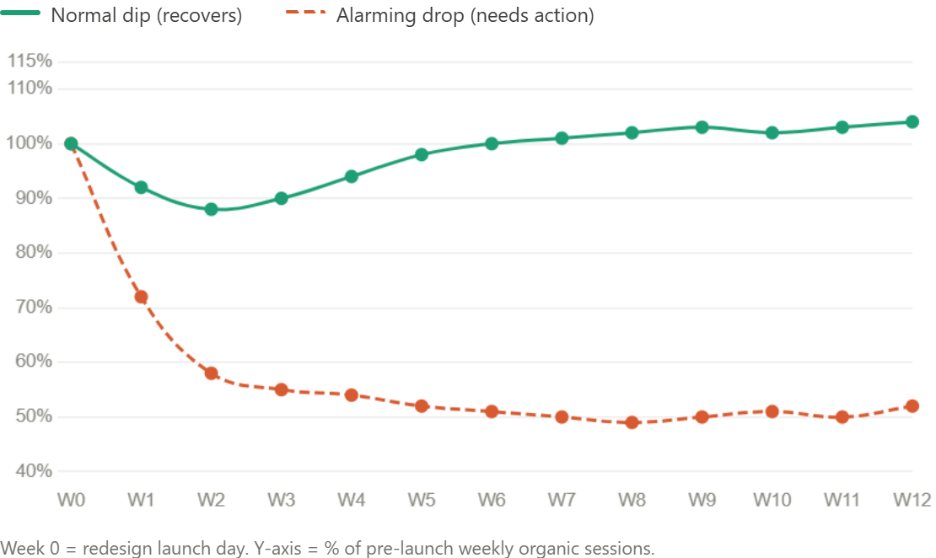
A small drop of 5% to 15% in the first two to three weeks after launch is completely normal. Google needs time to recrawl and re-evaluate your updated pages. This kind of drop usually recovers on it’s own within four to six weeks as long as your redirects are in place and your content is intact.
A sustained drop of 30% or more that continues beyond the first month is a signal that something is structurally broken. This is when you need to act quickly because the longer broken URLs sit without redirects and the longer Google goes without a submitted sitemap then the harder the recovery becomes.
How to redesign a website without losing Leads and Traffic?
The best way to deal with a post redesign traffic is to prevent it from happening in the first place. If you are planning a redesign or helping a client through one then this checklist will save you from months of recovery work.
1) Run A Full SEO Audit
Document every URL that is currently indexed, every page that drives traffic and every keyword you currently rank for. This is your baseline. You cannot protect what you have measured.
2) Preserve Your Existing URL Structure Wherever Possible
The safest redesign keeps URLs exactly the same. If URLs must change then map every single old URL to it’s new destination before launch day.
3) Set Up 301 redirects
Every old URL that is changing needs a redirect in place from the moment the new site goes live. A redirect tells Google that the page moved and transfers it’s ranking value to the new address.
4) Benchmark Your Analytics Before Launch
Screenshot your top 20 landing pages by organic traffic, your total monthly sessions and your key conversions metrics. You need a clean comparison point for the weeks ahead.
5) Submit Your XML sitemap
Do not wait for Google to find it organically. Submit it manually so the recrawl starts as fast as possible.
6) Test The Structure
Keep track of things like every CTA and navigation link before the site goes live after the redesign. Have someone outside the project test every conversion path on both desktop and mobile.
7) Keep Analytics Tool Open For Sometime after the launch
Use Tools Like Google Search Console. Check weekly for spikes in 404 errors, drops in impressions or pages that disappeared from the index. Catching problems in week one is far easier than fixing them in month three.
8) Do Not Rewrite All Your Page Content During The Redesign
If a page currently ranks well, update the design and layout but leave the core content and keyword structure intact. Rewriting ranked content is one of the most common causes of post-redesign ranking drops.
| Traffic Change | What It Usually Means | Action Required |
|---|---|---|
| 0%–15% Drop | Normal Google re-crawling after redesign | Monitor only |
| 15%–30% Drop | Possible indexing or redirect issues | Run SEO audit |
| 30%–50% Drop | Significant technical SEO problems | Immediate investigation |
| 50%+ Drop | Major migration failure or deindexing issue | Emergency recovery plan |
Increase Qualified Leads by Up to 70% With SEO-Driven Optimization
A great-looking website should generate more business, not fewer leads. We help businesses recover lost traffic, improve conversions, and turn redesigned websites into growth engines through proven SEO and conversion optimization strategies.
👉 Request Your Free SEO Recovery ProposalWrapping Up
A website redesign is supposed to grow your business not shrink it. But when it is done without protecting the SEO foundations that were already working, it almost always leads to a traffic drop and a leads downfall that can last months.
The core problem is that most redesign projects focus entirely on how a website looks and almost never on how Google reads it. URLs change without redirects. Content gets rewritten and loses it’s keyword signals. Forms break in migration. Trust signals disappear in the name of clean design. The result is a site that looks modern but performs worse than the one it replaced.
Understanding how website design affects SEO, knowing how to analyze a traffic drop with the right tools and having a clear recovery plan in place puts you back in control. Also if you plan a redesign in the future then running an SEO audit before launch day is the single most important step you can take to protect what you have already built.
Important Questions About Website Redesign SEO
With redirects in place and a sitemap resubmitted, most sites begin recovering within 6 to 12 weeks, though full recovery can take up to 6 months depending on how many issues were created.
Yes, if broken URLs go unredirected for a long time, Google removes those pages from its index entirely and the backlinks pointing to them lose their value permanently.
Google will eventually discover the changes on its own, but you should always manually submit your updated XML sitemap in Google Search Console to speed up the recrawl process.
The CMS matters less than the process. Any platform can preserve SEO if you maintain URL structures, set up redirects, and carry over all existing meta tags and content correctly.
Paid ad traffic is not directly affected by the redesign, but if landing pages change URL or get removed, your ads will point to broken destinations, which will hurt your ad performance and quality scores.
You open Google Search Console on a Monday morning, and the graph looks like someone pulled the floor out. Traffic is down 40% overnight. Rankings you spent months building have quietly vanished. No warning email. No error message. Just a number that makes everything stop.
According to Google Search Central and multiple industry studies, technical SEO errors, algorithm updates, and content quality issues account for more than 80% of sudden organic traffic losses. For businesses relying on organic search, even a 20% traffic drop can significantly impact leads, sales, and revenue.
The 40% overnight drop in traffic on your website can happen due to many reasons like Site redesign or migration, large scale content update, technical issue, and Google algorithm updates etc.
This happens more often than most people realize and in almost every case, the cause is traceable and fixable. The problem is that most site owners skip straight to making changes without understanding what actually went wrong which makes recovery take three time as long.
This guide walks you through every likely cause of a sudden traffic drop, A step by step process to diagnose it correctly and what to do to bring your traffic back and keep it stable.
SEO Circular provides free SEO audit along with a strategy plan which helps startups and businesses regain their lost traffic. If you need expert help recovering faster, SEO Circular’s Enterprise SEO and Technical SEO team has done exactly this for 500+ global brands.
Want To Regain Your Lost Traffic And Scale More?
Every day your traffic remains down is a day your competitors gain ground. Our SEO experts can identify the real cause of your traffic loss, fix critical issues, and create a recovery strategy that restores rankings, leads, and revenue. Get a free SEO audit and discover the fastest path back to growth.
→ Get a Free SEO Audit & Recovery Plan TodayKey Takeaways
- A sudden traffic drop almost always has one specific, traceable cause which is to diagnose before making any changes.
- Technical issues are the fastest to fix and the first thing you should rule out after checking for manual penalties.
- Algorithm updates require content quality improvements, not quick SEO workarounds.
- Documenting every change, you make during recovery is essential for connecting your actions to results.
- Proactive monitoring and pre-deployment SEO checklist will prevent most traffic drops before they happen.
What Caused Your Traffic Drop?
Before you touch anything on your site, you need to understand what you are dealing with. Traffic drop can signal many things. Either you were creating backlinks which were spammy, you changed and updated your content or your site hits some penalties. Let’s dive deep into the reasons behind your traffic drop:
Change In Website
This is the most overlooked cause of sudden traffic drops because the people who made the changes and the people watching the traffic numbers are often not the same person.
Site Redesigns Or Migrations
Website redesign means you are changing the visual appearance, layout and user experience of a website without necessarily changing it’s underlying platform or structure. On the other hand, website migration includes changing your website from one environment to another like changes in platform, domain, hosting, or structure.
Both can be reasonable behind your traffic drop. That is why choosing between website redesign vs migration is a decision that should be rooted in a clear understanding of your goals.
Large scale content updates
Bulk content changes carry the same risk as migration. Deleting thin or underperforming pages without redirecting them, merging multiple articles into one without preserving the original URLs or removing content sections to “clean up” the site can all trigger significant traffic losses.
Content that seems useless from a business perspective often carries SEO value through backlinks, internal link equity or search demand you had not mapped. Removing it without a proper audit can take rankings with it.
URL Structure
Changing URL slugs, restructuring category paths or moving pages to a different subdirectory breaks the signals Google has built around those URLs over time. Even with redirects in place, there is always some loss when URLs change. Without redirects, the loss is severe and immediate.
Technical Implementations
Technical changes can also have serious SEO consequences when pushed without checking their impact on crawlability and indexation. The most common technical causes of overnight traffic drops include a robots.txt update that blocks Googlebot from crawling key sections of the site, a no index tag that was meant for staging but got pushed to production, canonical tag changes that accidentally point pages away from themselves and JavaScript rendering issues that prevent search engines from reading page content correctly.
A single line of code pushed to the wrong environment can remove thousands of pages from Google’s index within days.
For example, a single line in your robots.txt file can accidentally block Google from crawling your entire website:
User-agent: *
Disallow: /


Similarly, a noindex tag intended for a staging environment can prevent important pages from appearing in Google:
<meta name="robots" content="noindex, nofollow">
If either of these configurations is pushed to a live website by mistake, search engines may stop crawling or indexing critical pages, leading to significant traffic losses within days.
Algorithm updates
If nothing changed on your site and your traffic still dropped sharply, a Google algorithm update is most likely the cause.
Google runs thousands of algorithm changes every year. The major ones, called Core Updates can shift rankings significantly across large portions of the web. These updates do not always penalize bad content. Sometimes they simply reward competitors who have stronger content, better user experience signals or more authoritative backlinks than you do. The result looks the same on your end but the fix is completely different.
Core Updates tent to affect content quality signals most heavily, looking at things like depth of information, author expertise, trustworthiness of claims and whether a page genuinely serves the person searching. If your content is thin, generic or has not been updated in years, a Core Update is likely the cause of your drop.
Other algorithm level updates target specific issues like page experience, product review quality, spam and helpful content. Knowing which type of update hit you tells you exactly what to improve.
Backlinks, Spammy Links and Penalties
Your backlink profile directly affects your site’s authority and rankings. Here are some things that can go wrong here:
Losing High-Quality Backlinks
If a publication that linked to you removed that link, went offline or changed their page then you lose the authority that link was passing. If several of those links disappear at once such as after a major site closes or a linking page gets deleted then your rankings can drop noticeably within weeks.
Spammy or Toxic Links
If someone pointed a large number of low quality, irrelevant or manipulative links at your site, either through a negative SEO attack or through past link-building practices that no longer meet Google’s guidelines, Google may devalue those links or take action against your site because of them.
Manual Penalties
A manual penalty is issued by a human reviewer at Google not an algorithm. It appears in the manual actions section of Search Console and comes with a specific description of what was found to be in violation. Manual penalties can remove specific pages or an entire site from search results entirely. They require you to fix the underlying issue and submit a reconsideration request before rankings can return.
What To Do After Losing Your Traffic?
Now that you understand the most likely causes, here is the step-by-step process to find your specific cause and start recovering.
1) Is The Drop Real Or A Tracking Issue?
Before diagnosing an SEO problem, confirm the drop is actually happening in search and not a measurement error.
Check these first:
- Did your Google Analytics 4 tracking code get removed or break during a recent site update?
- Was a date filter or segment accidentally applied to your dashboard that is hiding traffic?
- Did a referring traffic source dry up, for example a social campaign ending which is not an SEO issue at all?
- Is the drop in all channels or only organic search?
If organic search is the only channel affected and the tracking code is intact, then the drop is real and you move to the next step.
2) Analyze Google Search Console For Any Errors
Google Search Console is your most direct source of truth. Open it and check the following in this order.
- Manual Actions Check this first. If a manual penalty has been issued then it will be listed here with a clear description. This changes your entire recovery plan.
- Coverage Report Look for a sudden spike in pages listed as “Excluded,”Noindex”, or “Crawl anomaly”. A large increase here means pages dropped out of the index.
- Security Issues If Google detected malware or hacked content then it will be flagged here. This can cause rankings to vanish within days.
- Performance Report Set the date range to compare the period before and after the drop. Sort by biggest decline in clicks to identify which pages and queries were affected the most.
Note: Give yourself at least 48 to 72 hours after a drop before drawing conclusions from this data, as Search Console have a processing delay.
3) Check For Algorithm Updates
If Search Console shows no manual action and no indexing issues, check whether a Google algorithm update rolled out around the time your traffic dropped.
- Visit the Google Search Central blog to check for any officially announced updates near your drop date.
- Check third-party volatility trackers like Semrush Sensor, Mozcast or RankRanger which measure ranking volatility across millions of search results and will clearly show spikes when a major update hits.
- Cross-reference the type of pages that lost traffic with the known focus of recent updates.
4) Check For Technical Issues
Go through your deployment logs and ask your development team whether any code, plugin, theme, or configuration changes went live in the 48 to 72 hours before the drop.
Then run these checks:
- Open your robots.txt file at yourdomain.com/robots.txt and confirm no important sections are being blocked.
- Use the URL Inspection tool in Search Console to check how Google last rendered your most important pages.
- Run a crawl using Screaming Frog or a similar tool and filter for pages returning 4xx errors, redirect chains, or missing canonical tags.
- Check whether your XML sitemap is up to date and submitted correctly in Search Console.
5) Identify Which Pages Lost Traffic
Understanding whether this is a site wide or a page level drop is critical because each requires a different solution.
In Search Console’s performance report, go to the Pages tab, compare the last 28 days to the previous period and sort by the biggest decline in clicks. Look for these patterns:
- If one page or a small cluster of pages is responsible for most of the drop then the issue is likely specific to that content, template or URL.
- If the drop is spread evenly across the entire site, it points to a technical issue or broad algorithm signal.
- If the pages that dropped share a content type, section or template issue or a broad algorithm signal.
- If the pages that dropped share a content type, section or template that is your starting point for the fix.
6) Check For Competitor Changes
Search the keywords you lost rankings for and look at who moved into the positions you previously held. Then ask:
- Did a competitor publish significantly more detailed, better structured content on the same topic?
- Did a major publication or authority site enter the results for your core keywords?
- Did a competitor earn a strong cluster of new backlinks recently?
- Did Google introduce a new SERO feature like an AI Overview of a featured snippet that now absorbs clicks before they reach your result?
Use Semrush or Ahrefs to check which domains gained visibility in the same window you lost it. If a competitor’s domain grew while yours shrank, your recovery plan needs to focus on producing content that is genuinely better, not just longer.
7) Run Quick Diagnostics
You do not need a paid enterprise platform to run a solid first-pass diagnosis. These free tools cover the most critical areas:
1) Google Search Console — Errors, coverage, manual actions, performance data.
2) Google PageSpeed Insights — Check if Core Web Vitals scores dropped after a recent update.
3) Google’s Mobile-Friendly Test — Confirm your site is still rendering correctly on mobile.
4) Google’s Rich Results Test — Check whether structured data on key pages is still valid.
5) Screaming Frog (free up to 500 URLs) — Crawl errors, redirect chains, missing tags.
6) Ahrefs Webmaster Tools (free) — Recently lost backlinks and referring domains
7) Google Alerts — Set alerts for your domain name to catch any public discussion about issues.
8) Document Everything
This step is skipped constantly and it always creates problems during recovery. When traffic drops and urgency sets in, people make changes without tracking them which means they cannot connect their actions to any improvements or regression they see later.
Document the following from the moment you identify the drop:
- The exact date the drop started and the percentage declined.
- Which pages and keywords lost the most traffic.
- Any site changes made in the 7 days before the drop.
- Every diagnostic check you ran and what it showed.
- Every fix you implemented and the exact date it went live.
- Weekly traffic and ranking numbers after each fix.
| Step | Check | Tool |
|---|---|---|
| 1 | Verify the traffic drop is real | Google Analytics 4 |
| 2 | Check for manual penalties | Google Search Console |
| 3 | Review indexing and coverage issues | Google Search Console |
| 4 | Look for recent algorithm updates | Google Search Central |
| 5 | Audit technical SEO changes | Screaming Frog |
| 6 | Analyze affected pages and keywords | Google Search Console |
| 7 | Review backlink losses | Ahrefs Webmaster Tools |
| 8 | Compare competitor movements | Semrush / Ahrefs |
How Long Website Traffic Recovery Takes?
This depends entirely on what caused the drop
1) Technical Issues
Usually it takes time to handle Issues such as noindex tag, robots.txt block or broken redirects. Once the fix is deployed and Google recrawls the affected pages then the recovery takes 1 to 3 weeks.
2) Manual Penalty
After resolving the violation and submitting a reconsideration request, Google usually responds within a few weeks. Full recovery can take 1 to 3 months.
3) Algorithm Update
This is the longest recovery path. Google has confirmed that recovery from a core update often comes only with the next Core Update, which can be several months away. Content quality improvements made during this time lay the groundwork for that recovery.
4) Lost Backlinks
Recovery depends on how authoritative the lost links were and how quickly you can earn comparable replacements. In competitive niches, this can take 3 to 6 months.
Read Something Similar: AI Startup SEO & Marketing Strategy
How To Avoid Future Drops?
The best recovery strategy is one you never need. Building proactive monitoring and governance into your SEO operations is what separates sites that bounce back quickly from those that stay down.
Here is what to put in place:
- Set up automated weekly crawls with alerts for sudden increases in crawl errors, 404 pages or noindex tags.
- Monitor Core Web Vitals continuously not just after something breaks.
- Build a pre-deployment SEO checklist that every development push goes through before going live.
- Track your share of voice monthly across your 20 to 30 most important keywords so you catch competitor movement before it becomes a crisis.
- Audit your content every 6 months for accuracy, depth and alignment with current search intent.
- Maintain a healthy backlink profile with diverse referring domains rather than relying on a small number of sources.
- Follow the Google Search Central blog and trusted SEO news sources, so algorithm updates are never a surprise.
Bonus Tip
Even the errors you catch are just the surface. The ones you are not familiar with, the crawl misconfigurations, algorithm signals, and indexation issues you do not know how to look for, are quietly doing the most damage. Hiring an experienced SEO company means nothing gets missed.
Conclusion
A sudden traffic drop is stressful, but it is almost never the end of the story. The sites that recover fastest are the ones that diagnose before they act, document what they find, and make focused improvements rather than scattered reactive changes. Start with Search Console, rule out technical issues, identify whether an algorithm update or competitor shift is involved, and build the monitoring systems that catch the next problem before it becomes a crisis.
The longer you wait to act with clarity, the more ground a competitor gains. Every day without direction is a day the gap widens. Treat the drop as a reason to build something more resilient than what existed before.
Traffic drops are signals, not a death sentence.
Frequently Asked Questions
Yes, Algorithm updates and competitor improvements can reduce your rankings even when your site has not changed at all.
No, Penalties are one of the less common causes. Algorithm updates, technical errors, and content quality issues are far more frequent.
Only if you have clear evidence of a toxic or manipulative link profile. Disavowing clean backlinks can remove authority and worsen your rankings.
Check the Google Search Central blog and third-party volatility trackers for update announcements that coincide with your drop date.
Only if that content is genuinely more useful, accurate, and authoritative than what already exists. Publishing thin content in bulk will not help and may make things worse.
You spent months writing your book. You published it. And then, nothing.
No traffic, no new readers, no sales from users who do not already know you.
This is the reality for the majority of authors and book sellers today. With over 4 million books published every year, discoveries do not happen by accident. It requires a deliberate strategy to make your book findable online. According to industry reports, Amazon controls a massive share of the global eBook market, while Google remains the starting point for billions of discovery searches every day. Readers are actively searching for terms like “best fantasy books for beginners,” “books like Atomic Habits,” or “top psychological thriller novels.” Authors who optimize for these searches gain long-term visibility, recurring traffic, and higher book sales without depending entirely on paid promotions or social media algorithms.
This is exactly what SEO for book authors solves. Search Engines Optimization is the process of making your book, your author page and your listings show up when the right readers are searching for them. Unlike paid ads that stop working the moment your budget runs out, SEO compounds over time. A well-optimized page written today can bring readers to your book for years.
This guide covers everything you need to know as an author or book seller.
Need help making your book visible where it matters?
SEO Circular’s content and digital PR team helps authors and publishers build a searchable, rankable presence online.
Need Help Growing Your Book Visibility Online?
At SEO Circular, we help authors, publishers, and book-selling businesses improve organic visibility through SEO strategy, content marketing, technical optimization, and digital PR. From Amazon SEO optimization to authority link building and author website growth, our team builds long-term discoverability systems designed to generate recurring traffic and book sales. Whether you are launching your first title or managing a growing publishing brand, we help turn search visibility into measurable growth.
Book Your Free SEO Strategy Call Today
Key Takeaways
- SEO produces free traffic that grows over time unlike paid ads which stop the moment you stop paying.
- Your book description is your most important metadata. Optimize it everywhere it appears.
- Amazon has its own algorithm. Backend keywords, categories, and review velocity all affect where your book ranks on the platform.
- Off-page authority through backlinks, digital PR, and reviews is what makes Google trust and rank you above others.
- A blog updated consistently around your genre and subject matter is the highest-return SEO move most authors are completely ignoring.
How Do Search Engines Evaluate Your Book?
Before you can optimize anything, let’s understand what search engines are looking for. Whether it is Google evaluating your author’s website or Amazon ranking about your book listing, the goal should be the same to show the most relevant and trustworthy result to the person searching.
Book Title and Subtitle
Your book title is one of the first things search engines read. A vague title like “Wings” gives algorithm no signal at all. A title like “Wings: A Coming of Age Story About Loss and Belonging” communicates genre, theme and emotional context at the moment. Use your subtitle as a natural keyword placement opportunity and think about what your ideal reader would type into a search bar.
Book Description and Metadata Optimization
Your book description is the most important piece of metadata you control. On your website it becomes your meta description, the short text Google shows under your link in search results. On Amazon it decides whether a reader clicks buy or moves on.
Keep your meta description under 160 characters. Lead with an emotional hook in the first two lines since only these show before “read more.” Include genre keywords naturally, for example “A gripping psychological thriller for fans of Gone Girl” tells both the reader and the algorithm exactly where your book belongs. Never copy the same description across multiple book pages.
Reviews and Ratings
Reviews build trust with readers and act as ranking signals for both Google, Amazon, and other book publishing websites. On Amazon, review velocity meaning how quickly you collect reviews after launch directly impacts your ranking. On Google, star ratings from Goodreads can appear as rich snippets making your listing more clickable. Send Advance Review Copies before launch and ask readers to post on day one. Never buy fake reviews.
Backlinks and Mentions
When another website links to your book or author page, Google counts it as a vote of confidence. One link from a respected literary blog is worth more than fifty links from random directories. Even unlinked mentions of your book title online contribute to your authority in the algorithm.
Publication and Update Dates
Google favors content that is actively maintained. Adding new reviews, refreshing your description, or publishing a blog post every few weeks is enough to signal that your site is alive and relevant.
Keyword Research For Book Authors And Sellers
You cannot optimize your book for search without first knowing what words your readers are actually typing. Keyword research is the process of finding those phrases so you can use them in the right places across your website and listings.
Types Of Keywords To Target
- Genre keywords like “best psychological thriller novels” or “young adult fantasy books 2026” connect your book to the category readers already browsing.
- Comparison keywords like “books like Atomic habits” or “novels similar to Gone Girl” carry strong buyer intent because the reader already knows what kind of experience they want and is looking for a solution.
- Problem Based keywords like “books that help with anxiety” or “self-help books for new entrepreneurs” work especially well for non-fiction authors because they match the exact language a reader uses when looking for a solution.
- Author name keywords like “books by your name” or “your name new release” are important to claim early so your own name ranks for your own content.
- Long-tail keywords are longer and more specific phrases like “best self-help books for women in their 20s”. These have lower competition and higher conversion because the reader knows what they want before they even land on your page.
Ecommerce SEO for Book Authors and Sellers
Amazon is the world’s largest book search engine and most buyers go there before they go to Google. Amazon ranks books on relevance and sales performance. SEO gets you the initial visibility needed for sales to begin.
| Platform | Primary SEO Goal | Important Ranking Factors |
|---|
| Discovery & organic traffic | backlinks, content quality, authority | |
| Amazon | Book sales & conversions | reviews, sales velocity, backend keywords |
| Goodreads | Reader engagement | ratings, reading lists, activity |
| YouTube | Author visibility | watch time, keyword optimization |
| Long-term discovery | visual SEO, pins, keyword-rich boards |
Optimizing Your Amazon Listing
Use your subtitles as your primary keyword placement on Amazon. Only the first two lines of your description show before “read more” so those lines need to hook the reader and communicate your genre immediately. Including comparison phrases like “for fans of Brandon Sanderson” signals to the algorithm exactly which audience your book serves. Always end with a direct call to action.
Backend Keywords in KDP
Kindle Direct Publishing gives you 7 keyword fields of 50 characters each. Use all of them with phrases rather than single words since that is how readers actually search. Do not repeat anything already in your title as Amazon indexes those automatically. Use phrases like “books to read after Gone Girl” or “dark romance novels 2025” rather than generic terms.
Categories and Subcategories
Amazon lets you select two browse categories. Choosing a specific subcategory works heavily in your favor since it is far easier to earn a Best Seller badge in “Mystery > Indian Crime Fiction” than in “Mystery” alone. Research which subcategories your closest competitors are in and look for niches where top-ranked books have fewer reviews than your own.
Other Platforms
Goodreads has 150 million members and is essential for discovery even though it is not a purchase platform. Complete your author profile fully and engage with reading lists in your genre. For Indian authors, Flipkart follows the same principles as Amazon. For direct selling on Gumroad or Instamojo, treat your product page like an SEO landing page with a keyword-aware title and description. Amazon Author Central is a free SEO tool that brings all your books, bio and blog feed into one author page on Amazon and most authors never set it up.
Off-Page SEO for Authors
Off-page SEO is everything outside your website that signals trust and authority to Google.
Building Authority Online
Guest post on established literary websites like Reedsy, Writers Digest, and LitReactor to earn credible mentions and links. Start a newsletter on Substack since a growing subscriber base often attracts organic backlinks from readers who share your work. Participate in author panels and book fairs as these events are frequently covered online and generate both mentions and links. Become the go-to recommendation voice in your genre because topical authority builds trust with both readers and algorithms over time.
Earning Quality Backlinks
Reach out to book bloggers in your genre and offer a review copy. Pitch author interviews to literary websites and genre-specific blogs. Appear on podcasts relevant to your topic since podcast websites consistently link back to guests. Use HARO to respond to journalist queries and get quoted in news articles with a link back to your site. Submit your book to Goodreads, BookBub, and LibraryThing as each listing creates a web presence point Google indexes.
Book Reviews as an SEO Signal
Reviews on Amazon, Goodreads, and literary blogs create a network of mentions around your book title that Google tracks over time. Review velocity on Amazon meaning how fast you collect reviews after launch is a direct ranking factor. Coordinate with ARC readers before your launch date to maximize early reviews from day one.
Website SEO for Authors
Your author website is your owned SEO asset. Unlike Amazon, you control every element of it and Google indexes it independently of any third-party platform. Even a simple website with a few well-optimized pages gives you a significant advantage over authors who rely entirely on marketplace listings.
Key On-Page Elements and Metadata Optimization
| SEO Element | What It Is | Best Practice | Example |
|---|---|---|---|
| Title Tag | The blue clickable headline shown in Google search results. | Keep it under 60 characters and include the book title + genre + author name if possible. | The Silent Garden: Psychological Thriller by Sarah Mehta |
| Meta Description | The short description shown below the title in Google results. | Keep it under 160 characters. Write a compelling one-line hook and make every page description unique. | A gripping psychological thriller filled with secrets, betrayal, and unexpected twists by Sarah Mehta. |
| H1 Heading | The main heading displayed on the page. | Use only one H1 per page. It should usually be the book title or author name. | The Silent Garden |
| Clean URL Structure | The page URL format used for the website. | Use readable, keyword-friendly URLs instead of random IDs or numbers. | yoursite.com/books/the-silent-garden |
| Image Alt Text | Description added to book cover images for SEO and accessibility. | Clearly describe the image using the book title, genre, and author name. | The Silent Garden book cover, psychological thriller novel by Sarah Mehta |
Technical Basics
Mobile-friendly design: 63% of Google searches happen on mobile. A site that does not work on a phone loses rankings. Fast loading pages: Google uses page speed as a ranking signal so compress your book cover images and avoid heavy plugins. HTTPS: Google marks non-secure sites as untrusted and every modern hosting platform provides this for free. A blog section updated with one to two posts per month on topics related to your genre, writing process, or subject matter is enough to build topical authority gradually and consistently.
You Might Also Enjoy: Top Python Libraries for Technical SEO
Measuring Success: Book SEO Metrics
Check these five numbers once a month.
- Search rankings: are your pages appearing for your target keywords? Use Google Search Console, it is free.
- Organic traffic: how many visitors are arriving from Google without paid ads?
- Keyword coverage: how many relevant search terms is your site ranking for?
- Click-through rate: of people who see your link in results, how many clicks? A low rate means your title tag or meta description needs to work.
- Conversion rate: of visitors who land on your book page, how many buy or take action?
Many authors underestimate the resources needed to compete in organic search. An SEO Cost Calculator can help publishers and self-published authors estimate investment requirements based on keyword competition, content production, technical optimization, and digital PR needs.
Conclusion
SEO is not a one-time task. It is a long-term investment that compounds the longer you stay consistent with it. The author who optimizes their Amazon listing today, publishes one blog post this month, and earns a single quality backlink this quarter will quietly outrank the author who does nothing and hopes word of mouth does the work.
Start with the fundamentals covered in this guide: optimize your title and description with natural keyword language, set up your author pages on Amazon Author Central and Goodreads, make sure your website has proper on-page elements in place, and begin earning mentions and reviews wherever your ideal readers gather. Each of these steps is manageable on its own. Together they build a discovery engine that works for your book around the clock.
What People Want to Know
Typically, 3 to 6 months for a new site. Content you publish today continues building authority for years.
You can overlap genres and themes but the approach differs. Use your website for broader informational keywords and Amazon for buyer-intent phrases.
Not directly. But a large following increases share which leads to more backlinks which does affect rankings.
Core principles are the same. Add format-specific phrases like “psychological thriller eBook” or “self-help audiobook for commuting” for additional reach.
For one book, applying these fundamentals yourself is a solid start. For multiple titles or a publishing business, professional help accelerates results significantly.
SEO costs for subscription-based businesses typically starts within from $500 to $3,000+ per month for standard services with comprehensive national campaigns often costing $3,000–$5,000+ monthly. Pricing also depends on industry competition, content needs and backlink strategies with hourly rates ($15–$20) and projects free audits for your website are also available.
Most subscription businesses ask the wrong question when it comes to SEO. They ask “how much does SEO cost?” – when the question they should be asking is “what is SEO worth to a business where every customer pays monthly for years?”
That second question changes everything – your budget, your agency negotiations, your content priorities and the patience you extend before expecting results. It reframes SEO from an expense into a capital allocation decision.
Seo for SaaS platforms, B2B tools and recurring revenue businesses demands its own cost framework not a guide built for e-commerce or one-time service businesses. The stakes, the timelines, the content requirements and the competitive dynamics are entirely different.
In this guide, we break down exactly what SEO costs at every stage of a subscription-based business, what drives those costs up or down, where to allocate spend for maximum long term value impact and how to make the investment defensible to any leadership team or board.
Turn SEO into Your Highest ROI Channel 🚀
Struggling to generate consistent leads from SEO? We help subscription businesses attract qualified traffic and convert it into trials, signups, and recurring revenue.
Pre-Requisites For Subscription Based Businesses
- A clearly defined ideal customer profile — know exactly who you are targeting before a single keyword is researched.
- A conversion-ready website — SEO drives traffic, your site needs to be capable of converting it.
- A consistent content operation — the pipeline for briefing, writing and publishing must already be moving.
- Proper analytics and conversion tracking — trial signups and MRR contributions must be measurable from day one.
- A 12-month commitment from leadership — SEO compounds over time, teams that pull budget early never see the return.
- A realistic budget allocation — subscription businesses should plan for a minimum of $1,500/month at early stage, scaling to $5,000–$8,000/month as the channel matures and competition demands it.
What Does SEO Cost for Subscription-Based Businesses?
SEO spend for subscription businesses breaks into four distinct phases each with its own cost profile, strategic focus and expected output. These are not aspirational estimates. They reflect what competitive subscription businesses are actually allocating in 2025-2026. Let’s explore the cost below
| Stage | Monthly SEO Spend | Key Focus | Expected Output |
|---|
| Startup / Pre-PMF | $500 – $800 | Technical setup, keyword mapping, basic content, early link outreach | Indexing, initial rankings, topical relevance |
| Growth (Seed – Series A) | $800 – $1,000 | Competitive content, landing pages, conversion-focused keywords | Qualified traffic, early conversions, improved visibility |
| Scale (Series B+) | $1,000 – $3,000 | Authority building, link acquisition, product-led SEO, international expansion | Strong rankings, consistent traffic growth, market positioning |
| Enterprise SaaS | $3,000+ | Digital PR, programmatic SEO, multi-language content, technical scaling | Market dominance, high-volume traffic, sustained growt |
What Factors Determine Your SEO Cost As a Subscription Business?
SEO pricing is not arbitrary, it is a direct output of your business’s complexity, competitive environment and growth stage. These are the factors that move the number and why two subscription business in the same category can come with a big cost difference.
1. Competitive Density Of Your Category
Category competition is one of the single largest cost drivers in B2B subscription SEO. It determines how much domain authority you need to rank, how long it takes to get there and how much content and link acquisition investment is required to close the gap.
Consider two SaaS businesses: one selling project management software in a market with Asana, Monday.com and notion and another selling niche compliance automation for a single regulated industry. The first is competing against companies with figure SEO budgets. The second has a manageable competitive landscape. Their SEO costs will differ by 3-5x even if their product pricing and team size are identical.
High Competition (CRM.HRMS<Marketing tools)
$800 – $1,000/month to compete
Niche vertical SaaS
$1,000-$1,500/month to compete
To assess your competitive density before setting a budget, look at the domain authority of the top 5 organic results for your core keywords. If those pages consistently show domain authority around 70+ then you are in a high-cost category and need to plan accordingly – particularly for link acquisition.
Low Competition
$500-$900/month Niche verticals, emerging categories, undeserved industries
Medium Competition
$1,000-$1,200/month Established but not saturated. Mid-tier SaaS, regional B2B tools
High Competition
$2,000 – $3,000/month Established but not saturated. Mid-tier SaaS, regional B2B tools
2. Content Volume And Funnel Coverage Required
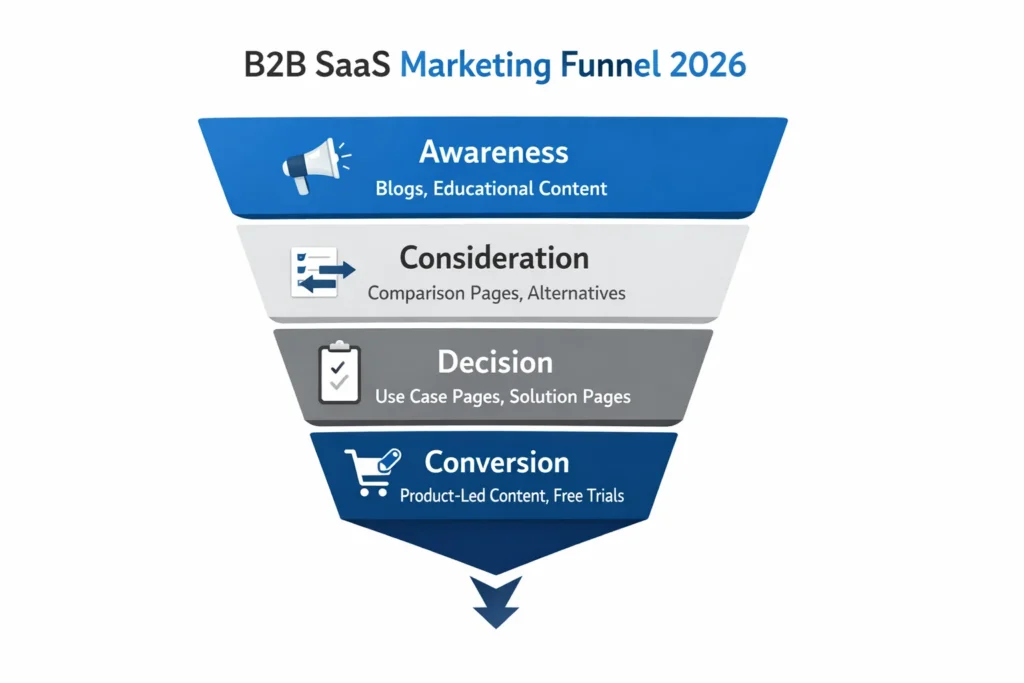
Content is typically the largest ongoing SEO cost for subscription businesses and the requirement is significantly heavier than for transactional or local businesses. A subscription buyer goes through a multi-week research process spanning awareness, evaluation, comparison and decision stages. Each stage needs content optimised to capture and advance that intent.
Here is the breakdown of the content types required and their approx. production costs.
Awareness Articles
$300 – $500 Per 1,500-2,500 word article. Top-of-funnel educational content.
Comparison Pages
$500-$700 Per page. High conversion value
Use-Case/ Solution Pages
$600-$800 Per page. Directly maps your product to a buyer’s specific workflow problem.
Product-Led Content
$700-$1,000 Per piece. Integrates product demonstrations into how-to content. Highest trial conversion rate.
The volume of content needed depends heavily on your subscription model type. A SaaS platform targeting multiple industries and uses cases may need 8-12 pieces per mouth to build topical authority. A niche B2B data subscription can often achieve strong results with 4-6 highly targeted pieces. A content or strong results with 4-6 highly targeted pieces. A content or newsletter subscription may need 10-15 shorter editorial pieces to maintain organic visibility.
3. Technical Complexity of your Platform
Technical SEO is where subscription businesses – particularly software platforms face costs that have no equivalent in simpler business models. Your product’s architecture introduces SEO challenges that require specialist expertise to resolve and maintain.
The most common and costly issues specific to subscription platforms include:
- JavaScript rendering issues
- Login-gated content not indexing
- Multi-tenant subdomain structure
- Duplicate meta across plan tiers
- App vs. marketing site architecture
- Page speed on feature-heavy Uls
For SaaS and API subscription businesses, a one-time technical SEO audit conducted by a specialist who understands JavaScript – rendered applications typically costs $1,000-$2,000 and almost always uncovers issues that are silently suppressing rankings. Ongoing technical maintenance runs $800 -$2,000/month.
For content subscriptions and membership platforms, technical SEO is considerably simpler. A WordPress or Webflow-based site can often be maintained technically for $300-$600/month with a lighter initial audit for free.
1.High Technical Cost
SaaS platforms, API subscription, multi-product suites with complex app architecture.
Initial audit: $200-$500.
Ongoing: $300-$500/monthly
2. Standard Technical Cost
Content subscription, newsletters, membership communities on standard CMS platforms.
Initial audit $300-$600
Ongoing: $400-$600/month
5. Link Acquisition
Backlinks remain one of the strongest ranking signals in competitive B2B search categories. For subscription businesses, organic link velocity – links earned without active effort is typically very low. Publications and websites do not naturally link to SaaS tools or membership platforms the way they link to research, news or freely accessible resources.
This means link acquisition has to be proactive and budget – allocated. The cost is driven by the domain authority you are targeting and the category you are operating in.
1) Niche Outreach
$600-$800/month
8-15 quality links/month from relevant but mid-tier publications and directories
2) Authority-Tier Links
$800-$1,000/month
5-10 links/month from DA 60+ publications in your industry vertical.
3) Digital PR Campaigns
$1,000m – $2,000 Per campaign
Data-led PR designed to earn 20-50 links from mainstream and trade press.
The subscription model type significantly affects link acquisition strategy. SaaS platforms can leverage integration directories (G2, Capterra, Product Hunt), partner ecosystem and developer communities for natural link sources. Data and API subscriptions often earn links through original research and datasets. B2B membership platforms benefit from speaker citations and industry publication mentions. Content subscriptions typically need to invest more actively in outreach since their product itself does not generate actively in outreach since their product itself does not generate natural link sources.
5. Target Market Scope – Geographic and ICP (Ideal Customer Profile) Breadth
Two subscription businesses with identical products can have SEO costs that differ by 2-3x purely on the scope pf their market. Scope has two dimensions:
- Geographic reach
- Ideal customer profile breadth
Geographical scope
It is the more straightforward cost driver. A subscription business targeting a single English-speaking market (US, UK,) has a contained SEO program. One targeting multiple languages or regional markets requires localised content, hreflang implementation and in some cases entirely separate link acquisition programs per region. International SEO typically adds 40-80% to a program’s total cost.
ICP breadth
It refers to how many distinct buyer personas, industries or company sizes your product addresses. A SaaS platform that serves HR teams, finance teams and operations teams across small and medium size businesses, mid-market and enterprise segments needs separate content tracks for each – multiplying content volume and the complexity of keyword strategy. A focused tool built exclusively for a single persona in a single industry can execute SEO with far greater efficiency.
1) Single Market, Single ICP
Base Cost – The most efficient SEO configuration. Focused keyword strategy, one content track.
2) Multi-Persona, Single Market
1.5-2x Base
Separate content strategies per persona. Higher volume, more complex internal linking.
3) Multi-Market, Multi-Language
2-3x base
Localised content, regional link building, technical hreflang configuration and separate rank tracking per market.
You Should Also Check Out: SEO Cost For Small Businesses
SEO Pricing Models for Subscription-Based Businesses — Which One Actually Fits You
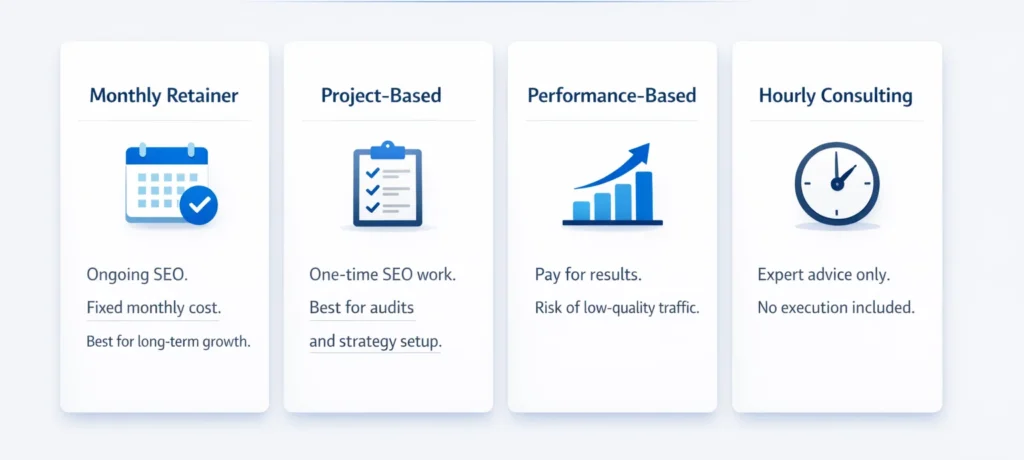
Before signing any SEO contract or hiring anyone, you need to understand how SEO is priced because the model you choose affects not just what you spend but what you get, when you get it and how accountable your provider is for results.
There are usually four primary pricing models used in B2B SEO today. Each suits a different stage and type of subscription business.
1. Monthly Retainer
This is the most common model for subscription businesses and for good reason — SEO itself is a recurring, ongoing activity. You pay a fixed amount every month in exchange for a defined scope of work: strategy, content production, link building, technical maintenance and reporting.
Typical range: $1,000 – $2,000/month depending on scope and provider level.
This model works best for SaaS platforms, B2B membership tools, and data subscription products that need sustained, compounding SEO activity. The consistency of effort is what builds domain authority over time. The risk is that retainers can become passive — you pay monthly but output and accountability drift if there is no clear deliverables framework tied to the contract.
2. Project-Based Pricing
Here you pay a one-time fixed fee for a specific, defined piece of work — most commonly a technical SEO audit, a keyword strategy, a content architecture plan or a site migration. There is no ongoing commitment.
Typical range: $1,500 – $3,000 per project depending on scope and complexity.
For subscription businesses, project pricing makes the most sense at two points: at the very beginning (to build the strategic foundation before committing to a retainer) and at specific inflection points (a platform rebuilds, an international expansion or a significant algorithm recovery). A SaaS company rebuilding its marketing site should commission a technical SEO project before going live not after.
3. Performance-Based Pricing
In this model you pay based on results typically on rankings achieved, organic traffic delivered or leads generated. It sounds appealing because it appears to remove risk from the buyer.
In practice, it rarely works well for subscription businesses. The metrics that get optimised (keyword rankings, raw traffic) are often misaligned with the metrics that matter (trial signups, MRR, organic CAC). An agency can rank you for high-volume keywords that bring zero qualified subscribers and still collect full payment. Additionally, reputable SEO providers rarely agree to pure performance-based models because SEO outcomes depend on factors outside their direct control — your product, your conversion rate, your sales cycle.
Where it can work as a hybrid model where a base retainer covers core activity and a performance bonus is tied to clearly defined conversion outcomes like organic trial signups.
4. Hourly Consulting
You pay a senior SEO consultant by the hour for strategy, advice, audits or training. No execution is included, just expertise.
Typical range: $10 – $20/hour for a qualified B2B SEO consultant.
This model is underused by early-stage subscription businesses and overused by growing ones. For a pre-seed SaaS or content subscription that cannot afford a retainer, a 10–15 hour engagement with the right consultant can deliver a keyword strategy, a technical priority list and a 6-month content plan giving you a roadmap to execute with internal resource. The mistake is relying on hourly consulting past the point where you need full execution not just direction.
Why the SEO Team Behind Your Subscription Business Matters More Than the Budget?
Most subscription businesses that struggle with SEO do not have a strategy problem or a budget problem. They have a people problem. The wrong team — or no dedicated team at all — is the single most common reason SEO spend produces no meaningful return.
SEO for subscription businesses is not a set-and-forget task. It requires consistent execution across content, technical health, and link acquisition — simultaneously, every month. That demands people who understand not just SEO mechanics, but the specific dynamics of recurring revenue: how to target buyers mid-research, how to write content that converts to trials, and how to report performance in terms of MRR and CAC rather than just traffic.
What a capable SEO team actually does for your business
A properly structured SEO team does four things that no tool or one-off agency engagement can replicate. Maintains your technical foundation, so rankings are not silently lost to crawl errors or platform updates. It builds topical authority through consistent, high-quality content that earns trust with both search engines and your buyers. It acquires links that signal credibility in your category. Also it connects every activity back to revenue — so the investment is always justified and always directionally correct.
Without that team in place, even the right strategy degrades quickly. Content gets published without a brief. Technical issues go unresolved for months. Link building stops the moment a freelancer moves on. The compounding nature of SEO — its greatest advantage — only works when the effort is continuous.
Where SEO Circular comes in
At SEO Circular, we work exclusively with subscription-based businesses — SaaS platforms, B2B membership tools, data products, and recurring-revenue brands that need SEO built around LTV, not just traffic. Our team handles the full execution stack: technical audits, content strategy and production, link acquisition, and performance reporting tied directly to your growth metrics.
You do not need to hire, train or manage an in-house team from day one. You need the right partner who already understands your model, your buyer and what good SEO results actually look like for a subscription business.
That is what SEO Circular is built to be.
The Cost Of Hiring SEO Circular For Your Subscription Business
Hiring the right SEO team is an investment decision and like any investment, the number only makes sense when you understand what it buys and what it returns. Here is what working with SEO Circular practically costs based on real market rates for the scope of work involved.
Starter Engagement – 600 to $1,000/month
Built for early-stage subscription businesses and startups that need a strong foundation without overextending budget. This covers a full technical SEO audit, keyword and competitor research, a content strategy mapped to your ICP and two of your published articles per month.
Link outreach is included at a baseline level. At this tier your get a clear roadmap, consistent execution and monthly reporting tied to organic traffic and trail metrics.
Best fit for pre-seed to seed stage SaaS, niche B2B tools and content or newsletter subscription getting SEO off the ground.
Growth Engagement – $1,000 to $2,000/month
Designed for subscription businesses post product market fit that are ready to compete seriously in their category. This includes full technical maintenance, six to eight pieces of content per month, active link acquisition targeting DA 50+ publications and competitive tracking across your core keyword set. Reporting at this tier to MRR contribution and organic CAC- not just rankings.
Best fit for Series A SaaS platforms, B2B membership communities and data subscription products scaling their organic channel.
Scale Engagement – $2,000 to $3,000/month
For subscription businesses where SEO is a primarily acquisition channel and the competitive environment demand sustained authority-building. This covers the full execution stack – technical SEO, high volume content production, digital PR and link campaigns, programmatic SEO where applicable pipeline and revenue benchmarks.
Best fit for Series B+ SaaS companies, multi-product subscription platforms, and enterprise B2B SEO agencies competing in high-density markets.
Every engagement fits your stage and goals, get in touch with SEO Circular directly.
The Right SEO Investment Turns Subscribers Into a Compounding Growth Engine
SEO for subscription businesses is not complicated but it is specific. The cost is real, the timeline is longer than most businesses expect, and the factors that drive your number are different from every other business model. What makes it worth it is equally specific: a single ranked page delivering qualified trials every month for years, an organic CAC that drops while your paid CAC climbs and a customer acquisition channel that does not switch off the moment you stop paying for it.
The businesses that win with SEO are not necessarily the ones with the biggest budgets. They are the ones that understand their model, invest at the right stage, choose the right pricing structure and commit long enough to let the compounding effect do its work.
If you are a subscription business ready to build that engine — SEO Circular is built to help you exactly do that.
Commonly Asked Questions
Yes — freemium models can leverage product-led SEO by indexing user-generated content, public project pages, and feature-specific landing pages, creating organic surface area that paid-only models cannot. The content strategy and keyword targeting differ significantly between the two.
SEO and paid ads serve different stages of the funnel and different timeframes. Paid fills the pipeline immediately while SEO builds the long-term organic base. Running both simultaneously is the most effective approach, with the expectation that organic gradually reduces dependency on paid spend over 18 to 24 months.
A domain migration without proper SEO planning can wipe out years of accumulated authority overnight. 301 redirects, canonical tags, and a structured crawl validation process are non-negotiable before any migration goes live. Businesses should expect a temporary rankings dip of 20 to 40 percent even with a well-executed migration.
Entering a new vertical requires treating it as a separate SEO program — distinct keyword research, dedicated landing pages, and new content tracks built around that segment’s specific pain points. Trying to rank for a new vertical by repurposing existing content rarely works and dilutes topical authority.
Yes, but only with the right constraints. A single in-house SEO manager can effectively own strategy, technical maintenance, and content oversight — provided content production is outsourced to freelance writers and link acquisition is handled by a specialist. Trying to do everything in-house with one person typically results in either content or technical SEO being neglected entirely.