Selling carbon credits worldwide is no longer limited to large corporations or government-backed projects. Today, startups, sustainability platforms, brokers, and even niche marketplaces are entering this space. And the demand is real. According to market data, the global carbon credit market is expected to cross $100 billion by 2030, driven by corporate net-zero commitments and regulatory pressure.
To sell carbon credits globally, you need verified credits, a global sales channel, and an SEO-driven strategy to attract buyers.
At SEO Circular, we work with climate tech platforms and carbon marketplaces, and we see a clear pattern. Many businesses have access to carbon credits but struggle with visibility, buyer trust, and global reach. Hire us a marketing partner, we will help you to seel your Carbon globally. Schedule a free call
So the real question is not just how to sell carbon credits, but how to sell them worldwide consistently, safely, and at scale.
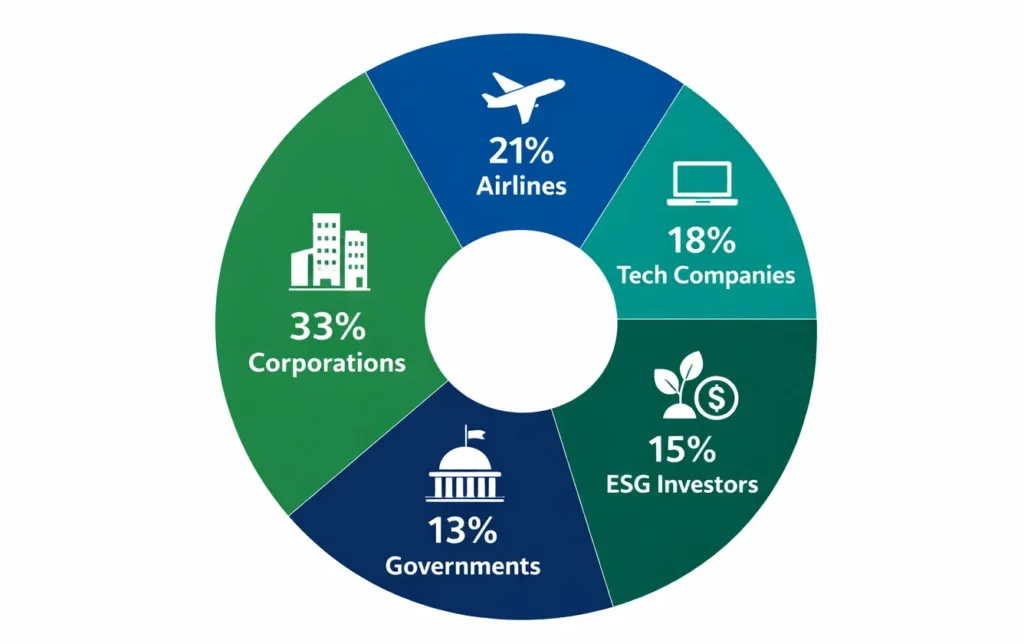
Global carbon credit demand is driven by corporations, airlines, and ESG-focused investors.
Key Takeaways
Carbon credits demand is growing globally
Selling requires more than just listing
SEO plays a major role in visibility
Trust and transparency drive conversions
Structured systems outperform random marketing
Global sales require localization and targeting
Turn Carbon Credit Traffic into Revenue 🚀
Want to rank for high-intent keywords like sell carbon credits or carbon credit marketplace and generate real leads?
We help clean tech and sustainability brands scale visibility and conversions.
✔ High-Intent Traffic✔ Lead Generation✔ ROI-Focused SEO
What Are Carbon Credits and How Global Selling Works
Carbon credits represent 1 ton of CO₂ removed or reduced from the atmosphere. These credits can be bought by companies to offset their emissions.
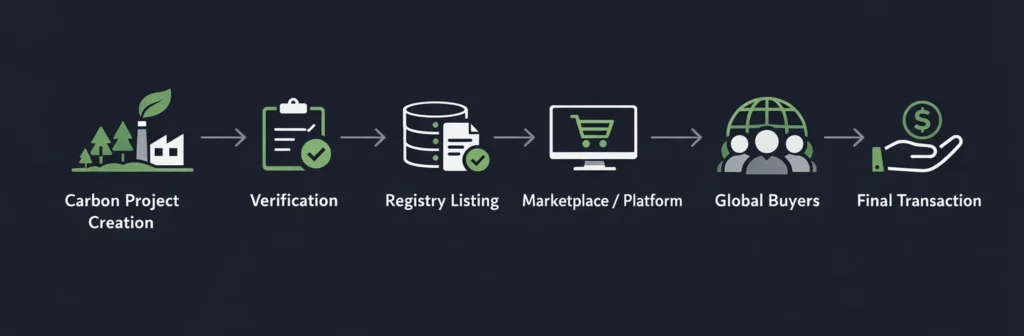
Here’s how global selling works in simple terms:
A project (forest, renewable energy, carbon capture) generates credits
These credits are verified by standards
Credits are listed on registries or marketplaces
Buyers from anywhere in the world purchase them
Sounds simple, but this is where most businesses struggle. The system exists, but distribution and visibility don’t.
We see this problem very often. Many platforms rely only on listing credits, expecting buyers to come automatically. That rarely works.
Types of Carbon Credits You Can Sell
Not all carbon credits are the same. Understanding this is important if you want to sell globally. Different buyers look for different types of credits based on their goals, compliance needs, and budget. If you don’t position your credits correctly, even good projects struggle to sell.
Here’s how each type works in real-world selling scenarios.
1. Voluntary Carbon Credits
Used by companies for sustainability goals
No legal obligation
High flexibility in pricing and marketing
Voluntary carbon credits are the most accessible entry point for global selling. These are purchased by companies that want to reduce their carbon footprint but are not legally required to do so. Think of brands working toward net-zero goals or improving ESG positioning.
From what we see at SEO Circular, this market is driven heavily by branding, storytelling, and trust. Buyers care about the impact story behind the project, not just the credit itself.
This also means you have more control over:
Pricing strategy
Buyer targeting
Marketing narrative
But at the same time, competition is higher. So visibility becomes critical. This is why many voluntary credit sellers invest in SEO and content to attract global buyers actively searching for offsets.
2. Compliance Carbon Credits
Regulated by governments
Used in mandatory emission systems
Harder to access but higher value
Compliance credits operate in regulated markets where companies are legally required to offset emissions. These systems are controlled by governments or regional authorities, such as cap-and-trade programs.
Because of strict regulations, entry barriers are higher. You need:
Approved project types
Government recognition
Strong documentation
But the advantage is clear. These credits usually have stable demand and higher pricing compared to voluntary ones.
In practical terms, selling compliance credits is less about marketing and more about regulatory alignment and institutional relationships. However, for platforms trying to scale globally, combining compliance credibility with online visibility can create a strong positioning.
3. Nature-Based Credits
Forestry, reforestation
Conservation
High demand globally
Nature-based credits come from projects like forest conservation, tree planting, and ecosystem restoration. These are among the most popular carbon credits in the global market.
Why? Because they are easy to understand.
Buyers like them because:
They have visible environmental impact
They support biodiversity
They are easier to communicate in ESG reports
We often see higher conversion rates for these credits when marketed correctly. A simple explanation of “this project protects forests” works better than complex technical descriptions.
But there is also scrutiny. Buyers now expect:
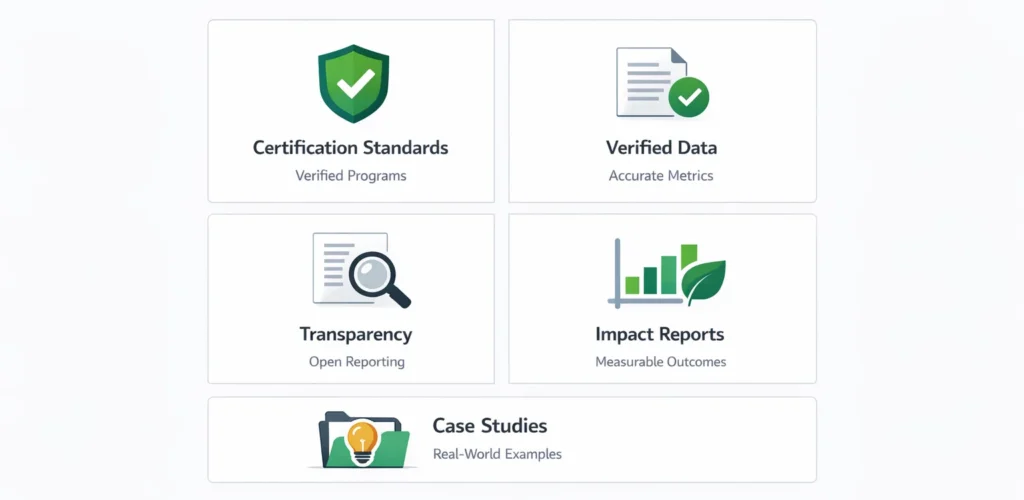
Verified data
Transparency
Proof of long-term impact
So while demand is high, trust signals must be stronger.
4. Tech-Based Credits
Carbon capture
Direct air removal
Growing fast but complex
Tech-based credits come from advanced solutions like carbon capture and storage (CCS) or direct air capture (DAC). These are newer and still evolving, but demand is growing, especially among large corporations.
These credits are usually:
More expensive
Backed by innovation
Preferred by tech-driven companies
However, they are harder to sell if not explained properly.
This is where most platforms struggle. The concept itself is complex, and buyers need education before making decisions. Without clear content and positioning, these credits remain underutilized.
From our experience, combining educational SEO content + simplified messaging works best for this category.
What We Recommend
If you are entering the global carbon credit market, starting with voluntary carbon credits is usually the most practical approach.
They allow you to:
Enter the market faster
Test pricing and demand
Build buyer relationships
Scale through digital channels
Then, as your platform grows, you can expand into compliance or tech-based credits based on your capabilities.
We see this pattern often. Businesses that start simple, build visibility, and then expand tend to scale much faster than those trying to do everything at once.
Who Buys Carbon Credits Worldwide
Understanding your buyer is where strategy starts.
Key Global Buyers:
Corporations with net-zero goals
Airlines and logistics companies
Tech companies (huge buyers)
ESG-focused investors
Governments and institutions
What matters here is intent. Buyers are not just looking for credits. They are looking for:
Verified sources
Transparent pricing
Reliable supply
Trust signals
This is exactly where positioning becomes critical.
How to Sell Carbon Credits Internationally (Step-by-Step)
Let’s break this down into a practical system.
Step 1: Get Your Credits Verified
Without verification, you cannot sell globally.
Use standards like:
Verra (VCS)
Gold Standard
Climate Action Reserve
Verification builds trust and allows global listing.
Step 2: Register on Carbon Registries
Registries act as proof and tracking systems.
Ensure your credits are listed
Make data transparent
Maintain audit records
This step is not optional. It’s your foundation.
Step 3: Choose Your Sales Model
You can sell in multiple ways:
Direct to buyers
Through brokers
Via marketplaces
Through long-term contracts
We usually recommend a hybrid model for scalability.
Step 4: Build a Global Sales Channel
This is where most businesses fail.
Listing is not selling.
You need:
Website with SEO structure
Landing pages targeting buyers
Clear messaging
Lead capture system
Without this, your credits remain invisible.
Step 5: Target International Buyers
Focus on high-demand regions:
USA
Europe
Australia
Japan
Each region has different expectations. Messaging must adapt.
We see many sellers underpricing just to compete. That’s not sustainable.
Instead, focus on value positioning.
Marketing Carbon Credits (Where Most Fail)
This is the biggest gap in the industry.
Most platforms think:
“List credits → buyers will come”
That doesn’t happen.
Real Problems We See:
No search visibility
Most platforms don’t rank on Google for buyer-intent keywords. This means they rely heavily on marketplaces or outbound efforts. Without search visibility, you miss global buyers who are already looking to purchase.
No content strategy
Carbon credits are not simple products. Buyers need clarity before they commit. Without proper content explaining use-cases, benefits, and project details, users drop off early. This is where many platforms lose potential deals.
No buyer targeting
Generic messaging creates confusion. Different industries have different needs, but most platforms don’t tailor their communication. When buyers don’t see relevance, they don’t convert.
No brand positioning
If your platform looks like just another listing site, buyers compare only on price. There’s no differentiation, no trust, and no reason to choose you. Strong positioning changes how buyers perceive value.
So even with good credits, sales remain inconsistent.
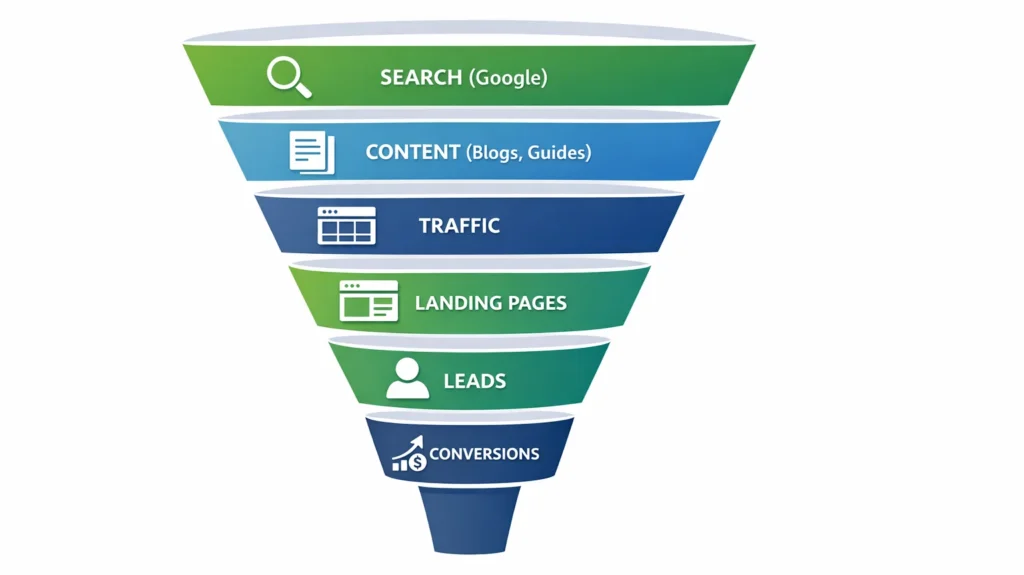
Instead of relying on random marketing efforts, this structured system creates predictable, scalable, and repeatable growth by guiding users step-by-step through a clear conversion journey.
Turn Search Into Sales
We help carbon credit businesses attract high-value buyers through SEO that actually converts.
Selling carbon credits worldwide is a massive opportunity, but only for those who build the right system.
We’ve seen platforms with great projects fail simply because no one could find them.
And we’ve seen smaller players grow fast just by focusing on visibility, positioning, and structured SEO.
At SEO Circular, we believe the future of carbon credit sales is not just in supply, but in discoverability and trust.
If you build that properly, growth becomes predictable.
FAQs: Selling Carbon Credits
1. Can individuals sell carbon credits globally?
Yes, but usually through registered projects or platforms. Direct selling requires verification and compliance.
2. How long does it take to sell carbon credits?
It depends on demand, pricing, and visibility. With proper SEO, lead flow improves within a few months.
3. Do I need a website to sell carbon credits?
Yes. A website helps you control visibility, explain your project, and capture global buyers.
4. What is the best platform to sell carbon credits?
There is no single best platform. A mix of marketplaces, direct sales, and SEO works best.
5. Is SEO really important for carbon credit sales?
Yes. Many buyers search online before purchasing. Without SEO, you miss high-intent traffic.
6. How do I find international buyers?
Through SEO, content marketing, partnerships, and industry platforms. Visibility is key.
Climate change is now a money-making opportunity. Yes, you read that right. The world is heating up. Governments and big companies are under pressure to reduce pollution. But they can’t do it alone. So, they buy “carbon credits” from people and businesses who help the environment like those who plant trees or create clean energy projects.
This is called carbon trading and it’s becoming a billion-dollar market.
Key Takeaways
Carbon trading is a fast-growing, billion-dollar opportunity driven by global climate regulations, ESG goals, and net-zero commitments from corporations and governments.
Startups can enter the carbon market through multiple paths: launching a carbon trading platform, running green projects, acting as a broker, or combining all models for higher profitability.
Carbon credits are earned by reducing or removing CO₂ through projects like tree planting, renewable energy, or clean technology initiatives.
Verified carbon credits hold higher value and trust, making certification through recognized standards essential for long-term success.
Carbon trading platforms generate scalable revenue through commissions, premium listings, analytics, and verification support.
Buyers include corporations with net-zero goals, compliance-driven industries, governments, NGOs, and climate investment funds.
Combining project ownership with platform control gives startups maximum revenue, brand authority, and market influence.
Strong documentation, verification, transparency, and marketing visibility are critical to winning buyers in the carbon market.
SEO and digital marketing play a major role in helping carbon startups attract buyers, partners, and investors globally.
Ready to Build a Profitable Carbon Trading Business?
Whether you want to launch a carbon trading platform, start a verified green project, or scale your carbon credit sales, SEO Circular helps you get visibility, buyers, and real revenue.
Now, here’s the opportunity: If you’re a startup, you can enter this business in two big ways:
Build a carbon credit trading platform or app – like a stock market, but for carbon.
Start a green project – like planting trees – and sell the carbon credits you earn.
Real Example:
Imagine you plant enough trees to absorb 1,000 tons of CO₂. You earn 1,000 carbon credits. If each credit sells for $10, you just made $10,000.
But how do you sell your carbon credits?
You have two options to earn money from carbon trading:
Sell on an Existing CTX Platform
You contact any carbon credit exchange or platform (like Gold Standard, Verra, or voluntary platforms). They verify your project and then buy or list your carbon credits for sale. Once sold, you get paid. In this case the platform will charge you a commission fee.
Launch Your Own Carbon Credit Platform
This is the bigger business model. You can build your own carbon trading platform and:
Sell your own carbon credits directly
Invite other farmers, landowners, or green project owners to sell their credits through your platform
Charge commission or fees on every transaction
This way, your platform becomes a hub for carbon trading — just like a stock exchange, but for environmental impact.
At SEO Circular, we help startups promote both models. Whether you’re launching a green project or a full-scale trading platform, we help you get traffic, leads, partners, and real buyers through smart digital marketing.
What Is Carbon Trading? (Explained Simply)
Let’s explain everything in detail — so even if you’re new, you’ll get it clearly.
Carbon trading is like selling fresh air to people who are polluting too much.
Here’s how it works:
Every company, factory, or airline releases carbon dioxide (CO₂) into the air. But there’s a limit to how much they’re allowed to pollute. If they go beyond that limit, they need to buy carbon credits to make up for the extra pollution.
Now, if you plant trees or run a clean energy project, you’re helping reduce carbon from the air. For that, you earn carbon credits — like reward points.
So, carbon trading means:
One side is selling carbon credits (people who reduce emissions)
The other side is buying carbon credits (people who pollute more than allowed)
This creates a carbon market — just like a regular market where goods are bought and sold. Here, carbon credits are the product.
Quick Example:
Let’s say:
You reduce 500 tons of CO₂
You earn 500 carbon credits
A factory needs 500 credits to stay within legal limits
They buy your credits for $12 each
That’s $6,000 in your pocket — just for running an eco-friendly project. This system rewards people who protect the planet and lets businesses stay compliant with climate rules.
Carbon Credit Business Models for Startups
If you’re a startup planning to enter the carbon credit industry, you have more than one way to make money. Let’s break down the most popular and profitable business models — explained with real examples and startup-friendly language.
Model #1: Start a Carbon Credit Trading Platform (App or Website)
This is like building a stock exchange, but for carbon credits. You create a platform where:
Project owners (like tree planters or solar farms) list their carbon credits. You can charge for listing their project.
Buyers (companies, governments, investors) come to buy them
Also you can charge commission from buyers and sellers for every transaction.
How You Make Money:
Charge commission on every credit sold : Earn a small percentage from every carbon credit transaction made on your platform, just like a marketplace commission model.
Offer verification support or consulting for a fee: Help project owners with carbon credit verification, documentation, and compliance, and charge a service or consulting fee.
Provide premium listing or marketing for sellers: Allow sellers to pay extra to promote their carbon credits, get featured listings, or reach more buyers faster.
Sell platform data analytics or reporting tools : Offer paid access to market insights, pricing trends, emission data, and reports useful for buyers and investors.
Example:
If 10,000 credits are sold on your platform in a month at $10 per credit, and you charge 2% commission: You make: $2,000/month. As volume increases, so does your revenue.
What You Need:
A website or app (we help with marketing). We have already developed both an app and website. You can buy readymade ones from us.
Legal approval to operate (depending on country)
A team to manage listings, compliance, and tech
Bonus Tip: You can also run your own credit projects and sell them on your own platform — keeping 100% profit.
Model #2: Run a Carbon Credit Project (Like Tree Planting)
If you have land or a way to reduce carbon, you can run a carbon project and earn credits yourself.
Common projects include:
Tree planting (reforestation, agroforestry)
Solar power or wind farms
Clean cooking or waste-to-energy systems
How You Make Money:
Each ton of carbon you reduce = 1 carbon credit
You sell these credits to platforms or directly to buyers
Example:
You plant trees that absorb 5,000 tons of CO₂ per year. If each credit sells at $10: You make $50,000/year (minus verification and project costs).
What You Need:
A valid project with monitoring
Verification from trusted body (we’ll explain in Section 7)
A place to sell credits — via platform or your own network
Model #3: Be a Carbon Credit Broker or Aggregator
You don’t need land or a platform — you can be a middleman.
Here’s how:
Find farmers or small project owners with tree plantations or clean projects
Help them get verified and listed on carbon markets
Charge a commission for every sale
This is like real estate agents who help people sell property — but here you sell carbon credits.
Example:
If your farmer client earns $20,000 by selling carbon credits, and you charge 10% commission: You earn $2,000 just for connecting the dots.
Model #4: Combine Platform + Project
The most powerful model? Do both.
Start your own tree plantation project
Build your own platform
Sell your own credits
Invite others to list their projects too
Now you’re making money from:
Selling your own credits
Platform commission
Branding and marketing fees
Partner projects
It’s like owning a farm and the marketplace where all farms sell. Pure profit + full control.
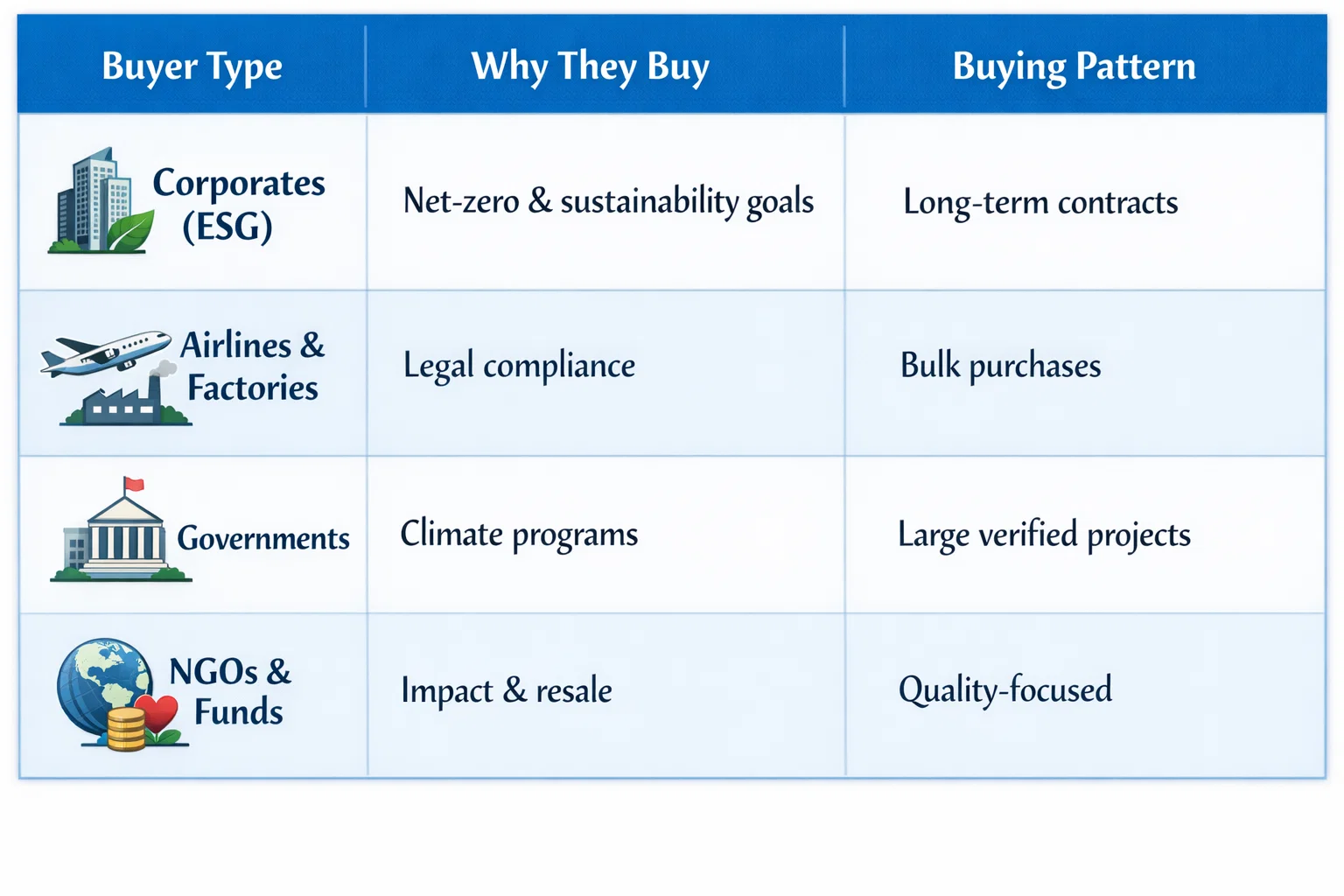
Some industries are required by law to limit emissions. If they go over the legal cap, they must buy carbon credits.
Example buyers:
Airlines (international flights)
Oil & gas companies
Cement, steel, and coal-based factories
These buyers often purchase in bulk and care more about price and volume.
Governments and Public Sector Programs
Some governments support green goals through:
National carbon offset programs
Buying credits for climate funds
International climate partnerships
They usually buy from large projects or verified registries and offer long-term contracts.
NGOs, Climate Funds & Carbon Brokers
Some climate-focused NGOs and investment funds buy carbon credits to:
Support eco-projects
Resell at higher value
Help communities go green
These buyers look for impact + quality, not just numbers.
Why Do They Pay?
To avoid fines (compliance buyers)
To improve brand image (corporate buyers)
To attract investors with ESG goals
To fulfill global climate commitments
What This Means for You
If you run a carbon project or own a platform:
Target the right buyer for your model
Use SEO and marketing to get discovered online
Show transparency and verification to earn trust
Revenue Models in Carbon Trading (With Examples & Calculations)
If you’re entering the carbon market, you have multiple ways to earn. Whether you’re planting trees, building a solar farm, or launching a carbon credit trading platform, there’s real profit potential.
Let’s break down each revenue model one by one:
Model #1: Selling Carbon Credits from Your Own Green Project
If you run a project like tree planting, clean cookstoves, or renewable energy — you earn carbon credits based on how much CO₂ you reduce.
Example:
You plant trees that reduce 5,000 tons of CO₂ per year
Model #2: Commission from a Carbon Credit Trading Platform
If you launch a carbon exchange platform, you earn money by:
Charging transaction fees (like 1-5% per trade)
Offering premium listings or promotions
Selling analytics or reporting tools
Providing verification support for new sellers
Example:
20,000 credits are sold monthly
Average price = $12 per credit = $240,000 trade volume
Your platform charges 2% commission
You earn $4,800/month
As volume increases, your income scales fast — and you don’t need to own any projects yourself.
Model #3: Aggregator/Broker Commission
If you connect farmers or small project owners to buyers or platforms, you act as a broker. You help them get verified and listed.
Example:
Farmer sells 3,000 credits at $10 = $30,000
You take 10% commission = $3,000 profit (no project cost!)
You can work with multiple farmers or NGOs, and scale this without owning land or assets.
Model #4: Combine All for Maximum Profit
Smart startups combine models for full control.
Example:
You start a tree planting project (Model 1)
You build a trading platform (Model 2)
You let other farmers list their credits on your platform (Model 3)
Now, you’re making money from:
Selling your own credits
Platform commissions
Partner credit listings
It’s like owning both the farm and the market — you win from every angle.
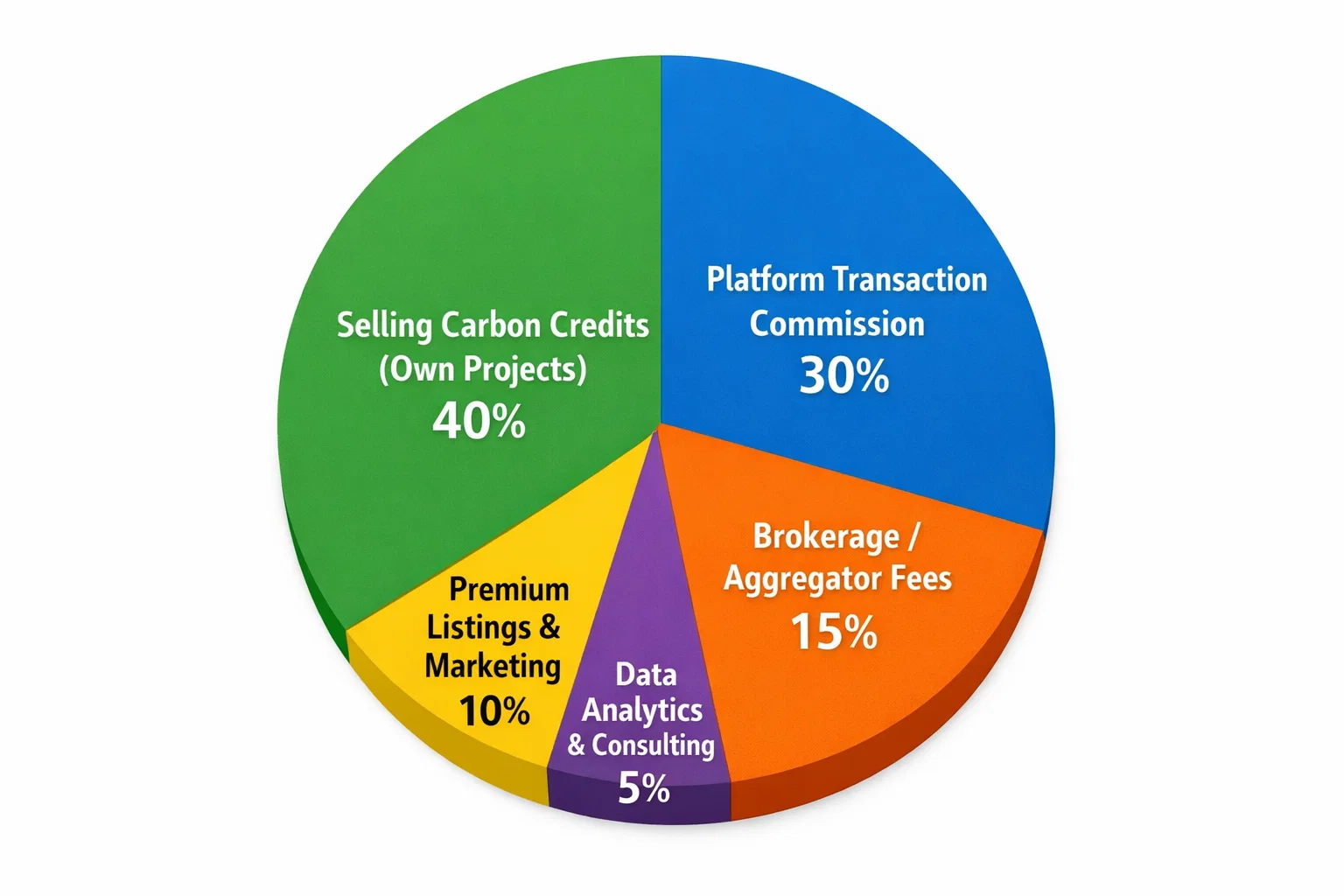
Revenue Sources in a Carbon Trading Business
Selling carbon credits (40%) is the main revenue source, especially from owned green projects like tree planting or renewable energy.
Platform transaction commissions (30%) generate recurring income as buyers and sellers trade credits on the platform.
Brokerage or aggregator fees (15%) come from helping project owners connect with buyers and complete verified sales.
Premium listings and marketing (10%) allow sellers to pay for better visibility and faster deal closures.
Data analytics and consulting (5%) provide added value through reports, insights, and advisory services.
Legal & Verification Process Made Simple
Before you can sell carbon credits, your project must go through a verification process. This is how you prove that your project is real, measurable, and actually reducing or removing carbon from the atmosphere.
Think of it like getting a product certified before selling it to the public.
Step 1: Choose the Right Type of Market
There are two types of carbon markets:
Voluntary Market
You choose to sell credits without legal pressure
Buyers include corporations, NGOs, ESG investors
Most startups and green projects begin here
Easier to enter, fewer regulations
Compliance Market
Governments require companies to offset emissions
Requires strong documentation and legal approvals
Good for large-scale industrial projects
Tip: As a startup, it’s easier and faster to start in the voluntary market.
Step 2: Select a Verified Standard
A standard is an organization that checks your project, calculates your carbon savings, and issues the official carbon credits.
Top verification bodies include:
Verra (VCS) – Most widely used
Gold Standard – High-quality, trusted for climate and community impact
Global Carbon Council – Popular in MENA region
Climate Action Reserve – Mainly U.S.-focused
Each has its own rules, documents, and fees. You’ll need to follow their methodology based on your project type (forestry, energy, agriculture, etc.)
Step 3: Monitor, Measure, and Document
You must keep proper data to prove your project’s impact:
GPS maps or satellite images of land
Tree species and growth data (for plantations)
Energy savings (for solar, clean cookstoves, etc.)
Proof of additionality (your project wouldn’t happen without carbon finance)
Some tools can help — or you can hire a carbon project consultant.
Step 4: Hire a Third-Party Verifier
The chosen standard will send an independent verifier to check your data. This is a professional body that:
Visits your project (sometimes virtually)
Reviews your documents
Confirms your carbon savings
Once verified, the credits are issued in your name.
Step 5: Register and Sell Credits
After verification, your credits are live on the registry. You can:
List them on your own platform
Sell to companies or brokers
Partner with existing exchanges
Now your credits are legally valid and sellable — just like gold with a certificate.
Estimated Startup Cost for Carbon Trading Business
Business Model
Cost Category
Estimated Cost Range
What This Includes
Carbon Credit Project (Tree, Solar, Clean Energy)
Project setup & operations
$10,000 – $50,000
Land access or partnerships, planting or installation, monitoring
Verification & certification
$5,000 – $20,000
Verification by standards like Verra or Gold Standard
Monitoring & reporting
$2,000 – $5,000 / year
Data tracking, satellite images, documentation
Carbon Trading Platform (App / Website)
Platform development (MVP)
$15,000 – $40,000
Website or app, dashboards, basic trading features
Legal & compliance setup
$3,000 – $10,000
Business registration, legal approvals, policies
Hosting & maintenance
$1,000 – $3,000 / year
Server, security, updates
Marketing & user acquisition
$2,000 – $8,000 / month
SEO, content, ads, outreach
Broker / Aggregator Model
Verification support & onboarding
$1,000 – $3,000
Documentation help, consultant fees
Sales & marketing
$1,000 – $2,000
Outreach, lead generation
Total starting cost
Under $5,000
Low-risk entry model
Hybrid Model (Platform + Project)
Combined investment
$30,000 – $80,000+
Project costs + platform + marketing
How to Start a Carbon Trading Platform or Project
Now that you understand the models, the buyers, and the verification process — it’s time to launch. Whether you’re starting a carbon trading platform or running a tree planting or clean energy project, here’s a simple action plan to get you moving.
A. How to Start a Carbon Credit Platform (App or Website)
If you want to build a carbon credit marketplace, here’s what you need:
Step 1: Finalize Your Platform Idea
Decide:
Will your platform allow others to list and sell carbon credits?
Will you also sell your own credits?
Will you charge commission, listing fees, or offer extra services?
Tip: Start simple — basic buying/selling. Add more features later.
Step 2: Build the Platform (MVP First)
You don’t need to build a massive app from Day 1. You can launch an MVP (Minimum Viable Product) — a simple website or app that allows:
Sellers to register and list projects
Buyers to browse and buy
Admin dashboard to manage trades
Use a web development agency or hire developers. Focus on:
Secure login
Payment integration
Project listing
Credit tracking system
Step 3: Get Legal & Verification Ready
If your platform also supports verification or registration:
Learn the process from Verra or Gold Standard
Build a partner network with carbon consultants
Create a project submission form for sellers
Step 4: Attract Sellers and Buyers
This is where SEO Circular comes in:
We run digital marketing campaigns to bring project owners and buyers to your platform
We use SEO, PPC, content, social media, and more to grow traffic and trust
B. How to Start a Carbon Credit Project (Tree Planting, Solar, etc.)
If you want to generate and sell your own credits, here’s your path:
Step 1: Pick a Project Type
Choose what works for you:
Tree planting (great for landowners or farmer networks)
Renewable energy (solar/wind for rural areas)
Clean cookstoves or biogas units
Step 2: Choose Your Location & Partners
If you don’t have land or resources yourself, partner with:
Local farmers
Landowners
NGOs
Create a simple agreement that says you’ll manage the carbon credit side and share profit.
Step 3: Document Everything
Start tracking from day one:
Area covered
Type of project (trees, energy, etc.)
Tools or tech used
Pictures, GPS maps, reports
This is needed later for verification.
Step 4: Apply for Verification
Choose a registry (like Gold Standard or Verra), follow their steps, and get your credits verified. You can do it yourself or hire a consultant.
How SEO Circular Helps You Succeed in the Carbon Market
Starting a carbon credit project or platform is smart. But without visibility, buyers and investors won’t find you. That’s where SEO Circular comes in — your digital marketing partner in the green economy.
We don’t just run ads. We build your brand, visibility, and trust in the carbon market.
FAQs
What is the difference between voluntary and compliance carbon markets?
Voluntary markets allow businesses to offset emissions by choice, while compliance markets are regulated by governments and legally require companies to offset emissions.
How much does one carbon credit cost?
Carbon credit prices vary based on project type, quality, and verification, but typically range between $5 and $30 per credit in voluntary markets.
How long does carbon credit verification take?
Verification can take several months depending on project type, documentation quality, and the chosen verification body.
Who buys carbon credits the most?
Major buyers include large corporations with ESG goals, airlines, oil and gas companies, manufacturers, governments, NGOs, and climate funds.