How To Optimize Your Product Pages For AI Purchasing Agents?
AI purchasing agents are reshaping ecommerce by evaluating products, comparing listings, and influencing buying decisions before users ever visit a website. This guide explains how to optimize product pages for AI purchasing agents using structured data, merchant feeds, trust signals, technical SEO, and AI-ready checkout systems to improve visibility in AI-powered shopping experiences.
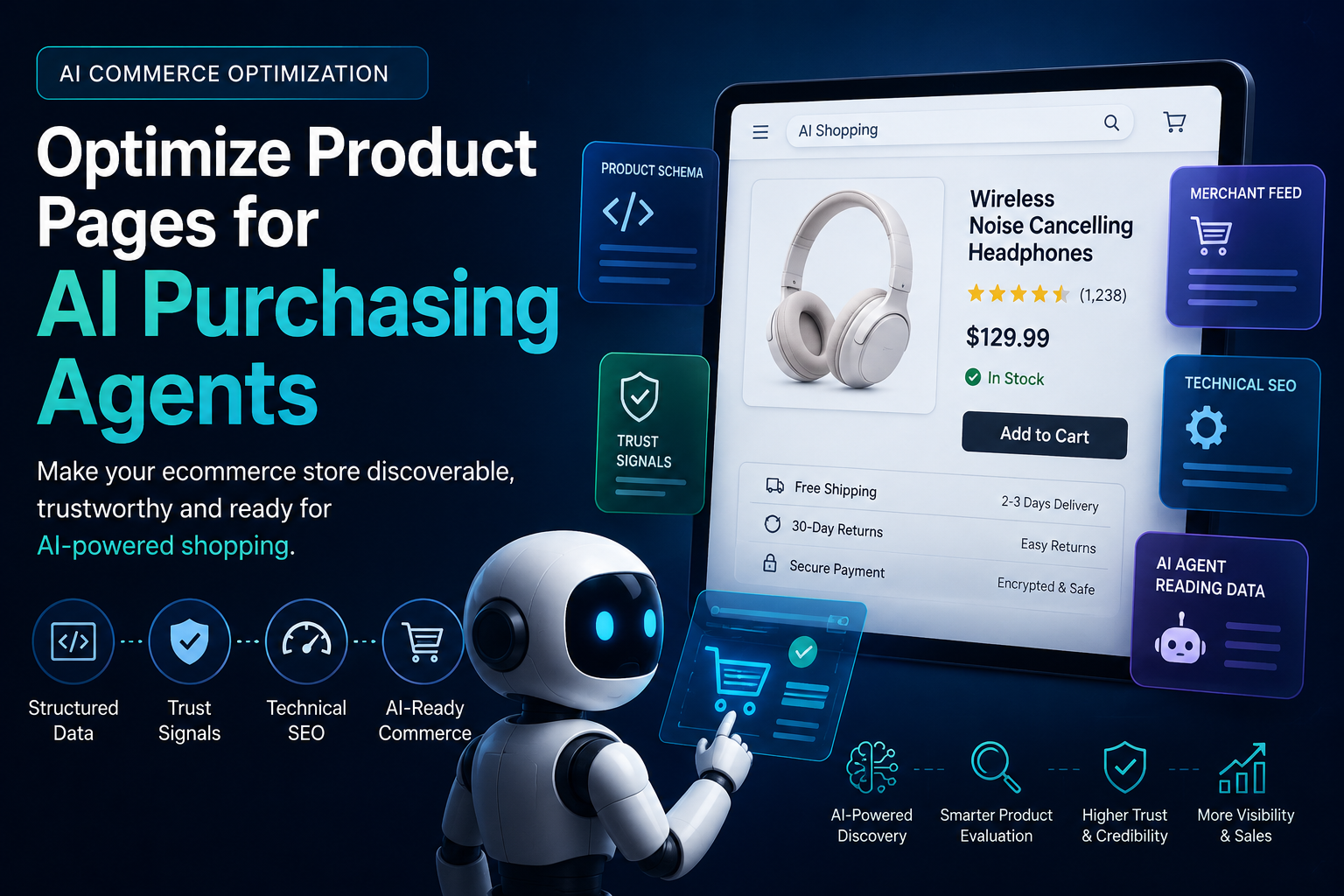
AI purchasing agents are no longer a future concept. Tools like ChatGPT shopping, Perplexity, Google AI Mode and autonomous buyer agents are already scanning product pages, comparing options and either recommending or purchasing on behalf of real users. If your product page is not structured in a way these agents can read and trust then you are invisible to a growing share of buyer decisions.
According to Klaviyo’s 2025 Global AI Shopping Index, 78% of consumers used AI for shopping or product research in the past three months, showing that AI-assisted commerce is already becoming a mainstream part of the buying journey.
Optimizing your product pages for AI purchasing agents includes various steps like structured data, writing product descriptions, trust signals, technical fixes to make your product pages optimized for AI purchasing agents and also price listing and payment gateway verification.
This guide breaks down exactly what AI purchasing agents look for, how they evaluate product pages and what you need to change to show up in their recommendations.
SEO Circular helps enterprise brands and ecommerce businesses get found, read and recommended by AI search systems. Talk to a strategist to make your product pages AI agent already.
Prepare Your Product Pages for AI Shopping
SEO Circular helps ecommerce brands optimize product pages for AI purchasing agents, conversational search engines, and AI-powered shopping experiences.
Get AI SEO Strategy
Key Takeaways
- AI purchasing agents evaluate product pages on structured data, factual descriptions, and trust signals, not visual design or emotional copy.
- Schema markup using Product, Offer, and AggregateRating schemas is the highest leverage technical change you can make for AI agent visibility.
- Product descriptions must be fact-led and specific, answering buyer questions with measurable details that match agent query intent.
- Trust signals like review volume, verified payment gateways, return policy clarity and brand entity authority directly affect whether an AI agent recommends your product.
- Technical issues like JavaScript rendering, slow page speed, missing canonicals and crawl blocks can make even well optimized product pages invisible to AI agents.
What Are AI Purchasing Agents And Why Should You Care?
AI purchasing agents are software systems that act on behalf of a buyer. Instead of a person typing a search and clicking through ten tabs, the agent does the research, evaluates options and either makes a recommendation or completes the transaction directly.
Some well-known examples include:
Perplexity shopping which pulls product data and recommends items with direct buy links. ChatGPT with shopping plugins that read product listings and compare them. Also Google AI Mode that surfaces product answers before a user ever clicks. Autonomous agents built on tools like LangChain or AutoGPT that browse and transact on behalf of users.
These AI purchasing agents do not browse the way humans do. They parse structured information, evaluate trust signals, and prioritize clarity over creativity. A beautifully designed product page with vague copy and no schema markup will lose to a simple, well-structured competitor page every single time.
How AI Agents Read And Evaluate Your Product Pages?
Before you change anything on your pages, you need to understand what an AI purchasing agent is actually doing when it lands on one.
An AI purchasing agent is not admiring your hero image or reading brand story in the footer. It is scanning for specific data points that let it answer one question: “Is this the right product for the buyer I am serving?”
Here is what it is looking for:
- Clear product name that states exactly what the item is, no clever branding that hides the actual product.
- Visible and current price marked up with structured data, so the agent reads it directly.
- Explicit availability status like “In Stock” or “Ships in 3 days”, not vague phrases like “Get yours today.”
- Specific attributes that match buyer intent such as product life, weight, compatibility, or size.
- Schema marked up reviews and ratings for quick social proof verification.
- Return and shipping policy accessible at the product page level, not buried three clicks away.
Structured Data Is The Language That AI Agents for Purchasing Speak
Structured data is how you communicate with machines in a format they understand without having to interpret your copy. This is not optional anymore.
The schema types that matter the most :
- Product schema covering name, description, brand, SKU and category.
- Offer schema communicating price, currency availability and seller information.
- AggregateRating schema packaging your review score and count in machine readable format.
- BreadcrumbList schema helping agents understand where the product sits in your catalog.
- FAQPage schema on product pages so agents can extract and use common buyer answers directly.
A few things to check immediately:
- Nest “offers” within your product schema, not just product name and description.
- Aways keep the current price in schema. A mismatch between schema price and visible price is trust failure that AI purchasing agents are trained to detect.
- Use standard availability values like “In Stocks” or “Out of Stock” rather than free text.
Merchant Feed Optimization For AI Purchasing Agents
AI agents for purchasing do not depend only on the content and schema on your product pages. Many shopping systems ingest product feeds submitted through platforms like Google Merchant Center and ecommerce platforms such as Shopify. These feeds provide structured product information including titles, prices, availability, shipping details, and product identifiers.
To make your products easier to understand for AI purchasing agents to discover and evaluate, keep your product feed synchronized with the information shown on your website. Ensure titles are descriptive, prices and stock status are updated frequently, and shipping and tax data are accurate. Any mismatch between your feed and your product page can reduce trust and prevent your products from being recommended.
Product Identifiers
Standardize product identifiers such as GTIN, UPC, EAN, ISBN and MPN help AI systems make sure and confirm that your listing refers to a specific product sold across multiple retailers. This allows AI purchasing agents to compare prices, aggregate reviews and verify authentically with much greater confidence.
Whenever manufacturer-issued identifiers are available, then include them in your product schema, merchant feeds and catalog data. Without these identifiers, AI purchasing agents may struggle to match your product to equivalent listing, making it less likely to appear in recommendations or price comparisons.
Off-Page Brand Validation Increases Recommendation Trust
AI agents for purchasing do not evaluate your website in isolation. They cross-reference your brand against external sources such as LinkedIn, Crunchbase, industry directories, press coverage and third-party reviews.
Consistent business information across the web, strong customer ratings, and credible media mentions help establish your brand as a trustworthy entity. The stronger your off-page brand presence, the more confidence an AI purchasing agent has in recommending your products to buyers.
Also Read: AI Chatbot Marketing Strategy For B2B
Writing Product Descriptions That AI Can Understand And Recommend
Most product descriptions are written to persuade humans emotionally. AI agents are not persuaded by adjectives. They are persuaded by facts that match buyer’s intent.
What makes description AI purchasing agent friendly?
- Answers “what is this product” in the first sentence, not the third paragraph.
- Includes measurable specifications like weight, dimensions, battery life, material or compatibility.
- Uses the same language buyers use in their searches naturally within the copy.
- Answers common objections directly on the page such as compatibility, sizing or skill level required.
What kills AI purchasing agent readability in product copy?
- Opening with brand story or mission instead of product facts.
- Using adjectives like “revolutionary” or “industry leading” where specifications should be.
- Hiding key specs in collapsible tabs that agents may not parse.
- Publishing one generic description across multiple products instead of an accurate, unique copy per variant.
Trust Signals That AI Measures When Recommending Your Product
An AI purchasing agent is working on behalf of a real buyer. If it recommends a bad product, then the user stops trusting the agent. This makes agents conservative about trust.
The trust signals that carry the most weight:
- High review volume with recent dates, not just a handful of old reviews.
- Schema marked ratings, so the agent does not have to scrape stars visually.
- Specific return policy visible at the product page level, not linked away.
- Verified business information, contact details and brand entity markup.
- Clear shipping timelines like “Delivers in 2 to 4 business days” rather than vague statements like “fast shipping.”
One increasingly important signal is brand entity establishment. AI purchasing agents cross reference your product pages against what they already know about your brand. A Google Knowledge Panel and consistent structured information across the web all increase how much weight an agent places on your products.
Price Listing And Payment Gateway Verification
AI agents for purchasing check whether your store is safe to transact through not just whether your product is the right fit. An unclear price or an unverified payment process is a hard stop.
On pricing:
- Display the final price on the product page along with the checkout.
- Show all additional costs like taxes and shipping upfront.
- A price gap between the product page and checkout is flagged as deceptive by AI purchasing agents.
On Payments gateways
- Use authorized and regulated payment processors like, Stripe or PayPal. These carry PCI DSS compliance that AI systems are built to recognize and trust.
- Display payment gateway logos visibly on the product page and checkout.
- Ensure your checkout runs on HTTPS. An expired SSL or http checkout is an immediate trust failure.
- List all accepted payment methods clearly so agents can match them to buyer preferences.
The payment layer is the final checkpoint before purchase. A verified, transparent checkout setup directly affects whether an AI agent completes or abandons the transaction.
MCP ready Payment structure
MCP ready payment structure allows AI agents for purchasing to securely initiate transactions, handle subscriptions, and issue refunds by interacting directly with payment gateways through standardized APIs.
If your payment structure is not MCP ready, an AI purchasing agent cannot programmatically complete a purchase on your platform regardless of how well optimized your product page is.
What an MCP ready payment structure looks like?:
- Checkout exposes structured APIs that agents can call directly without simulating human clicks.
- Payment flows are tokenized so agents can pass pre-authorized tokens instead of entering card details each time.
- Gateway supports machine readable responses, so agents know in real time if a transaction succeeded or failed.
- Checkout steps are minimal and linear. Multi step JavaScript heavy flows break agent navigation entirely.
- Platform supports headless or API first checkout, which is the foundation MCP agents rely on to complete purchases autonomously.
Best Ecommerce Platforms For AI Agent Optimization
The ecommerce platform you choose directly affects how easily AI purchasing agents can crawl, interpret, and transact through your website. Platforms with strong API accessibility, structured data support, fast performance, and flexible checkout systems are better positioned for AI-assisted commerce and autonomous shopping experiences.
| Ecommerce Platform | Why It Works Well For AI Purchasing Agents | Potential Limitations |
|---|---|---|
| Shopify | Strong structured data ecosystem, fast hosting, app integrations, and merchant feed compatibility make Shopify highly AI-commerce friendly. | Heavy app usage can sometimes create JavaScript bloat and duplicate schema issues. |
| Magento (Adobe Commerce) | Enterprise-level customization allows advanced schema implementation, API integrations, and scalable product catalog management. | Requires strong technical management to avoid crawl inefficiencies and slow performance. |
| WooCommerce | Flexible SEO customization and plugin ecosystem help optimize product pages for AI search systems. | Plugin conflicts and poor hosting setups can negatively affect speed and crawlability. |
| Headless Commerce | API-first architecture supports AI agent interactions, structured commerce systems, and MCP-ready checkout experiences. | Requires advanced development resources and careful technical SEO management. |
Agent to Payment Security
This protocol forms a secure, open-source standard for AI purchasing agents to conduct authorized, traceable financial transactions. It mainly helps prevent fraud.
When an AI purchasing agent initiates a transaction, the security of the handoff between the agent and your payment gateway becomes critical.
What needs to be secured:
- All agent-initiated API calls must be authenticated using API keys or OAuth tokens. Unauthenticated requests should be rejected automatically.
- Your gateway should verify agent identity, confirming requests come from a trusted agent and not a malicious script mimicking one.
- Set transaction limits for agent-initiated purchases. Unusually large orders should trigger a secondary verification step.
- Use fraud detection layers that can handle automated transaction patterns without falsely flagging legitimate agent driven purchases.
- All agents to payment communication must run over encrypted channels with TLS 1.2 or higher.
- Maintain a separate transaction log for agent initiated purchases so you can audit and trace them when needed.
Technical Page Health That Affects AI Purchasing Agent Crawling
AI purchasing agents access you page through crawlers. If your pages are slow, broken or blocked then none of the optimization above matters.
Key technical checks for product pages:
- Page speed under 2.5 seconds on mobile. Slow pages signal poor site quality to agents.
- Clear descriptive URLs that include the product name or category, not parameter heavy strings.
- No accidental crawl blocks via robots.txt or noindex tags which is a common issue on large ecommerce catalogs.
- Correct canonical tags pointing to the right product URL especially for variant pages.
- Accurate image alt text describing the product since some AI agents process visuals.
- Accurate image alt text describing the product since some AI agents process visual content alongside text.
How To Test If AI Agents Can Read Your Product Pages
As AI shopping systems become more common, businesses need to verify whether AI purchasing agents can actually crawl, interpret, and trust their product pages. Traditional SEO audits alone are no longer enough. Testing AI readability helps identify technical barriers, missing structured data, rendering problems, and trust issues that may prevent your products from appearing in AI-generated recommendations. This is especially important for SEO for AI Startups, where visibility across search engines, AI summaries, and LLM-driven discovery platforms can directly impact growth and user acquisition.
| Test Area | What To Check | Why It Matters For AI Purchasing Agents |
|---|---|---|
| Crawlability | Test whether important product pages are blocked by robots.txt, noindex tags, or JavaScript rendering issues. | AI purchasing agents rely on crawler access. If pages cannot be crawled properly, products may never appear in AI recommendations. |
| Structured Data Validation | Use schema validation tools to confirm Product, Offer, AggregateRating, and FAQ schema are error-free. | Broken or incomplete schema reduces machine readability and lowers trust signals. |
| Mobile Page Speed | Measure Core Web Vitals and mobile loading speed. | Slow product pages can reduce crawl efficiency and signal poor user experience to AI systems. |
| Feed Consistency | Compare merchant feed data with live product page information. | Mismatched pricing, stock status, or shipping details can cause AI agents to distrust your listings. |
| JavaScript Rendering | Check whether important product details load only after JavaScript execution. | Many AI crawlers still struggle with JavaScript-heavy ecommerce pages. |
| Product Attribute Visibility | Ensure specifications, pricing, availability, and reviews are visible in HTML source. | AI agents prioritize directly accessible product information over visually hidden content. |
| AI Search Visibility | Search your products through AI shopping tools and conversational search systems. | This helps identify whether your product pages are discoverable and accurately interpreted by AI systems. |
Common Mistakes That Stop AI Purchasing Agents From Recommending Your Products
- JavaScript heavy product pages where key information only loads after page render, since many crawlers do not execute JavaScript fully.
- Duplicate product descriptions across variant pages, which agents treat as thin content.
- Outdated schema after a price or availability change.
- Reviews hidden behind a login wall or loaded in a way agents cannot access.
- Inconsistent product name across page title, H1, schema, and URL, which confuses agents about what the product actually is.
- Missing or generic meta descriptions, which are among the first data points an agent reads.
- Product pages that do not answer the most obvious buyer questions anywhere on the page.
Conclusion
AI purchasing agents are adding a new layer between your product page and the buyer. They are not replacing search entirely, but they are changing who makes the first evaluation. Optimizing these agents means being factually precise, structurally sound, and trustworthy at every layer from your schema to your checkout. The brands that get this right will capture a growing share of AI-influenced purchases. The ones that do not will become invisible to an audience that never clicks, only converts.
AI Shopping & Product Page Optimization FAQs
Do AI purchasing agents use the same signals as Google for product ranking?
There is overlap in signals like structured data and page trust, but AI agents also weigh conversational query match and real time availability more heavily than traditional Google product ranking.
Does this optimization apply to both ecommerce stores and SaaS product pages?
Yes, SaaS product pages need the same clarity around features, pricing, compatibility, and social proof that ecommerce pages do, especially as AI agents are increasingly used for software purchasing decisions.
How often should I update my product page schema?
Any time price, availability, or product specifications change, your schema should be updated at the same time. Stale schema is flagged as a trust failure by AI systems.
Are voice search and AI purchasing agents the same thing?
They are related but different. Voice search returns answers to spoken queries while AI purchasing agents actively compare options and can initiate transactions. Both benefit from the same structured, clear product page foundation.
Does brand authority outside my website affect how AI agents treat my products?
Yes, AI agents cross reference your brand against external signals like press mentions, knowledge panels, and third-party reviews. Stronger off page brand authority increases the confidence an agent has in recommending your products.
Ready to rank on Google and AI at the same time?
We help brands win across search and AI answers — technical SEO, content strategy and Generative Engine Optimization in one workflow. Tell us your goals and we’ll show you the plan.