Top Strategies to Improve Brand Visibility in AI Search Engines
AI search engines prioritize trust, authority, and intent—not just keywords. Learn how brands can improve visibility across AI summaries, voice search, and conversational results.

Published Date: January 8, 2026
AI-powered search is fundamentally changing how people discover brands online. According to recent industry studies, more than60% of searches are now influenced by AI-driven features such as Google’s AI-generated summaries, voice assistants, and conversational interfaces. Users are no longer scrolling through ten blue links, they are expecting direct answers, trusted recommendations, and brand-backed insights. For brands, this shift is critical.
AI search engines don’t just rank pages; they interpret intent, evaluate credibility, and select sources they believe are most reliable. This means visibility is no longer about ranking for a single keyword. It’s about whether AI systems recognize your brand as an authority worth surfacing.
For brands, this shift is critical. AI search engines don’t just rank pages; they interpret intent, evaluate credibility, and select sources they believe are most reliable. This means visibility is no longer about ranking for a single keyword. It’s about whether AI systems recognize your brand as an authority worth surfacing.
At SEO Circular, we see this change across enterprise and international campaigns. Even brands ranking on page one can lose visibility if AI-generated answers don’t reference them. At the same time, brands with strong authority, consistent messaging, and clear expertise are appearing repeatedly across AI summaries, voice responses, and conversational results, often without users ever clicking a traditional link.
Another major shift is user behavior. Searches are becoming longer, more conversational, and more specific. Instead of typing “best CRM software,” users now ask, “Which CRM is best for B2B SaaS companies scaling globally?” AI-powered search engines are built to answer these complex questions by pulling insights from trusted brands, not just optimized pages.
This is why improving brand visibility in an AI overview requires a new strategic approach, one that blends SEO, content, authority, and brand trust into a single, AI-ready framework.
Key Takeaways
- AI search prioritizes brands with experience and expertise, not just keywords. AI systems now evaluate brand authority, consistency, and credibility across the web before surfacing results.
- Conversational and intent-driven content wins. AI-powered search engines favor content that directly answers user questions in natural, human language, not indirect or overly long responses.
- E-E-A-T is a core ranking signal in AI search. Experience, expertise, authority, and trust determine whether AI systems consider your brand reliable enough to reference.
- Brand visibility extends beyond Google. AI discovery happens across search engines, voice assistants, AI chat interfaces, and multimodal platforms.
- Measurement requires a mindset shift. Traditional rankings alone are not enough; brand mentions, AI citations, and visibility across AI answers matter more than ever.
Still Wondering Whether AI Search Engines Eee Your Brand as Trustworthy?
Schedule a short discovery call with our experts, and we’ll help you understand what AI systems need to confidently surface your brand.
Get a Free AI Search Visibility Consultation.
What Are AI-Powered Search Engines?
Human minds scan things that are naturally happening and are explained in simple terms. Similarly, AI-powered search engines are trained using Natural Language Processing (NLP) and Large Language Models (LLMs). These systems work to understand the exact intention behind a query, rather than randomly giving answers around a keyword, as traditional SEO used to do.
AI-powered answers are extracted and summarized based on the query. Brands that rank in AI overviews are undoubtedly the winners of this AI-driven ranking environment.
Why Brand Visibility in AI Search Directly Impacts Business Growth?
AI-powered search is reshaping how B2B and enterprise buyers discover, evaluate, and shortlist brands. Visibility at this early stage now determines whether your business enters the consideration set at all.
AI search influences early-stage discovery
AI-generated summaries, recommendations, and conversational answers often shape buyer perception before websites are visited.
Visibility loss happens silently
Brands may maintain traditional rankings while disappearing from AI-driven results, reducing brand recall and weakening demand without obvious warning signs.
Traditional SEO alone is no longer sufficient
Keyword rankings and traffic metrics do not guarantee visibility in AI summaries, voice responses, or conversational search experiences.
AI visibility requires a strategic shift
Enterprises must move beyond isolated SEO tactics and focus on brand clarity, authority, and trust signals that AI systems recognize and prioritize.
Growth now depends on being referenced, not just ranked
In AI-powered search, brands that are consistently understood and recommended gain a competitive advantage in pipeline creation and long-term demand generation.
Key Factors That Influence Brand Visibility in AI-Powered Search
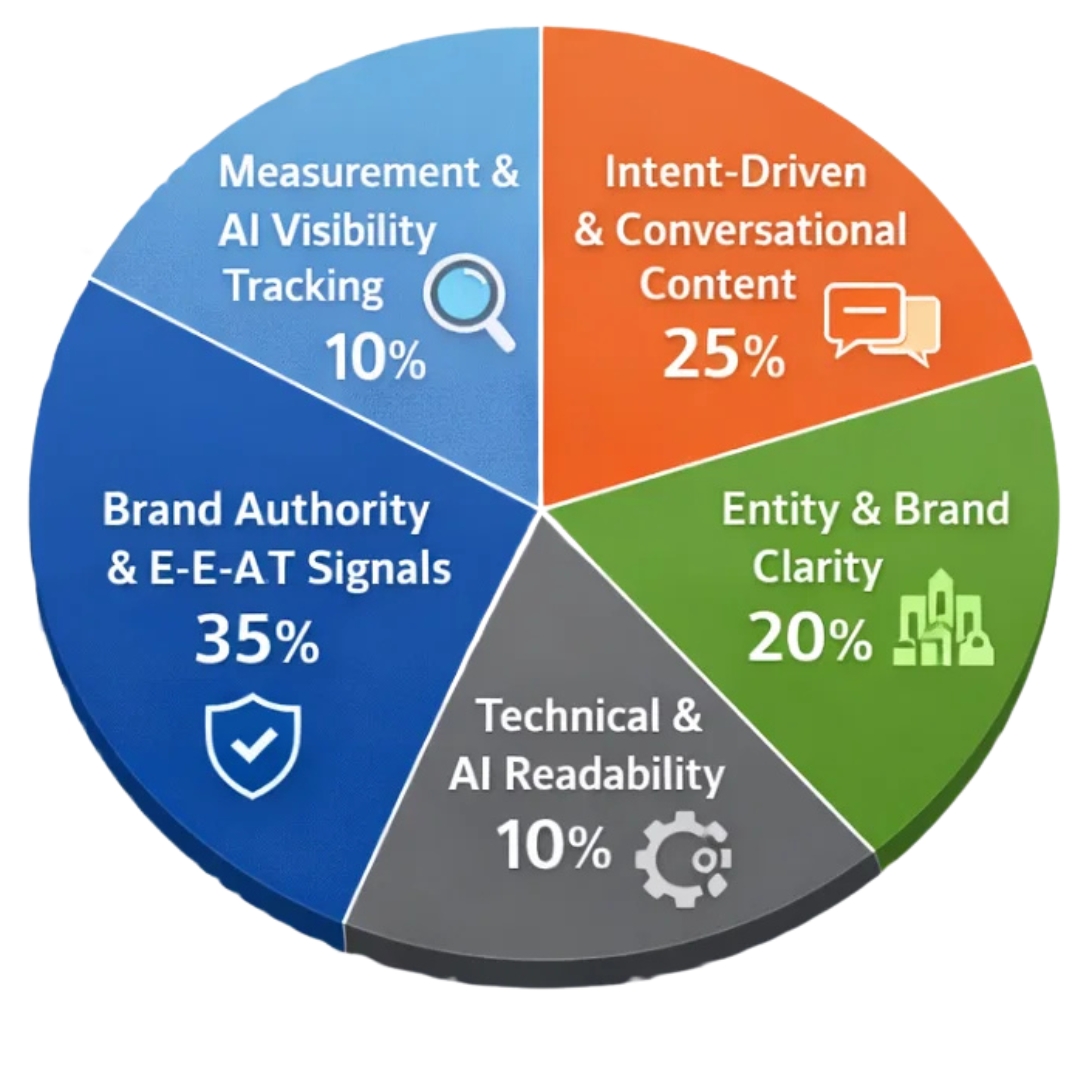
This visual helps readers quickly understand what AI search engines prioritize most when deciding which brands to surface in AI-generated answers, summaries, and voice responses.
Measurement & AI Visibility Tracking – 10%
(Brand mentions, AI citations, conversational presence)
Brand Authority & E-E-A-T Signals – 35%
(Experience, expertise, authority, trust, brand credibility)
Intent-Driven & Conversational Content – 25%
(Natural language, prompt-based answers, real user questions)
Entity & Brand Clarity – 20%
(Clear positioning, consistent messaging, defined expertise)
Technical & AI Readability – 10%
(Structured content, crawlability, entity recognition)
How AI Search Engines Discover, Evaluate, and Rank Brands in 2026?
AI-powered search engines work very differently from traditional search algorithms. Instead of simply matching keywords to web pages, they focus on understanding brands as entities, interpreting context, and predicting which sources are most trustworthy for a specific query.
At a high level, AI search engines start by discovering brand signals across the web. This includes your website, content, author profiles, product pages, knowledge panels, and how consistently your brand appears across multiple platforms. AI systems look for patterns that confirm your brand is real, credible, and active within a specific domain.
Once discovered, AI engines move into evaluation mode. Here, they analyze:
- Whether your content demonstrates real experience and subject-matter expertise
- How often your brand is referenced or implied in relevant contexts
- The consistency of your messaging, positioning, and topical focus
This is where many brands struggle. Even with strong SEO fundamentals, fragmented content or unclear positioning makes it harder for AI systems to confidently “understand” what a brand actually stands for.
Ranking in AI-powered search is not always a visible ranking at all. Often, AI systems select brands to cite, summarize, or recommend directly in answers. This selection is influenced by trust signals, clarity, and relevance, not just page-level optimization.
What we consistently observe at SEO Circular is that AI search engines reward brands that:
- Own a clearly defined niche or problem space
- Publish content that answers real, specific user questions
- Maintain authority signals across multiple digital touchpoints
How to Build Brand Authority for AI Search Algorithms?
Brand authority is one of the strongest visibility drivers in AI-powered search. Unlike traditional SEO, where individual pages could rank in isolation, AI search engines evaluate the overall credibility of a brand before deciding whether to surface it in answers, summaries, or recommendations.
From our experience at SEO Circular, AI systems build authority profiles by observing how consistently a brand demonstrates expertise over time. This includes the depth of knowledge in its content, the clarity of its positioning, and the real-world signals that validate its claims. Brands that publish surface-level or disconnected content often fail to reach this threshold, even if they technically rank well.
Authority in AI search is also cumulative. Each high-quality article, expert insight, case study, or authoritative mention reinforces your brand’s perceived expertise. Over time, this creates a feedback loop, AI engines become more confident in referencing your brand because it repeatedly proves its value in answering complex, intent-driven queries.
Where points are important is understanding what actually strengthens authority in AI search:
- Demonstrating first-hand experience and practical insights, not just theory
- Publishing content that goes beyond keywords and solves real business problems
- Maintaining a focused topical footprint instead of chasing unrelated topics
Another key factor is brand consistency. AI systems struggle with brands that shift messaging, target too many audiences, or lack a clear value proposition. The more consistent your brand voice, expertise, and subject focus, the easier it becomes for AI to recognize and trust your brand.
Enhancing Readability for AI, Relying Entities
AI-powered search engines rely heavily on entities, people, brands, products, services, and concepts they can clearly identify and connect. If your content is not structured in a way that AI systems can easily interpret, your brand becomes harder to reference, even if the information is accurate.
Entity-driven content focuses on clarity over cleverness. Instead of vague language or broad statements, AI search prefers content that clearly defines who you are, what you do, and which problems you solve. At SEO Circular, we see stronger AI visibility when brands explicitly state their expertise, target industries, and solutions rather than assuming the reader, or the algorithm, will infer it.
AI-readable content also means writing in a way that mirrors how users ask questions. AI systems are trained on natural language patterns, so content that explains concepts conversationally while remaining precise performs better across AI summaries and voice-based results.
Points are useful here to highlight what makes content more entity-friendly:
- Clearly reference your brand name, services, and areas of expertise in context
- Use consistent terminology for products, solutions, and core offerings
- Write structured explanations that answer one clear intent at a time
Another often-overlooked factor is contextual depth. AI search engines don’t just look for definitions; they look for relationships between entities. When your content connects your brand to specific industries, use cases, and problems, it strengthens AI understanding.
If your brand cannot be described clearly in one sentence, AI systems will struggle to describe it at all. Start by defining your primary expertise, core audience, and main problem you solve , then reflect that consistently across content.
Optimizing for Conversational & Prompt-Based Search Queries
AI-powered search is driven by how people actually speak and ask questions, not how they type short keywords. Users now interact with search engines using full prompts, follow-up questions, and conversational language. This shift directly impacts how brands appear, or disappear, in AI-generated answers.
At SEO Circular, we see that brands optimized only for traditional keywords struggle to surface in conversational search. AI systems prioritize content that mirrors real user questions, provides direct explanations, and maintains contextual continuity across topics. If your content answers only fragments of a query, AI engines are less likely to select it as a source.
Prompt-based optimization starts with understanding intent depth. Users don’t just want information; they want clarity, recommendations, and reasoning. Content that anticipates follow-up questions and addresses them naturally performs better in AI summaries and voice responses.
Where structure matters most:
- Write content in a question-and-answer flow without forcing FAQs
- Use natural transitions that reflect how a conversation evolves
- Answer “why,” “how,” and “which” within the same narrative
Another critical factor is response readiness. AI search engines often extract short, precise explanations from longer content. Brands that clearly state insights, outcomes, or opinions within their content are more likely to be quoted or summarized by AI systems.
Optimizing for conversational and prompt-based search is not about gaming AI. It’s about aligning your content with how humans think, speak, and decide. Brands that do this well gain visibility at the exact moment users are seeking trusted guidance.
The Role of E-E-A-T in AI Search Visibility
E-E-A-T, Experience, Expertise, Authority, and Trust, has become a foundational signal for AI-powered search engines. As AI systems generate direct answers and recommendations, they must rely on sources they believe are credible, accurate, and safe to reference. This is where E-E-A-T directly impacts brand visibility.
AI search engines evaluate experience by looking for signs that content is informed by real-world use, not just theory. Brands that share practical insights, original observations, and clear outcomes stand out because AI systems are trained to identify depth and authenticity. Expertise is reinforced when content demonstrates subject mastery consistently across multiple related topics.
Authority is built over time. AI engines observe how often a brand appears in relevant contexts, how clearly it owns a niche, and whether its content aligns with established industry knowledge. Trust, however, is the deciding factor. Inconsistent messaging, exaggerated claims, or thin content reduce the likelihood of being surfaced in AI-generated answers.
Where clarity matters most:
- Clearly communicate who is creating the content and why they are qualified
- Support claims with context, data, or real experience
- Maintain consistency across brand messaging and expertise areas
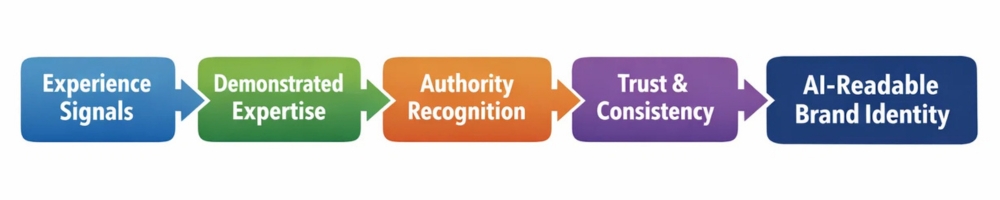
E-E-A-T Framework for AI Search Visibility
The E-E-A-T framework (Experience, Expertise, Authority, Trust) determines whether a brand is reliable enough to be cited, summarized, or recommended by AI systems.
Voice Search and Multimodal Optimization for AI Discovery
Voice search and multimodal search are expanding how users interact with AI-powered search engines. People now search using voice assistants, images, and even combined inputs like voice plus screen. This changes how brands need to think about visibility. AI systems must be able to understand, interpret, and respond with your brand in real time.
Voice-driven queries are typically longer, more conversational, and intent-rich. Users ask complete questions and expect immediate, accurate responses. Brands that rely on short, keyword-heavy content often miss these opportunities because AI prefers clear, spoken-language explanations.
Multimodal search adds another layer. AI engines connect text, visuals, context, and intent to deliver answers. If your brand messaging is inconsistent across formats, AI systems struggle to confidently surface your content.
What matters most here is clarity and context, not complexity. Your brand needs to explain ideas in a way that works whether the response is spoken aloud, summarized on-screen, or combined with visual elements.
Measuring Brand Visibility in AI Search Ecosystems
Measuring visibility in AI-powered search requires a different mindset than traditional SEO. Rankings and clicks still matter, but they no longer tell the full story. AI search engines often surface brands directly within answers, summaries, and voice responses, without sending users to a website.
At SEO Circular, we focus on understanding where and how a brand appears, not just whether a page ranks. Visibility now includes being referenced, cited, or implied as a trusted source within AI-generated responses. This is especially important for B2B and enterprise brands, where early-stage discovery often happens inside AI summaries.
The most reliable signals of AI search visibility include brand mentions across AI answers, consistency of brand presence for high-intent queries, and repeated inclusion in conversational or follow-up prompts. These indicators show whether AI systems recognize your brand as an authority within a topic.
Measurement also involves trend analysis. Over time, brands that invest in AI-ready strategies see stronger recall, more frequent inclusion, and broader topical coverage across AI search experiences.
Without this expanded measurement approach, brands risk missing critical visibility gains, or losses, happening beyond traditional search results.
How SEO Circular Helps Brands Win Visibility in AI-Powered Search?
| Strategic Area | What We Do at SEO Circular | Impact on AI Search Visibility |
|---|---|---|
| Unified AI-Ready Growth Framework | Align SEO strategy, content, and brand authority into one integrated approach designed specifically for AI-powered search behavior. | Ensures AI systems clearly understand your brand instead of seeing disconnected SEO signals. |
| AI Visibility & Brand Interpretation Analysis | Analyze how AI engines currently interpret, reference, and recall your brand across AI summaries and conversational results. | Identifies visibility gaps and improves how often your brand is surfaced in AI-generated answers. |
| Clear Positioning for AI Understanding | Refine brand messaging, value proposition, and expertise signals for AI clarity and trust. | Makes it easier for AI systems to explain, recommend, and cite your brand accurately. |
| AI-Readable, Intent-Driven Content Ecosystems | Build content around real user problems, use cases, and decision moments beyond keyword optimization. | Increases selection probability in AI summaries, voice responses, and prompt-based queries. |
| Scalable Authority & E-E-A-T Strengthening | Strengthen experience, expertise, authority, and trust through expert-led content and consistent brand signals. | Builds long-term credibility that AI systems rely on when choosing sources. |
| Sustained Visibility Beyond Rankings | Focus on brand presence within AI answers, conversational flows, and voice search, not just SERP positions. | Delivers long-term discovery, recall, and demand generation across AI search ecosystems. |
Final Thoughts: Preparing Your Brand for the Future Search
AI-powered search has redefined how brands are discovered, evaluated, and trusted. Visibility is no longer driven by rankings alone, but by how clearly AI systems understand and reference your brand at critical decision moments. For B2B and enterprise businesses, this makes AI-ready visibility a growth priority, not a future consideration.
Traditional SEO still matters, but it must evolve into a strategy built on authority, clarity, and trust. Brands that adapt early gain lasting visibility across AI-generated answers and conversational search. At SEO Circular, we help businesses navigate this shift by aligning SEO, content, and brand authority into strategies designed for how AI search works today, and where it’s heading next.
FAQs
Traditional SEO prioritizes rankings and keywords, while AI search prioritizes brand understanding and trust. Even well-ranked pages may not appear in AI-generated answers if the brand lacks authority or clarity.
Yes, but keywords alone are not enough. AI search relies more on conversational language, intent depth, and entity-based content that clearly explains who you are and what expertise you offer.
AI visibility builds over time. Brands typically see early signals within a few months, but consistent authority and recognition develop through sustained content, expertise, and trust-building efforts.
Absolutely. AI search favors clarity and expertise over brand size. Focused positioning, high-quality content, and consistent messaging can help smaller brands gain visibility faster than in traditional search.
Table of Content
- Key Takeaways
- What Are AI-Powered Search Engines?
- Why Brand Visibility in AI Search Directly Impacts…
- Key Factors That Influence Brand Visibility in AI-Powered…
- How AI Search Engines Discover, Evaluate, and Rank…
- How to Build Brand Authority for AI Search…
- Enhancing Readability for AI, Relying Entities
- Optimizing for Conversational & Prompt-Based Search Queries
- The Role of E-E-A-T in AI Search Visibility
- Voice Search and Multimodal Optimization for AI Discovery
- Measuring Brand Visibility in AI Search Ecosystems
- How SEO Circular Helps Brands Win Visibility in…
- Final Thoughts: Preparing Your Brand for the Future…
- FAQs