Google Ads For Doctors SEO Outline
Learn how Google Ads and SEO work together to help doctors attract more patients, improve local search visibility, increase appointment bookings, and build long-term practice growth. This guide covers keyword research, local SEO, content strategy, technical SEO, and Google Ads optimization for medical practices in 2026.
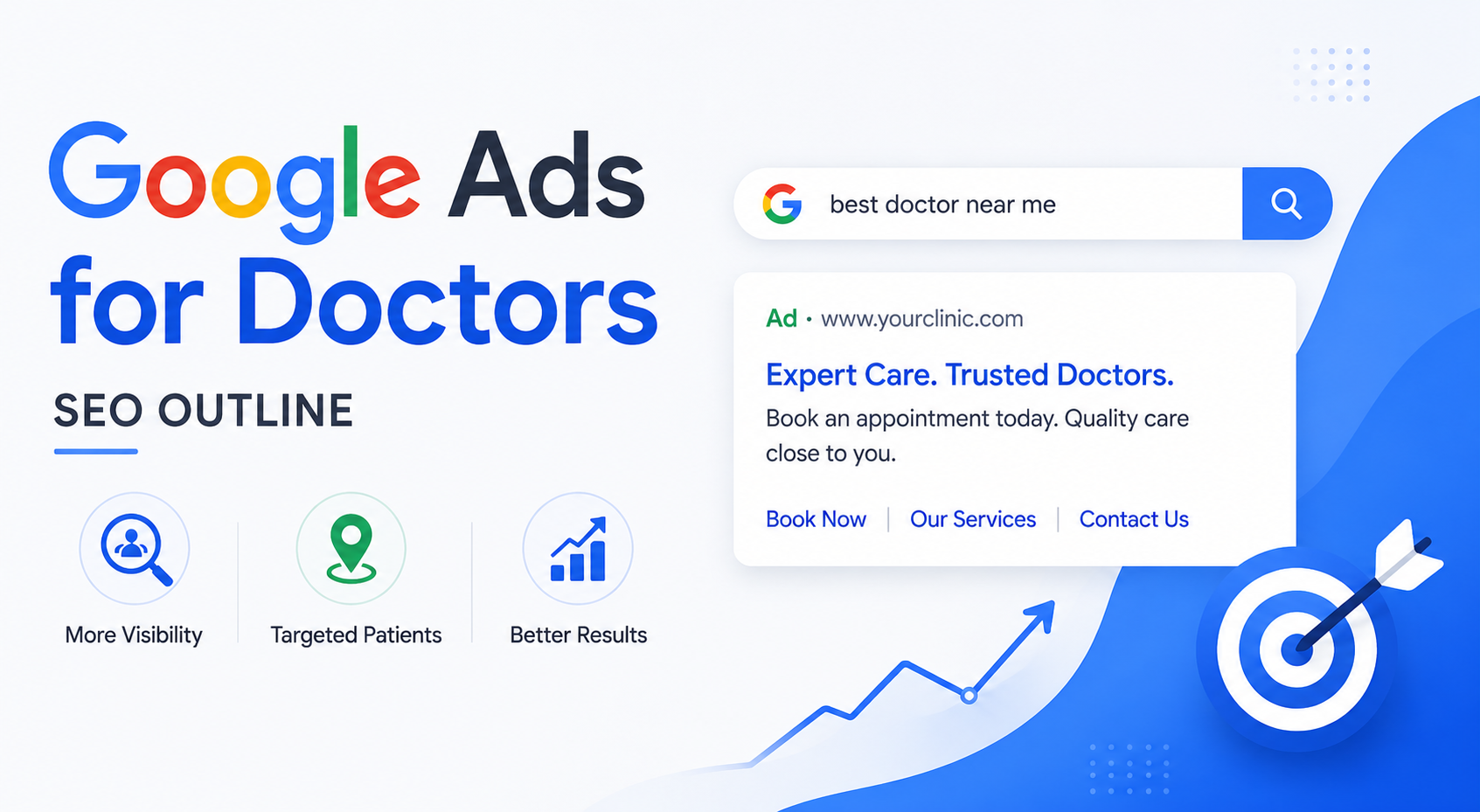
Around 77% Of patients search online before booking a doctor, making Google Ads one of the fastest ways for medical practices to reach high-intent patients.
Every day, thousands of patients open Google and type things like “orthopedic surgeon near me” or “best dermatologist for acne”. They are not browsing. They are ready to book. The question is whether they find your clinic or your competitor’s.
Most medical practices rely on word of mouth or a basic website and hope that is enough. In 2026, it is not. Patients research online before they call, compare clinics before they choose, and trust search results. If your practice is not visible on Google, then you will lose leads, clients both in paid ads and in organic search results.
A Google Ads for doctors SEO outline comes with the combination of SEO and paid ads including many strategies like smart location targeting, keyword research optimization for local queries and much more.
If you want a team that understands exactly how to grow a medical practice through search, then SEO Circular’s SEO for healthcare and clinics program is built for this. From patient-intent keyword strategy to technical SEO for clinic websites, the team stays until the end. Schedule a free strategy call to see what can work for you.
Need More Patient Appointments From Google?
Most clinics lose potential patients because they are not visible when people search online. Our healthcare SEO and Google Ads specialists help medical practices attract qualified patients, increase bookings, and improve local search visibility.
Book a Free Healthcare Marketing Strategy CallKey Takeaways
- Trust signals in both ad copy and on-page content are the single biggest factor in whether a patient books or bounces.
- Location targeting in Google Ads and local SEO are not optional, they connect the right patient to your specific clinic.
- Keyword research serves both channels: patient search language drives ad bids and SEO content strategy at the same time.
- Mobile usability, tap to call and tap to book directly determine whether a visit becomes an appointment.
- Technical SEO fixes improve both organic rankings and google Ads Quality Score simultaneously, making it one of the most cost-effective investments a clinic can make.
Build Trust With Your Clients
Before anything else, building trust through reviews and showing your work is really important. Your website should be optimized in a way in which you are showing your team and also adding reviews properly. Many patients while searching online will look for reviews and also seeing your expertise will create trust within them.
Set Smart location Targeting
Unlike an e-commerce store that can sell to anyone in the world, a medical practice serves patients within a specific geographic radius. A patient in one city will almost never travel two hours to see a general practitioner. This makes location targeting one of the most important settings in your entire Google Ads account.
In Google Ads, you have three main location targeting options for medical practices. Radius targeting lets you draw a circle around your clinic and only show ads to people within that distance. This works well for single location practices in cities where patients travel predictably. City or Zip code targeting is better for multi-location practices or those serving defined suburban areas. For specialists who draw patients from a wider region such as fertility clinic or a cancer treatment center, broader city or regional targeting makes more sense.
One the SEO side, location targeting means something different. It means optimizing your Google Business Profile completely, keeping your name, address and phone number consistent across every directory listings, earning local citations from health directories like Healthgrades and Zocodoc and creating location-specific pages on your website if you have multiple clinic branches.
3 location targeting mistakes that drain healthcare ad budgets
- Targeting too wide a radius and playing for clicks from patients who will never travel to your clinic.
- Forgetting to exclude nearby cities or suburbs where you have no physical presence.
- Running the same ads in multiple locations without adjusting a copy to reflect each location’s name or neighborhood.
Optimize For Local Healthcare Search Queries
There is a consistent gap between how doctors describe their services and how patients search for them. A cardiologist may offer “interventional cardiology”. A patient types “heart doctor near me”. A physiotherapy clinic lists “post-surgical rehabilitation”. A patient searches “physio after knee surgery”.
If your keywords and content only reflect clinical vocabulary, then you will stay invisible to patients who are ready to cook. For Google Ads, close this gap by using location specific keywords, location extensions, call extensions, and reviewing your search term report weekly. For SEO Longevity Clinics, or use natural patient language on services pages, add “near me” and location modified variations and implement local schema markup.
5 local query types of every medical practice should be targeting:
- Proximity queries: “dentist near me”, “General practitioner open near me”.
- Condition queries: doctor for back pain (city)”, “allergist for kids (city)”.
- Availability Queries: “same day doctor appointment (city)”, “walk-in clinic open Sunday”.
- Comparison queries: “best orthopedic surgeon in (city)” ,”top rated pediatrician (city)”.
- Insurance queries: “cardiologist accepting (insurance name)”, “private GP (city)”.
Keyword Research For Doctors: Finding What Your Patients Are Searching
Keyword research is the foundation of both your Google Ads and SEO strategy. In Google Ads, it tells you what content to create and which pages to optimize.
For Google Ads, use exact and phrase match keywords to control where your budget goes and build a negative keyword list before launching. Exclude terms like “free”, “jobs”, “how to become” and any condition unrelated to your specialty.
For SEO, keywords are split by intent. Informational keywords such as “what causes high blood pressure” attract patients researching a condition. Transactional keywords such as “book a dentist (city)” attract patients ready to act. Both matter but they serve different pages.
Keyword categories every medical practice should cover:
1) Specialty keywords: orthopedic surgeon (city)”, “ENT specialist (city)”.
2) Symptom keywords: Doctor for knee pain (city), “treatment for migraine (city)”.
3) Procedure Keywords: “root canal near me”, “Lasik eye surgery (city)”.
4) Appointment intent keywords: book GP appointment (city)”, “online doctor consultation”.
5) Comparison keywords: “best pediatrician in (city), “top-rated Mental Health doctor near me”.
Use Google Keyword Planner for search volumes and Google Search Console to see what queries are already bringing patients to your site.
Create Patient Centric Content
Content connects both channels. For SEO it earns organic rankings. For Google Ads the quality of your landing page content directly impacts your overall quality score which determines how much you pay per click and how prominently your ad appears.
Generic service pages that read like brochure do not rank and do not convert. Google applies medical quality guidelines strictly. A page written or reviewed by a qualified professional that answers real patient question will consistently outperform a keyword-stuffed page. Write for the person not searching for the algorithm.
5 content types every, medical practice website needs:
- Service pages: one page per specialty or treatment, in clear patient language with a booking call to action.
- Condition Pages: what is this condition, what are the treatment options when a patient should see a doctor.
- FAQ pages: real patient questions answered directly and simply.
- Doctor profile pages: qualifications, experience, approach and photo.
- Location Pages: One page per clinic branch with local keywords, address and hours.
AI tools like ChatGPT, Google AI Overviews and Perplexity increasingly cite authoritative medical content. Well-written, credible clinic stands a much higher chance of being referenced by these platforms which is fast becoming a major source of patient discovery in 2026.
How AI Search Engines Help Patients Find Doctors
The way patients discover healthcare providers is changing. Traditional Google searches are no longer the only path to finding a doctor. Today, AI-powered search platforms such as ChatGPT, Google AI Overviews, Perplexity, and Gemini are increasingly answering healthcare questions directly and recommending trusted sources.
For example, a patient searching for “best treatment for chronic knee pain” may receive an AI-generated answer that cites a clinic website, medical article, or physician profile. Instead of clicking through multiple search results, patients often rely on the information surfaced by these AI systems to guide their healthcare decisions.
Healthcare websites that publish accurate, trustworthy, and patient-focused content have a greater chance of being referenced by AI search engines. To improve AI visibility, medical practices should:
- Publish expert-written and medically reviewed content.
- Answer common patient questions clearly and directly.
- Build strong author profiles for doctors and specialists.
- Implement structured data and healthcare schema markup.
- Keep treatment, service, and physician information updated.
- Earn authoritative backlinks and online mentions.
Healthcare organizations optimize not only for traditional search engines but also for emerging AI search experiences. Our AI-ready SEO strategies are designed to increase visibility across Google Search, AI Overviews, ChatGPT, Perplexity, Gemini, and other next-generation discovery platforms, helping clinics attract patients wherever they search.
Also Read: Brand Cited By ChatGPT, Gemini And Perplexity
Build A User-Friendly Website That Turns Visitors Into Patients
Getting a patient on your website is only half the job. A slow or confusing experience loses the conversation your ad spend or SEO work just earned.
Mobile-friendly optimization
More than 60 percent of medical searches happen on mobile. If your site is slow to load or difficult to navigate on a small screen, patients leave within seconds. Mobile-friendly optimization means loading under three seconds, readable text without zooming and forms simple enough to complete on a phone. Google also uses mobile performance as a ranking factor so a poorly optimized site hurts your SEO as well.
Tap to call button
The phone call is still the primary conversion point for most medical practices. A tap to call button placed prominently at the top of your mobile page removes friction between a patient’s intent and their action. Connect it to Google Ads call tracking so you know exactly which keywords and campaigns are driving real calls.
Tap to book an appointment
For patients who prefer not to call, online booking is now expected. Keep the form short : name, contact number, preferred date and reason for visit. Every extra field reduces completion. If you use a third-party booking tool then make sure it loads fast and works smoothly on mobile.
Quick website checklist for doctors running Google Ads and SEO together:
| Checklist Item | Why It Matters |
|---|---|
| Page load speed under three seconds on mobile. | Faster websites improve user experience, reduce bounce rates, and support both SEO rankings and Google Ads performance. |
| Tap-to-call button visible above the fold on all mobile pages. | Makes it easy for patients to contact your clinic immediately, increasing phone inquiries and conversions. |
| Online booking form accessible in two taps or fewer. | Simplifies appointment scheduling and reduces friction in the patient journey. |
| HTTPS certificate active across the entire site. | Protects patient information, builds trust, and is a ranking factor for search engines. |
| Landing pages match the specific ad or keyword that brought the visitor. | Improves ad relevance, Quality Score, and conversion rates by meeting user expectations. |
| Patient reviews visible without scrolling on service pages. | Social proof builds credibility and encourages potential patients to take action. |
| Doctor name and credentials displayed on every page. | Increases trust, supports healthcare SEO expertise signals, and reassures potential patients. |
Top Google Ads and SEO Agencies For Doctors (2026)
Most general marketing agencies do not have the healthcare-specific knowledge medical practices need. When evaluating an agency, look for proven experience with healthcare clients, knowledge of Google’s Healthcare and Medicines ad policies, transparent reporting tied to actual appointment bookings and a clear local SEO process.
- SEO Circular operates a dedicated healthcare division working with hospitals, private practices and medical groups on paid search and SEO. Known for detailed reporting and a large in-house team.
- Intrepy Healthcare Marketing specializes exclusively in healthcare, focusing on practice growth through SEO, Google Ads and reputation management.
- Patient Gain combines healthcare marketing software with managed services including Google Ads, website design and local SEO tools built specifically for clinics.
- Victorious brings deep technical SEO experience to healthcare organizations and hospitals systems with strength in paid search, local SEO and patient acquisition at scale.
When reviewing any agency, ask to see results from a medical client with a similar practice size and specialty.
Check Informative Idea: Healthcare SEO Cost For Clinics and Startups
Get Your Technical SEO Right For A Medical Website
Technical SEO is the infrastructure that everything else sits on. A technically broken or slow website limits how high your pages can rank regardless of content quality. It also directly affects your Google Ads Quality Score meaning poor technical health raises the cost of every click you pay for.
Core technical SEO checklist for medical website:
- Site speed: pages load under three seconds on mobile and desktop.
- HTTPS: every page served over a secure connection.
- Crawlability: No broken links, blocked pages or redirect chains preventing Google from indexing your site.
- Core Web Vitals: Largest Contentful Paint, Interaction to Next Paint and Cumulative Layout Shift must all pass Google’s thresholds.
- Mobile usability: tested and confirmed on every key services and landing page.
- Schema markup: structured data helping Google understand your page precisely.
Medical schema types worth implementing:
1) Medical Organization: Identify your clinic as a medical entity to Google.
2) Physician: marks up doctor profile pages with name, specialty, and credentials.
3) Medical Clinic: provides structured clinic location, hours and services.
4) Review Schema: enables start rating to appear directly in search results.
Fixing technical Healthcare SEO improves both organic rankings and Google Ads performance simultaneously, making it one of the highest-return investments a medical practice can make.
Ready to Grow Your Medical Practice Online?
Whether you need more patient inquiries, better Google rankings, or higher-performing ad campaigns, our team can create a strategy tailored to your specialty, location, and growth goals.
Get Your Free Clinic Growth Audit TodayConclusion
Google Ads bring patients to your door immediately. SEO keeps them coming long after you stop paying per click. Trust signals, location targeting, patient-focused keywords, quality content, a fast mobile website, and clean technical foundations all work together toward one outcome: more patients finding your clinic and booking appointments.
Our SEO Services for Wellness Brands cover every layer of this, from patient-intent keyword strategy to technical SEO for the clinic website.
Schedule a free strategy call and get a clear picture of where your practice stands today.
FAQs About Ads For Doctors SEO Outline
How much does Google Ads typically cost for medical practice?
Cost per click in healthcare ranges from $5 to $40 depending on specialty and location, making monthly budgets of $1,500 to $4,000 a realistic starting point for most practices.
Does Google allow healthcare ads for all medical specialties?
Most specialties can advertise on Google but addiction treatment, clinical trials and certain pharmaceutical products require certification or are restricted in specific regions.
How long does SEO take to show results for a clinic?
Most medical practices see meaningful ranking improvements within three to six months of consistent SEO work with results compounding steadily beyond that.
Can a small single doctor practice compete with hospital ad budgets?
Yes, smaller practices can focus on hyper-local and specialty-specific keywords where competition is lower. Hospitals bid broadly, a focused clinic can own a specific neighborhood or condition category at a fraction of the cost.
Is Google Business Profile the same as Google Ads?
No, Google Business Profile is a free listing that appears in local map and organic results. Google Ads is a paid system where you bid for top placement. Both work best when used together.
Ready to rank on Google and AI at the same time?
We help brands win across search and AI answers — technical SEO, content strategy and Generative Engine Optimization in one workflow. Tell us your goals and we’ll show you the plan.