How Much Should an AI Startup Spend on SEO in Early Stage?
Early-stage AI startups often overspend on SEO without clear returns. This guide explains the ideal SEO budget, pricing models, ROI timelines, and when to scale. Learn how to invest strategically, avoid common mistakes, and build a sustainable growth-driven SEO strategy.

Published Date: March 26, 2026

You just closed your seed round. The pressure to grow is real. Someone on your team or an agency that slid into your inbox – is telling you that SEO is a long-term play and you need to start now. So, you budget $5,000 maybe $10,000 a month for content, backlinks and technical audits.
It feels responsible. Strategic and even.
But it’s probably a mistake.
Most early-stage AI startups spend heavily on SEO before they have nailed product market fit. Founders pour runway into keywords strategies and content calendars while their core product is still finding its footing. The result is months of spend, a spike in traffic that does not convert and a marketing channel that looks busy but delivers nothing meaningful to growth.
The data supports this. According to FirstPageSage, the average B2B SaaS company takes 9 to 18 months to see meaningful organic ROI from SEO. For an AI startup burning cash in its first 12 to 24 months and that timeline is not a strategy – it is a liability.
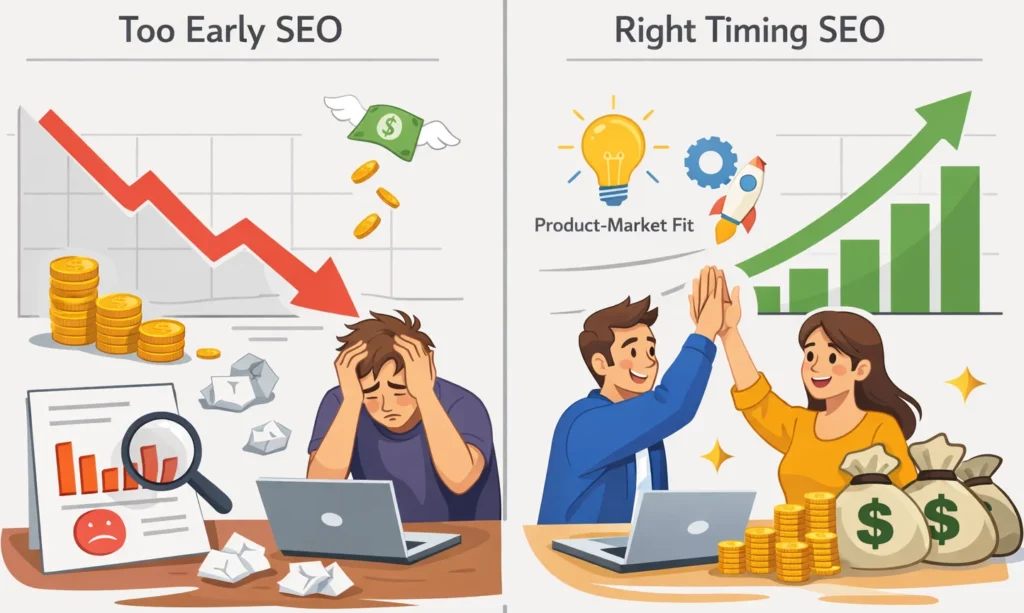
This does not mean SEO is irrelevant for AI startups. It means timing and allocation are everything. This blog breaks down exactly how much you should spend on SEO at the early stage, what you should get for that spend and the signals that tell you when it is time to scale up.
Key Takeaways
- Don’t spend heavily on SEO before product-market fit — it drains runway without delivering meaningful results.
- SEO pricing varies by model — from $50/hour for consulting to $20,000+ per month for enterprise campaigns.
- An in-house local SEO team costs $3,600 to $4,400 per month in salaries alone — add tools and training and the real cost is closer to $5,000 to $6,000 monthly.
- SEO ROI takes at least 6 months to materialize — at 12 months expect 2.6x and at 18 months expect 3.8x on average.
- Timing is everything — SEO is not a question of if, but when. Match your spend to your stage and scale only when your organic channel proves it can convert.
Build SEO That Drives Revenue — Not Just Traffic
Traffic without conversions is just noise. What your startup needs is a structured SEO approach tied to real business outcomes. At SEO Circular, we focus on what matters — growth, conversions, and long-term scalability. Ready to turn SEO into a growth engine?
👉 Get started with a custom SEO roadmap.
How Much Does SEO Costs For AI Startups And Businesses?
The cost of SEO has continuously changed over the years. Various factors affect the overall expense of SEO services regarding specific tasks. If we talk about the SEO pricing in 2025 then it usually comes between $1,000 to $1,500 per month along with some enterprise campaigns exceeding $10,000.
In 2026, the cost for AI startups and businesses should be between $2,000 to $2,500 per month for foundational SEO.
On the other hand, PR and authority building is also one of the crucial step for brand awareness and authority building. Businesses and startups should not ignore this important step. The cost of PR and authority building should be around $5,000 per year. If an AI startup or a business invests around $5,000 based on a year including tasks like PR, media mentions and brand positioning then it can help the business to create a strong credibility and visibility layer. This is really an important step for AI startups because users and investors both look for trust signals before engaging with new platforms.
So, if we explain this in simple terms then the cost for an early-stage startup must look like:
SEO: $2,000 – $2,500 (Monthly)
PR & Authority Building: $5,000 (Yearly)
This blend helps in forming both Higher visibility and authority at the same time.
Also we should keep in mind that this cost is not just a specific set of random numbers. They are actually based on what it will actually take in order to stand out in a kind of market where AI tools are launching every single year.
Many startups at first prefer investing less but they don’t know one major thing is that less investment can often lead to incomplete execution and will unlikely or rarely produce results.
At the same time, spending more without any kind of strategy will not help either. Our main objective is not to spend more but to spend in the right channels with a good strategy and a proper structure.
What affects the cost of SEO?
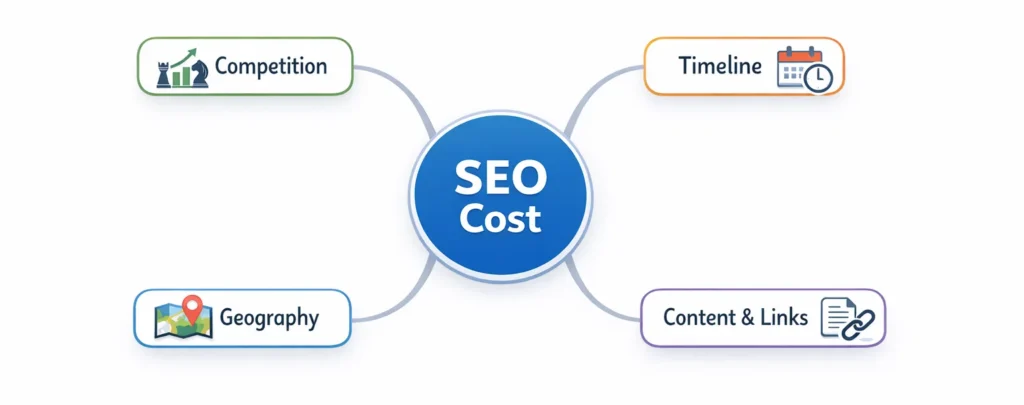
Usually, the cost of SEO ultimately depends on many factors including:
Industry And Keyword Competition
As the competition in any industry is increasing day by day, the need to have more efforts and resources in order to have higher ranking is also getting stronger. The more the competition is, the more you will have to put in the work to stand out in the industry. A space where the competition usually requires a larger scope including more aggressive content creation, extensive link building campaigns and deeper technical analysis. The scope directly affects the hours needed which in turn influences the price.
Time Span And Expertise
SEO strategy and execution take time but the desired speed can shift the overall cost. A more combative timeline demands more resources on time. An SEO team which is experienced with a proven track record in specific areas like advanced AI SEO will demand or need a higher rate than a generalist or a newcomer.
Geographic Targeting
Geo-targeting is essential in SEO because it matches the content of the website with the specific needs and preferences of the target audience. Geographical targeting majorly impacts SEO cost with Localized campaigns usually being cheaper and more efficient than national or international efforts due to lower competition. Cost increase with the number of target locations and the intensity of competition often ranging from $250 to $3,000 along with local services. While broader campaigns require higher more sustained investment.
Content Creation & Link Building:
When it comes to generating high quality content and obtaining high quality backlinks (often $100+per link) majorly raises the overall cost.
SEO Pricing Models For Startups Explained
Learning how SEO is priced is just as knowing how to spend. There is no single, universal pricing structure – agencies, consultants and freelancers use different models depending on the scope of work and your business needs. Here is a breakdown of the four main models and how much each one costs in 2026.
1. Monthly Retainer :
The monthly retainer is by far the most common SEO pricing model. You pay a fixed fee each month for an agreed upon set of services and the work compounds over time. This typically covers on page optimization content creation, link building, technical audits and monthly reporting.
Cost range in 2026
Most businesses in the USA pay between $1,500 and $5,000 per month with the national average for agency retainers sitting around $3,500 to $4,500 per month.
Best for
AI startups that have confirmed product market fit and are ready to invest in long term organic growth.
Watch Out For
Most agencies require a minimum commitment of 6 to 12 months often with 30-to-60-day exit clauses after the initial term. Do not sign a long retainer before your product and messaging are stable.
2. Project based Pricing :
Projects based pricing works best for businesses with well defined goals and a need for specialized, short term SEO services. Common projects include website audits site migrations content strategy build outs and penalty recovery.
Cost Range in 2026 :
Project based SEO typically costs between $5,000 and $30,000 for enterprise specific deliverables.
Best For
Early stage AI startups that need a one time technical audit or an initial SEO foundation before committing to an ongoing spend.
Watch Out For
Project based work delivers a snapshot in time. SEO is not a one-time fix, so use this model to establish a baseline not as a substitute for a long-term strategy.
Hourly Consulting
Hourly SEO services are ideal for businesses needing specific, limited tasks such as audits, consultation or training. This model is commonly used by startups within house marketing teams that need periodic expert guidance rather that full Service management.
Cost Range in 2026
Hourly SEO rates typically fall between $50 and $100 per hour globally with senior consultants in competitive markets charging $100 to $300 per hour.
Best for
Pre-revenue or early-stage AI startups that need strategic direction without committing to a full retainer.
Watch Out For
If a project becomes more complex, it is difficult to predict how many hours will be needed which can add up quickly. Always make sure to set up a cap on hours before engagement begins.
Performance-Based Pricing
Performance based SEO ties payment to measurable results such as keyword rankings, organic traffic growth or leads generated. It sounds attractive on paper but it comes with significant risks.
Cost Range In 2026
Costs vary widely depending on the agreed KPIs and outcomes. Hybrid models with a base retainer and performance bonuses are gaining traction as a more balanced alternative to pure pay for performance arrangements.
Best For
Startups with a stable, converting website that want to align agency incentives with business outcomes.
Watch Out For
Performance based pricing is the least popular model in SEO. Because SEO is a long-term game with considerable nuance, pay for performance is often incompatible with real business goals. Agencies my chase easy low intent keywords just to hit metrics. If an agency promises guaranteed page one rankings with no base fee, treat it is as a red flag.
Quick Comparison Table
| Model | Cost Range (2026) | Best For |
| Monthly Retainer | $1,500 – $5,000/month | Ongoing growth post product-market fit |
| Project-Based | $500 | One-time audits or SEO foundation setup |
| Hourly Consulting | $40 – $90/hour | Early-stage guidance with in-house teams |
| Performance-Based | Varies (hybrid recommended) | Conversion-ready sites with clear KPIs |
Benefits Of Setting Up An In-House SEO team
Sometimes managing SEO tasks altogether at once can become challenging. That’s where we need an experienced In-house SEO team who can help AI startups and businesses scale their SEO journey.
Let’s have a detailed analysis on the advantages of having an In-House SEO team.
Complete Control Over Strategy
An in-house team ensures that every decision aligns with your branding, mission, organizational goals and stakeholder opinions. When your SEO team sits inside your company, there are no approval delays, no miscommunication and no waiting faor your agency’s next scheduled call. You set the priorities and your team executes them directly.
Faster Collaboration Across Teams
Internal teams benefit from proximity. An Internal marketing team can collaborate closely with web development, product sales and leadership without formal handovers. Decisions happen faster, feedback loops are shorter and marketing managers do not need to translates context for external partners. For an AI startup where speed matters, this alone can be a significant competitive advantage.
Deeper Brand And Product Knowledge
Internal teams win on nuance and institutional insight especially for industries with technical or regulated content. AI products are complex. An in-house SEO professional will understand your audience, your use case and your competitive positioning far better than any agency that manages dozens of clients simultaneously.
Long-Term Institutional Knowledge
In-house management allows for complete control over brand voice , SEO strategy and marketing processes. For organizations focused on consistency rather rapid experimentation, this approach reduces reliance on external partners and builds institutional knowledge over time. Every campaign, every test and every insight stays within your organization- compounding in value as your startup scales.
What Does it Actually Cost to have an In-House local SEO Team?
Having an In-house SEO team is a recurring monthly commitment not a one time investment. Once your team is in place, you need a clear image of what it costs to keep them running effectively every single month. Here is a realistic role by role breakdown based on current market data.
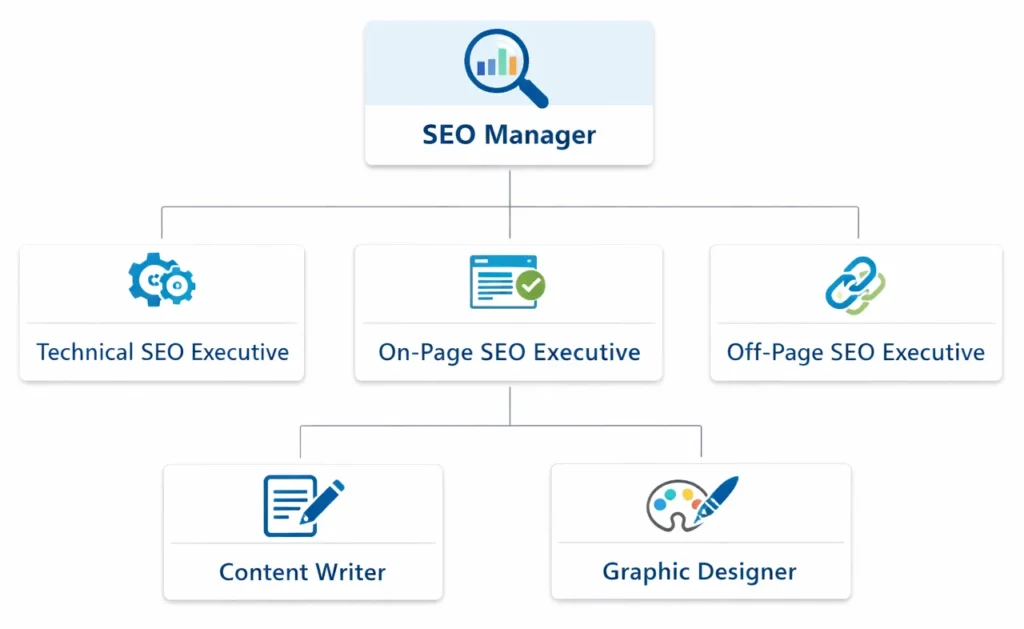
The Core Team Roles & Monthly Costs
1. SEO Manager
The SEO manager leads the entire SEO operation – owning the strategy, managing the team, reporting on performance and aligning SEO efforts with your broader business goals.
Monthly Costs – $1,200
2. SEO Executives
SEO executives are the hands-on operators of your team. Each executive typically owns a specific function including
1) One focused on technical SEO,
2) One on On-page optimization
3) one on off-page and link building
Ensuring all pillars of SEO are covered Simultaneously.
Monthly Cost – $1,200 – $1,800
3. Content Writer
A dedicated content writer produces the local landing page, blog posts and location specific content that drives organic visibility in your target market. Without consistent output, your SEO strategy stalls.
Monthly cost: $600 – $800
4. Graphic Designer
A graphic designer supports the team with blog visuals, infographics and landing page assets. Strong visuals improve user engagement, reduce bounce rates and increase the shareability of your content – all of which indirectly support SEO performance.
Monthly cost – $600
Total Monthly Cost of Maintaining Your In-House SEO Team
| Role | Monthly Cost |
| SEO Manager | $1,200 |
| SEO Executives (×3) | $1,200 – $1,800 |
| Content Writer | $600 – $800 |
| Graphic Designer | $600 |
| Total | $3,600 – $4,400/month |
What this does not include
These figures only cover salaries. Managing an effective in-house SEO team comes with additional monthly expenses that are easy to overlook. They include:
SEO Tools
Platforms like Ahrefs, SEMrush and Screaming Frog are non- negotiable for a functioning SEO team and can add $500 to $1,500 per month
Content tools
Tools like Surfer SEO, Grammarly or Jasper for content optimization carry their own recurring costs
Management Time:
The hours your leadership spends reviewing work, aligning strategy and conducting performance reviews represents a real and ongoing opportunity cost
Hiring & Training Costs
When team members leave or new tools emerge, recruitment and upskilling add expenses that recur unpredictably throught the year
When these additional costs are factored in, maintaining a fully operational in-house local SEO team realistically costs closer to $5,000 to $6,000 per month in total.
How to Measure SEO ROI for Your AI Startup
Without a clear ROI framework, SEO is impossible to justify or to scale. Here is what you actually need to know in order to measure the ROI
The Core Formula
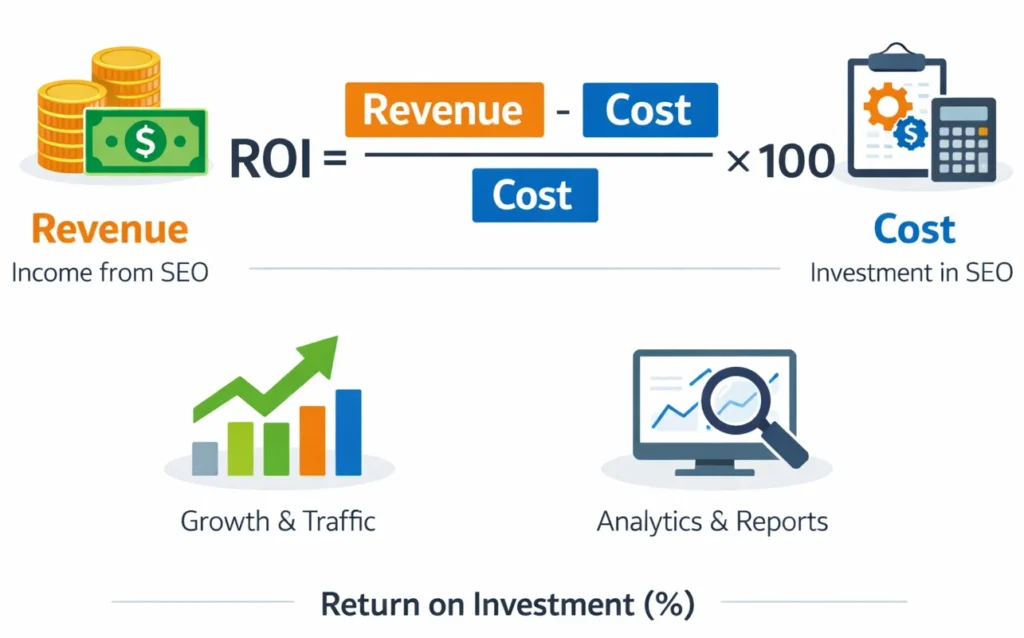
ROI = (Revenue Generated from SEO − Cost of SEO Investment) ÷ Cost of SEO Investment × 100
For example, if your SEO generates $150,000 in revenue against a $50,000 investment, your ROI is 200% — meaning every dollar spent returned $2 in revenue.
What ROI Should You Realistically Expect?
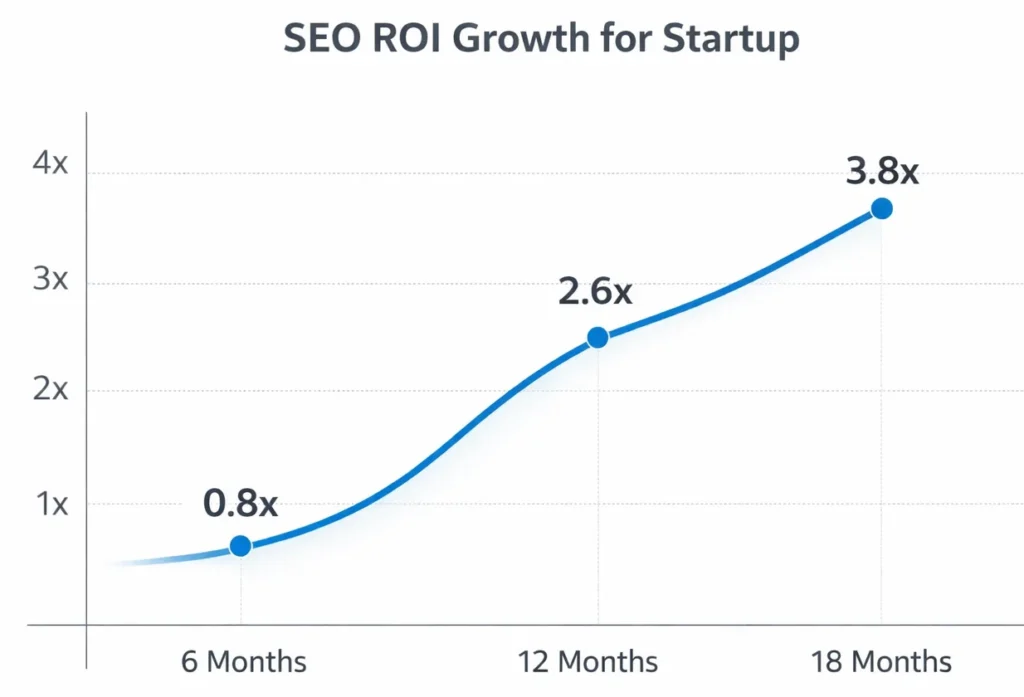
Here is how SEO ROI typically progresses over time:
| Time Period | Average ROI |
| 6 Months | 0.8x |
| 12 Months | 2.6x |
| 18 Months | 3.8x |
Most startups should aim for a 3:1 return or higher. Long-term SEO programs often reach 5:1 or more over time.
The 3 Metrics You Must Track
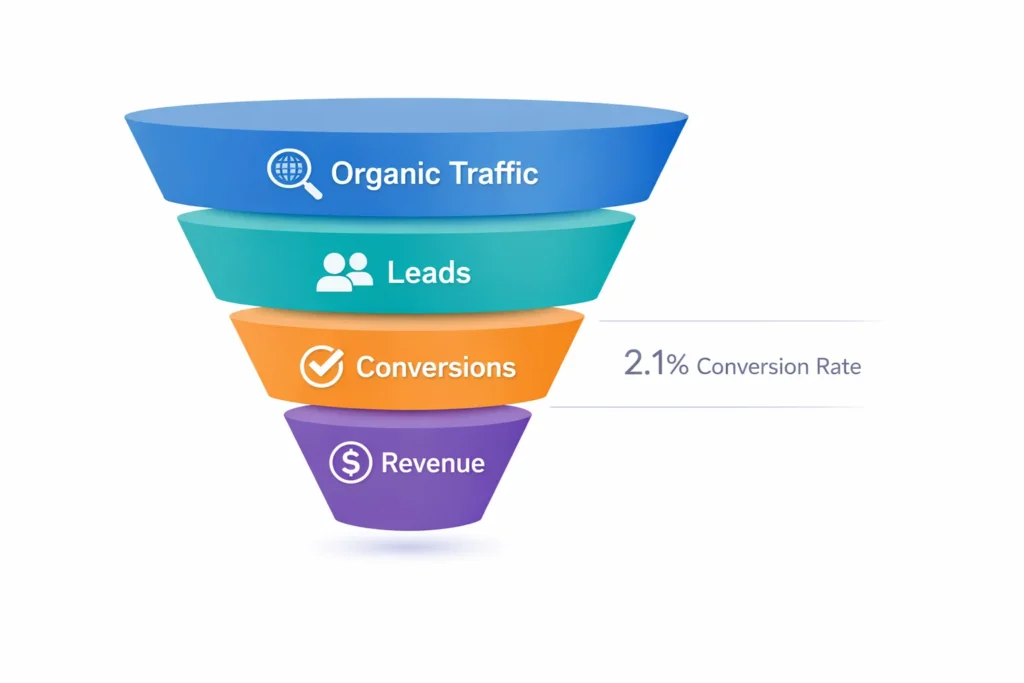
- Organic Revenue — Track organic visitors through to closed revenue in your CRM
- Conversion Rate — The average SEO conversion rate for B2B SaaS companies is 2.1% — use this as your baseline
- Cost Avoidance — Factor in the paid ad spend your organic traffic is replacing
One Important Rule
Never measure SEO return on investment before at least 6 months. Calculating it sooner will produce inaccurate and misleading results. Evaluate SEO year over year, not quarter to quarter.
Conclusion
SEO is not a question of if — it is a question of when and how much. Spending too early drains the runway. Spending too late hands organic growth to your competitors. The right move is timing your investment to match your stage and your overall revenue goals.
For most early-stage AI startups, the smartest first step is partnering with the right SEO agency. You get the strategy, execution and expertise without the overhead.
Ready to grow your organic presence the right way? SEO Circular specializes in helping AI startups build SEO strategies that are lean, focused, and built for results. Get in touch with us today.
Commonly Asked Questions: AI Startup Spend on SEO
Yes — in 2026, GEO is no longer optional. AI Overviews now appear on nearly half of all Google searches, meaning visibility on ChatGPT and Perplexity is just as critical as ranking on Google.
Generic content no longer works. Structure content with clear question-and-answer formatting, concise definitions, and citable statistics, AI models favour factually dense, well-attributed content over broad informational articles.
More than ever. Sites with over 32,000 referring domains are 3.5 times more likely to be cited by ChatGPT, strong backlink profiles now directly impact both Google rankings and AI search visibility.
It adds an overlooked layer of investment. Budget for founder bylines, original research, and verified reviews — a focused 90-day E-E-A-T sprint can close the trust gap against older, more established domains.
Only with a strong editorial layer. Over 82% of content marketers will integrate AI tools by 2026 but an AI-generated content without human oversight risks violating Google’s E-E-A-T principles and triggering ranking penalties.
Table of Content
- Key Takeaways
- How Much Does SEO Costs For AI Startups And Businesses?
- What affects the cost of SEO?
- SEO Pricing Models For Startups Explained
- Quick Comparison Table
- Benefits Of Setting Up An In-House SEO team
- What Does it Actually Cost to have an In-House…
- Total Monthly Cost of Maintaining Your In-House SEO…
- How to Measure SEO ROI for Your AI…
- What ROI Should You Realistically Expect?
- Conclusion
- Commonly Asked Questions: AI Startup Spend on SEO