
Climate change is now a money-making opportunity.
Yes, you read that right. The world is heating up. Governments and big companies are under pressure to reduce pollution. But they can’t do it alone. So, they buy “carbon credits” from people and businesses who help the environment like those who plant trees or create clean energy projects.
This is called carbon trading and it’s becoming a billion-dollar market.
Key Takeaways
- Carbon trading is a fast-growing, billion-dollar opportunity driven by global climate regulations, ESG goals, and net-zero commitments from corporations and governments.
- Startups can enter the carbon market through multiple paths: launching a carbon trading platform, running green projects, acting as a broker, or combining all models for higher profitability.
- Carbon credits are earned by reducing or removing CO₂ through projects like tree planting, renewable energy, or clean technology initiatives.
- Verified carbon credits hold higher value and trust, making certification through recognized standards essential for long-term success.
- Carbon trading platforms generate scalable revenue through commissions, premium listings, analytics, and verification support.
- Buyers include corporations with net-zero goals, compliance-driven industries, governments, NGOs, and climate investment funds.
- Combining project ownership with platform control gives startups maximum revenue, brand authority, and market influence.
- Strong documentation, verification, transparency, and marketing visibility are critical to winning buyers in the carbon market.
- SEO and digital marketing play a major role in helping carbon startups attract buyers, partners, and investors globally.
Ready to Build a Profitable Carbon Trading Business?
Whether you want to launch a carbon trading platform, start a verified green project, or scale your carbon credit sales, SEO Circular helps you get visibility, buyers, and real revenue.
Book a free carbon business strategy call.
Now, here’s the opportunity:
If you’re a startup, you can enter this business in two big ways:
- Build a carbon credit trading platform or app – like a stock market, but for carbon.
- Start a green project – like planting trees – and sell the carbon credits you earn.
Real Example:
Imagine you plant enough trees to absorb 1,000 tons of CO₂. You earn 1,000 carbon credits. If each credit sells for $10, you just made $10,000.
But how do you sell your carbon credits?
You have two options to earn money from carbon trading:
- Sell on an Existing CTX Platform
You contact any carbon credit exchange or platform (like Gold Standard, Verra, or voluntary platforms). They verify your project and then buy or list your carbon credits for sale. Once sold, you get paid. In this case the platform will charge you a commission fee.
- Launch Your Own Carbon Credit Platform
This is the bigger business model. You can build your own carbon trading platform and:
- Sell your own carbon credits directly
- Invite other farmers, landowners, or green project owners to sell their credits through your platform
- Charge commission or fees on every transaction
This way, your platform becomes a hub for carbon trading — just like a stock exchange, but for environmental impact.
At SEO Circular, we help startups promote both models. Whether you’re launching a green project or a full-scale trading platform, we help you get traffic, leads, partners, and real buyers through smart digital marketing.
What Is Carbon Trading? (Explained Simply)
Let’s explain everything in detail — so even if you’re new, you’ll get it clearly.
Carbon trading is like selling fresh air to people who are polluting too much.
Here’s how it works:
Every company, factory, or airline releases carbon dioxide (CO₂) into the air. But there’s a limit to how much they’re allowed to pollute. If they go beyond that limit, they need to buy carbon credits to make up for the extra pollution.
Now, if you plant trees or run a clean energy project, you’re helping reduce carbon from the air. For that, you earn carbon credits — like reward points.
So, carbon trading means:
- One side is selling carbon credits (people who reduce emissions)
- The other side is buying carbon credits (people who pollute more than allowed)
This creates a carbon market — just like a regular market where goods are bought and sold. Here, carbon credits are the product.
Quick Example:
Let’s say:
- You reduce 500 tons of CO₂
- You earn 500 carbon credits
- A factory needs 500 credits to stay within legal limits
- They buy your credits for $12 each
That’s $6,000 in your pocket — just for running an eco-friendly project. This system rewards people who protect the planet and lets businesses stay compliant with climate rules.
Carbon Credit Business Models for Startups
If you’re a startup planning to enter the carbon credit industry, you have more than one way to make money. Let’s break down the most popular and profitable business models — explained with real examples and startup-friendly language.
Model #1: Start a Carbon Credit Trading Platform (App or Website)
This is like building a stock exchange, but for carbon credits. You create a platform where:
- Project owners (like tree planters or solar farms) list their carbon credits. You can charge for listing their project.
- Buyers (companies, governments, investors) come to buy them
- Also you can charge commission from buyers and sellers for every transaction.
How You Make Money:
Charge commission on every credit sold : Earn a small percentage from every carbon credit transaction made on your platform, just like a marketplace commission model.
Offer verification support or consulting for a fee: Help project owners with carbon credit verification, documentation, and compliance, and charge a service or consulting fee.
Provide premium listing or marketing for sellers: Allow sellers to pay extra to promote their carbon credits, get featured listings, or reach more buyers faster.
Sell platform data analytics or reporting tools : Offer paid access to market insights, pricing trends, emission data, and reports useful for buyers and investors.
Example:
If 10,000 credits are sold on your platform in a month at $10 per credit, and you charge 2% commission: You make: $2,000/month. As volume increases, so does your revenue.
What You Need:
- A website or app (we help with marketing). We have already developed both an app and website. You can buy readymade ones from us.
- Legal approval to operate (depending on country)
- A team to manage listings, compliance, and tech
Bonus Tip: You can also run your own credit projects and sell them on your own platform — keeping 100% profit.
Model #2: Run a Carbon Credit Project (Like Tree Planting)
If you have land or a way to reduce carbon, you can run a carbon project and earn credits yourself.
Common projects include:
- Tree planting (reforestation, agroforestry)
- Solar power or wind farms
- Clean cooking or waste-to-energy systems
How You Make Money:
- Each ton of carbon you reduce = 1 carbon credit
- You sell these credits to platforms or directly to buyers
Example:
You plant trees that absorb 5,000 tons of CO₂ per year.
If each credit sells at $10: You make $50,000/year (minus verification and project costs).
What You Need:
- A valid project with monitoring
- Verification from trusted body (we’ll explain in Section 7)
- A place to sell credits — via platform or your own network
Model #3: Be a Carbon Credit Broker or Aggregator
You don’t need land or a platform — you can be a middleman.
Here’s how:
- Find farmers or small project owners with tree plantations or clean projects
- Help them get verified and listed on carbon markets
- Charge a commission for every sale
This is like real estate agents who help people sell property — but here you sell carbon credits.
Example:
If your farmer client earns $20,000 by selling carbon credits, and you charge 10% commission:
You earn $2,000 just for connecting the dots.
Model #4: Combine Platform + Project
The most powerful model? Do both.
- Start your own tree plantation project
- Build your own platform
- Sell your own credits
- Invite others to list their projects too
Now you’re making money from:
- Selling your own credits
- Platform commission
- Branding and marketing fees
- Partner projects
It’s like owning a farm and the marketplace where all farms sell. Pure profit + full control.
How Carbon Credits Are Created, Verified & Sold
Let’s now break down the entire carbon credit process into easy steps — so you know exactly how to earn and sell carbon credits.
Whether you’re planting trees, setting up a solar farm, or working with farmers — the steps are mostly the same.
Step 1: Start a Green Project That Reduces Carbon
First, you need a project that actually reduces carbon emissions or removes carbon from the atmosphere.
Examples:
- Planting trees on empty land
- Installing solar panels to replace coal energy
- Running clean cookstove programs in rural areas
Every time your project reduces pollution or absorbs CO₂ — you’re creating carbon savings.
Step 2: Measure How Much CO₂ You’re Reducing
You must track and measure your project’s carbon impact.
Example:
If your tree plantation absorbs 1,000 tons of CO₂ in a year, that equals 1,000 carbon credits.
You’ll need basic tools like:
- GPS maps
- Satellite images
- Carbon calculators (available online)
- A consultant (optional but helpful)
Step 3: Get Your Project Verified
This is an important step. To sell credits, your project must be verified by an approved body — like:
- Verra (VCS)
- Gold Standard
- Climate Action Reserve
- Global Carbon Council
They check:
- Is your project real?
- Is the carbon saved measurable?
- Is it long-term and not already claimed?
Once approved, they issue your carbon credits in their system — and you’re ready to sell!
Step 4: Sell Your Carbon Credits
Now comes the fun part — you sell your verified carbon credits for money.
You can sell them in 3 ways:
- On carbon exchanges (like a marketplace)
- Directly to buyers (companies, NGOs, government)
- On your own carbon trading platform (if you built one)
Pro tip: Verified credits sell for more money than unverified ones. Buyers trust certified credits.
Real Example:
Let’s say your project reduces 5,000 tons of CO₂ per year
You get 5,000 verified carbon credits
You sell them at $10 per credit
You earn: $50,000/year
If you do this every year, you’ve built a recurring revenue business — plus you’re helping the planet.
Carbon Credit Creation & Selling Process
| Step | What Happens | Key Output |
| Start Green Project | Trees, solar, clean energy, cookstoves | Carbon reduction begins |
| Measure CO₂ Impact | Track emissions reduced or removed | Carbon data |
| Verification | Third-party verification by standards | Verified credits |
| Credit Issuance | Credits issued on registry | Tradable assets |
| Selling Credits | Exchange, direct buyers, or own platform | Revenue generated |
Buyers in the Carbon Market: Who Pays & Why
If you’re going to sell carbon credits, you need to know who’s buying and what they care about.
Here’s the good news — there’s a growing list of companies and organizations that must or want to buy carbon credits. Why? Because they either:
- Legally have to (compliance)
- Or they voluntarily want to go green (reputation, branding, ESG goals)
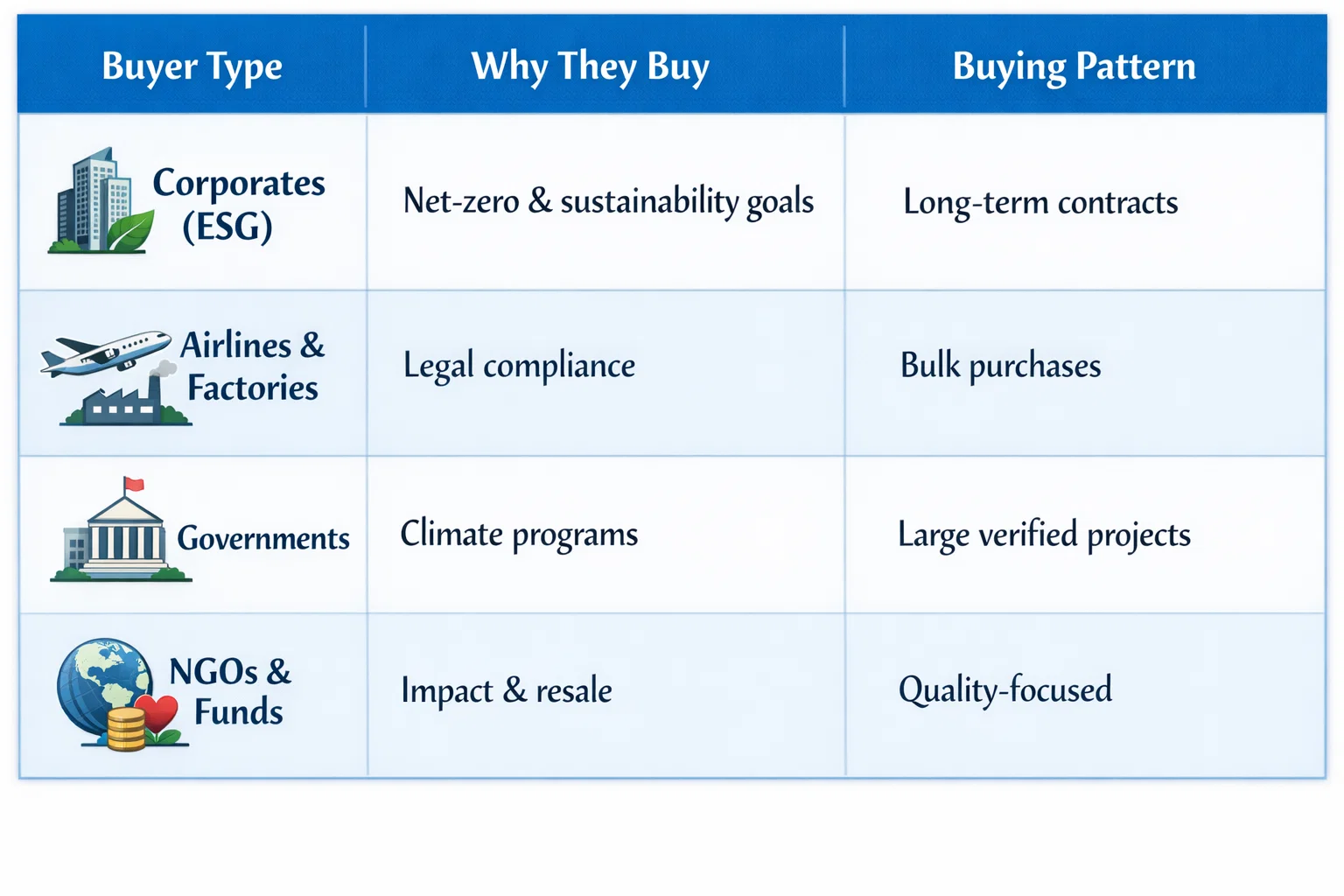
Let’s understand them in detail:
Large Corporations with ESG or Net-Zero Targets
Big brands like Microsoft, Google, Apple, Amazon all have net-zero emission goals. That means they promise to cancel out their carbon footprint.
They still pollute (flights, data centers, deliveries), so to balance that, they buy carbon credits.
These companies want:
- Verified, high-quality credits
- Green projects they can show in reports
- Reliable sellers or platforms
Airlines, Oil Companies & Factories (Compliance Buyers)
Some industries are required by law to limit emissions. If they go over the legal cap, they must buy carbon credits.
Example buyers:
- Airlines (international flights)
- Oil & gas companies
- Cement, steel, and coal-based factories
These buyers often purchase in bulk and care more about price and volume.
Governments and Public Sector Programs
Some governments support green goals through:
- National carbon offset programs
- Buying credits for climate funds
- International climate partnerships
They usually buy from large projects or verified registries and offer long-term contracts.
NGOs, Climate Funds & Carbon Brokers
Some climate-focused NGOs and investment funds buy carbon credits to:
- Support eco-projects
- Resell at higher value
- Help communities go green
These buyers look for impact + quality, not just numbers.
Why Do They Pay?
- To avoid fines (compliance buyers)
- To improve brand image (corporate buyers)
- To attract investors with ESG goals
- To fulfill global climate commitments
What This Means for You
If you run a carbon project or own a platform:
- Target the right buyer for your model
- Use SEO and marketing to get discovered online
- Show transparency and verification to earn trust
Revenue Models in Carbon Trading (With Examples & Calculations)
If you’re entering the carbon market, you have multiple ways to earn. Whether you’re planting trees, building a solar farm, or launching a carbon credit trading platform, there’s real profit potential.
Let’s break down each revenue model one by one:
Model #1: Selling Carbon Credits from Your Own Green Project
If you run a project like tree planting, clean cookstoves, or renewable energy — you earn carbon credits based on how much CO₂ you reduce.
Example:
- You plant trees that reduce 5,000 tons of CO₂ per year
- You get 5,000 carbon credits
- If market price = $10 per credit
You earn $50,000/year
You can increase revenue by:
- Expanding the project (more land, more trees)
- Getting premium verification (some buyers pay more)
- Selling directly to buyers (to avoid middlemen)
Model #2: Commission from a Carbon Credit Trading Platform
If you launch a carbon exchange platform, you earn money by:
- Charging transaction fees (like 1-5% per trade)
- Offering premium listings or promotions
- Selling analytics or reporting tools
- Providing verification support for new sellers
Example:
- 20,000 credits are sold monthly
- Average price = $12 per credit = $240,000 trade volume
- Your platform charges 2% commission
You earn $4,800/month
As volume increases, your income scales fast — and you don’t need to own any projects yourself.
Model #3: Aggregator/Broker Commission
If you connect farmers or small project owners to buyers or platforms, you act as a broker. You help them get verified and listed.
Example:
- Farmer sells 3,000 credits at $10 = $30,000
- You take 10% commission = $3,000 profit (no project cost!)
You can work with multiple farmers or NGOs, and scale this without owning land or assets.
Model #4: Combine All for Maximum Profit
Smart startups combine models for full control.
Example:
- You start a tree planting project (Model 1)
- You build a trading platform (Model 2)
- You let other farmers list their credits on your platform (Model 3)
Now, you’re making money from:
- Selling your own credits
- Platform commissions
- Partner credit listings
It’s like owning both the farm and the market — you win from every angle.
Revenue Sources in a Carbon Trading Business
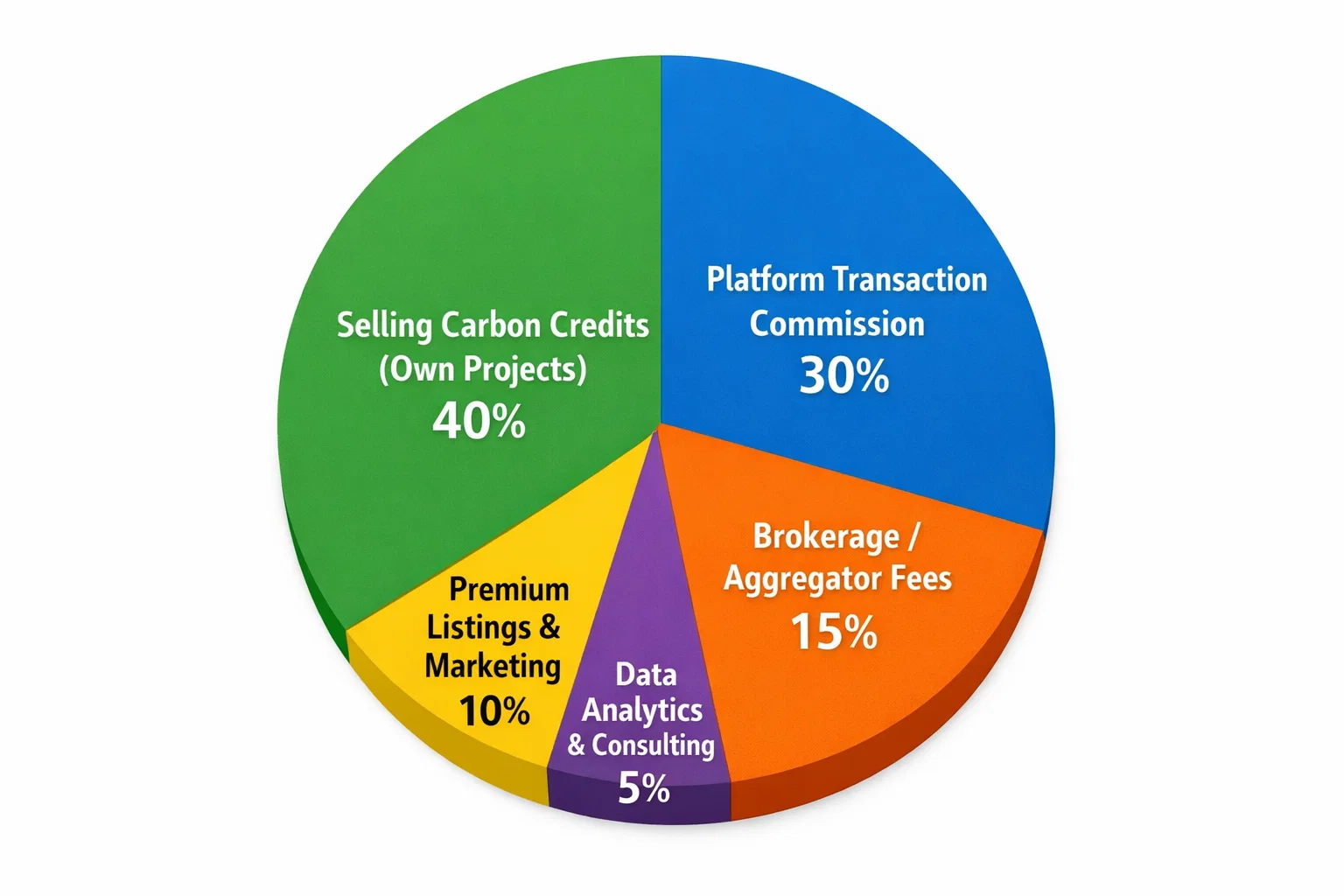
Selling carbon credits (40%) is the main revenue source, especially from owned green projects like tree planting or renewable energy.
Platform transaction commissions (30%) generate recurring income as buyers and sellers trade credits on the platform.
Brokerage or aggregator fees (15%) come from helping project owners connect with buyers and complete verified sales.
Premium listings and marketing (10%) allow sellers to pay for better visibility and faster deal closures.
Data analytics and consulting (5%) provide added value through reports, insights, and advisory services.
Legal & Verification Process Made Simple
Before you can sell carbon credits, your project must go through a verification process. This is how you prove that your project is real, measurable, and actually reducing or removing carbon from the atmosphere.
Think of it like getting a product certified before selling it to the public.
Step 1: Choose the Right Type of Market
There are two types of carbon markets:
Voluntary Market
- You choose to sell credits without legal pressure
- Buyers include corporations, NGOs, ESG investors
- Most startups and green projects begin here
- Easier to enter, fewer regulations
Compliance Market
- Governments require companies to offset emissions
- Requires strong documentation and legal approvals
- Good for large-scale industrial projects
Tip: As a startup, it’s easier and faster to start in the voluntary market.
Step 2: Select a Verified Standard
A standard is an organization that checks your project, calculates your carbon savings, and issues the official carbon credits.
Top verification bodies include:
- Verra (VCS) – Most widely used
- Gold Standard – High-quality, trusted for climate and community impact
- Global Carbon Council – Popular in MENA region
- Climate Action Reserve – Mainly U.S.-focused
Each has its own rules, documents, and fees. You’ll need to follow their methodology based on your project type (forestry, energy, agriculture, etc.)
Step 3: Monitor, Measure, and Document
You must keep proper data to prove your project’s impact:
- GPS maps or satellite images of land
- Tree species and growth data (for plantations)
- Energy savings (for solar, clean cookstoves, etc.)
- Proof of additionality (your project wouldn’t happen without carbon finance)
Some tools can help — or you can hire a carbon project consultant.
Step 4: Hire a Third-Party Verifier
The chosen standard will send an independent verifier to check your data. This is a professional body that:
- Visits your project (sometimes virtually)
- Reviews your documents
- Confirms your carbon savings
Once verified, the credits are issued in your name.
Step 5: Register and Sell Credits
After verification, your credits are live on the registry. You can:
- List them on your own platform
- Sell to companies or brokers
- Partner with existing exchanges
Now your credits are legally valid and sellable — just like gold with a certificate.
Estimated Startup Cost for Carbon Trading Business
| Business Model | Cost Category | Estimated Cost Range | What This Includes |
|---|---|---|---|
| Carbon Credit Project (Tree, Solar, Clean Energy) | Project setup & operations | $10,000 – $50,000 | Land access or partnerships, planting or installation, monitoring |
| Verification & certification | $5,000 – $20,000 | Verification by standards like Verra or Gold Standard | |
| Monitoring & reporting | $2,000 – $5,000 / year | Data tracking, satellite images, documentation | |
| Carbon Trading Platform (App / Website) | Platform development (MVP) | $15,000 – $40,000 | Website or app, dashboards, basic trading features |
| Legal & compliance setup | $3,000 – $10,000 | Business registration, legal approvals, policies | |
| Hosting & maintenance | $1,000 – $3,000 / year | Server, security, updates | |
| Marketing & user acquisition | $2,000 – $8,000 / month | SEO, content, ads, outreach | |
| Broker / Aggregator Model | Verification support & onboarding | $1,000 – $3,000 | Documentation help, consultant fees |
| Sales & marketing | $1,000 – $2,000 | Outreach, lead generation | |
| Total starting cost | Under $5,000 | Low-risk entry model | |
| Hybrid Model (Platform + Project) | Combined investment | $30,000 – $80,000+ | Project costs + platform + marketing |
How to Start a Carbon Trading Platform or Project
Now that you understand the models, the buyers, and the verification process — it’s time to launch. Whether you’re starting a carbon trading platform or running a tree planting or clean energy project, here’s a simple action plan to get you moving.
A. How to Start a Carbon Credit Platform (App or Website)
If you want to build a carbon credit marketplace, here’s what you need:
Step 1: Finalize Your Platform Idea
Decide:
- Will your platform allow others to list and sell carbon credits?
- Will you also sell your own credits?
- Will you charge commission, listing fees, or offer extra services?
Tip: Start simple — basic buying/selling. Add more features later.
Step 2: Build the Platform (MVP First)
You don’t need to build a massive app from Day 1. You can launch an MVP (Minimum Viable Product) — a simple website or app that allows:
- Sellers to register and list projects
- Buyers to browse and buy
- Admin dashboard to manage trades
Use a web development agency or hire developers. Focus on:
- Secure login
- Payment integration
- Project listing
- Credit tracking system
Step 3: Get Legal & Verification Ready
If your platform also supports verification or registration:
- Learn the process from Verra or Gold Standard
- Build a partner network with carbon consultants
- Create a project submission form for sellers
Step 4: Attract Sellers and Buyers
This is where SEO Circular comes in:
- We run digital marketing campaigns to bring project owners and buyers to your platform
- We use SEO, PPC, content, social media, and more to grow traffic and trust
B. How to Start a Carbon Credit Project (Tree Planting, Solar, etc.)
If you want to generate and sell your own credits, here’s your path:
Step 1: Pick a Project Type
Choose what works for you:
- Tree planting (great for landowners or farmer networks)
- Renewable energy (solar/wind for rural areas)
- Clean cookstoves or biogas units
Step 2: Choose Your Location & Partners
If you don’t have land or resources yourself, partner with:
- Local farmers
- Landowners
- NGOs
Create a simple agreement that says you’ll manage the carbon credit side and share profit.
Step 3: Document Everything
Start tracking from day one:
- Area covered
- Type of project (trees, energy, etc.)
- Tools or tech used
- Pictures, GPS maps, reports
This is needed later for verification.
Step 4: Apply for Verification
Choose a registry (like Gold Standard or Verra), follow their steps, and get your credits verified. You can do it yourself or hire a consultant.
Step 5: Sell Your Credits
Once verified, you can:
- Sell to brokers
- List on existing exchanges
- Or better — sell on your own platform
How SEO Circular Helps You Succeed in the Carbon Market
Starting a carbon credit project or platform is smart. But without visibility, buyers and investors won’t find you. That’s where SEO Circular comes in — your digital marketing partner in the green economy.
We don’t just run ads. We build your brand, visibility, and trust in the carbon market.
FAQs
Voluntary markets allow businesses to offset emissions by choice, while compliance markets are regulated by governments and legally require companies to offset emissions.
Carbon credit prices vary based on project type, quality, and verification, but typically range between $5 and $30 per credit in voluntary markets.
Verification can take several months depending on project type, documentation quality, and the chosen verification body.
Major buyers include large corporations with ESG goals, airlines, oil and gas companies, manufacturers, governments, NGOs, and climate funds.
In 2026, search is no longer just about ranking links, it’s about being selected, cited, and recommended by AI systems. Generative AI-powered search engines now answer questions directly, summarize sources, and guide user decisions without requiring a click.
According to industry studies, over 65% of searches are expected to end without a website visit by 2026, driven by AI overviews and answer engines. At the same time, more than 70% of users trust AI-generated answers for research, product comparison, and decision-making. This shift has fundamentally changed how brands gain visibility.
Traditional SEO tactics alone are no longer enough. AI models evaluate context, entities, topical depth, factual accuracy, and brand authority not just keywords and backlinks. If your brand is not structured in a way AI can understand and trust, it simply won’t appear in AI-generated answers.
At SEO Circular, we see Generative AI Optimization as the next evolution of search visibility. It’s about aligning your content, brand signals, and digital presence with how large language models interpret expertise and relevance. Brands that adapt now will dominate AI-driven discovery, while others risk becoming invisible even if they still rank on page one.
Key Takeaways
- Generative AI Optimization (GAIO) is about being cited and recommended, not just ranking
- AI search engines rely heavily on entity clarity and contextual trust
- Topical authority beats isolated, keyword-focused content
- Conversational and prompt-driven content performs best in AI answers
- Brand mentions and Digital PR influence AI visibility more than links alone
- Long-term consistency matters more than short-term SEO tactics
Struggling to Stay Visible in AI Search?
See how we help businesses adapt to generative AI search and build long-term authority beyond traditional SEO.
Learn How SEO Circular Optimizes for AI Search.
What Is Generative AI Optimization (GAIO)?
Generative AI Optimization (GAIO) is the process of optimizing your brand, content, and digital signals so AI-powered search engines can understand, trust, and recommend you in generating answers.
Unlike traditional SEO where the goal is to rank a webpage, GAIO focuses on becoming a reliable source for AI-generated responses. AI search systems don’t just scan keywords. They evaluate meaning, context, factual consistency, entity relationships, and authority across the web.
In simple terms, GAIO answers one critical question:
“Why should an AI model choose your brand as the best answer?”
At SEO Circular, we define GAIO as the intersection of:
- Entity-based optimization (brands, people, products, topics)
- Topical depth and clarity, not surface-level content
- Consistent brand mentions and citations across trusted sources
- Content structured for question-answer and conversational queries
GAIO also goes beyond websites. AI models learn from blogs, media mentions, reviews, documentation, PR coverage, and expert content. If your brand appears fragmented or inconsistent across these sources, AI engines hesitate to reference you.
This is why GAIO is not a replacement for SEO it’s an evolution of it. Strong technical SEO, high-quality content, and authority still matter, but they must now be aligned with how generative AI systems interpret knowledge.
Brands that invest in GAIO early don’t just gain visibility—they gain AI-driven trust, which is the real currency of search in 2026.
How Generative AI Search Engines Work in 2026
By 2026, generative AI search engines no longer function like traditional search systems that list blue links. They act as answer engines, powered by large language models that understand intent, context, and relationships between entities.
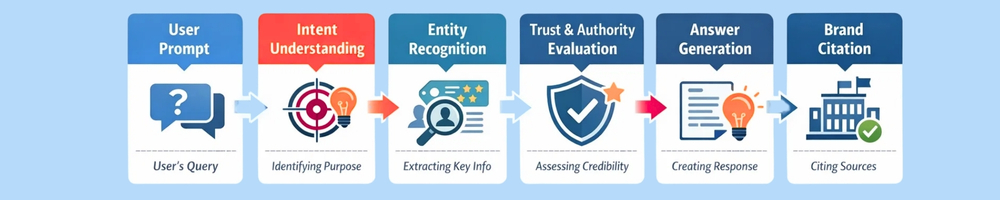
When a user asks a question, AI systems analyze multiple signals at once query intent, past user behavior, trusted data sources, topical authority, and real-world credibility. Instead of ranking pages, the AI synthesizes information from multiple sources and generates a single, consolidated response.
These systems prioritize:
- Clear entity identification (who you are, what you do, and why you matter)
- Factual accuracy and consistency across the web
- Depth over volume—comprehensive answers beat keyword-stuffed content
- Source reliability, including expert authorship and reputable mentions
AI models also learn continuously. Each interaction helps them refine which brands and sources are trustworthy. If your content is vague, outdated, or lacks authority signals, it gets ignored—even if it once ranked well on Google.
How Generative AI Search Engines Generate Answers
A simplified view of how AI systems interpret prompts, evaluate trust signals, and generate answers that cite authoritative brands.
Key Differences Between SEO and Generative AI Optimization (GAIO)
| Aspect | Traditional SEO | Generative AI Optimization (GAIO) |
| Primary Goal | Rank webpages on search engine results pages (SERPs) | Be referenced, cited, or recommended inside AI-generated answers |
| How Visibility Is Earned | Driven by keywords, backlinks, and page-level optimization | Driven by entity clarity, topical authority, and trust signals across the web |
| How Systems Decide | Search engines ask: “Which page ranks best?” | AI systems ask: “Which source is most reliable to answer this question?” |
| Traffic & Exposure | Focuses on driving clicks to websites | Often delivers brand exposure without a click through AI summaries and responses |
| Measurement Focus | Rankings, traffic, and click-through rates | Brand recall, authority, and presence inside AI-generated answers |
| Optimization Approach | Optimizes for search engine algorithms | Optimizes for language models that reason, summarize, and contextualize information |
| Content Requirements | Keyword relevance and on-page optimization | Clear explanations, factual depth, consistency, and contextual accuracy |
| Strategic Role | Foundational visibility channel | Visibility multiplier for AI-driven search |
| SEO Circular’s View | Core framework for discoverability | Strategic layer that amplifies trust and long-term AI visibility |
Optimizing Content for AI Answer Engines
Optimizing content for AI answer engines requires a shift from writing for rankings to writing for clarity, completeness, and trust. AI models favor content that directly solves a user’s question in a structured, factual, and easy-to-understand way.
Instead of long introductions or promotional language, AI engines prioritize clear definitions, step-by-step explanations, and concise insights. Content that answers who, what, why, and how in a single place is far more likely to be selected.
Key elements AI answer engines look for include:
- Well-defined entities (brand, product, industry terms)
- Context-rich explanations, not surface-level commentary
- Consistent facts and terminology across sections
- Natural language that mirrors conversational queries
AI systems also cross-check information across multiple sources. If your content contradicts widely accepted data or lacks supporting context, it loses credibility fast.
Entity Optimization: The Core of AI Visibility
In generative AI search, entities are everything. An entity can be a brand, company, product, person, or concept. AI models rely on entities to understand who is trustworthy and what they are known for.
If your brand is not clearly defined as an entity, AI systems struggle to place you in relevant answers—even if your content is strong. This is why entity optimization has become a core Generative AI Optimization technique in 2026.
Effective entity optimization means:
- Clearly defining who your brand is and what problem you solve
- Maintaining consistent brand descriptions across your website, PR coverage, and third-party platforms
- Connecting your brand to relevant topics, industries, and use cases
- Reducing ambiguity by avoiding mixed messaging or unclear positioning
AI models build knowledge graphs internally. When your brand appears repeatedly in the right context, AI starts associating you with specific expertise areas.
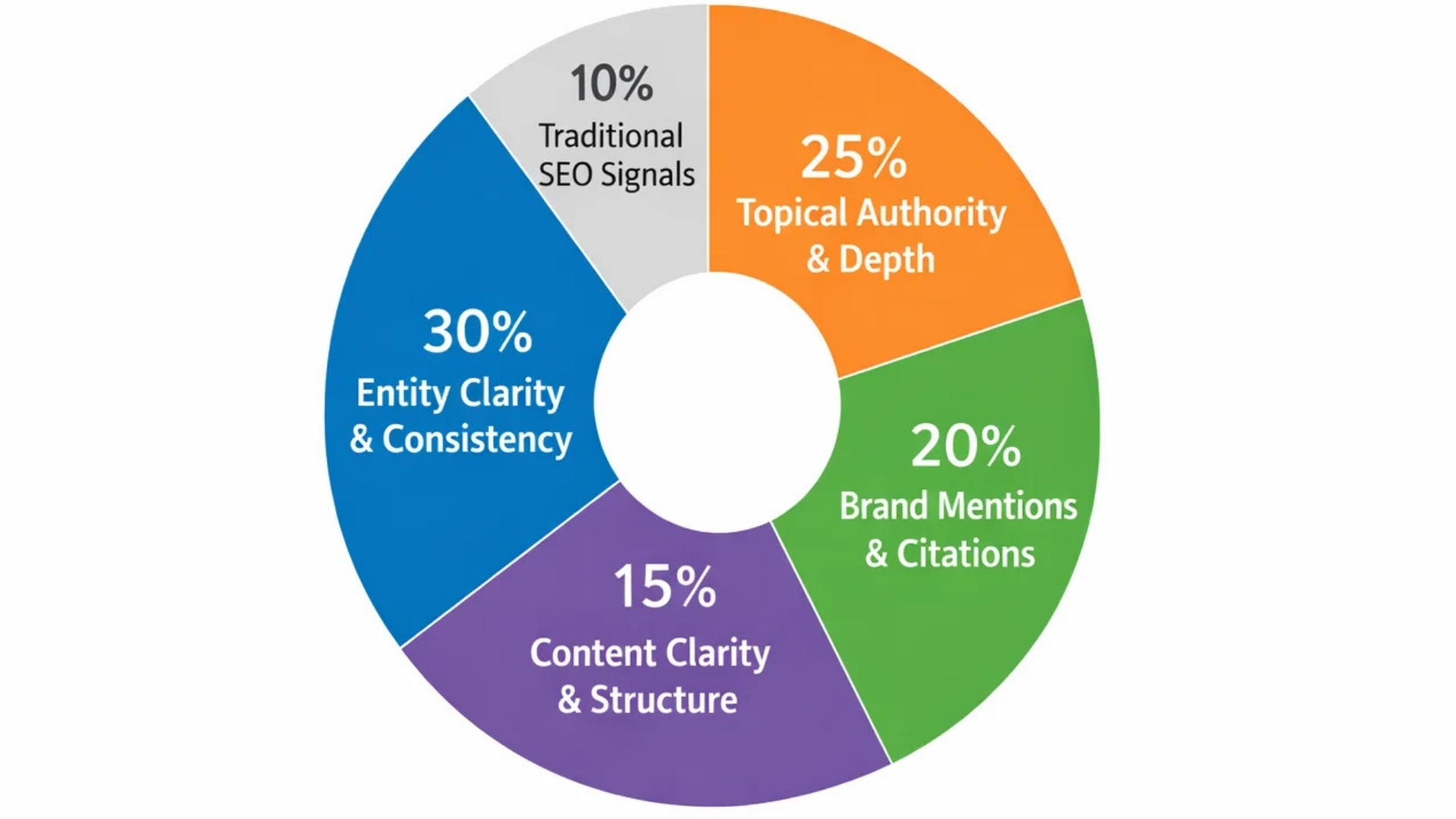
How Generative AI Search Engines Evaluate Brand Trust in 2026
The pie chart below illustrates how generative AI search engines evaluate trust and select brands in 2026. Unlike traditional SEO, where
rankings and backlinks dominate, AI-driven search prioritizes entity clarity, topical authority, and brand credibility.
As shown, entity consistency and topical depth account for more than half of AI trust signals, while traditional SEO factors play a much smaller role. Brand mentions, citations, and content clarity also significantly influence whether a brand is cited inside AI-generated answers.
This visual highlights a critical shift: winning AI search is no longer about optimizing pages—it’s about building trust at the brand and knowledge level. Understanding these priorities helps brands focus their efforts on what actually drives visibility in AI-powered search experiences.
Topical Authority & Knowledge Graph Alignment
Topical authority is how generative AI systems decide who truly understands a subject. In 2026, AI doesn’t trust isolated articles—it trusts brands that consistently cover a topic in depth and from multiple angles.
When your content ecosystem answers related questions, explains subtopics, and uses consistent terminology, AI models begin mapping your brand into their internal knowledge graphs. This alignment helps AI understand not just what you say, but how deeply you know the topic.
Topical authority is built by:
- Covering core topics and supporting subtopics comprehensively
- Connecting concepts logically instead of publishing random content
- Updating content to reflect current data and trends
- Maintaining consistency in definitions, examples, and messaging
Generative AI prefers sources that show contextual continuity. One strong article helps, but a network of related, high-quality content builds trust faster.
Prompt-Driven Search & Conversational Query Optimization
Generative AI has changed how users search. Instead of short keywords, users now ask full questions, follow-ups, and multi-intent prompts. This shift has made conversational query optimization a critical Generative AI Optimization technique in 2026.
AI systems break prompts into intent layers—informational, comparative, and decision-driven. Content that matches these layers performs better than content written only for single keywords.
To optimize for prompt-driven search:
- Write content that answers questions naturally, as a human expert would
- Include follow-up explanations that anticipate the next question
- Use real-world examples, comparisons, and clarifications
- Structure content so answers appear early and clearly
AI engines favor content that feels like a conversation, not a blog post filled with SEO jargon. The clearer and more helpful your response, the more likely AI will reuse it in generated answers.
Brand Mentions, Citations & Digital PR for AI Search
In generative AI search, brand mentions matter as much as backlinks often more. AI models learn trust by observing how frequently and consistently a brand is referenced across credible sources.
Unlike traditional SEO, AI systems don’t rely solely on link equity. They analyze unlinked mentions, citations, expert quotes, media coverage, and contextual references to understand authority. If reputable publications repeatedly mention your brand in the right context, AI treats that as a strong trust signal.
Effective AI-focused digital PR includes:
- Mentions in authoritative industry publications
- Consistent brand descriptions across media outlets
- Expert commentary and data-backed insights
- Association with trusted topics and entities
AI also evaluates sentiment and relevance. Random mentions don’t help. Contextual mentions tied to your expertise do.
Optimizing for AI Overviews, SGE & Answer Engines
AI overviews and answer engines have become the primary visibility layer in search by 2026. Instead of ten blue links, users now see summarized answers generated from multiple trusted sources. If your brand isn’t optimized for these systems, you’re invisible at the moment decisions are made.
AI engines select content that is clear, factual, and immediately useful. They extract short explanations, definitions, comparisons, and steps—often without sending traffic back to the website.
To optimize for AI overviews:
- Provide direct answers early in the content
- Use simple language and unambiguous explanations
- Support claims with data, examples, or real-world context
- Maintain consistency across similar topics and pages
AI systems also favor brands that appear repeatedly across related queries. One optimized page helps, but consistent coverage across a topic area wins.
Measuring Generative AI Visibility & Performance
Measuring success in generative AI search requires a mindset shift. Traditional SEO metrics like rankings and clicks don’t fully reflect AI-driven visibility, especially when users get answers without visiting a website.
In 2026, brands need to track presence, citations, and influence inside AI-generated responses. This includes how often your brand is mentioned, quoted, or referenced across AI answer engines.
Key indicators we focus on include:
- Brand mentions in AI-generated answers
- Visibility across prompt-based and conversational queries
- Consistency of brand positioning in AI summaries
- Assisted conversions influenced by AI discovery
AI visibility measurement is less about volume and more about quality and authority. Being cited once in the right context can be more valuable than hundreds of low-intent clicks.
Common Mistakes Brands Make in Generative AI Optimization
One of the biggest mistakes brands make in Generative AI Optimization is treating it like traditional SEO. Keyword stuffing, thin content, and surface-level blogs may still rank—but AI systems rarely trust or cite them.
Another common issue is unclear brand identity. If your messaging, services, or expertise appear inconsistent across your website, PR mentions, and third-party platforms, AI models struggle to understand what your brand actually stands for.
Brands also fail by:
- Publishing content without topical depth or continuity
- Ignoring brand mentions and authority signals outside their website
- Over-promoting instead of educating
- Relying only on tools without validating how AI responds to real prompts
Many companies assume AI will “figure it out.” In reality, AI needs clear, repeated, and reliable signals to build trust.
Future-Proof Generative AI Optimization Strategies
Generative AI search will continue to evolve beyond 2026, but the foundations of visibility are already clear. Brands that focus only on short-term tactics will struggle as AI models become more selective and context-aware.
Future-proof GAIO strategies focus on durable signals, not quick wins. This includes building strong entities, consistent expertise, and long-term trust across the web.
Key strategies that will remain relevant include:
- Investing in deep topical authority, not isolated content
- Treating brand mentions and PR as core SEO assets
- Publishing expert-led, experience-driven insights
- Continuously updating content to reflect real-world changes
- Testing visibility directly inside AI tools and answer engines
AI models reward brands that behave like reliable knowledge sources, not marketers chasing algorithms. The more stable and consistent your signals, the more AI trusts you over time.
How SEO Circular Approaches Generative AI Optimization
At SEO Circular, we approach Generative AI Optimization as a business growth strategy, not a standalone SEO tactic. Our focus is on making brands understandable, credible, and preferred by AI-driven search systems.
We start by strengthening entity clarity—defining exactly who our clients are, what they do, and where they lead. From there, we build topical authority frameworks that align with how AI models organize knowledge. This ensures consistent visibility across multiple prompts, not just individual queries.
Our approach combines:
- AI-focused content architecture
- Entity and brand signal optimization
- Digital PR and authoritative mentions
- Prompt-based visibility testing and refinement
We integrate GAIO with enterprise SEO, content, and analytics so AI visibility translates into real business impact, not just exposure.
Because AI search evolves fast, we constantly test how brands appear inside generative answers and adapt strategies accordingly. This keeps our clients ahead as AI becomes the primary discovery layer.
Final Thought
Search in 2026 is no longer about who ranks first it’s about who AI trusts enough to recommend. Generative AI-powered search engines don’t scan pages; they interpret meaning, validate authority, and synthesize answers. If your brand is not structured for how AI understands expertise, it simply won’t appear—no matter how strong your traditional SEO looks.
Generative AI Optimization as the natural evolution of SEO. It shifts the focus from keywords to entities, topical authority, brand credibility, and conversational relevance. Brands that adapt early don’t just gain visibility—they become the default answers inside AI-driven discovery.
FAQs
Yes. Even websites that rank well can lose visibility in AI-driven search. Generative AI Optimization ensures our brand is trusted and cited inside AI-generated answers, not just listed in traditional search results.
Yes. AI search engines often display brand names, insights, and recommendations directly in answers. This improves brand recall, authority, and influence, even when users don’t click through to a website.
AI models evaluate trust using entity consistency, factual accuracy, topical authority, brand mentions across reputable sources, and contextual relevance rather than relying only on keywords or backlinks.
Industries like SaaS, B2B services, healthcare, finance, ecommerce, technology, and professional services benefit most, as users frequently rely on AI for comparisons, recommendations, and expert guidance.
Yes. AI prioritizes clarity, expertise, and authority over content volume. A smaller set of well-structured, expert-led content combined with strong brand signals can outperform high-volume publishing.
Brand mentions help AI models understand credibility and relevance. Consistent mentions across trusted publications reinforce authority, even when links are not present.
Generative AI Optimization works alongside SEO. SEO builds discoverability, while GAIO ensures our brand is selected, trusted, and cited inside AI-generated responses.
AI-powered search is fundamentally changing how people discover brands online. According to recent industry studies, more than60% of searches are now influenced by AI-driven features such as Google’s AI-generated summaries, voice assistants, and conversational interfaces. Users are no longer scrolling through ten blue links, they are expecting direct answers, trusted recommendations, and brand-backed insights. For brands, this shift is critical.
AI search engines don’t just rank pages; they interpret intent, evaluate credibility, and select sources they believe are most reliable. This means visibility is no longer about ranking for a single keyword. It’s about whether AI systems recognize your brand as an authority worth surfacing.
For brands, this shift is critical. AI search engines don’t just rank pages; they interpret intent, evaluate credibility, and select sources they believe are most reliable. This means visibility is no longer about ranking for a single keyword. It’s about whether AI systems recognize your brand as an authority worth surfacing.
At SEO Circular, we see this change across enterprise and international campaigns. Even brands ranking on page one can lose visibility if AI-generated answers don’t reference them. At the same time, brands with strong authority, consistent messaging, and clear expertise are appearing repeatedly across AI summaries, voice responses, and conversational results, often without users ever clicking a traditional link.
Another major shift is user behavior. Searches are becoming longer, more conversational, and more specific. Instead of typing “best CRM software,” users now ask, “Which CRM is best for B2B SaaS companies scaling globally?” AI-powered search engines are built to answer these complex questions by pulling insights from trusted brands, not just optimized pages.
This is why improving brand visibility in an AI overview requires a new strategic approach, one that blends SEO, content, authority, and brand trust into a single, AI-ready framework.
Key Takeaways
- AI search prioritizes brands with experience and expertise, not just keywords. AI systems now evaluate brand authority, consistency, and credibility across the web before surfacing results.
- Conversational and intent-driven content wins. AI-powered search engines favor content that directly answers user questions in natural, human language, not indirect or overly long responses.
- E-E-A-T is a core ranking signal in AI search. Experience, expertise, authority, and trust determine whether AI systems consider your brand reliable enough to reference.
- Brand visibility extends beyond Google. AI discovery happens across search engines, voice assistants, AI chat interfaces, and multimodal platforms.
- Measurement requires a mindset shift. Traditional rankings alone are not enough; brand mentions, AI citations, and visibility across AI answers matter more than ever.
Still Wondering Whether AI Search Engines Eee Your Brand as Trustworthy?
Schedule a short discovery call with our experts, and we’ll help you understand what AI systems need to confidently surface your brand.
Get a Free AI Search Visibility Consultation.
What Are AI-Powered Search Engines?
Human minds scan things that are naturally happening and are explained in simple terms. Similarly, AI-powered search engines are trained using Natural Language Processing (NLP) and Large Language Models (LLMs). These systems work to understand the exact intention behind a query, rather than randomly giving answers around a keyword, as traditional SEO used to do.
AI-powered answers are extracted and summarized based on the query. Brands that rank in AI overviews are undoubtedly the winners of this AI-driven ranking environment.
Why Brand Visibility in AI Search Directly Impacts Business Growth?
AI-powered search is reshaping how B2B and enterprise buyers discover, evaluate, and shortlist brands. Visibility at this early stage now determines whether your business enters the consideration set at all.
AI search influences early-stage discovery
AI-generated summaries, recommendations, and conversational answers often shape buyer perception before websites are visited.
Visibility loss happens silently
Brands may maintain traditional rankings while disappearing from AI-driven results, reducing brand recall and weakening demand without obvious warning signs.
Traditional SEO alone is no longer sufficient
Keyword rankings and traffic metrics do not guarantee visibility in AI summaries, voice responses, or conversational search experiences.
AI visibility requires a strategic shift
Enterprises must move beyond isolated SEO tactics and focus on brand clarity, authority, and trust signals that AI systems recognize and prioritize.
Growth now depends on being referenced, not just ranked
In AI-powered search, brands that are consistently understood and recommended gain a competitive advantage in pipeline creation and long-term demand generation.
Key Factors That Influence Brand Visibility in AI-Powered Search
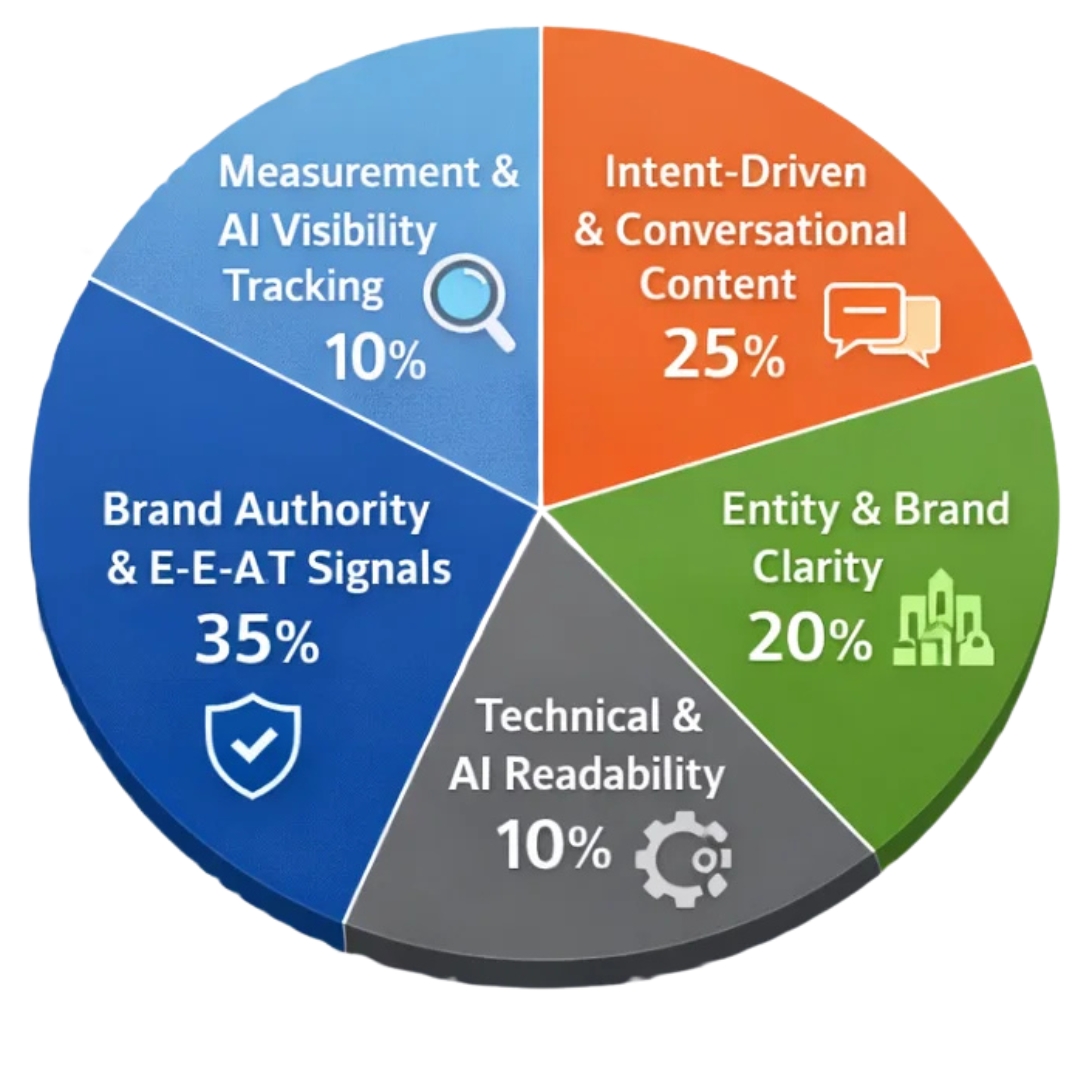
This visual helps readers quickly understand what AI search engines prioritize most when deciding which brands to surface in AI-generated answers, summaries, and voice responses.
Measurement & AI Visibility Tracking – 10%
(Brand mentions, AI citations, conversational presence)
Brand Authority & E-E-A-T Signals – 35%
(Experience, expertise, authority, trust, brand credibility)
Intent-Driven & Conversational Content – 25%
(Natural language, prompt-based answers, real user questions)
Entity & Brand Clarity – 20%
(Clear positioning, consistent messaging, defined expertise)
Technical & AI Readability – 10%
(Structured content, crawlability, entity recognition)
How AI Search Engines Discover, Evaluate, and Rank Brands in 2026?
AI-powered search engines work very differently from traditional search algorithms. Instead of simply matching keywords to web pages, they focus on understanding brands as entities, interpreting context, and predicting which sources are most trustworthy for a specific query.
At a high level, AI search engines start by discovering brand signals across the web. This includes your website, content, author profiles, product pages, knowledge panels, and how consistently your brand appears across multiple platforms. AI systems look for patterns that confirm your brand is real, credible, and active within a specific domain.
Once discovered, AI engines move into evaluation mode. Here, they analyze:
- Whether your content demonstrates real experience and subject-matter expertise
- How often your brand is referenced or implied in relevant contexts
- The consistency of your messaging, positioning, and topical focus
This is where many brands struggle. Even with strong SEO fundamentals, fragmented content or unclear positioning makes it harder for AI systems to confidently “understand” what a brand actually stands for.
Ranking in AI-powered search is not always a visible ranking at all. Often, AI systems select brands to cite, summarize, or recommend directly in answers. This selection is influenced by trust signals, clarity, and relevance, not just page-level optimization.
What we consistently observe at SEO Circular is that AI search engines reward brands that:
- Own a clearly defined niche or problem space
- Publish content that answers real, specific user questions
- Maintain authority signals across multiple digital touchpoints
How to Build Brand Authority for AI Search Algorithms?
Brand authority is one of the strongest visibility drivers in AI-powered search. Unlike traditional SEO, where individual pages could rank in isolation, AI search engines evaluate the overall credibility of a brand before deciding whether to surface it in answers, summaries, or recommendations.
From our experience at SEO Circular, AI systems build authority profiles by observing how consistently a brand demonstrates expertise over time. This includes the depth of knowledge in its content, the clarity of its positioning, and the real-world signals that validate its claims. Brands that publish surface-level or disconnected content often fail to reach this threshold, even if they technically rank well.
Authority in AI search is also cumulative. Each high-quality article, expert insight, case study, or authoritative mention reinforces your brand’s perceived expertise. Over time, this creates a feedback loop, AI engines become more confident in referencing your brand because it repeatedly proves its value in answering complex, intent-driven queries.
Where points are important is understanding what actually strengthens authority in AI search:
- Demonstrating first-hand experience and practical insights, not just theory
- Publishing content that goes beyond keywords and solves real business problems
- Maintaining a focused topical footprint instead of chasing unrelated topics
Another key factor is brand consistency. AI systems struggle with brands that shift messaging, target too many audiences, or lack a clear value proposition. The more consistent your brand voice, expertise, and subject focus, the easier it becomes for AI to recognize and trust your brand.
Enhancing Readability for AI, Relying Entities
AI-powered search engines rely heavily on entities, people, brands, products, services, and concepts they can clearly identify and connect. If your content is not structured in a way that AI systems can easily interpret, your brand becomes harder to reference, even if the information is accurate.
Entity-driven content focuses on clarity over cleverness. Instead of vague language or broad statements, AI search prefers content that clearly defines who you are, what you do, and which problems you solve. At SEO Circular, we see stronger AI visibility when brands explicitly state their expertise, target industries, and solutions rather than assuming the reader, or the algorithm, will infer it.
AI-readable content also means writing in a way that mirrors how users ask questions. AI systems are trained on natural language patterns, so content that explains concepts conversationally while remaining precise performs better across AI summaries and voice-based results.
Points are useful here to highlight what makes content more entity-friendly:
- Clearly reference your brand name, services, and areas of expertise in context
- Use consistent terminology for products, solutions, and core offerings
- Write structured explanations that answer one clear intent at a time
Another often-overlooked factor is contextual depth. AI search engines don’t just look for definitions; they look for relationships between entities. When your content connects your brand to specific industries, use cases, and problems, it strengthens AI understanding.
If your brand cannot be described clearly in one sentence, AI systems will struggle to describe it at all. Start by defining your primary expertise, core audience, and main problem you solve , then reflect that consistently across content.
Optimizing for Conversational & Prompt-Based Search Queries
AI-powered search is driven by how people actually speak and ask questions, not how they type short keywords. Users now interact with search engines using full prompts, follow-up questions, and conversational language. This shift directly impacts how brands appear, or disappear, in AI-generated answers.
At SEO Circular, we see that brands optimized only for traditional keywords struggle to surface in conversational search. AI systems prioritize content that mirrors real user questions, provides direct explanations, and maintains contextual continuity across topics. If your content answers only fragments of a query, AI engines are less likely to select it as a source.
Prompt-based optimization starts with understanding intent depth. Users don’t just want information; they want clarity, recommendations, and reasoning. Content that anticipates follow-up questions and addresses them naturally performs better in AI summaries and voice responses.
Where structure matters most:
- Write content in a question-and-answer flow without forcing FAQs
- Use natural transitions that reflect how a conversation evolves
- Answer “why,” “how,” and “which” within the same narrative
Another critical factor is response readiness. AI search engines often extract short, precise explanations from longer content. Brands that clearly state insights, outcomes, or opinions within their content are more likely to be quoted or summarized by AI systems.
Optimizing for conversational and prompt-based search is not about gaming AI. It’s about aligning your content with how humans think, speak, and decide. Brands that do this well gain visibility at the exact moment users are seeking trusted guidance.
The Role of E-E-A-T in AI Search Visibility
E-E-A-T, Experience, Expertise, Authority, and Trust, has become a foundational signal for AI-powered search engines. As AI systems generate direct answers and recommendations, they must rely on sources they believe are credible, accurate, and safe to reference. This is where E-E-A-T directly impacts brand visibility.
AI search engines evaluate experience by looking for signs that content is informed by real-world use, not just theory. Brands that share practical insights, original observations, and clear outcomes stand out because AI systems are trained to identify depth and authenticity. Expertise is reinforced when content demonstrates subject mastery consistently across multiple related topics.
Authority is built over time. AI engines observe how often a brand appears in relevant contexts, how clearly it owns a niche, and whether its content aligns with established industry knowledge. Trust, however, is the deciding factor. Inconsistent messaging, exaggerated claims, or thin content reduce the likelihood of being surfaced in AI-generated answers.
Where clarity matters most:
- Clearly communicate who is creating the content and why they are qualified
- Support claims with context, data, or real experience
- Maintain consistency across brand messaging and expertise areas
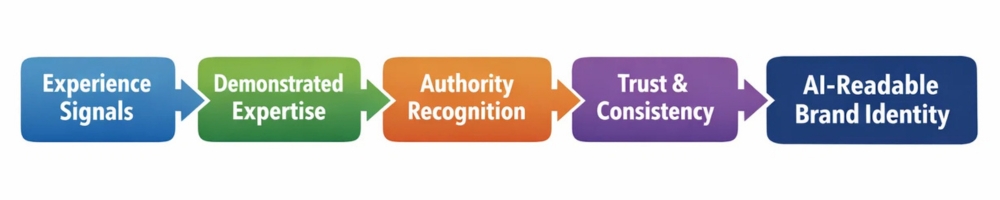
E-E-A-T Framework for AI Search Visibility
The E-E-A-T framework (Experience, Expertise, Authority, Trust) determines whether a brand is reliable enough to be cited, summarized, or recommended by AI systems.
Voice Search and Multimodal Optimization for AI Discovery
Voice search and multimodal search are expanding how users interact with AI-powered search engines. People now search using voice assistants, images, and even combined inputs like voice plus screen. This changes how brands need to think about visibility. AI systems must be able to understand, interpret, and respond with your brand in real time.
Voice-driven queries are typically longer, more conversational, and intent-rich. Users ask complete questions and expect immediate, accurate responses. Brands that rely on short, keyword-heavy content often miss these opportunities because AI prefers clear, spoken-language explanations.
Multimodal search adds another layer. AI engines connect text, visuals, context, and intent to deliver answers. If your brand messaging is inconsistent across formats, AI systems struggle to confidently surface your content.
What matters most here is clarity and context, not complexity. Your brand needs to explain ideas in a way that works whether the response is spoken aloud, summarized on-screen, or combined with visual elements.
Measuring Brand Visibility in AI Search Ecosystems
Measuring visibility in AI-powered search requires a different mindset than traditional SEO. Rankings and clicks still matter, but they no longer tell the full story. AI search engines often surface brands directly within answers, summaries, and voice responses, without sending users to a website.
At SEO Circular, we focus on understanding where and how a brand appears, not just whether a page ranks. Visibility now includes being referenced, cited, or implied as a trusted source within AI-generated responses. This is especially important for B2B and enterprise brands, where early-stage discovery often happens inside AI summaries.
The most reliable signals of AI search visibility include brand mentions across AI answers, consistency of brand presence for high-intent queries, and repeated inclusion in conversational or follow-up prompts. These indicators show whether AI systems recognize your brand as an authority within a topic.
Measurement also involves trend analysis. Over time, brands that invest in AI-ready strategies see stronger recall, more frequent inclusion, and broader topical coverage across AI search experiences.
Without this expanded measurement approach, brands risk missing critical visibility gains, or losses, happening beyond traditional search results.
How SEO Circular Helps Brands Win Visibility in AI-Powered Search?
| Strategic Area | What We Do at SEO Circular | Impact on AI Search Visibility |
|---|---|---|
| Unified AI-Ready Growth Framework | Align SEO strategy, content, and brand authority into one integrated approach designed specifically for AI-powered search behavior. | Ensures AI systems clearly understand your brand instead of seeing disconnected SEO signals. |
| AI Visibility & Brand Interpretation Analysis | Analyze how AI engines currently interpret, reference, and recall your brand across AI summaries and conversational results. | Identifies visibility gaps and improves how often your brand is surfaced in AI-generated answers. |
| Clear Positioning for AI Understanding | Refine brand messaging, value proposition, and expertise signals for AI clarity and trust. | Makes it easier for AI systems to explain, recommend, and cite your brand accurately. |
| AI-Readable, Intent-Driven Content Ecosystems | Build content around real user problems, use cases, and decision moments beyond keyword optimization. | Increases selection probability in AI summaries, voice responses, and prompt-based queries. |
| Scalable Authority & E-E-A-T Strengthening | Strengthen experience, expertise, authority, and trust through expert-led content and consistent brand signals. | Builds long-term credibility that AI systems rely on when choosing sources. |
| Sustained Visibility Beyond Rankings | Focus on brand presence within AI answers, conversational flows, and voice search, not just SERP positions. | Delivers long-term discovery, recall, and demand generation across AI search ecosystems. |
Final Thoughts: Preparing Your Brand for the Future Search
AI-powered search has redefined how brands are discovered, evaluated, and trusted. Visibility is no longer driven by rankings alone, but by how clearly AI systems understand and reference your brand at critical decision moments. For B2B and enterprise businesses, this makes AI-ready visibility a growth priority, not a future consideration.
Traditional SEO still matters, but it must evolve into a strategy built on authority, clarity, and trust. Brands that adapt early gain lasting visibility across AI-generated answers and conversational search. At SEO Circular, we help businesses navigate this shift by aligning SEO, content, and brand authority into strategies designed for how AI search works today, and where it’s heading next.
FAQs
Traditional SEO prioritizes rankings and keywords, while AI search prioritizes brand understanding and trust. Even well-ranked pages may not appear in AI-generated answers if the brand lacks authority or clarity.
Yes, but keywords alone are not enough. AI search relies more on conversational language, intent depth, and entity-based content that clearly explains who you are and what expertise you offer.
AI visibility builds over time. Brands typically see early signals within a few months, but consistent authority and recognition develop through sustained content, expertise, and trust-building efforts.
Absolutely. AI search favors clarity and expertise over brand size. Focused positioning, high-quality content, and consistent messaging can help smaller brands gain visibility faster than in traditional search.
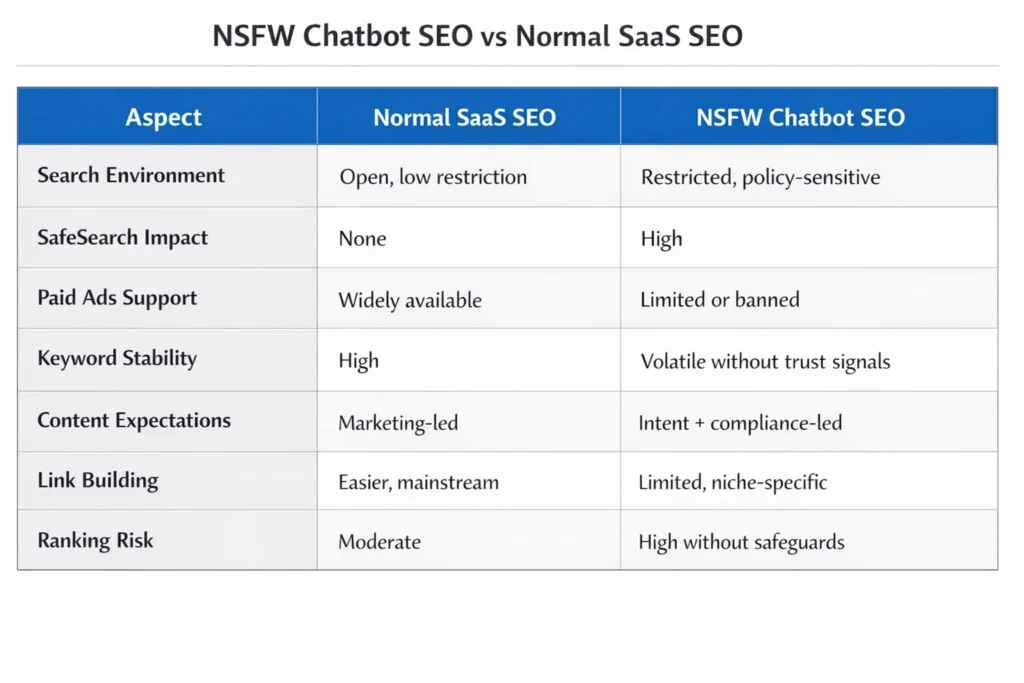
SEO for NSFW chatbots is fundamentally different from SEO for SaaS tools, blogs, or standard AI products. We are not operating in a neutral search environment. We are working inside a restricted, high-risk category where Google applies tighter quality checks, algorithmic filters, and manual scrutiny.
Most NSFW chatbot platforms sit at the intersection of adult content, AI-generated experiences, and sensitive user intent. That combination changes how search engines treat your website.
In practical terms, this means visibility is limited in ways many founders don’t anticipate. Pages are often filtered by SafeSearch. Paid ads are restricted or completely unavailable. Even well-researched keywords can be partially suppressed. In this space, authority and trust matter far more than publishing volume or chasing trends.
Despite these limitations, search demand is rising quickly.
The global AI chatbot market is projected to cross $27 billion by 2030, and adult or NSFW AI tools are becoming a visible segment of that growth. Users are actively searching for solutions using direct, intent-heavy terms such as NSFW AI chatbot, adult AI chat app, uncensored AI chatbot, and NSFW chatbot online. These are not casual searches. They reflect real demand and real usage intent.
This creates a genuine SEO opportunity.
But here is the reality we see repeatedly when NSFW chatbot platforms approach us. Without a focused and compliant SEO strategy, most sites fall into one of three patterns. They struggle to get indexed properly. They gain rankings briefly and lose them after core updates. Or they remain permanently stuck on page two or beyond, despite consistent content efforts.
At SEO Circular, we approach NSFW chatbot SEO as a technical, intent-driven, and trust-focused discipline, not a keyword placement exercise. In this guide, we break down what actually works in 2026 if your goal is to rank on Google and other search engines without triggering penalties or long-term visibility loss.
Key Takeaways
- Understand Search Behavior: Users search with intent—discovery, comparison, access, and privacy. Align your pages accordingly.
- Keyword Strategy Matters: Short-tail, long-tail, and exact-match keywords all play roles, but long-tail and problem-based keywords convert better.
- Technical SEO is Critical: Proper crawl control, rendering, site speed, and security are non-negotiable for indexing and ranking.
- Content Must Be Helpful and Compliant: Avoid thin AI content or sensational claims. Build content that educates, informs, and converts.
- International SEO Requires Care: Localized content, hreflang tags, and compliance with regional restrictions stabilize global visibility.
- Trust and Privacy Influence Rankings: Clearly communicate safety, privacy, and usage policies to reduce bounce rates and increase engagement.
- Sustainable Approach Wins: Avoid spammy links or shortcuts. Focus on authority, intent alignment, and long-term SEO health.
Need Help Ranking an NSFW Chatbot Safely?
At SEO Circular, we specialize in SEO for restricted and high-risk niches, including adult AI and NSFW chatbot platforms. We focus on stable indexing, intent-driven traffic, and long-term rankings — not shortcuts that disappear after the next update.
Talk to Our SEO Team and Get a Strategy Built for Visibility, Compliance, and Growth.
How People Search for NSFW Chatbots on Google in 2026
People searching for NSFW chatbots in 2026 are not browsing casually. In most cases, they already know what they want and are trying to find a platform that feels accessible, private, and reliable.
Unlike mainstream SaaS searches, NSFW chatbot queries are usually direct and descriptive. Users do not overthink phrasing. They type exactly what they are looking for, often in the simplest possible way.
For example, broad discovery searches still exist. Queries like nsfw chatbot, nsfw ai chatbot, or adult ai chatbot are common entry points. These terms indicate early-stage intent, where users are exploring what tools are available or comparing options at a high level.
As users move deeper into the funnel, searches become more specific. Many queries include modifiers that signal a concern or requirement rather than curiosity. Privacy is a major driver. So is freedom from filters. Access without friction is another recurring theme.
You see this reflected in searches such as anonymous nsfw ai chat, nsfw chatbot without login, uncensored ai chatbot, or private adult ai chatbot website. These are not informational searches. They are access-driven and action-oriented.
Another important shift in 2026 is how people adapt their searches based on restrictions. When users struggle to find results on Google due to SafeSearch or regional filters, they modify behavior. Add terms like safe, private, or online. They switch to Bing or DuckDuckGo. Search through Reddit threads, AI tool directories, or community recommendations before returning to search engines.
This behavior matters because it changes how pages should be structured. One generic landing page cannot satisfy all these intents. A page built for discovery will not convert access-driven users, and an access page without context often fails to rank.
Core SEO Challenges for NSFW & Adult AI Chatbot Platforms
Most NSFW chatbot platforms don’t fail at SEO because demand is low. They fail because the rules of visibility are different, and those rules are rarely explained clearly.
One of the biggest challenges is search suppression, not outright penalties. NSFW chatbot pages may be indexed, but their visibility is limited by SafeSearch, user account settings, and regional policies. This creates a situation where rankings look unstable, impressions fluctuate, and traffic never reaches its true potential.
Another common issue is how these platforms are built.
Many NSFW chatbots rely on JavaScript-heavy interfaces, dynamic URLs, and user-generated conversations. From a product standpoint, this makes sense. From a search engine perspective, it creates confusion. Google struggles to understand which pages represent value, which pages are duplicate, and which pages should never be indexed at all. As a result, crawl budget is wasted and important pages are ignored.
Content is another weak point.
Because these platforms are AI-driven, there is a temptation to scale AI-generated text aggressively. In adult niches, this backfires. Thin pages, repetitive descriptions, and auto-generated content without human oversight tend to lose trust quickly. Rankings may appear briefly and then disappear after updates.
Authority is harder to build as well.
Mainstream publishers, SaaS blogs, and high-authority websites rarely link to NSFW projects. This limits backlink opportunities and often pushes site owners toward risky link sources. Without a controlled strategy, link profiles become unnatural, which increases long-term SEO risk.
Finally, trust is not optional in this niche.
Users want to know how their data is handled, whether usage is anonymous, and whether the platform is safe. When this information is unclear or hidden, engagement drops. High bounce rates and low dwell time send negative signals back to search engines, even if the content itself is technically sound.
At SEO Circular, we plan around these constraints instead of fighting them. Every technical decision, content structure, and keyword target is designed to reduce risk while improving clarity, stability, and trust.
Keyword Research for NSFW Chatbots: Short-Tail, Long-Tail & Intent-Driven Queries
Keyword research for NSFW chatbots cannot be approached like normal SEO projects. High volume alone is not a signal of opportunity here. In many cases, the highest-volume keywords are also the most filtered, the most unstable, and the hardest to hold long-term.
We start by understanding why a user is searching, not just what they typed.
Some searches are broad and exploratory. Terms like nsfw chatbot, nsfw ai chatbot, or adult ai chatbot usually come from users who are discovering the space. These keywords are important for brand visibility, but they are competitive and often partially suppressed. We treat them as authority targets, not quick-win keywords.
The real performance comes from long-tail and requirement-based searches.
Users looking for NSFW chatbots often include constraints directly in their queries. They mention privacy, access, or limitations they want to avoid. Searches such as nsfw chatbot without login, anonymous nsfw ai chat, or uncensored ai chatbot reveal very clear intent. These users are not researching; they are trying to use something.
There is also a third layer that many platforms miss: problem-driven searches.
Instead of naming a product, users describe a frustration. Queries like ai chatbot with no filters, adult ai chatbot that remembers conversations, or nsfw ai that is safe to use fall into this category. These keywords may not show massive volume in tools, but they convert extremely well and face less competition.
At SEO Circular, we group NSFW chatbot keywords into:
- Discovery keywords for visibility and education
- Access keywords for usage and conversions
- Problem-solution keywords for high-intent traffic
Each group is mapped to a different page type. We avoid forcing all keywords onto one landing page because that dilutes relevance and weakens rankings.
In restricted niches, keyword research is less about scale and more about precision. When intent, content, and page purpose align, rankings become far more stable.
Search Intent Mapping for Adult AI & NSFW Chatbot Pages
Once keywords are identified, the real work begins. Ranking NSFW chatbots is not about placing keywords into content. It is about matching the page to the mindset of the searcher.
In adult and NSFW AI niches, intent mismatches are one of the fastest ways to lose rankings.
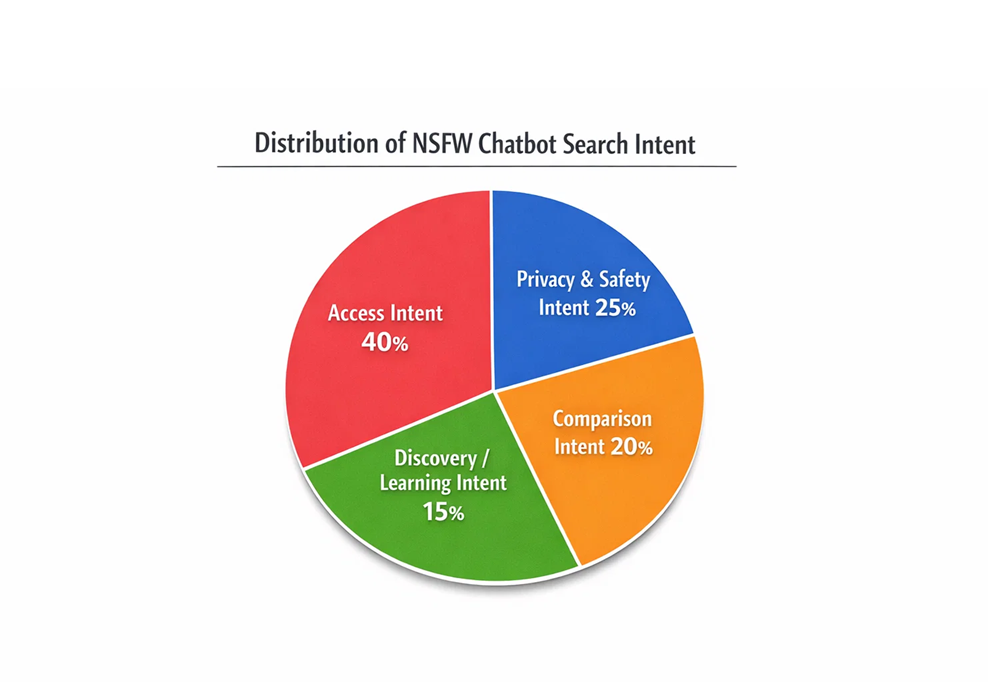
Some users are still learning. They are trying to understand what an NSFW chatbot is, how it works, or whether it is even legal to use. These searches require explanatory content, not sales-driven pages. When discovery-focused users land on a hard product pitch, they leave quickly, and that behavior hurts performance.
Other users are comparing options. They search for the best nsfw ai chatbot or alternatives to a tool they already know. These users want clarity. They want features, limitations, and use cases explained honestly. Overpromising or hiding restrictions usually leads to distrust.
Then there are users with access intent. These searches are the most direct. They include phrases like online, free, without login, or uncensored. When these users land on slow pages, gated flows, or vague descriptions, they abandon instantly.
There is also a fourth intent that is especially important for NSFW chatbots: privacy and safety.
Many users are not just looking for functionality. They want reassurance. Searches that include words like anonymous, private, or safe are signals that trust matters as much as features. Pages targeting this intent need transparency, not fluff.
At SEO Circular, we assign one dominant intent per page. We do not blend education, comparison, and access into a single URL. This makes the page clearer for users and easier for search engines to classify.
When intent mapping is done correctly, engagement improves naturally. Users stay longer, bounce less, and interact more. Over time, these behavioral signals reinforce rankings, even in restricted categories.
Keyword Intent Mapping for NSFW Chatbots
| Search Intent | Example Keywords | Best Page Type |
| Discovery | nsfw chatbot, adult ai chatbot | Educatioal blog |
| Comparison | best nsfw ai chatbot, alternatives | Comparison page |
| Access | nsfw chatbot online, without login | Core landing page |
| Privacy | anonymous nsfw ai chat, private ai chatbot | Trust / privacy-focused page |
Technical SEO Strategies That Keep NSFW Chatbots Indexed
In NSFW chatbot SEO, technical decisions often matter more than content itself. Many platforms publish good content but remain invisible because search engines struggle to crawl, render, or trust the site.
One of the first problems we see is uncontrolled URL generation.
Chatbots naturally create thousands of variations through sessions, parameters, and user interactions. If search engines are allowed to crawl all of these, crawl budget is wasted and important pages get ignored. The solution is not aggressive blocking, but selective control. Search engines should clearly understand which pages represent core value and which pages exist only for users.
Rendering is another major issue.
Most NSFW chatbots rely on JavaScript frameworks that load content dynamically. While modern search engines can process JavaScript, they still prefer clarity. When headings, descriptions, and core content are missing from the initial HTML, rankings suffer. We usually solve this by separating SEO-facing pages from the chat interface itself, allowing search engines to understand the product without needing to interact with it.
Performance also plays a larger role than many expect.
Users often access NSFW chatbot platforms in private browsing modes or on mobile devices. Slow load times, unstable layouts, or intrusive elements cause immediate exits. These behavioral signals compound visibility problems in an already sensitive niche.
Structured data requires restraint.
While schema can help clarify what a platform does, aggressive or misleading markup increases the chance of manual review. We apply structured data only where it improves understanding, not where it inflates claims.
Security is non-negotiable.
NSFW platforms are frequent targets for spam injections, malicious redirects, and negative SEO. A single security issue can remove a site from search results entirely. Clean hosting, HTTPS, and monitoring are foundational, not optional.
At SEO Circular, we treat technical SEO for NSFW chatbots as risk management. The goal is not to push boundaries, but to create an environment where search engines can index and rank the platform with confidence.
International SEO for NSFW Chatbot Platforms
NSFW chatbots attract users from all over the world, but search visibility does not behave the same way in every country. Regulations, cultural norms, and search engine enforcement vary widely, and ignoring these differences often leads to unstable rankings or complete suppression in certain regions.
The first step in international SEO for NSFW chatbots is market selection, not translation.
Some regions apply stricter filtering to adult AI content, even when SafeSearch is disabled. Others show more tolerance and consistent indexing. We analyze search behavior, visibility patterns, and competitor performance before expanding into a new market. This prevents wasted effort on regions where organic visibility is realistically limited.
Language targeting needs more than copied content.
Directly translating English pages into multiple languages usually creates duplicate intent without local relevance. Users in different regions search differently, even when they want the same thing. Keyword structure, modifiers, and expectations change by language. Without localized intent mapping, international pages fail to rank or cannibalize each other.
Compliance signals also play a role internationally.
Clear age disclaimers, privacy explanations, and usage boundaries are interpreted differently across regions. Search engines look for signals that the platform understands its audience and responsibilities. Localized legal and trust messaging helps reduce friction and improves stability.
Search engine diversity matters more outside the US.
In some countries, Bing, DuckDuckGo, or privacy-focused search engines drive a meaningful share of NSFW chatbot traffic. Optimizing only for Google creates unnecessary dependency. A multi-engine approach spreads risk and stabilizes growth.
At SEO Circular, international SEO for NSFW chatbots is built around control, clarity, and sustainability. The goal is not to rank everywhere at once, but to expand deliberately into markets where long-term visibility is achievable.
Conclusion
SEO for NSFW chatbots is challenging but entirely achievable with the right strategy. Success depends on intent-driven content, technical precision, and trust-building measures. Generic SEO tactics rarely work because search engines apply stricter rules to adult AI platforms, SafeSearch limits visibility, and users have unique expectations around privacy and access.
At SEO Circular, we focus on creating stable, scalable SEO strategies that align with user intent, comply with policies, and prioritize long-term growth over short-term hacks. By combining keyword research, structured content, technical safeguards, and international optimization, NSFW chatbot platforms can achieve sustainable visibility, higher engagement, and more conversions.
FAQs: SEO for NSFW Chatbots
Yes, but visibility will always be influenced by SafeSearch settings and region. The goal is not to bypass SafeSearch, but to structure content, intent, and technical SEO in a way that allows consistent indexing and exposure to users who actively search for NSFW chatbot solutions.
Yes. Separating pages by intent (education, comparison, access, privacy) improves relevance and engagement. One generic page rarely ranks well or converts in this niche.
Absolutely. For most NSFW chatbot platforms, SEO is the most reliable and scalable acquisition channel. Organic traffic compounds over time, while paid options remain limited or unavailable.
Treating NSFW SEO like normal SaaS SEO. Overusing AI content, ignoring crawl control, and mixing multiple intents on one page usually lead to unstable rankings and suppressed visibility.
SEO timelines vary, but most NSFW chatbot platforms start seeing measurable visibility within 3 to 6 months. Competitive keywords and international expansion usually take longer due to stricter filtering and authority requirements.
Promoting NSFW tools online offers strong revenue potential but comes with unique marketing challenges. Strict platform policies, higher payment processing fees, and advertising restrictions make traditional growth strategies difficult. Still, NSFW SaaS products, AI tools, creator platforms, and adult-tech businesses continue to scale by using compliant, data-driven digital marketing.
This guide explains how to promote NSFW tools online using a conversion-focused and policy-safe strategy built for long-term growth.
The global adult and NSFW technology market is projected to exceed $60 billion, with AI-powered tools driving much of this expansion. Studies also show that over 70% of users discover NSFW tools through organic search, and many adult SaaS brands see 30–50% higher conversions from SEO traffic compared to paid ads. These trends make SEO and trust-led content essential for safe, scalable growth in restricted industries.
Key Takeaways
- Promoting NSFW tools online requires a compliance-first, trust-led strategy
- SEO is the most reliable and scalable channel for NSFW and restricted products
- Educational content builds credibility and drives qualified traffic
- Programmatic SEO enables safe expansion across niches and regions
- Community, influencer, and PR strategies support long-term visibility
- Conversion optimization turns traffic into revenue
- Privacy-first analytics ensure compliance and sustainable growth
What Are NSFW Tools?
NSFW tools include software, platforms, or digital products that create, enhance, distribute, or manage adult or sensitive content. These often include:
- AI image and video generation tools
- Adult content creation platforms
- Dating and intimacy apps
- Chatbots and conversational AI
- Content moderation or filtering tools
- Creator monetization platforms
These devices cater solely to the B2B channel in these advanced, regulated digital systems, involving late-stage marketing inputs.
Why NSFW Marketing Requires a Different Strategy?
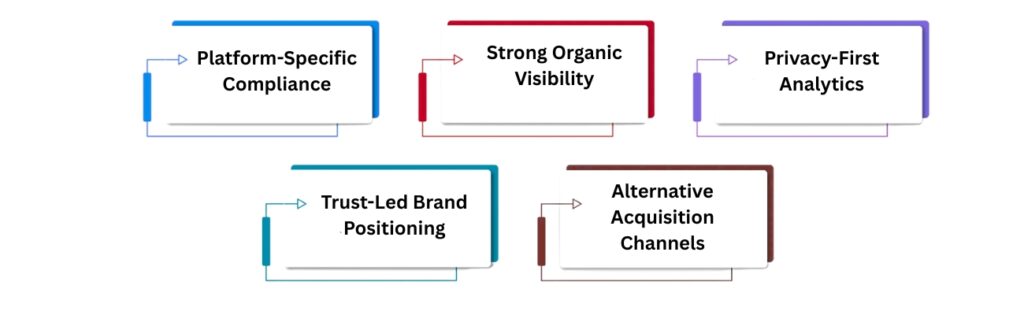
The marketing of the NSFW (Not Safe for Work) industry necessitates a unique practice different from the usual SaaS methods. The main elements that determine success in this sector are:
Platform-Specific Compliance
Promotional efforts must be compliant with the authorities and regulations of the various platforms in order to avoid limitations or fines.
Strong Organic Visibility
To effectively and efficiently penetrate the target audience without heavily relying on paid pushes, it is crucial to have a strong organic presence.
Privacy-First Analytics
Prioritizing user privacy when gathering and processing data is crucial for maintaining user confidence and adhering to privacy regulations.
Trust-Led Brand Positioning
Establishing a brand that emphasizes trust and credibility can significantly impact customer loyalty and engagement in the NSFW market.
Alternative Acquisition Channels
Unorthodox methods for attracting customers can sometimes be new growth avenues that are usually neglected by conventional marketing.
Here at SEO Circular, we consider NSFW tools as enterprise-level consumables needing sophisticated tactics, not just looking for easy ways or taking advantage of gaps.
SEO: The Most Important Channel for NSFW Tools
Why SEO Works Best for NSFW Tools
SEO delivers the most reliable and scalable growth for NSFW tools. Paid advertising platforms restrict or block adult-related products, which limits reach and increases acquisition costs. SEO removes this dependency and connects your product with users who already show strong intent.
When users search for NSFW tools, they actively look for a solution. This intent leads to higher conversion rates and stronger lifetime value.
SEO helps NSFW businesses achieve:
- Consistent, high-intent organic traffic
- Lower customer acquisition costs (CAC)
- Long-term search visibility
- Strong brand trust and topical authority
For most NSFW brands, SEO becomes the primary revenue-driving channel because it delivers qualified traffic without ongoing ad spend risk.
Keyword Research for NSFW SEO
To conduct keyword research for NSFW tools, it is imperative to have a professional, compliant, and intent-driven strategy. The aim remains to lure potential buyers without violating any search engine and platform regulations.
Best practices include:
- Target long-tail keywords that show buying intent.
- Highlight product features, use cases, and business benefits.
- Avoid unsafe or inappropriate terms.
- Check competitor keywords to find ranking opportunities.
Safe keyword examples include:
- “AI content creation tool for adults”
- “secure NSFW chatbot software”
- “creator monetization platform”
SEO Circular leverages Artificial Intelligence in certain categories of keyword-oriented investigation to come up with those attributes, which hold warrants high-ranking while inbound conversion, while matching the guidelines.
On-Page SEO for NSFW Websites
On-page SEO guarantees that search engines will easily recognize the content and its significance. It also enhances the user’s experience and the potential for conversion.
Key on-page optimization areas include:
- Clearly defined H1, H2, and H3 content hierarchy structure
- Simple, formal, and business-oriented language
- Improved meta descriptions and title tags
- Internal links between sites that are strategically placed
- URLs that are clear, understandable, and optimized for keywords
Avoid explicit visuals or language on public-facing pages. Keep all content informative, solution-oriented, and aligned with a B2B audience.
Technical SEO for NSFW Platforms
Technical SEO shields the rankings, enhances the performance, and it also supports the long-term scalability. The NSFW sites must be very secure and at the same time accessible.
Core technical SEO priorities include:
- Fast page load speed
- Mobile-first and responsive design
- Secure HTTPS implementation
- Proper indexing and crawl control
- Clean and scalable site architecture
SEO Circular builds fast, secure, and SEO-friendly websites specifically designed for NSFW and restricted-category businesses, ensuring compliance, performance, and sustainable growth.
Content Marketing That Builds Trust
Why Educational Content Works Best
NSFW tools, on the other hand, the educational content gives the brand credibility and sales, too. Not relying on shock value, brands are able to make it with the help of expert and informative content. Search engines also give priority to content that is good for users, increases trust, and shows expertise.
High-performing content types include:
- How-to guides
- Product comparisons
- Industry trend analyses
- Compliance and safety guides
- Feature explainers
Educational content positions NSFW tools as legitimate business solutions, helping brands attract serious users and decision-makers.
Blogging Strategy for NSFW Tools
An effective blog strategy focuses on clarity, intent, and relevance. Key elements include:
- Targeting one primary keyword per article
- Using simple, professional language
- Explaining user problems and solutions clearly
- Including internal links to product pages for conversion
SEO Circular creates SEO-optimized blogs that drive qualified traffic, educate audiences, and convert readers into leads or paying users.
Programmatic SEO for Scale
NSFW tools often serve multiple niches, regions, or use cases. Programmatic SEO enables large-scale content creation, targeting hundreds of landing pages safely.
Benefits include:
- Faster traffic growth
- Broader keyword coverage
- Increased visibility in niche searches
SEO Circular implements enterprise-level programmatic SEO systems that remain compliant, safe, and performance-focused.
Social Media and Influencer Marketing for NSFW Tools
Best Social Platforms for NSFW Brands
Not all social platforms are suitable for NSFW tools. Effective channels include:
- Twitter (X): Engages creators and facilitates discussions
- Reddit: Targets niche communities and forums
- Telegram & Discord: Builds private, loyal user groups
- LinkedIn: Positions your tool professionally for B2B audiences
Each platform requires a policy-aware content strategy to ensure safety and reach.
How to Stay Safe on Social Media
To maintain consistent visibility without risking bans:
- Use neutral, professional language
- Avoid explicit visuals or language
- Focus on features, benefits, and technology
- Direct traffic to age-gated or verified pages
SEO Circular ensures NSFW brands maintain compliance while building engagement.
Community Marketing for Growth
Private communities accelerate growth by:
- Educating users
- Collecting feedback
- Increasing retention
- Building brand loyalty
Community-led strategies reduce dependency on paid advertising while creating long-term engagement.
Influencer Marketing for NSFW Tools
Influencers already hold trust in NSFW niches, helping brands gain:
- Brand awareness
- Faster product adoption
- Enhanced credibility
Key practices include:
- Choosing influencers with relevant audiences and strong engagement
- Prioritizing content quality and compliance over follower count
- Running campaigns with clear guidelines, disclosures, and performance tracking
SEO Circular manages influencer outreach, compliance, and analytics to ensure measurable ROI and safe, effective promotions.
Paid Advertising, PR, CRO, and Analytics for NSFW Tools
Understanding Paid Ad Limits
Mainstream ad platforms restrict NSFW content, but paid growth remains possible through alternative channels. Safe options include:
- Native ad networks
- Adult-friendly advertising platforms
- Sponsored content placements
- Search ads using allowed, compliant keywords
- Smart PPC Strategy
Effective PPC campaigns target high-intent users while staying compliant. Focus areas include:
- Brand and feature-based keywords
- Clean, professional landing pages
- Accurate conversion tracking
- Continuous A/B testing
SEO Circular manages policy-safe PPC campaigns that prioritize quality leads and measurable ROI.
Digital PR and Brand Authority
PR strengthens visibility, credibility, and SEO rankings for NSFW tools. Effective strategies include:
- Thought leadership articles
- Industry insights and data-driven reports
- Product announcements and launches
By focusing on professional, credible placements, SEO Circular helps NSFW brands build authority without sensationalism.
Conversion Rate Optimization (CRO)
Traffic alone does not guarantee revenue. CRO converts visitors into sign-ups, trial users, and paying customers. Best practices include:
- Clear value messaging and benefits
- Strong, visible CTAs
- Privacy and security signals
- Simplified onboarding
SEO Circular integrates SEO and CRO, ensuring every visitor contributes to revenue growth.
Analytics and Privacy Compliance
NSFW tools must comply with global privacy regulations. Use:
- Consent-based tracking
- Server-side analytics
- Secure data handling
We implement privacy-first analytics systems that provide actionable insights while protecting user data and maintaining regulatory compliance.
This combined approach ensures safe, measurable, and scalable growth for NSFW businesses.
Advanced Tips for Promoting NSFW Tools Online
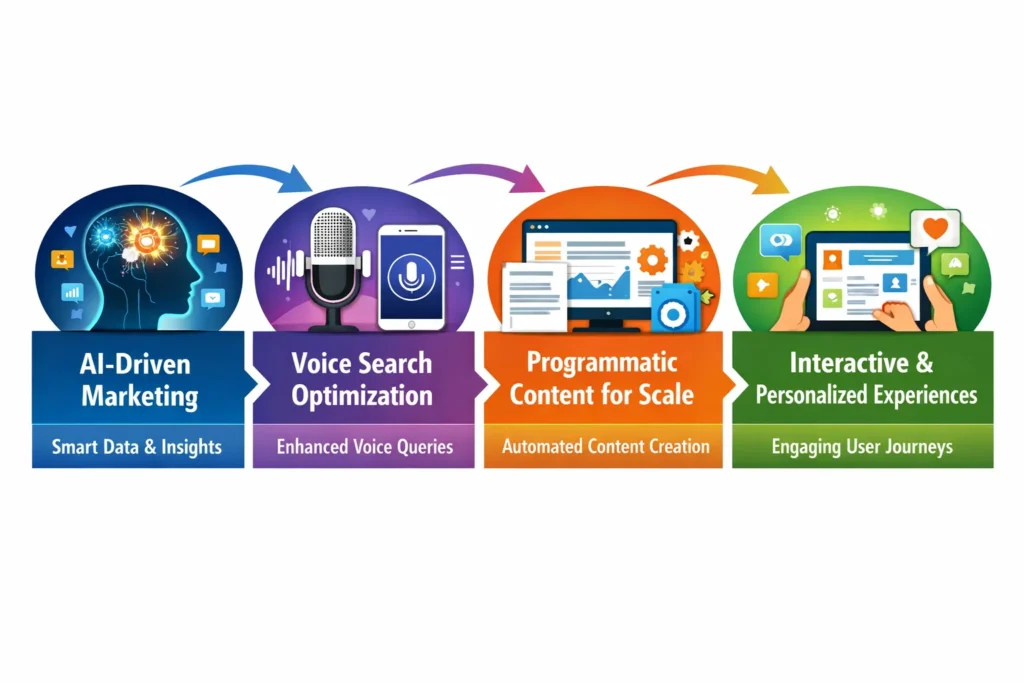
As the NSFW tools market evolves, staying ahead of digital marketing trends can give your brand a competitive edge. Advanced strategies help increase visibility, engagement, and conversions while maintaining compliance.
1. AI-Driven Marketing
AI tools can optimize campaigns, personalize user experiences, and improve content creation. For NSFW tools, AI can:
- Generate compliant, engaging content faster
- Analyze user behavior to target high-intent audiences
- Predict trends and optimize marketing spend
- Enhance email, chat, and in-app engagement
Leveraging AI ensures your marketing is data-driven, scalable, and highly efficient, even in restricted industries.
2. Voice Search Optimization
Voice search is becoming more prevalent, even in professional and niche markets. Optimizing your NSFW tool content for voice search can:
- Capture long-tail, conversational queries
- Improve local and global visibility
- Enhance mobile search performance
Focus on natural language keywords and concise, informative answers to rank for voice queries.
3. Programmatic Content for Scale
NSFW tools often target multiple niches, geographies, or use cases. Programmatic content allows brands to:
- Generate hundreds of landing pages efficiently
- Target intent-specific keywords
- Increase visibility in niche search results
SEO Circular implements enterprise-level programmatic SEO systems that scale content safely, improve rankings, and drive qualified traffic.
4. Interactive and Personalized Experiences
Engaging users through interactive and personalized content boosts conversions and retention for NSFW tools. Strategies include:
- Personalized product recommendations based on user behavior
- Interactive demos or calculators showcasing tool benefits
- Quizzes or surveys to guide users to the right solution
- Dynamic landing pages tailored to user segments
Common Mistakes to Avoid When Promoting NSFW Tools
Online promotion of NSFW tools tries to take a shortcut and, by doing so, creates common mistakes which, in turn, stop the flow of potential users, reduce conversion rates, or even cause the business to get into compliance trouble. The process of identifying and correcting these mistakes is necessary to gain safer and long-term marketing success.
1. Using Explicit Language in SEO
The use of explicit or provocative words can not only lower the position in the search results but also attract penalties and decrease the company’s trustworthiness. It is best to use a jargon-free, compliant language that conveys the tool’s features and benefits to the decision makers clearly.
2. Depending Only on Paid Ads
There is a danger in using paid campaigns as the only method of marketing because of the strictness of the rules concerning the ads and the possibility of account closure. However, you can create a steady, long-term traffic source by blending SEO, content marketing, social media, and community building.
3. Ignoring Compliance Rules
Violation of platform rules, privacy laws, or advertising regulations can result in the suspension of accounts, imposition of legal fines, or loss of reputation. To avoid these consequences, always adhere to the rules and industry practices that are the best ones.
4. Targeting Low-Quality Traffic
Infiltration of unfit or non-related users makes numbers look good, but does not result in important conversions. Concentrate on the audience with the highest intent that is likely to sign up, engage, or become a customer for a better return on investment (ROI).
5. Weak Website Trust Signals
Lack of security, professional design, and clear messaging reduces conversions. Include HTTPS, privacy assurances, testimonials, and transparent product information to build credibility.
The Future of Promoting NSFW Tools Online
The NSFW and adult-tech market is evolving rapidly due to changes in technology, regulations, and consumer behavior. Brands that adapt early will gain a strong competitive advantage.
| Future Trend | Impact on NSFW Tools | Strategic Opportunity |
|---|---|---|
| AI-Driven SEO & Content | Faster content production with compliance safeguards | Scale educational content and product pages safely |
| Privacy-First Analytics | Reduced reliance on third-party cookies | Build trust while gaining actionable insights |
| Voice & Conversational Search | Increase in long-tail, intent-based queries | Optimize content for natural, question-based searches |
| Programmatic SEO | Expansion across niches and global markets | Create scalable landing pages without policy risks |
| Creator Economy Growth | More creators monetizing niche audiences | Position tools as business solutions for creators |
| Community-Based Marketing | Stronger user retention and engagement | Build private, loyal user ecosystems |
| Regulation-Aware Marketing | Stricter content and ad policies | Gain advantage by staying compliant early |
How SEO Circular Helps NSFW Tools Grow?
Established in 2022, SEO Circular is a complete-service digital marketing and enterprise SEO agency that concentrates on NSFW and restricted-category businesses. We assist brands in their development, safely attract high-intent traffic, and convert the most through data-driven, compliant approaches.
Our services include:
- Enterprise SEO and content marketing to boost organic visibility
- Programmatic SEO for large-scale landing page creation
- Paid media and PPC with policy-safe campaigns
- Influencer marketing to build trust and awareness
- Digital PR for authority and backlinks
- Conversion-focused web design and development for secure, high-performing websites
With 500+ clients across 10+ countries, SEO Circular acts as a strategic growth partner, aligning digital initiatives with business goals for measurable, sustainable results.
Conclusion
Online promotion of NSFW tools demands a well-planned strategy, which would primarily focus on SEO, educational materials, and trust-building. Companies that successfully connect with the high-intent audience, plus, of course, compliance with the platform, can enjoy the advantages of long-term growth and a professional user experience.
If you are an NSFW tool aiming at safe and scalable growth, SEO Circular is there to provide you with the expert knowledge, systems, and implementation, which are essential for making your company more visible, leading it to measurable results, and thereby, establishing your brand as a market leader in a very competitive and restricted industry.
FAQs
Yes, promoting NSFW tools is legal in most regions if the business follows platform policies, privacy laws, and local regulations. Marketing efforts must remain compliant and avoid prohibited or misleading claims.
Most NSFW platforms see meaningful SEO traction within 3–6 months, depending on competition, content quality, and technical optimization.
Yes, when done correctly. Working with niche-relevant influencers, setting clear content guidelines, and maintaining transparency helps ensure compliance and measurable ROI.
Trust affects conversions, user retention, and platform longevity. Secure websites, transparent messaging, privacy signals, and professional content are critical in restricted industries.
Emotional intelligence in branding helps companies understand how customers feel, think, and respond to every touchpoint. In today’s competitive B2B market, businesses cannot win only with features and pricing. They must build trust and create a real emotional connection with their audience. Studies show that over 70% of B2B buying decisions are influenced by emotional factors, not logic alone.
Brands that use emotional intelligence and brand success as a combined strategy are more likely to increase loyalty, improve customer experience, and stand out from competitors. Emotion-driven branding strategies allow the marketing team to design messages that feel personal and meaningful. According to research, emotionally connected customers are up to 52% more valuable than those who are just satisfied.
When companies invest in EI in marketing, they improve communication, strengthen relationships, and drive higher engagement. Emotional branding turns customers into long-term partners who stay with the brand and recommend it to others. Brands that focus on emotional connection see higher retention rates and stronger word-of-mouth growth.
Large and rapidly changing sectors will continue to rely on emotional intelligence as a major factor in brand growth and mission keeping. In fact, trust-led brands grow revenue up to two times faster than brands that compete only on price or features. The blog post will delve into the meaning of emotional intelligence in the business sector and its impact on performance.
To get the full picture, keep on reading.
Key Takeaways
- Emotional intelligence in branding helps B2B brands understand customer feelings, not just their needs and budgets.
- Brands that use emotional branding build trust faster, making it easier for customers to choose and stay with them.
- EI in marketing improves communication, creating messages that feel human, clear, and respectful.
- Emotion-driven branding strategies increase customer loyalty, leading to repeat business and long-term relationships.
- Emotional intelligence and brand success go hand in hand, helping businesses stand out in competitive markets.
- Using data and customer insights strengthens emotional connections, while keeping brand messaging personal and relevant.
- The future of B2B branding is human-focused, where empathy, trust, and experience matter as much as product features.
What does Emotional Intelligence Mean for Modern Brands?
Modern B2B brands use emotional intelligence in branding to act with empathy and understand customer needs at every stage of the journey. Instead of pushing messages, smart brands listen first. They study how customers feel when they explore products, talk to sales teams, or interact with support teams.
Emotional intelligence and brand success work together when brands show clarity, transparency, and respect. Buyers choose partners who make decision-making easier and who communicate humanely. This is what EL in marketing matters for every B2B leader.
Emotion-driven branding strategies help businesses create experiences that match the customer’s goals and challenges. When brands respond to emotions like trust, confidence, and security, they stay top of mind during the purchase process. This approach leads to better brand loyalty and stronger revenue growth.
Emotional branding turns companies into more relatable partners. It builds long-lasting relationships based on understanding, not pressure.
The Role of Emotional Intelligence in Brand Success
The incorporation of emotional intelligence in branding strategies leads to better company performance and more solid customer ties. By applying EI in marketing, companies not only provide value through their products or services but also go beyond that. Read below about the ways EI is contributing to the branding triumphs:
Builds Trust Faster
Emotional intelligence in branding helps companies build trust by showing genuine care for customer needs. When brands communicate with empathy and honesty, customers feel respected and confident in their decisions, which accelerates business relationships.
Improve Customer Experience
Emotion-driven branding strategies allow brands to design touchpoints that feel smooth and personalized. When businesses respond to customer emotions in real-time, they reduce friction and create a memorable experience that drives customer satisfaction.
Strengthen Brand Loyalty
When customers feel emotionally connected to a brand, they stay longer and buy more often. Emotional branding supports loyalty programs, improves retention rates, and encourages repeat purchases that sustain long-term growth.
Increase Positive Brand Perception
Emotional intelligence and brand success work together when companies act human and authentic. Brands that represent customer values earn higher credibility and trustworthy reputations, making them more attractive than competitors in the same market.
Boost Engagement Across Channels
EL in marketing helps brands create relatable and meaningful content. When messaging reflects customer emotions and motivations, audiences interact more, share more, and stay engaged across social media, email, and web platforms.
Enhances Sales and Revenue
The buying journey is accelerated and simplified through the use of emotion-driven techniques. Customers who perceive that their feelings are taken into account will more readily pick the brand, resulting in higher conversion rates and increased revenue performance.
Differentiates Brands in Competitive Markets
Emotional intelligence in branding gives companies a unique advantage when product features look similar. Emotional value helps brands stand out, influence decision-making, and become the preferred choice in crowded B2B spaces.
Empowers Internal Teams
Leadership with an EI focus fosters a good work atmosphere and uplifts the spirits of the employees. Teams that have a sense of appreciation and emotional support are more productive in service delivery and also in maintaining a positive image of the brand during every customer interaction.
Integrating EI in Marketing
- Start by listening to customers: Collect feedback from surveys, emails, reviews, and support conversations to understand customer emotions and concerns.
- Use data to understand behavior and feelings: Analyze user actions, engagement patterns, and drop-off points to learn where customers feel confused, stressed, or confident.
- Create human and clear messaging: Replace aggressive sales language with supportive and simple communication that guides customers instead of pressuring them.
- Personalize marketing experiences: Deliver relevant content based on customer needs and stages in the buying journey to make communication feel personal and meaningful.
- Align marketing with sales and support teams: Ensure all teams communicate with the same tone and empathy to create a consistent emotional experience.
- Address customer fears and risks clearly: Use emotional intelligence in branding to reduce uncertainty and build confidence in decision-making.
- Measure emotional impact regularly: Track engagement, sentiment, and retention to understand how EI in marketing improves trust and long-term growth.
EI vs Traditional Branding
| Traditional Branding | Emotional Intelligence (EI) Branding |
|---|---|
| Focuses on product features and specifications | Focuses on customer feelings and needs |
| One-way communication from brand to customer | Two-way communication with active listening |
| Sales-driven messaging | Trust-driven and relationship-focused messaging |
| Highlights price and functionality | Highlights value, confidence, and outcomes |
| Uses formal or technical language | Uses clear, human, and empathetic language |
| Short-term conversion focused | Long-term loyalty and retention focused |
| Limited personalization | Personalized experiences based on customer emotions |
| Reactive customer support | Proactive and empathetic customer support |
How to Build Emotional Intelligence in Branding?
Brands that use emotional intelligence in branding build better relationships and improve long-term success. Here are smart and practical ways to use EI in marketing and emotional branding:
Train Teams to Understand Customer Emotions
Teach teams to listen actively and show empathy during every interaction. When employees understand emotional signals, they improve communication, solve problems faster, and deliver a more positive customer experience.
Use Customer Data to Personalize Experience
Analyze behaviour, preference, and feedback to send the right message at the right time. Personalization shows customers that the brand values their needs and simplifies decision-making.
Align Brand Voice With Customer Values
Utilize a plain and human-like manner that shows concern for the audience’s interests. When brand messaging aligns with customer values, it creates a bond of credibility and emotional trust.
Improve Internal Collaboration and Culture
Emotional intelligence starts inside the company. Open communication nd supportive culture motivate employees to serve customers better and protect the brand’s reputation.
Create Emotion-Driven Branding Strategies
Focus on emotional benefits like security, confidence, and growth. When branding highlights outcomes customers want, it influences buying behaviour and strengthens brand loyalty.
Track Emotional Impact With Real Metrics
Measure customer sentiment, engagement, and retention to learn how emotions shape buying decisions. These insights help bbrandsoptimize strategies and maintain meaningful connections over time.
How to Measure Emotional Intelligence and Brand Impact?
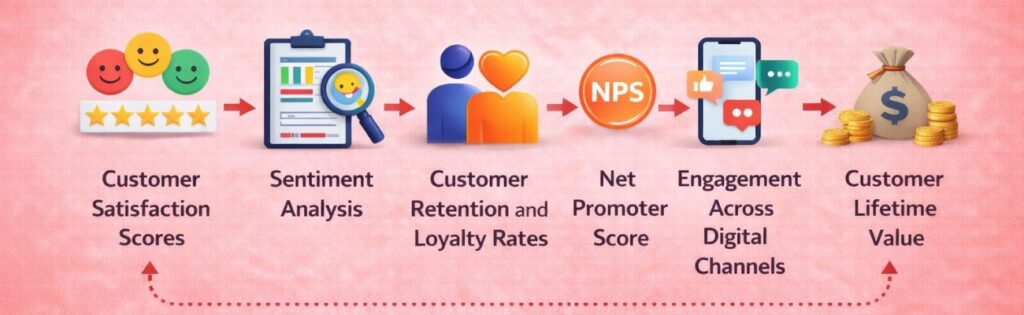
BB brands can gauge emotional intelligence by tracking how customers think, feel, and act throughout their journey—revealing how emotional branding drives loyalty and growth.
Customer Satisfaction Scores
Use surveys and feedback to understand how customers feel after interactions. Higher satisfaction means the brand shows empathy, solves problems quickly, and leaves a positive emotional impression.
Sentiment Analysis
Monitor social media, reviews, and support conversations to learn how customers talk about the brand. Positive sentiment signals trust and a strong emotional connection, while a negative tone reveals improvement needs.
Customer Retention and Loyalty Rates
Track how long customers stay and renew contracts. When emotional branding works, loyalty increases because customers feel valued and confident in the partnership.
Net Promoter Score (NPS)
Measure how likely customers are to recommend your brand to others. Rising NPS proves emotional intelligence and brand success are aligned to create advocates who support business growth.
Engagement Across Digital Channels
Analyze clicks, shares, comments, and interaction time. Strong engagement means marketing content connects emotionally, motivates action, and keeps the audience involved with the brand.
Customer Lifetime Value (CLV)
Check revenue earned from each customer over the entire relationship. Higher CLV shows that emotional intelligence drives trust, repeat purchases, and long-term business profit.
Real Examples of Emotional Intelligence in B2B Branding
B2B brands that apply emotional intelligence focus on how customers feel during every interaction. Below are clear, practical examples:
- SaaS onboarding experience: A software company simplifies its onboarding process, uses friendly language, and offers step-by-step guidance. This reduces user anxiety and builds early trust.
- Consulting and service brands: Instead of promoting services, consultants highlight client challenges and risks, showing understanding before offering solutions.
- Customer support interactions: Support teams respond with empathy, explain issues clearly, and provide realistic timelines. Customers feel respected even when problems occur.
- Enterprise sales communication: Sales teams listen first, address buyer concerns, and remove pressure from decision-making. This builds confidence and long-term partnerships.
Emotional Branding Trends Shaping the Future
Emotional branding continues to evolve as customer expectations rise and digital experiences expand. B2B companies are using emotional intelligence in branding to stay relevant, build trust, and create deeper relationships. Here are key trends shaping the future of emotional branding:
Hyper-Personalization at Every Touchpoint
Brands are using data and AI to deliver personalized content, pricing, and recommendations. When messaging matches customer goals and emotions, decision-making becomes easier and faster.
Human-Centric Brand Voices
EI in marketing encourages brands to speak clearly and honestly. A human tone builds trust, reduces friction, and helps buyers feel supported throughout the journey.
Purpose-Driven Communication
Customers expect brands to show strong values. Emotional intelligence and brand success align when companies talk openly about sustainability, ethics, and community impact.
Predictive Emotion Analytics
Businesses are investing in tools that read customer behavior and sentiment. These insights help teams create emotion-driven branding strategies that influence loyalty and satisfaction.
Interactive and Immersive Experiences
From interactive content to virtual product demos, brands are making digital journeys more engaging. Strong emotional branding helps customers feel more confident before buying.
Employee-Driven Brand Advocacy
Happy teams create positive customer experiences. When internal culture supports emotional intelligence, employees share that energy with clients and boost brand reputation.
How Emotional Intelligence Improves Long-Term Brand Growth
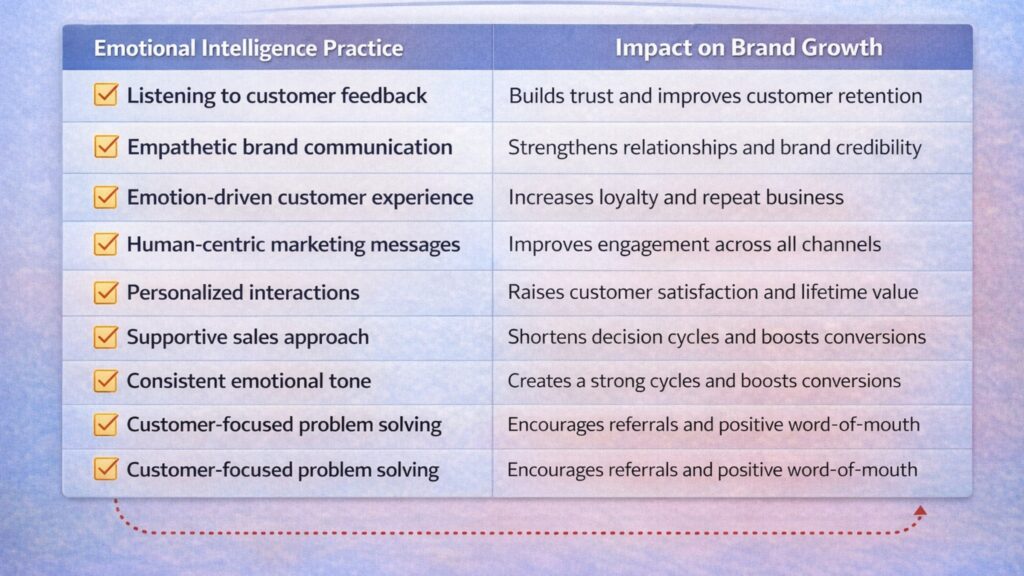
Partner With SEO Circular to Build Emotionally Intelligent Brands
SEO Circular helps B2B companies use emotional intelligence in branding to build trust, improve visibility, and drive revenue. We apply emotion-driven branding strategies, advanced SEO, and customer-centric content to create strong digital experiences that influence decision-making.
Our team focuses on real customer needs, human-centric communication, and AI-powered insights to boost engagement and retention. From brand storytelling to web design and performance tracking, we deliver measurable growth across every channel.
Choose SEO Circular to build a brand that customers trust, remember, and prefer in competitive markets. Let’s build a brand that people trust, remember, and choose.

Conclusion
Emotional intelligence, in branding, assists B2B firms in consolidating trust, loyalty, and long-lasting customer relationships. By incorporating EI in marketing and emotional branding, brands not only reach out to customers but also provide meaningful experiences that eventually lead to customer engagement and increased sales. The future is for those companies that handle the situation with empathy and appeal to both the brain and the heart. The humane brands will be the market leaders.
Emotional intelligence helps B2B brands understand buyer motivations beyond logic and pricing. By addressing emotions such as trust, confidence, and risk reduction, companies can shorten sales cycles and build stronger decision-maker relationships.
B2B buyers may rely on data, but emotions still drive final decisions. Emotional branding reduces uncertainty, increases confidence, and makes brands feel like long-term partners rather than just vendors.
No. Emotional intelligence impacts sales, customer support, leadership, and internal culture. When all departments adopt EI principles, brand messaging becomes consistent and customer experiences improve across touchpoints.
Results vary, but many brands notice improved engagement and customer satisfaction within a few months. Long-term benefits include higher retention rates, stronger loyalty, and increased lifetime customer value.
AI helps analyze customer behavior, sentiment, and engagement patterns at scale. When combined with human insight, AI enables more accurate personalization and emotionally relevant brand communication.
Have you ever wondered how much time your team could save if property listings wrote themselves? It’s not difficult to create real estate listings that attract buyers and result in a sale. However, there are a few tricks that you should be aware of.
According to recent industry reports, over 74% of real estate professionals now use some form of AI or automation to speed up listing creation, and AI-generated descriptions can reduce writing time by up to 85%.
In today’s fast-moving real estate market, speed and clarity matter, and that’s where real estate AI tools can make a real impact. Many agencies now rely on AI property descriptions to streamline workflow, reduce manual writing, and keep listings consistent across all platforms.
Rather than taking hours to make the copy, your team is able to quickly produce polished, precise, and interesting AI listing descriptions in minutes. This change is not only a matter of comfort.
It is about the expansion of the business process without the hiring of additional personnel or the creation of non-quality products. If properly managed, AI can do all these things: tell the property’s best points, follow your brand’s voice, and allow you to go to market faster.
This blog will explain the proper use of AI, what to do beforehand for description generation, and how your company will remain in the competition through the implementation of clever and efficient listing processes.
Key Takeaways
- AI tools help real estate professionals create polished, accurate, and high-converting property descriptions in minutes.
- Using AI reduces manual writing time, improves consistency, and enables large-scale listing management without extra staff.
- Adding accurate details and editing AI-generated outputs ensures high-quality, trustworthy listings.
- AI boosts SEO visibility for property listings, helping them rank on Google, Zillow, and Realtor.com.
- Trends like AI personalization, VR/AR, voice search, and rich media integration will shape property listings in 2025.
- SEO Circular can enhance your AI-generated property descriptions with SEO optimization for better reach and conversions.
What is a Real Estate Listing?
Real estate listings are advertisements that reveal the property’s selling or renting position. Normally, such an advertisement is composed of the main features such as property type, price, square footage, number of bedrooms and bathrooms, and age of the building.
Besides that, it also has descriptions regarding property features such as swimming pool, garage, new appliances, etc., accompanied by high-quality pictures or virtual tours aimed at giving the prospective buyers or tenants a clear view of the property’s look.
Moreover, they provide the seller’s or agent’s contact information, and sometimes a short text putting forward the property’s unique selling points (USP) or the location’s benefits. You can come across these listings in places like real estate websites, MLS databases, and applications such as Zillow and Realtor.com.
How Does AI Help to Create Property Descriptions?
Artificial intelligence (AI) is capable of generating descriptions of properties by means of natural language processing (NLP), which converts simple property facts into marketing texts that are not only attractive and engaging but also tailored to the specific audience.
It acts as an excellent support, gaining quality and conserving time. However, human monitoring is still necessary for correctness and legal compliance. A real estate listing is the first contact between the seller and the buyer, which means it is the one that most directly impacts the property’s attractiveness.

Steps to Generate Property Listing Descriptions With AI
At SEO Circular, we help real estate businesses generate powerful, SEO-friendly property listing descriptions using AI. It’s fast, easy, and ranks on Google.
How It Works:
Use AI tools like ChatGPT to create high-converting property descriptions in seconds.
Expert Tip:
Craft a clear and detailed prompt. Mention location, property type, features, price, and vibe.
Example Prompt:
“Write an engaging real estate listing for a 3-bedroom modern apartment in downtown Miami. Include ocean view, open kitchen, 2 baths, smart home features, gym access, asking price $850,000. Target buyers aged 30-45.”
The AI will give you a ready-to-use, keyword-rich listing that attracts more clicks and leads.
Generating compelling property listing descriptions with AI is a game-changer for real estate professionals looking to save time and create high-quality content. Here’s a step-by-step guide to help you get started with AI property descriptions using real estate AI tools:
Choose the Right AI Tool
To begin with, choose an AI that is specifically for real estate and focused on property listing descriptions. Among the variety of AI tools available for real estate listings, there are property description generators. The main purpose of these platforms is to produce attractive descriptions of a house that will bring out its features, amenities, and location.
Input Key Property Information
Most AI property description generators require basic details about the property. This includes the number of bedrooms, bathrooms, square footage, unique features, like a pool or renovated kitchen, and location specifics. The more accurate details and information you provide, the more tailored and effective the AI descriptions will be.
Select the Tone and Style
A lot of AI tools for the real estate market offer the possibility to change the tone and the style of the text. You may pick a formal tone, use casual language, or get a more imaginative, lively copy. This range of options ensures that the property description is in line with your brand and target market.
Generate the Description
After inputting all the required details and preferences, you can then proceed to create the listing description with the help of the AI tool. It will take only a few seconds to get a professionally written draft ready, which will point out the finest aspects of the property. The AI operates by fusing linguistic patterns with the latest in real estate to make sure the description is not only clear but also appealing to the audience of possible buyers or tenants.
Edit and Fine-Tune
Although AI can produce high-quality content, it’s always a good idea to review the generated description. You can fine-tune the text by adjusting the details or adding a personal touch to make it more specific to your target market. Most property description generators also allow for easy editing.
Publish Across Multiple Platforms
When you have the AI listing descriptions that you like, you can start using them on different channels. Real estate AI tools are great as they not only help you to generate content rapidly for a number of properties, but also ensure that all the listings are in the same tone, hence saving you time on each listing.
Manual Property Description Writing vs. AI-Generated Descriptions
In a competitive real estate market, speed, clarity, and consistency matter. Here is how AI compares to traditional, manual listing creation:
| Feature | Manual Writing | AI-Generated Writing |
|---|---|---|
| Time Required | 30–90 minutes per listing | 1–3 minutes per listing |
| Cost | Requires writer or agent time | Very low (AI subscription) |
| Consistency | Varies by writer | Highly consistent tone/style |
| SEO Optimization | Depends on writer skill | Automatically optimized |
| Scalability | Hard to scale during busy seasons | Easily produces 50+ descriptions/day |
| Customization | High but time-consuming | High and fast |
| Error Rate | Human typos / missed details | Low but requires quick review |
| Creativity | Depends on writer | Multiple creative variations instantly |
| Brand Voice Control | Difficult to maintain across team | AI maintains uniform brand voice |
| Turnaround Time | Slow | Instant |
Tips to Write Better AI Property Listing Descriptions
While AI property descriptions are a huge time-saver, refining them to make them more engaging and effective requires a bit of finesse. Here are some tips to help you get the best results from real estate AI tools and create AI listing descriptions that truly stand out:
Provide Detailed and Accurate Information
Include specifics like property age, unique features (e.g., hardwood floors, energy-efficient appliances), and neighborhood perks. Accurate data ensures AI-generated descriptions effectively highlight the property’s appeal to potential buyers.
Highlight the Property’s Best Features
Emphasize unique aspects such as large rooms, up-to-date features, or beautiful vistas. AI instruments can demonstrate these main advantages if they get precise instructions about what is really important.
Use Descriptive Language Without Overloading
Keep descriptions concise and readable, emphasizing key features without overwhelming buyers. Use vivid but straightforward language to create an engaging picture of the property’s best aspects.
Incorporate Local Amenities and Community Features
Highlight nearby amenities, such as schools, parks, and transportation, to boost the property’s appeal. A well-rounded description with local perks enhances the lifestyle appeal and attracts more potential buyers.
Review and Edit for Accuracy
Always review AI-generated descriptions for accuracy and clarity. Check for factual errors, grammar issues, or awkward phrasing to ensure your listing is polished and reflects your professional brand.
Leverage AI to Stay Consistent Across Listings
Use AI tools to maintain consistency in style and tone across multiple listings. This ensures a cohesive brand voice and helps potential buyers easily identify your agency’s properties, building trust and professionalism.
Benefits of AI For Property Listing
Here are the benefits of using AI property descriptions for your property listings:
Time Savings
AI property descriptions generate content quickly, saving real estate professionals hours of writing. This allows more time for client interactions, property showings, and other critical tasks.
Consistent Quality Across Listings
Real estate AI tools ensure consistency in tone and structure, delivering polished, professional listings for every property. This consistency builds trust with potential buyers and enhances brand reputation.
SEO Optimization
AI listing descriptions can automatically include SEO-friendly keywords, improving visibility on search engines and property websites, helping your listings reach a larger audience and attract more potential buyers.
Customization and Flexibility
AI for real estate allows you to customize descriptions based on the target audience, adjusting tone and style to make listings more appealing, whether for luxury buyers or first-time homebuyers.
Increased Efficiency and Scalability
AI tools enable real estate professionals to generate property descriptions at scale, handling large volumes of listings quickly without sacrificing quality, making the process more efficient, especially during busy seasons.
Enhanced Creativity
AI can offer multiple description variations, providing fresh perspectives and creative ways to highlight a property’s unique features, helping listings stand out in a competitive market.
Cost-Effective
Using AI for property descriptions reduces the need for copywriters, cutting costs while maintaining high-quality listings. This makes AI tools a budget-friendly solution for real estate agencies.
Trends You Can Follow for Property Listing in 2026
As we move into 2025, the real estate industry continues to evolve, with AI-driven solutions becoming increasingly important for generating property listings. Here are some key trends to keep an eye on for property listings in the coming year:
AI-Powered Personalization
AI property descriptions will become more personalized, targeting specific buyer personas. Advanced algorithms will tailor listings to match buyer preferences, making each property appeal directly to its ideal audience.
Virtual and Augmented Reality Integration
AI for real estate will integrate VR and AR, offering immersive property experiences. Listings will feature 3D walkthroughs or virtual staging, allowing buyers to interact with properties beyond static images.
Voice-Activated Listings
With growing voice search, AI property description generators will adapt to voice commands, creating listings optimized for voice search and offering a more conversational, user-friendly experience.
AI for Cross-Platform Consistency
AI tools will ensure consistent property descriptions across various platforms, from MLS to social media, maintaining a professional, cohesive brand voice and maximizing reach across channels.
Enhanced Visual and Content Integration
AI will integrate rich media like photos, videos, and infographics into property listings, automatically suggesting the best visuals to complement descriptions, creating a more engaging, seamless experience for buyers.
Why You Need SEO Circular for Your Property Listings?
In today’s competitive real estate market, boosting online visibility is crucial, and partnering with SEO Circular can help you achieve that. As a leading SEO agency, we specialize in optimizing property listings for search engines.
We integrate the best-performing keywords into your AI-generated property descriptions, ensuring your listings rank higher on platforms like Google, Zillow, and Realtor.com. This increased visibility attracts more potential buyers and renters, accelerating sales and driving more traffic to your website.
Our team streamlines SEO optimization, saving you time and ensuring consistency across platforms. We also provide analytics to track performance and refine your strategy, ensuring your listings are optimized for maximum visibility.

Conclusion
AI is revolutionizing real estate listings, making the process faster, more efficient, and cost-effective. With AI property descriptions and tools, you can save time, maintain consistency, and create engaging listings that attract buyers. Leveraging trends like AI personalization, VR, and voice search will keep your business competitive.
Partnering with SEO Circular further boosts your visibility by optimizing listings for search engines, driving more traffic to your website. Embracing AI helps streamline your workflow, improve listing quality, and ultimately close deals faster, growing your business.
AI can create high-quality drafts, but human review is still essential to ensure accuracy, compliance, and brand tone.
Yes. MLS platforms allow AI-generated descriptions as long as they are accurate, truthful, and follow MLS rules.
Yes. Most AI tools can tailor tone and style depending on property type—luxury homes, rentals, apartments, or commercial listings.
AI-generated descriptions can improve SEO when optimized properly. Tools like SEO Circular help add the right keywords to increase visibility.
Modern AI tools can now recommend or select the best images for listings and even suggest ideal photo order to boost engagement.
Across B2B organizations, conversions are becoming harder to win. Recent industry data shows that 68% of B2B buyers now expect fully personalized digital experiences, while companies using AI see up to a 45% increase in marketing-driven conversions. Buyers expect faster answers, a personalized experience, and a seamless journey, yet marketing teams are under pressure to deliver more with fewer resources. This gap is exactly where AI marketing is creating a massive impact.
Today’s top marketers are using artificial intelligence in marketing to increase efficiency, make smarter decisions, and drive higher conversion rates at scale. From real-time personalization to automated testing and predictive analytics, AI is reshaping the way modern B2B marketing teams operate.
In this blog, we’ll explore how leading marketers use AI to boost conversions, which strategies work best, and what tools you can use to achieve similar results.
Key Takeaways
- AI marketing helps B2B teams deliver faster, more personalized buyer experiences.
- AI conversion optimization improves targeting, reduces costs, and increases ROI.
- Tools like Jasper, Mutiny, Clearbit, and Optimizely AI enhance performance and decision-making.
- AI-powered CRO tools are essential for personalization, lead scoring, and full-funnel optimization.
- Predictive analytics identify high-intent leads and forecast campaign outcomes.
- The future of AI in marketing includes adaptive journeys, predictive pathways, and automated optimization.
- Combining AI insights with human strategy creates the strongest conversion results.
Introduction to AI in B2B Marketing
AI is changing the way B2B marketing teams work. As buyers expect faster responses and more personalized experiences, marketers need smarter tools to keep up. AI marketing helps by analyzing large amounts of data, spotting patterns, and making quick decisions that improve results.
Using AI in marketing has brought about a radical change in the way teams operate; they can zero in on precisely the right accounts, make content personal, and no longer need to do manual tasks, as they can be automated. AI does not merely predict. It tells what the factors are that enliven the audience and cause the sales to happen.
Marketing professionals are using the likes of AI-driven personalization, marketing automation, and AI conversion optimization to achieve better results, cut down on expenses, and keep their attention on strategy.
For B2B organizations, AI isn’t just a nice-to-have anymore. It’s becoming essential for staying competitive and converting more leads.

Why AI Matters for Conversion Optimization?
AI technology has become a key player in the contemporary digital marketing sphere as it supports teams in performing tasks that are impossible for humans. It can handle vast quantities of data, recognize patterns with great speed, and manage complicated processes automatically. B2B marketers who focus on conversion will get the following benefits from this:
- Faster responses
- More accurate targeting
- Personalized buyer experiences
- Higher ROI
- Lower acquisition costs
At its core, AI for conversions turns data into action. Instead of guessing what buyers want, AI predicts their behavior and helps marketers deliver the right message at the right time.
Top 10 Ways that Marketers Are Using AI to Boost Conversions
Modern B2B marketers rely on AI marketing to increase engagement, improve efficiency, and drive more revenue. Here are the top 10 ways businesses are using artificial intelligence in marketing to improve conversion rate and turn more prospects into customers.
Delivering AI-Driven Personalization
Marketers use AI-driven personalization to tailor messages, recommendations, and website content for every visitor. AI analyzes behaviour and intent, helping businesses to show the right content at the right time. This increases engagement, builds trust, and boosts overall conversions across the customer journey.
Automate Campaigns With AI
With marketing automation AI, teams automate follow-ups, emails, and lead scoring. AI ensures prospects receive timely, relevant communication without manual work. This consistency keeps leads warm, moves them through the funnel faster, and supports better AI conversion optimization.
Improve A/B Testing With AI
Marketers use A/B testing with AI to test and optimize headlines, CTAs, layouts, and emails at high speed. AI identifies winning versions quickly and adjusts campaigns automatically. This helps businesses learn faster, reduce guesswork, and improve conversion performance in real time.
Find High-Intent Leads With AI
AI evaluates behavior patterns, past interactions, and intent signals to identify high-quality leads. Marketers use these insights to prioritize outreach and personalize messaging. This leads to better AI for conversions, stronger sales alignment, and improved efficiency in the lead qualification process.
Improve Ad Targeting With AI
Marketers are aided by AI in targeting ads more precisely, which is made possible through the analysis of audience behavior, channel performance, and engagement data. It suggests, in a completely automatic manner, the budget to be allocated for the leading segments. Thus, it brings about a reduction in the amount of money spent without any benefits, increases campaign precision, and leads to the realization of higher conversion rates amongst the various paid marketing platforms.
Personalize Website Content With AI
Using artificial intelligence in marketing, companies personalize website pages, CTAs, and product suggestions instantly. AI adapts content based on the visitor’s industry, behavior, and journey stage. This creates a smooth experience, increases time on site, and boosts conversions for B2B audiences.
Create Better Content With AI Tools
Marketers use AI tools for marketers to research topics, improve SEO, generate outlines, and optimize content. AI identifies what prospects search for and suggests compelling angles. This helps teams produce high-quality, conversion-focused content faster and with greater consistency.
Use AI Chatbots for Support
AI chatbots provide instant answers, guide users to resources, and qualify leads. They reduce friction, cut response times, and support sales teams by handling early-stage questions. This seamless support experience helps increase conversions and keeps prospects engaged 24/7.
Predict Campaign Results With AI
AI analyzes historical data, engagement patterns, and audience behavior to forecast campaign success. Marketers use these predictions to choose the best strategies, channels, and messages. This improves planning, increases ROI, and supports more effective AI marketing decision-making across campaigns.
Optimize the Full Funnel With AI
Top teams apply AI conversion optimization across the full funnel—from ads to nurturing to retention. AI improves targeting, personalization, automation, and measurement. This creates a unified, data-driven marketing system that consistently converts prospects and supports scalable business growth.
Real-World Examples of AI Improving Conversions
SaaS Company Boosts Demo Sign-Ups With AI-Driven Personalization
A growing SaaS company used AI-driven personalization to tailor website messaging for every visitor. Personalized headlines and CTAs increased relevance and boosted demo sign-ups by 22% within three months.
B2B Tech Firm Improves Lead Quality Using Predictive Scoring
A B2B tech firm applied AI for conversions to score leads based on intent and engagement. Sales teams received higher-quality leads, improving qualified pipeline by 30% and reducing manual evaluation time.
Enterprise Marketing Team Saves Time With Automation
Marketing automation AI was utilized by an enterprise marketing team to make the process of follow-ups and email workflows more efficient. Thanks to automation, over 20 hours weekly were saved, and consistency was improved, which resulted in higher conversions at each stage of the funnel.
eCommerce Supplier Increases Revenue Using AI-Optimized Ads
A B2B eCommerce supplier took to using AI in marketing to improve its advertisement targeting. This reduces the amount spent that was useless – the whole campaign became much more effective because the dollars were allocated to the right intents!
AI Marketing Challenges and How AI Solves Them
Even with the best strategies, B2B marketers face common challenges that slow down conversions. AI helps solve these problems by analyzing data, automating tasks, and predicting buyer behavior. Here are the top challenges and how AI addresses them:
Low Lead Quality
AI improves targeting and uses predictive scoring to identify the best-fit accounts. This helps sales teams focus on leads that are more likely to convert.
High Customer Acquisition Costs
AI analyzes engagement and optimizes campaigns automatically. By reducing wasted ad spend, B2B marketers can lower acquisition costs and improve overall marketing ROI efficiently.
Manual and Slow Processes
Marketing automation AI handles repetitive tasks like follow-ups and email sequences. It speeds up workflows, allowing teams to focus on strategy and increase conversion rates.
Lack of Personalization
AI-driven personalization tailors messages, website content, and product recommendations for each prospect. Personalized experiences engage buyers and improve conversions across the funnel.
Difficulty Understanding Intent
Predictive analytics uncovers what prospects want and when they are ready to buy. AI insights help marketers deliver the right message at the right time.
Ethical Use of AI in Marketing
As B2B teams adopt AI, they must use it responsibly. Following ethical guidelines ensures trust, compliance, and better outcomes with AI-driven strategies.
Protect Customer Data
Use only trusted AI tools and follow strict data privacy standards. Protecting customer information builds trust and ensures compliance with regulations in all marketing activities.
Maintain Transparency
Be clear about how you collect, process, and use buyer information. Transparency helps prospects understand AI actions and strengthens relationships between businesses and customers.
Avoid Biased Models
Use diverse datasets and regularly audit AI systems to prevent bias. Fair AI ensures marketing decisions are accurate, inclusive, and aligned with company values.
Use AI to Enhance — Not Replace — Human Expertise
AI supports better decision-making but should not replace human judgment. Teams should combine AI insights with experience to create smarter, more effective marketing strategies.
Common Mistakes Marketers Make When Using AI for Conversions
| Mistake | Description |
|---|---|
| Over-Relying on Automation | Depending too heavily on AI without human strategy leads to generic, inaccurate messaging. |
| Poor Data Quality | AI delivers weak predictions if data is outdated, incomplete, or inconsistent. |
| Not Training or Updating AI Models | AI needs continuous updates to stay accurate and improve conversion insights. |
| Weak Personalization Strategy | AI-driven personalization fails when segmentation and content mapping are not properly set. |
| Ignoring Continuous Testing | Skipping A/B testing reduces AI’s ability to optimize campaigns effectively. |
| Using Too Many Tools Without Integration | Disconnected AI tools create data silos and inconsistent buyer experiences. |
| Lack of Clear KPIs | Without defined goals, AI cannot optimize effectively for conversions. |
The Future of AI in Conversion Optimization in 2026
| Trend | What It Means for Marketers |
|---|---|
| Real-Time Adaptive Journeys | AI will personalize content, CTAs, and offers instantly based on live user behavior. |
| Predictive Conversion Mapping | AI will forecast buyer paths and recommend the best actions for higher conversions. |
| Fully Automated Optimization | Campaigns across ads, email, and content will auto-optimize without manual input. |
| AI-Driven Voice Search Optimization | Voice-led search will rise, requiring more conversational, intent-focused content. |
| Autonomous AI Agents for Sales | AI bots will qualify leads, run demos, and support sales teams more efficiently. |
| Deeper Intent Prediction | AI will predict buyer needs before they express them, improving first-touch engagement. |
| Privacy-Focused Personalization | AI will deliver personalization using anonymized data to stay compliant with regulations. |
Why SEO Circular is the Smart Choice for AI-Driven B2B Marketing?
SEO Circular empowers B2B marketers to get the most from their AI marketing efforts by turning insights into measurable results. Our platform uncovers high-intent keywords, optimizes content, and improves website structure, helping your business reach the right audience at the right time.
What makes us the best choice is our blend of AI-driven insights and practical SEO solutions. Seamlessly integrating with AI-driven personalization, marketing automation AI, and AI conversion optimization, SEO Circular ensures your content ranks higher, engages visitors, and converts leads. Track performance, refine campaigns, and achieve smarter, more impactful marketing growth.

Conclusion
AI is transforming B2B marketing, making it faster, smarter, and more efficient. By leveraging AI marketing, AI conversion optimization, and AI-driven personalization, businesses can deliver tailored experiences, improve targeting, and boost conversions across every stage of the funnel. Real-world examples show how predictive scoring, automated campaigns, and AI-optimized content can increase leads, save time, and maximize ROI.
For B2B marketers, combining AI strategies with tools like SEO Circular ensures insights translate into measurable results. By using AI responsibly and ethically, teams can enhance human expertise, make data-driven decisions, and achieve scalable, sustainable growth in a competitive digital landscape.
Results vary, but most B2B teams begin seeing improvements within weeks as AI optimizes targeting, automates workflows, and enhances personalization.
Absolutely. AI integrates data from email, paid ads, SEO, social, and CRM systems to create unified insights and optimize the entire conversion path.
Most AI tools integrate smoothly with popular CRMs and automation platforms, enhancing what teams already use rather than replacing their systems.
AI reduces manual work by generating ideas, outlines, and optimizations, but human teams still enhance quality, tone, and authenticity.
AI strengthens overall marketing efficiency, supports strategic planning, improves customer experiences, and delivers deeper insights that fuel sustainable business growth.
What if your local businesses could out-market national giants without a massive budget or a large team? What if you could understand customers faster, create better content, and launch smarter campaigns, all with less effort?
Small businesses using AI see up to 78% higher marketing efficiency because AI automates time-consuming tasks. AI personalization can boost conversions by 20–30%, while AI-powered ad tools help reduce wasted ad spend by up to 40%. Chatbots now handle 70% of customer queries instantly, improving service without extra staff. Overall, businesses using AI insights grow 2X faster, and 63% of small businesses say AI helps them compete directly with big brands.
Today, that’s possible thanks to AI for local businesses.
AI is not just a toy for big brands anymore. It’s a viable, cost-effective advantage for all companies. If you embrace the correct way, AI-powered marketing techniques will allow you to customize communication, forecast client trends, and even perfect the entire marketing process.
This blog explores how you can use AI for small business growth to strengthen your brand, win more customers, and out-market the giants in your industry without needing a huge budget or a large marketing team.
Key Takeaways
- AI helps local businesses compete with big brands by improving targeting, personalization, and speed.
- AI tools make small business digital marketing more efficient with automation and data-driven decisions.
- Local businesses can use AI for content creation, ads, customer insights, and chatbots without big budgets.
- AI-driven marketing strategies provide better accuracy than traditional marketing.
- Starting small with AI and scaling gradually helps small businesses grow faster and smarter.

Why AI Levels the Playing Field for Local Businesses?
AI levels the playing field because it gives local businesses powerful tools that used to be available only to big brands. With AI for small business growth, you can understand your customers better, save time on everyday marketing tasks, and create messages that fit each audience.
AI simplifies the digital marketing of small businesses by making their advertisements, content, and customer outreach better. This means that you can still go fast and get the right people without a huge team or money. In a saturated market, AI is the remedy that your small business needs to challenge larger competitors.
Key AI Marketing Tools Local Businesses Can Start Using Today
Local companies don’t need big budgets to benefit from modern marketing technology. Today, AI for local businesses makes it easier to automate tasks, improve targeting, and connect with customers at scale.
Below are practical tools you can start using right away to strengthen your marketing and stay competitive:
AI Content Creation Tools
AI content tools help AI for local businesses by quickly producing emails, social posts, and ads. They save time, keep your message consistent, and support small business digital marketing without needing a full marketing team.
AI Customer Insight Platforms
These tools use artificial intelligence for small businesses to reveal customer behaviour, top products, and local trends. With better insights, you can make smarter decisions and support AI for small business growth with data-backed marketing.
AI Ad Optimization Tools
Ad platforms powered by artificial intelligence enhance targeting, control budgets automatically, and at the same time increase sales. Customers are found quickly through the use of AI, which not only makes the marketing strategies even more effective but also more cost-effective for small groups of people.
AI Chatbots for Customer Service
Chatbots help local companies respond instantly to questions, book appointments, and guide buyers. They boost customer experience and help you stay competitive, especially when competing with big brands using AI that offer 24/7 support.
AI Reputation Management Tools
These tools track reviews, customer comments, and online ratings. They help local businesses maintain a strong reputation, respond quickly to feedback, and strengthen trust in crowded markets.
AI Marketing Automation Platforms
Automation tools streamline follow-ups, email campaigns, and lead nurturing. They make small business digital marketing more effective by running tasks in the background, giving you more time to focus on growth and strategy.
How Local Businesses Can Use AI to Out-Market Big Brands?
Local businesses can compete with big brands using AI. Artificial intelligence enables small teams to act faster, personalize marketing, leverage data, and focus on agility and local customer connections.
Use AI to Personalize Every Message
Local companies can use AI to create highly personalized messages. This helps you connect faster with customers and build trust, something big brands often struggle to do on a local scale.
Target the Right Customer More Accurately
With artificial intelligence for small businesses, you can identify high-value audiences and target them precisely. This focus helps you spend less, reach better leads, and improve overall performance in small business digital marketing.
Respond Faster With AI Automation
AI automations let you respond quickly to customer questions, leads, and reviews. This speed helps when competing with big brands using AI, because your business can act faster and feel more personal.
Create Strong Local Content With AI Tools
AI content platforms help you produce blogs, ads, and social posts that fit your local audience. These tools support AI-driven marketing strategies and help you stay visible in your community.
Use AI Insights to Improve Local Offers
AI tools reveal buying trends and customer needs. This supports AI for small business growth, helping you create offers that match what your local audience wants more accurately than national brands.
Run Smarter Ads With AI Optimization
AI-powered ad systems adjust budgets, test variations, and target ideal customers. This gives you an edge when competing with big brands using AI, because your campaigns stay efficient and adaptable.
Strengthen Customer Loyalty With AI Tools
With AI, you can track customer behavior and create loyalty programs that feel more personal. This helps you keep customers longer and grow repeat business.
Automate Routine Marketing Tasks
AI platforms handle follow-ups, emails, and scheduling. This frees your team to focus on strategy and big-picture planning. It also supports digital marketing without stretching your resources.
How to Start: Practical AI Implementation Roadmap
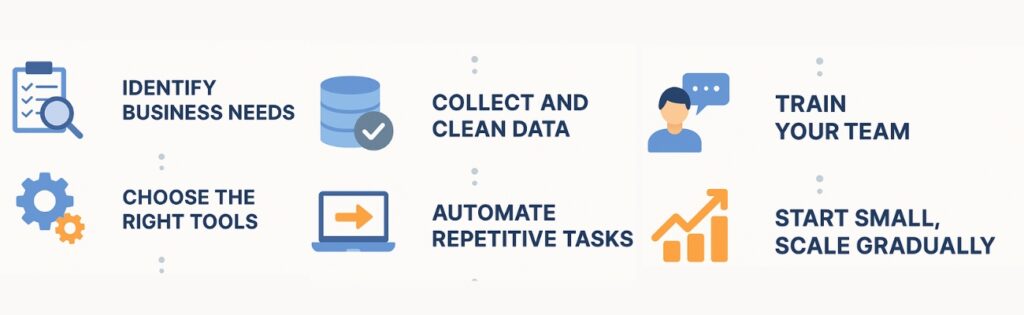
Getting started with AI may seem overwhelming, but with the right approach, local businesses can implement it effectively. Follow this roadmap to unlock AI’s potential and out-market larger competitors. Here are the steps to get started:
Identify Business Needs
Begin by identifying key business challenges where AI can deliver value, whether in marketing, customer insights, or personalized experiences. This helps focus AI efforts on solving specific problems and improving efficiency.
Choose the Right Tools
Pick AI tools that align with your business goals. Ensure the solutions are easy to use, integrate seamlessly with your systems, and offer scalability to grow alongside your business needs.
Collect and Clean Data
AI depends on quality data. Collect relevant data from sales, customer interactions, and marketing activities, then clean and organize it to ensure accuracy for effective analysis and decision-making.
Automate Repetitive Tasks
Use AI to automate repetitive tasks like email marketing, customer support, or inventory management. This saves time, increases productivity, and allows your team to focus on more strategic initiatives.
Train Your Team
Invest in training your team to use AI tools effectively. Ensure they understand how AI can support their roles and empower them with the skills to maximize its potential for business growth.
Start Small, Scale Gradually
Start with small AI pilot projects in areas like social media or customer service. Track results, optimize, and scale your AI applications across other business functions as you gain insights and confidence.
Common Myths About AI in Small Business Marketing
Several misconceptions about AI may prevent small businesses from adopting it. Here are some common myths debunked to help you better understand AI’s potential in marketing:
AI is only for Big Companies
AI isn’t exclusive to large enterprises. Small businesses can use affordable, accessible AI tools to automate tasks, enhance customer experiences, and stay competitive against large competitors.
AI Requires Technical Expertise
You don’t need to be a tech expert to use AI. Many AI tools are user-friendly, designed for non-technical users, and can easily integrate with your existing systems and processes.
AI Replaces Human Workers
AI doesn’t replace people. It enhances their work. It automates repetitive tasks, freeing up your team to focus on strategic decisions, creative initiatives, and building stronger customer relationships.
AI Tools are Expensive
AI solutions have become more affordable and scalable. Small businesses can find budget-friendly options that deliver significant value, helping to streamline operations, improve marketing efforts, and increase ROI.
AI Can’t Understand Small Business Needs
AI tools can be optimized to fit your business needs. With flexible solutions, AI can help you solve unique challenges, whether it’s improving customer service, generating insights, or optimizing marketing strategies.
AI Doesn’t Provide Tangible Results
AI offers measurable results, from better customer targeting to increased sales. By analyzing data and tracking key metrics, AI helps you refine strategies, improve engagement, and drive real growth for your business.
Real Examples
| Local Business Type | AI Used | What They Did | Result Achieved |
|---|---|---|---|
| Local Salon | AI Appointment Chatbot | Automated bookings, reminders, FAQs | 30% increase in monthly appointments and fewer missed calls |
| Small Café | AI Ad Optimization | Ran targeted local ads on a small budget | 2.1X increase in foot traffic within 45 days |
| Retail Clothing Store | AI Customer Insight Tool | Analyzed buying patterns to refine offers | 25% boost in repeat customers in 3 months |
| Local Gym | AI Content Generator | Produced daily social posts + email newsletters | 10 hours/week saved and 40% more engagement |
| Home Services Business (plumber, electrician) | AI Review & Reputation Management | Automated review replies and tracked ratings | Improved Google rating from 3.9 → 4.6 in 8 weeks |
| Real Estate Agent | AI Lead Scoring + Automation | Prioritized high-value leads with predictive AI | 35% increase in qualified leads and faster responses |
| Boutique Shop | AI Product Recommendation Tool | Suggested products based on customer behaviour | 18% increase in average order value |
Future of AI for Local Businesses
The future of AI for local businesses holds immense potential to level the playing field with larger competitors. As AI technology continues to evolve, small businesses can harness powerful tools for personalized marketing, customer service, and operational efficiency—at a fraction of the cost of traditional methods.
By leveraging AI-driven insights, local businesses can better understand customer preferences, predict trends, and deliver hyper-targeted ads or tailored recommendations. AI-powered chatbots, for instance, can offer 24/7 customer support, allowing local businesses to provide the kind of personalized experience that larger companies may struggle to match.
Additionally, AI can streamline administrative tasks like inventory management and pricing optimization, helping businesses improve their bottom line without adding extra overhead. By adopting AI solutions now, local businesses have an unprecedented opportunity to not only compete with but out-market the giants by offering more relevant, timely, and personalized experiences to their customers.
AI for Small Businesses: Compete with Big Brands
Looking to help your local business compete with national giants without breaking the bank?
Our latest blog dives into the power of AI for local businesses, showing how small companies can leverage artificial intelligence to drive growth, improve customer engagement, and out-market larger competitors.
From AI content creation tools that produce high-quality blogs, emails, and social posts, to AI-powered ad optimization platforms that target the right audience and maximize ROI, this guide covers practical solutions that fit any small business budget.
Learn how AI customer insight platforms reveal buying trends and local preferences, while chatbots and automation tools streamline customer service and routine marketing tasks. The blog also breaks down a step-by-step roadmap for implementing AI, from identifying business needs and choosing the right tools to training your team and scaling gradually.
Say goodbye to outdated traditional marketing and discover how AI-driven strategies can help your business save time, make smarter decisions, and build stronger customer loyalty in today’s competitive market.

Conclusion
AI offers local businesses a powerful, cost-effective way to compete with larger brands. By leveraging AI-driven tools for personalized marketing, smarter ad targeting, and improved customer experiences, small businesses can operate more efficiently and make data-backed decisions.
AI helps automate tasks, optimize campaigns, and build customer loyalty, all without the need for a large team or a big budget. With the right tools and strategy, small businesses can out-market larger competitors, offering tailored, agile solutions that foster growth and success. Now is the perfect time to embrace AI and unlock its potential for your business.
Faqs
AI gives small businesses access to advanced tools—like automated marketing, customer insights, and personalized messaging—that used to be available only to large companies. With AI for local businesses, you can understand customers faster, improve targeting, and run smarter campaigns that help you compete with big brands using AI.
No. Many AI tools today are affordable and even offer free plans. Small businesses can start with cost-effective AI-driven marketing strategies such as automated email tools, chatbots, or AI ad optimization without stretching their budget.
AI vs traditional marketing is about speed, accuracy, and personalization. Traditional marketing relies on guesswork, while AI uses real data to target the right customers, predict behaviour, reduce costs, and improve ROI.
AI strengthens small business digital marketing by helping you:
Generate content faster
Run smarter ad campaigns
Personalize every message
Gain insights into customer behaviour
Automate follow-ups and customer service
These tools help you create effective campaigns even with a small team.
No. AI supports your team by handling repetitive tasks. Your team can then focus on creativity, strategy, and customer engagement—areas where humans outperform machines.
B2B lead generation is getting tougher as buyers expect faster responses and personalized engagement. Over 70% of B2B buyers now expect vendors to reply within 24 hours, and 82% prefer personalized outreach before considering a sales call. Traditional methods like manual research and cold outreach can’t keep up. They’re slow, inefficient, and often deliver weak results, with over 60% of manual outreach efforts resulting in no response.
AI changes this through automation research and improving targeting. Modern AI tools for B2B marketing give businesses data-driven insights that build stronger pipelines. Companies using AI for lead research report a 40–60% reduction in time spent on manual tasks and up to 35% higher lead qualification accuracy.
This is where Perplexity AI for business excels. It uses advanced NLP and real-time data to speed up research and B2B lead generation. With automated workflows and instant access to insights, teams generate leads faster and more accurately, helping sales teams improve productivity by up to 50%.
Key Takeaways
- AI makes B2B lead generation faster, more accurate, and more personalized.
- Perplexity AI helps identify high-quality prospects using real-time data and smart research.
- AI-powered insights improve targeting, reduce manual work, and boost team productivity.
- Personalized outreach becomes easier with automated prospect insights.
- Strong prompts lead to better research, smarter decisions, and higher-quality leads.
- Integrating Perplexity AI with CRM and enrichment tools improves data accuracy and conversion potential.
- Businesses using AI early gain a major advantage in pipeline growth and revenue.
Using AI-driven B2B leads, your sales team will be able to:
- Find suitable leads more quickly
- Focus on the right accounts with greater precision
- Send personalized messages in large volumes
- Shift from reactive marketing to proactive growth
With less effort and better results, Perplexity AI helps you find the proper decision-makers. It simplifies complex research into straightforward, practical insights, thereby assisting your business in developing more potent pipelines and gathering large numbers of qualified leads.
What is Perplexity AI?
Perplexity AI is an incredibly advanced tool that supports research and automation. It is powered by natural language processing, which is the reason behind its ability to deliver fast and reliable insights.
Thus, the automatic gathering of accurate information, the analysis of market trends, and the gaining of understanding of prospects are the most important activities in which businesses rely upon using the tool to conduct research. This feature makes it an excellent choice for B2B lead generation and the contemporary sales process.
Perplexity works like an intelligent research assistant. You ask a question, and it pulls real-time data from trusted sources, summarizes insights, and presents clear answers. This capability gives your team a smarter and faster way to identify opportunities, qualify leads, and understand your market.
Role of AI in B2B Lead Generation
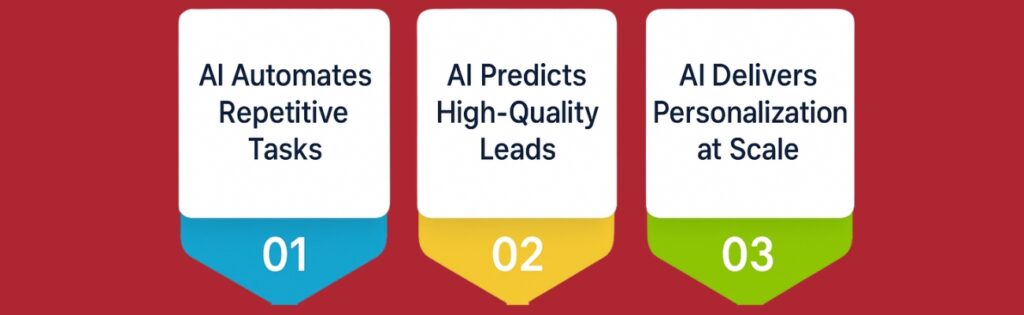
Artificial intelligence is reshaping the way businesses generate and qualify leads. Modern B2B teams rely on AI to speed up research, improve targeting, and reduce the time spent on manual tasks. With tools like perplexity, companies can build stronger pipelines and reach high-value accounts with greater accuracy.
AI Automated Repetitive Tasks
AI takes over time-consuming tasks such as data entry, prospect research, and market tracking. This gives your sales and marketing teams more time to focus on strategy, relationships, and revenue growth. By reducing manual work, AI tools create a cleaner workflow and faster results.
AI Predicts High-Quality Leads
AI uses historical data and behaviour patterns to identify which prospects are most likely to convert. This predictive capability helps you focus on leads with real potential, improving the efficiency of your B2B lead generation process.
AI Delivers Personalization at Scale
Modern buyers expect relevant communication. AI makes this possible by analyzing data points and helping your team send the right message at the right time. This creates strong engagement and supports AI-powered B2B leads.
Key Benefits For B2B Teams:
- Higher efficiency and faster research
- Smarter targeting with real-time insights
- Better ROI across marketing and scale campaigns
- Improved accuracy in lead qualification
AI gives B2B teams a competitive edge. It turns unstructured data into clear, actionable insights and helps businesses run Perplexity AI lead generation workflows that deliver consistent results.
Benefits of Using Perplexity AI for B2B Lead Generation
Perplexity AI gives the B2B team a faster and smarter way to identify and qualify leads. It reduces manual research, improves targeting, and brings real-time insights into your sales and marketing workflows. This makes it a powerful engine for Perplexity AI lead generation.
Faster Market Research and ICP Insights
Perplexity AI is there to assist you in sharpening your Ideal Customer Profile (ICP) through very reliable and data-driven insights. The staff will be able to easily get the gist of the industry, the customers’ requirements, and the changes in the market that are of interest. This will result in B2B lead generation strategies that are more potent and precise.
Automated Lead Discovery at Scale
With Perplexity, you can automate the entire research process. It finds potential accounts, filters prospects, and highlights opportunities without manual efforts. This automation helps businesses generate qualified AI-powered B2B leads at scale.
Data-Backed Decision-Making
Perplexity AI analyzes real-time data from trusted sources. It gives your team reliable information to support purchasing decisions, campaign planning, and outreach strategies. This ensures every decision is driven by facts, not assumptions.
Improved Personalization in Outreach
Perplexity AI creates relevant and personalized insights for each prospect. You can use these insights to write targeted emails, LinkedIn messages, and sales pitches. This increases engagement and improves the overall success of your Perplexity AI for business workflow.
Improve Personalization in Outreach
Perplexity AI creates relevant and personalized insights for each prospect. You can use these insights to write targeted emails, LinkedIn messages, and sales pitches. This increases engagement and improves the overall success of your Perplexity AI for business workflows.
Enhanced Productivity Across Teams
By automating research and analysis, Perplexity AI frees your team to focus on high-value tasks like closing deals and building client relationships. This leads to faster workflows and better alignment between marketing and sales.
Perplexity AI turns complex research into simple and actionable insights, helping your team generate consistent, high-quality leads.
How Perplexity AI Helps Identify High-Quality B2B Leads?
Perplexity AI helps businesses find high-quality leads faster by analyzing real-time data and delivering insights that match your ideal customer profile. It strengthens your B2B lead generation process and ensures your team focuses on accounts with genuine potential.
Use Perplexity AI to Define and Refine Your ICP
Perplexity AI evaluates industry trends, company sizes, budgets, technologies, and buyer behaviour. It helps you refine your ICP continuously, making your targeting more accurate. This gives you a strong foundation for effective Perplexity AI lead generation.
Find Companies That Match Your Target Segment
You can use Perplexity AI to search for businesses that fit your ICP. It identifies companies with the right characteristics and highlights accounts that are likely to convert. This speeds up your lead discovery and improves the quality of your AI-powered B2B leads.
Extract Firmographic and Technographic Data
Perplexity AI gathers firmographic data like revenue, location, and employee size, along with technographic details such as tech stack and tools used. This information helps you qualify leads quickly and understand whether they are a good fit for your offer.
Conduct Real-Time Competitor and Market Analysis
Perplexity AI tracks your industry, competitors, and emerging trends. It identifies market gaps, demand signals, and new opportunities. This insight helps you target accounts at the right moment and strengthens your AI tools for a B2B marketing strategy.
Perplexity AI gives you the clarity and confidence to focus on leads that match your ideal buyer’s profile, reducing guesswork and improving conversion potential.
Step-by-Step Guide to Generate B2B Leads with Perplexity AI
Perplexity AI helps your business discover leads faster and create smarter outreach campaigns. Follow these steps to build a strong B2B lead generation workflow:
Build Your Ideal Customer Profile (ICP)
Utilize perplexity AI to identify the industries, company sizes, revenues, and technology usage that align with your top customers. This provides you with solid directions for Perplexity AI lead generation, preventing wasted effort on unqualified prospects.
Discover Companies That Match Your ICP
Search for relevant companies using Perplexity’s advanced research features. Collect details on each business and identify key decision-makers. This helps you build a list of high-potential AI-powered B2B leads.
Automate Lead Research and Insights
Create a workflow in the Perplexity AI that continuously tracks competitor activity, market shifts, and buyer signals. This automation ensures your team receives fresh lead opportunities and strong market intelligence without manual effort.
Personalize Your Outreach
Use Perplexity AI insights to write a stronger message. Create personalized emails, LinkedIn outreach, and pitch scripts that speak directly to each prospect’s needs. This level of personalization improves engagement and strengthens the AI tool for B2B marketing.
Score and Prioritize Leads
Evaluate leads based on fit, interest, and buying readiness. Focus on accounts with clear intent signals. These are the leads most likely to convert. Perplexity AI makes this scoring faster and more accurate, boosting the success of Perplexity AI for business lead workflows.
Best Practices to Get Quality B2B Leads from Perplexity AI
Your results depend on the quality of your prompts. When you ask clear questions, Perplexity AI delivers better data, deeper insights, and more accurate AI-powered B2B leads. Below are easy-to-use prompt examples your sales and marketing teams can use today.
Prompt to Discover New Leads
These prompts help you find companies that match your Ideal Customer Profile (ICP) and show intent:
- List SaaS companies in North America with 50–200 employees that recently raised funding.
- Find manufacturing companies that are currently hiring for IT roles and might need digital transformation solutions.
These prompts help you identify companies that match your ICP and show real buying signals, a strong win for B2B lead generation.
Prompts to Identify Decision-Makers
These prompts help you find key people who influence buying decisions:
- Who are the top IT directors at mid-size cybersecurity companies in Europe, and what are their LinkedIn profiles?
- Provide contact insights for CFOs in logistics companies with $50M+ revenue.
Your outreach becomes more precise and delivers faster conversions. This gives your team accurate buyer intelligence and helps you build targeted outreach lists.
Prompt to Personalize Outreach
Perplexity AI for business makes personalization simple and fast:
- Summarize the recent achievements of {Company Name} and suggest their current challenges.
- Write a short outreach message for CTOs in fintech companies who want faster product delivery.
Personalized messaging drives higher conversions when using AI tools for B2B marketing.
Prompt for Competitive Intelligence
Use competitive insights to position your brand as the better choice:
- Compare {Competitor A} and {Competitor B} product positioning in the enterprise CRM market.
- What complaints do customers share about {Competitor} on review sites?
These insights help your team improve messaging and highlight stronger value.
Prompts for Lead Intent and Scoring
These prompts help you target prospects ready to buy:
- Identify companies searching for AI automation tools in the last 60 days.
- Find businesses that expanded into new regions and may need operational support.
Stronger intent signals = more qualified Perplexity AI lead generation opportunities.
How to Measure KPIs AI-powered B2b Leads?
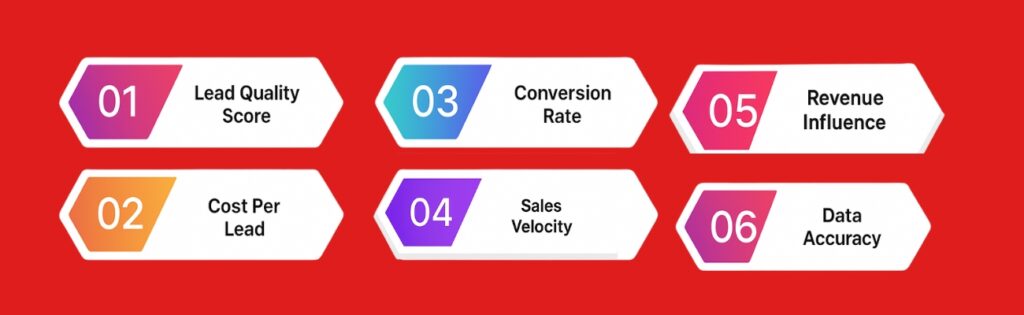
To grow smarter, your sales and marketing team must track the right numbers. When you use Perplexity AI for business, these KPIs show how well your B2B lead generation efforts are performing.
Lead Quality Score
Measure how well each lead matches your ICP, industry, budget, and intent signals. Strong perplexity AI leads generation delivers with real buying interest and higher chances of conversion.
Cost Per Lead (CPL)
Track the cost of every captured lead. Perplexity AI for business reduces manual tasks, improves targeting accuracy, and helps you lower CPL while maintaining high-quality B2B lead generation.
Conversion Rate
Measure how many leads take action, like booking a meeting or requesting demos. AI-powered B2B leads convert faster because outreach becomes personalized, relevant, and aligned with real business needs.
Sales Velocity
Review the speed at which leads move through the sales pipeline. When Perplexity AI finds interested prospects, sales cycles shorten, driving faster revenue and stronger team productivity.
Revenue Influence
Analyze how much pipeline and revenue come from Perplexity AI lead generation. This confirms the financial impact of AI tools for B2B marketing and supports smarter budgeting decisions.
Data Accuracy
Verify that lead and company information remains correct, updated, and useful. AI reduces outdated data, improves decision-making, and prevents your team from wasting time on bad prospects.
Common Mistakes to Avoid When Using Perplexity AI
Even the best AI tools for B2B marketing need the right approach. Avoid these common mistakes to get better results from Perplexity AI lead generation:
Using Generic Prompts
If prompts are vague, the output becomes broad and irrelevant. Always include filters such as industry, location, revenue, tech stack, and buying signals to generate high-quality AI-powered B2B leads.
Not Verifying AI Results
AI can make assumptions. Cross-check important data like contact roles, company size, and funding status. Verification protects your team from wasted outreach and low-quality B2B lead generation.
Failing to Integrate Insights with Your CRM
If you don’t sync results with your CRM, insights get lost. Integrating Perplexity AI with platforms like HubSpot or Salesforce ensures smarter lead tracking and faster follow-ups.
Ignoring Personalization in Outreach
Prospects ignore generic messages. Use Perplexity AI to personalize emails based on buyer needs, pain points, and recent updates. This boosts conversions and improves pipeline efficiency.
Tools to Combine with Perplexity AI for Stronger Lead Generation
Perplexity AI becomes more powerful when you combine it with the right marketing and sales tools:
CRM Platforms
To assist your team in storing lead information, scoring AI-driven B2B leads, and monitoring sales performance from discovery to conversion, tools such as HubSpot, Salesforce, and Pipedrive are available.
LinkedIn Sales Navigator
It is used to verify the decision-makers, improve the profiles, and communicate with the prospects directly. It not only improves your audience targeting but also opens the door for high-intent outreach.
Email Automation Tools
Mailchimp, Outreach, or Lemlist are some of the platforms that help you unveil and send personalized campaigns to a large number of people at the same time. You remain visible, consistent, and important during the whole buying process.
Data Enrichment Tools
While ZoomInfo, Apollo, and Lusha strengthen accuracy by verifying contact information and adding buyer insights, data enrichment is unavoidable for productive Perplexity AI lead generation.
Manual Lead Gen vs Perplexity AI
| Activity | Manual Lead Generation | With Perplexity AI |
|---|---|---|
| Lead research | 2–3 hours per list | 5–10 minutes |
| Finding decision-makers | Time-consuming | Instant, accurate |
| Personalization | Basic, limited | Deep insights at scale |
| Data accuracy | Often outdated | Real-time verified data |
| Market insights | Requires multiple tools | Single-source intelligent summary |
| Lead scoring | Mostly guesswork | Data-backed intent signals |
Future of AI in B2B Lead Generation In 2026
AI will soon transform B2B lead generation even further:
- AI agents will automatically discover, qualify, and route leads 24/7.
- Predictive intent models will identify buyers months before outreach.
- Hyper-personalized content will be generated instantly for each prospect.
- Voice-based research tools will replace manual data searches.
- Full-funnel automation will reduce manual workload by over 70%.
Scale Your B2B Lead Generation Faster with SEO Circular
Perplexity AI gives you powerful data, but you need the right strategy to turn those insights into revenue. That’s where SEO Circular helps you grow.
We use advanced SEO, content marketing, and AI-driven outreach strategies to attract high-intent buyers and improve your pipeline. Our team builds search-focused campaigns that bring consistent traffic and qualified B2B leads to your business.
Why B2B Brands Choose SEO Circular?
- We align SEO with sales goals to increase revenue impact
- We build keyword strategies that drive enterprise decision-makers
- We optimize content for better rankings and product discovery
- We help you integrate AI tools for smarter marketing
- We deliver measurable ROI and transparent reporting
With us, your marketing team gets more than leads. You get predictable business growth.

Conclusion
Perplexity AI transforms B2B lead generation by helping companies find high-quality prospects faster, personalize outreach at scale, and make smarter decisions with real-time insights. With the right prompts and workflows, you can discover new markets, target ideal buyers, and accelerate your sales pipeline.
As AI tools for B2B marketing continue to grow, businesses that adopt them early will gain a major competitive advantage. If you want to scale your pipeline and improve conversion rates, now is the right time to leverage Perplexity AI for business.
Start applying these strategies today and unlock a steady flow of AI-powered B2B leads that fuel long-term growth. Let AI do the heavy lifting, so your sales team can focus on closing deals.
Faqs
Yes, small teams benefit the most because Perplexity reduces research time, automates insights, and speeds up lead identification without needing large resources.
You should refresh them monthly or whenever your target market changes to maintain accurate and relevant AI insights.
Absolutely. It helps identify target accounts, gather firmographics, analyze competitors, and personalize messaging for each segment.
Yes, it can generate summaries, pain points, industry insights, and personalized points that help craft stronger email and LinkedIn messages.
It provides a single source of real-time data, helping both teams make decisions based on the same insights—improving coordination and reducing miscommunication.