
In 2026, search is no longer just about ranking links, it’s about being selected, cited, and recommended by AI systems. Generative AI-powered search engines now answer questions directly, summarize sources, and guide user decisions without requiring a click.
According to industry studies, over 65% of searches are expected to end without a website visit by 2026, driven by AI overviews and answer engines. At the same time, more than 70% of users trust AI-generated answers for research, product comparison, and decision-making. This shift has fundamentally changed how brands gain visibility.
Traditional SEO tactics alone are no longer enough. AI models evaluate context, entities, topical depth, factual accuracy, and brand authority not just keywords and backlinks. If your brand is not structured in a way AI can understand and trust, it simply won’t appear in AI-generated answers.
At SEO Circular, we see Generative AI Optimization as the next evolution of search visibility. It’s about aligning your content, brand signals, and digital presence with how large language models interpret expertise and relevance. Brands that adapt now will dominate AI-driven discovery, while others risk becoming invisible even if they still rank on page one.
Key Takeaways
- Generative AI Optimization (GAIO) is about being cited and recommended, not just ranking
- AI search engines rely heavily on entity clarity and contextual trust
- Topical authority beats isolated, keyword-focused content
- Conversational and prompt-driven content performs best in AI answers
- Brand mentions and Digital PR influence AI visibility more than links alone
- Long-term consistency matters more than short-term SEO tactics
Struggling to Stay Visible in AI Search?
See how we help businesses adapt to generative AI search and build long-term authority beyond traditional SEO.
Learn How SEO Circular Optimizes for AI Search.
What Is Generative AI Optimization (GAIO)?
Generative AI Optimization (GAIO) is the process of optimizing your brand, content, and digital signals so AI-powered search engines can understand, trust, and recommend you in generating answers.
Unlike traditional SEO where the goal is to rank a webpage, GAIO focuses on becoming a reliable source for AI-generated responses. AI search systems don’t just scan keywords. They evaluate meaning, context, factual consistency, entity relationships, and authority across the web.
In simple terms, GAIO answers one critical question:
“Why should an AI model choose your brand as the best answer?”
At SEO Circular, we define GAIO as the intersection of:
- Entity-based optimization (brands, people, products, topics)
- Topical depth and clarity, not surface-level content
- Consistent brand mentions and citations across trusted sources
- Content structured for question-answer and conversational queries
GAIO also goes beyond websites. AI models learn from blogs, media mentions, reviews, documentation, PR coverage, and expert content. If your brand appears fragmented or inconsistent across these sources, AI engines hesitate to reference you.
This is why GAIO is not a replacement for SEO it’s an evolution of it. Strong technical SEO, high-quality content, and authority still matter, but they must now be aligned with how generative AI systems interpret knowledge.
Brands that invest in GAIO early don’t just gain visibility—they gain AI-driven trust, which is the real currency of search in 2026.
How Generative AI Search Engines Work in 2026
By 2026, generative AI search engines no longer function like traditional search systems that list blue links. They act as answer engines, powered by large language models that understand intent, context, and relationships between entities.
When a user asks a question, AI systems analyze multiple signals at once query intent, past user behavior, trusted data sources, topical authority, and real-world credibility. Instead of ranking pages, the AI synthesizes information from multiple sources and generates a single, consolidated response.
These systems prioritize:
- Clear entity identification (who you are, what you do, and why you matter)
- Factual accuracy and consistency across the web
- Depth over volume—comprehensive answers beat keyword-stuffed content
- Source reliability, including expert authorship and reputable mentions
AI models also learn continuously. Each interaction helps them refine which brands and sources are trustworthy. If your content is vague, outdated, or lacks authority signals, it gets ignored—even if it once ranked well on Google.
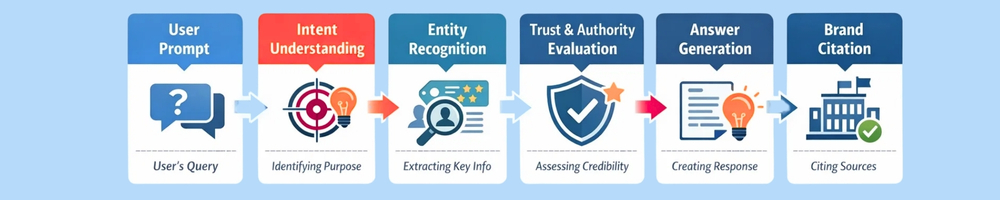
How Generative AI Search Engines Generate Answers
A simplified view of how AI systems interpret prompts, evaluate trust signals, and generate answers that cite authoritative brands.
Key Differences Between SEO and Generative AI Optimization (GAIO)
| Aspect | Traditional SEO | Generative AI Optimization (GAIO) |
| Primary Goal | Rank webpages on search engine results pages (SERPs) | Be referenced, cited, or recommended inside AI-generated answers |
| How Visibility Is Earned | Driven by keywords, backlinks, and page-level optimization | Driven by entity clarity, topical authority, and trust signals across the web |
| How Systems Decide | Search engines ask: “Which page ranks best?” | AI systems ask: “Which source is most reliable to answer this question?” |
| Traffic & Exposure | Focuses on driving clicks to websites | Often delivers brand exposure without a click through AI summaries and responses |
| Measurement Focus | Rankings, traffic, and click-through rates | Brand recall, authority, and presence inside AI-generated answers |
| Optimization Approach | Optimizes for search engine algorithms | Optimizes for language models that reason, summarize, and contextualize information |
| Content Requirements | Keyword relevance and on-page optimization | Clear explanations, factual depth, consistency, and contextual accuracy |
| Strategic Role | Foundational visibility channel | Visibility multiplier for AI-driven search |
| SEO Circular’s View | Core framework for discoverability | Strategic layer that amplifies trust and long-term AI visibility |
Optimizing Content for AI Answer Engines
Optimizing content for AI answer engines requires a shift from writing for rankings to writing for clarity, completeness, and trust. AI models favor content that directly solves a user’s question in a structured, factual, and easy-to-understand way.
Instead of long introductions or promotional language, AI engines prioritize clear definitions, step-by-step explanations, and concise insights. Content that answers who, what, why, and how in a single place is far more likely to be selected.
Key elements AI answer engines look for include:
- Well-defined entities (brand, product, industry terms)
- Context-rich explanations, not surface-level commentary
- Consistent facts and terminology across sections
- Natural language that mirrors conversational queries
AI systems also cross-check information across multiple sources. If your content contradicts widely accepted data or lacks supporting context, it loses credibility fast.
Entity Optimization: The Core of AI Visibility
In generative AI search, entities are everything. An entity can be a brand, company, product, person, or concept. AI models rely on entities to understand who is trustworthy and what they are known for.
If your brand is not clearly defined as an entity, AI systems struggle to place you in relevant answers—even if your content is strong. This is why entity optimization has become a core Generative AI Optimization technique in 2026.
Effective entity optimization means:
- Clearly defining who your brand is and what problem you solve
- Maintaining consistent brand descriptions across your website, PR coverage, and third-party platforms
- Connecting your brand to relevant topics, industries, and use cases
- Reducing ambiguity by avoiding mixed messaging or unclear positioning
AI models build knowledge graphs internally. When your brand appears repeatedly in the right context, AI starts associating you with specific expertise areas.
How Generative AI Search Engines Evaluate Brand Trust in 2026
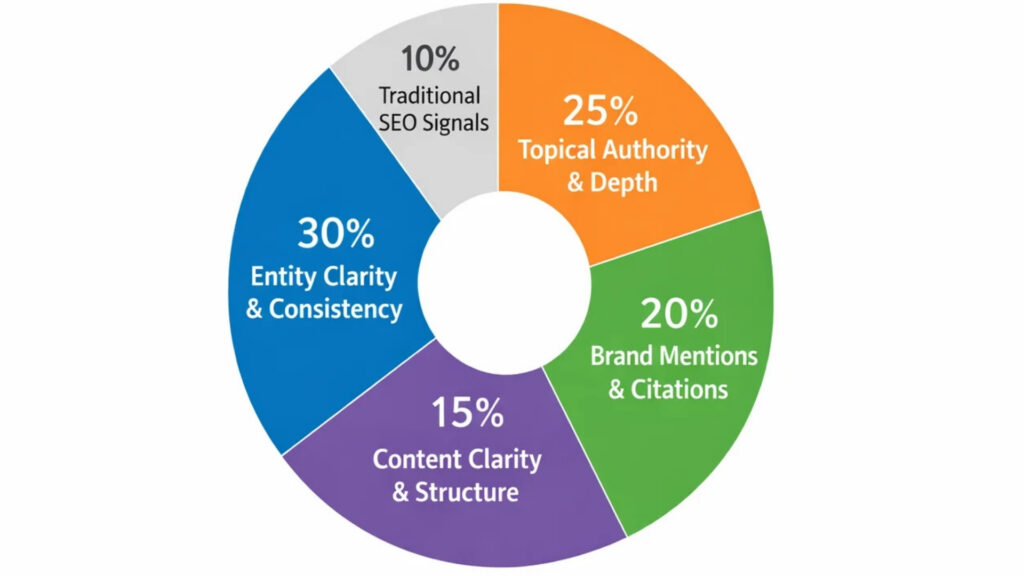
The pie chart below illustrates how generative AI search engines evaluate trust and select brands in 2026. Unlike traditional SEO, where
rankings and backlinks dominate, AI-driven search prioritizes entity clarity, topical authority, and brand credibility.
As shown, entity consistency and topical depth account for more than half of AI trust signals, while traditional SEO factors play a much smaller role. Brand mentions, citations, and content clarity also significantly influence whether a brand is cited inside AI-generated answers.
This visual highlights a critical shift: winning AI search is no longer about optimizing pages—it’s about building trust at the brand and knowledge level. Understanding these priorities helps brands focus their efforts on what actually drives visibility in AI-powered search experiences.
Topical Authority & Knowledge Graph Alignment
Topical authority is how generative AI systems decide who truly understands a subject. In 2026, AI doesn’t trust isolated articles—it trusts brands that consistently cover a topic in depth and from multiple angles.
When your content ecosystem answers related questions, explains subtopics, and uses consistent terminology, AI models begin mapping your brand into their internal knowledge graphs. This alignment helps AI understand not just what you say, but how deeply you know the topic.
Topical authority is built by:
- Covering core topics and supporting subtopics comprehensively
- Connecting concepts logically instead of publishing random content
- Updating content to reflect current data and trends
- Maintaining consistency in definitions, examples, and messaging
Generative AI prefers sources that show contextual continuity. One strong article helps, but a network of related, high-quality content builds trust faster.
Prompt-Driven Search & Conversational Query Optimization
Generative AI has changed how users search. Instead of short keywords, users now ask full questions, follow-ups, and multi-intent prompts. This shift has made conversational query optimization a critical Generative AI Optimization technique in 2026.
AI systems break prompts into intent layers—informational, comparative, and decision-driven. Content that matches these layers performs better than content written only for single keywords.
To optimize for prompt-driven search:
- Write content that answers questions naturally, as a human expert would
- Include follow-up explanations that anticipate the next question
- Use real-world examples, comparisons, and clarifications
- Structure content so answers appear early and clearly
AI engines favor content that feels like a conversation, not a blog post filled with SEO jargon. The clearer and more helpful your response, the more likely AI will reuse it in generated answers.
Brand Mentions, Citations & Digital PR for AI Search
In generative AI search, brand mentions matter as much as backlinks often more. AI models learn trust by observing how frequently and consistently a brand is referenced across credible sources.
Unlike traditional SEO, AI systems don’t rely solely on link equity. They analyze unlinked mentions, citations, expert quotes, media coverage, and contextual references to understand authority. If reputable publications repeatedly mention your brand in the right context, AI treats that as a strong trust signal.
Effective AI-focused digital PR includes:
- Mentions in authoritative industry publications
- Consistent brand descriptions across media outlets
- Expert commentary and data-backed insights
- Association with trusted topics and entities
AI also evaluates sentiment and relevance. Random mentions don’t help. Contextual mentions tied to your expertise do.
Optimizing for AI Overviews, SGE & Answer Engines
AI overviews and answer engines have become the primary visibility layer in search by 2026. Instead of ten blue links, users now see summarized answers generated from multiple trusted sources. If your brand isn’t optimized for these systems, you’re invisible at the moment decisions are made.
AI engines select content that is clear, factual, and immediately useful. They extract short explanations, definitions, comparisons, and steps—often without sending traffic back to the website.
To optimize for AI overviews:
- Provide direct answers early in the content
- Use simple language and unambiguous explanations
- Support claims with data, examples, or real-world context
- Maintain consistency across similar topics and pages
AI systems also favor brands that appear repeatedly across related queries. One optimized page helps, but consistent coverage across a topic area wins.
Measuring Generative AI Visibility & Performance
Measuring success in generative AI search requires a mindset shift. Traditional SEO metrics like rankings and clicks don’t fully reflect AI-driven visibility, especially when users get answers without visiting a website.
In 2026, brands need to track presence, citations, and influence inside AI-generated responses. This includes how often your brand is mentioned, quoted, or referenced across AI answer engines.
Key indicators we focus on include:
- Brand mentions in AI-generated answers
- Visibility across prompt-based and conversational queries
- Consistency of brand positioning in AI summaries
- Assisted conversions influenced by AI discovery
AI visibility measurement is less about volume and more about quality and authority. Being cited once in the right context can be more valuable than hundreds of low-intent clicks.
Common Mistakes Brands Make in Generative AI Optimization
One of the biggest mistakes brands make in Generative AI Optimization is treating it like traditional SEO. Keyword stuffing, thin content, and surface-level blogs may still rank—but AI systems rarely trust or cite them.
Another common issue is unclear brand identity. If your messaging, services, or expertise appear inconsistent across your website, PR mentions, and third-party platforms, AI models struggle to understand what your brand actually stands for.
Brands also fail by:
- Publishing content without topical depth or continuity
- Ignoring brand mentions and authority signals outside their website
- Over-promoting instead of educating
- Relying only on tools without validating how AI responds to real prompts
Many companies assume AI will “figure it out.” In reality, AI needs clear, repeated, and reliable signals to build trust.
Future-Proof Generative AI Optimization Strategies
Generative AI search will continue to evolve beyond 2026, but the foundations of visibility are already clear. Brands that focus only on short-term tactics will struggle as AI models become more selective and context-aware.
Future-proof GAIO strategies focus on durable signals, not quick wins. This includes building strong entities, consistent expertise, and long-term trust across the web.
Key strategies that will remain relevant include:
- Investing in deep topical authority, not isolated content
- Treating brand mentions and PR as core SEO assets
- Publishing expert-led, experience-driven insights
- Continuously updating content to reflect real-world changes
- Testing visibility directly inside AI tools and answer engines
AI models reward brands that behave like reliable knowledge sources, not marketers chasing algorithms. The more stable and consistent your signals, the more AI trusts you over time.
How SEO Circular Approaches Generative AI Optimization
At SEO Circular, we approach Generative AI Optimization as a business growth strategy, not a standalone SEO tactic. Our focus is on making brands understandable, credible, and preferred by AI-driven search systems.
We start by strengthening entity clarity—defining exactly who our clients are, what they do, and where they lead. From there, we build topical authority frameworks that align with how AI models organize knowledge. This ensures consistent visibility across multiple prompts, not just individual queries.
Our approach combines:
- AI-focused content architecture
- Entity and brand signal optimization
- Digital PR and authoritative mentions
- Prompt-based visibility testing and refinement
We integrate GAIO with enterprise SEO, content, and analytics so AI visibility translates into real business impact, not just exposure.
Because AI search evolves fast, we constantly test how brands appear inside generative answers and adapt strategies accordingly. This keeps our clients ahead as AI becomes the primary discovery layer.
Final Thought
Search in 2026 is no longer about who ranks first it’s about who AI trusts enough to recommend. Generative AI-powered search engines don’t scan pages; they interpret meaning, validate authority, and synthesize answers. If your brand is not structured for how AI understands expertise, it simply won’t appear—no matter how strong your traditional SEO looks.
Generative AI Optimization as the natural evolution of SEO. It shifts the focus from keywords to entities, topical authority, brand credibility, and conversational relevance. Brands that adapt early don’t just gain visibility—they become the default answers inside AI-driven discovery.
FAQs
Yes. Even websites that rank well can lose visibility in AI-driven search. Generative AI Optimization ensures our brand is trusted and cited inside AI-generated answers, not just listed in traditional search results.
Yes. AI search engines often display brand names, insights, and recommendations directly in answers. This improves brand recall, authority, and influence, even when users don’t click through to a website.
AI models evaluate trust using entity consistency, factual accuracy, topical authority, brand mentions across reputable sources, and contextual relevance rather than relying only on keywords or backlinks.
Industries like SaaS, B2B services, healthcare, finance, ecommerce, technology, and professional services benefit most, as users frequently rely on AI for comparisons, recommendations, and expert guidance.
Yes. AI prioritizes clarity, expertise, and authority over content volume. A smaller set of well-structured, expert-led content combined with strong brand signals can outperform high-volume publishing.
Brand mentions help AI models understand credibility and relevance. Consistent mentions across trusted publications reinforce authority, even when links are not present.
Generative AI Optimization works alongside SEO. SEO builds discoverability, while GAIO ensures our brand is selected, trusted, and cited inside AI-generated responses.